Top AI Tools for Marketing: 10 Best Picks
Compare the top AI tools for marketing by use case, features, pricing considerations, ideal users, limitations, and practical implementation tips.
The best AI marketing tool isn't the one with the longest feature list. It's the one that removes the bottleneck slowing your team down. A content team may need brand-controlled production, while an e-commerce team may need predictive messaging, and an SEO team may care more about visibility in AI search than another writing assistant.
That distinction matters as adoption moves into everyday operations. One 2026 industry report says 86% of marketing teams use AI somewhere in their workflow, compared with 41% in 2024, yet only 6% of organizations have reached full GenAI maturity. The market is expanding quickly, but tool adoption alone doesn't create a reliable marketing system. The report estimates the global AI marketing market at $57.99 billion in 2026, which reflects how far AI software has moved beyond experimental productivity experiments.
This roundup groups 10 top AI tools for marketing by the job they perform: full-funnel coordination, content production, workflow automation, governance, SEO and AI-search visibility, creative production, customer messaging, analytics, and social management. Each pick is evaluated through workflow fit, governance, data requirements, adoption complexity, and variable usage costs. If you're still picking the right AI assistant, start with the work you need to improve, not the model you want to try.
1. HubSpot Marketing Hub and HubSpot AI
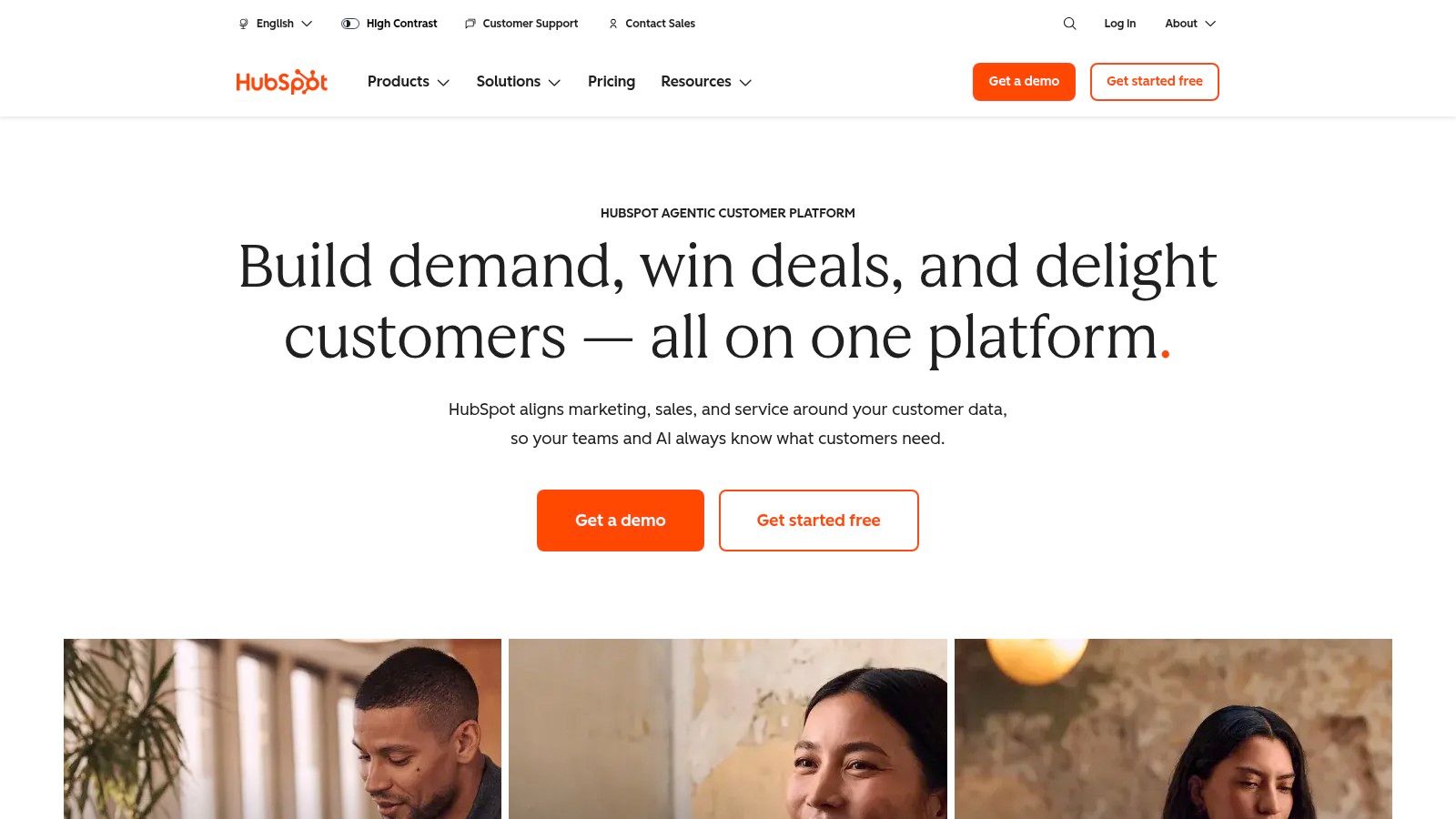
HubSpot Marketing Hub is the strongest choice here when marketing and sales need to work from the same customer context. Its AI sits inside a broader platform covering CRM, email, automation, ads, forms, landing pages, CMS, and reporting, so teams can connect campaign execution to lead and deal activity without stitching together as many point tools.
The practical advantage is context. AI content and email assistants can work inside existing HubSpot workflows, while the CRM supplies information about contacts, companies, and active deals. HubSpot also offers AEO tooling for tracking and improving brand visibility across AI-search surfaces, alongside AI agents and Smart Deal Progression for go-to-market teams.
Where HubSpot fits best
Choose HubSpot when your main problem is fragmented execution. A team already managing CRM records, email campaigns, forms, and reporting in HubSpot can add AI without forcing every marketer into a new interface. That unified data model can also make attribution easier to reason about than a stack of disconnected assistants.
It isn't the best first purchase for a small team that only needs blog drafts or simple email copy. Editions and pricing can be complex, and advanced scoring or forecasting needs enough historical data to calibrate properly. Teams should also map which features belong to which Hub before assuming every AI capability is included.
For a broader evaluation of automation platforms, compare HubSpot with other options in this marketing automation software guide.
Practical rule: Buy HubSpot for connected revenue workflows, not merely for its writing assistant.
2. Jasper
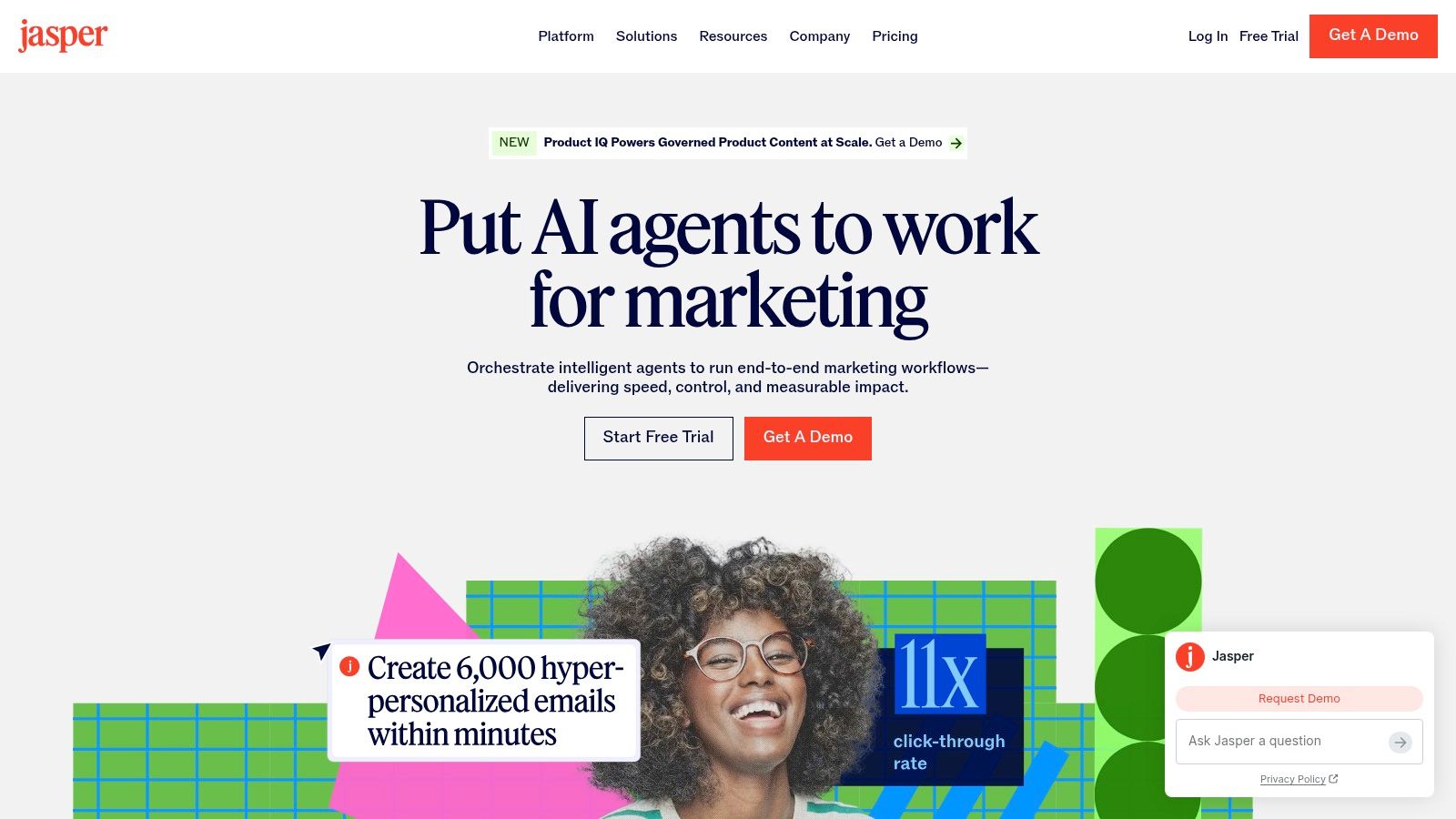
Jasper is built for marketing teams that need to produce many assets while keeping messaging consistent. Its Canvas supports structured, multi-asset campaign production, and its Brand Voices, Knowledge assets, and Audiences features give the system more context than a blank chat window.
That distinction matters for organizations with multiple writers, campaign managers, and reviewers. A brand team can establish approved language and reference material, then use Jasper to create coordinated drafts for campaigns rather than asking each contributor to recreate the brief in a separate tool.
Strong brand control, variable consumption
Jasper's prebuilt and custom marketing agents extend the platform beyond individual prompts. Teams can use agents for campaign tasks, deep research, translations, and GEO-related work, while API access and governance features support a more controlled enterprise rollout. The platform therefore fits best when content volume and consistency are both important.
The trade-off is usage economics. Some agent and GEO functions consume additional credits beyond the seat subscription, so a team running heavy research or multi-asset workflows needs to monitor consumption. Business and advanced capabilities are sales-led or custom, which makes budgeting less straightforward than choosing a simple per-seat writing app.
Jasper also isn't a replacement for a source-of-truth CRM, analytics system, or editorial approval process. It can standardize production, but subject-matter review still matters for claims, product details, and regulated messaging.
Teams comparing Jasper with other writing platforms can use this AI writing tools comparison to narrow the shortlist.
3. Copy.ai
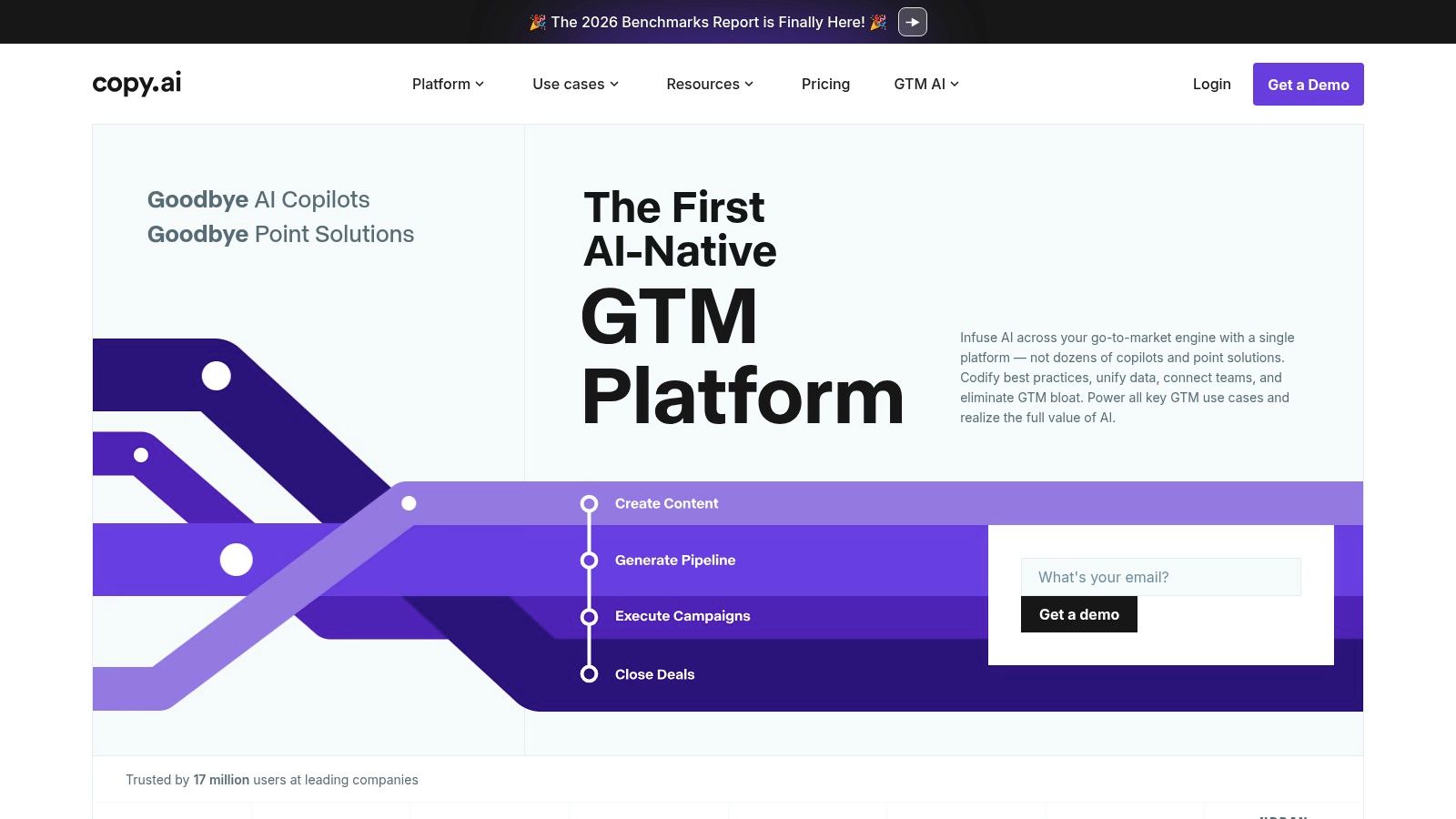
Copy.ai is a good fit when the marketing bottleneck is handoff-heavy go-to-market work. Instead of treating AI as a single drafting window, it uses a Visual Workflow Builder where teams chain Actions for generation, analysis, scraping, and search.
That structure supports workflows such as researching a prospect list, enriching information, drafting outreach, creating ad variations, and translating assets. The platform also provides access to multiple model families, including OpenAI, Anthropic, and Gemini, which can reduce dependence on one model for every task.
Build repeatable workflows, not prompt collections
Copy.ai's Tables and Brand Voice layer help teams organize information and keep output consistent. Content Agents and packaged workflows make the first implementation easier, especially for common GTM activities. The strongest use case isn't an occasional blog post. It's a repeatable process that would otherwise move through spreadsheets, browser tabs, and several separate AI tools.
The main limitation is the credit model. Every added action can affect consumption, particularly when workflows scrape, research, analyze, and generate in the same run. High-volume teams need to test a representative workflow before committing, because a cheap-looking seat price can become less attractive when automation runs frequently.
Governance also depends on workflow design. Set approval points before generated content reaches a CRM, ad account, or outbound sequence. Copy.ai can connect the steps, but your team still decides which actions are allowed to run without review.
4. Writer
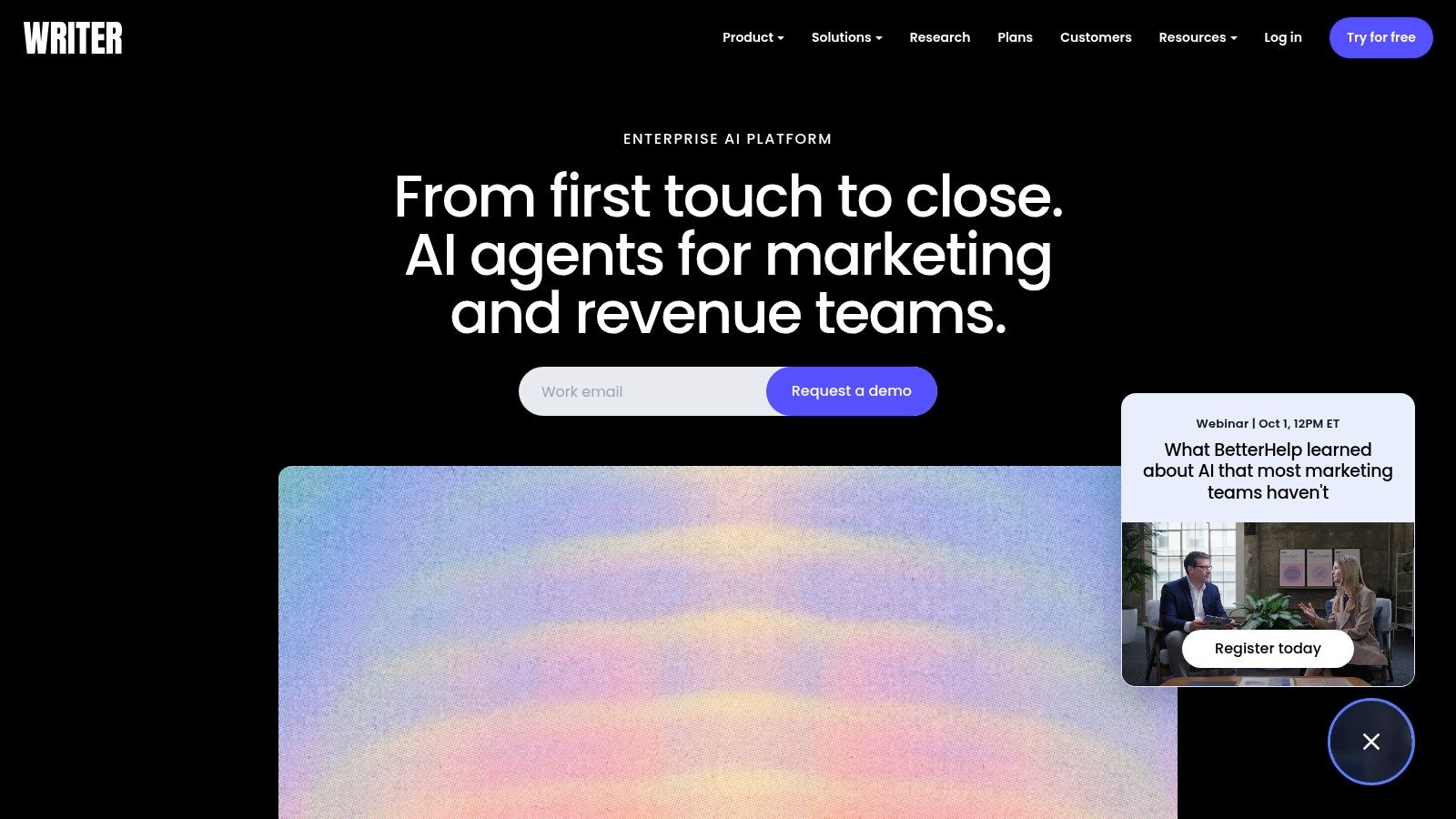
Writer is the most governance-focused option in this list. It targets organizations where brand consistency, regulatory controls, claims substantiation, and auditability matter as much as speed.
Its Enterprise Brain acts as a shared context layer for brand and compliance information. Voice Profiles, terminology rules, Style controls, Playbooks, and Agents help teams standardize how AI handles language across departments. AI Studio adds a way to build governed AI applications with connectors and policy controls rather than leaving every employee to invent their own process.
Governance changes the buying decision
Writer fits financial services, healthcare, legal, and other environments where an incorrect claim can create more than an editing problem. Its system can enforce terminology and approved claims while preserving an audit trail, giving reviewers a clearer view of how content was produced and checked.
That strength brings implementation work. Teams need to define approved language, collect source material, establish policy owners, and decide which workflows require human sign-off. Writer won't eliminate that work. It makes the rules easier to apply after the organization has agreed on them.
Pricing is sales-led for enterprise deployments, and credit limits apply to certain features. Smaller teams may find the governance layer heavier than they need. Larger teams should judge it against the cost of inconsistent messaging and manual review, not against the price of a basic copy generator.
Governance is a workflow requirement, not a checkbox in a vendor comparison.
5. Semrush with AI toolkits
Semrush is the broadest visibility and competitive intelligence choice in the group. It combines traditional SEO research with tools for paid media, content, social, local marketing, AI PR, and AI visibility, which makes it useful for teams that want one vendor to connect search and campaign analysis.
Its AI capabilities add recommendations for campaign optimization and support ad creative work, while competitive keyword and advertising data helps marketers understand the environment around a brand. Unified dashboards and exports for Google and Meta ads are useful when paid and organic teams need to share evidence rather than work from separate reports.
Broad coverage versus stack complexity
Semrush works well for an in-house SEO team that also supports paid search, content planning, and competitive research. It can reduce the need to export data from several specialist tools, and modular toolkits mean a team can start with the areas closest to its current priorities.
The risk is expansion without discipline. Costs can rise as teams add toolkits and users, while advanced AI capabilities may carry separate pricing. The interface also gives teams a great deal to configure, so a new user can spend time collecting dashboards instead of acting on a clear decision.
Use Semrush when you have a defined visibility question, such as which competitors are winning a topic, where paid messaging overlaps with organic demand, or how your brand appears across AI search. Don't buy every toolkit before identifying who will use each dataset and what decision it will support.
For teams assessing the category, this Semrush alternative guide offers another discovery path.
6. Surfer
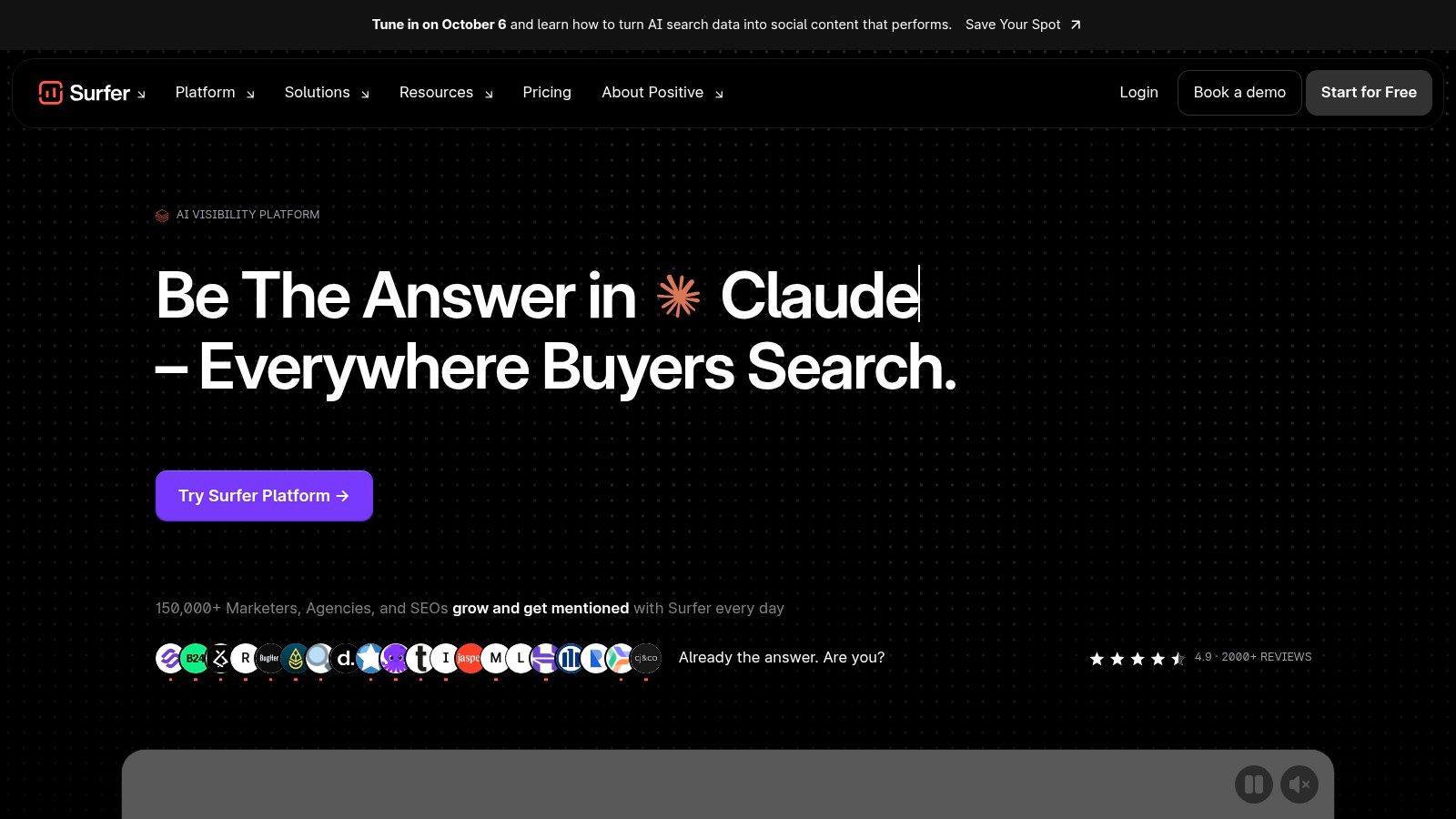
Surfer is designed around the SEO content workflow, from brief creation to optimization and publishing. Its AI Content Editor uses NLP terms and structural guidance, while Content Audit, keyword research, one-click automations, CSV export, and sharing help content teams move work through production.
Its newer AI Search Analytics and Tracker features are particularly relevant for teams that care about brand visibility in AI-generated answers as well as conventional search rankings. Daily refreshes and seat bundles support ongoing monitoring, although the right configuration depends on how many prompts, brands, and markets a team needs to track.
Useful for production teams
Surfer's strength is clarity. A writer can open a brief, review recommended topics and structure, draft in the editor, and pass the work to an editor or publisher without building the workflow from scratch. That makes it more practical than a general-purpose chatbot for teams producing SEO content repeatedly.
The platform shouldn't be treated as an automatic ranking machine. NLP suggestions can help identify coverage gaps, but they don't replace original research, first-hand expertise, internal linking decisions, or editorial judgment. A draft that satisfies an optimization panel can still be weak for the reader.
Usage limits also matter. Prompt and credit caps may constrain heavy users, while unlimited tiers are sales-led and custom-priced. Run a pilot using the content types your team publishes, then compare the time saved against the credits consumed.
7. Canva with Magic Studio and AI Pass
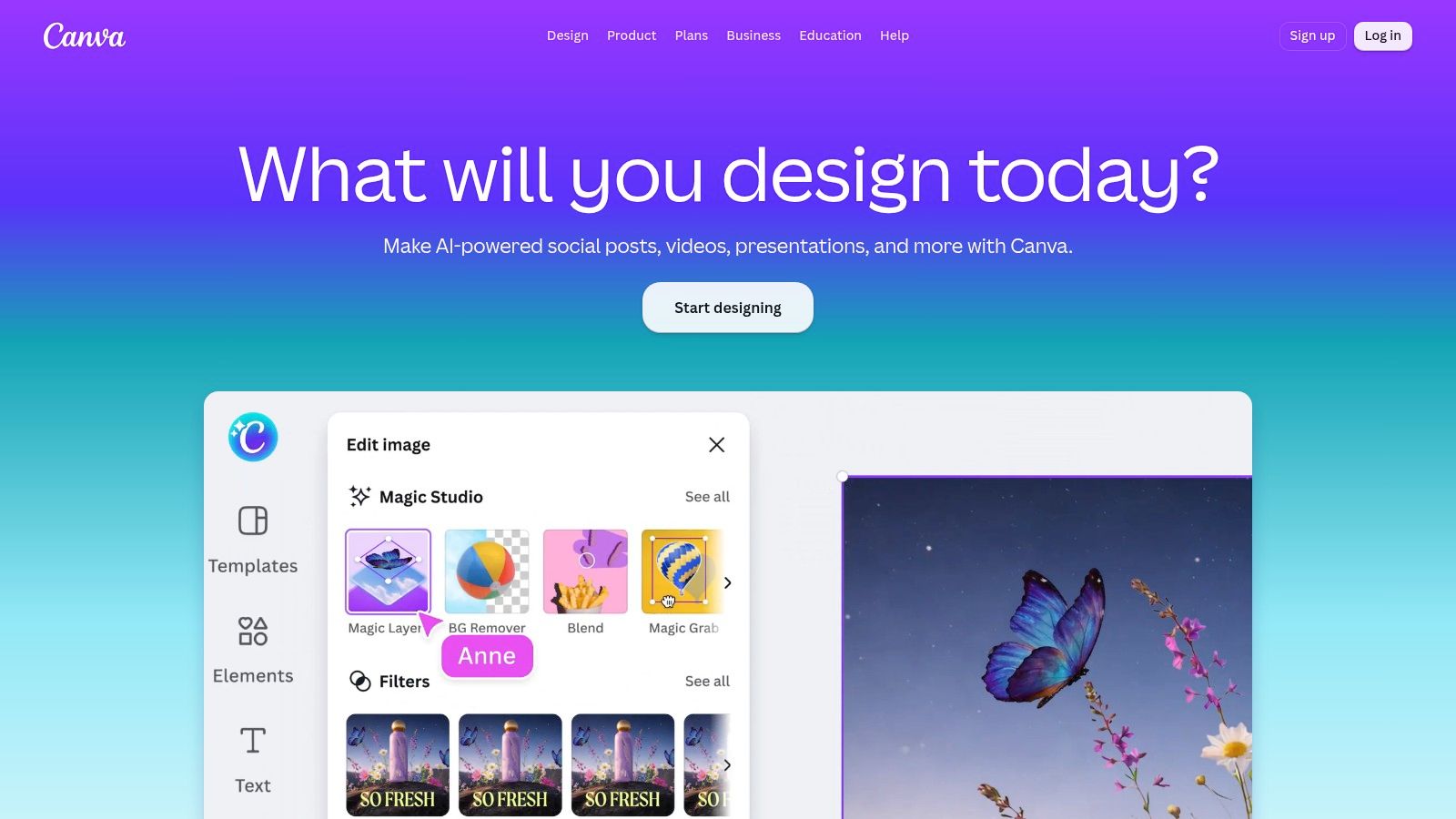
Canva remains the easiest creative production choice for marketers who need polished assets without a dedicated designer for every request. Magic Studio brings AI into image, video, resizing, translation, background removal, and layout work, while templates, brand kits, approvals, and a large stock library keep routine production moving.
The practical value is speed at the edge of the organization. A demand marketer can adapt a campaign into social formats, an executive can prepare a presentation, and a small team can create ad concepts without handing every minor revision to a design department.
Fast production needs clear boundaries
Brand kits and approvals provide useful controls, but Canva isn't a full enterprise DAM. Teams with extensive asset permissions, complex versioning, or strict archival requirements may need a stronger system alongside it. Canva can standardize everyday creation, but it won't solve every governance problem around final files and usage rights.
AI Pass increases capacity for heavier AI use, and top-ups or additional allowances can affect the cost of high-volume production. That makes usage monitoring important for teams generating many variations, especially for paid campaigns where iteration can multiply quickly.
Canva works best when a human owns the final selection. AI can produce a fast starting point, but marketers still need to check product accuracy, visual hierarchy, accessibility, and whether the result looks appropriate for the audience rather than merely attractive in isolation.
8. Klaviyo
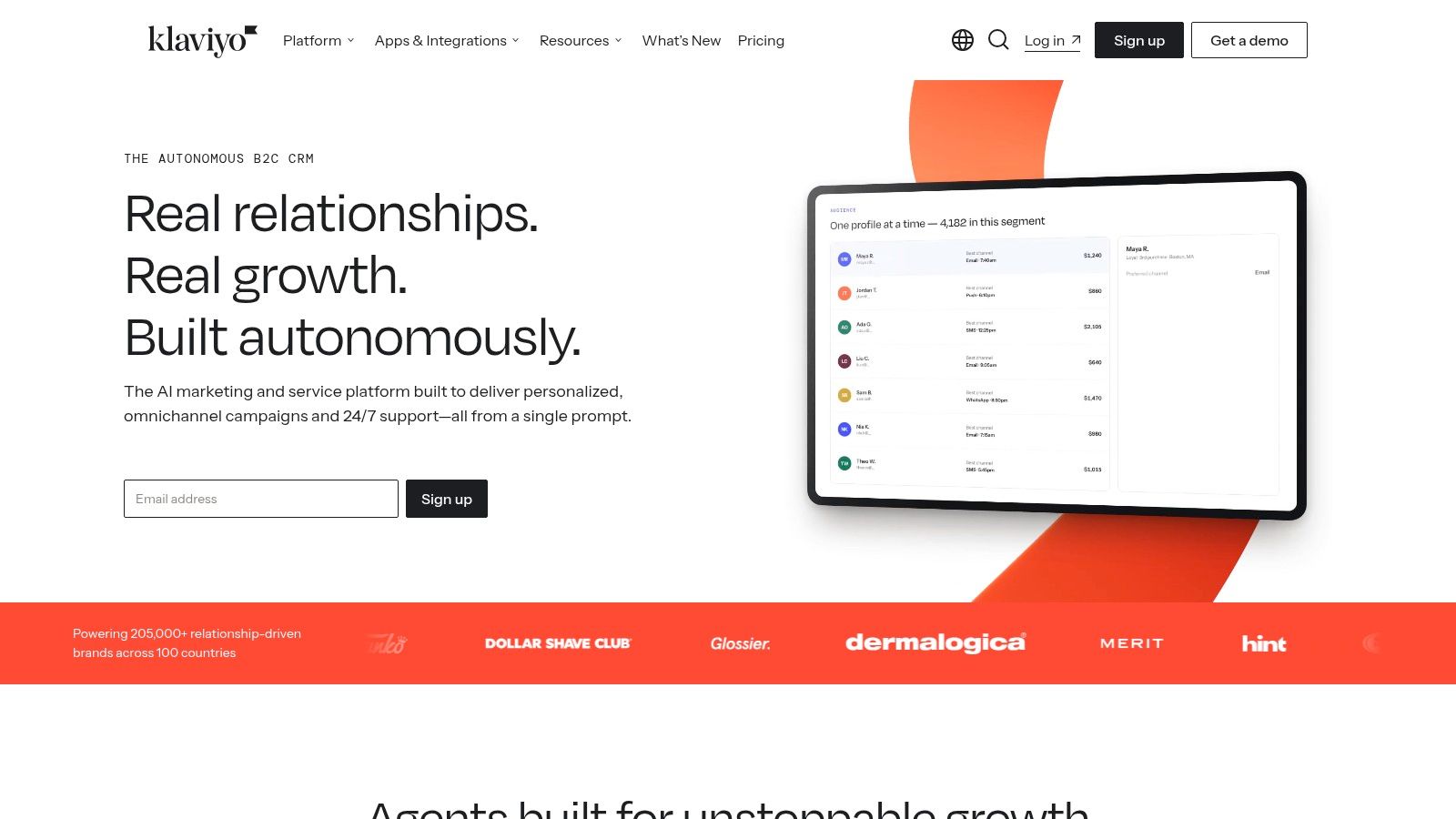
Klaviyo is the most focused option for commerce teams that want AI connected to customer behavior. It combines email, SMS, and messaging automation with predictive analytics, AI copy suggestions, deep commerce integrations, and CDP-style data capabilities.
That data context is the reason to choose it over a general writing assistant. Klaviyo can support audience segmentation and triggered messaging based on commerce activity, rather than asking marketers to export customer data into a separate AI workspace. The platform's predictive features are most useful when event data, purchase history, and consent records are reliable.
Model message economics before launch
Klaviyo provides billing views that show exact per-message costs by channel and region, which helps U.S. mobile senders plan campaigns. Mobile messaging still varies by carrier and region, and email pricing is profile-based, so the plan structure matters alongside the AI features.
The platform is a strong match for e-commerce brands with meaningful first-party customer data and a team ready to manage lifecycle journeys. It isn't the obvious choice for a B2B company that mainly needs long-form content, account-based marketing, or sales pipeline coordination.
Start with a narrow journey, such as abandoned browsing, post-purchase education, or win-back messaging. Review the segments, suppression rules, consent logic, and message costs before adding predictive automation across the entire customer base.
9. Mailchimp by Intuit
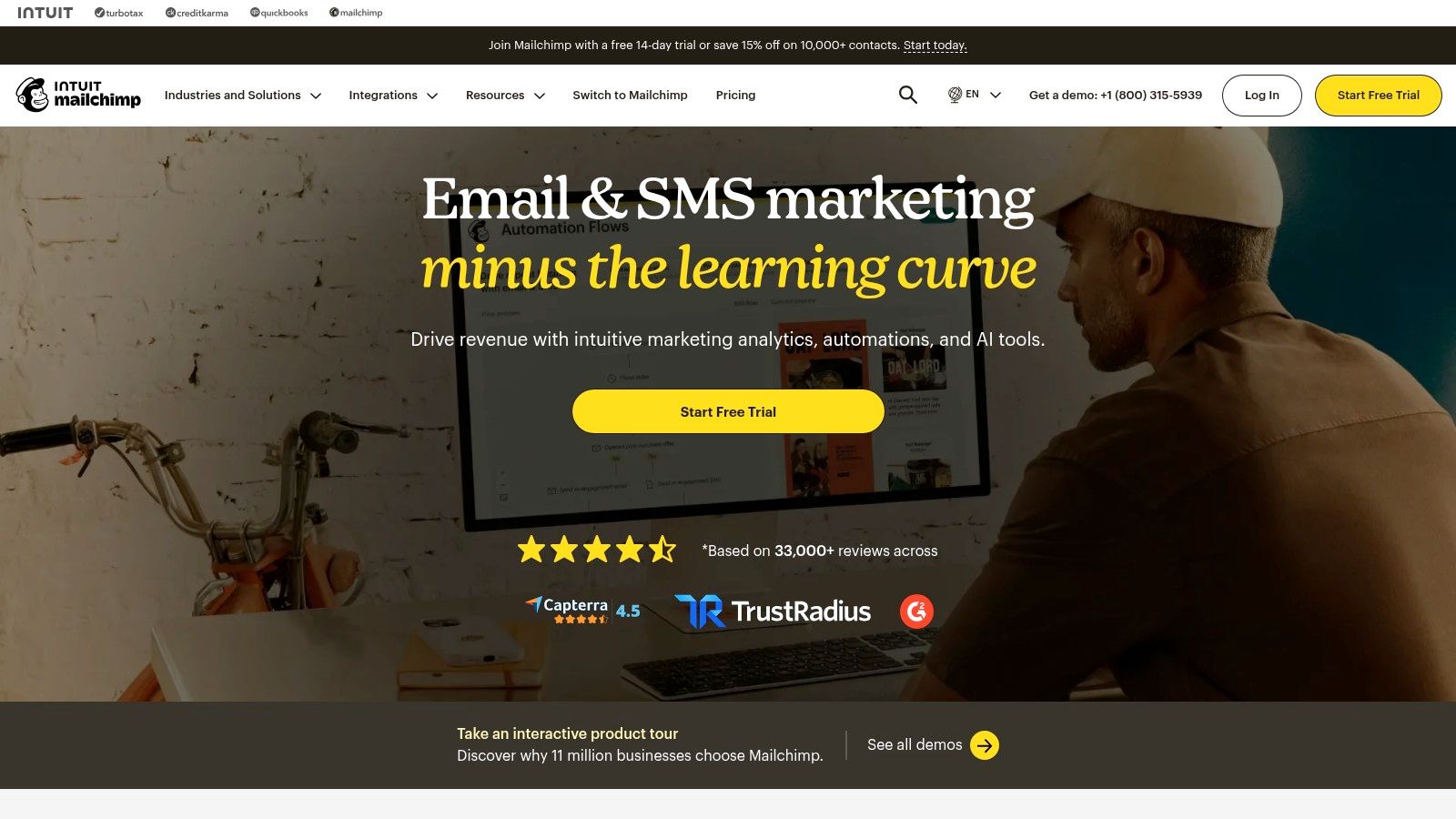
Mailchimp is the practical adoption choice for small and midsize teams that want familiar email workflows with newer AI capabilities. It combines email, SMS, automation, templates, integrations, and Analytics AI, including conversational performance insights on supported paid plans.
The advantage isn't depth in one narrow AI task. It's the low friction of putting AI inside a tool the team may already know. The new builder supports AI writing and content creation, while turnkey automations help teams move from a draft to a live campaign without designing an entire system.
Familiarity can outweigh sophistication
Mailchimp makes sense when the organization needs to improve campaign execution without introducing a large implementation project. A marketer can use AI to develop subject lines, refine body copy, or interpret performance questions while keeping list management and campaign production in one place.
The limitations are commercial and operational. The strongest AI features sit on paid tiers, and SMS or mobile messaging uses separate credits. Teams should model contact-based email pricing and message costs together, especially if they intend to expand beyond email.
Mailchimp also works best with clear audience hygiene. AI won't fix duplicated records, weak consent practices, or poorly defined segments. Before scaling automation, make sure the team knows which events trigger messages, who gets excluded, and how a human can pause a campaign when the output looks wrong.
For a wider comparison of email platforms, review this email marketing software comparison.
10. Hootsuite with OwlyWriter and Wisdom AI
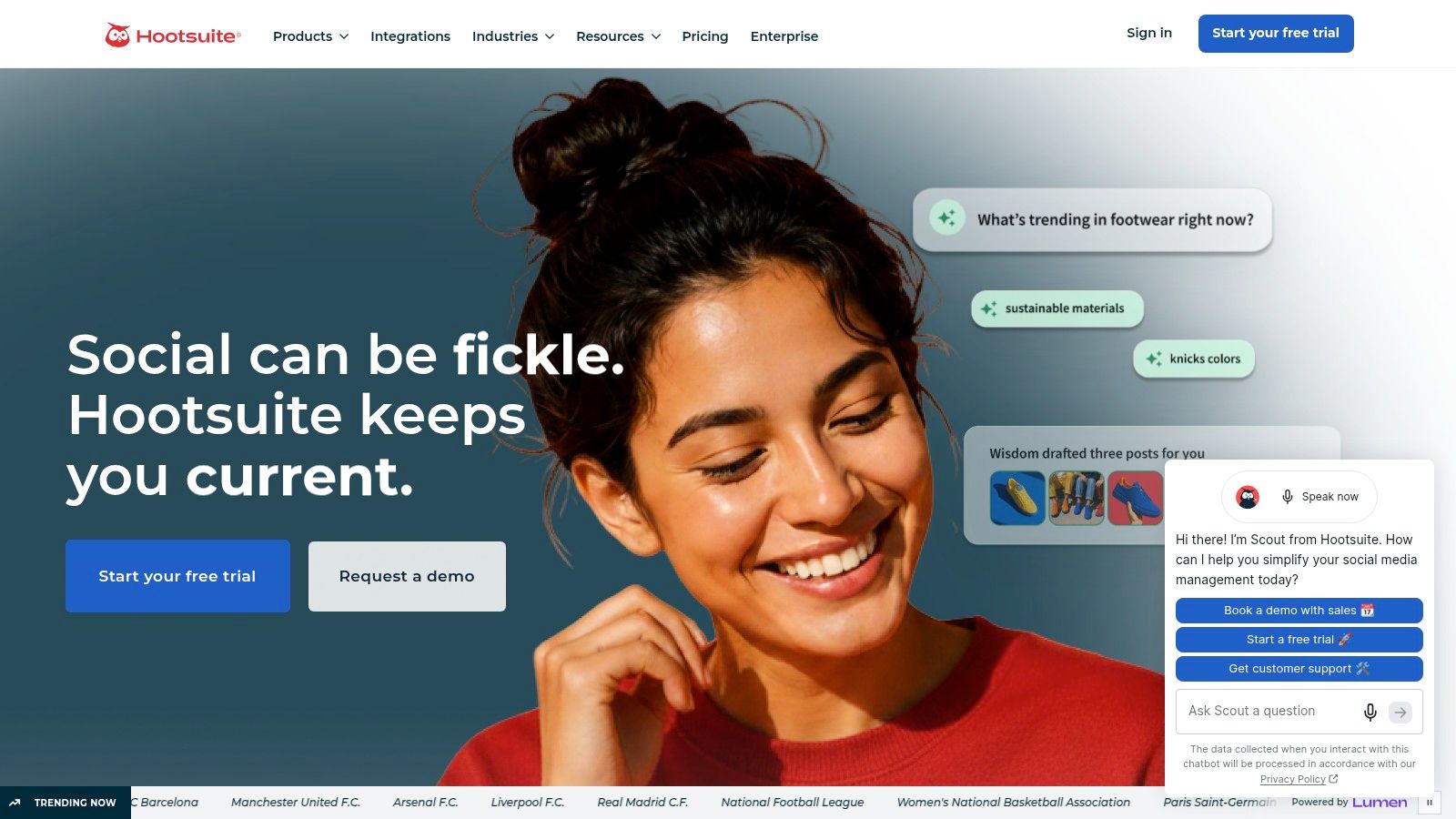
Hootsuite suits teams that treat social media as an operating workflow, not only a copywriting task. OwlyWriter and Wisdom AI support caption drafts, image creation, hashtag suggestions, posting-time recommendations, social analysis, scheduling, listening, and reporting across connected channels.
Its practical advantage is workflow consolidation. A team can draft variations, schedule posts in bulk, manage the social inbox, review sentiment, and compare channel performance without switching among separate creation, publishing, and monitoring tools. Teams evaluating alternatives can compare social media management tools based on those workflow requirements.
Choose it for social operations
Hootsuite is a stronger fit for social teams that need dependable publishing, approvals, monitoring, and reporting than for teams seeking an isolated content generator. Listening and competitive benchmarking add context to performance reviews, including audience response, timing, and conversation trends.
Plan selection affects the business case. Advanced capabilities may require higher tiers, while enterprise deployments can use custom pricing. Confirm supported networks, user seats, approval workflows, and listening features before comparing plan costs.
AI-generated copy still requires editorial review. Brand tone, current events, legal claims, and community replies can alter the risk of a post. Set approval rules for sensitive topics, then use automation for routine variations, scheduling, and recurring reporting.
Top 10 AI Marketing Tools, Feature & Use Case Comparison
| Product | Core features | Quality ★ | Price/Value 💰 | Target 👥 | Unique / USP ✨🏆 |
|---|---|---|---|---|---|
| HubSpot Marketing Hub + HubSpot AI | CRM + email, automation, CMS, reporting, AEO & AI agents | ★★★★ | 💰 Mid–High; complex tiers | 👥 GTM teams, SMB→Enterprise | 🏆 Unified CRM+AI stack; ✨ AEO for AI search |
| Jasper | Multi-asset Canvas, Brand Voices, Agents, API & governance | ★★★★ | 💰 Mid; Business & enterprise sales-led | 👥 Marketing teams, brand-led orgs | ✨ Strong brand control & enterprise ramp |
| Copy.ai | Visual Workflow Builder, Actions, cross-model access, Brand layer | ★★★★ | 💰 Mid; credit-based workflows | 👥 GTM ops, automation-first teams | ✨ No-code multi-step AI automations |
| Writer | Enterprise Brain, Voice Profiles, Playbooks, AI Studio & policies | ★★★★ | 💰 Enterprise; custom pricing | 👥 Regulated industries, large orgs | 🏆 Governance & compliance-first platform |
| Semrush (with AI toolkits) | SEO, paid media, competitive research, AI toolkits | ★★★★ | 💰 Modular toolkits; costs add up | 👥 SEO teams, agencies, marketers | ✨ Broad visibility + cross-channel insights |
| Surfer | AI content editor, AI Search Analytics, audits, keyword tools | ★★★★ | 💰 Affordable tiers; AI add-ons | 👥 Content & SEO teams | ✨ Brief→publish SEO workflows |
| Canva (Magic Studio + AI Pass) | Magic design tools, templates, brand kits, AI Pass add-on | ★★★★★ | 💰 Freemium; AI Pass for heavy use | 👥 Non-designers, marketers, SMBs | 🏆 Fast on-brand asset production at scale |
| Klaviyo | Email/SMS automation, predictive AI, commerce integrations | ★★★★ | 💰 Usage-based; per-message fees | 👥 E‑commerce marketers | ✨ Predictive analytics + transparent messaging costs |
| Mailchimp (by Intuit) | Email/SMS, Analytics AI, templates, builder & automations | ★★★★ | 💰 SMB-friendly; best AI on paid tiers | 👥 SMBs, small teams | ✨ Familiar workflows + large template ecosystem |
| Hootsuite (OwlyWriter/Wisdom AI) | AI content gen, scheduling, listening, analytics, inbox | ★★★★ | 💰 Tiered plans; enterprise custom pricing | 👥 Social teams, agencies | ✨ Unified social management + listening & scheduling |
Build a Smaller Stack Around One Clear Job
The safest way to choose among the top AI tools for marketing is to start with a bottleneck, not a category label. “We need AI” doesn't define a buying requirement. “Our SEO team spends too much time turning research into briefs,” “our lifecycle team can't connect messages to commerce behavior,” or “our brand reviewers catch inconsistent claims late” gives you something testable.
AI adoption is already widespread, but maturity remains uneven. A 2025 Marketing AI Institute report found that 60% of respondents were piloting or scaling AI, while 49% currently measured ROI from AI investments and 22% planned to do so. That makes measurement part of tool selection, not a reporting task to postpone. The report supports a simple principle: choose systems that can connect activity to a business outcome you already track.
Use this selection process:
- Define the job: Choose one workflow, such as content briefing, campaign creation, social scheduling, customer segmentation, or AI-search monitoring.
- Map the existing stack: Confirm integrations, permissions, data access, export options, and where approvals currently happen.
- Inspect the data requirement: Predictive messaging needs dependable customer events, while governed writing needs approved knowledge and terminology.
- Model usage economics: Include seats, credits, message volume, add-ons, toolkits, storage, and custom enterprise charges.
- Test a real workflow: Use an ordinary campaign or content brief, not a polished demo prompt. Measure time saved, review effort, output quality, and failure points.
- Set human review rules: Decide which outputs can be drafted automatically and which require approval before publication, sending, or CRM updates.
Avoid building a stack where five tools generate similar copy but none owns the source data or measurement. HubSpot can consolidate revenue workflows, Jasper and Writer can strengthen controlled content production, Copy.ai can orchestrate GTM tasks, Semrush and Surfer can support visibility work, and Canva, Klaviyo, Mailchimp, and Hootsuite each address more specific execution needs.
The wider discovery problem is real. The 2026 market includes thousands of AI marketing products, and teams often struggle to distinguish a useful workflow from another disconnected subscription. A curated directory such as SubmitMySaas can help founders and marketing teams discover SaaS, AI, productivity, marketing, and design tools by category. Treat discovery as the beginning of evaluation, then validate every candidate against your data, governance, and cost requirements.
The best stack is usually smaller than the first shortlist. Pick one job, prove that the workflow improves, document the review process, and expand only when the next tool removes a different constraint.
SubmitMySaas helps founders and teams discover modern SaaS, AI, productivity, marketing, and design products through launches, categories, trending lists, and curated roundups. Visit SubmitMySaas to explore new marketing tools and find products that may fit the workflow you're building.