How to launch a saas product: Founder's playbook for a successful launch
Discover how to launch a saas product: a founder's practical playbook with validation, MVP steps, pre-launch marketing, and sustainable growth.
Before a single line of code is written, the real work of launching a SaaS begins. It all starts with one crucial step: validating that you've found a genuine market pain. This isn't about having a cool idea; it's about proving that a specific group of people has a problem they're actively, and desperately, trying to solve—and are willing to pay for a solution.
The entire game is shifting from "I think this is a great idea" to "I have hard evidence people need this."
Laying the Groundwork: Validating Your Idea and MVP

It’s easy for founders to fall in love with their own idea, but the market doesn’t care about your feelings. It's brutally honest. That’s why the first phase of your launch isn't about building at all. It's about listening, learning, and de-risking the entire venture before you invest significant time and money.
And the opportunity is massive. The global SaaS market is on track to hit $300 billion by 2025, but with that growth comes fierce competition. This makes early validation completely non-negotiable.
Uncovering Genuine Market Pain
First things first: forget asking friends and family if they like your idea. Their feedback is almost always biased and won't give you the truth. Your real mission is to find people who are currently living with the exact problem you want to solve and get them on a call.
Your goal in these interviews isn't to pitch your solution. It's to become an expert on their pain. Ask open-ended questions to dig into their daily workflows, their biggest frustrations, and the clunky "hacks" they've duct-taped together to get by.
Here’s what you should be asking:
- "What are you currently using to solve this problem?" This uncovers your real competitors—which are often spreadsheets or a manual process, not another SaaS.
- "Walk me through the last time you dealt with this." This gets you the raw, emotional details and reveals the true pain points.
- "What happens if you just do nothing about this?" This tells you how severe the problem really is.
Listen for emotional language. When you hear words like "frustrating," "so annoying," or "a huge waste of time," you know you've struck gold. If they aren’t actively trying to solve the problem already, it’s a major red flag that it isn't painful enough for them to pay for a solution.
Building Your Minimum Viable Product
Once you’ve confirmed a core problem for a specific audience, it's time to think about a Minimum Viable Product (MVP). The key word here is minimum. Your MVP is not a watered-down version of your final product. It’s a targeted tool built to solve one core problem exceptionally well for one specific type of user.
The purpose of an MVP is to test your core hypothesis with the least amount of effort and resources. It's a tool for learning, not just a product for selling.
Resist the siren song of feature bloat. Every extra feature you add increases complexity, blows up your timeline, and pollutes the feedback you get from early users. For example, if you're building a social media scheduler, your MVP should probably just support Twitter and basic scheduling. Forget analytics, team features, or a fancy content library for now.
Finding Your Ideal Customer and Building a Waitlist
Those initial validation interviews do more than just confirm a problem—they help you build your Ideal Customer Profile (ICP). This is a crystal-clear description of the exact person who will get the most value from what you're building. A sharp ICP focuses your marketing, your messaging, and every product decision you make. You can find excellent tools to help you nail this, like the guidance available for founders seeking quick market fit.
With your ICP defined and your MVP in the works, it’s time to start building a waitlist. Put up a simple landing page that clearly states the problem you solve and who you solve it for. Your only goal is to collect email addresses from people who are genuinely interested.
This pre-launch audience is your most valuable asset. They will become your first users, your most brutally honest critics, and, hopefully, your biggest champions on launch day.
Positioning Your Product with Smart Pricing and Messaging
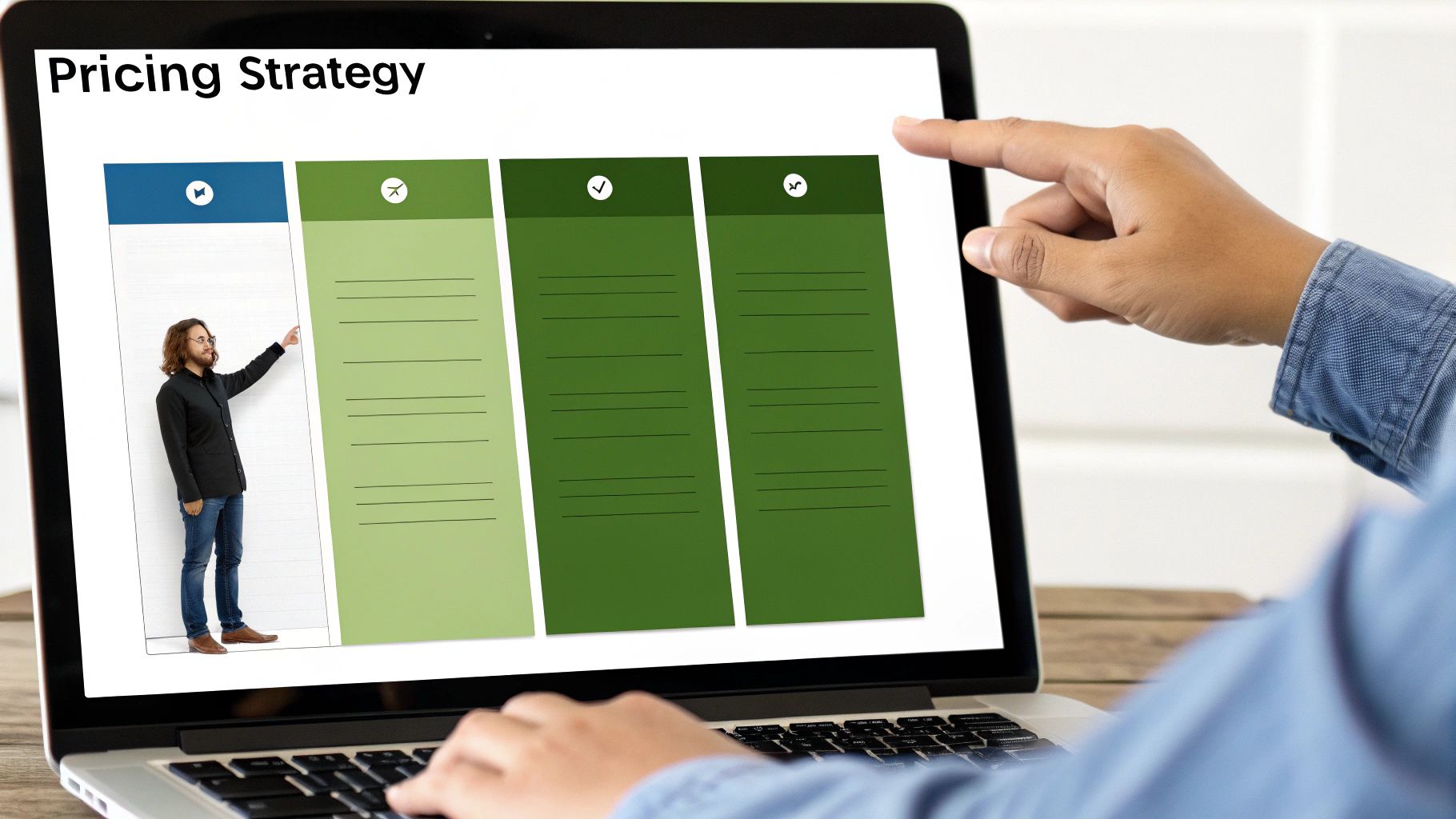 With your MVP starting to look like a real product, it's time to tackle two of the most critical pieces of the launch puzzle: pricing and messaging. Honestly, getting these right is just as important as the code itself. Too many founders bolt on pricing at the last minute, but it's one of your most powerful tools for showing your product's value and carving out your spot in the market.
Think of your pricing strategy as the very first thing that tells a potential customer what you think your product is worth. It’s not just about covering your server costs; it's about anchoring your solution to the real, tangible value it brings to the table.
Choosing Your Pricing Model
The model you land on will shape how you make money and how customers see you. There’s no magic formula here, so you need to understand the main playbooks before you commit.
- Value-Based Pricing: This is where you tie your price directly to the value the customer gets. If your software saves a business $10,000 a month in wasted time, charging $1,000 suddenly feels like a steal. To pull this off, you have to know your customer's pain points inside and out.
- Competitor-Based Pricing: This one’s simple: you look at what everyone else is charging and price yourself accordingly—maybe a little lower, a little higher, or right on par. It’s a quick way to get a number, but it’s a dangerous game that can easily turn into a race to the bottom, completely ignoring what makes you unique.
- Cost-Plus Pricing: With this model, you add up all your costs (devs, marketing, support) and slap a markup on top. It guarantees you’ll be profitable on paper, but it totally disconnects your price from customer value. You’re almost always leaving money on the table.
For most SaaS startups I’ve seen, a value-based approach is the way to go. It forces you to stay obsessed with your customer's success, which is exactly what you should be doing anyway.
Structuring Your Pricing Tiers
Okay, so you have a price in mind. Now you need to package it. A well-thought-out pricing page acts like a silent salesperson, guiding people to the perfect plan for them.
The classic three-to-four-tier structure ("Basic," "Pro," "Enterprise") works for a reason. Each tier should be built for one of the customer personas you’ve already defined.
The goal of your pricing tiers is not just to offer choice, but to make the right choice obvious for each customer segment. Differentiate tiers based on key value metrics, not just a random collection of features.
Let's say you're building a project management tool. You could structure your tiers around things that scale with a customer’s growth:
- Number of users
- Amount of file storage
- Access to premium features like automations or key integrations
This creates a natural upgrade path. A solopreneur might start on your basic plan, but as they hire people, moving up to the pro tier becomes a no-brainer. To get some inspiration, you can find a directory of SaaS product pricing to see how others do it: https://submitmysaas.com/pricing
Crafting a Compelling Message
Your pricing tells half the story; your messaging tells the other. This is the copy on your landing page, the words in your ads, and the tone in your emails that explain why you’re the answer to their problems. Your message has to be sharp, simple, and all about the customer.
Ditch the jargon. Nobody cares about your tech stack. Translate features into real-world benefits. Don't say, "We offer a 256-bit AES encrypted database." Say, "Your data is always secure, giving you complete peace of mind." For SaaS products targeting other companies, a solid B2B Marketing Strategy is the foundation for messaging that actually connects with decision-makers.
Your core value proposition should hit them the second they land on your site. It needs to answer three questions in five seconds or less:
- What is this?
- Who is it for?
- Why should I care?
Nail this combination of smart pricing and sharp messaging, and you'll find that when people show up, they get it instantly. And they'll see a plan that feels like it was made just for them.
Building Pre-Launch Momentum and an Eager Audience
A massive launch day doesn't just happen. It's the grand finale of months of deliberate, strategic work behind the scenes. The SaaS launches that truly make a splash create such a strong sense of anticipation that people are practically banging on the digital door, ready to get in. This is where you pivot from building a product in private to building a community in public.
The core idea is simple: show up where your ideal customers already spend their time. Don't just shout into the digital void and hope they find you. The goal is to deliver real value long before you ever ask for a credit card.
Content as a Magnet for Your First Users
Content is the engine that drives your pre-launch hype. It’s how you prove you know what you’re talking about, solve a small piece of your audience's bigger problem, and start earning their trust. Forget about generic, SEO-bait blog posts. Your content needs to be a direct, compelling answer to the questions your ideal customers are actually asking.
For example, if your SaaS helps remote teams with project management, don't just write about "project management." Get hyper-specific. Create articles like, "The 5 Communication Breakdowns Killing Your Remote Team's Productivity," or offer a downloadable checklist for seamlessly onboarding a new remote employee. Every single piece of content should be a breadcrumb that leads straight back to the core problem your product solves.
To really build a solid foundation, you need to think bigger than just one-off articles. It’s critical to employ effective startup customer acquisition strategies right from the start. This makes sure your content efforts are a key part of a cohesive plan to bring the right people into your world.
Engaging Where Your Audience Lives
Creating great content is only half the job; getting it in front of people is the other half. Your future customers are already hanging out in digital "watering holes"—niche subreddits, focused LinkedIn groups, private Slack communities, or industry forums. Your mission is to become a valued member of these communities, not just another spammer.
Find relevant conversations and add genuine value. Answer questions. Share your own experiences. Only mention your upcoming product when it's a natural, helpful solution to the discussion at hand. This approach builds your reputation as a helpful expert, so when you finally announce your launch, the community sees it as a solution from a trusted peer, not just a sales pitch from a stranger.
Don’t spread yourself too thin. Pick two or three channels that seem promising and run small experiments to see what gets the most traction. It's far better to be a well-known name in one community than a ghost in ten.
For instance, a founder building a tool for indie game developers might become a consistently helpful presence on the r/gamedev subreddit. By offering solid advice over time, they build up a bank of credibility that will be absolutely priceless on launch day.
Nurturing Your Pre-Launch Email List
Your email list is, without a doubt, the single most important asset you will build before you launch. It’s a direct line to your most interested prospects—the people who have literally raised their hand and said, "Yes, I want to hear more."
Every piece of content you put out there should have a clear call-to-action encouraging people to join your waitlist. A simple landing page that clearly explains the problem you solve and offers early access is non-negotiable.
But getting subscribers is just the beginning. Now you have to nurture that list with a thoughtful email sequence.
- The Welcome Email: Instantly confirm their subscription and remind them of the value you promised to deliver. Make them feel smart for signing up.
- Problem-Focused Content: Send them your absolute best resources—the articles and guides that dig deep into the pain points they're struggling with.
- Behind-the-Scenes Updates: People love a good story. Share progress on your MVP, sneak peeks of the UI, challenges you've overcome, and key decisions you're making. This creates a sense of co-creation and makes your audience feel invested in your journey.
This isn’t about just blasting out updates. It’s about transforming a list of email addresses into a genuine community of advocates. By the time you’re ready to launch, this group should feel like they're part of an inner circle, making them far more likely to become your first paying customers and your most passionate champions. This is the fuel that will make your launch day a success.
5. Executing a Flawless Launch Day
All the months of validating, coding, and audience building have led you to this. Launch day isn't just about flipping a switch; it's a carefully orchestrated event designed to make a real splash. This is your moment to convert all that pre-launch buzz into a wave of new sign-ups, priceless feedback, and a solid footing in the market.
Think of it as opening night for a Broadway show. Every detail has been rehearsed. Your job is to execute the plan, ensuring every channel you control is singing the same song at the same time. This is how you turn a simple product release into an event people remember.
All that work you did building an audience? That's your built-in support system, ready to cheer you on.
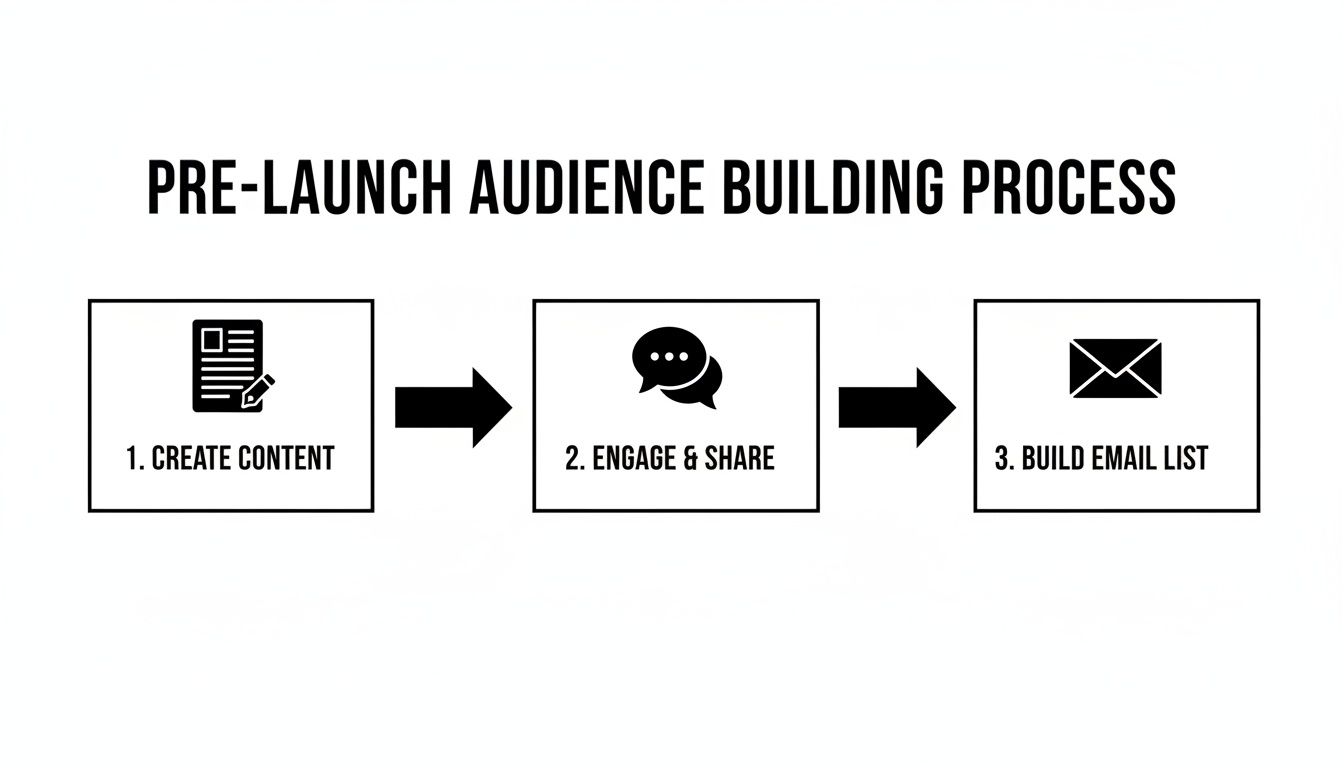
This simple flow—create great content, engage with people, and get them on your email list—is the foundation for a powerful launch.
Get Instant Visibility on Discovery Platforms
On launch day, you have to show up where the early adopters hang out. Product discovery platforms are gold for generating immediate buzz and attracting users who are actively hunting for new tools.
Product Hunt: This is the big one for most SaaS launches. Success here is earned, not given. You need your assets lined up: eye-catching visuals, a killer tagline, and a thoughtful first comment explaining the why behind your product.
Specialized Directories: Don't sleep on the niche directories. Submitting your product to a platform like SubmitMySaas is a no-brainer. It gets you in front of a hyper-targeted audience of founders and tech folks, plus it gives you a nice SEO bump. Those backlinks from reputable sites help build your domain authority right from the start. Using a service like the SubmitMySaas Launchpad can really pour fuel on the fire.
Timing is everything here. A Product Hunt launch, for example, is a 24-hour sprint. Be prepared to spend the day engaging with the community, answering every single question, and thanking people for their support.
Orchestrate Your Multi-Channel Announcement
Your launch message needs to hit hard across every single platform where you've built a presence. This isn't about copy-pasting the same text everywhere. It's about tailoring the message to the specific audience and format of each channel.
Your coordinated push should hit these key areas:
Your Email List: This is your warmest audience, your core supporters. Send them a personal, direct email announcing you're live. Tell your story, hammer home the value, and give them a crystal-clear call-to-action to sign up.
Your Company Blog: Publish a detailed launch post. This is where you can go deep on the problem you're solving, show off key features with slick screenshots or GIFs, and share your vision for the future. This post becomes the central hub you can link to from everywhere else.
Social Media: Craft specific posts for LinkedIn, Twitter, and other relevant networks. Use your best launch-day visuals, tag any influencers or early supporters who helped you along the way, and use smart hashtags to break out of your follower bubble.
Online Communities: Remember those Reddit, Slack, or Discord communities where you've been genuinely helpful? Now's the time to go back. Share your launch news, but do it in a way that feels authentic, not like a sales pitch. Frame it as a solution built for people just like them.
Create Your Launch Day Checklist
A chaotic launch day is almost always the result of poor planning. You need a master checklist, a "run of show" that outlines every single task, who owns it, and the exact timing. This document is your team's single source of truth.
A great launch isn't about improvising. It's about flawlessly executing a well-rehearsed plan. Your checklist is your script—stick to it.
Here is a look at what your priority list for the day might look like.
| Task | Priority | Key Objective |
|---|---|---|
| Final "Go Live" Technical Checks | Critical | Ensure the product is stable and accessible. |
| Post on Product Hunt | High | Drive initial wave of traffic and early adopters. |
| Send Launch Email to Your List | High | Activate your most engaged audience first. |
| Publish Company Blog Post | High | Create a central hub for launch information. |
| Announce on Key Social Media | High | Amplify reach across all owned channels. |
| Share in Relevant Online Communities | Medium | Tap into niche audiences and generate discussion. |
| Monitor Real-Time Analytics | Medium | Track sign-ups, traffic sources, and user behavior. |
| Engage with Comments and Feedback | High | Build community and show you're responsive. |
This checklist will keep you focused when things get hectic, allowing you to spend your energy engaging with new users instead of scrambling to figure out what to do next.
Prepare for the Human Element
The moment you launch, the feedback will start rolling in. This is exactly what you want, but you have to be ready for it. The first few hours are your best chance to make an amazing first impression.
Have a clear support system in place. It could be a simple shared inbox, a dedicated Slack channel, or a helpdesk tool. Whatever you choose, the goal is to be insanely responsive. Early users who feel heard are the ones who become your biggest advocates.
Obsessively monitor social media mentions, community comments, and your support channels. Thank people for bug reports, answer questions with patience, and celebrate the wins. How you engage on launch day sets the tone for your company's customer relationships for years to come.
Driving Sustainable Growth After the Launch Hype
The confetti from launch day has settled, and the initial wave of sign-ups has slowed. This is the moment where many founders get nervous, but it’s actually where the real work of building a sustainable SaaS business begins.
Think of it this way: the launch isn't the finish line; it's the starting pistol for a marathon. The race is all about growth, retention, and creating a product that becomes indispensable to your users.
Your focus has to shift now from making a big splash to building a solid foundation. That means stepping away from vanity metrics like website traffic and social media likes and zeroing in on the numbers that actually measure the health of your business.
Finding Your North Star Metrics
To grow a business that lasts, you need to become obsessed with a few core metrics. These aren't just numbers for a spreadsheet; they are the vital signs of your company. They tell you what's working, what’s broken, and where to point your limited resources.
- Monthly Recurring Revenue (MRR): This is the lifeblood of any SaaS. It’s the predictable revenue you can count on every single month, and its growth is your primary measure of progress.
- Customer Acquisition Cost (CAC): This tells you exactly how much you spend, on average, to win a single new paying customer. Knowing your CAC is fundamental to making smart decisions about your marketing and sales budget.
- Lifetime Value (LTV): This is the total revenue you can expect from a single customer over their entire time with you. A healthy SaaS needs an LTV that is significantly higher than its CAC—a good rule of thumb is aiming for an LTV to CAC ratio of at least 3-to-1.
These metrics tell a story together. If your CAC is high but your LTV is low, you have a leaky bucket. You’re spending too much to acquire customers who don't stick around long enough to become profitable. This data-driven thinking is a core part of knowing how to launch a saas product that has legs beyond the initial buzz.
Create a Tight User Feedback Loop
Your first users are an absolute goldmine of information. They are the ones who will show you the real-world gaps between what you thought your product was and what it actually is. You have to establish a direct, continuous line of communication with them. It's non-negotiable.
Don't ever rely on guesswork to decide what to build next. Your product roadmap should be heavily influenced by the people using your tool every single day.
Your earliest customers aren't just users; they're co-creators. They bought into your vision when it was still rough around the edges. Their feedback is the most valuable asset you have for building a product people will actually pay for.
Make it ridiculously easy for users to give feedback. This could be a simple widget inside your app, regular check-in emails, or even scheduling quick 15-minute calls to watch them use the product. And when you implement a feature based on a user's suggestion, close the loop and let them know. That simple act turns customers into loyal advocates who feel a sense of ownership in your product’s success.
Battling Churn and Boosting Retention
Getting new customers is exciting, no doubt. But keeping the ones you already have is what builds a truly scalable business. Churn—the rate at which customers cancel their subscriptions—is the silent killer of SaaS companies.
Even a seemingly small monthly churn rate of 5% means you lose half of your customer base every single year. Let that sink in.
Reducing churn starts with understanding why customers are leaving in the first place. When a user cancels, trigger a simple, one-question survey asking why. Over time, you’ll see patterns emerge.
- Poor Onboarding: Are users dropping off in the first week? Your onboarding process might be confusing or failing to show them that "aha!" moment quickly enough.
- Missing Features: Are they jumping ship to a competitor with a specific feature you lack? This is direct input for your roadmap.
- Pricing Issues: Is the price too high for the value they're getting? This could signal a need to revisit your pricing tiers or better communicate your value.
By systematically digging into the root causes of churn and relentlessly delivering value, you shift your focus from a launch-day sprint to the long-term journey of building a beloved and profitable product.
Got SaaS Launch Questions? We've Got Answers.
When you're figuring out how to launch a SaaS product, the theory only gets you so far. The real-world execution is where the tough calls are made. Let's tackle some of the biggest questions that pop up for founders, with some straight-up advice to help you push forward.
What if I Get Negative Feedback Right Out of the Gate?
First things first: this isn't a "what if," it's a "when." Getting early negative feedback isn't a red flag signaling failure; it's a gift. Seriously. The first people who take the time to point out what's wrong are your most valuable critics, and their insights are pure gold for your product roadmap.
Don't get defensive. Get curious.
When someone complains, dig deeper. A vague comment like "the UI is confusing" doesn't help you much. But asking, "what specific task were you trying to do when you got stuck?" gives you a concrete problem you can actually fix.
Embrace the criticism. A user who complains is a user who cares enough to want your product to be better. Silence is far more dangerous than honest feedback.
How Long Should My Pre-Launch Phase Really Be?
This can be anywhere from six months to over a year, and it all depends on how complex your product is. But honestly, you're asking the wrong question. A better question is, "What milestones signal that we're ready to launch?"
Your pre-launch isn't just about coding away in the dark. It’s about validating your idea and building a tribe of early fans. Before you even think about hitting that "go live" button, you should have these things dialed in:
- A Validated MVP: This means real users have confirmed your product solves a real, painful problem for them.
- An Engaged Waitlist: You need a core group of at least 50-100 ideal customers on an email list who are genuinely excited for your solution.
- Solid Messaging: You’ve nailed your value proposition and have a landing page that actually converts curious visitors into sign-ups.
So many founders rush this phase, and it's a huge mistake. It’s far better to delay your launch by three months to build a real foundation than it is to launch to crickets.
Should I Actually Charge People from Day One?
For most SaaS products, the answer is a hard yes.
Putting a price tag on your product from the very beginning is the ultimate form of validation. It’s the only way to know for certain if you’ve built something that people find valuable enough to open their wallets for.
It's tempting to offer a free-forever plan to get users in the door, but this often attracts the wrong crowd—people who will never become paying customers. A free trial is a much smarter play. It gives users a chance to see the full value of your product before you ask them to commit.
Setting a price, even a small one, acts as a filter. It brings in serious customers, and their feedback will be infinitely more valuable. Their willingness to pay is the strongest signal you can get that you’re on the right track.
Ready to get your new SaaS in front of thousands of early adopters and build critical backlinks? SubmitMySaas is the launchpad designed for founders. Submit your SaaS today!