Choosing the Best Marketing Automation Software for SaaS Growth
Struggling to choose the best marketing automation software? Our guide dives deep into real-world comparisons, feature analysis, and ROI to help you scale.
The right marketing automation software gives a SaaS company the power to scale its communication, nurture leads, and keep customers happy without having to hire a massive team. For bootstrapped startups, platforms like ActiveCampaign or HubSpot offer solid toolkits that can grow with you. On the other hand, more established companies might lean towards the data-heavy approach of a platform like Customer.io.
Ultimately, the best choice isn't just a task manager; it's a strategic lever for growth.
Why Marketing Automation Is Essential for SaaS
For any SaaS business, growth isn't just about landing new customers. It's about getting them onboarded efficiently, keeping them engaged, and making sure they stick around for the long haul. Trying to manage this entire lifecycle by hand is next to impossible, especially for lean teams. This is where marketing automation software becomes a force multiplier for your efforts.

Automation allows you to create consistent, personalized experiences for every single user. Instead of sending a generic welcome email, you can design a sophisticated onboarding sequence that walks new users through your product’s most important features, which can have a huge impact on activation rates. It shifts your marketing from being reactive to being a proactive engine for growth.
Driving Growth and Efficiency
The biggest challenge for most SaaS founders is figuring out how to do more with less. Marketing automation hits this problem head-on by systematizing the repetitive but crucial tasks that eat up your team's time. This frees them up to focus on the big picture—strategy, innovation, and product development.
- Scale Customer Acquisition: You can automatically score leads based on their behavior, pinpoint who is a product-qualified lead (PQL), and nurture them with targeted content until they're ready to buy.
- Enhance User Onboarding: Trigger personalized emails or in-app messages based on what users do (or don't do). This helps new sign-ups grasp your product's value much faster.
- Improve Retention: Proactively spot users who are at risk of churning by tracking their engagement. From there, you can launch automated re-engagement campaigns to win them back before they're gone.
The real magic of marketing automation for SaaS is its ability to tie user behavior directly to your communication. It turns your platform from a passive tool into an active partner in the customer's journey.
Given how critical growth is, especially for SaaS, you need to look for platforms that offer scalable marketing automation capabilities. This makes sure your system won't break as your user base and complexity grow.
The demand for these tools is exploding. The global marketing automation software market is projected to jump from USD 7.23 billion in 2025 to USD 18.36 billion by 2030, reflecting a compound annual growth rate of 12.9%. This growth is driven by the need to automate tasks like lead nurturing and email marketing, which you can read more about in the full market analysis from Mordor Intelligence.
Investing in automation is no longer just a nice-to-have; it's a competitive necessity for sustainable SaaS growth.
Evaluating Core Features for SaaS Success
Picking the right marketing automation software isn't about finding the tool with the longest feature list. For a SaaS business, it's about identifying the specific functions that turn trial users into paying customers and keep them engaged for the long haul. Get this wrong, and you'll end up with a pricey, glorified email sender that doesn't actually move the needle.
Before you even look at a demo, you need a clear framework. Think less about what a feature is and more about what it does for your bottom line. How will this capability help you nudge a trial user toward that "aha!" moment? Which function will free up your lean team to focus on hot prospects instead of lukewarm leads? That's the mindset that leads to a smart investment.
First, let's nail down what truly matters. We've put together a quick checklist of the essential marketing automation features that directly contribute to SaaS growth, connecting each function to a tangible business outcome.
Essential Marketing Automation Features for SaaS
| Feature Category | Core Functionality | Impact on SaaS Growth |
|---|---|---|
| Multi-Channel Campaigns | Orchestrate campaigns across email, in-app, SMS, and push. | Reduces churn by reaching users on their preferred channel. |
| Behavioral Segmentation | Group users based on in-app actions, login frequency, and feature usage. | Boosts trial-to-paid conversions with hyper-relevant messaging. |
| Lead Scoring | Assign points to users based on demographic data and engagement level. | Increases sales efficiency by focusing efforts on product-qualified leads (PQLs). |
| Dynamic Workflows | Create automated "if-then" journeys that adapt to user behavior in real time. | Improves user onboarding and feature adoption without manual effort. |
| A/B Testing | Test variations of emails, subject lines, and in-app messages. | Optimizes campaign performance and increases key metrics like open and click rates. |
| Analytics & Reporting | Track campaign ROI, user lifecycle stages, and conversion funnels. | Provides clear data to justify marketing spend and inform future strategy. |
Think of this table as your non-negotiable list. If a platform you're considering is weak in any of these areas, it's probably not the right fit for a growing SaaS company.
Multi-Channel Campaign Management
Your users don't live in a single channel, and neither should your marketing. Today's customer journey fluidly moves between email, in-app pop-ups, push notifications, and even SMS. Your automation platform needs to be the central command center for all of it, otherwise, you're just creating a disjointed experience and leaving money on the table.
Think about it: a user might ignore an email about a new feature, but an in-app notification pointing it out the next time they log in could be exactly what they need. A good system lets you build smart workflows that try one channel, and if that doesn't get a response, it automatically pivots to another. It’s all about getting the right message to the right person in the right place.
A truly effective multi-channel strategy isn't about blasting the same message everywhere. It's about using each channel for its unique strength—email for detailed updates, in-app for contextual guidance, and SMS for urgent alerts—to create a unified and helpful customer experience.
Advanced Segmentation and Personalization
For a SaaS business, "one-size-fits-all" marketing is a death sentence. The single most powerful feature you should look for is the ability to slice and dice your user base based on what they actually do inside your product. The best platforms let you create dynamic segments that update automatically as user behavior changes.
This is what unlocks real personalization, going way beyond just using a {{first_name}} tag.
- Trial User Segmentation: Group users by features they’ve tried, their last login date, or whether they’ve hit a paywall. This lets you send perfectly timed nudges to encourage upgrades or exploration of sticky features.
- Paying Customer Segmentation: Create segments based on subscription tiers (e.g., Basic vs. Pro) to run targeted upsell campaigns for relevant add-ons or introduce them to premium features they already have access to.
- Churn-Risk Segmentation: Automatically flag users whose activity has tanked. This triggers a proactive re-engagement campaign to win them back before they hit the cancel button.
This kind of segmentation is the engine that drives higher trial conversion rates and lower churn. If you want to explore some specific platforms, our guide on the best email automation tools like Premium Sender is a great place to start.
Intelligent Lead Scoring
Let's be honest: not every signup is a future power user. Lead scoring is how you separate the signal from the noise, allowing your team to focus their energy on prospects who are genuinely kicking the tires and showing buying intent. It works by assigning points based on who they are and what they do.
A solid lead scoring model will assign points for:
- Demographic Fit: Things like job title, company size, or industry that match your ideal customer profile.
- Behavioral Engagement: What are they doing? Visiting the pricing page, downloading a case study, or, most importantly, taking specific high-value actions inside your app during a trial.
For example, a trial user who immediately invites three teammates is a far more valuable lead than someone who signs up and ghosts. An intelligent scoring system automatically jacks up the first user’s score and flags them for immediate follow-up. This data-first approach stops your team from wasting precious time on leads that were never going to convert anyway.
Comparing Top Marketing Automation Platforms
Choosing the right marketing automation software isn't about finding the one "best" tool. It’s about finding the right fit for your business model, your current stage, and where you want to go. A feature that’s a game-changer for a high-touch B2B SaaS company might just be expensive noise for a bootstrapped startup. This comparison cuts through the generic feature lists to look at the top contenders through the lens of real-world SaaS needs.
We're going to break down three of the heavy hitters—HubSpot, ActiveCampaign, and Customer.io—and map their strengths to the unique challenges you face. The goal here isn't just to see what each tool does, but to understand who it does it for best.
The diagram below nails the core pillars of any solid SaaS marketing automation strategy: smart user segmentation, accurate lead scoring, and analytics that actually tell you what to do next.
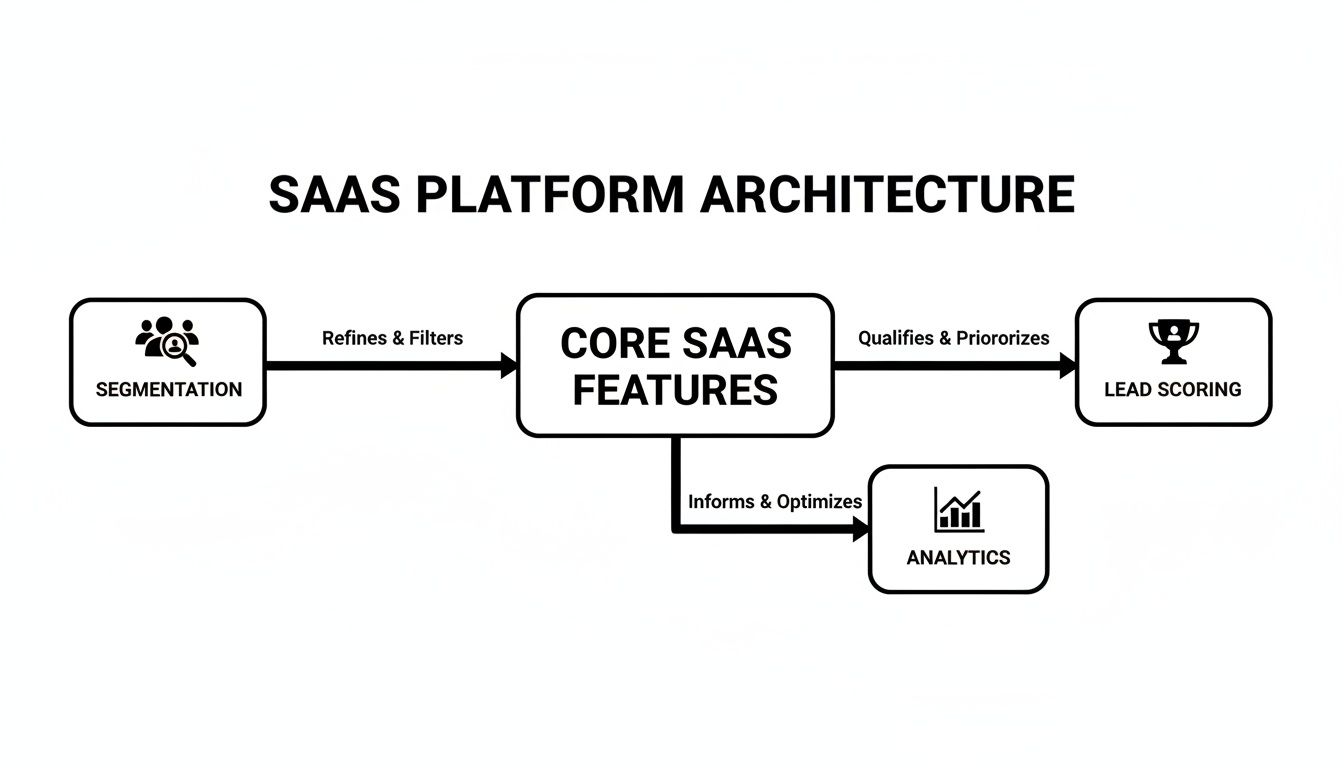
This isn't just a pretty picture; it shows how these pieces must work together to turn raw user data into targeted conversations that fuel growth. A platform’s real value is measured by how well it handles these fundamentals.
HubSpot: The All-in-One for Bootstrapped Startups
There's a reason so many startups start with HubSpot. Its biggest win is the all-in-one ecosystem that wraps a very capable CRM with marketing, sales, and service tools. For a lean team where everyone wears multiple hats, this consolidation is a lifesaver. You're not stuck trying to stitch together a half-dozen different tools.
The platform is famously easy to use, boasting one of the most intuitive workflow builders you'll find. Even better, the free tier is incredibly generous. You get email marketing, forms, and that powerful CRM to get your business off the ground with zero initial investment. It’s the perfect launchpad for bootstrapped or pre-seed SaaS companies focused on capturing their first leads and setting up a basic marketing process.
HubSpot's Key Differentiator: It’s a CRM first, with marketing automation built on top. This structure means every single marketing touchpoint is automatically tied to a customer record, giving your whole team a single source of truth from day one.
The trade-off? Advanced automation logic is locked behind the pricier Professional or Enterprise plans. But for a startup that just needs solid lead capture, simple email nurturing, and clean contact management, the free and Starter plans deliver a ton of value right out of the box.
ActiveCampaign: For Nailing Complex User Journeys
As your SaaS grows, so does the complexity of your user journeys. Suddenly you're juggling trial users, freemium conversions, multiple paid tiers, and churn risks all at once. This is ActiveCampaign's playground. It delivers a level of workflow flexibility that leaves basic email sequences in the dust.
With ActiveCampaign, you can build incredibly detailed, multi-path automations based on a huge range of triggers—website visits, in-app events, CRM data, you name it. Its "if/then/else" logic is robust, letting you craft dynamic campaigns that react to what individual users are actually doing. For example, you can build a flow that sends a feature tutorial only if a user hasn't used that feature yet.
ActiveCampaign's Key Differentiator: It blends enterprise-grade automation power with a visual, drag-and-drop interface. It’s that perfect middle ground, giving marketers deep customization without needing a developer on speed dial.
For a SaaS company, the real magic is in its site and event tracking. You can track custom events inside your application and use that data to trigger incredibly specific, helpful messages. This is the key to effective user onboarding, driving feature adoption, and getting ahead of churn before it happens.
Think about what you could do with this kind of flexibility:
- Tailored Onboarding: Create completely different onboarding flows based on a user's role or the very first action they take in your app.
- Usage-Based Upsells: Automatically trigger an upsell offer when a user on a basic plan starts bumping up against their usage limits.
- Proactive Re-engagement: If a paying customer's activity drops off, you can automatically enroll them in a sequence to highlight new features or offer support.
It also comes with a built-in CRM, making it a powerful choice for teams that need sales and marketing to work together without the hefty price tag of some all-in-one giants.
Customer.io: For Data-Driven, High-Touch B2B SaaS
If you’re a B2B SaaS with a high-touch sales process or a product that generates a lot of data, Customer.io should be at the top of your list. This platform was built from the ground up to handle massive streams of event data. That makes it the best marketing automation software for companies needing to send messages based on granular, real-time user behavior inside their product.
Unlike tools that think email-first, Customer.io is data-first. You unlock its true potential through its API, which lets your developers pipe rich event data straight from your app into the platform. This allows marketers to build campaigns around hyper-specific actions, like "user invited 3 teammates" or "user’s API usage hit 80% of their monthly limit."
Customer.io's Key Differentiator: Unbeatable data flexibility and API-centric design. It treats your product's event stream as the ultimate source of truth, enabling the most timely and contextual messaging possible—a must for product-led growth and retaining high-value customers.
The platform is a master of multi-channel orchestration, seamlessly coordinating email, SMS, push notifications, and in-app messages from a single workflow. This is critical for high-touch B2B, where you might use an in-app message for a quick tip, an email for a detailed report, and an SMS for an urgent alert.
Its segmentation engine is also a beast, letting you build audiences from any combination of event data, user attributes, and messaging history. That level of precision ensures your sales team is only alerted to true product-qualified leads (PQLs) who have shown clear intent through their actions.
Once you have a feel for your core needs, you can dig even deeper with a comprehensive marketing automation software comparison guide to see how other platforms stack up.
How to Match Software to Your Business Stage
Picking the right marketing automation software isn't a one-and-done decision. The powerhouse platform that works for a Series B company will absolutely crush a solo founder's budget and schedule. On the flip side, that nimble free tool that helped you get your first users can quickly turn into a bottleneck that holds back your growth. The real key is matching the software’s firepower to where you are right now and where you’re headed next.
One of the most common mistakes I see is over-investing in an enterprise-level platform with features you won't even look at for years. It's not just a waste of money; it adds a layer of complexity your team simply doesn't need. The smart play is to choose a tool that solves today’s problems but has a clear, scalable path for tomorrow.
Pre-Seed and Bootstrapped Startups
When you're just starting, the mission is crystal clear: prove your product works and get those first crucial users. Everything is about lean operations, quick adjustments, and making every single dollar count. Your marketing automation needs are pretty straightforward at this point—you need to capture leads from a landing page, send a simple welcome email series, and maybe tag people who seem interested.
Your priorities should be laser-focused:
- Cost-Effectiveness: A generous free plan or a super low-cost entry point is non-negotiable.
- Ease of Use: You don’t have time to wrestle with a steep learning curve. The interface needs to be intuitive, period.
- Core Functionality: It has to handle basic email, simple forms, and contact management without a fuss.
Tools like HubSpot's free CRM or the starter plans from ActiveCampaign are perfect here. They give you the essential building blocks for capturing and nurturing leads without the overwhelming price tag or feature set. For a deeper dive, check out our guide on how to launch a SaaS product to make sure your marketing lines up with your launch strategy.
Picking software at this stage is like choosing your first car. You don't need a semi-truck to run errands; you need something reliable and efficient that gets the job done without draining your bank account.
Scaling Startups (Seed to Series A)
Okay, you've found product-market fit and landed some funding. Your goals have shifted from pure survival to aggressive growth. Your user base is growing fast, and your marketing needs are getting a lot more sophisticated. Simple email blasts just won't cut it anymore. It's time to think about slick user onboarding, segmenting users by what they do, and reaching them on multiple channels to keep them happy and paying.
At this point, your platform absolutely must support:
- Advanced Segmentation: The ability to group users based on their in-app behavior is mission-critical for personalization.
- Flexible Workflows: You need to build "if this, then that" automations that can guide users down different paths.
- Multi-Channel Capabilities: It's time to integrate email with in-app messages or push notifications.
This is where platforms like ActiveCampaign and Customer.io really start to make sense. They have the power you need to create detailed, behavior-driven campaigns that are essential for turning trial users into loyal customers. You're officially moving beyond basic lead nurturing and into full-funnel marketing.
Established Companies (Series B and Beyond)
For well-established companies, the game changes again. The focus is now on optimization, data-driven decisions, and scaling everything globally. You probably have dedicated marketing, sales, and product teams who all need to work from a single source of truth. The best software for this stage has to handle enormous amounts of data and plug into a complex tech stack without breaking a sweat.
Your must-have list now includes:
- Deep API and Integration Support: The platform must connect flawlessly with your CRM, data warehouse, and other business-critical tools.
- Robust Analytics: You need granular reporting to measure ROI and fine-tune every customer touchpoint.
- High-Volume Performance: The system has to reliably handle millions of contacts and events without getting bogged down.
Here, data-centric platforms like Customer.io or the enterprise-grade solutions from HubSpot become the standard. These tools are engineered to manage complexity at scale, empowering you to run highly personalized, data-heavy campaigns that drive long-term customer value.
Choosing the right software is a strategic decision that directly impacts your ability to grow. By honestly assessing where you are today and thinking about where you need to be tomorrow, you can pick a platform that becomes a genuine partner in your growth.
Platform Recommendations by Business Stage
To make this even clearer, here's a quick cheat sheet. Think of it as a starting point to help you find the right category of tools based on your company's current reality.
| Business Stage | Primary Goal | Recommended Platform Type | Example Tool |
|---|---|---|---|
| Pre-Seed / Bootstrapped | Validate idea, acquire first users | All-in-one with a strong free/cheap tier | HubSpot |
| Seed to Series A | Scale user base, reduce churn | Behavior-driven, multi-channel automation | ActiveCampaign |
| Series B & Beyond | Optimize ROI, unify data | Data-centric, highly integrable platform | Customer.io |
Remember, this isn't about finding a "forever" tool right away. It's about finding the right tool for right now—one that solves your immediate problems while giving you room to grow into your next stage.
Making the Business Case for Marketing Automation
Let's be real—investing in new software is a big deal, especially when every dollar counts. Before you even start comparing platforms, you need to convince your team (and maybe yourself) that marketing automation is a smart financial move. This means building a business case that’s less about cool features and more about one thing: return on investment (ROI).
A solid business case translates benefits into hard numbers. It needs to show stakeholders exactly how this expense will generate more revenue and make everyone more efficient. Get this right, and getting that budget approved becomes a whole lot easier.
Quantifying the Tangible Benefits
First things first, you have to pinpoint where automation will create real, measurable value. It's not enough to say it will "save time." You need to calculate what that time is actually worth to the business.
Start with the obvious: manual labor costs. If your team is burning 10 hours a week manually pulling lists, exporting data, or scheduling social media posts, that’s 40 hours a month you're paying for. Multiply those hours by their loaded hourly rate, and you’ve got your "manual process cost." That number is a direct, immediate saving you can claim.
Next, shift your focus to lead conversion. A good automation platform can boost lead-to-customer conversion rates by over 14%. By consistently nurturing leads with relevant content at the right time, you stop good prospects from slipping through the cracks. That’s an improvement you can tie directly to new monthly recurring revenue (MRR).
The heart of your business case is a simple equation: Will the new revenue and efficiency gains from this platform be greater than its monthly cost? Every benefit you list should be framed in terms of its direct impact on the bottom line.
Calculating Your Potential ROI
Once you've identified the benefits, it's time to build a clear ROI projection. This is all about comparing your current performance metrics to what you expect to achieve after implementing the new software. A simple before-and-after framework works best.
Before Automation (Your Current State):
- Customer Acquisition Cost (CAC): How much do you spend on sales and marketing to get one new customer?
- Lead Conversion Rate: What percentage of your leads become paying customers?
- Customer Lifetime Value (CLV): What's the total revenue you can expect from a single customer over their entire relationship with you?
After Automation (Your Projected State):
- Reduced CAC: With automation handling tasks, you should spend less to acquire each new customer.
- Increased Conversion Rate: Better, more consistent lead nurturing will almost certainly bump this number up.
- Higher CLV: Automated onboarding and engagement campaigns can reduce churn, which means customers stick around longer.
Here's a quick example. Let's say your CAC is currently $500. By automating lead scoring and nurturing, you might realistically project a 20% reduction, bringing it down to $400. If you're signing up 50 new customers a month, that alone is a $5,000 monthly saving.
When you add in the projected revenue from higher conversion rates and a better CLV, the financial argument becomes crystal clear. Sometimes, dedicated tools that focus on post-sale engagement, like those seen in customer success platforms such as SuccessCX, can further amplify these gains by directly tackling churn and expansion revenue.
By presenting a clear, data-backed projection, you shift the conversation from "Can we afford this?" to "How quickly can we get this return?" That's how you get the green light for the tools that will actually help you scale.
Your Platform Selection and Implementation Roadmap
Picking the right marketing automation software is a big deal, but the real work starts the moment you try to implement it. A smooth rollout is just as important as the tool itself; get it wrong, and you can kill team adoption and push back your ROI indefinitely. This roadmap will walk you through the process, from picking a vendor to a successful launch.

Think of this as a strategic project, not just a technical task. The goal is to sidestep the common pitfalls, get your team genuinely excited about the new system, and start seeing a return on your investment as fast as humanly possible. That means doing some careful planning before you even think about signing a contract.
Phase 1: Define Success and Audit Your Stack
Before you even glance at a vendor's website, you need to know what "winning" actually looks like for your business. Vague goals like "improve marketing" are completely useless here. You need hard, measurable objectives that will justify the cost and effort.
Your first moves should be all about getting internal clarity:
Establish Clear Success Metrics: Define specific, numbers-driven goals. Instead of a fuzzy objective, aim for something concrete like, "Increase marketing-qualified leads (MQLs) by 20% within six months" or "Reduce trial user churn by 15% in the first quarter post-implementation." These numbers are your North Star.
Audit Your Existing Tech Stack: Map out every single tool you're currently using, paying close attention to your CRM, analytics platforms, and any sales software. You need to know which systems are non-negotiable and exactly how this new platform will connect to them. A tool that creates more data silos is a step in the wrong direction.
A huge reason implementations fail is poor integration. If your shiny new marketing automation platform can't talk to your CRM without a ton of manual workarounds, you're creating headaches, not solving them. This audit is absolutely critical.
Phase 2: Evaluate Vendors and Prepare for Demos
Once you have your goals and integration needs mapped out, you can start talking to vendors with a clear agenda. The trick is to stay in control of the conversation. You want the demo to answer your questions, not just show off flashy features you’ll never touch.
I always recommend creating a scorecard to objectively compare each platform against your specific needs. This simple tool stops you from being wowed by a great sales pitch and keeps the focus on what actually matters to your team.
For every vendor, have a list of direct questions ready:
- Integration Capabilities: "Show me, step-by-step, how your platform syncs with our specific CRM. Is that connection native, or will I need a third-party tool like Zapier?"
- Onboarding and Support: "What does your onboarding process actually involve? Will we have a dedicated person to help us, and what are your support team's real-world average response times?"
- Scalability and Pricing: "What are the common triggers that push customers into a more expensive plan? How does your pricing change based on contacts, users, and feature sets?"
Phase 3: Plan the Migration and Launch
After you’ve made your choice, the final phase is all about execution. Trust me on this: a phased rollout is almost always better than a "big bang" launch. It minimizes the chaos and gives your team a chance to learn the system one piece at a time.
Your implementation plan should nail down these key areas:
- Data Migration Strategy: Figure out what historical data you actually need to bring over. Clean your contact lists before you migrate them—you don’t want to start with a database full of junk. A phased migration, starting with a small, manageable segment of contacts, is the safest bet.
- Team Training and Adoption: Appoint a "platform champion" on your team who will become the go-to internal expert. Schedule real, structured training sessions and create simple cheat sheets for your most common workflows.
- Launch Your First Campaign: Start small. Pick a simple but high-impact automation, like a welcome email series for new leads. This lets you score an early win, which does wonders for building confidence and showing the platform's value to the rest of the company.
Common Questions About Marketing Automation
Picking the right marketing automation tool can feel overwhelming. You're trying to balance features, price, and how it will actually help your team. Let's clear up some of the most common questions that pop up during this process.
Think of this as a quick-and-dirty guide to help you cut through the noise and focus on what really matters for your business.
What’s the Real Difference Between Marketing Automation and a CRM?
This is a big one, and it’s easy to get them mixed up. A Customer Relationship Management (CRM) tool is fundamentally your company's address book. It’s where you store and organize all the information about your customers—their contact details, interaction history, and where they are in your sales pipeline. It’s a database built for your sales team.
Marketing automation software, on the other hand, is the engine that acts on that data. It takes the information from your CRM and uses it to run campaigns automatically. Think sending personalized email sequences, sorting leads into different groups based on what they do on your site, and generally nurturing people along their journey. While many tools now combine both, their jobs are distinct: a CRM holds the data, and automation puts that data to work.
How Much Should I Actually Budget for This?
The price range for marketing automation is all over the map, so it’s critical to find a tool that fits where your business is right now.
Here’s a rough breakdown of what you can expect to pay:
- Free to Low-Cost (Under $100/month): Perfect for startups just getting their feet wet. These plans usually give you basic email marketing, simple automation workflows, and a contact limit that's often under 1,000. They're great for proving out your early marketing ideas without a big investment.
- Mid-Range ($100 - $500/month): This is the sweet spot for most growing businesses. You start to unlock more powerful features like A/B testing, automations that span different channels (email, SMS, etc.), and much more detailed audience segmentation.
- Enterprise ($500+/month): For larger, more established companies. These plans are built for scale and complexity, offering advanced analytics, full API access for custom integrations, and dedicated support to help you manage it all.
A key thing to remember: the sticker price isn't the whole story. You also need to think about implementation fees, the time it will take to train your team, and how the price will jump as you add more contacts. Always look for the pricing triggers—is it based on contacts, email sends, or something else?
Will Marketing Automation Make My Team Obsolete?
Definitely not. It's a common fear, but it gets the purpose of automation all wrong. Marketing automation isn't here to replace people; it's here to make them better at their jobs. It’s a force multiplier.
Your team is probably spending a ton of time on repetitive, manual tasks. Automation takes that work off their plate so they can focus on the things that actually require a human brain.
Instead of getting bogged down, your team can spend its time on:
- Creative Strategy: Crafting campaigns and messages that really connect with your audience.
- Data Analysis: Digging into the results to figure out what’s working and what isn’t.
- Big-Picture Planning: Thinking about long-term growth and how to build a stronger brand.
The best marketing automation software makes your team more strategic, not redundant. It’s the tool that lets a small, nimble team have the impact of a much larger one.
Ready to get your SaaS in front of thousands of early adopters and tech enthusiasts? Submit your product to SubmitMySaas and kickstart your launch with instant exposure and valuable backlinks. Start your launch today!