Top insights: email marketing software comparison for SaaS founders
Discover how email marketing software comparison helps SaaS founders compare features, pricing, and integrations to choose the best tool for growth.
Picking the right email marketing software isn't just about sending newsletters. For a SaaS founder, it's about investing in your primary growth engine. This decision will directly shape how you acquire users, keep them engaged, and ultimately drive revenue for years to come.
Choosing Your SaaS Growth Engine
Let's be clear: for any SaaS founder, choosing an email marketing platform is one of the most critical decisions you'll make early on. This isn't just about sending out a few email blasts. You're building the central nervous system for your entire customer communication strategy—from the first "welcome" email to complex sequences designed to keep users from churning.
The market for these tools is exploding. It's projected to hit USD 3.73 billion by 2032, growing at a staggering 11.8% each year. This growth isn't coming from massive enterprises; it's fueled by small and medium-sized businesses, especially SaaS startups like yours, that rely on email as a lifeline for growth.

Core Evaluation Criteria
To make the right call, we have to look past the flashy feature lists. Our comparison zeroes in on what actually matters for a growing SaaS company:
- Deliverability: Will your emails actually land in the inbox? Or are they destined for the spam folder? This is a non-negotiable.
- Automation Power: Can the platform handle the sophisticated, behavior-triggered workflows you need for user onboarding and churn reduction? Think "if user does X, then send Y."
- Integration Capabilities: How well does it play with the rest of your tech stack? We're talking seamless connections to Stripe, Zapier, your CRM, and other essential tools.
- Scalable Pricing: Is the pricing friendly to a startup budget, or are you going to get hit with a massive bill the moment you start growing?
For a broader view, checking out a comparison of the top marketing automation platforms can give you some valuable context. The right tool is what turns that initial flicker of interest from a launch into a loyal, paying user base, a journey we detail in our guide on https://submitmysaas.com/blog/how-to-launch-a-saas-product.
The biggest mistake I see startups make is picking a tool based on today's price tag, not tomorrow's needs. That cheap plan feels great now, but it’s worthless if it lacks the automation you’ll desperately need in six months. That forces a painful and expensive migration right when you should be focused on growth.
At-a-Glance Scoring for Top Email Platforms
To get us started, here’s a high-level scorecard for the leading platforms. I've rated them based on the criteria that matter most to SaaS startups, setting the stage for the more detailed breakdown to come.
| Platform | Best For Persona | Scalability Score (1-10) | Automation Score (1-10) | Value for Money (1-10) |
|---|---|---|---|---|
| Mailchimp | Indie Founders | 6 | 5 | 7 |
| Brevo | Bootstrapped Startups | 7 | 8 | 9 |
| ActiveCampaign | Growth-Focused Teams | 9 | 9 | 7 |
| Customer.io | Developer-Led Startups | 10 | 10 | 6 |
This table gives you a quick lay of the land. Now, let's dive into the specifics of each platform to see which one truly fits your SaaS.
Comparing Core Features: Deliverability and Automation
Let’s cut through the marketing fluff. When you’re really digging into an email marketing software comparison, it all boils down to three things that actually matter for a SaaS business: deliverability, automation, and segmentation. These are the pillars that decide if your emails get seen, if they engage users, and if they ultimately build value. A beautiful email is worthless if it never reaches the inbox.
It doesn't matter what features a platform has if your emails go straight to spam. Deliverability—the raw percentage of emails that actually land in the inbox—is the most critical metric, period. For a SaaS, anything less than a 98-99% rate is a problem, because every missed onboarding email or renewal notice is lost revenue.
The best platforms are obsessive about protecting their sender reputation to hit those numbers. This means they meticulously manage their IP addresses, give you easy-to-use authentication tools (like SPF and DKIM), and automatically clean your lists by handling bounces and unsubscribes. A platform that skimps on this isn't a serious partner for growth.
The Power of Sophisticated Automation
In the SaaS world, automation is the engine that drives everything from user onboarding to fighting churn. It’s what separates a static email tool from a dynamic growth partner. Sure, almost every platform can send a basic welcome series, but the real power is in building complex workflows that react to what your users actually do.
Let's walk through a common SaaS scenario: a user signs up for a free trial after you launch a new product. This is a make-or-break moment, and different platforms handle it very differently.
- Basic Automation (e.g., Mailchimp): A simple, one-way sequence kicks off. The user gets a welcome email, then maybe a few pre-scheduled tips over the next 14 days. It’s better than silence, but it's a monologue that doesn't adapt.
- Advanced Automation (e.g., ActiveCampaign, Customer.io): This is where you see a real impact. These platforms use conditional logic—think "if/then" splits—based on actions users take inside your app. If a user creates their first project (an "activation event"), they’re automatically pulled out of the generic onboarding sequence and moved into a new one focused on advanced features. If they don't activate in three days, they get a targeted email with a tutorial video or an offer to chat with support.
A great automation workflow feels like a personal conversation, not a broadcast. It should react to what a user does—or doesn't do—in your app. This level of responsiveness is what converts trial users into paying customers.
This advanced capability lets you build journeys that nurture users based on their real-time engagement, which is absolutely crucial for cutting down on trial abandonment. For more ideas on what other founders are using, you can check out user-submitted software reviews to see which tools really deliver on automation.
Segmentation: The Key to Relevance
Finally, you need powerful segmentation. Blasting your entire user base with the same generic update is a surefire way to drive up your unsubscribe rate. The best email marketing software lets you create deep, dynamic segments based on a whole host of data points.
When you compare platforms side-by-side, the gap in capability becomes incredibly clear:
| Segmentation Capability | Basic Platforms (e.g., Mailchimp, MailerLite) | Advanced Platforms (e.g., Brevo, Customer.io) |
|---|---|---|
| User Activity | Can segment by "opened last campaign" or "clicked a link." | Can segment by in-app events like "feature_X_used," "last_login_date," or "projects_created." |
| Subscription Tier | Requires manual tagging or separate lists for "Free" vs. "Pro" users. | Integrates with Stripe to automatically segment users by their current plan, payment status, and even MRR. |
| Engagement Level | Limited to basic open/click metrics. | Creates dynamic segments of "at-risk" users (low engagement) or "power users" (high activity) for targeted re-engagement or upsell campaigns. |
This is the kind of detail that allows a SaaS to send a relevant upsell offer only to its most active "Pro" users, or a targeted re-engagement campaign specifically to "Free" users who haven't logged in for 30 days. Without it, your communication stays generic and far less effective. So, as you continue your email marketing software comparison, don't just ask if a tool has segmentation; ask how deeply it can tap into your user data to build truly meaningful audiences.
How Well Does It Play with Others? Evaluating the Integration Ecosystem
Your email marketing platform can't live on an island. Its real power is unlocked when it talks to the other tools you use every single day. For a SaaS business, your email software needs to be a central hub for communication, not just a siloed sending machine.
Think of it this way: a platform's true value comes from its ability to seamlessly connect with your tech stack. We're talking fluid integrations with your CRM, your payment processor, and your analytics tools. Without those connections, you're stuck with fragmented data and a broken picture of your customer's journey. A great integration ecosystem turns your email tool into the command center for all user communication.
Native Connections vs. Third-Party Workarounds
When you're doing an email marketing software comparison, you have to look closely at the difference between native integrations and those that lean on a third-party tool like Zapier. While Zapier is a fantastic connector for many apps, relying on it for core functions can introduce delays, create unnecessary complexity, and even drive up your costs.
Native integrations, on the other hand, are built right into the platform. They’re faster, far more reliable, and offer much deeper data synchronization. For a SaaS founder, this is absolutely critical for any tool that handles customer data.
- Payment Processors (e.g., Stripe): A native Stripe integration is a game-changer. It lets you automatically segment customers based on their subscription status, plan tier, or even when a payment fails. You can trigger automated emails to fight churn without lifting a finger.
- Analytics Platforms (e.g., Segment): Hooking directly into a tool like Segment means you can pipe in-app user behavior into your email platform in real-time. This is how you send hyper-targeted campaigns based on actual feature usage or inactivity.
- CRMs (e.g., HubSpot, Salesforce): A deep CRM integration with platforms like HubSpot or Salesforce ensures everyone—sales, support, and marketing—is working from the same playbook. It creates a unified customer experience.
Don't be fooled by a long list of logos. The quality of integrations is far more important than the quantity. A platform boasting "500+ integrations" through Zapier is much less valuable than one with 50 rock-solid, native connections to the tools a SaaS business actually relies on.
The Power of a Robust API
Beyond the pre-built connections, the quality of a platform's Application Programming Interface (API) is a huge differentiator, especially for startups with a strong engineering team. A well-documented, flexible API means you can build custom solutions that are perfectly suited to your product's unique needs.
For example, maybe you want to create a custom workflow where a specific in-app action triggers a highly personalized email that pulls data straight from your own database. A clunky, limited API makes this impossible. A robust one gives your development team the freedom to build amazing things.
Here’s a practical look at how different levels of integration support can impact a SaaS business:
| Integration Level | What It Looks Like | Real-World SaaS Use Case |
|---|---|---|
| Basic (Zapier-Reliant) | Connections work, but you might see data lags. Customization is stuck within Zapier's pre-set "triggers" and "actions." | You manually build a "Zap" to add new Stripe customers to an email list. It gets the job done but lacks real-time segmentation when plans change. |
| Strong (Native Connections) | The platform has direct, one-click integrations with key SaaS tools. Data syncs automatically and reliably. | A native Stripe integration automatically tags users as "Pro Plan" or "Free Trial," letting you run targeted onboarding sequences. |
| Excellent (Flexible API) | On top of native connections, the platform offers extensive API documentation and support for custom event tracking. | You build a custom integration that sends an email with a personalized progress report when a user hits a key milestone in your app. |
At the end of the day, a strong integration ecosystem ensures your email marketing platform can grow with you. It’s what lets you move from sending simple newsletters to creating complex, behavior-driven communication that's deeply woven into your product experience. This is what turns an email tool from a line item expense into a core part of your growth engine.
Analyzing Pricing Models For Scalability
It's one of the most common traps SaaS founders fall into: picking an email marketing platform based on its "free" or super cheap entry-level plan. A deal that looks like a steal today can easily balloon into a major expense as your user base grows. To make a smart, long-term decision, you have to get under the hood and really understand how these pricing models work.
Let’s be honest, pricing pages can be intentionally confusing. They're designed to look great on the surface while hiding the real costs that pop up once you start to scale. You'll typically run into subscriber-based plans, usage-based models (pay-per-send), or tiered plans that gate features behind higher price points. For a SaaS business, you want a model that scales predictably with your MRR, not one that penalizes you for growing your audience.
Breaking Down The True Cost Of Ownership
To do a real email marketing software comparison, you have to look past the advertised monthly fee. The hidden costs are everywhere, from surprise overage charges for going over your subscriber limit to expensive add-ons for things that should be standard, like automation or removing their branding from your emails.
Keep an eye out for these common pricing gotchas:
- Subscriber vs. Contact Counting: This one is huge. Some platforms, like Mailchimp, count every single email address in your database toward your limit—even people who have unsubscribed. Others, like Brevo, are much fairer and only count your active subscribers.
- Email Send Limits: A free plan might look generous with a high subscriber count, but then they'll cap your monthly email sends so low that you're forced to upgrade almost immediately.
- Feature Gating: This is a big one for SaaS. Critical features like abandoned cart sequences, complex customer segmentation, or even basic A/B testing are often locked away in the most expensive tiers, making the cheaper plans practically useless for driving growth.
The sticker price you see is rarely the price you'll pay. To find a true partner for growth, you have to project your costs at future milestones. Think about the features you'll need a year from now, not just what you're using today.
A good email platform shouldn't just send messages; it should be the hub that connects all your customer data from your CRM, payment processor, and analytics tools.
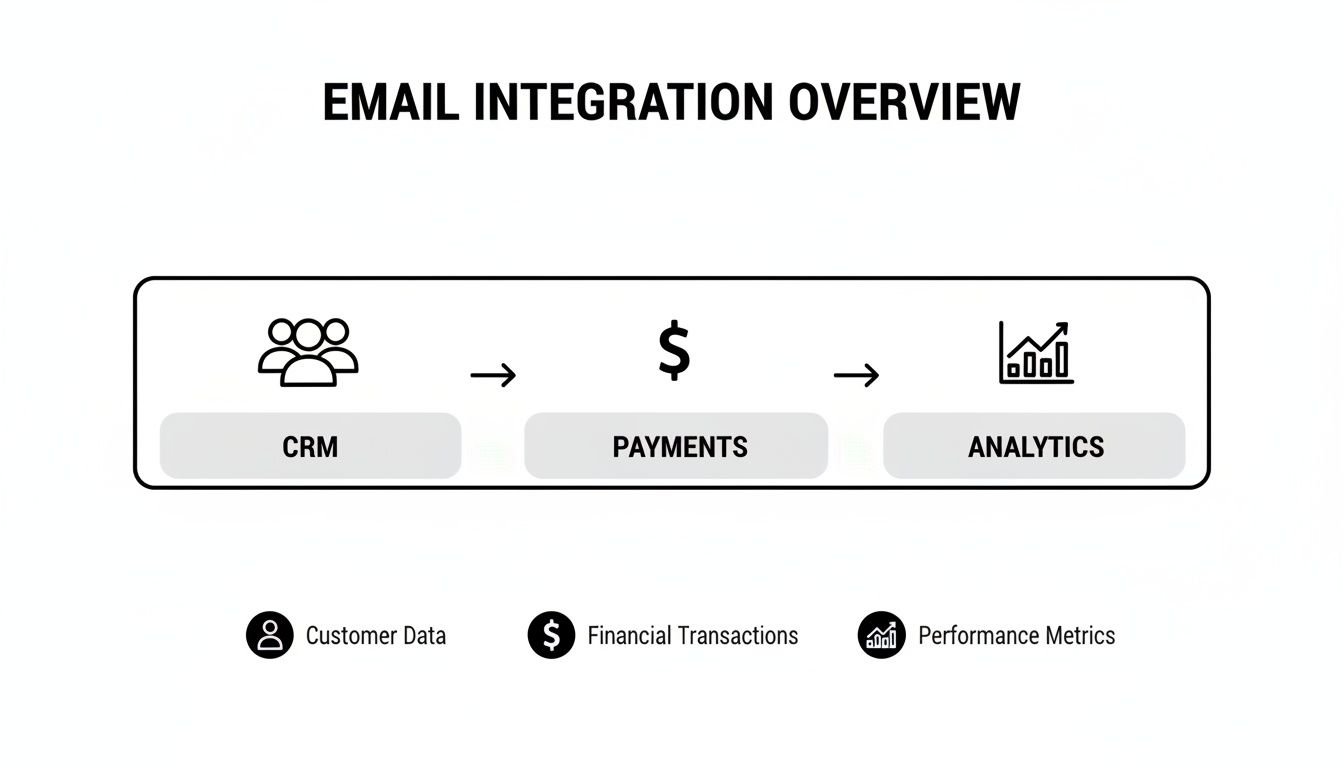
This flow is exactly why scalable pricing matters so much. As your customer data across all these systems expands, your email platform's cost should grow right alongside you—predictably and without punishing your success.
Cost Projection for a Growing SaaS Startup
Let's put some real numbers to this. The table below projects the estimated monthly costs for a SaaS startup as it hits key growth stages. These aren't based on the cheapest plans available; they reflect plans that include the essentials for a modern SaaS, like marketing automation and segmentation.
A quick look at these numbers shows how dramatically the costs can diverge as you add subscribers.
| Platform | Cost at 1,000 Subscribers | Cost at 10,000 Subscribers | Cost at 50,000 Subscribers | Key Pricing Notes |
|---|---|---|---|---|
| Mailchimp | ~$35/month | ~$135/month | ~$425/month | Counts unsubscribed contacts; essential automation requires the pricier Standard plan. |
| Brevo | $25/month | $65/month | $235/month | Amazing value. Costs are based more on email volume than just subscriber counts. |
| ActiveCampaign | $49/month | $149/month | $499+/month | Price ramps up quickly with more contacts. It's powerful but can get expensive fast. |
| Customer.io | ~$100/month | ~$275/month | ~$700+/month | A premium tool built specifically for complex event-based messaging common in SaaS. |
This table makes the scaling differences crystal clear. A platform like Brevo gives you a much gentler growth curve, whereas more advanced tools like ActiveCampaign and Customer.io require a much bigger budget commitment as you grow.
Your decision has to balance what you can afford today with the future cost of the features your SaaS will absolutely need to compete. For a broader look at what other tools cost, you can find a helpful breakdown of common SaaS pricing. Choosing wisely now saves you from a painful and expensive migration down the road.
So, Which Platform Is Right for Your Team?
Let's be real: there's no single "best" email marketing platform. The right tool for you depends entirely on your team's size, technical chops, and what you’re actually trying to accomplish. A platform that feels like a godsend for a solo founder will just get in the way of a fast-moving growth team.
This is why I always frame the decision around specific roles, or "personas." Forget the endless feature lists for a second. Let's connect these tools to the actual jobs you need to get done. Figuring out which platform fits your workflow is how you pick a partner for growth, not just another piece of software.
For the Indie Founder
When you're a solo founder or part of a tiny crew, you're always short on two things: time and money. You need a tool that’s cheap (or free) to start, a breeze to set up, and powerful enough to handle the basics without a lot of fuss. Your mission isn't to engineer a complex marketing machine; it's to automate your essential communications so you can get back to building your product.
Simplicity and efficiency are the name of the game here. You're looking for a platform that nails the fundamentals without a steep learning curve or a scary price tag.
- Top Recommendation: Brevo (formerly Sendinblue)
- Why it Fits: Brevo packs an unbelievable amount of value into its free and entry-level plans. You get marketing automation, a CRM, and even landing pages without paying a premium. Its free plan lets you send up to 9,000 emails a month to unlimited contacts, giving you a ton of runway before you ever have to pull out your credit card.
- Key Feature for Founders: The automation builder is surprisingly capable for the price. You can quickly set up crucial SaaS workflows, like welcome sequences and simple onboarding emails, without needing to write a single line of code.
The Indie Founder needs a "set it and forget it" tool for core email tasks. The goal is to automate the user journey from signup to first engagement, freeing up precious hours to focus on product development and customer feedback. Brevo nails this without the high costs.
For the Growth-Focused Marketing Team
Once you've hit product-market fit, the game completely changes. A growth-focused team needs a platform built for relentless experimentation, deep segmentation, and optimization. Your main job is to scale user acquisition and improve retention, which means you need a tool that can keep up with your testing velocity.
You’re well past simple welcome emails. Now, you need to be running sophisticated A/B tests, slicing and dicing your user base on in-app behavior, and digging into granular data to find what really moves the needle.
- Top Recommendation: ActiveCampaign
- Why it Fits: ActiveCampaign is built for marketers who live and breathe data. Its automation capabilities are truly best-in-class, allowing for complex "if/then" logic that can react to almost any user action. With deep segmentation and site tracking, you can create the kind of hyper-targeted campaigns that are essential for driving conversions at scale.
- Key Feature for Growth Teams: The split-testing functionality is what sets it apart. You can go far beyond just testing subject lines and actually test entire automation workflows against each other. This is how you find out which onboarding sequence is really more effective at converting trial users into paying customers.
For the Developer-Led Startup
For some startups, especially those with a deeply technical product, email isn't just marketing—it's an extension of the application itself. A developer-led team will always prioritize flexibility, reliability, and the power of a world-class API. A slick UI is a nice-to-have, but the ability to programmatically control every aspect of your email is what truly matters.
Your team needs to trigger highly personalized, event-based messages based on complex user actions inside your product. This demands a platform designed from the ground up for developers, with rock-solid documentation and the horsepower to handle high-volume transactional and behavioral emails.
- Top Recommendation: Customer.io
- Why it Fits: Customer.io was built for SaaS and mobile apps, period. It treats your product's event data as a first-class citizen, letting you trigger messages based on any custom event you can dream up and send its way. The API is robust, the Liquid templating is powerful, and the entire philosophy is geared toward programmatic control.
- Key Feature for Developers: Its superpower is the ability to use real-time event data from your app to trigger messages. This means you can send a perfectly timed email the instant a user completes a key action, creates their tenth project, or approaches a usage limit. It's how you create a truly seamless, product-led experience.
Making Your Final Decision
Alright, we've walked through a lot of features, pricing tiers, and nitty-gritty details. By now, you probably have a couple of platforms in mind that feel like a good fit. The final step is moving from "this looks good on paper" to making a confident commitment.
Remember, the goal isn't to find the one "perfect" tool. It's about finding the right partner for where your business is right now and where you plan to be in a year or two.
To boil it all down, here’s a quick recap of where each platform really stands out:
- Best for Automation: ActiveCampaign is the clear winner for teams that live and breathe complex workflows. If you need to test, branch, and optimize every single touchpoint, this is your powerhouse.
- Best for Scalability: Customer.io is built with developers in mind. Its powerful API and event-based triggers can handle incredibly sophisticated, high-volume messaging without breaking a sweat.
- Best Value for Startups: Brevo (formerly Sendinblue) packs a serious punch for its price. You get a solid feature set, including automation and a built-in CRM, at a cost that won't make an early-stage founder wince.
If you're still weighing your options, it never hurts to get a second opinion. You can cross-reference what we've covered here with a comprehensive review of the best email marketing software options to see how your top picks stack up elsewhere.
Your Pre-Commitment Checklist
Before you pull out the company credit card, you need to get your hands dirty. Every platform offers a free trial, and you should use it to its absolute limit. This isn't just about clicking around; it's about pressure-testing the features that will make or break your marketing efforts.
Your free trial isn’t just for exploring the user interface; it's a mission-critical opportunity to confirm that the platform's core functions—automation, segmentation, and integration—work exactly as you need them to. A tool that looks great in a demo can quickly become a bottleneck in practice.
Use your trial period to run through these essential tasks:
- Build a Core Automation: Try to build one of your most important workflows, like a trial onboarding sequence. How does the logic builder feel? Is it intuitive, or are you fighting with it?
- Test a Key Integration: Connect the platform to something vital in your tech stack, like Stripe or your CRM. See how cleanly the data syncs. Does it actually enable the kind of segmentation you need?
- Create a Dynamic Segment: Go beyond simple tags. Try building a segment based on real user behavior specific to your product—for example, "users who invited a teammate but haven't created a project."
- Contact Support: This one is huge. Ask a specific, semi-technical question. See how long it takes to get a response and, more importantly, if the answer is actually helpful. Good support is a lifeline you'll be glad to have later.
Ticking off these boxes takes your decision from a guess to a reality-tested choice. It's the best way to make sure the platform you pick is truly ready to help you grow.
A Few Final Questions
I get it—choosing the right email marketing platform can feel overwhelming. To wrap things up, let's tackle a few of the most common questions I hear from SaaS founders when they're in the trenches making this decision.
Seriously, How Big a Deal Is Deliverability?
It’s everything. Deliverability is the bedrock of your entire email marketing effort. Think of it as the percentage of emails that actually make it into a real person's main inbox, not their spam folder or some promotional tab they never check.
You can have the most beautifully designed emails and the cleverest automation sequences in the world, but if they aren't being delivered, they're completely useless. When you're vetting platforms, don't just glance at their marketing claims. Dig deeper. Look for ones that are transparent about their deliverability rates—you want to see numbers consistently above 98%. Crucially, make sure they support must-haves like SPF and DKIM authentication. These aren't optional anymore; they're essential for protecting your sender reputation and making sure your emails get seen.
Think of it this way: Deliverability is the foundation of your entire email strategy. If the foundation is weak, everything else you build on top of it—great content, smart automation—will eventually crumble. It's the one metric you cannot afford to compromise on.
Should I Just Get a Platform With a CRM Built-In?
For a brand-new startup, an all-in-one tool with a built-in CRM can feel like the easy button. It simplifies your tech stack and can save you a few bucks upfront. But be careful, because this approach often boxes you in as you start to grow.
A dedicated CRM will almost always outshine a bundled, lightweight version when it comes to managing sales pipelines and complex customer relationships. My advice? The best long-term play is to pick an email platform that offers a deep, reliable integration with a true CRM like HubSpot or Salesforce. You get the power of two specialized tools working together seamlessly, which is a far more scalable solution.
What's the Single Biggest Mistake Founders Make Here?
Hands down, the biggest mistake is picking a tool just because it's cheap. That low-cost plan looks tempting when you're bootstrapping, but it quickly becomes a massive headache when you realize it doesn't have the automation or segmentation features you desperately need six months down the road.
Switching email platforms is a painful, time-consuming, and surprisingly expensive process. Don't just solve for today's problems. Always evaluate a tool based on where you plan to be in two years. Choose the platform that can grow with you, not the one that just gets the job done for now.
Ready to launch your SaaS and get it in front of thousands of early adopters? SubmitMySaas is the discovery platform built for founders. Get featured and start growing your user base today!