Social Media Management Tools Comparison: Top Picks for SaaS Growth
Explore the social media management tools comparison to compare features, pricing, and suitability for your SaaS growth—find the best fit fast.

Picking the right social media management tool isn't just about scheduling a few posts—it's about finding a partner that will help you grow. The right platform can take the chaotic, time-sucking mess of social media and turn it into a predictable system for winning new users, building a real community, and actually seeing business results.
Why the Right Social Media Tool Is a Growth Multiplier
For SaaS founders and indie makers, social media isn't just another marketing channel. It's often the channel. It's where you build your authority, get raw feedback from your first users, and create the kind of loyalty that keeps you in business. But trying to manage it all manually is a recipe for burnout, pulling you away from what you should be doing: building your product.
This is exactly where a good management tool steps in. It takes all those repetitive, manual tasks and puts them on autopilot, letting you think strategically. Instead of frantically logging in and out of different accounts, you can map out a content calendar that actually supports your product launches, feature updates, and community conversations.
From Time-Sink to Strategic Asset
The real magic of these tools isn't just saving time; it's the data they give back. You can finally move past vanity metrics like "likes" and see what content actually makes people tick. This lets you sharpen your message and focus on what drives sign-ups, not just engagement.
Here’s how they give you a strategic edge:
- Systemized Content Delivery: You can batch-create and schedule weeks of content at once, so your social presence stays active even when you're deep in code.
- Unified Audience Engagement: All your comments, DMs, and mentions from every platform funnel into one inbox. Nothing gets missed, and you can respond way faster.
- Data-Driven Decisions: Get a single view of your analytics to see which channels and which types of posts are actually worth your time and effort.
The right social media tool doesn’t just save you time—it multiplies your effort. It turns scattered actions into a focused strategy, ensuring every post and interaction contributes directly to your growth goals.
Market Growth and Opportunity
It's no secret that these tools are becoming essential. The global market for social media management platforms is sitting at around $15 billion right now, and it’s on track to double to $30 billion by 2028. That explosive growth tells you just how vital these systems have become for any business trying to be heard online.
For founders launching a new product on a site like SubmitMySaas, using a tool with smart, AI-driven features can make all the difference in getting that crucial early traction. You can dig deeper into the numbers in this social media tools market report.
The sheer scale of the audience you're trying to reach is staggering, as the data below shows.

With billions of people active on platforms like Facebook and YouTube, trying to manage your brand's presence by hand is simply not a sustainable strategy for anyone serious about growth.
Our Evaluation Framework: How We Actually Tested These Tools
Let's be honest: another generic pros-and-cons list for social media tools isn't going to help you. That’s why we built our own evaluation framework from the ground up, specifically for SaaS founders and lean startup teams. We wanted a transparent, no-fluff way to show you which tool will actually help you grow.
Our methodology wasn't about ticking off feature boxes. We focused on how well each platform handles the real-world tasks that move the needle for a new SaaS business. We’re talking about efficiency, the ability to scale without breaking the bank, and a clear return on your investment.
The Five Pillars of Our Scoring
Everything in this comparison is built on five core pillars. We’ve weighted each one based on what truly matters when you’re trying to build a business, not just manage a social calendar.
Here's the breakdown of what we looked for:
- Core Functionality (35%): This is the non-negotiable stuff. We put every tool through its paces on post scheduling, managing a unified inbox for comments and DMs, and pulling basic analytics. If a tool fumbled here, it didn't stand a chance.
- Advanced Capabilities (20%): This is where we separated the good from the great. We dug into the AI content creation tools, tested the depth of the social listening features, and ran competitor analysis to see who delivered genuinely useful insights.
- Scalability and Integrations (20%): The right tool has to grow with you. We looked at how smoothly each platform handles adding more team members and social profiles, and how well it plays with the other marketing software you already use.
- User Experience for Lean Teams (15%): Founders don't have time to fight with clunky software. We scored each tool on how quick it was to set up and how intuitive the day-to-day workflow felt for a small, fast-moving team.
- True Cost and Value (10%): We looked past the sticker price. This score reflects the hidden costs, those annoying per-user fees, and the real-world return on investment a startup can expect from each plan.
By sticking to this framework, we get past the surface-level marketing claims. It allows us to show you not just what tool is "best," but what tool is the right fit for you—whether you're a solo founder bootstrapping your way to launch or a small team ready to scale.
A Head-To-Head Social Media Tools Comparison
Diving into a direct comparison of social media management tools means looking past the flashy feature lists and getting real about how they work day-to-day. We’re putting four of the heavy hitters—Buffer, Hootsuite, Sprout Social, and Agorapulse—under the microscope. I’ve tested each one against a practical evaluation framework to see how they truly stack up for different startup needs, from a solo founder hustling to get the word out to a full-fledged team scaling up.
The goal here isn't to crown one "winner." Instead, my aim is to break down the critical trade-offs you'll face in functionality, user experience, and cost. This way, you can confidently pick the platform that actually fits your growth stage and how you like to work.
To kick things off, this chart gives you a visual of our five-pillar evaluation framework. It shows the key areas I scored for each tool, giving you a sense of what I prioritized in this analysis.
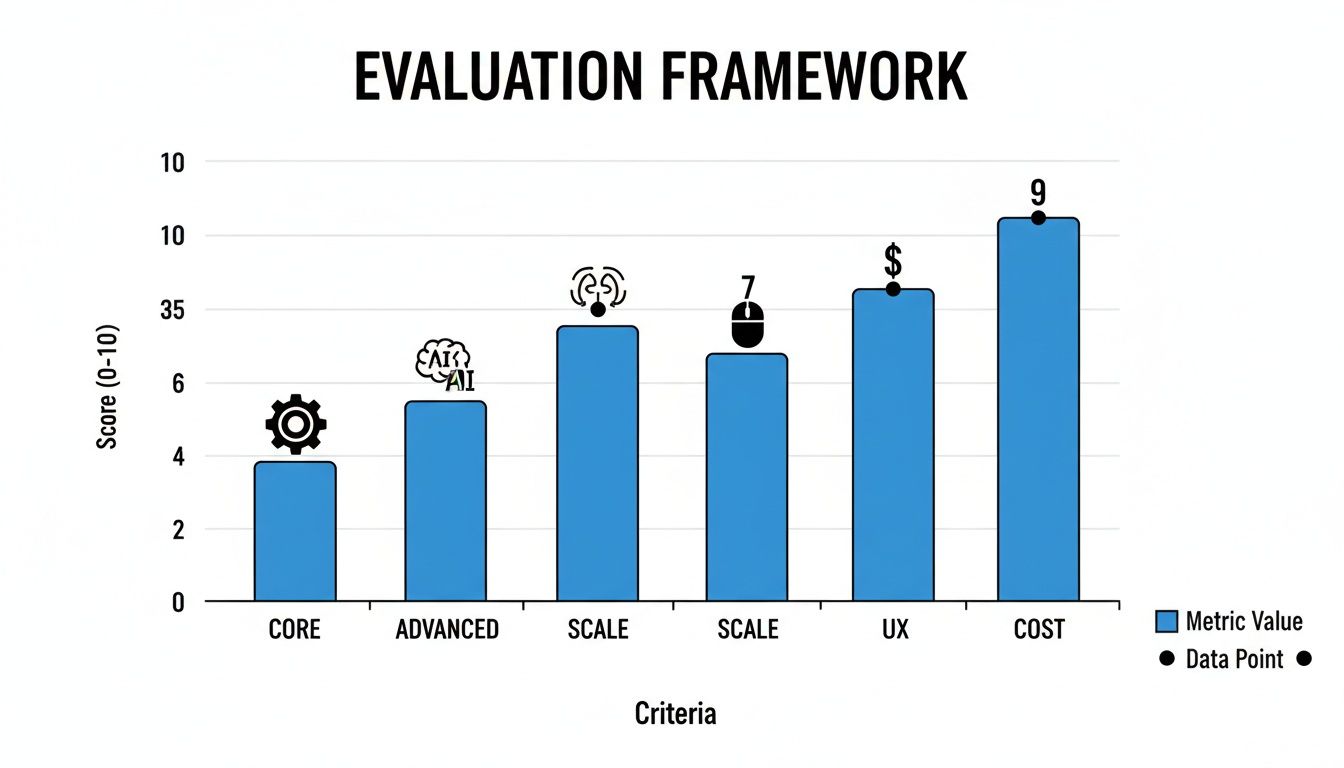
Using this framework helps me offer a balanced view, weighing core features just as heavily as the often-overlooked factors like how a tool feels to use every day and whether the price tag makes sense.
Buffer: The Champion Of Simplicity And Focus
Buffer built its name on a clean, ridiculously intuitive interface that just gets out of your way. For a solo founder or a tiny team just finding its footing, this is its superpower. It absolutely nails its core job: publishing and scheduling content without drowning you in a dozen features you don't need yet.
The whole platform is built around a simple content queue. You load it up with posts, and Buffer sends them out based on your pre-set schedule. This "set it and forget it" vibe is a lifesaver for maintaining a consistent presence when you’re being pulled in a million directions.
For instance, a founder launching their new SaaS on a platform like SubmitMySaas can map out a week’s worth of announcements and feature spotlights in less than an hour. That frees them up to focus on what really matters—user feedback and engagement.
But that beautiful simplicity is also its limitation. While Buffer gives you the basic analytics and engagement tools you need to get by, it's missing the deep social listening and advanced reporting you’ll find in more enterprise-grade platforms. It’s a specialist, not a generalist.
Hootsuite: The All-In-One Powerhouse
Hootsuite is one of the OGs in this space, and it shows. The sheer breadth of its features is massive. It was built for teams that need to keep an eye on multiple social streams, run complex campaigns, and pull detailed performance reports. Its dashboard is centered around "Streams," which are basically customizable columns that can track anything from brand mentions and keywords to specific hashtags.
This makes it an absolute beast for social listening. A marketing manager can set up streams to watch what competitors are doing, gauge brand sentiment across the web, and spot potential customer service fires in real-time. For a SaaS company trying to grow, that kind of insight is pure gold.
Hootsuite's real edge is its 360-degree view of the social landscape. While other tools are more focused on what you’re putting out, Hootsuite excels at looking outward, giving you the power to monitor conversations and trends across the entire ecosystem.
The trade-off? Complexity and cost. The interface can feel a bit dated and cluttered, and it definitely has a steeper learning curve than Buffer. On top of that, the pricing can climb quickly for smaller teams, making it a better fit for businesses ready to make a serious investment in their social media operations.
Sprout Social: The Premium Choice For Team Collaboration
Sprout Social markets itself as a premium solution, and honestly, its powerful features for team collaboration and customer relationship management (CRM) back that up. It beautifully blends scheduling, monitoring, and analytics with tools designed specifically for teams that need to work in lockstep.
Its killer feature is the Smart Inbox, which pulls all your incoming messages from every platform into a single, unified stream. From there, team members can assign tasks, leave internal notes, and see a full conversation history. It effectively turns your social media channels into a well-oiled customer support and engagement machine.
Imagine a support team at a growing startup. A customer tweets a technical question. The social media manager sees it in the Smart Inbox and immediately assigns it to a product specialist. That specialist can then reply directly from Sprout Social with the right answer, and the whole exchange is logged for anyone else to see later.
- Task Assignment: Easily route messages to the right person or department.
- Collision Detection: Prevents two people from awkwardly replying to the same message.
- Approval Workflows: A must-have for ensuring content is on-brand before it goes live.
While incredibly powerful, Sprout Social is one of the priciest options out there. Its per-user pricing model makes it a serious investment, best suited for established teams where seamless collaboration isn't just a nice-to-have, it's a top priority. Of course, new tools are always popping up to fill this gap. You can often find more affordable alternatives with strong features, like exploring AI-powered social media managers like HypeSuite AI, on platforms that showcase new SaaS launches.
Agorapulse: The Balanced Contender For Engagement
Agorapulse strikes a fantastic balance between the stripped-down simplicity of Buffer and the all-out power of Sprout Social. It has a solid suite of features for scheduling, monitoring, and reporting, but its real talent lies in inbox management and driving user engagement.
The platform is smart enough to automatically categorize your inbox items—comments, mentions, DMs—so you can triage the most important conversations first. It also bakes in helpful CRM-like features, letting you see your entire interaction history with a specific user and add internal notes. That context is invaluable for building real relationships with your community.
This focus on efficiency makes it a great choice for brands that get a lot of engagement. A community manager can set up inbox rules in Agorapulse to automatically hide spam or assign certain types of questions to specific team members, which can drastically reduce manual moderation time. For a closer look at the nuts and bolts of what different platforms offer, it's worth checking out guides to the best social media scheduling tools.
Managing this engagement is more critical than ever. With projections showing social media users hitting 5.42 billion by 2025 and platforms like Facebook serving over 3 billion monthly active users, the scale is staggering. It’s why 86% of marketers say these tools have boosted their brand’s exposure. This trend is fueling a market expected to surge from $185.26 billion in 2024 to $341.7 billion by 2029—a wave that smart SaaS founders can ride to amplify their own launches.
Core Feature Comparison of Leading Social Media Tools
To give you a quick, at-a-glance view, this table breaks down how our top contenders handle the essential features. It's a simple way to see which platforms meet your baseline needs before you dive deeper.
| Feature | Buffer | Hootsuite | Sprout Social | Agorapulse |
|---|---|---|---|---|
| Content Scheduling | Excellent (Queue & Calendar) | Excellent (Bulk & Auto-scheduling) | Excellent (Optimal Send Times & AI) | Excellent (Queue & Calendar) |
| Social Inbox | Basic (Comments & Mentions) | Good (Streams for multiple sources) | Excellent (Unified Smart Inbox & CRM) | Excellent (Automated Moderation) |
| Analytics & Reporting | Good (Core metrics, basic reports) | Excellent (Customizable & deep data) | Excellent (Presentation-ready reports) | Very Good (Competitor analysis) |
| Team Collaboration | Basic (Limited to higher tiers) | Good (Assignments & Team metrics) | Excellent (Workflows & Collision alerts) | Very Good (Roles & Assignments) |
| Social Listening | None | Excellent (Real-time keyword streams) | Very Good (Keyword & Trend monitoring) | Good (Brand & Keyword monitoring) |
| Supported Networks | All major platforms | Extensive (20+ integrations) | All major platforms | All major platforms |
As you can see, while all four tools cover the basics, their strengths really start to show when you look at more advanced functions like social listening and team collaboration.
Making The Final Call
So, which tool is right for you? It really comes down to your immediate priorities, your team's size, and your budget.
| Tool | Best For | Key Strength | Price Point |
|---|---|---|---|
| Buffer | Solo Founders & Early-Stage Startups | Simplicity & Intuitive Publishing | Low |
| Hootsuite | Scaling Teams & Agencies | Comprehensive Social Listening & Monitoring | Mid-High |
| Sprout Social | Established Businesses with Support Teams | Advanced Team Collaboration & CRM Features | High |
| Agorapulse | Community-Focused Brands | Efficient Inbox Management & Engagement | Mid-Range |
At the end of the day, there’s no single "best" platform. Buffer is an amazing, accessible entry point. Hootsuite delivers unmatched monitoring capabilities. Sprout Social provides an elite-level collaboration suite. And Agorapulse hits the sweet spot for teams that live and breathe engagement. By understanding these core differences, you can pick the tool that won’t just manage your social media—it will actively help you grow.
Finding the Right Tool for Your Startup's Stage
Trying to crown one social media tool as the "best" is a fool's errand. The perfect platform for a scaling marketing team is overkill—and wildly overpriced—for a solo founder. It really boils down to where you are right now, what you can spend, and what you’re trying to achieve.
So, let's move beyond the feature-for-feature spec sheets and get into practical, real-world recommendations. By looking at the unique headaches of different startup roles, we can match you with the tool that strikes the right balance of simplicity, power, and price.
For The Solo Founder Juggling Everything
You're the CEO, developer, marketer, and customer support all rolled into one. Time is your most precious resource, and complexity is your biggest enemy. You need a tool that just works, automates the basics, and doesn't demand a week-long training course to figure out.
Your core needs are straightforward:
- Painless Scheduling: A true "set it and forget it" system to keep your social feeds alive while you're busy building.
- No-Nonsense Interface: You need to be up and running in minutes, not hours.
- Serious Affordability: Every dollar is scrutinized. The tool has to deliver obvious value without a painful monthly bill.
For this job, Buffer is the clear winner. Its clean, queue-based scheduling is the gold standard for a reason—it’s just dead simple. You can load up your content pipeline for the week in under an hour and trust that it will go out, freeing you up to focus on the things that actually move the needle, like product development and talking to users.
For The Bootstrapped Startup Needing An Edge
Your team is small, the budget is tight, but the ambition is massive. You've graduated from just scheduling posts and now need a platform that helps you genuinely engage with your community and see what's resonating—without draining your bank account.
The focus here shifts to efficiency and real engagement:
- A Unified Inbox: Juggling DMs, comments, and mentions across five different apps is quickly becoming a time-suck. You need it all in one place.
- Analytics That Matter: Vanity metrics are nice, but you need to know which content is actually driving traffic and sign-ups.
- A Balanced Price Tag: The cost has to be justifiable with a clear return.
Both Agorapulse and Metricool are fantastic fits here. Agorapulse really shines with its powerful, automated social inbox that makes community management feel effortless. On the other hand, Metricool hits an incredible sweet spot with a great mix of scheduling, solid analytics, and inbox features at a price that’s tough to beat. It's an amazing choice for teams watching every penny.
The right tool at this stage transforms social media from a broadcasting channel into a conversation hub. It’s less about just pushing content out and more about efficiently pulling community feedback in.
For The Scaling Marketing Team Driving Growth
Okay, now you have dedicated roles, a real marketing strategy, and a mandate to show measurable results. Your needs have evolved. You're past simple management and into sophisticated collaboration, reporting, and brand monitoring. Your tool must support a structured workflow and deliver deep, report-ready insights.
Your priorities are now collaboration and hard data:
- Advanced Team Workflows: You need approval chains for content, task assignments, and a way to see who's replying to what so two people don't answer the same message.
- In-Depth Reporting: Stakeholders want to see the ROI. That means customizable reports connecting social media activity directly to business goals.
- Social Listening: It's time to monitor what people are saying about your brand, keep tabs on competitors, and spot industry trends as they happen.
For a team at this level, Sprout Social is the premium, best-in-class option. Its Smart Inbox and collaboration tools are unmatched, turning your social channels into a well-oiled customer engagement machine. If social listening is a higher priority and your budget has some flex, Hootsuite still offers some of the most powerful monitoring capabilities on the market.
These platforms provide the structure and data you absolutely need to scale your efforts effectively. It’s a crucial step in the growth journey, which you can read more about in our guide on how to launch a SaaS product successfully.
Implementing Your Tool for Maximum ROI
Picking the right platform in a sea of social media management tools is just the beginning. The real magic happens when you properly weave that tool into your day-to-day marketing, turning a monthly subscription into a real engine for growth. Without a solid plan, even the most powerful software is just an expensive, glorified calendar.
A structured onboarding process is your best friend here. It’s all about standardizing how you work, killing off those repetitive manual tasks, and getting your team comfortable with the new system. The sooner you do that, the sooner you can get back to focusing on strategy instead of fumbling with settings.

Your Essential Onboarding Checklist
To get off to a running start, you need a simple but effective setup process. This isn't about learning every single bell and whistle on day one. It's about getting the essentials right to avoid major headaches down the road.
- Securely Connect All Social Accounts: First things first, get all your brand’s social profiles hooked up. Take a minute to double-check that you’ve granted the right permissions for everything you need, like direct publishing and inbox access.
- Configure Your Publishing Calendar: Next, lay out your master content calendar. A lot of tools will even suggest the best times to post based on when your audience is most active. Take that advice—it's low-hanging fruit.
- Establish Team Roles and Permissions: If you're working with a team, this step is non-negotiable. Define who does what right away. Set up clear permissions for who can create drafts, who has final approval, and who handles customer messages.
- Set Up Your Social Inbox Filters: Don't let your unified inbox become a chaotic mess. Set up some simple rules or filters from the get-go. For instance, you could automatically tag any message with words like "help" or "broken" and route it straight to your support team.
The most successful teams I've seen focus on automating one key workflow at a time. Instead of trying to master every feature at once, nail your content approval process first. Then, move on to building out your analytics dashboard.
From Setup to Strategic Impact
With the technical nuts and bolts in place, it’s time to shift your focus to getting that return. This is where you start folding the tool’s more advanced features into your actual strategy. A great example is keeping an eye on emerging platforms like the social scheduling tool Grapevine Social, which is built specifically to make content workflows simpler for smaller, leaner teams.
If you really want to squeeze every drop of value out of your investment, dig into advanced automation features. For example, leveraging Instagram comment automation can be a game-changer for saving time and even capturing new leads. Features like this are what elevate your tool from a passive scheduler to an active part of your customer service and sales machine.
The final piece of the puzzle is analytics. Build a custom dashboard that tracks the KPIs that actually matter to your business—think click-through rates on website links or conversions from your social campaigns. Make a habit of reviewing these reports. They’ll tell you exactly what’s working and what isn’t, helping you constantly refine your strategy and prove the tool’s value to anyone who asks.
Burning Questions, Answered
Even after laying out all the details, a few big questions usually pop up. It’s one thing to compare features, but it’s another to make that final call. Let’s tackle the common questions we hear from founders and marketers to help you feel confident in your choice.
Think of this as the final checklist before you commit. Getting these answers straight ensures you’re not just picking a tool, but setting your strategy up for success from day one.
Should I Start with a Free Tool or Jump into a Paid Plan?
This is the classic "bootstrap vs. invest" debate, and there’s no single right answer. If you're a founder just getting started, a free plan from a tool like Metricool or Buffer is a fantastic way to build a posting habit without spending a dime. It gets you in the rhythm of scheduling content and peeking at basic analytics.
But let's be real—the moment you need to bring on a teammate or get data that actually informs your strategy, you’ve hit the limits of "free." Paid plans are where the real time-saving and value happens. They unlock critical features like:
- Unified Inboxes: Juggling DMs and comments across platforms is a nightmare. A single inbox solves that instantly.
- Approval Workflows: This is non-negotiable for teams. It's the safety net that prevents off-brand or typo-filled posts from going live.
- Analytics That Matter: Moving past vanity metrics like likes and followers to see what content actually drives clicks and leads.
Our Takeaway: Start free to get your feet wet and build consistency. But have your credit card ready for an upgrade the second social media becomes a conversation, not just a broadcast, or when you need hard numbers to prove it's working.
How Do I Actually Measure ROI from My Social Media Tool?
Calculating the return on investment (ROI) from your social media efforts means you have to stop counting likes and shares. While those numbers are nice for the ego, they don't keep the lights on. To get to true ROI, you have to connect your social activity to real business results.
First, define your "win." Is it a newsletter sign-up? A demo request? A free trial start? Once you know what you’re aiming for, you can use your tool's reporting to track it. The best platforms plug right into Google Analytics, letting you draw a straight line from a specific tweet to a new customer.
For instance, a tool like Agorapulse has a specific ROI report that lets you assign a dollar value to actions. You can track clicks from a campaign promoting a new feature, see how many of those turned into trial sign-ups, and put a real number on your work. The formula is refreshingly simple: (Revenue Gained - Tool Cost) / Tool Cost.
Which Tools Have the Most Useful AI Features?
AI isn't just a buzzword anymore; it's a legitimate co-pilot for creating content faster. When you’re looking at AI features, ignore the hype and focus on what actually saves you time. The best AI assistants don't just write generic captions—they solve specific, painful problems.
Here’s what a truly great AI feature set looks like in practice:
- Smart Repurposing: The ability to feed it a single blog post and have it spit out a dozen tweets, a LinkedIn thought-leader post, and an Instagram carousel script.
- Tone & Style Adaptation: AI that understands you talk differently on LinkedIn than on TikTok and can rewrite content to fit the vibe of each platform.
- Predictive Scheduling: AI that goes beyond "post at 2 PM on Tuesday" by analyzing your own data to pinpoint the exact times your audience is most likely to engage.
Platforms like SocialBee and Sprout Social are really pushing the envelope here. Their AI feels less like a robot and more like a junior strategist, helping you build out a month of diverse, platform-specific content in a fraction of the time. For a small team, that's a massive advantage.
Ready to get your SaaS project the attention it deserves? SubmitMySaas is the launchpad for founders looking to reach thousands of early adopters, tech enthusiasts, and investors. Submit your product today and amplify your launch with valuable exposure and powerful backlinks. Discover more at SubmitMySaas.com.