What Is SaaS Marketing: A Founder's Guide
Discover what is SaaS marketing and how it drives recurring revenue. Learn key metrics, acquisition channels, and retention strategies for modern SaaS growth.
Most advice about SaaS marketing starts in the wrong place. It tells founders to publish blog posts, buy clicks, optimize a landing page, and wait for signups. That playbook treats software like a one-time purchase, even though subscription businesses must keep proving value after the account is created.
So, what is SaaS marketing in practice? It's the discipline of attracting, converting, onboarding, retaining, and expanding customers for software sold through recurring subscriptions. The work spans acquisition, product education, customer success, pricing, distribution, and measurement. Traffic matters, but recurring revenue depends on what happens after the click.
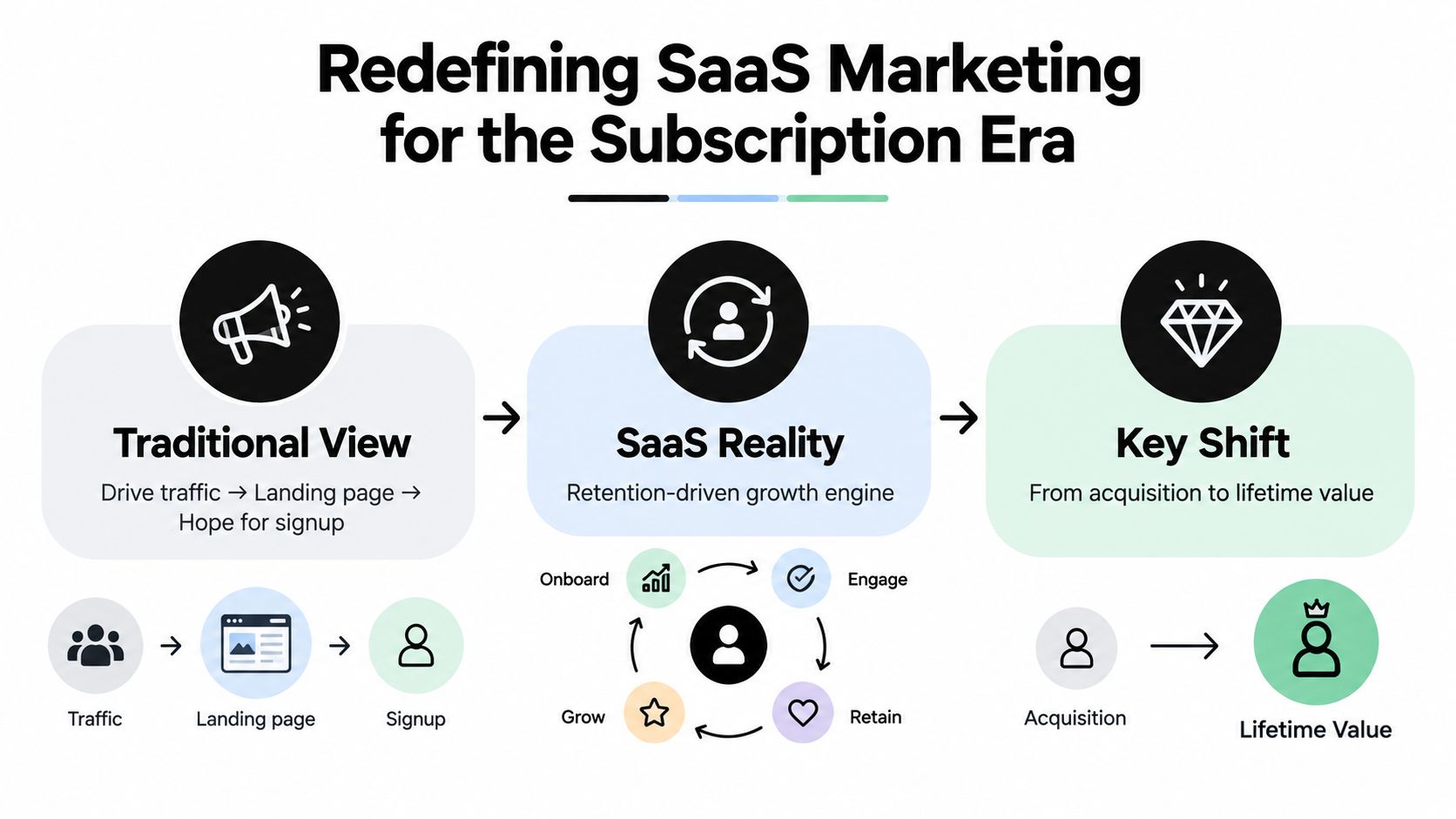
Redefining SaaS Marketing for the Subscription Era
The “drive traffic, collect signups, and move on” model breaks down because a signup isn't the outcome. It's an invitation to demonstrate value.
SaaS marketing grew out of the application service provider model in the late 1990s, followed by the modern model popularized by Salesforce, founded in 1999. The major change was practical and economic. Instead of installing software on a customer's own servers, companies delivered centrally hosted, multi-tenant applications through the internet. Customers could access the product continuously, while vendors depended on continuing subscription payments.
That model changed the marketer's responsibility. A campaign can attract a prospect, but the product experience must help that prospect activate, adopt, renew, and potentially expand. Marketing therefore connects acquisition metrics such as traffic, qualified leads, conversion rate, and customer-acquisition cost with lifecycle measures including activation, churn, expansion, and lifetime value. This lifecycle definition is consistent with the broader explanation of SaaS marketing strategy, which treats the discipline as an end-to-end system rather than a signup campaign.
The subscription loop
A useful operating model has three connected movements:
- Acquisition: Reach a defined customer profile through search, partnerships, communities, outbound activity, launches, or paid media.
- Activation: Help new users reach the product's first meaningful value quickly, with clear setup, useful defaults, and relevant education.
- Retention and expansion: Keep customers successful, identify new use cases, and turn sustained value into renewals, upgrades, referrals, or wider adoption.
Retention deserves more attention than it usually receives. Industry benchmark summaries report that a 5% improvement in customer retention can increase profits by 25% to 95%, a finding associated with Bain & Company and research published by Harvard Business Review, as documented in this customer retention statistics reference. The exact effect will vary by business, but the strategic point is durable: a customer who stays creates more opportunity than a customer who only clicks.
Practical rule: Treat every acquisition campaign as the beginning of a value-delivery sequence, not the finish line.
Founders should also connect marketing to the product's actual buying experience. A fast, credible SaaS site can make positioning easier to understand, reduce friction around evaluation, and provide a stable home for product proof. Teams assessing implementation options can review how Operosus builds SaaS sites when deciding how the site should support discovery and conversion. For the wider commercial sequence, the SaaS go-to-market strategy guide can help align audience, channels, launch activity, and lifecycle goals.
The Unit Economics Driving SaaS Growth
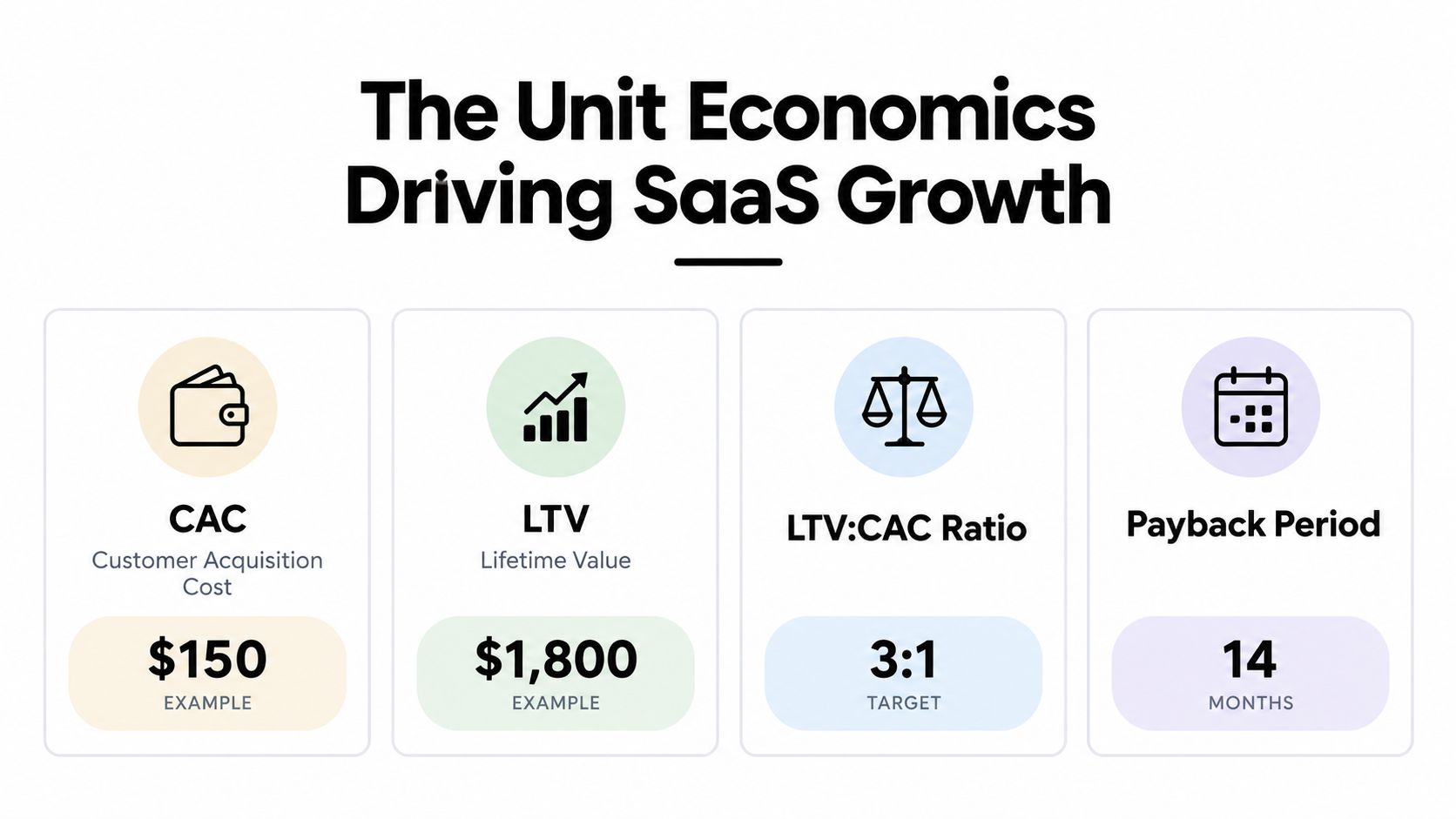
SaaS marketing becomes expensive when teams optimize for attention without understanding what a customer is worth. The essential question isn't “How many visitors did this campaign generate?” It's “Can this channel acquire customers whose expected value supports the cost of winning and onboarding them?”
The basic vocabulary is familiar:
- Customer acquisition cost, or CAC: The sales and marketing cost required to acquire a customer.
- Monthly recurring revenue, or MRR: Predictable subscription revenue expected each month.
- Lifetime value, or LTV: The value a customer is expected to generate during the relationship.
- Churn: The rate at which customers or revenue leave.
- CAC payback: The time required for gross contribution from a customer to recover acquisition cost.
A recent benchmark summary citing Benchmarkit's 2025 SaaS Performance Metrics report states that the median B2B SaaS company spent $2.00 in sales and marketing for every $1.00 of new-customer annual recurring revenue in 2024, with the ratio increasing 14% year over year. The same summary reports blended average B2B SaaS CAC of $239 per customer, with organic acquisition averaging $205 and paid acquisition averaging $341, as detailed in this SaaS marketing statistics summary.
What the benchmark changes
These figures don't mean every SaaS company should copy a benchmark. Pricing, sales complexity, contract size, market maturity, and customer segment all change the economics. They do show why paid acquisition alone can create a fragile growth engine. If every additional customer requires proportionally more ad spend, the company may increase revenue while leaving less room for product development, onboarding, and support.
Organic discovery, useful content, partnerships, communities, and product-led experiences can improve the cost structure over time. They don't eliminate labor or require no investment. They can, however, create assets that continue helping prospects discover and evaluate the product after the original work is complete.
A practical review should connect channel data to customer quality:
| Question | What to inspect |
|---|---|
| Can the channel create demand? | Qualified visits, referrals, branded searches, and product interest |
| Can it convert demand? | Trial, demo, activation, and paid conversion behavior |
| Can customers succeed? | Onboarding completion, product usage, support needs, and churn signals |
| Can the channel compound? | Reusable content, backlinks, referrals, community mentions, and product proof |
Don't judge a launch platform, article, or community contribution solely by immediate last-click conversions. Its contribution may appear later as a branded search, direct visit, referral mention, or more informed sales conversation. For a deeper treatment of the value side of the equation, use this guide to SaaS lifetime value.
Budget discipline: A channel that produces fewer leads but better activation can be healthier than one that fills the CRM with cheap, unqualified demand.
Mapping the Modern SaaS Acquisition Funnel
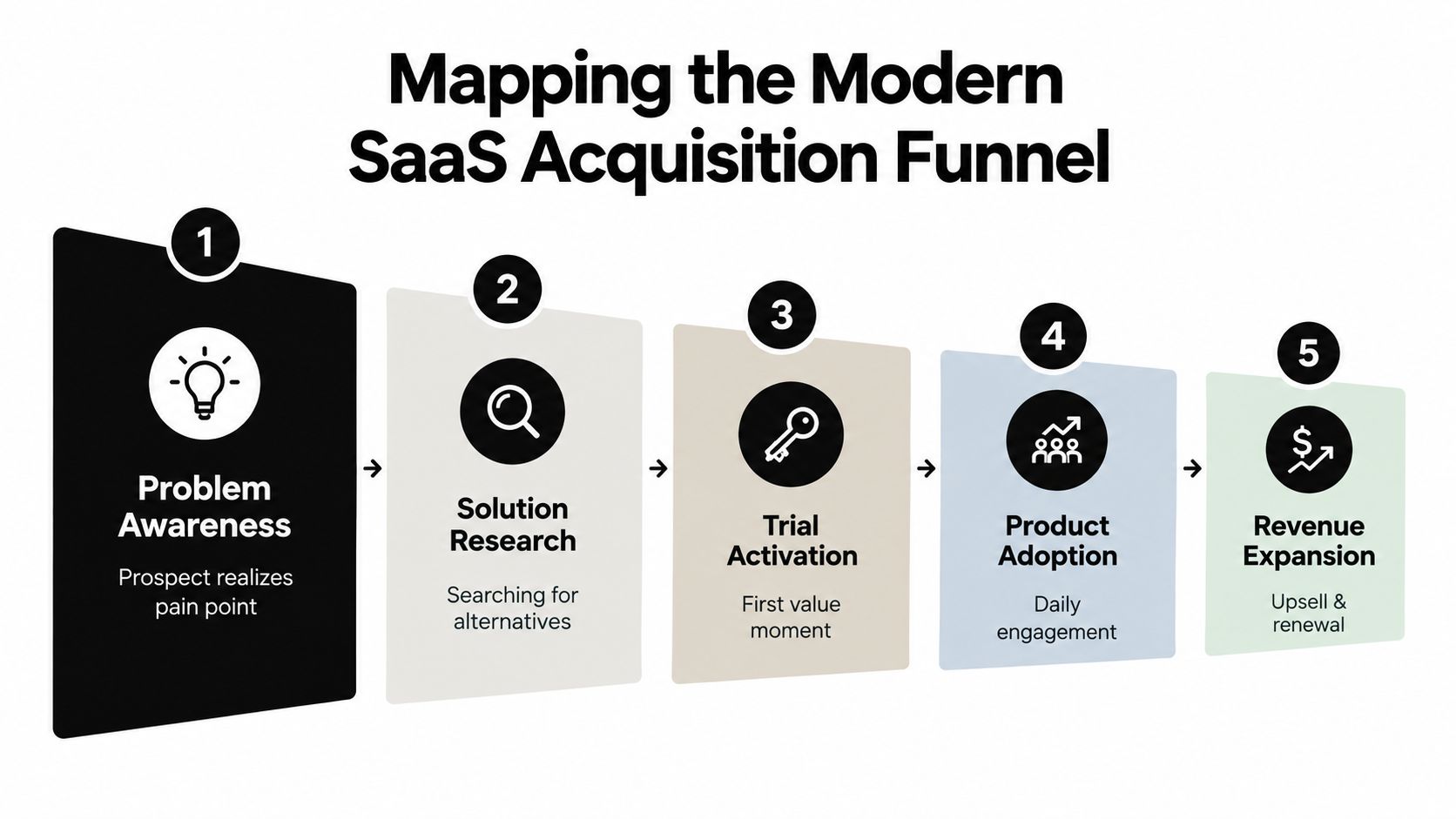
The modern funnel isn't a straight line from advertisement to checkout. A prospect may discover a problem in a community, compare products through an AI tool, watch a demonstration, ask peers for feedback, and only then arrive at a product page. Your funnel should reflect that behavior without becoming impossible to operate.
Five stages worth designing
1. Problem awareness begins when a buyer recognizes friction, risk, cost, or an unmet need. Educational content works here, but only when it describes the customer's situation accurately. A page about “project management software” is weaker than a page that explains how a specific team can prevent missed handoffs between product and engineering.
2. Solution research starts when the buyer searches for approaches and vendors. Comparison pages, integrations, product documentation, security information, customer evidence, and transparent pricing reduce uncertainty. Buyers don't need more feature adjectives. They need to understand fit.
3. Trial activation is the first value moment. A signup isn't activation. Activation means the user has completed the action that demonstrates why the product matters, such as importing data, sending a campaign, creating a report, or inviting a teammate.
4. Product adoption follows when the useful action becomes part of the customer's operating routine. In-app guidance, lifecycle email, templates, and contextual prompts should help users overcome specific obstacles rather than interrupting them with generic promotion.
5. Revenue expansion comes from deeper adoption, additional seats, higher plans, complementary capabilities, or renewal. Expansion works best when it follows a demonstrated customer need, not an arbitrary sales quota.
Product-led growth makes the product itself part of acquisition and onboarding. That doesn't mean every SaaS business needs a freemium model. A complex enterprise product may need sales assistance, implementation support, or a guided proof of concept. The choice depends on how quickly prospects can experience value and how much risk they associate with adoption.
For teams that use human-assisted qualification, Appointment Setters can be relevant when the product requires conversations before a qualified opportunity reaches sales. The important distinction is between adding useful guidance and adding another layer of friction.
A signup flow should answer three questions immediately:
- What happens next? Show the first action clearly.
- Why should I complete it? Connect setup to a concrete customer outcome.
- How do I recover? Offer help when data, permissions, integrations, or decisions block progress.
The SaaS marketing funnel guide can support the broader mapping exercise, but the operating test is simple: measure the distance between account creation and first meaningful value.
Navigating Dark Social and Rep-Free Buying Journeys
Your analytics dashboard probably underreports the channels that shape demand. Buyers increasingly research across AI tools, peer communities, review sites, newsletters, LinkedIn discussions, Slack groups, and private conversations before they identify themselves. A direct visit may be the final visible step in a decision that began somewhere your analytics can't observe.

Recent industry reporting cites an average of ten interaction channels in the buying journey and reports that 61% of B2B buyers prefer an overall rep-free experience, as summarized in the supplied B2B SaaS marketing research. Other 2025 coverage cited in the same brief estimates that more than half of buyers research anonymously. These findings don't make sales irrelevant. They make self-serve proof, discoverability, and trusted third-party discussion more important.
Build an influence record, not a perfect attribution model
Last-click attribution is useful for reporting a conversion event. It isn't sufficient for explaining why a buyer trusted your company. A founder should combine measurable signals with structured qualitative evidence:
- Ask every new customer how they first heard about the product. Keep the answer open-ended so buyers can mention a community, person, newsletter, AI tool, or review site.
- Record unprompted brand mentions. Capture screenshots, URLs, community names, and recurring objections when customers or prospects refer to the product elsewhere.
- Watch branded demand. Branded searches, direct traffic, referral visits, and product signups can rise after a distribution effort even when the original source is absent from analytics.
- Tag sales evidence. Add fields for competitor mentions, content references, peer recommendations, and research locations in the CRM.
- Compare patterns over time. Don't claim that a channel caused revenue from one anecdote. Look for repeated associations between distribution, informed conversations, qualified signups, and retention.
The absence of a referral code doesn't mean the absence of influence.
This approach changes content strategy. Instead of producing more articles just because publishing is easy, teams can create proof that travels well. A clear comparison page, a strong integration guide, a useful benchmark explanation, or a launch listing can be shared in places your analytics cannot reliably track. The content distribution channels guide offers a useful way to think beyond publishing as the final step.
The video below adds context for how modern buyers encounter products outside a company's owned website.
The practical goal isn't to assign every sale to one source. It's to identify which forms of visibility repeatedly create better-informed prospects, stronger activation, and healthier customer relationships.
Retention and Expansion as Core Marketing Functions
Acquisition gets attention because it's easy to visualize. Retention deserves authority because it determines whether growth stays in the business.
A customer who never reaches value becomes a support burden and a churn risk. Marketing can reduce that risk before the customer contacts support by setting accurate expectations, explaining the first workflow, and reinforcing the reason the product was purchased. Customer success may own the relationship, but marketing owns many of the messages that shape it.
Design the first value path
Start with the customer's desired job, not your feature inventory. Build onboarding around the shortest credible route to that job.
- Set a clear starting point: Show new users the first task and remove unnecessary choices.
- Use behavioral triggers: Send different messages to users who completed setup, stalled during configuration, invited no colleagues, or returned repeatedly without completing the core action.
- Teach in context: Place explanations beside the workflow where confusion occurs. A long feature tour rarely replaces useful guidance at the moment of need.
- Create recovery paths: Give users a way to restart, import sample data, contact a person, or consult documentation when the normal path fails.
Lifecycle email should continue after onboarding. Useful sequences can explain advanced workflows, introduce relevant integrations, surface new use cases, and remind customers of outcomes they haven't yet achieved. The message should follow behavior. Sending every customer the same product newsletter wastes an opportunity to respond to actual needs.
Turn success into expansion
Expansion isn't just an upsell banner. It starts when the customer has a reason to need more capacity, automation, collaboration, security, or reporting. Product usage can reveal that need, while customer conversations confirm whether the additional capability solves a real problem.
Marketing can support expansion with role-specific education, comparison pages between plans, adoption campaigns, customer stories, and renewal communications that summarize achieved value. These assets help customers justify continued spend internally, especially when several stakeholders influence the renewal.
Advocacy follows the same logic. Ask satisfied customers for referrals, reviews, introductions, or permission to share their workflow after they've experienced a meaningful outcome. Don't treat every active user as a case study candidate. Look for clear fit, a credible result, and a customer who can describe the buying and adoption process openly.
Retention isn't a customer support metric with a marketing footnote. It's evidence that the promise made in acquisition survives contact with the product.
Localizing Pricing and Positioning for Global Markets
Translation changes language. Localization changes the buying decision.
A translated landing page can still feel foreign if the currency, tax treatment, payment method, contract terms, proof, security language, onboarding, or pricing model conflicts with local expectations. The same value proposition may also land differently across markets because buyers weigh efficiency, risk, compliance, support, and procurement in different ways.
A 2025 SaaS pricing report found that 52% of companies adjust international prices, but only 24% localize according to willingness to pay. It also reported that only 12% localize packaging, pricing models, or value propositions. Companies without price localization were more likely to miss growth targets, with reported miss rates of 45% versus 29% for companies that localized pricing, according to the supplied 2025 SaaS pricing report.pdf).
Translation versus localization
| Translation approach | Localization approach |
|---|---|
| Converts copy into another language | Reframes value for local buying priorities |
| Displays a direct currency conversion | Tests local willingness to pay |
| Reuses the same plan structure | Evaluates packaging and billing conventions |
| Keeps the original proof | Adds market-relevant trust signals |
| Treats one funnel as universal | Adapts payment, onboarding, and sales assistance |
Founders shouldn't localize everything at once. Start with a market hypothesis and test the largest sources of friction. Does the target audience expect local currency? Are annual contracts common? Do buyers require a particular payment method, invoice process, security explanation, or support model? Does the product need local compliance language before a serious evaluation can begin?
SEO creates an important warning. A translated page may attract search traffic while failing to convert because the terminology sounds unnatural, the offer is priced strangely, or the proof doesn't match local expectations. Search visibility is useful only when the landing experience makes the visitor feel understood.
Preserve the promise, adapt the proof
A consistent product promise protects the brand. Localized proof makes that promise believable. Adapt examples, onboarding instructions, customer evidence, plan names, sales support, and payment options where market research shows a genuine difference.
This is also a positioning decision. A product may be sold as a productivity tool in one market, a compliance safeguard in another, or a cost-control system elsewhere. The underlying software can remain the same while the buyer's definition of value changes.
Executing a Launch and Discovery Playbook
A launch shouldn't be treated as a single announcement. It's a coordinated discovery event followed by a system for turning temporary attention into durable demand.
Start with the product's clearest audience and problem. Write the launch message in language that a real user would use, then prepare the evidence needed to evaluate the claim. That may include a concise product walkthrough, feature screenshots, documentation, pricing context, integration details, and a clear explanation of who shouldn't use the product.
Build the launch sequence
Before launch, create a small group of relevant early adopters rather than collecting a large list of unqualified contacts. Ask them to test the workflow, identify confusing language, and describe the moment when the product becomes useful. Their feedback should improve the product page and onboarding, not just generate launch-day comments.
At launch, coordinate owned, earned, and community distribution. Publish the product page, notify relevant subscribers, contact partners with a specific reason to share, and participate in communities where the problem is already discussed. Don't paste the same announcement everywhere. Adapt the message to the context and contribute something useful.
For discovery, a platform such as SubmitMySaas can provide a public listing, launch visibility, community feedback, and a backlink for a submitted SaaS product. Its launch and discovery model fits the early phase where founders need a credible place for people to find and evaluate the product, alongside other channels such as directories, partnerships, product communities, and search content.
After launch, follow up with everyone who engaged. Ask what they expected, what blocked activation, and what alternative they considered. Turn repeated questions into documentation, comparison content, onboarding improvements, or product changes.
Make the launch compound
A launch spike fades if the team doesn't build a second layer of assets. Convert the strongest questions into evergreen pages. Link the public listing to the product site. Add useful product proof to future campaigns. Invite early users into a feedback loop, then use their language in positioning and lifecycle messages.
The guide to launching a SaaS product can help structure the operational sequence, but the principle is broader than any one platform. Launch visibility creates an opening. Product value, distribution, and retention determine whether that opening becomes recurring revenue.
Track more than launch-day traffic. Review qualified signups, activation behavior, referral mentions, branded searches, customer feedback, and later conversions. Some influence will remain untracked, so pair quantitative reporting with direct customer questions and documented evidence. That gives founders a more honest view of what the launch changed.
SubmitMySaas helps SaaS makers submit products for public discovery, launch exposure, community feedback, and backlink-supported visibility through listings, trending feeds, and roundups. If you're preparing a launch or strengthening your organic discovery engine, visit SubmitMySaas and evaluate whether its format fits your acquisition and credibility goals.