A Modern SaaS Go To Market Strategy Playbook
Build a winning SaaS go to market strategy with this playbook. Learn how to define your ICP, choose a growth model, and scale with actionable frameworks.
Let's be honest, a SaaS go-to-market (GTM) strategy is way more than just a fancy marketing plan. Think of it as the complete operational blueprint for getting your product into the right hands. It’s the master plan that gets your product, sales, marketing, and success teams all pulling in the same direction—winning and keeping customers.
So, What Exactly Is a SaaS Go To Market Strategy?
Imagine you’ve built the world’s most incredible rocket. It's a marvel of engineering, sleek and powerful. But without a meticulously planned launch sequence, a clear trajectory, and a target destination, it's just a very expensive lawn ornament. It’s never going to reach orbit.
Your SaaS GTM strategy is that launch plan. It’s the detailed, step-by-step guide that coordinates everything from the pre-launch buzz to hitting escape velocity and achieving sustainable growth.
It pushes you past basic marketing tactics and forces you to answer the tough, foundational questions that ultimately decide if you succeed or fail. Without it, you get chaos. Marketing generates leads that sales can't close, sales complains about lead quality, and the product team is off building features that nobody actually wants. That kind of misalignment is a classic startup killer—it's expensive, burns everyone out, and is why so many great SaaS products never get off the ground.
Why You Can't Afford to Skip It
In the insanely crowded SaaS universe, the old "build it and they will come" mantra is a recipe for disaster. A well-defined go-to-market strategy is your shield against being ignored. It gives you the focus you need to cut through the noise and navigate a competitive market without getting lost. It’s your map from a cool idea to a solution people can't live without.
A solid GTM plan helps you do a few crucial things really well:
- Define Your Battlefield: It forces you to get crystal clear on who your ideal customer is, what nagging problem you’re solving for them, and how you’re genuinely different from the ten other guys who look just like you.
- Align Your Entire Company: It’s the single source of truth that gets everyone on the same page. From engineering to customer support, everyone knows the mission, the message, and their role in making it happen.
- Spend Smarter, Not Harder: It points your limited time, money, and energy toward the channels and activities that will actually make you money. No more wasting your budget on tactics that just don't work.
- Launch Faster: With a clear roadmap, your launch becomes a coordinated effort instead of a frantic scramble, getting your product to customers much more quickly.
A go-to-market strategy isn’t some dusty document you write once and forget about. It’s a living, breathing blueprint that you’ll constantly tweak as you talk to customers, look at the data, and figure out what really moves the needle.
Answering the Core Questions
When you boil it all down, a SaaS go-to-market strategy is all about answering three fundamental business questions with absolute clarity. It’s about replacing your assumptions with validated truths, building a rock-solid foundation for every decision that follows.
Your plan needs to define:
- Who you are selling to: Nailing down your Ideal Customer Profile (ICP) until you know them better than they know themselves.
- Where you are selling: Figuring out the most effective marketing and sales channels to actually reach these people.
- How you are selling: Choosing the right growth model (like product-led vs. sales-led) and crafting a message that resonates.
Getting this clarity upfront turns your launch from a hopeful shot in the dark into a calculated mission engineered for success.
Building The Core of Your GTM Strategy
Every solid SaaS GTM strategy stands on four critical pillars. These aren't just abstract business school concepts; they're the interconnected parts of your growth engine. Nail these, and you're building a business on bedrock. Get them wrong, and it’s like trying to build a skyscraper on sand.
Think of these pillars as the blueprint for everything that follows. They bring the focus you need to make every decision—from your first marketing campaign to your sales team's outreach—both effective and efficient. This framework ensures you’re not just doing things, but doing the right things.
This diagram shows how product, marketing, sales, and customer success should work together, not in silos, to create a single, powerful GTM motion.
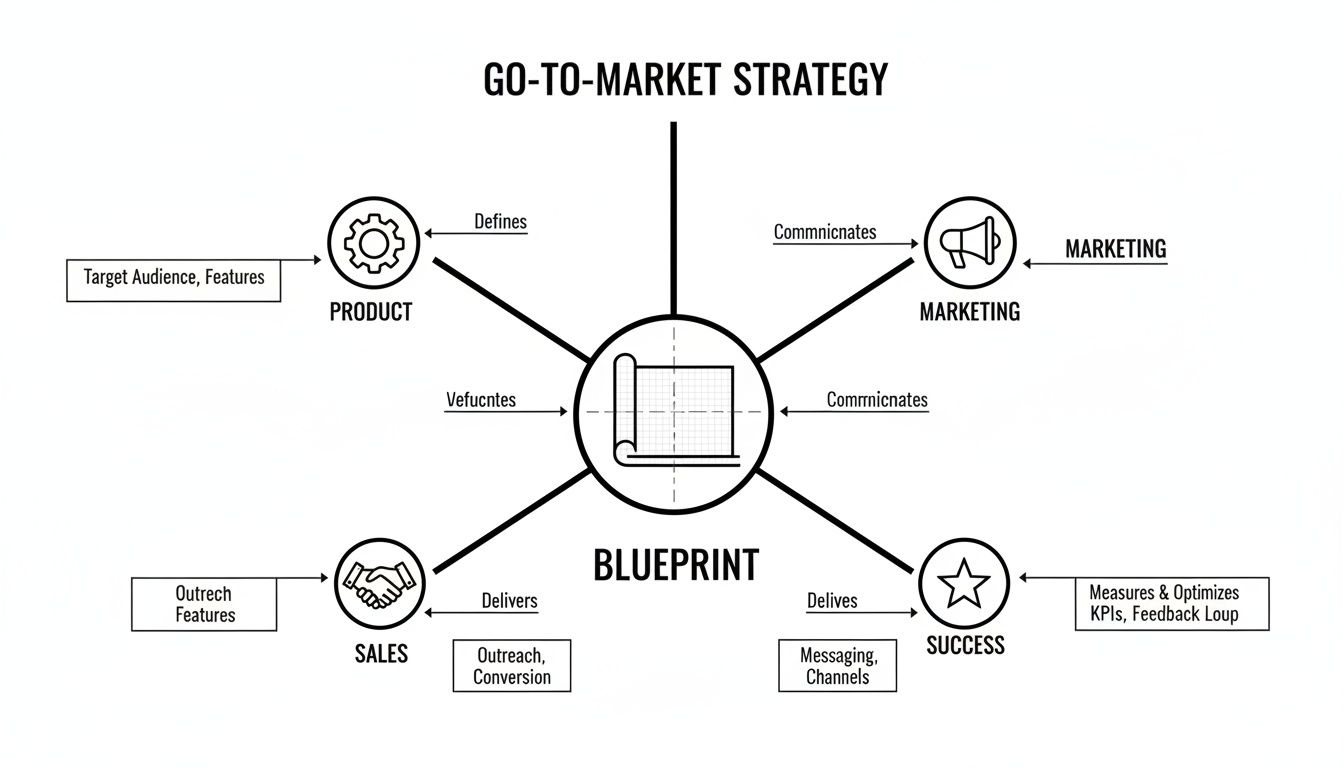
As you can see, a winning strategy is a team sport. Each function has a role to play, and they all need to be reading from the same playbook.
1. Pinpoint Your Ideal Customer Profile
Before you write a single line of ad copy or code, you have to know exactly who you're building for and selling to. Your Ideal Customer Profile (ICP) is a hyper-specific description of the perfect company for your product. This goes way beyond basic demographics.
A strong ICP should detail things like:
- Industry and Niche: Are they B2B tech startups, local brick-and-mortar stores, or enterprise finance firms?
- Company Size: How many employees? What's their annual revenue?
- Technographics: What other tools are already in their software stack?
- Pain Points: What specific, expensive problems are keeping their leaders up at night?
For example, a project management tool’s ICP might be: "Creative agencies with 10-50 employees struggling to manage client feedback and consistently over-allocating resources." That level of detail is what guides all your product and marketing decisions.
An ICP tells you where to aim. Without it, you’re just throwing marketing dollars into the wind and hoping something sticks. A clear ICP turns your strategy into a heat-seeking missile aimed directly at your most profitable future customers.
2. Craft a Value Proposition That Resonates
Once you know who you're talking to, you have to nail what you're going to say. Your value proposition is a clear, punchy statement that explains the unique benefit you deliver. It’s not about features; it's about the promise of a better outcome.
A great value proposition instantly answers three questions:
- What specific problem are you solving?
- What real benefits will the customer see?
- Why should they choose you over anyone else?
A crucial step here is getting a firm grip on your market, which includes knowing how to find competitors so you can truly stand out. Instead of a weak statement like, "We offer cloud storage," a powerful value proposition sounds more like, "We help remote teams securely share and collaborate on massive files, cutting project review times by 50%." See the difference?
3. Map The Customer Journey
Knowing your customer and what to tell them is a great start. Now, you need to map out every single step they take, from the first time they hear about you to the day they become a raving fan. This journey map shows every touchpoint, helping you create a smooth, intuitive experience.
A typical SaaS customer journey flows through these stages:
- Awareness: How do people discover they have a problem and find you as a potential solution? (e.g., SEO, content, social media)
- Consideration: What do they need to properly evaluate you? (e.g., demos, case studies, clear pricing)
- Decision: What finally pushes them to sign up? (e.g., free trial, a great sales call, customer reviews)
- Retention: How do you make them successful and keep them around? (e.g., seamless onboarding, proactive support)
- Advocacy: What turns them into evangelists who bring you more customers? (e.g., referral programs, amazing service)
4. Select The Right Pricing Model
Finally, your pricing has to be perfectly aligned with the value you deliver. The right pricing strategy can be a massive growth lever, while the wrong one will kill your momentum before you even get started. It’s a core part of your GTM strategy, not just something you tack on at the end. For a deeper look at this, check out our guide on how to launch a SaaS product.
Here are a few common pricing models in SaaS:
- Tiered Pricing: Different packages with different features and limits, designed for specific customer segments.
- Usage-Based Pricing: Customers pay for what they use (e.g., per transaction, per gigabyte of storage).
- Freemium: A free, limited version of the product acts as a lead magnet, with a clear path to upgrade to a paid plan.
The key is to anchor your pricing to your product's "value metric"—the core unit of value a customer gets. For Slack, it's active users. For a data storage service, it's gigabytes. When your price scales with the value a customer receives, it just feels fair.
To pull it all together, here’s a quick summary of how each of these components fits into the bigger picture.
Key GTM Strategy Components at a Glance
| Component | Core Question It Answers |
|---|---|
| Ideal Customer Profile (ICP) | Who are our most valuable and successful customers? |
| Value Proposition | Why should our ideal customer choose us over anyone else? |
| Customer Journey Map | How do customers find, evaluate, buy, and use our product? |
| Pricing Model | How do we charge for our product in a way that reflects its value? |
Getting these four elements right provides the strategic clarity you need to build a go-to-market plan that actually works.
Choosing Your Primary Growth Engine
Once you’ve nailed down the core pieces of your GTM strategy, you'll hit a major fork in the road: choosing your primary growth engine. This isn't just a marketing or sales decision; it fundamentally shapes how your entire company runs. It’s like deciding if you’re building a self-driving Tesla, a high-octane Formula 1 car, or a versatile hybrid.

This choice steers everything—your team structure, where you spend your money, and the kind of experience your customers have. The three main engines on the road today are Product-Led Growth (PLG), Sales-Led Growth (SLG), and an increasingly popular Hybrid model that pulls from both.
The Product-Led Growth (PLG) Engine
With Product-Led Growth, the product does the selling. It’s a GTM motion where the product itself is the main tool for acquiring, converting, and growing customer accounts. Users get to experience the value for themselves, usually through a freemium plan or a free trial, long before they ever talk to a salesperson.
This engine is a perfect fit for products that are intuitive, deliver value fast, and can be picked up by individuals or small teams without a complicated setup. Think about tools like Slack, Calendly, or Dropbox—you can sign up and solve a real problem in a matter of minutes.
The PLG model runs on a smooth, low-friction user experience. It's often fueled by a powerful SaaS product marketing strategy that drives awareness and gets people to sign up. When aimed at SMBs, PLG can be unstoppable. In fact, top B2B companies using a full PLG model at lower price points hit 1,000 subscribers in just 11 months, while the median for others is 2 years. ChartMogul's analysis of over 2,500 SaaS firms is packed with more insights on scaling with PLG.
The Sales-Led Growth (SLG) Engine
Sales-Led Growth is the classic SaaS GTM motion where a human sales team guides potential customers through their buying journey. This approach is absolutely essential for products that are complex, carry a high price tag (Average Contract Value), and often require deep consultation or integration work.
If your product solves a thorny, multifaceted business problem for big companies, you can't get by without a sales team. They’re the ones who build relationships, navigate tricky procurement departments, and demonstrate a clear ROI that justifies a major purchase.
Companies like Salesforce or Workday are prime examples. You can't just sign up and start running their full enterprise suites. The sales cycle is long and demands a high-touch, consultative approach to get deals across the finish line.
The Hybrid Growth Engine
A Hybrid model is exactly what it sounds like: a strategic blend of the best parts of PLG and SLG. It uses a product-led motion to bring in a wide base of users, then layers a sales team on top to spot and convert the most promising, high-value accounts.
This approach gives you incredible flexibility. A company might offer a self-serve freemium plan to get individuals and small teams in the door. As those users start showing signs of heavy usage or happen to work at larger organizations, they become "Product-Qualified Leads" (PQLs). At that point, the sales team steps in to upsell them to a lucrative enterprise plan.
Key Takeaway: A hybrid model lets you harness the efficiency and scale of PLG for the masses while applying the high-touch, revenue-driving power of SLG to your most valuable customers. Companies like Figma and Asana are masters of this, letting individual adoption create a groundswell that sales can turn into major enterprise deals.
To make the right call for your business, you need to weigh these factors:
- Product Complexity: How easy is it for a new user to "get it" and find value without any help? The simpler the product, the better it is for PLG.
- Average Contract Value (ACV): Is your product a low-cost monthly subscription or a six-figure annual contract? High ACVs almost always demand a sales-led motion.
- Target Customer: Are you selling to one person, a small team, or a whole enterprise with a complicated buying committee? The more people involved, the more you’ll need a sales team.
Executing a High-Touch Sales and ABM Strategy
When your SaaS solves complex, high-stakes problems for large enterprise customers, a self-serve model simply isn't going to work. Landing those big-name clients requires a completely different playbook—one that’s personal, strategic, and deeply consultative. Welcome to the world of high-touch, Sales-Led Growth (SLG).

Unlike the wide net you cast with a product-led approach, an SLG motion is more like a spear. It’s a focused, human-driven effort designed to navigate long sales cycles, complex buying committees, and contracts well into the six figures. This model absolutely depends on a skilled sales team that can build relationships, prove immense value, and guide prospects through a meticulous evaluation process.
Adopting an Account-Based Mindset
The engine driving a modern, high-touch GTM strategy is almost always Account-Based Marketing (ABM). Instead of marketing to a broad audience and hoping the right accounts show up, ABM flips the funnel on its head. You start by identifying your highest-value target accounts, then you treat each one as its own "market of one."
This demands an incredibly tight alignment between your sales and marketing teams. They have to work in lockstep to create hyper-personalized campaigns, content, and outreach for specific individuals within each target company. For any business chasing high-value deals, understanding what is Account-Based Marketing (ABM) is the first real step toward building an effective enterprise sales machine.
An ABM strategy doesn’t just generate leads; it creates opportunities within the exact companies you want to win. It’s all about quality over quantity, precision over volume.
Building Your High-Touch Playbook
Pulling this off requires a structured and disciplined game plan. This isn't about blasting out random cold calls; it's about running orchestrated plays designed to engage key decision-makers with relevant, valuable insights.
Here are the core components of a winning high-touch sales and ABM playbook:
Tiered Account Lists: Not all target accounts are created equal. You need to segment your list into tiers. For example, Tier 1 could be for strategic, must-win accounts, while Tier 2 is for high-potential targets. Tier 1 gets a deeply personalized, one-to-one approach, while lower tiers might get a one-to-few or a broader programmatic touch.
High-Impact Content: Generic blog posts won’t move the needle here. You need content that speaks directly to the pains of your target accounts. Think ROI calculators, industry-specific benchmark reports, personalized demo videos, and detailed case studies that prove you can deliver on your promises.
Orchestrated Outreach: Coordinate your outreach across multiple channels and touchpoints. A typical sequence might involve a personalized LinkedIn connection request from a sales rep, followed by a targeted ad, an email referencing a shared connection or recent company news, and finally, a call to offer a consultative workshop.
Leveraging Intent Data: Use tools to see which of your target accounts are actively researching solutions like yours. This "intent data" lets your sales team prioritize outreach to companies that are already in-market, which dramatically increases your chances of getting a response.
This shift toward enterprise plays is backed by some serious data. Account-Based Marketing and Sales-Led Growth are dominating the high-value deal space, delivering an 81% higher ROI than other tactics by laser-focusing on ideal customer profiles. With B2B SaaS customer acquisition costs climbing and sales cycles stretching out, this kind of precision targeting is no longer a luxury—it's a necessity.
By combining the relationship-building power of a great sales team with the targeted precision of ABM, your SaaS can effectively land the large, transformative deals that define a market leader.
How to Measure and Optimize Your GTM Strategy
Launching a SaaS go to market strategy without metrics is just a well-intentioned guess. Think of it like flying a plane without a control panel—you feel like you're moving forward, but you have no real idea if you’re gaining altitude, losing fuel, or heading straight into a storm.
To actually take control of your growth, you need a dashboard of key performance indicators (KPIs) that tells you the real-time story of your business. These numbers are more than just spreadsheet filler; they're the vital signs of your company's health. They show you what’s working, what’s broken, and exactly which levers to pull to get better results. Tracking the right metrics is how you shift from putting out fires to proactively driving growth.
Core Metrics for Your GTM Dashboard
It's easy to get lost in a sea of data. Instead of tracking everything, focus on a handful of KPIs that measure the fundamental health of your customer acquisition and retention engines. These are the numbers that your leadership team, your investors, and your bottom line care about most.
Your essential dashboard should include:
- Customer Acquisition Cost (CAC): This is the total you spend on sales and marketing divided by the number of new customers you brought in over that period. It answers one simple question: How much does it cost us to win a new customer?
- Lifetime Value (LTV): LTV is the total revenue you can reasonably expect from a single customer over the entire time they do business with you. It answers: How much is one customer actually worth to us?
- LTV to CAC Ratio: Here’s where the magic happens. By comparing how much a customer is worth to how much they cost to acquire, you get a clear picture of your business model's profitability and long-term viability. A healthy SaaS company should be aiming for a ratio of 3:1 or higher.
- Net Revenue Retention (NRR): Sometimes called Net Dollar Retention, this metric tracks the recurring revenue from your existing customer base, factoring in upgrades, cross-sells, and downgrades (churn). It answers the make-or-break question: Would our business grow or shrink if we didn't add a single new customer?
A strong SaaS go to market strategy isn't just about finding new customers; it's about finding the right customers—those who will stick around, expand their usage, and become profitable advocates for your brand.
Interpreting the Story Behind the Numbers
Metrics are only useful if you understand the story they're telling. A high CAC isn't just a number; it might be screaming that your marketing channels are inefficient or your sales cycle is dragging on for too long. A low LTV could be a red flag for a pricing problem or a product that just isn't sticky enough.
The real insight comes from seeing how these numbers interact. A high CAC might be perfectly fine if your LTV is sky-high to match. On the other hand, a low CAC is totally meaningless if those customers churn after two months.
The industry's focus is also shifting. For top-tier SaaS companies, customer expansion now fuels over 50% of new ARR. This has turned the traditional acquisition funnel into a "bowtie" model where keeping and upselling customers takes center stage. Elite teams are now targeting 120%+ NRR and see 40-60% of their new revenue coming straight from expansion. You can find more data on this and other B2B SaaS marketing benchmarks on Directive Consulting.
A Continuous Cycle of Optimization
Your GTM dashboard isn't something you set up once and forget. It’s the engine for a continuous cycle of improvement.
- Measure: Track your core KPIs consistently, whether it's weekly or monthly.
- Analyze: Dive into the data to figure out the why behind the numbers.
- Hypothesize: Form a clear, testable idea about what you can change to improve a metric. For example, "Improving our onboarding flow will increase our activation rate and boost NRR."
- Test: Roll out the change and measure the impact.
- Repeat: Take what you learned—good or bad—and start the cycle all over again.
This disciplined approach is what transforms your go to market strategy from a static document into a dynamic, learning system that gets smarter and more efficient over time.
Your Go-To-Market Strategy Checklist
Alright, let's move from theory to action. A powerful SaaS go-to-market strategy isn't just about good ideas; it’s built by taking deliberate, sequential steps. Think of this checklist as your pre-flight inspection, making sure every part of your growth engine is ready for takeoff and built to scale.
We've laid this out chronologically to walk you through everything from validating your market to optimizing after launch. Each checkpoint turns your plan from a document on your hard drive into a confident, executable playbook. It’s your guide to getting it right the first time.
Phase 1: Pre-Launch Validation
Before you even think about spending money on marketing, you have to validate your core assumptions. This whole phase is about replacing guesswork with hard evidence. You need to be certain you’re solving a real problem for real people. This is the foundation everything else is built on.
Validate Your ICP: Get on the phone or Zoom and conduct at least 10-15 in-depth interviews with people you think are your Ideal Customer Profile. The key here is to listen, not sell. Ask about their workflow, their biggest headaches, and the exact words they use to describe their challenges.
Test Your Value Proposition: After listening, pitch them your core value proposition. Does it click? Do their eyes light up, or do you get a confused stare? If it’s not immediately clear and compelling to them, your messaging needs to be reworked before it ever hits a landing page.
Map Your Core Acquisition Funnel: Grab a whiteboard and sketch out the simplest possible journey from total stranger to happy user. What are the essential stages? Think Awareness > Consideration > Trial > Conversion. Now, pick just one primary channel you'll use to get started.
Phase 2: Launch Readiness
Once your core assumptions feel solid, it's time to build the machinery for your launch. This is where you turn your strategy into tangible assets, tools, and goals. You’re gearing up your team for those crucial first 90 days. A smooth, well-prepared launch creates the momentum you'll need later.
Set Your Initial Pricing Tiers: Pricing is a massive part of your GTM. Based on what you learned from your ICP interviews and the value you deliver, define your starting price points. If you need some direction, exploring different SaaS pricing strategies can help you find the right model.
Define Launch Goals: What does a successful launch actually look like in the first 90 days? Be specific and make it measurable. Good examples are getting your first 50 paying customers, hitting a 5% trial-to-paid conversion rate, or locking in three solid customer case studies.
Build Your Core KPI Dashboard: You can't improve what you don't measure. Create a simple dashboard to track the few metrics that truly matter at this stage. At a bare minimum, you need to be watching your Customer Acquisition Cost (CAC), Lifetime Value (LTV), and your main conversion rates.
Your Go-to-Market Questions, Answered
Even with a solid plan, building a GTM strategy always kicks up a few tricky questions. I've seen countless founders and marketers wrestle with the same hurdles, so let's clear up some of the most common ones.
When Should I Actually Start Building My GTM Strategy?
The short answer? Before you finish building your product.
Way too many founders wait until their product is live and then try to figure out who to sell it to. That's backward. All your early market research, customer interviews, and work defining your ideal customer profile (ICP) should be feeding directly into your product development from the start.
Ideally, you should start piecing this all together 3-6 months before you plan to launch. That way, when you do go live, you're not guessing. You'll already have a validated plan for who wants what you've built and a good idea of how to reach them. This saves a ton of time, money, and stress down the road.
What's the Biggest GTM Mistake I Can Make?
Hands down, the single biggest mistake is trying to sell to everyone. I hear it all the time: "Our target market is any business that needs our solution." That's not a strategy—it's a recipe for burning through your cash with absolutely nothing to show for it.
The smartest SaaS companies don't try to boil the ocean. They find a very specific, well-defined niche, completely own it, and then expand from that beachhead. It's always more powerful to own 80% of a small, targeted market than it is to have 2% of a massive one.
Should I Focus on Inbound or Outbound First?
This one almost always comes down to your Average Contract Value (ACV) and how complex your sale is. There's no single "right" answer, but there's a simple framework to help you decide.
Low ACV (think $50/month): You absolutely have to lean into an inbound, product-led approach. You can't afford to have a salesperson involved in every small deal. Your survival depends on getting a high volume of signups driven by great content, SEO, and maybe some targeted ads.
High ACV (think $25k+/year): Outbound is your best friend here. You can't just wait for big accounts to find you; you have to go find them. A targeted sales effort can start bringing in revenue in a matter of weeks, long before your inbound engine is fully humming.
Eventually, most B2B SaaS companies need a healthy mix of both. But where you start should be dictated by your price point.
How Much Money Do I Really Need for a GTM Launch?
There's no magic number, but here’s a good benchmark: established SaaS companies often spend 30-50% of their revenue on sales and marketing. When you're just starting out and don't have much revenue, think of your spending as an investment in learning.
For a serious launch, a starting budget of $3,000-$10,000 per month for your marketing activities is a realistic baseline. This gives you enough runway to run meaningful tests on paid channels and gather enough data to make smart decisions. The key isn't the total dollar amount, but how fast you can use it to test, learn, and double down on what’s actually working.
Ready to get your SaaS in front of thousands of early adopters? SubmitMySaas is the launchpad you need. Submit your product today to get featured, build high-quality backlinks, and kickstart your growth. Launch Your SaaS Now.