10 SaaS Pricing Strategies To Boost Revenue in 2025
Discover 10 powerful SaaS pricing strategies to optimize revenue. Explore freemium, value-based, and tiered models with real examples and actionable tips.
Choosing the right pricing model is one of the most critical decisions a SaaS founder can make. It's not just a number on a page; it's a strategic tool that directly impacts revenue, user acquisition, customer perception, and long-term scalability. A well-crafted strategy can act as a powerful growth lever, while a poorly chosen one can stall even the most innovative products.
Yet, with so many options, navigating the landscape of SaaS pricing strategies can feel overwhelming. Founders often struggle to decide between a Freemium model to maximize user adoption or a Value-Based approach to capture maximum revenue. This comprehensive guide is designed to eliminate that confusion. We will break down 10 proven models, providing a clear roadmap to help you select, implement, and optimize the perfect strategy for your specific product and market.
This is not a high-level theoretical overview. We move beyond basic definitions to provide actionable insights for each pricing model. You will find:
- Step-by-step implementation guides to get you started.
- Real-world examples from successful companies like Slack, HubSpot, and Twilio.
- Key metrics to track for measuring success and identifying optimization opportunities.
- Pros and cons tailored to different business goals and product types.
Whether you're launching a brand-new tool, refining an existing pricing structure, or seeking ways to scale more effectively, this playbook will equip you with the knowledge to turn your pricing page into your most effective conversion tool and a core driver of sustainable growth.
1. Freemium Model
The freemium model is one of the most popular and effective saas pricing strategies for driving rapid user acquisition. It operates on a simple principle: offer a core version of your product for free, forever, while gating more advanced features, higher usage limits, or premium support behind paid tiers. This strategy removes the initial purchase barrier, allowing users to experience your product's value firsthand before committing financially.
This approach creates a powerful, self-sustaining marketing funnel. A valuable free tier attracts a large volume of users, who then become potential candidates for upselling as their needs grow or they become more invested in the product ecosystem.
Ideal Use Cases
The freemium model works best for products with a broad potential user base and a low marginal cost to serve each new free user. It’s particularly effective for tools that benefit from network effects, like collaboration software (Slack, Figma) or platforms where user-generated content adds value. Startups aiming for market dominance and rapid growth often leverage freemium to build a massive top-of-funnel audience.
Pros and Cons
Pros:
- Massive User Acquisition: Drastically lowers the barrier to entry, enabling viral growth.
- Product-Led Growth Engine: The product itself becomes the primary driver of acquisition and conversion.
- Competitive Advantage: Can effectively box out competitors who only offer paid plans or limited trials.
Cons:
- High Costs: Supporting a large base of free users can be expensive in terms of infrastructure and support.
- Low Conversion Rates: Typically, only a small percentage (1-5%) of free users convert to paid plans.
- Brand Devaluation: A poorly implemented free tier can make users perceive the product as "cheap" or undervalue premium features.
Actionable Implementation Tips
- Define a Clear Value Metric: Gate your free plan based on a metric that scales with user value, such as storage (Dropbox), message history (Slack), or the number of team members.
- Make the Free Tier Genuinely Useful: The free product must solve a real problem and provide tangible value. If it's too restrictive, users will churn without ever seeing the potential of the premium version.
- Showcase Premium Features: Use in-app prompts, tooltips, and onboarding sequences to subtly highlight what users are missing. For example, show a grayed-out "Premium" feature button that explains its benefits upon clicking.
- Analyze Conversion Triggers: To optimize this strategy, it's crucial to understand what makes users upgrade. You can see how to track these metrics with a product like MetricGram, which helps you monitor free-to-paid conversion rates and identify key user behaviors that precede an upgrade.
2. Tiered/Usage-Based Pricing
Tiered pricing is a cornerstone of saas pricing strategies, structuring plans into distinct packages (e.g., Basic, Pro, Enterprise) at different price points. Each successive tier offers more features, higher usage limits, or greater support, allowing you to cater to various customer segments, from individual users to large organizations. This model aligns price with the value a customer receives, making it easy for them to upgrade as their needs expand.
This approach guides customers along a clear growth path within your product. A well-designed tiered structure simplifies the buying decision and creates natural upsell opportunities, as companies outgrow their current plan and see a clear reason to move to the next level.

Ideal Use Cases
Tiered pricing is highly versatile and fits most SaaS products that serve different customer personas with varying needs and budgets. It is especially effective for platforms like HubSpot or Mailchimp, where usage (e.g., contacts, users) and feature requirements scale directly with business size. Companies aiming to capture a wide market segment, from startups to enterprise clients, use tiers to create an offering for everyone.
Pros and Cons
Pros:
- Broad Market Appeal: Caters to multiple customer segments and their specific willingness to pay.
- Clear Upsell Path: Provides a defined journey for customers to grow, maximizing lifetime value.
- Predictable Revenue: Compared to pure usage-based models, fixed tiers offer more stable and predictable monthly recurring revenue.
Cons:
- Choice Paralysis: Too many options or poorly defined tiers can confuse potential buyers.
- Feature Creep: Customers on lower tiers may demand features from higher tiers, creating pressure to adjust packages.
- Misaligned Personas: If tiers are not based on deep customer research, you risk creating packages that no one wants.
Actionable Implementation Tips
- Anchor the Middle Tier: Design your middle tier to be the most attractive option, offering the best balance of features and price. This is a psychological pricing tactic that often makes it the most popular choice.
- Use a Feature Comparison Table: Clearly and visually differentiate what is included in each plan. This transparency helps users self-select the right tier and reduces buyer friction.
- Base Tiers on Value Metrics: Align each tier with a key value metric that grows with the customer, such as the number of users, contacts, projects, or API calls. This ensures customers upgrade when they get more value.
- Offer an Annual Discount: Encourage longer-term commitment and improve your cash flow by offering a discount (typically 10-20%) for customers who pay annually instead of monthly.
3. Pay-As-You-Go (Consumption-Based) Pricing
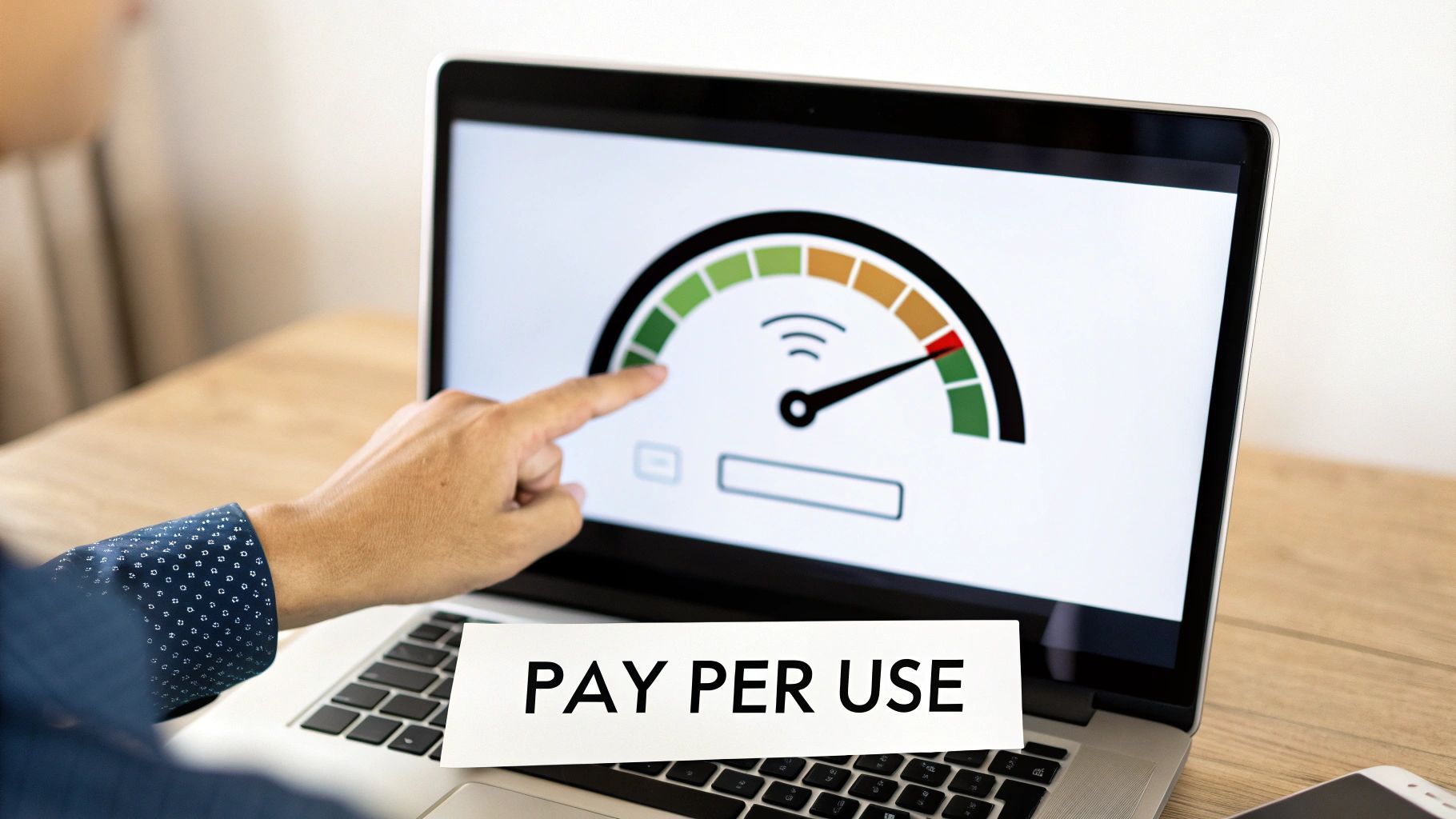
Pay-as-you-go, or consumption-based pricing, is a flexible model where customers are billed only for what they use. This approach directly ties cost to value by charging based on specific usage metrics like API calls, data storage, compute hours, or transactions processed. This model removes the risk of overpaying for unused capacity, making it highly attractive for customers with variable or unpredictable needs.
It's one of the most transparent saas pricing strategies, as costs scale directly with a customer's growth. Companies like AWS, Twilio, and OpenAI have popularized this model, building trust with developers and businesses who appreciate paying only for the resources they consume.
Ideal Use Cases
This model excels for infrastructure-as-a-service (IaaS) and platform-as-a-service (PaaS) products where resource consumption is the core value. It is also perfect for API-first companies like Stripe or SendGrid, where each transaction or call has a clear, measurable unit of value. For products or services heavily relying on API usage, it's crucial to consider effective API monetization strategies to ensure your pricing scales with the value you deliver.
Pros and Cons
Pros:
- Low Barrier to Entry: Customers can start with minimal investment, reducing friction and encouraging adoption.
- Direct Value Alignment: Costs are directly proportional to usage, making it a fair and transparent model.
- Scalability: The model naturally accommodates customers of all sizes, from small startups to large enterprises.
Cons:
- Unpredictable Revenue: Monthly revenue can be volatile and difficult to forecast, posing challenges for financial planning.
- Customer Budget Anxiety: Lack of cost predictability can be a major concern for customers, who may fear unexpectedly high bills.
- Complex Billing: Requires robust metering and billing systems to accurately track and invoice usage.
Actionable Implementation Tips
- Offer Transparent Calculators: Provide a clear, interactive pricing calculator on your website so prospects can estimate their costs based on projected usage.
- Implement Usage Alerts: Build in automated alerts and notifications to inform customers when they are approaching certain spending thresholds or usage limits.
- Provide Spending Caps: Give customers peace of mind by allowing them to set hard spending limits to prevent runaway costs.
- Document Pricing Clearly: Create comprehensive and easy-to-understand documentation for your pricing. This is especially vital for API products to build trust with engineering teams.
- Analyze Usage Data: To manage financial risk, analyze usage patterns to forecast revenue. For payment processing models like Stripe's, use a payment gateway fee calculator to understand the net revenue from each transaction.
4. Value-Based Pricing
Value-based pricing is one of the most powerful saas pricing strategies for maximizing revenue and aligning your product with customer success. Instead of basing your price on development costs or competitor rates, this model ties the price directly to the tangible economic value your product delivers to the customer. This value could be measured in increased revenue, cost savings, enhanced productivity, or risk reduction.
This strategy positions your product as an investment rather than an expense. By focusing on the customer's return on investment (ROI), you can justify premium pricing and attract high-quality customers who understand the direct impact your tool has on their bottom line. It shifts the conversation from features to outcomes.

Ideal Use Cases
Value-based pricing is ideal for B2B SaaS products that have a clear and measurable impact on a customer's core business metrics. It thrives in markets where the ROI is significant and can be easily demonstrated, such as marketing automation (HubSpot), sales CRMs (Salesforce), or financial optimization tools. It's particularly effective for products sold to sophisticated buyers in established industries who make purchasing decisions based on financial outcomes.
Pros and Cons
Pros:
- Higher Revenue Potential: Directly links price to customer value, allowing for significantly higher price points than cost-plus or competitor-based models.
- Stronger Customer Alignment: Fosters a partnership mentality where your success is tied to your customers' success, reducing churn.
- Premium Brand Positioning: Establishes your product as a high-impact solution, differentiating it from commoditized, feature-focused competitors.
Cons:
- Difficult to Implement: Requires deep customer research and data analysis to accurately quantify and communicate value.
- Complex Segmentation: Different customer segments may derive different amounts of value, requiring nuanced pricing tiers and messaging.
- Challenging for New Products: Can be hard to prove value without a strong track record of case studies and testimonials.
Actionable Implementation Tips
- Create a Value Calculator: Build an interactive tool on your pricing page that allows prospects to input their own data (e.g., team size, monthly ad spend) and see the potential ROI or savings.
- Develop ROI-Focused Case Studies: Don't just list features used. Publish detailed case studies with hard numbers showing how customers increased revenue or cut costs after implementing your solution.
- Price for Outcomes, Not Features: During sales conversations, shift the focus from "what our tool does" to "what our tool achieves for you." Frame your pricing tiers around business outcomes like "leads generated" or "time saved."
- Conduct Deep Customer Interviews: To truly understand value, you must talk to your customers. Ask them how your product impacts their workflow, revenue, and strategic goals. This research is foundational for anyone considering how to launch a SaaS product with this pricing model.
5. Per-Seat/Per-User Pricing
The per-seat or per-user pricing model is one of the most straightforward and widely adopted saas pricing strategies, especially for B2B products. Its logic is simple: the customer pays a fixed price per user, per month or year. As a team grows and adds more members to the platform, the total subscription cost increases proportionally.
This model directly links the price a customer pays to the value they receive, as each new user represents an expansion of the product's use within their organization. It’s transparent, predictable, and easy for customers to understand, making it a reliable choice for software centered around team collaboration and productivity, such as Asana, Slack, and Microsoft 365.
Ideal Use Cases
Per-seat pricing is a natural fit for software where the core value is tied to individual access and collaboration. This includes project management tools, CRMs, internal communication platforms, and design software. If each additional user requires their own login, consumes a similar amount of resources, and contributes to the collective value, this model works exceptionally well. It simplifies revenue forecasting, as growth is directly tied to the number of paid seats.
Pros and Cons
Pros:
- Simplicity and Predictability: Easy for customers to understand and for businesses to forecast revenue.
- Scales with Value: Revenue grows naturally as the customer's team size and product adoption increase.
- High Revenue Potential: Can be highly profitable for products deeply embedded in a company's daily workflow.
Cons:
- Discourages Adoption: Can create a barrier to inviting more team members, limiting the product's internal network effect.
- Seat Sharing: Customers may try to cheat the system by sharing a single login among multiple users.
- Perceived as Expensive: For large teams, the total cost can quickly become a significant expense, leading to churn.
Actionable Implementation Tips
- Offer Team Bundles: Create tiered discounts for larger teams to incentivize wider adoption. For example, offer a 10% discount for teams of 20 or more.
- Implement "Fair Billing" Policies: Adopt a model like Slack's, where you only charge for active users. This builds trust and reduces friction for customers whose team sizes fluctuate.
- Provide Flexible Roles: Create different user types, such as "Admin," "Editor," or "Viewer." You can offer free or discounted seats for limited-access roles like guests or commentators to encourage collaboration without inflating costs.
- Make Seat Management Easy: Design a simple, intuitive dashboard for admins to add or remove users instantly. This frictionless experience is crucial for accommodating team changes and reduces support overhead.
6. Flat-Rate Pricing
Flat-rate pricing is the essence of simplicity among saas pricing strategies. It involves charging a single, fixed price for access to your product, regardless of the number of users, features used, or consumption volume. This model offers complete transparency and predictability, making it easy for customers to understand exactly what they get and what they will pay.
This straightforward approach eliminates complex tiers and confusing add-ons, presenting a clear, all-inclusive value proposition. A well-known champion of this model is Basecamp, which offers all its features for one monthly price, empowering teams to grow without worrying about escalating costs. This simplicity can be a powerful differentiator in a crowded market.
Ideal Use Cases
This model is exceptionally well-suited for products with a singular, well-defined purpose and a relatively uniform customer base. It excels for tools where feature differentiation is minimal or counterproductive. It's also a strong choice for companies targeting small to medium-sized businesses (SMBs) that prioritize budget predictability and simplicity over granular customization. Platforms like Ghost and Substack use it effectively to provide creators with a straightforward subscription.
Pros and Cons
Pros:
- Ultimate Simplicity: The easiest model for customers to understand and for businesses to market and sell.
- Predictable Revenue: Both the customer and the business know exactly what the monthly or annual cost will be, simplifying financial forecasting.
- Reduces Sales Friction: Eliminates negotiation and decision-making around tiers, speeding up the sales cycle.
Cons:
- One-Size-Fits-None: A single price point may be too expensive for small users and a bargain for power users, leaving potential revenue on the table.
- Limited Upsell Path: Lacks natural pathways to increase revenue from existing customers as their needs grow.
- Value Perception Issues: Heavy-use customers receive immense value for the price, while low-use customers may feel they are overpaying.
Actionable Implementation Tips
- Position Around Simplicity: Emphasize the benefit of a single, all-inclusive price in your marketing. Highlight "unlimited users" or "all features included" as a key value proposition.
- Price for Your Ideal Customer: Analyze your target market and set a price that provides exceptional value for the median customer, while remaining profitable even with high-usage outliers.
- Offer an Annual Discount: While it's a single price, you can still encourage long-term commitment and improve cash flow by offering a discount for annual prepayment.
- Monitor Perceived Value: Regularly survey customers to ensure they feel the flat price is fair for the value they receive. Be prepared to adjust your pricing or add value if sentiment shifts. A tool like SurveySparrow can help you gather this crucial feedback to ensure your flat-rate model remains aligned with customer expectations.
7. Freemium + Premium Support/Services Model
This model is a sophisticated evolution of the standard freemium strategy, where the core product remains free but revenue is generated through paid support and professional services. Instead of gating features, this approach monetizes expertise, offering value-added services like dedicated account management, implementation assistance, priority support, or strategic consulting.
This strategy decouples the product's accessibility from its revenue stream. By providing the full product for free, it maximizes adoption and user dependency. Revenue is then derived from larger teams or enterprise clients who require guaranteed SLAs, personalized guidance, and hands-on help to maximize their return on investment.
Ideal Use Cases
This model excels for complex, mission-critical products that require significant setup or integration, such as developer tools, API-first platforms, or highly configurable enterprise software. Companies like Auth0 and Zapier use this strategy effectively. It's ideal for products with a steep learning curve or those that become deeply embedded in a customer's workflow, where expert assistance becomes a high-value commodity.
Pros and Cons
Pros:
- Maximizes Adoption: Offering the full-featured product for free removes all barriers to entry, encouraging widespread use and creating a massive user base.
- High-Margin Revenue: Professional services and premium support tiers often carry much higher margins than standard software subscriptions.
- Deep Customer Relationships: Direct service engagement builds strong, sticky relationships and provides invaluable product feedback.
Cons:
- High Service Delivery Costs: Scaling a services and support team is capital-intensive and requires specialized talent.
- Sales Complexity: Selling services requires a different skill set than selling a self-serve product, often involving a consultative sales process.
- Potential for Cannibalization: If the product is too easy to use, there may be little demand for paid support.
Actionable Implementation Tips
- Formalize Service Offerings: Clearly define your support tiers with specific Service Level Agreements (SLAs), such as guaranteed response times. For services, create packaged offerings like "Implementation Kickstart" or "Optimization Consulting."
- Create a Clear Escalation Path: Design a seamless process for free users to request and upgrade to paid support directly from within the product or support portal.
- Train Sales on Upselling Support: Equip your sales team to identify growing customers who are prime candidates for premium support. They should be able to articulate the ROI of faster, more expert assistance.
- Showcase Service Value: Use case studies and testimonials to highlight how your professional services have helped customers achieve specific business outcomes, demonstrating a clear return on their investment.
8. Annual Prepayment with Discount Model
The annual prepayment model is one of the most straightforward yet powerful saas pricing strategies for stabilizing revenue and improving cash flow. The concept is simple: offer customers a significant discount, typically 15-25%, if they commit to and pay for a full year upfront rather than paying month-to-month. This creates a win-win scenario where the customer receives a better price, and the business secures long-term commitment and immediate working capital.
This strategy effectively locks in revenue and drastically reduces the monthly churn risk associated with that customer. By getting cash upfront, SaaS businesses can reinvest in growth initiatives like marketing, product development, or hiring, accelerating their scaling efforts. It’s a standard, highly effective lever used by nearly every successful SaaS company, from early-stage startups to public enterprises.
Ideal Use Cases
This model is almost universally applicable to any subscription-based SaaS product that has demonstrated product-market fit. It is particularly effective for B2B SaaS companies where budgets are planned annually, making a yearly commitment a natural fit. Companies like Slack and Adobe Creative Cloud use it to incentivize longer-term adoption and reduce administrative overhead from monthly billing. It is also ideal for businesses looking to smooth out revenue predictability.
Pros and Cons
Pros:
- Improved Cash Flow: Provides a significant upfront cash injection that can be used for growth.
- Reduced Churn: Customers on annual plans are locked in for 12 months, drastically lowering monthly churn rates.
- Increased Customer Lifetime Value (LTV): Annual subscribers tend to have a higher LTV due to longer commitment and lower churn.
- Lower Administrative Costs: Reduces the frequency of billing transactions, support tickets, and payment failures.
Cons:
- Slower Initial Adoption: The higher upfront cost can be a barrier for some customers, especially smaller businesses or individual users.
- Revenue Recognition Complexity: According to accounting principles (like ASC 606), the revenue must be recognized monthly over the year, not all at once.
- Discounting Impact: The discount reduces the average revenue per user (ARPU) compared to what a full-price monthly subscription would yield over a year.
Actionable Implementation Tips
- Make the Savings Obvious: On your pricing page, visually highlight the annual plan as the "Best Value" or "Most Popular" option. Clearly display the percentage or dollar amount saved compared to the monthly plan.
- Set Annual as the Default: Use UI design to pre-select or emphasize the annual billing cycle, guiding new customers toward the preferred option.
- Implement Smart Renewal Reminders: Set up automated email reminders 30-45 days before the annual renewal date. This reduces surprise charges and gives customers ample time to manage their subscription.
- Leverage the Annual Upsell: Use email marketing and in-app notifications to encourage existing monthly subscribers to switch to an annual plan, often timed around their 90-day anniversary when they've fully realized the product's value.
9. Volume/Enterprise Discounts Model
The volume or enterprise discount model is a classic saas pricing strategy that incentivizes customer growth by offering progressively lower per-unit costs as usage increases. This strategy rewards loyalty and expansion by making it more cost-effective for customers to scale up their usage, team size, or commitment level within your platform rather than seeking out a competitor.
This approach is fundamentally about aligning your pricing with your customer's success. As their business grows and they need more from your product, their investment becomes more efficient, creating a powerful incentive to deepen their relationship with your service. It’s a common strategy for B2B SaaS companies like Salesforce and HubSpot, which target large organizations.
Ideal Use Cases
This model is exceptionally well-suited for B2B SaaS products where the value metric is easily quantifiable, such as per-user seats, API calls, or data storage. It's particularly effective for platforms aiming to land large enterprise accounts and drive expansion revenue. Companies that have a clear path for customers to grow from small teams to large departments will find this strategy essential for retention and upselling.
Pros and Cons
Pros:
- Encourages Upselling: Creates a natural, built-in incentive for customers to upgrade and expand their usage.
- Increases Customer Lifetime Value (LTV): By rewarding growth, it reduces churn and encourages long-term commitments.
- Predictable Revenue: Often paired with annual contracts, providing stable and foreseeable income streams.
Cons:
- Complex to Communicate: Tiers and discount thresholds can be confusing if not presented clearly on the pricing page.
- Potential for Revenue Cannibalization: If not structured carefully, you might give away too much margin on high-volume deals.
- Requires a Sales Team: Enterprise-level negotiations and custom quotes are often necessary, adding to overhead.
Actionable Implementation Tips
- Create Transparent Tiers: Clearly define the discount thresholds. For example, establish clear price breaks for 1-10 users, 11-50 users, and 51+ users to make the value proposition obvious.
- Offer Annual Prepayment Incentives: Add an extra discount (e.g., 10-20%) for customers who commit to an annual plan on top of their volume discount, which significantly improves cash flow.
- Empower Your Sales Team: Provide your sales representatives with the flexibility to negotiate custom enterprise deals that cater to the unique needs of large clients. For an example of how large-scale SaaS companies structure their offerings, consider delving into an in-depth explanation of ChatGPT Enterprise pricing.
- Build a Pricing Calculator: Add an interactive calculator to your pricing page. This allows potential customers to input their team size or usage needs and instantly see their discounted price, removing friction from the buying process.
10. Freemium Entry + Marketplace Monetization Model
This hybrid approach is one of the more sophisticated saas pricing strategies, blending a freemium acquisition model with a marketplace-driven revenue stream. The core product is offered for free to build a massive user base and strong network effects, but instead of monetizing through tiered feature upgrades, revenue is primarily generated from transactions, fees, and sales within an integrated ecosystem or marketplace.
This strategy effectively turns the free product into a platform. By providing essential infrastructure at no cost, companies like Shopify or Stripe attract millions of users (merchants, developers) who then generate revenue through transaction fees, app store commissions, or paid add-ons from third-party partners. The free product fuels the ecosystem's growth, and the ecosystem's activity generates the revenue.
Ideal Use Cases
This model is exceptionally powerful for platform-based businesses that can facilitate interactions and transactions between different user groups. It thrives in markets where a central hub can connect creators with consumers, developers with users, or merchants with customers. It's an ideal strategy for companies like Zapier, which connects disparate apps, or Discord, which connects community creators with their audiences through server boosts and future partner integrations.
Pros and Cons
Pros:
- Massive Network Effects: A free, valuable core product can achieve critical mass quickly, making the platform indispensable.
- Scalable Revenue Model: Revenue grows in direct proportion to the activity and value generated within the ecosystem, not just the number of paying subscribers.
- Strong Defensibility: A thriving marketplace ecosystem creates a powerful competitive moat that is difficult for others to replicate.
Cons:
- Complex to Build: Requires building both a compelling product and a vibrant, two-sided marketplace, which is a significant undertaking.
- Delayed Monetization: Revenue generation can be slow initially as it depends on achieving a critical mass of users and partners.
- Chicken-and-Egg Problem: It can be challenging to attract partners to the marketplace without a large user base, and vice versa.
Actionable Implementation Tips
- Make the Free Core Invaluable: Your free platform must be robust and genuinely useful on its own to attract the initial user base needed to ignite the marketplace.
- Establish Clear Partner Economics: Create a transparent and compelling commission structure. Partners need to see a clear win-win scenario to invest their time and resources in building for your platform.
- Actively Recruit Quality Partners: Don't just open the gates; curate and actively recruit high-quality developers, creators, or service providers to ensure the marketplace offers real value from day one.
- Optimize Transaction Fees: Continuously test your fee structure. It should be low enough to encourage high transaction volume but significant enough to build a sustainable business. Stripe, for instance, maintains a simple, predictable fee that scales with usage.
Top 10 SaaS Pricing Strategies Comparison
| Model | 🔄 Implementation Complexity | Resource Requirements | ⚡ Speed/Efficiency | 📊 Expected Outcomes (⭐) | 💡 Ideal use cases / Key tip |
|---|---|---|---|---|---|
| Freemium Model | Medium — feature gating & tier design | High infrastructure to support many free users | ⚡ Fast user acquisition, slow monetization | ⭐⭐⭐ — High adoption; conversion-dependent | Target makers and discovery platforms; limit free quotas to encourage upgrades |
| Tiered / Usage-Based Pricing | Medium-High — define tiers & boundaries | Moderate — pricing research, billing, analytics | ⚡ Balanced — predictable revenue with some ops overhead | ⭐⭐⭐⭐ — Captures multiple segments; steady ARR | Make middle tier most attractive; display clear feature comparisons |
| Pay-As-You-Go (Consumption) | High — metering & realtime billing needed | High — sophisticated metering, billing systems | ⚡⚡ Efficient cost alignment; revenue unpredictable | ⭐⭐⭐ — Fair pricing for users; forecasting harder | Use usage alerts, caps, and pricing calculators to avoid bill shock |
| Value-Based Pricing | High — requires customer ROI measurement | High — sales, CS, analytics, consultative selling | ⚡ Slower to implement but high yield per account | ⭐⭐⭐⭐ — High revenue if value is proven | Build ROI case studies and value calculators; price for outcomes |
| Per-Seat / Per-User Pricing | Low — straightforward per-user billing | Low–Moderate — user management and billing | ⚡ Very simple to explain and scale with teams | ⭐⭐⭐ — Predictable revenue; can deter large orgs | Ideal for collaboration tools; offer bundles and annual discounts |
| Flat-Rate Pricing | Low — single price point, minimal config | Low — simple billing and support | ⚡ Very simple purchase flow; risk of under-monetizing | ⭐⭐ — High conversion; limited revenue capture from power users | Best for simple/high-frequency tools; price conservatively |
| Freemium + Premium Support/Services | High — product + services coordination | Very high — skilled support, onboarding teams | ⚡ Slower monetization but diversified revenue | ⭐⭐⭐ — Strong retention and service revenue | Formalize SLAs, train sales to upsell services; track margins closely |
| Annual Prepayment with Discount | Low — billing and UX choices | Low — improves cash flow, less ops overhead | ⚡ Boosts cash flow and retention quickly | ⭐⭐⭐⭐ — Improved LTV and lower churn | Make annual default or prominent; show clear savings comparison |
| Volume / Enterprise Discounts | Medium-High — custom tiers & deals | High — sales enablement, negotiation authority | ⚡ Efficient at scale; adds pricing complexity | ⭐⭐⭐⭐ — Drives expansion revenue and CLV | Provide transparent discount tiers and commitment options |
| Freemium Entry + Marketplace Monetization | High — must build marketplace & ecosystem | Very high — partner ops, platform, compliance | ⚡ Slow to profitable but highly scalable | ⭐⭐⭐⭐ — Multiple revenue streams; strong network effects | Keep core free and recruit partners; balance commission vs. growth |
From Strategy to Success: Putting Your Pricing Plan into Action
We've explored a comprehensive landscape of ten distinct SaaS pricing strategies, from the user-acquisition power of Freemium to the pure alignment of Value-Based Pricing. Navigating these options can feel like choosing a path in a dense forest. However, the most critical takeaway is not which single path is "best," but understanding that your pricing is a dynamic tool, not a static decision etched in stone.
The journey doesn't end with selecting a model like Per-User or Tiered Pricing. That choice is merely your starting hypothesis. The real work begins when you launch, gather data, and listen intently to the market's response. The most successful SaaS companies treat pricing as a core product feature, one that requires continuous iteration, testing, and optimization.
Synthesizing Your Strategy: Key Takeaways
As you move from theory to implementation, keep these core principles at the forefront of your mind. They are the constants that underpin all effective SaaS pricing strategies.
Value is Your North Star: Regardless of the model you choose, your pricing must be anchored to the value you deliver. A Per-Seat model fails if an extra seat provides no marginal value, and a Usage-Based model crumbles if your value metric doesn't align with customer success. Always ask: "Does our price scale with the value our customer receives?"
Simplicity Sells: Complexity is a silent conversion killer. Your pricing page is not the place for intricate formulas or confusing jargon. Customers should grasp your tiers and understand what they get for their money within seconds. A confused visitor will almost always choose a competitor with a clearer, more direct offer.
Psychology is Powerful: The principles we’ve discussed, like decoy pricing, charm pricing ($99 vs. $100), and the power of "Free," are not just tricks. They are tools grounded in human psychology that reduce friction in the buying process. Use them ethically and strategically to frame your value proposition in the most appealing way possible.
Data Overrides Intuition: Your gut feeling about what a feature is "worth" is a starting point, not a conclusion. Your most reliable guide will always be quantitative and qualitative data. This means diligently tracking metrics and actively seeking customer feedback.
Your Action Plan: Moving Forward with Confidence
Feeling overwhelmed? Don't be. The path to a successful pricing model is iterative. Here are your immediate next steps to put this guide into practice:
Profile Your Ideal Customer: Go back to your Ideal Customer Profile (ICP). Are you selling to a single user, a small team, or a large enterprise? The answer will immediately narrow your choices. A Flat-Rate model might be perfect for a solo developer tool, but entirely unsuitable for a multi-department enterprise platform.
Identify Your Value Metric: What is the single most important unit of value your product provides? Is it contacts managed, projects completed, data processed, or reports generated? This metric is the heart of models like Usage-Based and Tiered pricing.
Conduct Competitor Analysis (with a twist): Don't just copy your competitors' pricing. Analyze why they chose their model. Is their Per-Seat pricing creating friction for growing teams? Is their Freemium plan too generous, cannibalizing paid conversions? Find the gaps and weaknesses in their strategy and exploit them.
Launch and Listen: Your initial pricing is Version 1.0. The most crucial step is to get it in front of real users and listen to their feedback. Are they confused? Do they feel it's unfair? Are they immediately seeing the value? This early feedback is pure gold.
Ultimately, mastering SaaS pricing strategies is a journey of continuous discovery. It’s an ongoing conversation with your customers, told through the language of value and exchange. As your product evolves, your market matures, and your customer base grows, your pricing must evolve in lockstep. Embrace this process of experimentation and refinement, and you will build not just a product, but a sustainable and profitable business engine.
Ready to get that crucial early feedback on your new pricing model? Don't launch into the void. Get your SaaS in front of thousands of early adopters and tech enthusiasts on SubmitMySaas. Presenting your product and its pricing to a real, engaged audience is the fastest way to validate your strategy and gather the insights you need to iterate and grow. Visit SubmitMySaas to start your launch campaign today.