Boost your growth with saas product marketing strategy
Discover saas product marketing strategy that drives acquisition and retention. Define your message, master growth channels, and scale your SaaS.
A winning SaaS marketing strategy doesn't start with a clever ad or a viral blog post. It starts with a story. A clear, powerful message that carves out your unique space in a crowded market and answers the most important question on your customer's mind: "Why should I care?"
This story—your core message and market position—is the foundation for everything that follows. Get it right, and every marketing decision becomes easier. Get it wrong, and you're just another product competing on features and price.
Crafting Your Core Message and Market Position
Before you write a single line of code or a single word of copy, you have to nail down who you are and why you exist. This isn't some fluffy branding exercise; it's the strategic bedrock of your entire business. Without a distinct position, your product is just a commodity.
Your core message is the promise you make to your customers. It needs to be simple, memorable, and laser-focused on the primary pain they're trying to solve. The goal here is to stop talking about what your product does and start talking about what your customer achieves.
Find Your Opening with Competitor Analysis
First things first: you need to understand the competitive landscape. But I'm not talking about a spreadsheet with a check-box for every feature. That’s a race to the bottom. A much smarter approach is to analyze your competitors' messaging and positioning.
Ask yourself these questions as you look at their websites, ads, and content:
- What story are they telling? Is their main hook being the "easiest" tool, the "most powerful" platform, or the "cheapest" option? Pinpoint the core value prop they're pushing.
- Who are they talking to? Is their language built for developers? Marketers? C-suite executives? This tells you who they're trying to win over.
- What are they not saying? This is your gold mine. Maybe every competitor is obsessed with "saving time," but no one is talking about "reducing compliance risk" or "improving team morale." That gap is your opportunity.
For example, a new project management tool might see that giants like Asana and Trello dominate the conversation around general team collaboration. But maybe there's a glaring gap for a tool built specifically for architectural firms that need robust version control for blueprints and client approval workflows. Suddenly, you're not competing with Trello; you're creating a new category.
Key Takeaway: Real differentiation isn't about having one more feature. It’s about owning a unique story and solving a specific problem better than anyone else. Your message needs to scream that unique value, not whisper about your feature list.
Build a Value Proposition That Clicks
Once you've spotted that gap in the market, you can craft a value proposition to fill it. A solid value proposition isn't a catchy slogan. It's a clear, concise statement that explains the tangible benefit you offer, how you solve your customer's problem, and what truly sets you apart.
Here’s a simple framework I’ve used countless times to get to the heart of it:
- For [your specific target customer]
- Who is struggling with [a very specific pain point]
- Our product is a [category of solution]
- That provides [the #1 benefit or outcome]
- Unlike [the competition or the old way of doing things]
- We deliver [your key, unique differentiator]
This structure forces you to be brutally specific and customer-obsessed. You go from a generic statement like, "We sell CRM software," to something sharp and compelling: "For Shopify store owners struggling with scattered customer data, our product is an integrated CRM that creates a single view of every customer, unlike generic CRMs that require complex and expensive integrations."
See the difference? One is a product description; the other is a solution.
Keep Everyone on the Same Page with a Messaging Framework
Your message has to be consistent everywhere—from the hero text on your homepage to the way your first salesperson talks about the product. A messaging framework is your single source of truth for this. It’s a simple but incredibly powerful tool for aligning the entire company.
This document organizes your core messages, the proof points that back them up, and the specific audience segments they're for. It ensures everyone is telling the exact same story.
Here's a template you can use to build your own:
| Messaging Pillar | Core Message | Supporting Proof Points | Target Audience Segment |
|---|---|---|---|
| Simplicity | "The easiest way for non-technical teams to build custom reports." | - Drag-and-drop interface - 5-minute setup wizard - 98% user satisfaction on G2 |
Marketing Managers at SMBs |
| Integration | "Connects seamlessly with the tools you already use every day." | - 50+ native integrations (Slack, Zapier) - Open API for custom workflows - "Plays well with others" testimonials |
Operations Leads in Mid-Market |
| Security | "Enterprise-grade security you can trust with your most sensitive data." | - SOC 2 Type II compliant - End-to-end encryption - Role-based access controls |
IT Directors in Regulated Industries |
This framework becomes the playbook for your marketing, sales, and even product teams.
Getting this foundation right is non-negotiable. If you're looking for ways to test and validate this positioning early on, you can also explore tools designed to help you find product-market fit faster. All this initial work ensures your entire saas product marketing strategy is built on solid, consistent ground.
Defining Your Go-to-Market Plan and Ideal Customer
Even the most brilliant product with the sharpest message will fall flat if it never reaches the right people. This is where your Go-to-Market (GTM) strategy comes in. It’s the playbook that gets your message in front of the right audience at precisely the right time.
A successful launch isn't a spray-and-pray operation. It’s about being incredibly deliberate, focusing all your energy on the people who feel the pain your solution solves most acutely. Your GTM plan is the bridge between your product and the market, ensuring you’re not just building something great but also delivering it effectively.
From Persona to Profile: Building Your ICP
The entire foundation of your GTM plan rests on a rock-solid Ideal Customer Profile (ICP). This isn't just a fluffy buyer persona; an ICP is a data-backed, hyper-specific description of the perfect company that should buy your product. It’s built on firmographic data and behavioral signals that point to a high chance of conversion and long-term retention.
This isn't a guessing game. You need to build your ICP from real-world insights:
- Talk to Your Champions: Get on the phone with your happiest customers or beta users. Ask them to describe the exact problem they solved with your product. What did their world look like before and after?
- Survey Your User Base: Use simple tools like Typeform or SurveyMonkey to gather hard data. Ask about their roles, company size, and the biggest challenges they face.
- Dig into Analytics: Look for patterns among your most engaged users in your product and website analytics. What industry are they in? What features are they using relentlessly?
Once you have this raw data, you can distill it into a sharp ICP statement. For a project management tool, it might be: "Marketing agencies with 15-50 employees who struggle with client deliverable tracking and currently use a messy mix of spreadsheets and generic task managers." That level of focus is what gives an ICP its power.
Structuring a Phased Go-to-Market Launch
With your ICP dialed in, you can build a launch plan that actually meets them where they are. I’ve always found a phased approach works best. It breaks the overwhelming task of launching into manageable stages, letting you build momentum instead of banking everything on a single, loud launch day that fizzles out.
- Pre-Launch: This is all about building buzz and warming up your initial audience. Think landing pages to capture emails, sharing behind-the-scenes content, and connecting with key influencers in your space. The goal is to have a small army of eager supporters waiting on day one.
- Launch Day: This is showtime. The focus is on making a splash and getting maximum visibility. This is your coordinated push across every channel—from a big debut on Product Hunt to your official email announcement. You're aiming for a huge wave of initial sign-ups.
- Post-Launch: The real work starts now. This phase is about keeping the momentum going and turning that initial interest into loyal, long-term users. This means actively gathering feedback, publishing case studies with your early wins, and nurturing any leads who didn't convert right away.
As you map this out, you can get more ideas by studying guides on crafting an effective SaaS marketing plan to see how your GTM fits into the bigger picture.
The process below perfectly captures the thinking required to align your message and market before you ever hit "launch."
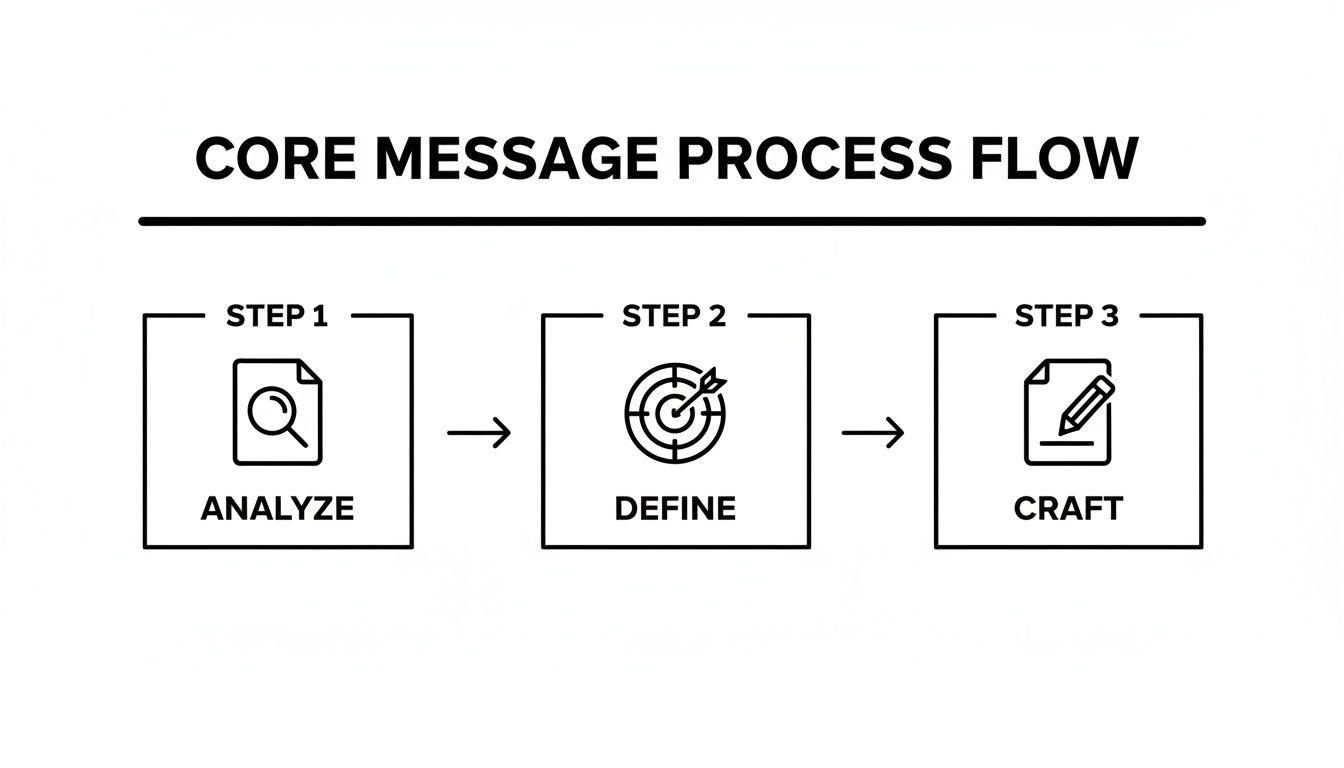
This simple flow—Analyze, Define, Craft—is a constant reminder that a great launch is born from careful strategy, not just frenetic activity.
Amplifying Your Launch with Discovery Platforms
A key piece of any modern SaaS launch is using discovery platforms to your advantage. These sites are watering holes for early adopters, tech junkies, and potential customers who are actively looking for new tools.
Launching on discovery platforms isn't just about the initial traffic spike. It's a strategic move to secure high-quality, high-DR backlinks that provide a foundational SEO boost from day one, helping you build long-term organic visibility.
Platforms like SubmitMySaas are built for exactly this. They connect you with that crucial first wave of users while generating the social proof and SEO authority you desperately need early on. The badge and 35+ backlinks that come with their launch package can give your domain's credibility a serious head start with search engines. For a step-by-step guide, check out their article on how to launch a SaaS product.
Don't go into launch day without a detailed checklist. It’s your safety net. This document should cover everything from pre-written social media copy to a schedule for replying to comments on launch platforms. A smooth, organized execution makes all the difference and ensures your hard work pays off.
Mastering Your SaaS Acquisition Channels
Once you've nailed your product and have a launch plan, the real work begins: bringing in a steady stream of customers. A smart saas product marketing strategy isn't about betting on a single channel. Relying only on paid ads is expensive, and hoping for a viral hit is just that—hope.
The goal is to build a balanced portfolio of acquisition channels that feed into each other, creating a powerful growth flywheel. Some will give you quick wins, while others are a long-term play, building a protective moat around your business that competitors can't easily cross. Let's dig into the channels that matter most for SaaS companies today.

Building Your Content and SEO Moat
Think of content marketing and SEO as assets, not expenses. They compound over time. When you turn off your ad spend, the leads stop. But a top-ranking blog post can deliver qualified traffic for years to come.
The secret is to get strategic and move beyond just publishing random articles. You need to build a content moat using the topic cluster model.
Here’s how it works: you create a massive, in-depth "pillar page" on a broad topic your customers care about. Then, you surround it with shorter, more specific "cluster" articles that dive into related sub-topics, with each one linking back to the main pillar.
- Pillar Page Example: "The Ultimate Guide to Remote Team Collaboration."
- Cluster Content Examples: "Best Tools for Asynchronous Communication," "How to Run an Effective Virtual Meeting," or "Managing Burnout in a Remote Team."
This structure tells search engines you're an authority on the subject, which helps all of your content rank higher. It also creates a fantastic experience for your readers, guiding them naturally from one helpful resource to the next.
Structuring High-Intent Paid Campaigns
While SEO is your long game, paid acquisition gets you immediate, predictable results. The key to making paid ads work without burning cash is to focus on high-intent channels where people are actively looking for a solution right now.
For most B2B SaaS, two platforms are non-negotiable:
- Google Ads (Search): Go after keywords that scream "I'm ready to buy." Think phrases like "best CRM for real estate agents" or "[competitor name] alternative." Yes, these clicks cost more, but they convert at a much higher rate because you're catching someone at the exact moment they need you.
- LinkedIn Ads: This is your playground for hyper-targeting. You can zero in on specific job titles, industries, and company sizes to get your message in front of the right decision-makers. A winning campaign here needs sharp copy and an irresistible offer, like a free trial or an industry-specific case study. If you're looking to fine-tune your approach, you can learn a ton from resources like The SaaS Ads Studio.
Pro Tip: Never, ever send paid traffic to your homepage. Create a dedicated landing page for each campaign with a single call-to-action. The message on the page should perfectly mirror the ad they just clicked. This alignment is a simple trick that can dramatically boost your conversion rates.
The Rise of Product-Led Growth
The most powerful trend in SaaS acquisition right now? Letting your product do the selling for you. Product-Led Growth (PLG) has taken over, and for good reason. It's a strategy where the product itself drives acquisition, conversion, and even retention.
Think of freemium models or free trials that let users see the product's value firsthand. This is especially potent for discovery platforms like SubmitMySaas, which feature daily launches of new AI and design tools. With customer expectations higher than ever, the best SaaS companies are growing faster by perfecting their onboarding. They know they need to get new users to that "aha!" moment within minutes to fight churn, which averages a painful 3.5% for B2B SaaS. You can dive deeper into these SaaS product marketing trends to see how they apply to your own strategy.
A great PLG model lives or dies by its user experience and a lightning-fast "time to value."
You generally have two paths to choose from:
- Freemium: Offer a forever-free plan with core features, just like Slack or Trello do. This is a massive lead generation machine, creating a huge top of funnel that you can later convert to paid plans.
- Free Trial: Give users the keys to the kingdom with full access for a limited time (usually 14 or 30 days). This approach works best for more complex products where people need to experience the entire feature set to really get it.
Whichever model you pick, your product's onboarding flow instantly becomes your most crucial marketing asset. It has to be intuitive, helpful, and completely focused on making your user successful.
Using AI and Niche Targeting to Dominate Your Market
In a market saturated with look-alike solutions, your best move isn't to be just a little bit better—it's to be completely different. Competing on features alone is a race to the bottom. Real, lasting dominance comes from owning a specific corner of the market and using today's technology to serve that corner better than anyone else.
This means you have to shift your thinking from broad appeal to razor-sharp focus. You want to build a product and a message so specific to one group of people that they feel like you built it just for them. At the same time, you need to use modern tools to execute that strategy with an intelligence and efficiency that was impossible just a few years ago.
The Power of Going Niche
The thought of narrowing your market can feel scary, especially when growth is the goal. But the numbers tell a fascinating story. The global SaaS market is already a massive $390.46 billion industry, growing at a rapid 19.38% clip each year.
But look closer. Vertical SaaS—software built for one specific industry—is hitting $157.4 billion while growing even faster at a 23.9% CAGR. That explosive growth isn't a fluke; it's proof that specialization is a powerful accelerator, not a limitation.
When you focus on a niche, say, project management software for architectural firms or a CRM designed purely for dental practices, you unlock some serious advantages:
- You sidestep the giants. Instead of trying to out-feature Asana or out-market HubSpot, you're playing a different game. You become the big fish in a well-defined pond.
- Your marketing just clicks. You can speak your audience's language, addressing their specific pains and workflows. That kind of resonance builds trust almost instantly and makes conversions way easier.
- You build a stickier product. By zeroing in on one vertical, you can solve deep, industry-specific problems that horizontal tools simply can't. That’s how you get true product-market fit.
This is the core idea behind Micro-SaaS and vertical SaaS. It’s a deliberate choice to be indispensable to a few, rather than just useful to many.
Weaving AI into Your Marketing Engine
If niching down tells you who to target, Artificial Intelligence defines how you do it. AI isn't just a buzzword anymore; it's a fundamental part of a modern marketing machine. The smartest product marketers are embedding it into every single stage of the customer journey to create personalized experiences at a scale we could only dream of before.
For example, AI can analyze user behavior inside your app to flag churn risks or spot the perfect upsell opportunity, often long before a human account manager would. It can also power dynamic website content that morphs based on a visitor's industry or company size, making your pitch feel custom-built on the fly.
Your competitors are already using AI to fine-tune their campaigns, personalize outreach, and generate content. If you're not putting AI to work in your marketing stack, you're essentially showing up to a Formula 1 race on a bicycle. You're at a massive disadvantage from the start.
Supercharging Your Strategy with Account-Based Marketing
For any B2B SaaS company chasing high-value contracts, Account-Based Marketing (ABM) is where niche targeting and AI-powered marketing come together beautifully. ABM flips the old sales funnel upside down. Instead of casting a wide net for leads, you start by hand-picking a list of your absolute dream customers.
Once you have that list, you treat each company like its own market. This is where AI becomes your most valuable player.
- Finding the right accounts: Use AI's predictive analytics to score potential accounts based on your ICP and, more importantly, to detect their buying intent signals from across the web.
- Creating personalized content: Automatically generate hyper-relevant ad copy, landing pages, and email sequences that speak directly to the known challenges of each target company.
- Optimizing your campaigns: Let AI continuously crunch the engagement data from your ABM efforts to shift budget and tweak messaging in real-time for the biggest possible impact.
When you combine a laser-focused niche strategy with the power of AI-driven tactics like ABM, you carve out a strong, defensible position in your market. To really drill down on how to make your product the leader in its space, you should explore AI visibility strategies tailored for SaaS companies. This one-two punch is how you stop just competing and start dominating.
7. Driving Retention Through Onboarding and Expansion
Getting a new customer isn’t the finish line—it’s the starting gun. This is where your entire SaaS product marketing strategy pivots from acquisition to pure value delivery. That brief window right after sign-up is everything. It's your one shot to prove your product's worth and lay the groundwork for a long-term relationship.
Nail this, and you turn a one-time transaction into a dependable, growing revenue stream. It all starts with a seamless onboarding experience that gets users to their first "aha!" moment as fast as humanly possible.

Designing a Frictionless Onboarding Flow
Those first few minutes a new user spends in your product are precious. A clunky, confusing, or empty-state experience is a guaranteed way to lose them forever. A great onboarding flow isn’t some passive product tour; it’s an active, goal-oriented process that makes the user feel like they've accomplished something right away.
To get there, you need to zero in on a few core ideas:
- Pinpoint the Core Activation Event: What's the one critical action a user must take to truly "get" your product's value? For a social media scheduler, it’s scheduling that first post. For a CRM, it’s importing their first contact. Your entire onboarding process should be laser-focused on getting them to that milestone.
- Use Interactive Walkthroughs: Forget long, boring video tutorials. Instead, build muscle memory with in-app tooltips, progress-tracking checklists, and guided actions that teach by doing.
- Personalize the Journey: Just a few simple questions during sign-up can make a world of difference. A marketer joining your platform has totally different needs than a sales rep, and their first experience should reflect that.
This is where smart tech comes into play. AI isn't just a buzzword anymore; it's a real factor in how we market. In fact, 64% of companies are now embedding AI directly into their marketing strategies. It goes even deeper, with 81% of B2B marketers using generative AI tools to hyper-personalize campaigns based on user behavior. If you want to dig into the numbers, these SaaS marketing statistics paint a clear picture of this shift.
Nurturing Users Beyond The First Session
Okay, so they're activated. Great. Now the real work begins: keeping them engaged and making your product an essential part of their daily routine. This isn't a single tactic but a combined effort of communication, community, and consistently delivering more value.
A well-oiled lifecycle email marketing program is your best friend here. Map out automated sequences that trigger based on what users actually do (or don't do) in your app.
- Welcome Series: Remind them why they signed up and nudge them back to finish any key setup steps they missed.
- Feature Adoption Campaigns: Shine a spotlight on valuable secondary features they haven't found yet. Show them new ways to win with your tool.
- Re-engagement Emails: Proactively reach out to users who have gone quiet, reminding them of the value they're missing and offering a helping hand.
Your product itself is your best retention tool. Consistently shipping improvements, fixing bugs, and listening to user feedback shows customers you are invested in their success, making them less likely to look for alternatives.
Turning Retention into Expansion Revenue
The real magic in SaaS isn't just keeping customers—it's growing with them. This is where expansion revenue comes in, and it's easily the most profitable growth lever you can pull.
Your strategy here is all about spotting natural moments for users to upgrade or add on services.
- Usage-Based Triggers: Build your pricing around a key value metric, like the number of contacts, projects, or gigabytes of storage. As a user gets close to their limit, the prompt to upgrade feels natural and justified by the value they're already getting.
- Feature Gating: Reserve your most powerful, advanced features for higher-tier plans. Then, use smart in-app messaging to show freemium or lower-tier users exactly what they’re missing out on. This creates a powerful, built-in incentive to upgrade when their needs evolve.
The table below breaks down some of the most effective tactics for both onboarding and long-term retention.
Onboarding and Retention Tactics
This table compares high-impact tactics that can seriously improve user activation and cut down on churn.
| Tactic | Impact on Activation | Impact on Retention | Implementation Effort |
|---|---|---|---|
| Interactive Walkthroughs | High | Medium | Medium |
| Onboarding Checklists | High | Medium | Low |
| Personalized Welcome Emails | Medium | High | Low |
| Lifecycle Email Campaigns | Low | High | Medium |
| In-App Feature Announcements | Low | High | Low |
| Usage-Based Upgrade Prompts | Medium | High | High |
Choosing the right mix of these tactics depends on your resources, but a strong start with checklists and a solid welcome series can make a huge difference right away.
By mastering onboarding, retention, and expansion, you stop fighting a leaky bucket and start turning your customer base into your most powerful and cost-effective growth engine.
Got Questions? Let's Talk Strategy.
Even the best playbook can leave you with a few head-scratchers. Building a solid SaaS product marketing strategy is a big job with a ton of moving pieces, so it's only natural to have questions. Here are a few common ones I hear all the time, along with some straight-up advice.
How Do I Pull This Off with a Tiny Budget?
When cash is tight, you have to get scrappy. Forget about a big ad spend and focus on activities where you can trade your time and creativity for results. This isn't just a short-term fix; it's how you build a real, sustainable engine for growth.
Your first priority should be a one-two punch of content marketing and SEO. It's a long game, but it creates an organic acquisition channel that pays dividends for years. While that's warming up, let your product do the heavy lifting. A well-designed free trial or a genuinely useful freemium plan can be your best salesperson.
A few other high-impact, low-cost moves to make:
- Smart Launch Platforms: Use a service like SubmitMySaas to get a burst of initial visibility. It's an affordable way to land in front of early adopters, get crucial feedback, and score some quality backlinks right out of the gate.
- Get into the Community: Find out where your ideal customers hang out online—think niche subreddits, industry Slack groups, or LinkedIn communities. Show up, be helpful, and build real relationships. It’s about listening and learning, not just blasting your sales pitch.
- Team Up: Find a non-competing company that serves a similar audience and partner up. You could co-host a webinar, write an ebook together, or even just swap guest posts. It's a fantastic way to get in front of a new, qualified audience without spending a dime.
What Metrics Actually Matter for a SaaS Product Marketer?
It’s easy to get lost in a sea of data. The key is to ignore the vanity metrics (looking at you, social media likes) and zero in on the numbers that directly impact revenue and customer happiness. Your dashboard shouldn't just be a bunch of charts; it should tell you the story of your business's health.
The specific metrics you obsess over will change as you grow, but these five are non-negotiable for any SaaS product marketer:
- Website-to-Trial Conversion Rate: Are people who visit your site actually signing up? This tells you how well your messaging is landing.
- User Activation Rate: How many of those signups are actually using the product and hitting that "aha!" moment? This is your onboarding report card.
- Monthly Recurring Revenue (MRR): The classic top-line growth metric. Is it going up and to the right?
- Customer Churn Rate: How many customers are leaving you each month? This is a critical indicator of product-market fit and customer satisfaction.
- LTV to CAC Ratio (Customer Lifetime Value to Customer Acquisition Cost): Is your business model sustainable? This ratio tells you if you're making more from customers than you're spending to get them.
When you're just starting out, pour all your energy into activation and engagement. Once you start to scale, that LTV:CAC ratio becomes your north star. It's the single most important number for proving you have a profitable business.
How Often Should I Revisit My Product Marketing Strategy?
Think of your strategy as a living, breathing document, not something you carve in stone and file away. The market simply moves too fast for a "set it and forget it" approach.
I recommend scheduling a deep, comprehensive review every quarter. This is your chance to zoom out and make sure your marketing plan is still perfectly synced up with your bigger company goals, like your OKRs.
But don't wait three months to look at the data. You should be checking in on your core KPIs weekly, or bi-weekly at the very least. This is how you spot trends—good or bad—and react before it's too late. A new competitor, a sudden shift in what customers are asking for, or a dip in a key metric could all be signals that you need to pivot now. Stay agile, and let the data and your customers guide you.
Ready to get your SaaS in front of thousands of early adopters and build a powerful SEO foundation? SubmitMySaas can amplify your launch with features on our daily discovery platform and provide a package of high-quality backlinks to kickstart your growth. Get the exposure your product deserves.