What is Product Positioning - what is product positioning for SaaS success
Discover what is product positioning - learn frameworks, real SaaS examples, and how to craft a standout strategy.
Product positioning is all about defining where your product fits in the market and, more importantly, in the minds of your customers. It’s the deliberate process of carving out a unique identity for your SaaS so that when your ideal user thinks about solving a specific problem, your product is the first thing that comes to mind.
Think of it as claiming a specific piece of mental real estate. You want to own that spot.
Why Product Positioning Is Your Most Important Launch Tool

Imagine trying to find your car in a massive stadium parking lot after a game. It’s a sea of similar-looking vehicles, and without knowing your exact spot, you’d wander for ages. Launching a SaaS product into a crowded market feels a lot like that. Without clear positioning, you’re just another car in the lot, easily overlooked.
Good positioning isn't about changing what your product is; it's about changing how people think about it.
It acts like your personal GPS, guiding your ideal customers directly to you. This becomes the bedrock of your entire story—influencing every ad you run, every sales call you make, and every feature you decide to build next.
What's The Real Goal Here?
At its core, the objective is to become the go-to, no-brainer choice for a very specific group of people wrestling with a very specific problem. You aren't trying to build a tool for everyone. That's a recipe for failure. Instead, you're aiming to be the only real solution for a niche you understand inside and out.
This kind of laser focus gets your entire team on the same page. When your positioning is nailed down, everyone from engineering to sales knows the answers to these critical questions:
- Who are we actually selling to? This is your ideal customer profile, defined in detail.
- What painful problem do we solve for them? This is the core value you deliver.
- Why are we the best ones to solve it? This is your unique differentiator, your secret sauce.
Strong positioning isn't some fluffy marketing task—it's a core business strategy. It answers the most fundamental question of all: in a world full of options, why should anyone choose you?
To give you a quick reference, here are the core principles of effective product positioning.
Core Principles of Product Positioning at a Glance
| Principle | Description | Why It Matters for SaaS |
|---|---|---|
| Customer-Centric | Positioning must start with the customer's needs, pains, and goals—not your product's features. | SaaS buyers purchase outcomes, not just software. If your positioning doesn't speak to their problem, they won't listen. |
| Competitive Differentiation | You must identify a unique space in the market that sets you apart from direct and indirect competitors. | The SaaS market is incredibly crowded. Without a clear differentiator, you'll be forced to compete on price alone, which is a race to the bottom. |
| Authenticity & Credibility | The claims you make in your positioning must be believable and backed up by your product's actual capabilities. | Trust is everything. Overpromising and under-delivering is the fastest way to kill your reputation and churn customers. |
| Simplicity & Clarity | Your positioning should be easy to understand, remember, and repeat. Avoid jargon and complexity. | Your message needs to cut through the noise. If a potential customer can't grasp what you do in seconds, they'll move on. |
| Consistency | Your positioning must be reflected across all touchpoints: website, ads, sales decks, and customer support. | A consistent message builds a strong, memorable brand identity and reinforces your value proposition at every stage of the customer journey. |
These principles are the building blocks that ensure your product doesn't just launch, but actually lands with the right audience.
Positioning in Today's Crowded Tech Market
The desperate need for products to stand out has turned positioning into a massive industry. In 2024, the market for Product Positioning and Messaging Services hit a valuation of USD 1.5 billion, and experts predict it will more than double to USD 3.5 billion by 2035.
This explosion is fueled by brands scrambling to differentiate themselves. North America currently leads the charge with a 75% market share, as countless tech startups and indie founders rely on sharp positioning to get noticed.
While our main focus here is on the product itself, it's helpful to understand the bigger picture of What Is Brand Positioning to see how your product fits into your company's broader story.
Ultimately, your positioning is the essential first step in building a successful SaaS product marketing strategy. It’s the compass that ensures every single marketing dollar and hour of effort moves you in the right direction.
The Four Pillars of a Powerful Positioning Strategy
To build a product positioning strategy that actually works, you need to lay a solid foundation. Think of it like building a house—if the supports are weak, the whole thing comes crashing down. Your presence in the market depends on four of these essential pillars. Nail these, and you'll have the clarity to carve out your unique space.
These pillars aren't separate ideas; they work together to paint a clear picture of where you fit and, more importantly, why anyone should care. Getting them right is the first real step in turning a vague concept into a strong, defensible position in the market.
Pillar 1: Your Target Audience
First things first: who is this for? Trying to be everything to everyone is a classic startup mistake that just leads to a watered-down message and a ton of wasted cash. You have to get specific and define a niche audience whose problems you solve better than anyone else.
This isn't just about demographics. You need to get inside their heads and truly understand their world.
- Pains and Frustrations: What are the nagging problems that keep them up at night? A project manager, for instance, might be constantly frustrated by team members missing deadlines because communication is all over the place.
- Goals and Aspirations: What are they ultimately trying to achieve? That same project manager just wants to deliver projects on time and under budget, maybe even get some recognition for being so darn efficient.
- Behavior and Workflow: How are they getting by right now? They're probably juggling spreadsheets, endless email threads, and a dozen Slack channels—a chaotic and clunky process.
When you define this group with this level of detail, your entire strategy can be tailored to speak directly to them.
Pillar 2: Your Market Category
Okay, you know who you're talking to. Now, you need to define the "pond" you're swimming in. Your market category is the mental shortcut customers use to understand what your product is. It’s the shelf in their brain where they place your solution.
For example, if you've built an AI-powered writing assistant, are you a "grammar checker" like Grammarly, or are you a "creative writing tool" like Jasper? The category you pick immediately sets customer expectations and tells them who you're up against.
You can either fit neatly into an existing category or, if your product is a true game-changer, create a new one. Just be warned: creating a new category is a much heavier lift. It means you have to educate the entire market on a whole new way of doing things.
Choosing your category is a massive strategic decision. It instantly tells people what you’re about and what the alternatives are, helping them "get it" in a split second.
Pillar 3: Your Unique Differentiators
With your audience and market sorted, the next step is to figure out what makes you different—and more importantly, better. Your unique differentiators are the specific benefits or features that make your product stand out from the pack. They're the real reasons a customer should choose you.
A differentiator isn't just a feature; it's a feature that provides a unique benefit nobody else can claim.
- For a project management tool: It's not just "task lists." It's "automated dependency tracking that prevents bottlenecks before they even happen."
- For an email marketing platform: It could be "AI-powered send time optimization that guarantees a 20% higher open rate."
Great differentiators have to be true, provable, and actually relevant to your target audience's problems. A unique feature that nobody cares about isn't a differentiator—it's just noise.
Pillar 4: Your Brand Promise
This final pillar is what ties everything together. Your brand promise is the core value you swear to deliver every single time a customer uses your product. It’s the combination of functional and emotional benefits they can count on. This is the very soul of your positioning, boiled down to one powerful idea.
Think of it as your product's core identity. For Slack, the promise was a life with less email clutter and more productive teamwork. For Canva, it was giving non-designers the power to create professional-looking graphics. This promise has to show up everywhere—in your marketing, in the product itself, and in your customer support. A strong promise builds trust and turns casual users into die-hard fans. This also has a direct impact on how you make money; you can see how value perception shapes what you can charge in our guide to SaaS pricing strategies.
Together, these four pillars—Audience, Category, Differentiators, and Promise—create the strategic blueprint for what your product is and who it's for.
Actionable Frameworks to Define Your Market Position
Alright, you've done the homework. You know your audience, you've sized up the market, and you have a solid handle on what makes your product different. But how do you pull all those insights together into something tangible?
This is where frameworks come into play. Think of them as the blueprints for your market position. They provide a structured way to turn your research and ideas into a clear, defensible spot in the market that your entire team can rally behind.
Let's walk through three of the most effective frameworks I’ve seen SaaS founders use to nail their positioning. Each one gives you a different, practical lens to build and refine your strategy.
Crafting Your Positioning Statement
The positioning statement is the classic for a reason: it’s direct, powerful, and forces you to be brutally clear. This isn't marketing copy meant for your website; it's a concise, internal-facing paragraph that acts as your team's North Star.
A great positioning statement answers the most vital questions about your product using a simple, time-tested format. Here's a template you can steal:
For [Your Target Audience], who [have a specific need or pain point], our [Product Name] is a [Market Category] that [provides a key benefit/brand promise]. Unlike [Primary Competitor/Alternative], our product [has a unique differentiator].
Let's make this real. Imagine a fictional SaaS called "SyncUp," a project management tool for creative agencies.
- Example Statement: "For remote marketing teams who struggle with siloed communication, SyncUp is a collaborative workspace that centralizes all project assets and conversations. Unlike general-purpose tools like Trello, our product offers integrated client feedback portals, saving agencies an average of 10 hours per week on revisions."
Boom. In just two sentences, we know exactly who it's for (remote marketing teams), what it is (a collaborative workspace), the core promise (centralized assets), and the killer differentiator (client feedback portals). Getting this clarity is a non-negotiable first step before you can figure out how to launch a SaaS product successfully.
This diagram shows how all these core components—audience, market, differentiators, and your core promise—fit together to build your positioning.
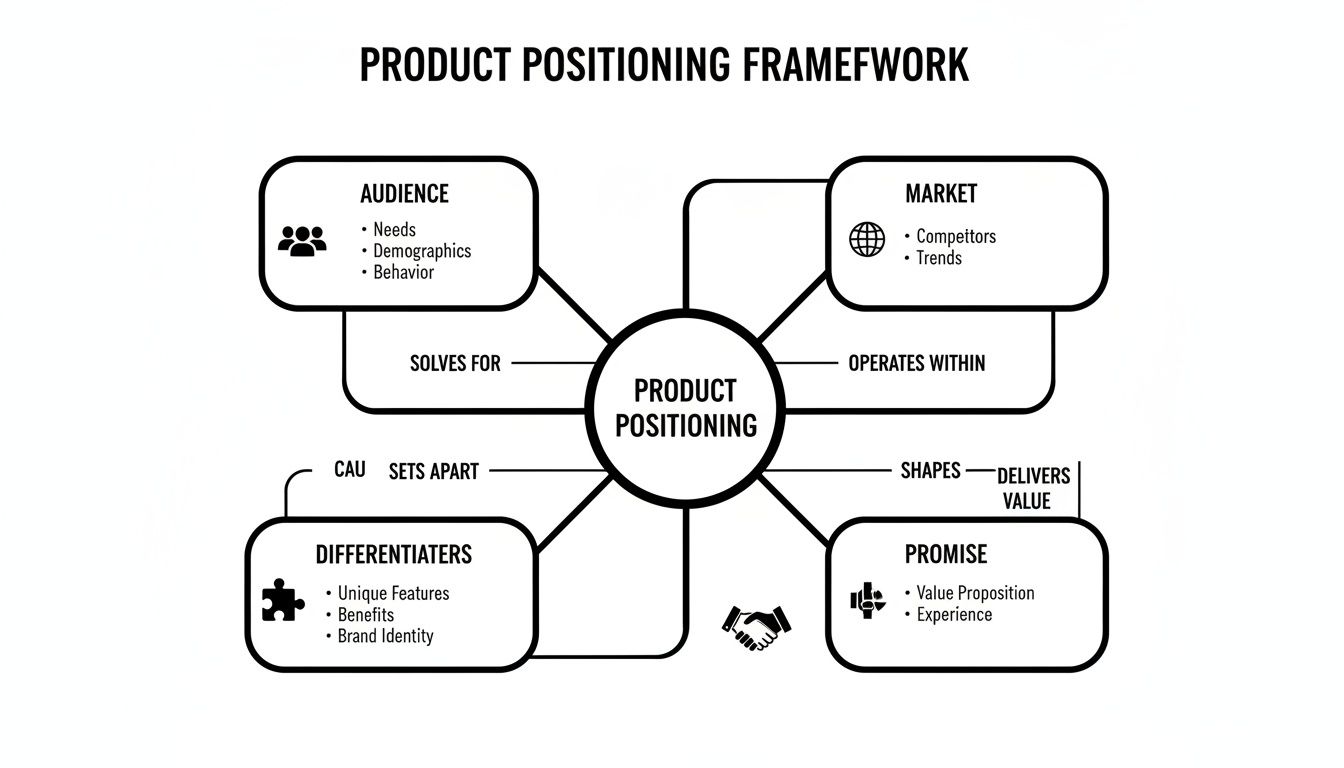
As you can see, a strong position isn't built on just one thing. It's the intersection of all these elements that gives your product a solid foundation in the market.
Using a Value Proposition Canvas
While the positioning statement defines your space in the market, the Value Proposition Canvas ensures your product actually solves a real problem for the people in that space. It's a fantastic tool for making sure you’re not just building features, but building solutions.
The canvas is split into two halves:
- Customer Profile: You get deep into your customer's world here. What are their "Jobs to be Done"? What "Pains" do they run into? And what "Gains" would make them heroes?
- Value Map: This is your product's side. You list your "Products & Services" (your features), how they act as "Pain Relievers," and how they become "Gain Creators" for your customer.
The magic happens when your Value Map perfectly mirrors the Customer Profile—when every pain has a reliever and every desired gain has a creator. That perfect fit is the core of a compelling value proposition.
Visualizing the Market with Perceptual Mapping
Finally, there's perceptual mapping (often just called a positioning map). This is a simple visual exercise that helps you see the competitive landscape in an instant. It’s all about understanding where you fit based on what customers actually care about.
You just plot your product and your competitors on a two-axis chart. For a SaaS business, those axes could be anything from Price vs. Ease of Use to Feature Set vs. Target Customer (e.g., SMB vs. Enterprise).
Here’s how to build one:
- Step 1: Pinpoint the two most important attributes your customers use to compare solutions.
- Step 2: Draw a simple X/Y graph, with each axis representing one of those attributes.
- Step 3: Plot your competitors on the map based on where the market perceives them. Be honest!
- Step 4: Place your own product on the map—either where it is today or where you want it to be.
Your goal is to find the open space. That gap in the market is your opportunity to own a unique position where you can thrive with less direct competition.
Comparing Product Positioning Frameworks
Choosing the right framework depends on what you need to achieve right now. Are you trying to align your internal team, validate your product-market fit, or find a gap in a crowded market? This table breaks down which tool is best for each job.
| Framework | Best For | Key Output | Complexity |
|---|---|---|---|
| Positioning Statement | Internal team alignment and creating a single source of truth for your market position. | A concise, one-paragraph statement that defines your audience, category, benefit, and differentiator. | Low |
| Value Proposition Canvas | Deeply understanding customer needs and ensuring your product features directly solve their problems. | A detailed map connecting customer jobs, pains, and gains to your product's features and benefits. | Medium |
| Perceptual Map | Visualizing the competitive landscape and identifying underserved market opportunities. | A two-axis chart that plots you and your competitors based on key customer attributes. | Low |
You don't have to pick just one. In fact, the most successful founders I know often use the Positioning Statement as their north star, validate it with the Value Proposition Canvas, and use the Perceptual Map to make sure their chosen spot is truly unique.
Product Positioning Examples from Top SaaS Brands
Theory is great, but the best way to really get a feel for product positioning is to see it in the wild. The most successful SaaS brands didn't just stumble into market leadership. They strategically claimed a specific, unoccupied space in their customers' minds.
Let's pull back the curtain on three iconic companies to see how they translated a sharp positioning strategy into complete market dominance.
Slack: The Email Killer
Remember life before Slack? Team communication was a nightmare of endless email chains, random instant messages, and frustrating file-sharing workarounds. Slack didn’t just enter this chaotic space as a better messaging app; it arrived as a fundamentally new way for teams to work together.
Target Audience: They went after tech-savvy teams, developers, and startups who were drowning in internal emails. These were people who valued speed and transparency and felt that email was a slow, clunky bottleneck for real-time collaboration.
Market Category: Slack brilliantly defined itself as a “collaboration hub.” This wasn't about competing with other chat apps. Instead, they declared war on a much bigger and more hated enemy: internal email.
Unique Differentiator: The magic was in its channel-based communication and powerful integrations. Conversations were organized into public channels, making information searchable and accessible to everyone. By connecting with hundreds of other tools, it became the central nervous system for a company's entire workflow.
By framing email as the villain, Slack gave teams a powerful and compelling reason to make the switch. It wasn't just a new tool—it was a better way of working.
Notion: The All-in-One Workspace
The productivity software market was a mess of disconnected tools. You had Google Docs for documents, Trello for projects, and Confluence for wikis. Notion's stroke of genius was positioning itself not as a competitor to any single one of them, but as the elegant replacement for all of them.
Target Audience: Notion zeroed in on individuals and teams who love to build and customize their own workflows—think creators, students, startups, and product managers. These users were fed up with rigid, single-purpose tools and craved a flexible platform they could shape to their exact needs.
Market Category: They carved out a new category: the "all-in-one workspace." This simple phrase instantly communicated their core value—consolidation. They promised to cut the complexity and cost of juggling multiple subscriptions by bringing everything under one roof.
Unique Differentiator: Its superpower is the flexible, block-based architecture. This "Lego-like" system lets users build anything from a simple to-do list to a complex company-wide operating system. None of its single-purpose competitors could come close to offering that level of customizability.
Notion’s success proves that a powerful position can be built on replacing a cluttered toolbox with a single, elegant Swiss Army knife. It sold the promise of simplicity and ultimate control over one's digital environment.
Canva: Democratizing Design
Not long ago, graphic design was locked away for professionals who could master complex and expensive software like Adobe Photoshop. For small business owners, marketers, or students, creating a simple social media post was a genuinely intimidating task. Canva saw this massive, underserved market and built its entire company around them.
Target Audience: Non-designers. Simple as that. This included anyone who needed to create professional-looking visuals but lacked the skills, budget, or time to learn traditional design tools.
Market Category: Canva brilliantly positioned itself as “Design for Everyone.” It wisely avoided a feature-for-feature battle with Adobe. Instead, it created an entirely new market focused on accessibility and simplicity.
Unique Differentiator: Its game-changer was the template-driven, drag-and-drop interface. By providing thousands of beautiful, ready-to-use templates, Canva removed the biggest obstacle for its audience: the terror of the blank page. It made design feel easy and fun.
This core idea—placing your product in the right context for the right person—is a universal principle. Globally, product placement spending is projected to hit USD 33 billion by 2024, a testament to how valuable it is to position a product naturally within a relevant environment. This is especially true in media, where brands like Apple placed products in films and shows to help build a user base of over 1.5 billion people.
You can explore more insights on this trend from PQ Media. For a SaaS company, the goal is exactly the same: become the obvious, natural choice for your ideal customer.
A Step-by-Step Guide to Crafting Your Positioning

Alright, let's get practical. Building your positioning isn't some abstract marketing theory—it’s a hands-on process that every founder needs to master. I’ve broken it down into five straightforward steps that take you from a vague idea to a rock-solid, defensible spot in the market.
Think of this as your roadmap for understanding your audience, sizing up the competition, and nailing down exactly what makes your product the only logical choice.
Step 1: Analyze Your Target Customers
Everything—and I mean everything—begins and ends with the customer. To create positioning that actually sticks, you have to understand your audience on a gut level, far beyond surface-level demographics. Great positioning is built on a foundation of empathy for their day-to-day headaches and what they’re ultimately trying to achieve.
The best way to do this? Talk to them. Get on a call with current users or folks in your target market. Your goal is to uncover the real story, the "why" behind their search for a solution.
Ask questions that get to the heart of the matter:
- What was the specific trigger that made them start looking for a product like yours?
- In their own words, what does success look like after using your solution?
- What are the most infuriating parts of their current process they’re trying to escape?
- Listen closely to the exact words and phrases they use to describe their problems. (Steal their language—it’s more powerful than yours.)
This kind of qualitative feedback is pure gold. It’s what lets you craft messaging that connects instantly because it speaks their language and validates their struggles.
Step 2: Map the Competitive Landscape
Your product doesn't exist in a bubble. Your prospects are constantly comparing you to other options, so you need a crystal-clear picture of how you measure up. This step is all about getting real about who you’re up against and how they’re pitching themselves.
Create a simple matrix to map your product against your 2-3 biggest competitors. Dig into their websites, comb through customer reviews, and dissect their marketing copy to figure out their game plan.
A quick pro-tip: Don't limit yourself to direct competitors. You need to think about indirect alternatives, too. If you're building a project management tool, you're not just competing with Asana or Trello. You’re competing against spreadsheets, messy Slack channels, and a wall of sticky notes.
This exercise isn't just about spying on the competition. It’s about finding the gaps—the unmet needs or overlooked customer groups that you can swoop in and own.
Step 3: Isolate Your Unique Differentiators
Now that you have a clear view of your customers and the competition, you can finally pinpoint what makes your product genuinely different and, more importantly, better. A strong differentiator isn't just a cool feature; it has to be relevant, defensible, and provable. If nobody cares about it, it’s not a differentiator—it’s just noise.
To find your unique angle, try finishing this sentence: "Unlike everyone else, only we..."
- ...have a specific feature that cuts down report-generation time by 50%.
- ...focus exclusively on creative agencies, giving us deep, unparalleled expertise.
- ...offer an intuitive user experience that gets a new team member up and running in under 10 minutes.
This differentiator becomes the heart of your value proposition. It’s the single biggest reason someone should pick you over everyone else.
Step 4: Craft and Validate Your Positioning Statement
It's time to pull all your hard work together into a sharp, focused positioning statement. This isn't for your website homepage; it's an internal North Star that keeps your entire team aligned.
Use this simple, battle-tested template:
- For: [Your ideal customer profile]
- Who: [Is struggling with this specific pain point]
- Our Product Is A: [The category you compete in]
- That Provides: [The single most compelling benefit]
- Unlike: [The main competitor or old way of doing things]
- Our Product: [Delivers on this key differentiator]
Once you have a draft, don't just admire it in a Google Doc. Get it in front of real people. Share the core idea with a few of your ideal customers. If they immediately nod and say, "Wow, that's exactly what I need," you know you've hit the mark.
Step 5: Use Analytics to Refine and Iterate
Finally, remember that positioning is never "done." It’s a living, breathing strategy that must evolve as your product and the market change. This is where data becomes your most trusted advisor. There's a reason the Product Analytics Market is set to skyrocket from USD 14.73 billion in 2023 to USD 84.33 billion by 2032. Smart founders are using data to sharpen their edge.
In fact, 65% of successful SaaS launches in 2024 used positioning maps built from analytics to boost retention by a massive 35%. You can read more about the Product Analytics Market growth on snsinsider.com. Use your analytics tools to see how customers actually use your product, then feed those insights back into your messaging to double down on what truly matters to them.
Common Positioning Mistakes That Sink Startups
You can learn a lot by watching where others have stumbled. I've seen countless promising SaaS products crash and burn, not because their tech was bad, but because their positioning was completely broken. If you want your launch to have a fighting chance, you have to sidestep these common traps.
The biggest pitfall? Trying to build something for everyone. It's a "spray and pray" strategy that just doesn't work. When you try to position your product for the entire world, you end up with a watered-down message that connects with absolutely no one.
Trying to Be Everything to Everyone
This is, without a doubt, the most frequent mistake I see. Founders create a product so generic that it fails to resonate with any real, specific group of people. Think about a tool that calls itself "the best productivity app for busy professionals"—what does that even mean? It's hopelessly vague.
Now, compare that to a tool positioned as "the ultimate project manager for remote creative agencies." See the difference? That second one immediately carves out a niche it can own.
A product for everyone is a product for no one. Strong positioning demands a ruthless focus on a specific audience with a specific problem you can solve better than anyone else.
Without that laser focus, your marketing becomes bland, your feature development loses its way, and you simply disappear into the noise of a crowded market.
Confusing Features with Benefits
Here's another classic blunder: leading with what your product does instead of what it does for the customer. People don't buy features; they buy better versions of themselves. They don't give a damn about your "AI-powered algorithm"—they care that it saves them 10 hours a week on soul-crushing data entry.
It's all about translation.
- Feature: "Our software has integrated analytics dashboards." (So what?)
- Benefit: "Make smarter business decisions in minutes with at-a-glance insights into your performance." (Now you're talking!)
Always, always translate your features into the real-world value they deliver.
Ignoring the Competitive Landscape
It's easy to get so obsessed with your own product that you forget customers have other choices. If you don't take the time to understand how your competitors are positioning themselves, you have no shot at standing out. You'll just end up building a "me-too" product that gives people zero compelling reasons to make the switch.
Finally, some founders treat positioning as a one-and-done task. That's a death sentence. Markets change, new competitors pop up, and your customers' needs will evolve. You have to constantly revisit and tweak your positioning to stay sharp. If you aren't adapting, you aren't competing.
Got Questions? Let's Talk Positioning.
We've walked through the what, why, and how of product positioning. But when the rubber meets the road, a few common questions always seem to pop up. Let's tackle them head-on.
What’s the Real Difference Between Product Positioning and Branding?
This one trips people up all the time. Here's a simple way to think about it: positioning is what you do, while branding is who you are.
Product positioning is a sharp, strategic exercise. It’s the logical case you build for your product, defining exactly who it's for, what market you're playing in, and why you’re the best choice. It’s all about carving out a specific, defensible spot in your customer’s mind.
Branding is the bigger picture. It’s the vibe, the feeling, the entire emotional gut reaction someone has to your company. It’s your logo, your tone of voice, your values—the whole personality. Great positioning is a critical building block for a strong brand, but the brand itself is the emotional story that wraps around everything you do.
How Often Should I Revisit My Product Positioning?
Don't let your positioning statement gather dust. The market is constantly shifting, and what worked last year might be totally off base today. A good rule of thumb is to give it a proper review at least once a year, or anytime you feel a major shift under your feet.
It's definitely time for a formal review if you see things like:
- A serious new competitor just showed up to the party.
- Your customers' core needs are evolving.
- Your sales team starts losing more deals to competitors than they used to.
- You're about to launch a game-changing feature or expand into a completely new market.
A "set it and forget it" mindset is a surefire way to become irrelevant. Staying on top of your positioning means you're always the right answer for your ideal customer, no matter how much the world changes.
Can My Product Have More Than One Positioning Statement?
This is a tricky one, but the short answer is no. You should have one primary positioning statement that serves as your single source of truth. It's your North Star.
What you can have, however, is different messaging for different audiences. Your core positioning—the unique value that makes you, you—never changes. It’s your bedrock.
But the way you talk about that value can, and should, adapt. For instance, the pain points you highlight for a massive enterprise company will be different from the benefits you shout about to a scrappy startup. The fundamental value is the same, but you’re just shining the spotlight on the part that matters most to each specific group.
Ready to carve out your unique space in the tech world? SubmitMySaas is the launchpad that gets your product in front of thousands of early adopters, founders, and tech enthusiasts. Boost your SEO and drive initial traction with a single submission. Get your SaaS discovered on SubmitMySaas.com.