What Is Domain Authority in SEO and How Can You Boost It
What is Domain Authority in SEO? Learn how this score predicts ranking potential, how it's calculated, and the actionable strategies you can use to improve it.
If you've spent any time in the SEO world, you've probably heard the term "Domain Authority" or "DA" thrown around. So, what is it, really?
At its core, Domain Authority (DA) is a search engine ranking score developed by the SEO experts at Moz. It's designed to predict how likely a website is to rank on search engine results pages (SERPs). The score runs on a logarithmic scale from 1 to 100—the higher the score, the stronger your website's ranking potential.
What Is Domain Authority and Why It Matters
Think of Domain Authority as your website's "street cred." A business with a stellar reputation tends to attract more customers and build trust effortlessly. Online, a high DA works in a similar way, signaling to search engines that your site is a trustworthy, credible, and authoritative source of information.
It's crucial to understand that DA is not an official Google ranking factor. Google doesn't look at your Moz DA score and decide where to place you. However, it's an incredibly useful proxy metric. Because DA is heavily influenced by the quality and quantity of backlinks pointing to your site—a major Google ranking factor—it gives you a reliable way to gauge your site's competitive strength and overall SEO health.
For a new SaaS product, building a solid DA from the get-go is like getting a VIP pass to your industry. It helps you cut through the noise and gain visibility much faster.
The Origins of Domain Authority
Back in the day, Google had its own public metric called PageRank. When Google made PageRank less transparent, a void was left. Around 2009, Moz stepped in and created Domain Authority to fill that gap, offering a predictive score from 1 to 100.
While the old PageRank was mostly about the volume of links, DA is more sophisticated. It crunches data from over 40 different signals to calculate its score, with the quality and number of incoming links being the most significant factors by far.
Practical Implications for Your SEO Strategy
Knowing your DA score is one thing; using it to drive growth is another. It gives you a clear benchmark of where you stand against your competitors. If your top rival has a DA of 65 and you're sitting at 30, you know you have some ground to cover. This helps you set realistic goals and spot opportunities to overtake competitors with weaker link profiles.
A higher Domain Authority doesn't just improve your ranking potential; it also often correlates with faster indexing times from Google. When Google sees your site as authoritative, it's more likely to crawl and index your new content quickly.
This speed is a massive advantage for any product launch, as it means you can start pulling in organic traffic almost immediately. Building a strong foundation involves earning a valuable DA backlink from reputable sites. Focusing on high-quality link-building from day one is the surest path to building your digital reputation and learning how to increase website traffic organically.
How Is Your Domain Authority Score Calculated?
So, how does Moz actually cook up this number? If you want to get a real handle on what is domain authority in SEO, you have to look under the hood. While their official recipe includes over 40 different ingredients, the entire calculation really comes down to one thing: your website’s backlink profile.
Think of it like a credit score for your website. Just as responsible financial habits build a strong credit rating, high-quality backlinks from reputable sites build a stronger DA score. It all boils down to two key components: the number of different websites linking to you and the authority of those sites.
Every backlink is like a vote of confidence, but not all votes carry the same weight. A single link from an industry giant like Forbes has a much bigger impact than a hundred links from brand-new, unknown blogs. It’s the difference between a rave review from an industry icon and a stack of flyers someone left on parked cars.
The Role of Linking Root Domains
The number of unique websites that link to yours—what we call linking root domains—is a huge piece of the puzzle. It’s far better to get 100 links from 100 different websites than to get 100 links from just one site.
Why? Because having a diverse group of sites linking to you signals to search engines that your content is widely respected and useful across the web. It shows your influence isn't just limited to a small niche; it has broad appeal, and that's a powerful signal for building a higher DA.
Quality Over Quantity Is the Golden Rule
Just chasing link numbers won't get you very far. The quality of those links is what truly matters. The algorithm looks at the authority of the sites linking to you. A backlink from a website that already has a high DA score passes more value—or "link juice"—to your site, acting as a much stronger endorsement.
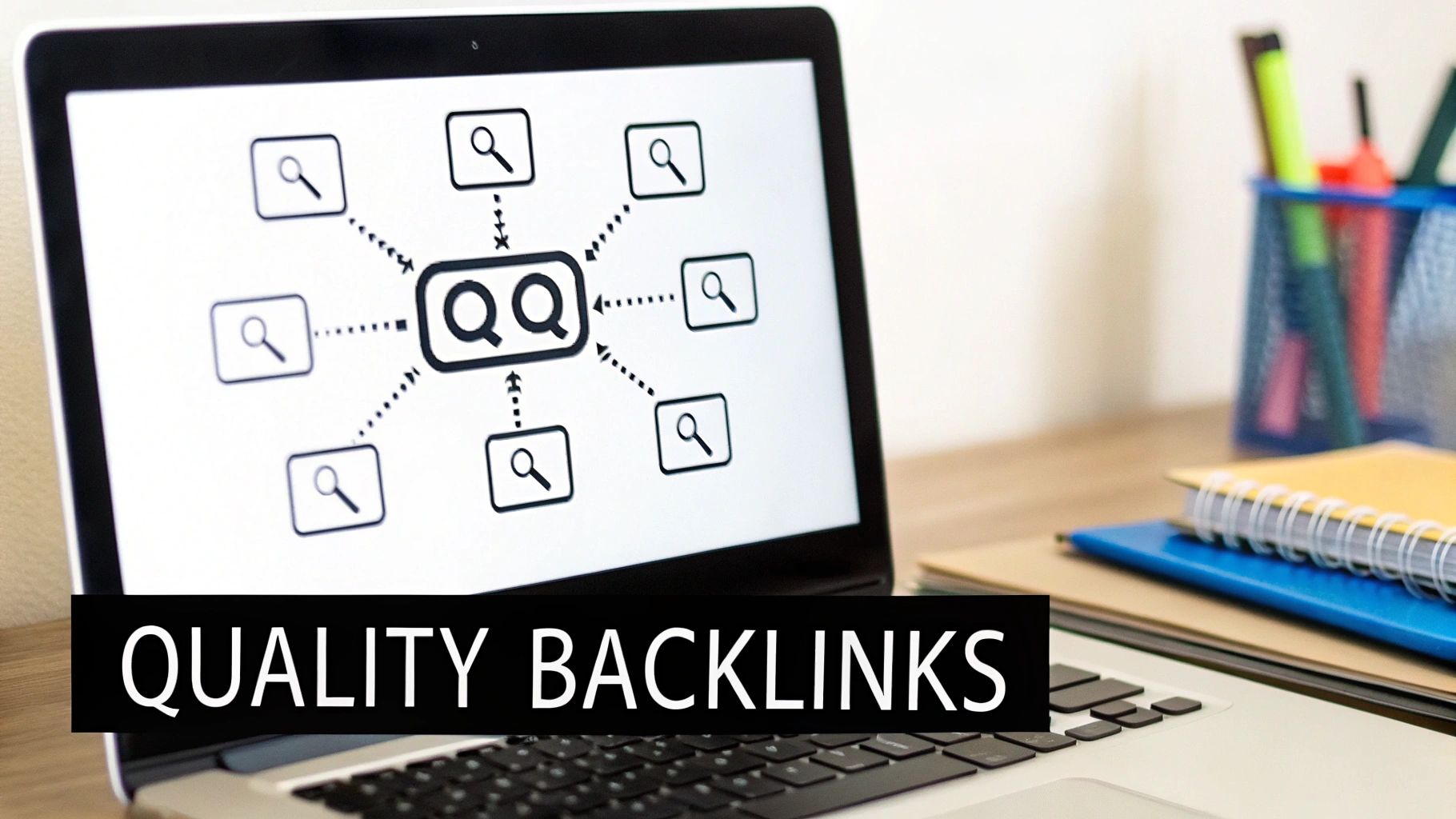
As you can see, a strong backlink profile built on authoritative, relevant sources is the engine that drives a higher DA. In the competitive tech world, this becomes a critical benchmark. Moz’s own data shows that sites with over 1,000 diverse inbound links often land in the 65-75 DA range, while those with fewer than 100 links tend to hover between 20-30.
Understanding the Logarithmic Scale
Finally, there’s a catch: DA is measured on a 100-point logarithmic scale. This simply means it gets exponentially harder to raise your score the higher it gets.
Moving your DA from 20 to 30 is far easier than climbing from 70 to 80. The higher you climb, the more high-quality, authoritative backlinks you need to earn for even a small bump in your score.
This system really hammers home the importance of link quality as your website grows. Early on, you can make gains by building a solid foundation of links. But to keep growing, you need to start earning links from the true heavy hitters in your industry.
To keep tabs on your progress, there are plenty of excellent free SEO tools that can help you analyze your backlink profile and track the metrics that influence your DA.
Busting the Biggest Myths About Domain Authority
When you're trying to figure out what Domain Authority really is, you first have to wade through a ton of misinformation. It's easy to get sidetracked by these myths, chasing a score on a dashboard instead of focusing on what actually moves the needle for your business. Let's clear the air and set the record straight on a few of the most common ones.
The biggest one? That Domain Authority is a ranking factor used by Google. It's simply not true. Google doesn't check your Moz DA score before deciding where to rank you. Think of DA as a weather forecast—it can give you a pretty good idea of what’s happening, but it isn’t the weather itself. It’s a predictive metric that often correlates with ranking potential because it’s built on signals Google does value, like high-quality backlinks.
Myth 1: You Can Directly "Fix" Your DA Score
So many people think they can just flip a few switches or complete a checklist to boost their DA. If only it were that simple! You can't just "update" your score with a few quick actions and expect it to jump.
Your Domain Authority score is an outcome, not an input. It’s a reflection of your site’s overall SEO health and the strength of your backlink profile. Improving it is the natural result of consistent, long-term work on link building, content creation, and technical SEO.
Instead of asking, "How do I increase my DA?" you should be asking, "How do I build a more authoritative website?" Focus on the right things, and the score will eventually take care of itself.
Myth 2: A High DA Is a Golden Ticket to High Rankings
It's tempting to see a high DA score and think you've made it. But while a strong score is a great asset, it’s just one piece of a much bigger SEO puzzle. A website with a DA of 80 can absolutely be outranked by a competitor with a DA of 40 if that smaller site nails the user's search query better.
Plenty of other critical factors are in play:
- Content Relevance: Your content has to be the best answer to what someone is searching for. A laser-focused article on a lower-authority site will almost always beat a generic, vague piece on a site with a higher DA.
- On-Page SEO: The fundamentals still matter. Smart keyword usage, clean page structure, and compelling meta descriptions send powerful relevance signals to search engines.
- Topical Authority: Search engines love experts. A site that proves it has deep knowledge in one specific niche can often punch well above its weight and outrank generalist sites.
- User Experience (UX): Things like lightning-fast page speed, a great mobile experience, and easy navigation tell both users and Google that your site is high-quality.
Once you let go of these myths, you can stop chasing a number and start building a genuinely valuable and authoritative website. That shift in mindset is what truly leads to lasting growth in both your rankings and, ultimately, your Domain Authority score.
Understanding DA vs. Page Authority and Other Metrics
To really get a handle on Domain Authority, it helps to see how it fits in with the other metrics in your SEO toolkit. Think of DA as a wide-angle lens—it gives you a fantastic bird's-eye view of your entire website's authority, but it doesn't capture all the details. For the full picture, you need to understand how it stacks up against metrics that zoom in on individual pages and see how other major tools like Ahrefs and Majestic measure authority.
It’s a bit like evaluating a football team. Domain Authority is the team's overall season record. It tells you, in general, how strong they are. But to really understand why they win or lose, you need to look at individual player stats—and that's where these other metrics come into play.
Domain Authority vs. Page Authority
The most frequent comparison you'll see is between Domain Authority (DA) and Page Authority (PA). Both are metrics from Moz, scored from 1-100, but they measure very different things.
- Domain Authority (DA): This predicts the ranking strength of your entire domain. It’s a big-picture score that reflects your site's overall credibility and SEO power.
- Page Authority (PA): This predicts the ranking strength of a single, individual page. It’s perfect for figuring out why a specific blog post or product page is performing the way it is.
For instance, your homepage might have a solid PA, but when you publish a new blog post, it starts with a PA of just 1. As that post earns its own backlinks and gets a boost from your site's overall DA, its PA will climb. This difference is crucial for a smart content strategy because it lets you target your link-building efforts to beef up specific pages that need it most.
The graphic below does a great job of clearing up some of the most common myths surrounding Domain Authority.
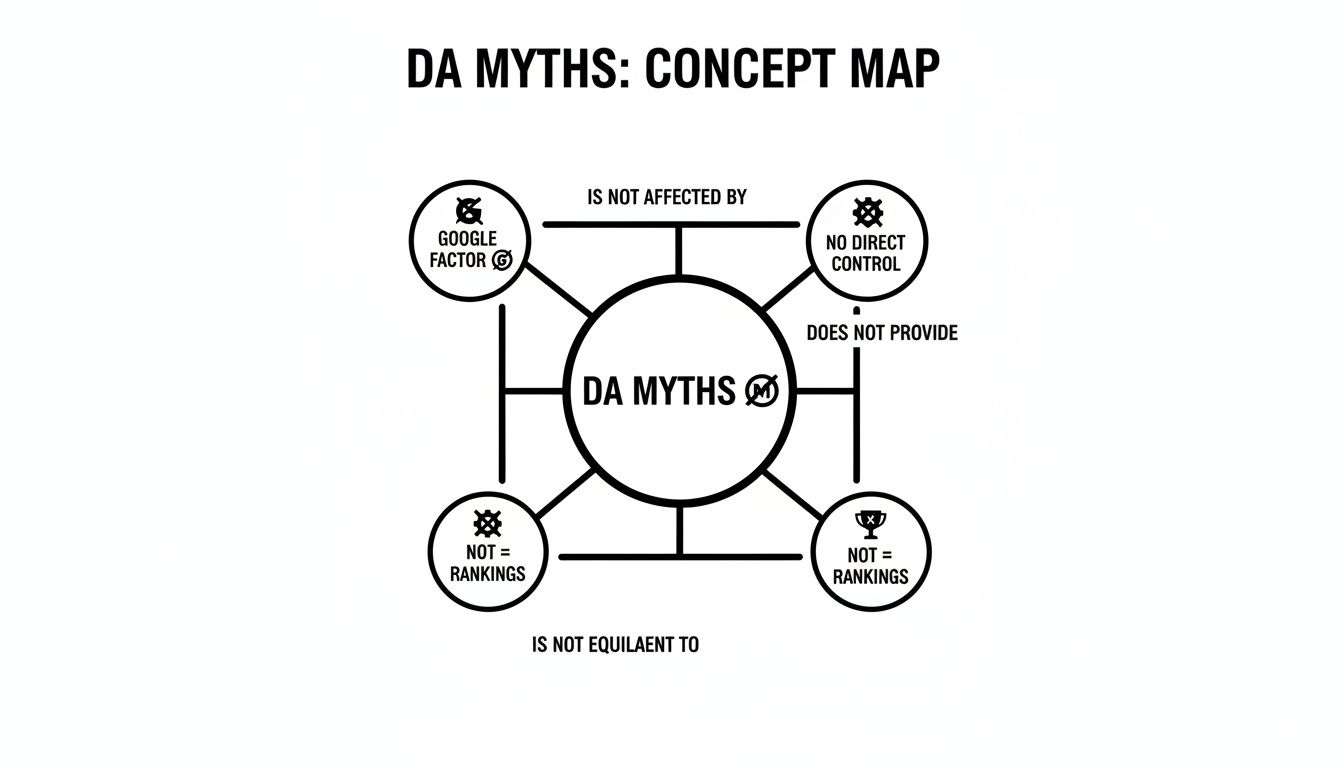
It’s a good reminder that DA is a third-party tool for prediction, not a metric Google actually uses, and you can't just flip a switch to change it.
Ahrefs Domain Rating Explained
Over in the Ahrefs camp, they have their own popular metric called Domain Rating (DR). It also uses a 100-point scale, but its calculation is much more focused on one thing: backlinks.
Domain Rating primarily measures the strength of a website's backlink profile. It looks at both the quantity and quality of backlinks, putting a strong emphasis on whether those links come from high-DR sites and if they are "dofollow" links that pass authority.
Many SEO pros see DR as a purer reflection of a site's "link juice" because DA pulls from over 40 different signals. A common practice is to use both together—DA for a broad health check and DR for a deep dive into your backlink profile's raw power.
Majestic Trust Flow and Citation Flow
Majestic takes a slightly different approach with two interconnected metrics: Trust Flow (TF) and Citation Flow (CF). Instead of one number, you get a ratio that gives you a much more nuanced look at your backlink quality.
- Citation Flow (CF): Scored from 0-100, this predicts a URL's influence based purely on the number of links it has. A high CF simply means a lot of sites are linking to it.
- Trust Flow (TF): Also scored from 0-100, this measures link quality. It predicts how trustworthy a site is by looking at how close its links are to a hand-picked list of highly trusted "seed" sites.
A healthy, authoritative website usually has a balanced TF/CF ratio. If you see a site with a Citation Flow of 40 but a Trust Flow of only 10, that's a huge red flag. It often means the site has a ton of low-quality or spammy links propping it up.
Comparison of Key SEO Authority Metrics
Understanding the nuances between these different authority scores is key to building an SEO strategy that covers all your bases. This table breaks down the main players at a glance.
| Metric | What It Measures | Primary Use Case |
|---|---|---|
| Domain Authority (DA) | Overall predictive ranking strength of an entire website, using over 40 factors. | Benchmarking your site's general SEO health against direct competitors. |
| Page Authority (PA) | Predictive ranking strength of a single, specific page on your website. | Assessing the strength of individual content pieces, like a key blog post. |
| Domain Rating (DR) | The strength of a website's backlink profile, focusing on link quality and quantity. | Analyzing link-building effectiveness and raw backlink strength. |
| Trust Flow (TF) | The quality of links, based on proximity to highly trusted websites. | Evaluating the trustworthiness and authority of your backlink profile. |
At the end of the day, no single metric can tell you everything. By using a combination of DA, PA, DR, and TF/CF, you get a multi-dimensional view of your site’s authority. This allows you to spot specific weaknesses and opportunities, leading to a much sharper and more effective SEO strategy.
Actionable Strategies to Increase Your Domain Authority
Knowing what Domain Authority is is one thing. Actually doing something about it is where the real work begins. Since DA is a reflection of your site's overall SEO health, there's no single magic button to push. Instead, you need a smart, consistent approach built on three core pillars.
These strategies aren't about finding quick loopholes. They're long-term investments in your site's reputation and credibility. When you nail these fundamentals, they create a powerful feedback loop—each effort reinforces the others, leading to a higher DA and better organic traffic over time.
Build a High-Quality Backlink Portfolio
The absolute bedrock of a strong Domain Authority score is your backlink profile. Think of every backlink as a vote of confidence from another website, telling search engines your content is legit. The game isn't about getting the most votes, but getting them from the right voters—respected, relevant sites in your industry. A handful of spammy links can hurt you more than a dozen good ones can help.
Here are a few proven ways to earn links that actually move the needle:
- Guest Posting on Industry Blogs: Get your name and expertise out there by writing for reputable blogs your customers already read. It's a triple-win: you get a quality backlink, position yourself as an authority, and drive real referral traffic back to your site.
- Secure Placements in Product Roundups: This is a goldmine for SaaS companies. Find those "best of" lists and comparison articles, then reach out and make a clear case for why your product earned a spot.
- Leverage Digital PR: Think like a publicist. Create newsworthy content—original data, an expert opinion, a compelling story—and pitch it to journalists. One link from a major news outlet can give your authority a massive boost.
Focusing on targeted outreach like this helps you build a clean, powerful backlink profile. If you want to go deeper, we've got a full guide on how to get backlinks for SEO.
Create Link-Worthy Content Assets
The easiest way to get backlinks? Stop chasing them. Instead, create content so good that other people want to link to it. This means moving beyond standard blog posts and developing true "link-worthy" assets that become the go-to resources in your field.
It's more work upfront, for sure. But these assets become link-generating machines that work for you 24/7, pulling in high-quality links without any outreach.
The best content doesn't just answer a question; it becomes the go-to resource that other creators cite. This is the foundation of a content strategy designed to build authority.
Think about creating assets like these:
- Original Research Reports: Run a survey, analyze some data, and publish your unique findings. Nothing attracts links like fresh, original data that others can reference.
- Ultimate Guides: Go bigger and better than anyone else. Create a comprehensive guide that covers a topic so thoroughly it becomes the definitive resource online.
- Free Tools and Templates: Build something genuinely useful. A simple calculator, a handy checklist, or a downloadable template that solves a real problem for your audience is incredibly shareable and linkable.
Strengthen Your Technical SEO Foundation
Finally, your website's technical health is the foundation holding everything else up. If search engines can't easily crawl, understand, and index your content, all your great backlinks and killer content won't count for much. Good technical SEO ensures that all the authority you're building actually gets recognized.
Think of it this way: DA isn't just a vanity score. It directly impacts how search engines treat your site. For instance, studies show that high-DA sites (with scores of 60+) are crawled up to 50% more frequently by Google. That's a huge advantage, especially when you're trying to get a new product or feature indexed quickly. You can read more about these findings over at Network Solutions.
To make sure your foundation is solid, focus on these areas:
- Mobile-Friendliness: This is non-negotiable. Google uses mobile-first indexing, which means your mobile site is your site in their eyes. Make sure it's flawless.
- Site Speed: Nobody waits for a slow website. Optimize your images, use smart caching, and invest in good hosting to make sure your pages load in a snap.
- Clean Internal Linking Structure: Guide users and search engine bots through your site with logical internal links. This helps spread authority from your strongest pages to others and shows how your content is all related.
By consistently working on these three pillars—backlinks, content, and technical SEO—you're not just chasing a score. You're building a genuinely authoritative website that earns its rankings, drives traffic, and is built to last.
How to Accelerate Your Authority Building at Launch
Building real Domain Authority takes time. We're talking months, sometimes years, of steady, hard work. But when you're launching a new product, you don't have that kind of time to wait for Google to notice you. You need traction, and you need it now.
This is where a smart launch strategy can make all the difference. Imagine skipping the soul-crushing grind of cold outreach and, instead, securing dozens of high-quality backlinks from day one. That’s not a fantasy; it’s what happens when you use platforms built specifically to showcase new products. It's the ultimate shortcut to building a solid foundation of authority right from the start.
The Power of Curated Backlinks
Every new website, whether it’s for a SaaS tool or a new app, starts with a Domain Authority of 1. That first backlink—and every one after—is a vote of confidence, telling Google that your site is worth paying attention to. The problem? Those first few links are always the hardest to earn.
Getting featured on a high-authority platform like SubmitMySaas gives your brand an immediate shot of credibility. Instead of chasing down links one by one, a single strategic placement gives you a whole package of them. This sends a loud, clear signal to search engines: this new product is credible and has the backing of a trusted source.
This initial boost does more than just nudge your DA score up; it dramatically speeds up how quickly Google finds and indexes your site. Search engines are far more likely to crawl a brand-new site if it already has links from reputable domains, which means you can start ranking for keywords weeks, or even months, sooner.
This concentrated burst of authority is the head start you need. It creates a strong backlink profile you can then build on with your own content and outreach, creating a snowball effect over time. To see how this fits into a bigger plan, check out our guide on what is link building strategy.
From Launch to Visibility in Weeks
Let's talk about what this actually looks like in practice. A new SaaS company might spend six months sending emails and networking just to get 10-15 decent backlinks. After all that effort, their DA might creep from 1 to maybe a 5 or 6. It’s progress, sure, but it's painfully slow.
Now, compare that to a strategic launch. The results are immediate and far more impactful.
Here’s how it accelerates your growth:
- Immediate Link Acquisition: Forget waiting for email replies that never come. You can secure over 35+ high-quality, relevant backlinks from established websites the moment your product goes live.
- Faster DA Growth: This initial wave of link equity can push a new site's DA to 10-15 within the first month. That’s a level of authority that could easily take half a year to build the old-fashioned way.
- Early Keyword Rankings: With a stronger base of authority, your product pages and blog posts have a real fighting chance to rank for valuable keywords, driving that all-important organic traffic much earlier.
This isn't about gaming the system. It's about smart partnerships. By tapping into platforms that have already earned the trust and authority you're seeking, you get to borrow their credibility to kickstart your own. You turn what would have been a slow, uphill crawl into a sprint right out of the starting blocks.
Wrapping Up: Your Top Domain Authority Questions Answered
Alright, let's tackle some of the most common questions I hear from founders diving into SEO. Think of this as the practical, no-fluff guide to what you really need to know about Domain Authority.
How Long Does It Really Take to Increase Domain Authority?
Let's get one thing straight: improving your Domain Authority is a marathon, not a sprint. It’s a long-term play where patience and consistency win. You're far more likely to see real, meaningful changes over several months of steady work, not in a matter of weeks.
While a strategic launch can give you a fantastic head start, lasting growth comes from the steady drumbeat of earning quality links and publishing great content. For a brand-new site, seeing your score jump by 5-10 points in the first six to eight months is a huge win and a very realistic target.
What’s a Good Domain Authority Score for a New Website?
Every single website on the planet starts with a Domain Authority of 1. So, when you see that number, don't sweat it. A "good" score is completely relative; you should be benchmarking yourself against your direct competitors, not giants like Wikipedia or Forbes.
For a new SaaS, aiming for a DA of 20-30 within your first year is a great goal. It tells you that you've built a solid foundation of backlinks. If you can manage to hit a DA of 40-50 in that same period, you’re not just competing—you’re likely becoming a serious contender in your niche.
The real game isn't about hitting some magic number. It's about consistently growing your authority faster than the competitors you need to outrank. Focus on progress, not perfection.
Can My Domain Authority Score Actually Go Down?
Yes, it absolutely can. Your DA score isn't set in stone. It's a living metric that can fluctuate based on what's happening across the web.
A drop in your score usually comes down to a few things:
- You've lost some good backlinks. If a high-authority site removes its link to you or their site goes offline, you might see your score take a small hit.
- Your competitors are growing faster. The DA scale is relative. If your top competitors go on a massive link-building spree, it can shift your position on the scale even if your own link profile hasn't changed.
- Moz tweaks its algorithm. Moz occasionally updates its index and calculation methods, which can cause scores everywhere to shift up or down.
This is exactly why you can't just "set it and forget it." Building authority means constantly monitoring your backlink profile and staying committed to your SEO strategy over the long haul.
Ready to give your new product the authority boost it deserves? SubmitMySaas can help you secure over 35+ high-quality backlinks from day one, accelerating your growth and getting you noticed by search engines faster. Launch your product and build authority today.