How to Get Backlinks for SEO A Guide for SaaS Founders
Learn how to get backlinks for SEO with this practical guide for SaaS founders. Discover proven link building strategies that drive real growth and authority.
Let's get straight to it: the single best way to get backlinks is to create something genuinely valuable—something worth linking to—and then get it in front of the right people. Think of it as earning digital endorsements that signal to search engines that your SaaS is a credible, authoritative voice in your space.
Why Backlinks Are Still the Engine for SaaS Growth
Backlinks are, in essence, digital recommendations. When another website links to yours, it's a vote of confidence. For a SaaS founder, every quality backlink is a signal to Google that your platform is a legitimate, helpful solution, which in turn boosts your site's authority and search rankings. It’s the online equivalent of a major tech publication giving your software a glowing review—it builds trust and, more importantly, drives qualified traffic your way.
This whole system of "digital endorsements" is a fundamental part of how search engines figure out who deserves the top spots. A site with a robust, relevant backlink profile is simply seen as more trustworthy than one without.
The Clear Impact on Your Rankings
The data doesn't lie. There's a direct, powerful connection between the number of backlinks a page has and how high it ranks. In fact, pages that hit the top of Google’s results have, on average, 3.8 times more backlinks than those languishing on pages two, three, and beyond. That statistic alone should tell you why experienced SaaS marketers are so obsessed with building high-quality links.
But this isn't a numbers game where you just chase any link you can get. Quality over quantity, always. A single, relevant backlink from an industry-leading site is infinitely more valuable than a hundred links from spammy, unrelated directories. For SaaS founders, backlink building needs to fit into a larger, cohesive winning SaaS SEO strategy to be truly effective.
More Than Just SEO: The Real Business Impact
While climbing the search rankings is usually the main goal, the ripple effects of a solid backlink profile go much further.
- Drives High-Quality Referral Traffic: A link in a popular industry blog post can send a steady stream of visitors to your site—people who are already interested in what you do and are far more likely to convert.
- Builds Your Brand and Establishes Trust: When reputable sites link to your content, it tells potential customers you’re a trusted expert. It's a powerful form of social proof.
- Opens Doors to Strategic Partnerships: The outreach process itself is a fantastic networking tool. You'll build real relationships with editors, influencers, and other companies, which often blossoms into co-marketing, integrations, or other valuable collaborations.
For a SaaS business, backlinks aren't just an SEO metric; they are a compounding asset. Each quality link builds upon the last, creating a defensible moat that competitors will find difficult to replicate over time.
To give you a clearer picture of the road ahead, let's break down the core strategies we'll be covering in this guide.
Key Backlink Strategies at a Glance
This table summarizes the main link-building methods we’ll dive into, giving you a quick look at the primary benefit and the general effort required for each.
| Strategy | Primary Benefit | Effort Level |
|---|---|---|
| Content-Led Link Building | Attracts natural, high-authority links | High |
| Strategic Outreach | Builds targeted, relevant links at scale | Medium |
| PR & Partnerships | Generates brand mentions and authority links | High |
| Directories & Launch Platforms | Secures foundational, niche-relevant links | Low |
Each of these approaches plays a unique role in building a well-rounded and powerful backlink profile. Now, let’s get into the nitty-gritty of how to execute them.
The Art of Outreach That Builds Relationships
Forget the generic, automated email blasts you’ve probably received. The true secret to getting backlinks that actually move the needle isn’t about volume; it's about building genuine connections. Effective outreach is a craft that turns a one-time link request into a long-term, mutually beneficial partnership.
The goal here is to provide undeniable value upfront. Instead of just asking for a link, you're offering to improve their content, share a unique resource, or collaborate in a meaningful way. This relationship-first approach is what separates campaigns that get ignored from those that consistently earn high-quality links.
This flow shows the direct path from building backlinks to establishing trust and, ultimately, fueling sustainable growth for your SaaS.
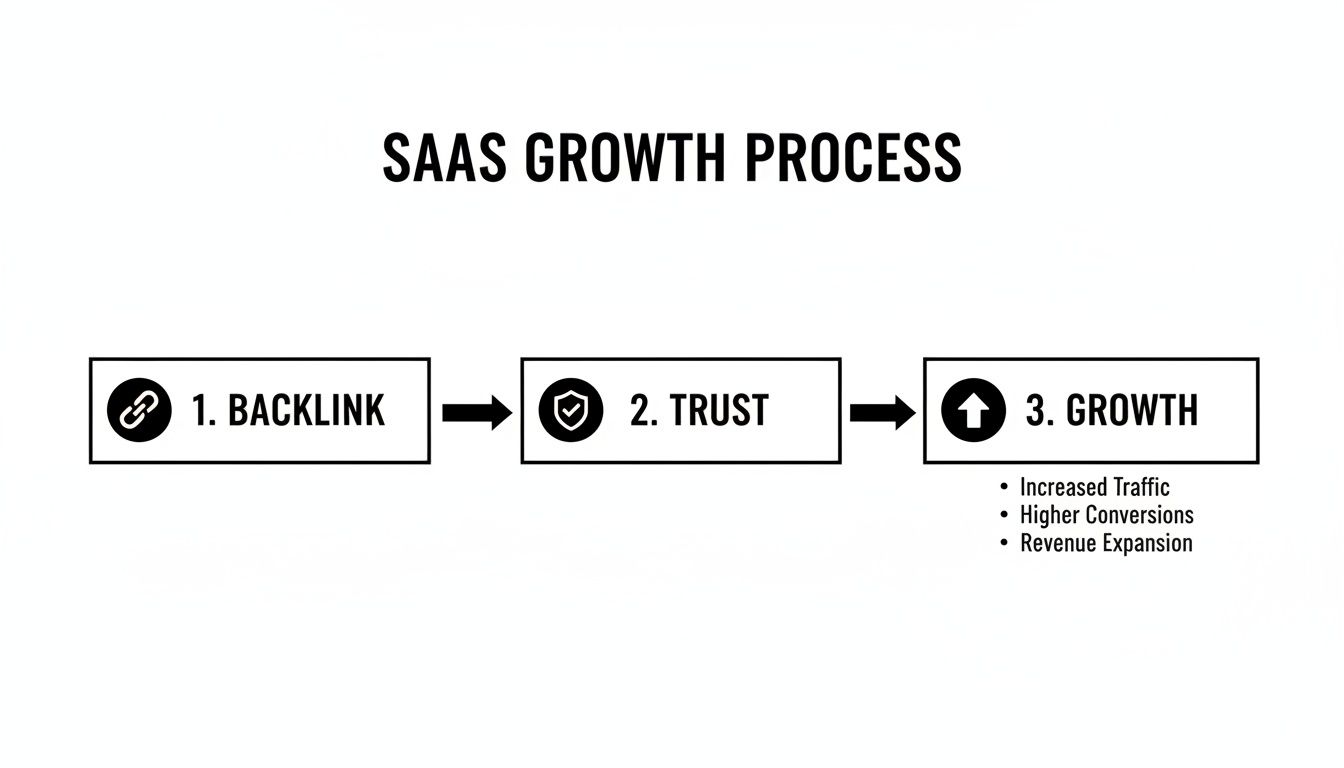
Think of each backlink as a foundational block. It builds the domain trust that search engines use to validate your authority, which is what drives that long-term, organic growth we're all after.
Finding Prime Link Opportunities
Before you write a single email, you need to know who to contact. The best opportunities are often hiding in plain sight. Your first stop should be finding websites that already link to content similar to yours—especially content from your direct competitors.
This is where a little friendly reverse engineering comes in. SEO tools let you see exactly who is linking to your competitors. By analyzing their backlink profiles, you can uncover a pre-vetted list of websites that are already interested in your niche and likely to link to valuable resources. Like yours.
Of course, finding the right people is only half the battle. Your outreach's success hinges on mastering cold email writing that truly resonates and gets replies.
Crafting a Value-First Pitch
Once you've got your list, it's time to craft a pitch that stands out from the noise. Personalization is non-negotiable. Mention something specific about their work—a recent article, a podcast episode you enjoyed, or a social media post—to show you've actually done your homework.
Here are a few proven outreach angles that prioritize giving before you ask:
- Broken Link Building: This is a classic for a reason. Find a broken external link on their site and offer your relevant resource as the perfect replacement. You're helping them fix a UX issue, which makes it an easy "yes."
- The Resource Upgrade: Identify an article where they link to a decent but slightly outdated or less comprehensive resource. You can then pitch your superior guide or tool as a valuable update for their readers.
- Guest Contribution: Propose a high-quality guest post on a topic you know their audience will love. The key is to focus on the value the article will bring to them, with a natural link back to your site included as a helpful citation.
Your outreach email should read less like a request and more like a helpful suggestion from a peer. Always frame your pitch around how it benefits their website and their audience, not just your own SEO goals.
Turning One Link Into a Long-Term Partnership
Securing that first backlink is just the beginning. The real power comes from nurturing the relationship you've just started. After you get the link, don't just disappear.
Circle back with a thank-you note and start looking for other ways to add value. Share their content on your social channels, drop a thoughtful comment on their new blog posts, or introduce them to someone in your network who could be a valuable connection.
This consistent, genuine engagement transforms a transactional link placement into a strategic partnership. Over time, that single contact can lead to so much more:
- Multiple Backlinks: As they publish new content, they'll be far more likely to link to you again without you even having to ask.
- Co-Marketing Opportunities: Think joint webinars, co-authored research reports, or even product integrations.
- Referrals and Introductions: A strong connection can introduce you to other influential people in your industry, expanding your network exponentially.
When you focus on building real relationships, you create a sustainable and scalable system for acquiring backlinks that strengthens both your SEO and your brand for years to come.
Creating Content That Earns Backlinks
We've all heard it a thousand times: "just write great content." It’s probably the most frustrating piece of SEO advice out there. While it’s not wrong, it’s not exactly actionable, is it?
The real secret isn’t just about quality. It’s about being strategic—creating specific types of content that are practically engineered to attract links. We're talking about the kind of assets that journalists, bloggers, and industry experts are actively searching for to cite in their own work.
This approach completely flips the script. Instead of constantly begging for links, you create something so valuable that people want to link to it. In the SaaS world, a few specific formats consistently knock it out of the park, turning into true backlink magnets.

Let's be real: most content published online just fades into the background. A pretty shocking 95% of all web pages have zero backlinks. That stat alone shows you just how fierce the competition is. For a SaaS company trying to get noticed, this means your content has to do more than just exist—it needs to solve a real problem, offer unique data, or provide a free tool that makes someone's life easier. For more context, check out these eye-opening SEO stats on Backlinko.com.
Develop Original Research and Data Reports
If you want a surefire way to get high-quality backlinks, publish original research. Journalists and bloggers are constantly on the hunt for fresh data and statistics to back up their points. When they cite your study, you get a powerful, relevant backlink.
And no, you don't need a massive research budget. You can get creative. Survey your own customers, dig into publicly available data to spot a new trend, or analyze your product's anonymized usage data to uncover industry-wide insights. The whole point is to become the primary source for a new piece of information that others will want to reference.
Mini Case Study: A State of the Industry Report
Picture a SaaS company with an AI-powered project management tool. They could survey 500 project managers about their biggest headaches with remote work.
- The Asset: They package the findings into a polished report, "The 2024 State of Remote Project Management," complete with compelling charts and key takeaways.
- The Hook: They uncover a juicy statistic, like "68% of remote teams struggle with asynchronous communication." This is the headline.
- The Outreach: They then reach out to tech journalists and productivity bloggers, sharing this specific data point and offering the full report as a source.
- The Result: Big-name publications pick up the story and cite the report, earning the startup a boatload of high-authority backlinks and instantly positioning them as experts.
Build Free Tools and Calculators
Nothing builds links quite like genuine utility. A simple, free tool that solves a nagging problem for your target audience can become a passive link-building machine. People will naturally add it to their resource pages, tutorials, and "best of" lists without you even having to ask.
Think about the little tasks or calculations your ideal customers do every day. Could you build a simple web tool to make that easier?
- For a Payroll SaaS: A "Startup Burn Rate Calculator" to help founders forecast their financial runway.
- For an Email Marketing Tool: An "Email Subject Line Grader" that gives instant feedback on clickability.
- For an SEO Tool: A "Website Downtime Cost Calculator" that shows the revenue lost during an outage.
These tools don't need to be incredibly complex. Their power lies in their focused simplicity and immediate usefulness, which makes them incredibly link-worthy. As you plan these assets, it's also worth exploring how to produce them efficiently. Learning about using AI for SEO content creation can give you a serious leg up in scaling these efforts.
Create the Definitive Ultimate Guide
Another proven winner is the "ultimate guide." The idea is to create the absolute best, most comprehensive resource on a specific topic in your niche. This isn't just another long blog post; it’s a meticulously structured piece that covers a subject from every conceivable angle.
Your objective is to create the single best page on the entire internet for your target topic. When your guide is so clearly more thorough and helpful than anything else out there, it becomes the obvious and logical choice for others to link to.
A truly ultimate guide should include:
- Multiple Media Formats: Don't just rely on text. Weave in images, custom graphics, embedded videos, and helpful diagrams.
- Actionable Checklists: Give your readers something they can use right away, like downloadable templates or practical checklists.
- Expert Insights: Add credibility by including quotes or contributions from other well-known experts in your field.
- Clear Navigation: Make the content easy to digest with a clickable table of contents or even a sticky side-navigation menu.
When you create a resource this definitive, you make it an easy "yes" for other creators to reference your work instead of trying to build their own. It’s a long-term play, for sure, but a single epic guide can keep earning backlinks for years, cementing your authority on the topic.
Getting Early Traction with Directories and Launch Platforms
Let’s be honest. Outreach and content marketing are long games. They work, but they demand a ton of time and resources—two things most early-stage SaaS founders are short on. This is where you can get clever. Using high-quality directories and launch platforms is one of the smartest, fastest ways to land your first foundational backlinks and get some immediate momentum.
When you submit your product to these kinds of sites, you're doing more than just getting a link. You’re putting your SaaS directly in front of people who are actively looking for new tools: early adopters, tech junkies, and your first potential customers. It’s a win-win: you get an instant SEO boost and some incredibly valuable early user feedback.
How to Spot the Good Directories (and Avoid the Junk)
Not all directories are created equal. The web is full of spammy, low-quality sites that will do more harm than good for your SEO. The trick is to be picky and focus only on platforms that actually provide real value.
So, what does a good one look like?
- A strong Domain Rating (DR) and a good name in the tech world.
- Real moderation. They don't just approve every submission that comes their way.
- An active community. You'll see real comments, upvotes, and actual conversations happening.
- A specific focus. They cater to a niche like SaaS, AI, or developer tools.
On the flip side, a low-quality directory usually has a messy design, is plastered with irrelevant ads, and features a laundry list of sketchy links with zero signs of life. Run away from these.
The goal isn't to get listed everywhere. It's to get listed in the right places. One single backlink from a respected, niche-specific platform is worth a hundred from generic, junk sites.
Making Your Launch Count on Submission Sites
Once you’ve found the right platforms, you need to nail your submission. Think of your listing as a mini-landing page for potential users, not just a place to drop a link. Give it the same attention you would your own website.
You're building a foundation here. Even as the digital world shifts, the power of a good link isn't going away. In fact, recent research shows backlinks still account for about 14% of overall SEO power, even with the rise of AI. You can dig into more stats on the enduring role of SEO and backlinks at SERanking.com. This really drives home why getting these early, high-quality links is so critical for your long-term growth.
Your Pre-Launch Checklist
Before you hit that submit button, run through this list. A little prep work can make a huge difference in how much visibility and engagement you get, not to mention the quality of the backlink itself.
Nail Your Tagline: Your one-liner has to be dead simple. It needs to instantly tell people what problem your SaaS solves. If it takes more than a few seconds to understand, it’s not working.
Get Your Visuals Ready: People are visual. Use clean screenshots, a slick GIF, or a quick demo video that shows your product in action. This helps people "get it" much faster than a block of text.
Write a Description That Sells: Don't just list features. Tell a story. Who is this for? How does it make their work or life better? Use a few bullet points to call out the top 3-5 benefits.
Stick Around and Engage: This is key. Don't just submit and ghost the platform. Be ready to answer questions, reply to feedback, and thank people for checking out your tool. Founders who engage with the community always get a better reception.
If you're looking for a curated list of places to start, checking out a solid database of SaaS launch directories can save you a ton of research time. It helps you focus your energy on the platforms that will actually move the needle, securing those vital early links that kickstart your SEO and bring in your first wave of users.
Building a Defensible Moat with PR and Partnerships

While content and outreach are foundational, a determined competitor can eventually replicate those efforts. If you want to build a true competitive advantage, you need to think bigger. That's where public relations and strategic partnerships come in.
These strategies do more than just earn links; they build brand authority that’s incredibly difficult for anyone else to copy. Think of it this way: anyone can write a blog post. But not everyone can land a feature in a major tech publication or co-host a webinar with a respected industry leader. This is how you build a moat around your brand and secure some of the most powerful backlinks out there.
Land High-Authority Links as an Expert Source
Ever wonder how startups get mentioned in places like Forbes, Fast Company, or TechCrunch? It feels out of reach, but it's often more accessible than you think. The secret is becoming a go-to source for journalists who are constantly working against tight deadlines and need expert insights now.
This is where platforms like Help a Reporter Out (HARO) and Featured.com are absolute gold. They connect reporters directly with subject matter experts—like you.
- How it works: Journalists post queries looking for quotes on specific topics. You subscribe to relevant categories (like "Business and Finance" or "High Tech") and get these requests sent to your inbox daily.
- Making your pitch: When a query matches your expertise, you send back a concise, insightful pitch. If the journalist uses your quote, you almost always get a backlink to your site.
The key is to be fast and genuinely helpful. Journalists get buried in responses, so yours has to cut through the noise. Keep your pitch short, answer their question directly, and state your credentials clearly. A single, well-placed quote can land you a backlink from a site with a sky-high Domain Rating, sending a massive signal of authority to Google.
Don’t just pitch—provide real insight. Your goal is to make the journalist’s job easier. A sharp, quotable take is far more likely to get picked than a generic, self-promotional response.
Form Co-Marketing Partnerships That Drive Growth
Another fantastic, and often overlooked, strategy is to team up with non-competing SaaS companies that serve a similar audience. These collaborations are a brilliant way to generate high-quality backlinks while also getting your brand in front of a new, highly relevant customer base.
The best part is that it's a true win-win. You aren't just asking for a favor; you're proposing a partnership that delivers real value to both companies and both of your audiences.
Partnership Ideas That Generate Backlinks
- Joint Webinars: Find a partner and co-host a webinar on a topic your audiences will love. Each company promotes the event on its website, social channels, and email list, creating natural links back and forth.
- Co-Authored Research Reports: Pool your data or resources to create an original industry study. This becomes an incredibly linkable asset that both of your teams can promote, effectively doubling your outreach power.
- Product Integration Announcements: If your tools work together, this is a no-brainer. Create a dedicated landing page or press release about the integration and its benefits. It gives both companies a perfect, logical reason to link to each other.
- Strategic Content Swaps: Go beyond a simple one-off guest post. Arrange a true content swap where you write for their blog and someone from their team writes for yours. It's a simple way to create two valuable, contextually relevant backlinks.
These partnerships don’t just build links; they build real business relationships that can lead to referrals, integrations, and sustainable growth for years to come.
Become a Guest on Relevant Podcasts
Podcast guesting is one of my favorite ways to build both a personal brand and a website's authority simultaneously. When you appear on a podcast in your niche, you get your voice directly into the ears of an engaged audience, and it almost always comes with a great backlink.
Most podcasts publish "show notes" for each episode on their website. These notes summarize the conversation and, crucially, include links to the guest’s website, social profiles, and any resources mentioned. That's your backlink right there.
To get started, make a list of 20-30 podcasts your ideal customers are listening to. Don't just chase the biggest shows on the charts; niche podcasts often have incredibly loyal audiences and are much more open to new guests.
When you reach out to the host, make your pitch personal. Mention a specific episode you enjoyed and suggest a few concrete topics you could talk about that would bring a ton of value to their listeners. Frame your pitch around what you can teach their audience, not just what you want to promote. A single great podcast appearance can drive referral traffic, build brand recognition, and secure a fantastic backlink all at once.
How to Measure and Scale Your Link Building Efforts
Getting backlinks is really only half the job. A great link building strategy isn't just about the number of links you land; it's about the real business results they drive. If you want to move from just occasionally getting a link to building a predictable growth engine, you need a solid system for measuring what's working and then scaling it up.
Simply counting your total referring domains is a classic vanity metric. The real win is understanding the quality and impact of each link. Are your efforts actually bringing in more organic traffic? Are you finally starting to rank for those high-intent keywords you've been targeting? Answering these questions is how you know if a campaign is truly successful.
Key Metrics to Track Your Progress
To get a clear picture of your performance, you need to zero in on a handful of key metrics. These are the numbers that tell you whether you’re building a strong, authoritative backlink profile or just spinning your wheels. You’ll absolutely need an SEO tool like Ahrefs or Semrush to gather this data efficiently.
Your main dashboard should focus on these core areas:
- Referring Domains: It’s not just the total number, but the growth of unique websites linking to you. A steady, upward trend is a sign that your strategy is alive and well.
- Domain Rating (DR) or Authority Score (AS): Keep an eye on the average authority of the sites linking back to you. You want this number to climb as you earn more powerful backlinks.
- Organic Traffic Growth: This is the ultimate bottom-line metric. Are more people finding your SaaS through search engines because of what you're doing?
- Keyword Rankings: Watch how your rankings for target keywords change over time. New, quality backlinks should give your most important pages a noticeable bump in the search results.
Don't get lost in a sea of data. Your primary goal is to connect the dots between a specific link building activity (like a guest post campaign) and a direct increase in organic traffic and keyword rankings. That’s the real measure of ROI.
Monitoring these metrics consistently is what allows you to see which tactics are actually worth your time and money. For a closer look at the right tools, our guide on the ultimate link and domain authority tracker can give you some great ideas for setting up your own monitoring system.
A Framework for Scaling Your Operations
Once you've found a process that works and you're seeing those positive results, it's time to scale. But scaling isn't just about "doing more of the same." It’s about systematizing your operations to create a predictable, repeatable process for growth. You’re moving from an ad-hoc approach to a well-oiled machine.
The journey usually follows a logical progression, starting small and building from there.
Stage 1: Hire a Specialized Freelancer
The perfect first step is often bringing on a freelance link building specialist. They already have their own tools, processes, and experience, which lets you get results without the overhead of a full-time employee. This is an ideal way to validate your strategy and score some early wins. Just make sure you find someone with proven case studies in the SaaS world.
Stage 2: Build an In-House Team
When you’re ready for more control and a bigger investment, it's time to bring the operation in-house. Start by hiring a dedicated SEO or link building manager. Their first task should be to document all your successful processes, create standard operating procedures (SOPs), and build the foundation for a proper team.
Stage 3: Systemize and Delegate
With a manager in place, you can start hiring and training junior team members or virtual assistants (VAs) to own specific parts of the workflow. You can break it down into specialized roles:
- Prospecting: Finding and vetting potential websites for outreach.
- Outreach: Personalizing and sending all the email pitches.
- Content Creation: Writing the guest posts or designing the linkable assets.
By breaking the process down like this, you essentially create an assembly line for acquiring links. Each person gets really good and efficient at their specific task, which dramatically increases your output while making it easier to maintain quality. This systematic approach is what transforms link building from a series of one-off projects into a continuous, scalable driver of SEO success for your SaaS.
Ready to kickstart your SEO with high-quality, relevant backlinks? SubmitMySaas offers a launch package that includes a featured listing, a verification badge, and over 35+ DR backlinks to give your SaaS the immediate authority boost it needs. Get started today at https://www.submitmysaas.com.