What Is a Link Building Strategy for SaaS Growth
what is link building strategy? Discover a practical, sustainable approach to build authority, drive organic traffic, and grow your SaaS business.

A link building strategy is simply your game plan for getting other websites to link back to yours. It's not about randomly collecting as many links as you can. Think of it as earning 'votes of confidence' from other respected players in your industry. Every quality backlink you get is like a trusted site telling Google, "Hey, these guys know their stuff," which boosts your credibility and, eventually, your search rankings.
Why a Link Building Strategy Is Essential for SaaS Growth

Without a real plan, link building becomes a messy, time-sucking task. Sure, you might get a link here and there, but those one-off wins rarely move the needle. A formal strategy turns this from a random chore into a targeted process designed to build your SaaS brand’s authority step by step.
Imagine your website is a brand-new shop in a huge, sprawling city. You could just open your doors and hope people stumble upon it, or you could build direct roads from the busiest parts of town straight to your entrance. That's what backlinks are—they're the roads. A link building strategy is the blueprint for making sure you're building those roads from the right neighborhoods.
The Primary Goals of a Link Strategy
At the end of the day, a good link building strategy is all about hitting key business goals that are absolutely critical for SaaS companies. It’s about more than just numbers on a dashboard; it’s about driving real, sustainable growth.
A successful plan always focuses on:
- Increasing Domain Authority: This is basically your website's reputation score in the eyes of search engines. High-quality links are the most powerful way to build it.
- Driving High-Intent Referral Traffic: Links from relevant blogs, industry news sites, or directories like SubmitMySaas do more than just help with SEO. They send people who are already interested in what you do straight to your website.
- Securing Top Search Rankings: The ultimate prize is ranking for the keywords your ideal customers are typing into Google every day. You simply can't compete for those valuable, high-traffic terms without a strong backlink profile.
For any SaaS, just being found in a ridiculously crowded market is the first major hurdle. Understanding "what is link building strategy" is the first step, but actually putting one into action is how you get seen.
Core Components of a SaaS Link Building Strategy
A solid strategy isn't just one tactic; it’s a mix of interconnected parts all working together. Each piece has a specific job to do in building a healthy, authoritative backlink profile that search engines will trust. Getting a handle on these pillars is key before you ever send a single email.
The table below breaks down the essential parts of a link building strategy, giving you a clear picture of how it all fits together.
| Core Components of a SaaS Link Building Strategy | | :--- | :--- | :--- | | Component | Description | Example for a SaaS Business | | Prospecting | The process of finding and vetting relevant websites, blogs, or directories that would be a good fit for a link. | Finding the top 10 marketing blogs your target audience reads to pitch a guest post. | | Content Creation | Developing genuinely valuable "linkable assets" that other sites will want to reference and link to on their own. | Publishing an original data study titled "The State of Remote Collaboration in 2025." | | Outreach | The actual work of contacting website owners, editors, or journalists to pitch your content or ask for a link. | Sending a personalized email to an editor showcasing your data study and its key findings. | | Measurement | Tracking key performance indicators (KPIs) to figure out what's working and what the ROI of your efforts is. | Monitoring the growth of your Domain Rating (DR) and referral traffic from new backlinks. |
Each of these components relies on the others to function. Great content is useless without good outreach, and outreach is impossible without solid prospecting. Mastering all four is what separates a successful campaign from a failed one.
Alright, let's look at the link building tactics that actually move the needle for modern SaaS companies. Once you have a solid strategy, it's all about execution.
Not all links are created equal. Some give you a massive boost in authority, while others are barely worth the effort. The real goal is to stop thinking about acquiring links and start focusing on earning endorsements that build your brand and send real, qualified traffic your way.
So, let's break down the most powerful approaches that smart tech companies are using right now to scale their visibility. These aren't about old-school, repetitive outreach; they're about creating genuine value that people can't help but talk about.
Win High-Authority Placements with Digital PR
If there's one tactic you need to know, it's Digital PR. This is all about creating newsworthy stories, unique data reports, or expert commentary that top-tier publications and journalists want to write about. Instead of begging for a link, you're handing them a great story on a silver platter.
This works especially well for SaaS companies because you're likely sitting on a goldmine of user data or industry insights.
For instance, imagine a project management SaaS analyzing its anonymous user data to publish a report on "The Most Productive Day of the Week for Remote Teams." That's original research. It's an asset that news sites and industry blogs will clamor to link to when they talk about productivity. It’s a classic win-win: the publication gets a compelling story, and you get an incredibly authoritative backlink.
The numbers don't lie. Digital PR is the undisputed champ of link building today, with a staggering 67.3% of marketers calling it their number one method for getting backlinks. It doesn't just build two or three times more links than traditional guest posting; it also drives referral traffic that actually converts. You can dive into more link building statistics to see just how dominant this strategy has become.
Build Targeted Authority with Strategic Guest Posting
While Digital PR casts a wide net to catch the big fish, strategic guest posting is about becoming a trusted voice within your niche. I’m not talking about spamming hundreds of low-quality blogs with generic articles. This is about hand-picking reputable blogs where your ideal customers already hang out.
The secret is to contribute genuinely helpful, non-promotional content that showcases your expertise. Let's say you run a SaaS that helps with social media scheduling. Writing a deep-dive guide on "How to Triple Your Instagram Engagement" for a major marketing blog hits several birds with one stone:
- It builds authority: You're instantly positioned as an expert in the social media world.
- It reaches the right people: You get your brand in front of an audience actively looking for the solutions you offer.
- It earns a contextual backlink: You get a powerful, highly relevant link back to your site, either in the content itself or in your author bio.
Create Linkable Assets That Work on Autopilot
Want a strategy that keeps working for you long after you've set it up? Start creating "linkable assets." These are high-value resources on your own website that people want to link to, naturally and without you having to ask. Think of them as link magnets that work 24/7.
These aren't your average blog posts. They're bigger, better, and more permanent.
Some of the most powerful linkable assets for SaaS businesses include:
- Free Tools: A simple ROI calculator, a headline generator, or even a freemium version of your product can attract links like crazy.
- Comprehensive Guides: An "ultimate guide" on a key topic that's more detailed and helpful than anything else out there becomes the definitive resource everyone references.
- Original Research: Just like with Digital PR, publishing your own data studies or industry surveys gives bloggers and journalists the stats they need to cite in their own work.
Sure, creating these assets takes a serious upfront investment of time and resources. But the payoff is huge. A single great asset can generate a steady stream of authoritative backlinks for years, building your site's authority on autopilot.
Establish Your Foundation with SaaS Directories
For any new SaaS, you have to build a baseline of trust and visibility from day one. That's where SaaS directories and launch platforms come in. Getting your product listed on reputable platforms like G2, Capterra, and specialized sites like SubmitMySaas is a non-negotiable first step.
These foundational links do two things. First, they send signals to search engines that your product is legitimate and part of the tech ecosystem. More importantly, they put your tool right in front of early adopters and buyers who are actively hunting for new solutions. A well-executed launch on a platform like SubmitMySaas can deliver that first burst of high-quality backlinks, targeted traffic, and social proof you need to get the ball rolling.
How to Build Your Link Building Strategy From Scratch
So, where do you even begin? Building a link building strategy isn't about throwing things at the wall and seeing what sticks. It's a systematic process, much like an architect drafting a blueprint before a single brick is laid. Without that plan, you’re just guessing.
A solid strategy is your roadmap. It ensures every piece of content you create and every email you send is a deliberate step toward building a stronger, more authoritative presence online. It’s the difference between wasting months on outreach that goes nowhere and efficiently earning links that actually move the needle on your search rankings.
Let's break down how to build this blueprint from the ground up.
A 5-Step Link Building Strategy Framework for SaaS
For SaaS founders, a structured approach is everything. The following framework breaks the process down into five manageable phases, turning a daunting task into a clear, actionable plan. It's designed to build momentum and deliver measurable results.
| Phase | Key Action | Primary Tool/Resource |
|---|---|---|
| 1. Planning & Goal Setting | Define specific, measurable KPIs like target keyword rankings, DR growth, or referral traffic goals. | Google Analytics, Ahrefs, Semrush |
| 2. Prospecting & Targeting | Identify high-quality, relevant websites, blogs, and directories to target for links. | Competitor backlink analysis, industry forums, SaaS directories |
| 3. Content & Asset Creation | Develop "linkable assets" – valuable content like data studies, free tools, or ultimate guides. | Your company blog, internal data, expert interviews |
| 4. Outreach & Relationship Building | Execute personalized, value-driven outreach to connect with site owners and editors. | Pitchbox, Hunter.io, LinkedIn |
| 5. Measurement & Refinement | Track progress against your initial KPIs and continuously adjust your tactics based on what's working. | Ahrefs Rank Tracker, Google Search Console |
This framework isn't just a to-do list; it's a feedback loop. Each phase informs the next, creating a cycle of continuous improvement that will strengthen your link building efforts over time.
Phase 1: Define Your Goals and Plan Your Attack
First things first: you need to know what winning looks like. A vague goal like “get more backlinks” won’t cut it. You need specific, measurable targets that tie directly to your SaaS company's growth.
Your goals will literally dictate your tactics. For instance, if you want to rank for the high-intent keyword "best project management software," your target list will be completely different than if your goal is to build brand awareness through mentions in major tech publications.
Get specific and set some clear, quantifiable objectives.
- Target Keyword Rankings: Aim to push a specific set of commercial keywords from page two to the top three spots on Google within six months.
- Domain Authority Growth: Set a tangible goal, like increasing your Ahrefs Domain Rating (DR) from 20 to 35 within one year.
- Referral Traffic Volume: Target a 20% increase in referral traffic from new backlinks over the next quarter.
- Competitor Backlink Parity: Pinpoint your top three competitors and aim to earn links from 50% of their top referring domains.
With these goals defined, you can work backward to create a realistic timeline and budget. This initial planning prevents you from chasing shiny objects and keeps everyone on the same page.
Phase 2: Pinpoint Your Targets and Prospects
Once you know your destination, it’s time to draw the map. Prospecting is the art of finding and vetting the right websites, journalists, and directories that can send valuable links your way. The mantra here is quality over quantity. A single link from a respected industry blog is worth a hundred from spammy, irrelevant sites.
Start by creating a "dream list" of websites where a link would be a genuine game-changer for your brand. Think high-authority publications, influential niche blogs, or trusted industry news outlets.
Key Insight: A site's relevance is just as critical as its authority. A link from a niche SaaS blog that your ideal customer reads every morning can drive more qualified leads than a link from a generic news site with a sky-high domain rating.
Your prospecting should zero in on a few key areas:
- Competitor Backlink Analysis: Use tools like Ahrefs or Semrush to see exactly where your competitors get their links. This hands you a pre-vetted list of sites already interested in businesses like yours.
- High-Value Directories: Find the top SaaS directories and review sites in your space. Getting listed is a vital first step for new products, and for established tools, it's about making sure your profile is fully optimized. Our guide on how to launch a SaaS product explains how these foundational links build that crucial early momentum.
- Resource and "Links" Pages: Hunt for pages that curate lists of helpful resources. If you’ve created a fantastic guide or a free tool, these pages are perfect outreach targets.
Phase 3: Develop Your Content and Outreach Assets
You can’t just show up and ask for a link without offering something valuable in return. This is where your linkable assets come in. These are the pieces of content—the in-depth guides, unique data studies, free templates, or insightful guest posts—that give another website a reason to link to you.
Your content creation needs to be intentional. If your strategy is centered on Digital PR, you'll need a newsworthy data report. If you're focused on guest posting, you’ll need a list of well-researched article pitches ready to go.
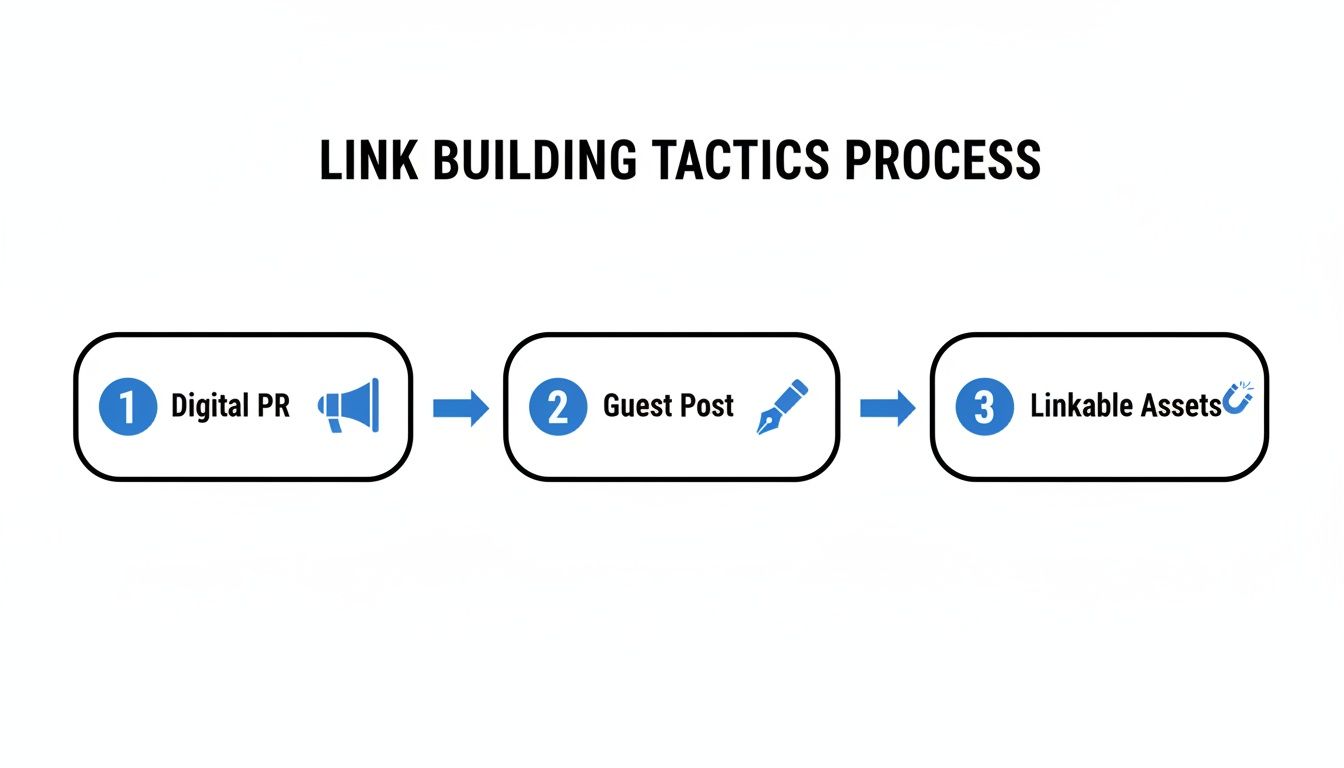
As you can see, different tactics feed into a cohesive process, all designed to earn those high-quality backlinks.
Phase 4: Execute Outreach and Build Relationships
This is where the rubber meets the road. Your outreach has to be personalized, professional, and laser-focused on providing value. Generic, copy-pasted emails are the fastest way to get ignored and deleted.
Show them you’ve done your homework. Reference a specific article on their site. Explain exactly why your content would be a perfect fit for their audience. The goal isn't just a one-time link; it's to build a genuine relationship. A good connection can lead to future collaborations, social media shout-outs, and more organic opportunities down the line.
Phase 5: Measure Performance and Refine Your Strategy
Finally, remember that a link building strategy is a living, breathing thing. You have to constantly track your progress against the KPIs you established back in Phase 1.
Keep a close eye on your keyword rankings, domain rating growth, and referral traffic. Analyze which outreach methods are hitting home runs and which are striking out. This data is gold—it lets you double down on what works and ditch what doesn't, constantly fine-tuning your approach for maximum impact.
If you find that your team doesn't have the time or expertise, bringing in a specialist can be a smart move to scale your efforts. It's worth learning about choosing a link building SEO service that can help manage this entire process for you.
2. Create Linkable Assets That Earn Authority on Autopilot

The best, most sustainable link building strategies aren't about endlessly begging for links. They’re about creating content so genuinely useful that it attracts high-quality links all on its own. This is the art of building "linkable assets"—often called "link magnets"—which are high-value resources that others in your industry want to reference and share.
Think about it like this: constant outreach is like handing out flyers one by one. It’s a ton of effort for a single result. Creating a linkable asset, on the other hand, is like building a landmark in the middle of town. People will naturally find their way to it, talk about it, and create their own paths leading to your front door for years to come.
The real goal here is to stop chasing every single link and start building assets that become a passive engine for your website's authority.
The Psychology Behind a Great Link Magnet
So, what transforms a simple piece of content into a genuine link magnet? It all comes down to providing undeniable, unique value that a journalist, blogger, or industry expert needs to make their own content more credible. We're not talking about your standard blog posts; these are definitive, go-to resources.
This approach does require a bigger investment of time and creativity upfront, but the payoff is massive. A single powerful asset can keep generating backlinks for months or even years, cementing your site's authority on autopilot. For a SaaS founder, this means creating something that becomes an indispensable tool or reference point in your niche.
For example, a project management SaaS could publish an annual “Future of Productivity” report packed with original data. A fintech company could create a free, interactive ROI calculator that other financial blogs would be thrilled to embed on their own sites.
Types of Powerful Linkable Assets
If you want to create content that naturally attracts links, you have to think bigger than a simple "how-to" article. The key is to produce something that is hard to replicate and solves a real problem for people in your industry.
Here are some of the most effective types of linkable assets for SaaS businesses:
- Original Research and Data Studies: This is one of the most reliable ways to earn authoritative links. Journalists and bloggers are always desperate for fresh statistics to back up their arguments, and they will always link back to the original source.
- Free Tools and Calculators: A simple, genuinely useful tool can be an absolute link-building powerhouse. A marketing SaaS could build a free headline analyzer, or an SEO tool could offer a free backlink checker. The goal is pure utility.
- Comprehensive "Ultimate" Guides: Aim to create the single best, most in-depth resource on a critical topic in your field. Your guide should be so thorough that it becomes the definitive page everyone else references when they need a complete explanation.
- Data-Rich Infographics: While the market has plenty of basic graphics, a well-researched, beautifully designed infographic that visualizes complex data is still a powerful asset. It's perfect for social sharing and getting picked up by media outlets.
Creating linkable assets like original research or data studies powers 36.3% of successful link building and can attract two to three times more natural backlinks than standard content. While 89% of marketers deliberately create link-worthy content, a stark 94% of web pages get zero external links, meaning only elite assets break through. Discover more about the impact of these powerful link building statistics.
From Asset to Authority
A fantastic way to create these assets is to adopt an engineering as marketing mindset. You’re essentially building small, valuable tools that inherently attract attention and links. This is especially potent for tech companies, where you can use your development talent to create free products that solve a real problem for your target audience.
These tools don't just pull in backlinks; they also work as incredible lead-generation mechanisms, introducing potential customers to your brand in a helpful, non-salesy way. Whether it's a free browser extension or a simple web-based calculator, these assets prove your expertise instead of just talking about it.
By focusing on creating true value, you build a foundation for a link building strategy that truly compounds over time. For those in the AI space, exploring how tools can be positioned as linkable assets is key. You can check out our guide on how Outblogai serves as an unfair SEO advantage for more ideas.
How to Measure Success and Avoid Common Pitfalls

A link building strategy without clear metrics is just wishful thinking. You're moving, but you have no idea if you're actually getting closer to your destination. To know if your hard work is paying off, you have to look past the simple vanity metric of how many backlinks you've built.
The real game is about quality and tangible results. Measuring what matters is the only way to prove ROI, fine-tune your approach, and stop pouring money into activities that look busy but accomplish nothing.
Key Performance Indicators for Your Link Building Strategy
Tracking the right KPIs turns link building from a hopeful guess into a predictable growth engine. These are the numbers that tell the true story of how your strategy is impacting your authority, visibility, and—most importantly—your bottom line.
Here are the essential metrics you need to watch like a hawk:
Domain Rating (DR) or Domain Authority (DA) Growth: Think of this as your website's credit score, courtesy of tools like Ahrefs and Moz. A steady climb in your DR/DA score is a powerful signal that you’re earning links from reputable, trustworthy sites. To keep a close eye on this, check out Ranccoon the ultimate link & domain authority tracker, a tool built for exactly this purpose.
Referral Traffic Volume: Don't just focus on SEO. Dive into your analytics and see how many actual humans are clicking through from the links you've built. Great referral traffic often consists of highly engaged, potential customers who are already warmed up to what you offer.
Organic Keyword Ranking Improvements: This is where the rubber meets the road. Are your target pages climbing the search results? Track a specific list of high-intent keywords to see if your new backlinks are giving you the authority boost you need to outrank the competition.
Sign-ups and Revenue Impact: This is the ultimate proof. You need to connect the dots between your link building efforts and actual business growth. Use your analytics to attribute sign-ups, demo requests, and new sales directly to the traffic coming from your link building campaigns.
Navigating the Risks of Low-Quality Links
While earning links is the goal, getting the wrong kind of links can torpedo your entire SEO effort. A crucial part of any solid link building strategy is knowing how to manage risk. Spammy, low-quality links can trigger Google penalties, which can make your search visibility vanish overnight.
A healthy backlink profile looks natural and earned. It has links from a diverse range of relevant, high-quality websites, with varied anchor text (the clickable words in a link). An unnatural profile—say, one with hundreds of links all using the exact same "buy now" anchor text—is a massive red flag for search engines.
Key Insight: Google’s algorithms are built to reward genuine authority, not manipulated rankings. A backlink profile that looks too perfect or aggressive is often the first to get flagged. The goal is a profile that looks like it grew naturally, because you truly earned every link.
You have to learn to spot and steer clear of toxic link opportunities. Keep an eye out for these common red flags when someone offers you a link:
- Private Blog Networks (PBNs): These are shady networks of websites built for the sole purpose of selling links and gaming search rankings. They usually have thin content and look completely unnatural themselves.
- Irrelevant Websites: A backlink from a blog about dog grooming does nothing for your B2B SaaS tool. It provides zero value and just looks suspicious to search engines.
- Over-Optimized Anchor Text: If a site insists on using an exact-match keyword like "best accounting software for startups" as the anchor text, run. It's a classic sign of a low-quality link scheme. Natural anchor text is much more varied.
- Paid Link Disclaimers: Be extremely cautious of sites that openly advertise "we sell links." While some legitimate sponsored content exists, many of these sites are part of low-value networks that Google can easily spot and devalue.
By focusing on these KPIs and diligently avoiding these traps, your link building strategy will build real, lasting authority and drive the kind of growth that matters.
Got Questions About SaaS Link Building? We’ve Got Answers.
Even the best-laid plans come with questions. When you're just starting to build links, it's natural to wonder about the nitty-gritty details that aren’t always covered in a high-level guide. Let’s clear up a few of the most common questions SaaS founders ask so you can move forward with confidence.
How Long Does It Really Take to See Results?
I get this question all the time. While a new backlink can send you a trickle of referral traffic almost instantly, the real SEO magic takes patience. You should expect to see a meaningful impact on your organic rankings and domain authority in about 3 to 6 months of consistent effort.
Why the wait? Well, a few things are at play:
- Your Starting Point: A brand-new site is like starting from a standstill. It takes more time to build momentum than it does for a site that's already been around for a while.
- The Competition: Trying to rank in a packed space like project management software is a tougher climb than dominating a smaller, newer niche.
- Your Consistency: Link building is a marathon, not a sprint. A steady, ongoing effort will always outperform short, intense campaigns that fizzle out.
Think of it like building a reputation in real life. It doesn't happen overnight. You have to consistently show up and provide value before people start talking about you.
What’s the Difference Between "White Hat" and "Black Hat" SEO?
This is a big one. Getting it wrong can have serious consequences for your business. The line between "white hat" and "black hat" link building is all about your approach—are you earning your reputation or trying to game the system?
White-hat link building is the ethical, long-term approach. It's all about earning high-quality links because you genuinely deserve them. This means creating amazing content, building real relationships, and doing authentic outreach. It’s what search engines like Google want you to do.
Black-hat link building, on the other hand, uses deceptive tactics to manipulate search rankings. This is the shady stuff, like buying thousands of spammy links from a sketchy service or using private blog networks (PBNs) to create fake authority.
Sure, black-hat tricks might give you a quick, temporary boost. But it’s a massive gamble. Sooner or later, Google catches on, and the resulting penalties can completely tank your website, sometimes for good. Sustainable growth is always built on a solid, white-hat foundation.
So, How Many Backlinks Do I Actually Need?
If I had a dollar for every time someone asked for the "magic number" of backlinks, I'd have a lot of dollars. The truth is, there isn't one. The number you need is entirely relative to your industry and the specific keywords you’re trying to rank for.
Instead of fixating on a number, shift your focus to your competitors. Use an SEO tool to look at who’s ranking on the first page for your target keywords. How many links do they have? Where are those links from? That’s your benchmark.
Your mission isn’t to hit an arbitrary quota. It’s to build a backlink profile that’s as strong, or ideally stronger, than the competition. And remember, quality trumps quantity every single time. One powerful, relevant link from a top-tier industry blog is worth more than a hundred low-quality links from random directories you've never heard of.
Ready to kickstart your link building with a few high-authority, foundational links? SubmitMySaas gets your product listed on a trusted platform, giving you an immediate SEO boost. You'll get in front of thousands of early adopters and secure the kind of quality backlinks that search engines love.