How to Increase Website Traffic Organically A Complete Guide
Discover how to increase website traffic organically using actionable SEO, content, and distribution strategies. Your practical guide to sustainable growth.
If you want to pull in more organic traffic, you need to start with a rock-solid foundation. This isn't about throwing content at the wall and seeing what sticks. It's about a disciplined approach to keyword research and building a content plan that actually works.
The whole game is about figuring out the exact phrases your ideal customers are typing into Google and then creating genuinely helpful content that answers their questions at every single stage of their journey.
Mastering Your Keyword And Content Foundation
Forget casting a wide net. Driving organic traffic that actually converts begins long before you write a single word. It starts with a deep, almost obsessive, understanding of what your potential customers are searching for. This isn't just about grabbing keywords with high search volume; it’s about decoding the intent behind the search.
Think of good keyword research as the blueprint for your entire content strategy. Without it, you're flying blind. You're building a product without doing any market research—a gamble that rarely pays off. Your goal is to create a direct line between a user's problem and your SaaS solution, with your content serving as the bridge.
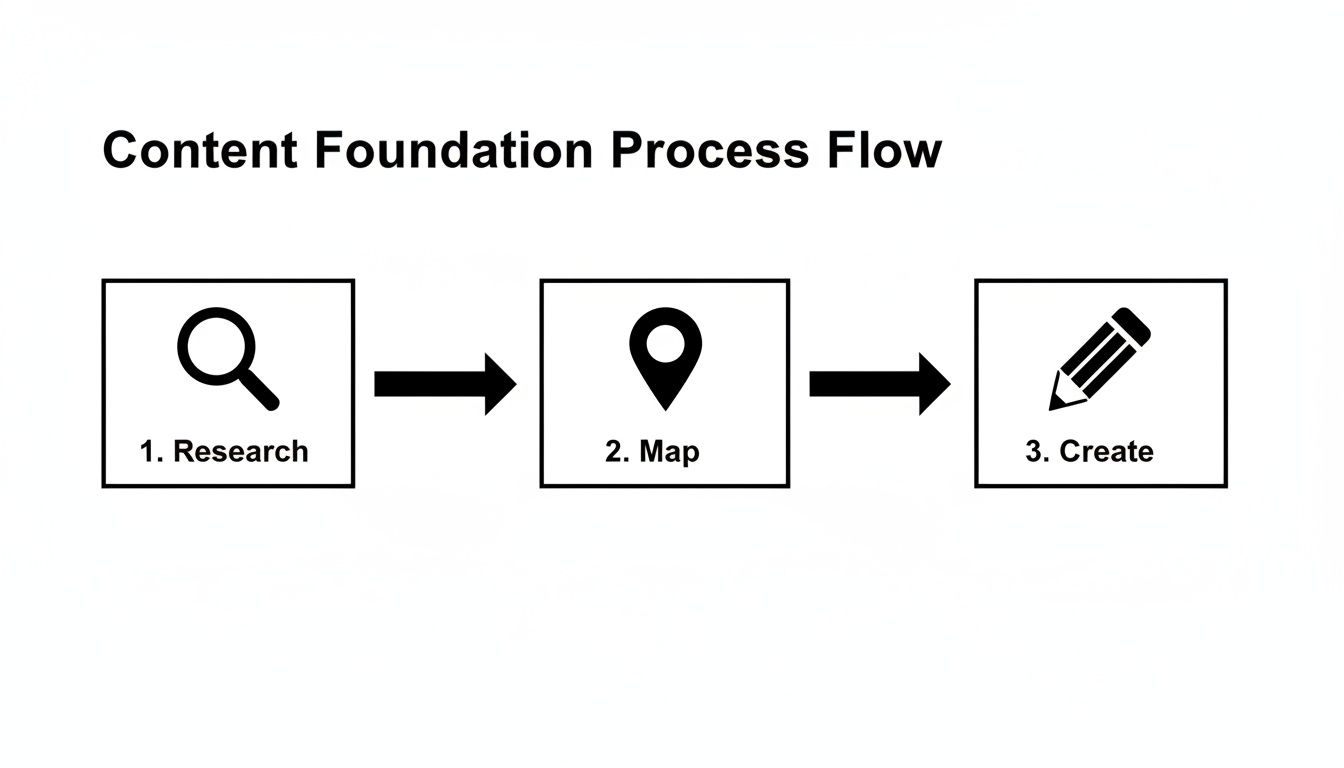
This simple flow—from research to mapping to creation—is how you ensure every article, guide, and landing page has a clear purpose. To really nail this, you have to learn how to build a keyword list that actually drives traffic and brings in qualified leads, not just window shoppers.
Uncovering High-Intent Keywords
Here’s a secret: the most valuable keywords are rarely the ones with the biggest search numbers. You want to chase the phrases that signal a user is actively looking for a solution like yours. These are often "long-tail keywords"—longer, more specific queries that practically tell you what a user needs.
- Go beyond the obvious tools. Yes, use tools like Ahrefs or Semrush, but don't stop there. Dive into forums like Reddit or Quora. What language are people using? What are their biggest frustrations? That's where the gold is.
- Think in problems, not just products. Your customers aren't just searching for "project management software." They’re searching for "how to manage a remote team's tasks" or "best way to track project deadlines." These problem-based queries are your ticket to their attention.
- Study the SERPs. Seriously, just Google your target keywords. What shows up? Are there featured snippets, "People Also Ask" boxes, or videos? This is Google telling you exactly what kind of content it wants to rank for that query.
Mapping Keywords To The User Journey
Once you have a solid list of keywords, the real strategy begins. You need to map them to the different stages of the SaaS customer journey. This ensures you’re creating content that meets people where they are, whether they're just realizing they have a problem or they're ready to pull out their credit card.
Mapping keywords to the customer journey is how you turn a blog into a predictable lead-generation machine. It helps you understand what type of content to create for each stage.
Mapping Keyword Intent to the SaaS Funnel Understand how different keyword types align with the customer journey, from problem awareness to purchase decision.
| Funnel Stage | Keyword Intent | Example Keyword (Project Management Tool) | Effective Content Format |
|---|---|---|---|
| Awareness | Informational | "how to improve team productivity" | Blog posts, guides, checklists |
| Consideration | Commercial | "best Asana alternatives" | Comparison pages, case studies, reviews |
| Decision | Transactional | "ClickUp pricing plans" | Product pages, pricing pages, demo videos |
This strategic mapping is what separates the pros from the amateurs. You’re no longer just chasing random traffic; you're building a funnel that guides visitors toward becoming customers.
This focus on specific, intent-driven content is only getting more important. Projections show long-tail keywords will drive 69% of search traffic by 2025.
This is exactly how launch directories like SubmitMySaas can rank for niche queries like ‘best AI productivity tools launching today,’ drawing in highly targeted visitors without a massive ad budget. The data backs this up: the #1 result for a search query can snag a 27.6% click-through rate, which is more than ten times what the tenth result gets.
Getting this foundation right sets you up for success with every other SEO tactic you try. And with the right tools, you can scale this process. We detail how to do this in our guide on OutblogAI, which can help you create this foundational content way more efficiently.
Creating High-Ranking Content With On-Page SEO
Once you’ve nailed down your keyword strategy, it’s time to actually create the content. This is where the magic happens—turning those keyword ideas into articles that both search engines and your ideal customers will love. This isn’t just about writing; it’s about architecting your pages to be instantly understood by Google while being incredibly valuable to a human reader.
Think of every blog post or landing page as its own mini-product. Your headline is the packaging, the article's structure is the user experience, and the words themselves are the core features. Get these elements right, and you'll build a bridge between a great idea and a top-ranking asset that pulls in qualified traffic.

Crafting Headlines That Command Clicks
Let's be blunt: your headline is the most critical piece of on-page SEO. It’s the first—and often only—thing a user sees in the search results. A great headline can genuinely drive 500% more traffic than a weak one. It has to be irresistible.
The best headlines walk a fine line between including your target keyword and creating a powerful emotional hook. They either promise a clear, tangible benefit or spark just enough curiosity to demand a click.
For instance, a generic title like "Tips for Remote Teams" is forgettable. But "10 Actionable Strategies to Boost Your Remote Team's Productivity" is worlds better. It’s specific, it includes a relevant keyword phrase, and it promises a real outcome.
Structuring Content for Readability and Rankings
Both people and search engine bots appreciate well-organized content. A huge wall of text is a nightmare for Google to crawl and a guaranteed way to make a human reader hit the back button. This is where your header tags (H1, H2s, H3s) become your best friend.
- Your H1 Tag: This is your main title. You get one, and only one, per page. Make it count.
- H2 Subheadings: Use these to break down your article into its main, logical sections. It's a great practice to include your primary keyword or a close variant in at least one H2.
- H3 Subheadings: These drill down even further, breaking up your H2 sections into more specific, bite-sized points. This makes your content incredibly easy to scan.
This simple hierarchy gives search crawlers a clear roadmap, helping them understand what your page is all about. More importantly, it makes your content digestible for actual readers, keeping them engaged.
A well-structured article does more than just look pretty. It has a direct impact on user engagement metrics like time on page and bounce rate. When people stick around longer, Google sees it as a strong signal that your content is valuable, which can give your rankings a nice boost.
Weaving in Keywords Naturally
Keyword stuffing is dead. Seriously. Forcing your keyword into every other sentence will get you penalized, not ranked. Today, the game is about using your target keywords and related phrases (LSI keywords) in a way that feels completely organic. Your number one priority should always be creating helpful, high-quality content for a person.
So, where should you place your keywords? Think strategically, not forcefully.
- In the first 100 words: Signal your article's topic right from the get-go.
- In your H1 and at least one H2 tag: As we covered, this is crucial for structure and relevance.
- In image alt text: Describe your images for visually impaired users and search engines. It’s a win-win.
- In the URL slug: Keep your URLs clean and descriptive (e.g.,
/increase-organic-traffic).
This approach helps Google connect the dots between your content and a user's search query without making your writing sound like a robot wrote it.
The Power of Internal Linking
Internal links are easily one of the most underrated tactics in on-page SEO. They are shockingly powerful for a couple of key reasons.
First, they help Google discover your new content and, just as importantly, understand the relationships between different pages on your website. When you link related articles together, you’re building topical authority and showing that you have deep expertise in your niche.
Second, they dramatically improve the user experience by guiding visitors to other relevant information, which keeps them on your site longer. That extended engagement is another massive positive signal to search engines. Before you go all-in on a massive content push, it's worth getting a quick health check; services that offer a Fast SEO Fix can help spot any underlying technical issues that might hold your content back.
Amplifying Reach Through Smart Distribution
Hitting "publish" on a great article is just the starting line. If you don't have a plan to get it in front of people, even the best content will just gather digital dust. To really move the needle on organic traffic, you have to be proactive and push your work to the right audience. Done right, a single article can become a reliable, long-term source of new visitors.
Smart distribution isn't about spamming your link across Twitter. It’s a more focused effort. You need to figure out where your potential customers are already hanging out online and then show up there in a way that’s genuinely helpful. This is how you create that first wave of traffic that leads to social shares, early backlinks, and all the right signals for search engines.

Platforms like SubmitMySaas are built for this exact purpose. They give founders a direct line to thousands of early adopters and tech enthusiasts, helping you gain that crucial initial exposure. Because it features new SaaS tools every day, it attracts an audience that is actively looking for new solutions—making it a perfect spot to get seen.
Find Your People in Niche Online Communities
Your ideal users are already talking, sharing, and learning in specific corners of the internet. Your job is to find those places and join the conversation. The mindset here is participation, not promotion.
- Reddit: Dive into subreddits relevant to your niche, like r/saas, r/marketing, or r/productivity. The golden rule? Don't just drop links and run. Become a real member of the community. Answer questions, offer your expertise, and only share your content when it’s the perfect solution to a problem someone is discussing.
- LinkedIn Groups: Find and join the groups where your target audience congregates. Instead of just posting a link, share a compelling snippet from your article and ask a question to get a discussion going. Then, you can link back to the full piece for anyone who wants to go deeper.
- Slack and Discord Communities: Private communities for professionals in your industry can be absolute goldmines. You can get direct feedback and highly targeted traffic, but always, always read and respect the community rules before posting.
It all comes down to adding value first. When people see you as a helpful expert, they’re far more likely to click your link and trust what you have to say.
A single, thoughtful post in a highly relevant community can drive more qualified traffic than a hundred generic social media blasts. It’s about precision over volume. The goal is to spark a conversation that naturally leads people back to your site.
The Power of Product Launch Platforms
For any SaaS founder or tech maker, product launch platforms are one of the most potent distribution channels you have. A well-run launch on a site like Product Hunt or SubmitMySaas can unleash a flood of initial traffic, create industry buzz, and give your backlink profile a massive head start.
And this strategy isn't just for your core product. It works wonders for content and free tools, too. Created an ultimate guide? A useful calculator? Launch it. This approach reframes your content as its own product, giving it a well-deserved moment in the spotlight.
Your Mini-Launch Playbook
- Pick the Right Platform: While Product Hunt is the biggest name, don't overlook niche platforms. A site like SubmitMySaas is laser-focused on an audience of founders and tech lovers, which can often lead to more meaningful, targeted engagement.
- Get Your Assets Ready: You'll need compelling visuals, a short and punchy benefit-driven description, and a crystal-clear call-to-action. Make sure your landing page is polished and prepared to handle a sudden traffic spike.
- Show Up and Engage: On launch day, be present. Make it a point to respond to every single comment and question. This hands-on engagement is what helps you climb the ranks and shows potential users that you're a founder who cares.
- Keep the Momentum Going: A launch is a beginning, not an end. Follow up with people who showed interest, write a blog post sharing your launch results, and plaster that social proof (like "Top Product of the Day") all over your marketing materials.
A great launch does so much more than drive a one-day traffic spike. It seeds your brand across the web, earns you those critical "first links" from directories and early fans, and sends a powerful signal to Google that your site is a rising authority. That initial push is often the catalyst for incredible long-term organic growth.
Building Authority with Strategic Link Building
Once your content is out there, you face the next big challenge: building authority. In SEO, backlinks are the currency of trust. Think of them as a vote of confidence from another website. When a credible site links to yours, it tells Google that you're a legitimate and valuable resource.
But this isn't a numbers game anymore. Gone are the days of collecting as many links as you could from anywhere. Today, one high-quality link from a respected industry blog is worth a hundred low-quality links from random directories. The real goal is to earn links that not only improve your rankings but also send relevant traffic your way.
Earning Links with Content People Actually Want
The best, most sustainable way to build links is to create content so good that people can't help but share and reference it. This is the bedrock of any solid link-building effort. When you publish something truly exceptional, links tend to come naturally.
This kind of "link-worthy" content typically falls into a few buckets:
- Original Research and Data: When you publish your own data, case studies, or survey findings, you become the primary source. Journalists and bloggers are always on the hunt for fresh stats to back up their claims, and they'll link to you for it.
- Comprehensive "Ultimate" Guides: Deep-dive, long-form guides that cover a topic better than anyone else become the definitive resource. When others write on that subject, they'll often point their readers to your guide for more information.
- Free Tools and Templates: A simple calculator, a handy checklist, or a useful template that solves a real problem can be an absolute link magnet. People love to share practical resources that make their work easier.
Don't Just Publish—Promote
Creating killer content is only half the battle. You have to get it in front of the right eyeballs. That’s where smart, strategic outreach comes in.
A tried-and-true tactic is guest posting. This means writing a genuinely helpful article for another well-regarded website in your niche. In exchange, you usually get a byline with a link back to your site. It’s a win-win: they get fantastic content for their audience, and you get a valuable backlink and exposure to a whole new group of potential customers.
Another great approach is to find and get featured in expert roundups. These are articles where an author gathers quotes from several experts on a single topic. You can find these by searching for things like "expert roundup + [your industry]" and then reach out to the creators to offer your perspective for their next piece.
Backlinks are the engine of organic growth. The data is clear: 96% of Google's top 10 pages have links from over 1,000 different domains. What's more, the #1 result typically has 3.8 times more backlinks than the pages ranking #2 through #10, according to research from Digital Silk.
For a SaaS founder, this underscores the power of platforms built to fast-track this process. A single launch package on a platform like SubmitMySaas, for example, can provide an instant SEO kickstart with over 35 high-DR backlinks from badges and listings. This gives your domain authority an immediate jolt, telling search engines that your new product deserves attention.
Of course, you'll want to track the impact of these new links. To learn how to keep a close eye on your progress, check out our guide on Ranccoon the ultimate link and domain authority tracker.
Measuring Performance And Optimizing For Growth
So, you’ve put in the work. You’ve researched keywords, created stellar content, and gotten the word out. What now? You can't just set it and forget it. If you want to turn your SEO efforts into a reliable growth engine, you have to measure what’s working, what’s not, and then double down on the wins.
This is the part where you stop guessing and start building a predictable system. By digging into the right data, you can spot your best-performing articles, find easy optimization opportunities, and create a sustainable flow of qualified visitors to your site.
Getting Your Measurement Stack in Order
Before you can analyze anything, you need to collect the right data. The good news is, the two most critical tools for this are completely free. Getting them set up isn't just a suggestion—it's non-negotiable for any founder serious about organic growth.
- Google Search Console (GSC): Think of this as your direct line to Google. It's the only place you can see exactly which keywords bring people to your site, your average ranking positions, and click-through rates. GSC also flags any technical issues holding you back.
- Google Analytics 4 (GA4): This tool picks up where GSC leaves off, showing you what people do after they land on your site. You can track organic sessions, user engagement, and—most importantly—conversions like sign-ups or demo requests.
Make sure you connect these two. Together, they provide a full-spectrum view of the journey, from a user’s initial search query all the way to a conversion on your site. This is your command center.
Focus on the Metrics That Actually Move the Needle
Once you're collecting data, it's easy to get lost in a sea of numbers. Don't fall into that trap. Instead, laser-focus on a few core KPIs that signal real progress.
- Organic Sessions: This is your big-picture number—the total visits from search engines. Is the line going up and to the right over time? If so, your overall strategy is paying off.
- Keyword Rankings (for non-branded terms): Sure, it's nice to rank for your company name, but the real money is in ranking for the problems your customers are trying to solve. Keep a close eye on your positions for these high-intent keywords in GSC.
- Organic Click-Through Rate (CTR): Found in GSC, this tells you what percentage of people who see your site in the search results actually click on it. If you’re ranking high but have a low CTR, it’s a huge red flag that your title tag or meta description isn't compelling enough.
The whole point of this is to build a reliable, cost-effective way to get customers. Organic search is an absolute powerhouse, driving 53% of all trackable website traffic. It’s also about five times more cost-effective than paid ads in the long run.
Why? Because SEO leads convert at a staggering 14.6%, which is 8.5 times better than outbound leads. For SaaS founders who use launch platforms like SubmitMySaas to secure 35+ high-DR backlinks, this strategy compounds by boosting domain authority and making all this organic growth possible. You can dive deeper into these numbers in the full report on organic traffic's impact from The Digital Bloom.
Embrace the SEO Flywheel
Top-ranking content doesn’t just stay there on its own. It needs maintenance. The "SEO flywheel" is a simple but incredibly powerful concept: systematically find and update your existing content to keep it fresh, relevant, and performing at its best. This is often the highest-ROI activity you can do.
Here’s how it works. First, pop into Google Search Console and find your "striking distance" keywords—these are the terms where you’re already ranking on the second page (positions 11-20). Google already sees these pages as relevant; they just need a little push to get onto page one.
Next, you give those corresponding articles a content refresh. That could mean:
- Adding new stats, facts, or examples.
- Expanding on a section to provide more detail.
- Improving on-page elements like headlines or internal links.
- Embedding a new video or an updated infographic.
Once you hit "republish," promote the updated piece like it’s brand new. This sends powerful freshness signals to Google and can often lead to a quick and significant rankings boost. This cycle of measuring, finding opportunities, and optimizing turns your content into an asset that grows in value over time.
Essential Organic Growth KPIs and Tools
To keep things simple, here's a quick-reference guide to the key metrics you should be tracking and the free tools you need to do it.
| Metric (KPI) | What It Measures | Why It Matters | Primary Tracking Tool |
|---|---|---|---|
| Organic Sessions | Total visits from search engines over a period. | The ultimate health check of your SEO strategy. | Google Analytics 4 |
| Keyword Rankings | Your site's position in search results for specific terms. | Shows visibility for valuable, non-branded keywords. | Google Search Console |
| Organic CTR | Percentage of impressions that result in a click. | Indicates how compelling your search snippet is. | Google Search Console |
| Conversions | The number of visitors who complete a goal (e.g., sign up). | Connects organic traffic directly to business results. | Google Analytics 4 |
| New vs. Returning Users | The ratio of first-time visitors to repeat visitors. | Helps gauge audience loyalty and content stickiness. | Google Analytics 4 |
Focusing on these core indicators will keep you from getting lost in vanity metrics and ensure your efforts are truly contributing to business growth.
Common Questions About Growing Organic Traffic
Jumping into SEO can feel like a minefield of questions, especially when you're a founder trying to juggle a hundred other things. Let's cut through the noise and get straight to the answers you actually need.
How Long Does This Stuff Actually Take?
It's the million-dollar question, isn't it? The honest, no-fluff answer is that you should expect to see meaningful results within 4 to 12 months.
Why such a wide range? A few things come into play. If you're launching a brand-new site in a crazy competitive space like "project management software," you're probably looking closer to that one-year mark to make a real dent.
But if you’re in a newer niche and you're smart about targeting specific, long-tail keywords, you could see the needle start to move in just a few months. The one thing that's non-negotiable is consistency. You have to keep publishing and building authority.
New Content vs. Updating Old Posts: Where Should I Spend My Time?
You need to do both, but the ratio changes depending on where you're at.
If your blog is just getting started (let's say you have under 50 articles), then 80% of your effort should be on creating new content. You're in a building phase, trying to establish topical authority and show Google you know your stuff.
Once you have a solid library of content, you can shift gears to a more balanced 50/50 split. Updating old posts is one of the highest-leverage things you can do in SEO. Taking a piece that's lingering on page two, adding fresh data, new images, and tightening up the on-page elements can be all it takes to vault it onto page one.
Pro Tip: Focus your updates on your "striking distance" articles. These are the pages already ranking for good keywords, but they're stuck somewhere between positions 11-20. A little nudge can make a huge difference in traffic.
Is All That Technical SEO Stuff Still a Big Deal?
Yes, 100%. Think of technical SEO as the foundation of your house. You can have the best furniture and the prettiest paint job, but if the foundation is cracked, none of it matters. It’s the behind-the-scenes work that lets your great content shine.
Don't skip these fundamentals:
- Wicked-Fast Page Speed: Your site has to load in a blink, especially on a phone. Google's Core Web Vitals are no joke.
- A Flawless Mobile Experience: Most of your traffic will come from mobile devices. Your site can't just be "mobile-friendly"; it has to be mobile-perfect.
- Simple, Clean URLs: A logical URL helps users and search engines know what a page is about before they even click.
- Schema Markup: This is like giving Google a cheat sheet to understand your content, which can land you those eye-catching rich snippets in the search results.
If search engine crawlers can't easily find, index, and understand your site, your content is practically invisible. For a deeper dive into these core concepts, check out this excellent guide on What Is Organic Traffic Guide How To Grow.
Ready to kickstart your SaaS launch and build a powerful backlink profile from day one? At SubmitMySaas, we help founders like you get immediate exposure and the authority needed to climb the rankings. Launch your SaaS with us today!