What Is a Product Roadmap Your Ultimate SaaS Founder's Guide
Struggling with what is a product roadmap? This guide shows SaaS founders how to turn vision into reality, align teams, and build products users love.

Ever heard someone describe a product roadmap as just a list of features with deadlines? That’s one of the biggest misconceptions out there.
A product roadmap is actually a high-level, visual summary that maps out the future of your product. Think of it less as a rigid project plan and more as a strategic guide. It’s the single source of truth that answers the why behind what your team is building, getting everyone from engineering to marketing on the same page and excited about the shared vision.
Understanding What a Product Roadmap Truly Is

Let's cut through the corporate jargon. The best way to think about a product roadmap is as your strategic GPS. It’s a visual story showing where your product is today, where you want it to go, and the key milestones you'll hit along the way.
This strategic compass is the crucial link between your big, ambitious vision and the tangible work needed to bring it to life. For a SaaS founder, this isn't just a nice-to-have; it's a survival tool. A clear roadmap is your best friend when you need to communicate priorities to stakeholders, build investor confidence, or simply guide your product's growth in a crowded market.
More Than Just a Document
A great roadmap is a living document, a key artifact within the broader product development lifecycle stages. Its job goes way beyond tracking tasks. It’s a powerful tool for communication, alignment, and maintaining a laser-like strategic focus.
The most effective roadmaps are all about outcomes, not just outputs. Instead of a dry entry like "Add new dashboard widget," a truly strategic roadmap might frame the same work as, "Improve user data visibility to increase daily active users by 15%." See the difference? That shift provides the context and motivation your team needs to do their best work.
A product roadmap is the manifestation of your strategy and the guide to its execution. It connects the 'why' (your vision) with the 'what' (your features) and the 'when' (your timeline), ensuring every development effort pushes the product in the right direction.
Without this strategic guide, it's easy for teams to drift into silos. Suddenly, you have misaligned efforts, wasted resources, and features being built without any clear connection to business goals. This is a massive challenge in tech. A recent Atlassian report found that 49% of product teams feel they don’t get enough time for strategic planning. That’s a huge problem.
The Strategic Value for SaaS Founders
For SaaS founders and indie makers, a product roadmap isn't just an internal document—it's a cornerstone of your entire business strategy. It serves a few critical functions that are essential for growth.
Here’s why it matters so much:
- Secures Stakeholder Buy-In: It clearly lays out your vision and priorities for investors, board members, and your own team. This builds confidence and makes sure everyone is pulling in the same direction.
- Aligns Cross-Functional Teams: The roadmap becomes the single source of truth for engineering, marketing, sales, and support. This prevents miscommunication and helps create a unified go-to-market plan.
- Guides Prioritization: It forces you to make those tough calls about what to build now, what comes next, and what can wait. This ensures your limited resources are always focused on the highest-impact initiatives.
- Manages Customer Expectations: A public-facing roadmap can be a game-changer. It builds transparency and gets your users excited, turning them into advocates who feel invested in your product’s journey.
In the end, a solid product roadmap helps your SaaS stay agile and responsive. It keeps you focused on the big-picture goals instead of getting lost in the noise of daily tasks.
The Core Components of an Effective Roadmap

A truly great product roadmap is so much more than a feature list. Think of it as a narrative, a story you’re telling about where your product is headed. It’s built from a few essential ingredients that work together to turn a simple plan into a powerful, strategic tool.
Getting these core elements right is the first step to building a roadmap that actually communicates your strategy with absolute clarity. They provide the scaffolding that connects your big-picture vision to the day-to-day work your team is doing.
Product Vision: The Guiding North Star
Every roadmap worth its salt starts with a strong product vision. This isn't just fluffy marketing-speak; it's a concise, ambitious statement about the ultimate purpose of your product. It’s the change you want to bring to your customers and the market. It’s the why that gets everyone out of bed in the morning.
Your product vision is your North Star. It’s that fixed point on the horizon that guides every single decision. When you’re wrestling with tough choices about what to build next, you can always ask: "Does this get us closer to our vision?"
For instance, a vision for a productivity app might be something like: "To help teams reclaim one million hours of focused time." That single sentence is inspiring, measurable, and gives clear direction for every feature or initiative that comes after it. It ensures your roadmap is a focused plan, not just a grab-bag of cool ideas.
A great product roadmap doesn’t just show what you’re building; it constantly reminds everyone why it matters. The vision provides the emotional and strategic anchor for the entire plan.
Themes and Initiatives: Providing Context
Instead of just listing a bunch of disconnected features, modern roadmaps group related work into strategic themes or initiatives. These are high-level goals that describe a specific customer problem you're trying to solve or a business outcome you want to hit. Most importantly, they give your team crucial context.
A theme isn’t a feature; it's a promise. Here’s the difference:
- A feature is: "Add a new commenting feature to documents."
- A theme is: "Improve Team Collaboration and Feedback Loops."
See the difference? The theme-based approach gives your team the freedom to figure out the best way to solve the problem. It shifts the entire conversation from "Did we ship the feature?" to "Did we actually solve the customer's problem?" That focus on outcomes is what separates a strategic roadmap from a simple to-do list.
Business Objectives and Key Metrics
Finally, every single initiative on your roadmap has to tie back to measurable business objectives. This is how you prove that your product development work is actually valuable and moving the company forward. Each theme should have Key Performance Indicators (KPIs) or Objectives and Key Results (OKRs) attached to it.
For a SaaS founder, this link is absolutely non-negotiable. Roadmaps are living documents that spell out both the 'why' and the 'what' of your strategy, which is critical for platforms like SubmitMySaas where you need to present a credible plan. In fact, by 2026, it's expected that 70% of high-growth SaaS companies will use visual roadmaps to outline their direction, which can lead to a 25% faster time-to-market. To dig deeper into how roadmaps power business goals, check out Amplitude's in-depth guide.
Choosing the Right Roadmap for Your SaaS
Think of a product roadmap like a map for a trip. You wouldn't use a subway map to hike a mountain, right? The same logic applies here. The type of roadmap you choose isn't just a matter of looks; it's about picking the right tool to communicate your product's story and strategy.
Your choice of format dictates how your team, your investors, and your customers will understand where you're headed. It’s about creating a shared vision. Let's break down the most common roadmap types so you can find the perfect one for your SaaS.
The Classic Timeline Roadmap
When most people think "roadmap," this is what comes to mind. The Timeline Roadmap lays out features and projects along a calendar, usually split into months or quarters. It’s perfect for answering the question, "When will this be ready?"
This format is a lifesaver when you have hard deadlines to meet. Maybe you've made promises to a major enterprise client or you have a big marketing launch scheduled that everything needs to sync up with.
But be careful. Its biggest strength—the focus on dates—can also be its downfall. It can accidentally push your team into a "feature factory" mode, where shipping on time becomes more important than shipping the right thing. For an early-stage startup that needs to stay flexible, locking yourself into rigid timelines can be a real trap.
The Goal-Oriented (OKR) Roadmap
A Goal-Oriented Roadmap flips the script entirely. Instead of focusing on what you're building, it focuses on why. The roadmap is built around strategic Objectives and Key Results (OKRs). So, instead of a feature like "Add new user checklist," the objective might be "Improve New User Onboarding," with a key result of "Increase activation rate by 15%."
This approach gives your team a clear mission and the freedom to figure out the best way to achieve it. It rallies everyone around measurable business outcomes, which is fantastic for building a culture of ownership. Leadership and investors love this format because it connects product development directly to business impact.
A Goal-Oriented Roadmap turns the conversation from "When will it be done?" to "Did we achieve the outcome we wanted?" It's a small change in language but a massive shift in mindset.
The Now-Next-Later Roadmap
For fast-moving, agile teams, the Now-Next-Later Roadmap is a godsend. It scraps the timelines and focuses purely on priority. Work is simply organized into three buckets:
- Now: What the team is actively building. These items are clearly defined, and work is underway.
- Next: What's coming up. The team has committed to tackling these problems, but the specific solutions are still being worked out.
- Later: Good ideas for the future. These are things you might do someday, but they need more research and validation before moving into the 'Next' column.
This format is brilliant for managing expectations. It tells stakeholders what you're prioritizing without chaining you to a delivery date that might change. For a SaaS startup navigating a dynamic market, that kind of flexibility is priceless. Picking the right roadmap is a key part of building a successful SaaS product marketing strategy that truly reflects how your team works.
Which Roadmap Type Is Right for Your SaaS?
Choosing the right format depends entirely on your company’s stage, culture, and who you’re communicating with. A startup trying to find product-market fit has very different needs than a scale-up with contractual obligations to enterprise customers.
This table breaks down which roadmap works best in different situations.
| Roadmap Type | Best For | Key Benefit | Potential Drawback |
|---|---|---|---|
| Timeline | Mature companies with fixed deadlines or external commitments. | Provides clarity on "when" and helps coordinate dependencies. | Can become rigid and discourage adaptation. |
| Goal/OKR-Driven | Outcome-focused teams that value autonomy and data. | Aligns development with business goals and empowers the team. | Can be too abstract for teams needing feature-level direction. |
| Now-Next-Later | Agile startups that need to adapt to feedback and market shifts. | Maximizes flexibility and clearly communicates current priorities. | Lacks long-term predictability, which may frustrate some stakeholders. |
| Portfolio | Large organizations managing multiple product lines or teams. | Gives a high-level view of all strategic initiatives in one place. | Can be overly complex for a single-product startup. |
Ultimately, there's no single "best" roadmap. The most effective approach is often a hybrid. You might use a Now-Next-Later roadmap for your internal development team and a timeline-based view for your annual board meeting. Don't be afraid to experiment to find what gives your team the most clarity and focus.
How to Build Your First Product Roadmap
Jumping from a grand strategy to a practical, day-to-day plan can feel like a massive leap of faith. But building your first product roadmap doesn't have to be a painful or overly complicated exercise. With a structured process, you can translate that high-level vision into a clear, visual guide that actually gets your team aligned and moving.
The trick is to be methodical. You start with the big picture and gradually layer in the details. Think of it like putting together a puzzle—you find the corner pieces first (your core strategy) and then start filling everything else in. This approach ensures your roadmap is built on a solid foundation, not just a pile of feature requests.
Step 1: Define Your Product's "Why"
Before you even think about a single feature, you have to anchor your roadmap in a powerful "Why." This is the soul of your product—its core purpose and vision. A strong "Why" becomes the ultimate filter for every idea, suggestion, and demand that comes your way, making sure only the most impactful work makes it onto the plan.
Start by asking the big questions:
- What problem are we genuinely solving for our customers?
- What is the ultimate outcome we want them to achieve by using our product?
- How will this tool fundamentally change the way they work or live?
The answers you come up with are the strategic bedrock of your entire roadmap. Without this clarity, you just have a glorified to-do list, leaving you vulnerable to every distraction and shiny object.
Step 2: Gather Insights and Ideas
With your "Why" firmly in place, it’s time to gather the raw materials: feedback, ideas, and data. The goal here is to cast a wide net and pull in input from every possible source. Don't worry about filtering or judging at this stage; just collect.
You'll find gold in places like:
- Customer Feedback: Dig through support tickets, schedule real user interviews, and analyze survey responses.
- Sales and Marketing Teams: What are the most common objections they hear? What features do prospects constantly ask for?
- Internal Teams: Your developers, designers, and support staff are on the front lines. What are their ideas for making the product better?
- Market and Competitor Analysis: What are the emerging trends in your industry? What are your competitors up to?
This process grounds your roadmap in reality—in what users actually need—rather than just your team's internal assumptions. It's an absolutely critical step before you can even think about what to build first.
Step 3: Prioritize With a Framework
This is often the toughest part. You’ll probably end up with a mountain of incredible ideas but only have the time and people to tackle a small handful. This is where a good prioritization framework becomes your best friend, helping you make objective, data-driven calls instead of just going with your gut.
Two popular and incredibly effective frameworks are:
- RICE Scoring: This method helps you score each idea based on its Reach, Impact, Confidence, and Effort. It gives you a simple, quantitative way to compare completely different types of ideas against each other.
- MoSCoW Method: This framework pushes you to categorize initiatives into four buckets: Must-have, Should-have, Could-have, and Won't-have. It's fantastic for getting crystal clear on what's non-negotiable for a specific release or quarter.
Using a framework strips the emotion and office politics out of the decision. It forces you to have honest conversations about trade-offs and focus your team’s precious energy where it will make the biggest difference.
Step 4: Visualize and Share Your Roadmap
Alright, it's time to bring it all together in a visual document. The format you pick—whether it's a Now-Next-Later board, a traditional timeline, or a goal-oriented view—should fit your team’s culture and how you communicate progress.
The image below shows a simple but powerful way to lay out priorities using the Now-Next-Later framework.
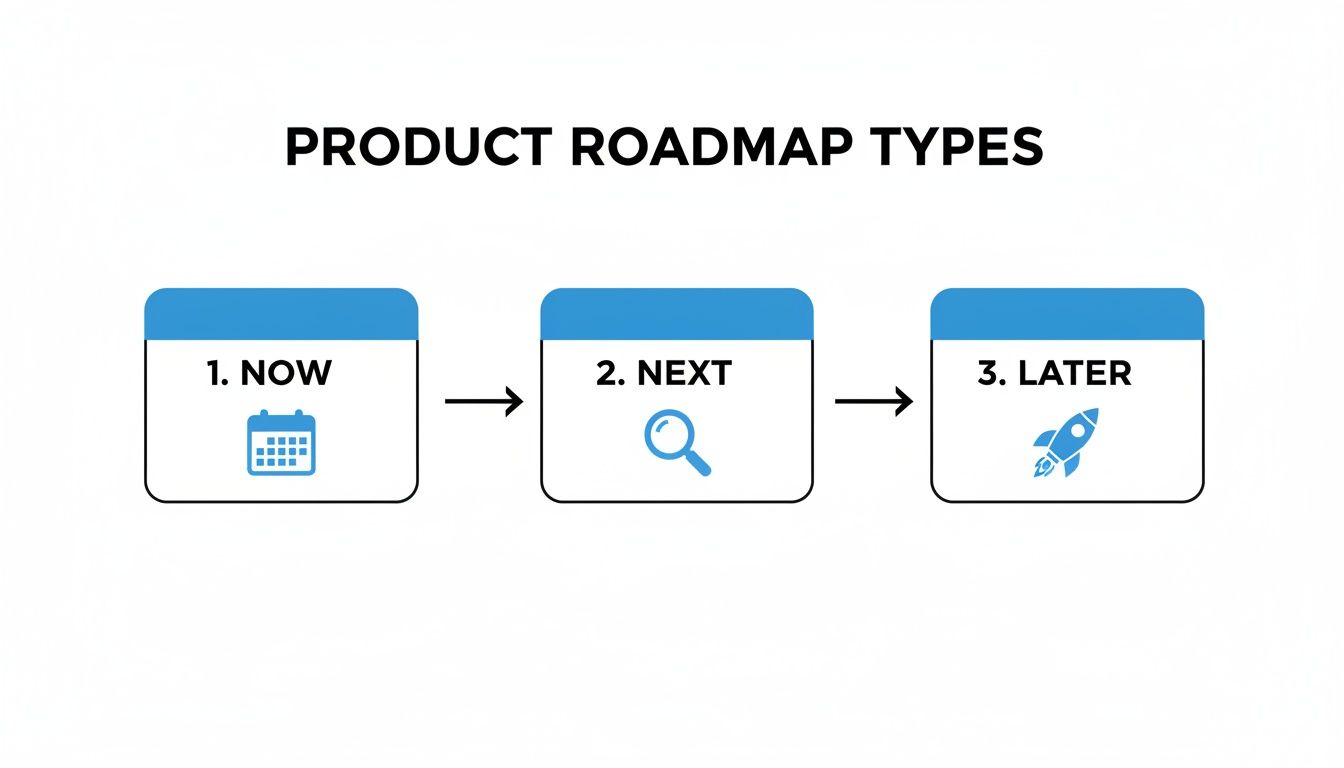
This visual approach does a great job of separating what the team is focused on right now from what’s coming up soon and what’s further down the line. It's a fantastic way to manage everyone's expectations.
Once you have a draft, share it! A roadmap isn't a top-secret document; it's a communication tool meant to create alignment and get people excited. The process of building and sharing it is just as vital as the final artifact and is a key part of how to launch a SaaS product effectively. As you build your first one, lean on proven product roadmap best practices to sidestep common pitfalls from the get-go.
Learning from Real-World Roadmap Examples
Theory is one thing, but seeing a great roadmap in the wild is another. The best way to really get a feel for what works is to look at how successful SaaS companies do it. By pulling apart their roadmaps, we can see what makes them so effective at communicating their vision.
These aren't just pretty timelines or long lists of features. They're masterclasses in transparency, communication, and managing customer expectations. A great roadmap tells a story, connecting the dots between day-to-day development work and the bigger strategic picture. It helps everyone—from your own team to your most loyal customers—understand the why behind every single update.
Let's look at a couple of different approaches to see how it's done.
The Trello Approach to Radical Transparency
It’s no surprise that Trello, a tool practically synonymous with visual planning, uses its own platform for its public roadmap. This move is more than just clever marketing; it’s a powerful commitment to transparency. They’re literally inviting their entire user base into their development process.
This level of openness is brilliant for a few reasons:
- It builds a community. Users feel like they’re part of the journey when they can see their feedback and ideas being considered.
- It sets clear expectations. The simple format shows what’s being worked on (Now), what’s coming up (Next), and what’s on the back burner (Later).
- It cuts down on support tickets. A public roadmap preemptively answers the classic question, "When are you building X?"
The visual layout makes it incredibly easy for anyone to understand priorities at a glance, without getting hung up on specific deadlines. This gives the development team the flexibility they need to do their best work.
GitHub's Focus on Outcomes
GitHub also has a public roadmap, but they frame it a bit differently. Instead of just listing individual features, they group initiatives under big strategic themes like "Copilot" or "Actions." This is a classic example of an outcome-driven strategy.
Each item on their roadmap ties back to a specific quarterly goal, giving everyone a high-level view that’s perfect for a wide audience. It shows users and stakeholders that every development effort is connected to a meaningful, impactful goal—not just small tweaks. It’s all about communicating a clear vision for where the entire platform is headed.
A public roadmap is a conversation with your users. It says, "This is where we're going, and we want you to come with us." It transforms a simple plan into a powerful tool for building loyalty and trust.
Applying These Lessons to Your Own Roadmap
You don't need a huge team or a fancy budget to create a roadmap with this kind of clarity. The principles are the same for everyone. Whether you're a solo founder hacking away or a growing startup, the goal is always to communicate your intent and get everyone on the same page.
Lots of founders just start with the tools they already know and love. You can build a surprisingly professional roadmap in Notion, lay out a visual plan on a Trello board, or even start with a simple spreadsheet.
If you’re trying to sync your roadmap with your go-to-market plan, using a dedicated product launch strategy template can give you the structure you need to link development milestones to your marketing and sales efforts. The key is to pick a tool that makes it easy to update and share your plan. A roadmap should be a living document, not a static artifact that gathers dust.
Avoiding Common Roadmap Mistakes
Building a product roadmap is one thing, but keeping it healthy and effective is another challenge entirely. Even seasoned teams can fall into common traps that turn a tool meant for clarity into a source of friction and confusion.
Think of it this way: a poorly managed roadmap can lead to misaligned teams, broken promises to customers, and a development culture that chases deadlines instead of delivering real impact. Let's walk through the most common mistakes I've seen over the years and, more importantly, how to sidestep them.
Mistake 1: Treating the Roadmap as a Fixed Contract
This is probably the most dangerous mistake of them all: treating your roadmap as an unbreakable promise with iron-clad deadlines. When you lock in specific delivery dates for features months down the line, you strip away all your flexibility. Markets change, customer needs evolve, and unexpected opportunities pop up. A rigid plan handcuffs you, making it impossible to adapt.
This approach also puts immense pressure on development teams to hit arbitrary dates, often forcing them to cut corners on quality or ship something that doesn't actually solve the user's problem. Your roadmap quickly becomes a source of anxiety instead of a strategic guide.
How to fix it: Ditch the exact dates and embrace flexible time horizons. Frameworks like the Now-Next-Later roadmap are perfect for this. They clearly communicate priority and intent without committing your team to a timeline that’s almost guaranteed to change. This simple shift reframes the roadmap as a statement of direction, not a delivery contract.
Mistake 2: Focusing on Features Instead of Outcomes
Take a look at your roadmap. Does it read like a laundry list of features, like "Add CSV export" or "Implement dark mode"? If it does, you're likely focused on outputs, not outcomes. This is the fast track to becoming a "feature factory," where the team celebrates shipping anything rather than solving real customer problems.
A feature-crammed roadmap is a roadmap without a soul. It completely misses the "why" behind the work and fails to connect what your team is building to what the business needs to achieve.
A roadmap packed with features but disconnected from user or business goals can lead to a bloated backlog and missed opportunities. The goal isn't to ship more features; it's to create more value.
How to fix it: Frame every single item on your roadmap as a problem to solve or an outcome to achieve. Instead of "Build a new dashboard," rephrase it as "Improve user data visibility to reduce support queries by 20%." This approach does two things: it empowers your team to find the best solution, and it guarantees every initiative is tied directly to tangible business impact.
Mistake 3: Letting the Roadmap Become Stale
An outdated roadmap isn't just useless—it's actively harmful. When your plan no longer reflects reality, it erodes trust and becomes irrelevant. People stop looking at it, stakeholders lose confidence, and the alignment you worked so hard to build falls apart.
A roadmap is not a "set it and forget it" document. It’s a living, breathing guide that must evolve right alongside your product and business.
How to fix it: Put regular roadmap reviews on the calendar and treat them as sacred. At a minimum, you should be reassessing and updating your roadmap every quarter. This cadence is frequent enough to stay relevant but still provides enough stability for your teams to maintain focus. Use these sessions to review progress, check your priorities against company goals, and adjust the plan based on new data and customer feedback. Make it a predictable, consistent part of how your company operates.
Common Questions About Product Roadmaps
Even the best-laid plans run into real-world questions. Let's tackle some of the most common things founders ask when they start managing a product roadmap day-to-day.
How Often Should I Update My Product Roadmap?
Think of it like a quarterly check-in. For most SaaS companies moving at a decent pace, reviewing the roadmap every quarter hits the sweet spot. It's frequent enough to react to market feedback and performance data but stable enough to prevent whiplash for your team.
Of course, small tweaks to reflect a task's progress might happen weekly or even daily. But the big-picture themes and major initiatives should stay locked in for the quarter. This gives your team the runway they need to actually build and ship meaningful work.
Who Should Own the Product Roadmap in a Startup?
In a startup, this usually falls to the CEO, a founder, or the first Head of Product. The most important thing is that one person has the final call on what gets prioritized. This is the only way to avoid the dreaded "design by committee" trap, where every good idea gets watered down into a messy compromise.
But ownership doesn't mean dictatorship. The owner's job is to be a master collaborator, gathering insights from everyone—engineering, marketing, sales, and especially customer support. A great roadmap is built on a complete picture of the business and its customers, not just one person's vision.
A roadmap isn't a top-down decree. It's a shared understanding, championed by a single owner but built with collective intelligence from the entire team. This approach ensures buy-in and a more robust strategy.
Should My SaaS Product Roadmap Be Public?
This is a classic "it depends" scenario, but it's a powerful tool if you use it right. A public roadmap can be fantastic for building trust with your users. It gets them excited about what's coming next and can be a goldmine for genuine customer feedback.
The downside? It can box you into deadlines and show your entire hand to competitors. Many companies find a happy medium: they keep a detailed, nitty-gritty roadmap for the internal team and share a simplified, high-level version with the public. This public-facing roadmap focuses on broad themes and problems you're solving, not specific features and hard dates.
Ready to get your SaaS in front of thousands of early adopters? SubmitMySaas is the discovery platform designed to amplify your launch, build high-quality backlinks, and connect you with your first users. Launch your product today.