Product Launch Strategy Template: A Proven Framework for SaaS Growth
Skip generic checklists. Use this product launch strategy template to plan, execute, and scale a SaaS launch with a proven framework.
Let's be real—most launch checklists are just glorified to-do lists. They're great for making sure you don't forget to schedule a tweet, but they completely miss the bigger picture. In today's ridiculously crowded SaaS market, just "launching" a product and hoping for the best is a recipe for disaster.
What you really need is a plan for building momentum, not just making a one-day splash. That's what this product launch strategy template is all about.
Why Generic Launch Checklists Fail Modern SaaS

A successful launch is so much more than just ticking boxes on a spreadsheet. Checklists ensure tasks get done, sure, but they lack the strategic glue that turns a simple product release into a real business-defining moment. They tell you what to do, but they totally ignore the why and the how.
And that's a huge problem, especially for SaaS companies where the launch is just the first "hello" in a long customer relationship.
The numbers don't lie. A study from McKinsey found that over 50% of product launches don't hit their business targets. It's rarely because the product is bad or the marketing team dropped the ball on an email. The real culprit? A lack of a unifying strategy that gets every single team—from engineering to sales—rowing in the same direction with a shared goal, audience, and message.
Moving from Tasks to Strategy
A true launch strategy provides a repeatable framework. It’s the master document that forces you to answer the hard questions before you're drowning in the day-to-day tasks.
Instead of a simple task list, a strategic template makes you define the important stuff first:
- The Core Objective: What are you actually trying to achieve? Is it driving new user sign-ups? Generating upsell revenue from your current customer base? Or maybe just validating an MVP? Your goal changes everything that follows.
- The Target Audience: Who, specifically, is this for? Generic personas lead to watered-down messaging that connects with no one. A killer launch targets a very specific segment with a message that hits them right between the eyes.
- The Value Proposition: Why should anyone care? You need to nail down the product's value in a single, compelling sentence that everyone in the company can recite in their sleep.
- Success Metrics: How do you define "success"? This goes way beyond launch-day traffic. Think about activation rates, user retention, and trial-to-paid conversion rates.
"A successful product launch is not just about customers knowing that the product exists. Everyone else within the company should know it exists, too—and more importantly, how to talk about it."
This guide walks you through a comprehensive product launch strategy template designed to bridge that gap. We're not just handing you another checklist. We’re giving you a structured framework that connects all the dots—from pre-launch groundwork to multi-channel execution and post-launch analysis.
You can download the template here, and we'll use its structure as our roadmap for the rest of this guide. We'll break down each section with practical advice to help you build sustainable growth from day one.
Building Your Pre-Launch Foundation
A great product launch is almost always won long before launch day. All the frantic energy of release week gets the spotlight, but the real, game-changing work happens quietly in the weeks and months leading up to it. This pre-launch phase is where you build an unshakeable foundation, turning a simple product release into a strategic event.
If you skip this groundwork, you’re basically planning to launch to an empty room. You'll be armed with messaging that doesn't connect and goals that no one on your team fully understands. Think of this period as your chance to get way ahead of the chaos.
Setting Crystal-Clear Objectives
Every solid launch strategy starts with one simple question: what are we actually trying to achieve here? Vague goals like "increase awareness" are totally useless—they can’t be measured, and they don’t help anyone make smart decisions. Your objectives have to be specific, measurable, and tied directly to a real business outcome.
Instead of fuzzy aims, get serious about defining what success looks like in hard numbers. For instance:
- User Activation: We need to hit a 25% activation rate for new sign-ups within their first week. This means they’ve completed a key action, like creating their first project or inviting a teammate.
- Early Revenue: The goal is to land 50 paying customers in the first 30 days, generating an initial MRR of at least $5,000.
- Community Engagement: We want to drive 1,000 members to our new user community on Slack or Discord to kickstart feedback and build some early loyalty.
When you define these targets upfront, your whole team gets on the same page. The marketing lead knows the real goal is 50 paying customers, not just 5,000 sign-ups, so they can aim their campaigns at higher-intent users. You can explore more detailed frameworks for how to launch a SaaS product that dig deeper into setting these kinds of foundational goals.
Developing Your Ideal Customer Profile
You can't write compelling copy if you don't know exactly who you're talking to. The next job is to develop a razor-sharp Ideal Customer Profile (ICP). This goes way beyond basic demographics. A truly useful ICP documents the pains, motivations, and day-to-day workflows of your target user.
To really sharpen your focus, ask these questions:
- What's their core problem? Pinpoint the exact frustration or inefficiency your product solves. What's the "before" state they're desperate to escape?
- What does a "win" look like for them? Describe the outcome they're hoping for. This is the "after" state your messaging needs to promise.
- Where do they "live" online? Figure out which communities, newsletters, and social platforms they actually use. This is how you'll find them and reach them authentically.
A great ICP means you can write copy that feels like you've been reading your customer's diary. It’s the difference between messaging that gets ignored and messaging that makes someone say, "Finally, someone gets it."
Conducting a Practical Competitive Analysis
Understanding your competitors isn’t about just copying their features—it's about finding your unique spot in the market. A practical competitive analysis helps you identify the gaps and opportunities where your product can really shine.
Don't just make a list of what they can do. Instead, look at their strategy through the eyes of your ICP.
| Competitor | Target Audience | Core Value Proposition | Primary Weakness |
|---|---|---|---|
| Tool A | Large enterprises | "All-in-one security suite" | Way too complex for small teams |
| Tool B | Solo developers | "Simple, free API monitoring" | Lacks advanced analytics |
| Tool C | Marketing agencies | "Automated client reporting" | No integrations with our key platforms |
This kind of analysis immediately shows you where your opening is. If your product offers powerful analytics in a simple package, you have a clear differentiator that speaks directly to the weaknesses of Tools A and B. That insight is pure gold for your messaging.
Assembling Your Launch Squad
Finally, you need to define your "launch squad" with perfectly clear roles and responsibilities. Even on a small team, any confusion about who owns what will lead to dropped balls. A simple DACI (Driver, Approver, Contributor, Informed) framework can bring a ton of clarity.
- Driver: This is the person who owns the launch execution from start to finish. Usually a product marketer.
- Approver: The person who signs off on the big decisions—think CMO or Head of Product.
- Contributors: The folks actually doing the work: content writers, designers, developers, etc.
- Informed: Stakeholders who need to be kept in the loop but aren't in the weeds, like the support team or the rest of the company.
With these foundational pieces locked in—clear goals, a sharp ICP, a defined market position, and an aligned team—you’re no longer just hoping for a good launch. You’re engineering one.
Executing a Coordinated Multi-Channel Launch
Launch day isn't just a starting line; it's the grand finale of all your preparation. Think of it as the moment all your quiet, behind-the-scenes work explodes into a concentrated burst of energy and awareness. The real goal here is to create a "surround sound" experience for your ideal customer—making them see you everywhere at once. When you pull this off, your product feels significant, almost inevitable. But it requires orchestrating every move across all your channels with near-perfect timing.
To really nail this, you need a solid grasp of what multi-channel marketing entails. It's so much more than just posting the same message on different platforms. It's about weaving a single, compelling story where each channel reinforces the others, creating a powerful narrative that pulls your audience in.
The Power of Coordinated Timing
A scattered launch—an email sent today, a social post tomorrow, a Product Hunt submission next week—is a surefire way to dilute your impact. A coordinated blitz, on the other hand, builds incredible momentum.
I’ve seen this play out time and time again. Research from thousands of tech launches confirms that a focused, multi-channel push dramatically amplifies discovery. A typical coordinated launch day often includes a Product Hunt submission (67%), an email announcement (89%), and a social media blast (94%). The results? A median website traffic spike of around 847% on the big day. Even better, this coordinated effort can boost conversion rates by about 23% during that critical launch window.
These numbers are why any serious launch plan needs to map out time-bound tasks for at least three core channels. Most successful launches spend months preparing for this brief, high-impact period.
Crafting Your Channel-Specific Plays
Every channel has its own language and audience, so your tactics need to be tailored accordingly. Your launch template should have a dedicated space to map out these specific plays.
- Product Hunt Launch: This is more than just a submission; it’s a community event. Get your assets ready well in advance: killer visuals, a sharp tagline, and a thoughtful first comment from the maker that tells your story. Most importantly, rally your existing network to support you with authentic feedback and upvotes on launch day.
- Email Waitlist Activation: Your email list is gold. Don’t just send a generic "We're live!" email. Build a sequence that creates anticipation, clearly explains the value you offer, and gives them a direct, frictionless way to sign up or buy.
- Social Media Blitz: Coordinate your messaging across platforms like Twitter, LinkedIn, or wherever your audience lives. Use a consistent hashtag, share behind-the-scenes content, and get your early adopters to share their experiences. This isn't just about broadcasting; it's about starting conversations.
My Key Takeaway: The whole point of a multi-channel launch is to create an echo chamber. When a potential customer hears about you in a newsletter, sees a post on LinkedIn, and then spots you on Product Hunt, that cumulative effect builds powerful social proof and makes you instantly credible.
Speaking of getting in front of early adopters, leveraging directories is a smart, low-effort move. For a curated list of places to submit your product for some quick visibility and valuable backlinks, check out this excellent collection of launch resources: https://submitmysaas.com/projects/my-launch-stash.
This timeline gives you a sense of the foundational work that paves the way for a powerful, coordinated launch day.
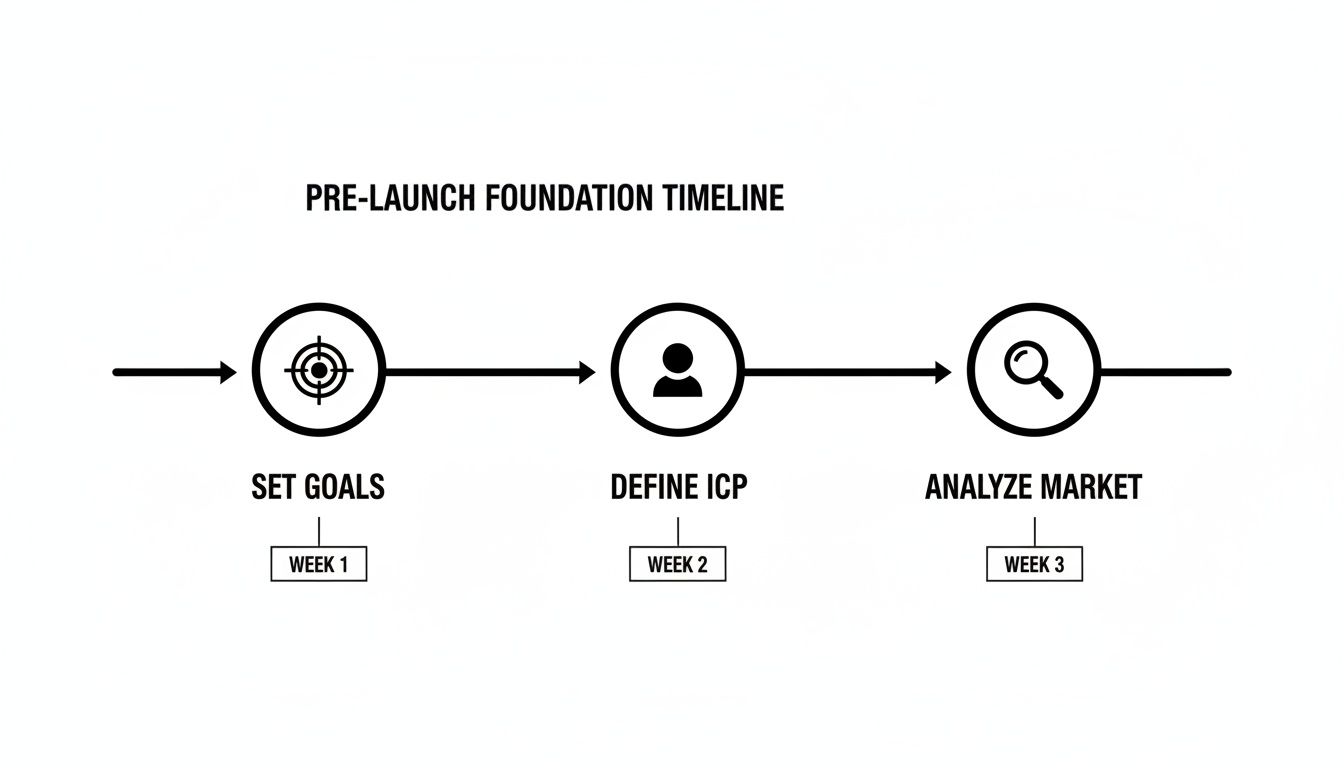
As you can see, a killer launch day is the direct result of methodical preparation that starts weeks, or even months, in advance.
To make this more concrete, here’s a simple timeline showing how you could coordinate activities across channels for a cohesive launch day experience.
Sample Multi-Channel Launch Day Timeline
| Time (EST) | Channel | Action Item | Owner |
|---|---|---|---|
| 12:01 AM | Website | Publish "Go Live" updates to homepage & pricing page. | Dev Lead |
| 8:00 AM | Send launch announcement to entire waitlist/newsletter. | Marketing | |
| 8:05 AM | Product Hunt | Post goes live. Founder adds the first comment. | Founder |
| 8:30 AM | Social Media | Announce launch on Twitter, LinkedIn, and Instagram. | Social Lead |
| 10:00 AM | Community | Share in relevant Slack/Discord/Reddit communities. | Founder |
| 12:00 PM | Social Media | Post a "mid-day update" on progress/milestones. | Social Lead |
| 3:00 PM | Send follow-up email to non-openers with a different subject. | Marketing |
This kind of minute-by-minute plan ensures everyone knows their role and helps create that crucial "surround sound" effect.
A Real-World SaaS Launch Scenario
Let's imagine a small, bootstrapped SaaS team launching "QueryFlow," an AI tool that helps people write SQL queries. With a team of just two, here’s what their coordinated, multi-channel launch could look like:
- Email (Owned Channel): At 8:00 AM EST, they email their 1,500-person waitlist. The subject line is direct: "QueryFlow is Live: Write SQL 10x Faster." The email features a GIF of the tool in action and a special launch-day discount to drive urgency.
- Product Hunt (Community Channel): At 8:05 AM EST, their Product Hunt page goes live. The "maker" comment doesn't just describe the product; it shares their personal story of struggling with SQL and why they felt compelled to build the tool. They've already reached out to 50 friends and beta testers to ask for their honest feedback on the page.
- Social & Community (Earned/Owned): Throughout the day, one founder is active on Twitter, sharing milestones (e.g., "Wow, top 5 on PH! Thanks, everyone!"). The other founder is active in relevant subreddits and Slack communities where data analysts hang out, focusing on adding value to conversations instead of just spamming a link.
This lean, highly coordinated effort makes sure their target audience sees QueryFlow across multiple touchpoints in a single day. The result? They create the illusion of a much larger, well-funded launch, punching far above their weight.
Keeping the Momentum Going: Post-Launch Analysis and Growth
Launch day is a rush, no doubt. But that initial spike of excitement is just the beginning. The real work—the kind that defines whether your product sinks or swims—happens in the 90 days that follow. This is your window to turn that launch buzz into real, sustainable growth.
Too many teams pop the champagne, high-five, and immediately shift focus to the next big thing. That’s a huge mistake. Your first batch of users is a goldmine of information, and how you listen and react in these early weeks sets the foundation for your entire customer relationship.
Move Beyond Vanity Metrics to Goals That Actually Matter
It’s tempting to get swept up in launch-day traffic and the sheer number of sign-ups. Those numbers feel great on a slide deck, but they don't tell the whole story. Success isn't about how many people knock on your door; it's about how many come inside, stick around, and eventually tell their friends about you.
That’s why any good product launch strategy template has to be built around outcome-based goals, not just vanity KPIs. Early adoption and, more importantly, sustained usage are the clearest signals you're on the right track. Get your analytics wired to track the metrics that reveal a healthy, growing product before you launch.
Here are the numbers I obsess over after a launch:
- Activation Rate: What percentage of users actually completes that one key action—the "aha!" moment—that shows they get the core value? This is everything.
- Day 1/7/30 Retention: This is the ultimate health check. Are people coming back after the novelty wears off? Solid retention is the bedrock of growth.
- Trial-to-Paid Conversion Rate: For any SaaS, this is the moment of truth. It’s the clearest signal that you’ve built something people genuinely find valuable enough to pay for.
- DAU/MAU Ratio: The "stickiness" ratio. A high number here means your product is becoming part of your users' regular routine, which is exactly what you want.
A relentless focus on retention isn't just a "nice-to-have"—it's a survival strategy. For SaaS, you should be aiming for benchmarks around 40% for Day 1, 20% for Day 7, and 10% for Day 30. If you're hitting those, you're in a great position.
Wondering how you stack up? Check your numbers against these startup benchmarks for SaaS retention to get some crucial context on your performance.
Create a System for User Feedback (Before It Overwhelms You)
Once you launch, feedback will hit you from every direction: support tickets, social media DMs, app store reviews, random emails. Without a system, it's a recipe for chaos. The goal isn't just to collect feedback, but to create a structured process for sorting, understanding, and acting on it.
The best product teams build a tight feedback loop where user insights directly shape the roadmap. It’s the key to turning initial interest into long-term loyalty. Getting this right is so important that it's worth reading up on mastering the product feedback loop to see how you can apply those principles.
Here’s a simple, practical way to get started:
- Centralize it. Funnel every piece of feedback into one place. This could be a dedicated Slack channel, a Trello board, or a purpose-built tool like Canny. Just get it out of scattered inboxes.
- Tag and sort. As feedback comes in, categorize it. Use tags like "Bug," "Feature Request," "UI/UX," or "Onboarding confusion." This makes it easy to spot trends and prioritize what needs fixing first.
- Close the loop. This is the step most teams forget. When you ship a fix or add a feature that a user suggested, tell them. A quick, personal email builds incredible goodwill and turns users into advocates.
Plan Your First Few Updates Based on Real Data
That roadmap you built before launch? Be prepared to tear it up. The data and feedback you gather in the first 30-60 days are far more valuable than any assumptions you made months ago. The most successful teams are the ones that listen and adapt.
Your first couple of product updates should be laser-focused on two things:
- Killing Friction: Where are people getting stuck or dropping off? Find those rough edges in your onboarding or core workflow and smooth them out. These fixes can have a massive impact on your activation and retention rates.
- Delivering Quick Wins: What are the most common (and easy to build) feature requests? Knocking out a few of these shows your new users you're listening and that the product is actively getting better. That builds trust right from the start.
Putting the Template to Work: Real SaaS Scenarios
A template is a great starting point, but let's be honest—it's just a skeleton. The real magic happens when you adapt that framework to your specific product, your market, and the resources you actually have. That’s what separates a good launch from a great one.
To make this less abstract, I'll walk you through two very different SaaS launch examples. This will show you exactly how to take those blank sections in the template and turn them into a focused, actionable plan. We'll look at a lean, community-first launch versus a more traditional, high-touch B2B rollout to give you a feel for how flexible this process can be.

Scenario 1: CodeCanvas AI for Solo Developers
First up, imagine a new AI productivity tool called "CodeCanvas AI," built for solo developers. The team is just two people with a shoestring budget. For them, a splashy, expensive launch is out of the question. They need something scrappy, smart, and community-driven.
Their whole strategy has to revolve around earning trust in a niche that's famously skeptical of marketing hype. Authenticity isn't a buzzword here; it's the entire game plan.
Here’s a snapshot of what their filled-out template would look like:
- Primary Objective: Hit 1,000 weekly active users and grow their Discord community to 500 members within 60 days. They're tracking real engagement, not just vanity sign-ups.
- Ideal Customer Profile (ICP): The indie hacker or solo dev who lives and breathes efficiency. You'll find them on Reddit (think r/SideProject), Hacker News, and deep in technical Twitter threads. Their biggest headache is the constant context-switching between writing code and managing tasks.
- Core Messaging: "Stop managing projects. Start building them. CodeCanvas AI turns your code comments into a dynamic project board, automatically."
- Launch Channels: The focus is 100% organic. A well-timed Product Hunt launch is the main event, supported by genuine participation in relevant subreddits and conversations with influential developers on Twitter. They're not spending a dime on ads.
For a product like CodeCanvas AI, the launch day "maker story" on Product Hunt is more valuable than any paid advertisement. It needs to be a personal narrative from the founders, explaining the exact frustration that led them to build the tool.
Scenario 2: NexusIQ for B2B Marketing Analytics
Now, let's switch gears completely. Meet "NexusIQ," a sophisticated B2B analytics platform for enterprise CMOs. The price point is high, the sales cycle is long, and they need to win over multiple decision-makers at each company. Their strategy isn’t about going viral; it’s about sales enablement and surgical outreach.
Their version of the product launch strategy template looks entirely different. It’s all about building credibility and giving the sales team the tools they need to close big deals.
Here's how they'd adapt the framework for a B2B play:
| Template Section | NexusIQ's B2B Adaptation |
|---|---|
| Primary Objective | Generate $250,000 in qualified sales pipeline and lock in 10 enterprise pilot programs in the first quarter post-launch. |
| Ideal Customer Profile (ICP) | VPs of Marketing and CMOs at B2B tech companies with over 500 employees. They’re wrestling with messy data and struggling to prove marketing ROI to the C-suite. |
| Core Messaging | "NexusIQ connects every marketing dollar to revenue. Get the C-suite clarity you need to prove your impact and secure your budget." |
| Launch Channels | The launch isn't a single day; it's a coordinated campaign. Key channels include hyper-targeted LinkedIn ads aimed at specific job titles, a co-hosted webinar with a respected industry analyst, and an Account-Based Marketing (ABM) push to a list of 100 dream-customer accounts. |
For NexusIQ, the launch hinges on creating high-value content the sales team can leverage. Instead of a simple blog post, their content team is producing a detailed whitepaper on the future of marketing attribution and a killer case study from an early beta customer.
The entire launch is an orchestrated effort to start meaningful conversations, not just drive clicks. As these two examples show, a template is a guide, not a straitjacket. Your real success comes from knowing your audience inside and out and tailoring every single piece of your launch to meet them where they are.
Common Product Launch Questions
Going through your first few launches often feels like you're just guessing your way through it. I get it. Over the years, I've heard the same sharp questions from SaaS founders who are determined to get it right. Here are my straight-up answers to the most frequent questions about putting together a launch that actually works.
How Far in Advance Should I Plan a Product Launch?
For most SaaS products, you really want to start your detailed planning at least three to four months out. That's the sweet spot. It gives you enough runway to handle all the critical pre-launch work without everything feeling frantic and chaotic.
This timeline lets you actually define your audience, nail your messaging, build a solid waitlist, and create all the marketing assets you'll need. Trying to cram this into just a few weeks is a recipe for a disconnected effort and a ton of missed opportunities to build real anticipation. And if you're in B2B with a longer sales cycle, I'd even stretch that to six months to give your outreach the time it needs to breathe.
What Are the Most Important Launch Metrics to Track?
It’s so easy to get fixated on vanity metrics like launch-day traffic or the total number of sign-ups. But the numbers that truly tell you if the launch was a success are the ones that measure real user engagement and business impact.
You need to focus your attention on these KPIs:
- Activation Rate: What percentage of new users actually completes that one key action that shows them your product's value? This is your "aha!" moment metric.
- Day 1/7/30 Retention: Are people sticking around after the initial hype dies down? This is where sustainable growth is born.
- Trial-to-Paid Conversion Rate: This is the ultimate proof. It tells you how many people find your product so essential they're willing to open their wallets for it.
- Qualitative Feedback: Forget just numbers for a second. Are users raving about a core feature or hitting a wall with a frustrating bug? This feedback is pure gold for your immediate roadmap.
Chasing a huge sign-up number feels great for the ego, but trust me, a high activation rate on a smaller, more targeted user base is infinitely more valuable. It proves you've built something that solves a real problem for the right people.
What Is the Biggest Mistake Founders Make When Launching?
Hands down, the single most common—and painful—mistake is building in a vacuum and then launching to an empty room. So many founders spend months polishing their product in private, completely convinced that a massive crowd will just show up on launch day. Then... crickets. It happens way more often than anyone likes to admit.
A great launch is the finale of weeks, or even months, of building an audience beforehand. That means starting a waitlist, talking to potential users where they hang out online, sharing your progress as you build, and getting beta testers involved from the get-go. Launching to an engaged audience, even a small one, is a world away from launching to nobody at all. It gives you momentum from day one.
How Should I Handle Negative Feedback or Bugs on Launch Day?
First thing's first: expect them. And have a plan. No launch is ever perfect. The real key is how you respond—it has to be with speed and total transparency. I always recommend setting up a "war room" team or designating one person to monitor all your channels: social media, email, support chats, community forums, you name it.
Your only goal should be to respond to every piece of feedback, especially the negative stuff, as fast as humanly possible. Acknowledge the problem, thank the user for pointing it out, and give them a clear timeline for a fix if you have one. You can even write some response templates beforehand for common issues to keep your messaging consistent under pressure. For those critical, show-stopping bugs, make sure you have a rollback plan ready to go. How you handle a crisis on launch day speaks volumes, and turning a bad experience into a fantastic support interaction can create a customer for life.
Ready to put your launch into overdrive? SubmitMySaas is a platform built to get your product in front of thousands of early adopters and tech enthusiasts. Get featured, build valuable backlinks, and give your growth a serious kickstart.