How to Start a Testimonial Collection: SaaS Guide
Learn how to build an effective testimonial collection strategy for your SaaS. This guide covers tools, templates, and best practices to attract more reviews.
Only 42% of consumers now trust online reviews as much as personal recommendations, down from 79% in 2020, so effective testimonials need more than enthusiastic praise. The strongest programs collect specific, verifiable customer evidence, secure clear permission, and publish each story where buyers can evaluate it.
You may already have a folder full of quotes. A customer called the product “amazing,” another said it was “a game changer,” and a third praised your team for being “super helpful.” Yet when a cautious buyer asks who used the product, what changed, and whether the result can be trusted, those quotes provide very little to examine.
I learned this the hard way. Early outreach produced plenty of positive replies, but few usable testimonials. Some customers didn't want their names shown. Others approved a quote for the website but not for paid advertising. A few statements sounded impressive until we asked for the context behind them. The work wasn't only collecting praise. It was building an evidence system that customers could review, approve, and recognize as their own.
Why Modern Testimonials Fail to Build Trust
A decade ago, a page of glowing quotes could create a useful first impression. Today, buyers encounter reviews, creator recommendations, comparison pages, AI summaries, and polished brand claims in the same research session. They don't automatically treat a testimonial as proof because it appears on a company website.
The shift is visible in BrightLocal's 2025 Local Consumer Review Survey. Among 1,026 U.S. adults, 42% said they trusted online reviews as much as personal recommendations, compared with 79% in 2020. That is a 37-percentage-point decline over five years. The implication for SaaS founders is direct: a short endorsement without context has less power than it once did.

The same survey found that 27% of consumers used only one review website, while 40% used at least two sites on average. That behavior matters even if your testimonial program focuses on owned content. A quote published only on your landing page may feel weaker than customer feedback that also appears through an independent review channel.
Praise without context creates doubt
Consider two statements:
“The easiest platform we've ever used.”
“We used the platform to organize launch submissions after relying on scattered spreadsheets. The team could find each project in one place, although we still needed a manual review before publication.”
The first is positive but interchangeable. The second identifies a workflow, starting problem, change, and limitation. It gives a buyer something to compare with their own situation. Specificity doesn't make every testimonial longer. It makes the evidence more useful.
A credible collection process asks for the customer's role, company type, use case, implementation period, and outcome. It also preserves enough source material to show that the claim came from a real customer rather than from a marketer's imagination.
The program must connect collection and verification
Treating testimonials as isolated content tasks creates predictable failures. The marketing team collects a quote, legal reviews it later, the customer forgets what they approved, and nobody knows whether the result is still current. A professional program connects four activities:
- Collection: Ask after the customer has experienced a meaningful product outcome.
- Verification: Record the source, context, and evidence behind the claim.
- Permission: Capture exactly where and how the testimonial may appear.
- Publication: Display the approved version with enough identity and context to support trust.
This approach also changes what you measure. A large response count can hide a small number of publishable stories. Track invitations, completed responses, usable testimonials, consent approvals, and published assets separately.
How to Design a High-Response Collection Workflow
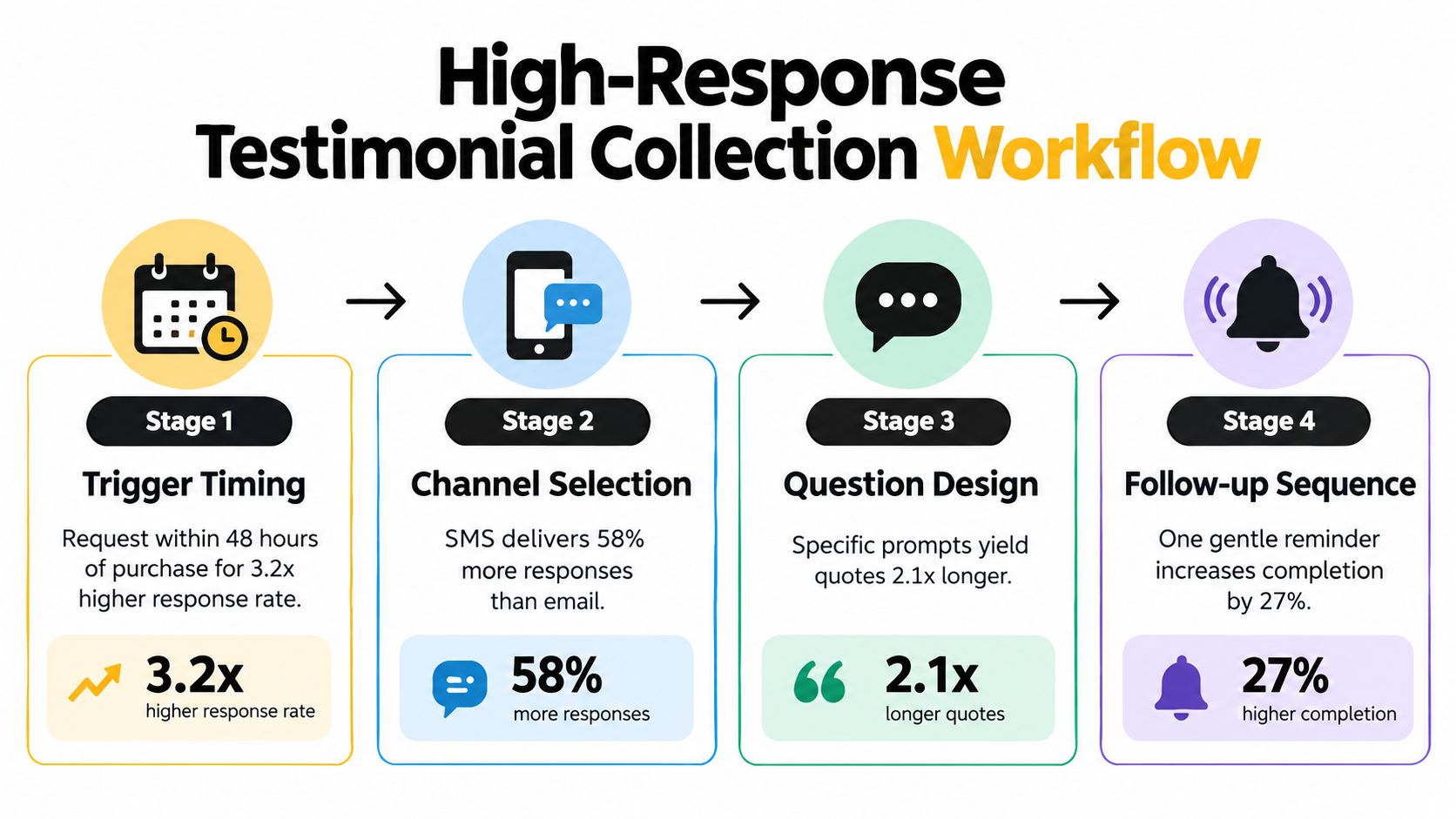
Customers rarely ignore a testimonial request because they have nothing positive to say. They ignore it because the request arrives at the wrong time, asks for too much effort, or gives them no clear starting point. A useful workflow reduces all three obstacles.
Start with the outcome, not the quote
Use a two-stage form.
- Capture the result first. Ask for one concrete change, such as hours saved, leads generated, activation lift, or time to first value. Request baseline-versus-current context when the customer can provide it.
- Invite the narrative second. Ask only respondents who report a positive outcome to explain what happened in a concise 50 to 100-word account.
The first step helps you identify evidence. The second gives the customer a manageable writing task. A prompt such as “What changed in your workflow after using the product?” works better than “Tell us what you think” because it points toward a real experience.
Trigger outreach after value realization, not immediately after signup. A new user may like the interface while still lacking a meaningful result. Product events, successful support resolutions, completed projects, or a customer milestone can provide better timing signals.
Make follow-up useful
An evidence summary on online survey reminders reports unsolicited survey response rates averaging 25% to 30%. The same source describes participation rising from 22.6% to 39.4% after reminders, and a separate analysis of more than 24,000 participants found that each of three successive reminders significantly increased response. Varying reminder wording was associated with a 36% improvement compared with repeating identical copy.
The practical lesson isn't to chase customers indefinitely. Send a short reminder that changes the reason for responding. The first message can ask for a result, the next can offer a few prompts, and the final message can explain how the customer can review the wording before publication. Avoid identical copy that makes the sequence feel automated and disposable.
Remove friction from supporting material
If you request a customer photo, logo, or short video, explain the format and intended use before asking them to upload anything. A simple media workflow, similar to the one used to collect guest photos, can help customers submit files without a long email exchange. Keep the testimonial form short, make optional fields clearly optional, and provide a preview of the final layout.
Connect triggers and follow-ups through your existing CRM or automation stack, but don't automate judgment. The workflow can identify a possible success event and send a request. A person should still verify the claim, resolve ambiguity, and approve the final edit. Teams building that system can also review marketing automation best practices before adding more sequences.
Navigating Legal Consent and Privacy Requirements
A customer may agree that your product helped them without agreeing to have their name, photograph, employer, logo, or result used in marketing. Those are separate permissions, and combining them into one vague checkbox creates avoidable risk.

Consent should be specific, informed, affirmative, demonstrable, and revocable, as outlined in this testimonial consent legal checklist. In practice, that means retaining a record of the exact wording approved, the date of approval, the person who approved it, and the permitted uses.
Separate the permissions
A durable consent form should distinguish between:
- Quote publication: Permission to publish the customer's words.
- Identity display: Permission to show name, role, company, or employer.
- Visual assets: Permission to use a photograph, video, logo, or uploaded file.
- Distribution: Permission for website, social media, email, sales materials, launch directories, or paid advertising.
- Adaptation: Permission to edit for clarity, translate, shorten, or reformat.
- Future reuse: Permission to use the approved asset in later promotional channels.
Don't assume that approval for a testimonial page covers every future use. A customer might welcome a website quote but reject an advertisement targeted at a different market. Your records should reflect that distinction.
A clear privacy notice should explain the purpose, audience, retention approach, withdrawal method, and contact route. Reviewing public examples such as the privacy practices at Leaping Lemur Media can help teams see how a privacy notice communicates operational details, though your own notice must match your processing activities and legal advice. You can also use this guide to write a privacy policy as a starting point for organizing the document.
Keep consent current
Store each testimonial as a versioned record. If you edit a sentence, translate it, remove a limitation, or add a new metric, send the revised version back for approval. Add a review date so the team can check whether the customer's role, employer, product plan, and result remain accurate.
Withdrawal needs a real process, not a promise buried in a form. Assign an owner, record the request, remove or anonymize the relevant asset across known channels, and update internal indexes so the old version doesn't reappear in sales material.
The following video offers additional context for teams formalizing privacy and consent procedures:
If a customer changes employers, the old testimonial may no longer represent their current role. Give them an anonymized option, such as “Head of Growth at a B2B SaaS company,” when identifying them publicly isn't appropriate. Privacy protection and credibility can coexist when the description remains honest and sufficiently contextual.
The Quality Over Quantity Paradox in Social Proof
More testimonials don't automatically create more trust. A large archive of vague, uniformly positive statements can look curated to the point of suspicion, especially when every customer uses the same adjectives and no account includes constraints.
A study published through the University of Illinois found a nonlinear relationship between review ratings and purchase probability. Purchase probability increased as ratings rose to approximately 4.2 to 4.5 stars, then decreased when ratings became even higher. The study also found that larger review volumes didn't always produce better outcomes.
The finding doesn't mean a SaaS company should manufacture criticism or lower its standards. It means your testimonial collection should represent reality rather than create a perfect-looking wall of praise.
Curate for buyer questions
A useful library helps a prospect answer questions such as:
| Buyer question | Evidence to collect |
|---|---|
| Is this product relevant to my situation? | Customer role, company type, industry, and use case |
| What changed after adoption? | Before-and-after workflow, measurable outcome, and timeframe |
| How difficult was implementation? | Setup conditions, integrations, onboarding experience, and remaining work |
| Can I trust the claim? | Identifiable source, supporting evidence, and approval record |
| What should I expect? | Benefits paired with realistic limitations or dependencies |
This is the difference between collecting compliments and collecting decision support. A founder who serves several segments may need fewer generic quotes and more varied accounts from different roles, price tiers, acquisition channels, and use cases.
Preserve nuance during editing
A customer saying, “The product solved our reporting problem, but our legacy integration still needs maintenance,” may produce a stronger testimonial than a polished sentence that removes the qualification. The limitation tells a buyer that the account hasn't been sanitized beyond recognition.
Don't cherry-pick only extreme outcomes. Invite customers to describe the problem before adoption, the product used, the time to value, the result, and the remaining constraint. A small set of specific accounts can carry more authority than a large set of interchangeable endorsements. For a broader explanation of how evidence influences buyers, see what social proof means in marketing.
Integrating AI Responsibly into Your Testimonial Process
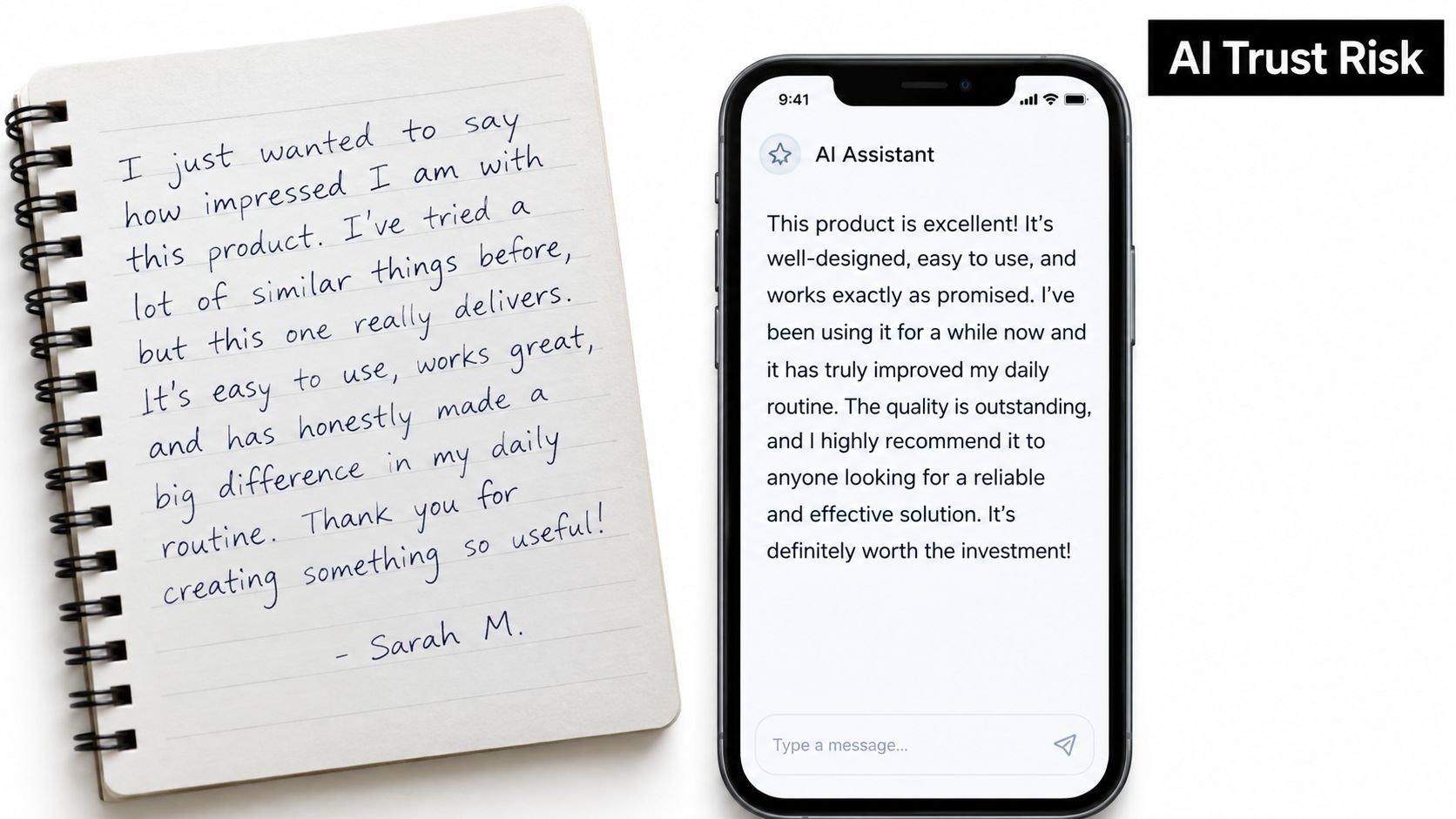
AI can reduce the administrative burden of testimonial collection. It can transcribe an interview, translate a customer response, identify repeated themes, and suggest a shorter version for a landing page. It shouldn't invent the customer voice, add an outcome, or turn a qualified statement into an absolute claim.
The trust risk is measurable. In GatherUp's Beyond the Stars 2025 research, 33% of surveyed consumers said they don't trust reviews they suspect were generated by AI, 33% frequently encounter reviews that look fake or AI-generated, and 70% trust a business less when review responses appear AI-generated. The same research found that 55% trust AI-generated review summaries, which suggests a useful distinction: people may accept automation that organizes genuine feedback while rejecting synthetic customer voices.
Define acceptable assistance
Create an internal policy before your team starts using an AI writing tool:
- Transcription is assistance: Keep the original recording or submission and let the customer correct transcription errors.
- Translation is assistance: Preserve the original language and send the translated version for review.
- Shortening is assistance: Remove repetition, not meaning, evidence, or important qualifications.
- Drafting is assistance: Use AI to propose structure, then have a human compare it with the source.
- Fabrication is prohibited: Never generate a customer experience, result, quote, or approval that didn't happen.
The customer should approve the final wording, especially when editing changes sequence, emphasis, or specificity. Retain the original submission beside the published version so the team can explain how the asset was created.
Responsible implementation also benefits from a clear division of labor. The article on human and AI collaboration provides useful framing for assigning automation to repetitive work while leaving judgment and accountability with people.
Disclose material assistance
Disclosure depends on the use. A translated or lightly polished testimonial may need a note that it was translated or edited, while an AI-generated summary should be clearly separated from a customer-authored quote. Never place a synthetic sentence inside quotation marks and attribute it to a customer.
For launch claims and product outcomes, preserve the customer's language wherever possible. A slightly imperfect sentence with an approved source is more valuable than fluent copy that no customer would recognize.
Displaying and Distributing Testimonials for Maximum Impact
A testimonial hidden in a spreadsheet has no effect on a buyer. Publication should follow the places where prospects make decisions, while each placement should retain the context and consent attached to the original record.
Start with a practical mapping exercise. Match each testimonial to a buyer question and a relevant page:
- Homepage: Use a concise proof point that establishes the category and customer type.
- Feature or use-case page: Show the workflow and result most relevant to that feature.
- Pricing page: Address implementation effort, value, or adoption concerns without making unsupported financial claims.
- Sales materials: Include the approved identity, date, source notes, and restrictions so representatives don't reuse expired wording.
- Launch listing: Prepare a short, verified account that helps early adopters understand who uses the product and why.
- Email and social posts: Adapt the format, but don't strip away the qualification that makes the original credible.
Build a cross-platform evidence trail
BrightLocal's research found that consumers often consult more than one review site, with 40% using at least two sites on average. That behavior makes distribution important, but syndication mustn't become careless duplication. Encourage customers to share their own experience through appropriate third-party channels, and keep your owned testimonial consistent with the approved source.
A website quote and a third-party review serve different purposes. Your site offers control and relevance. Independent channels provide another place for buyers to compare the story. Neither should replace verification, permission, or a clear distinction between a customer-authored review and a company-edited testimonial.
Use a content distribution channels framework to decide where each approved asset belongs. Record the publication URL, version, date, audience, and removal procedure. If a customer withdraws permission, you should be able to find every known placement without searching through old campaign folders.
Audit the library before adding more
Run a quarterly review using a simple evidence checklist:
- Source: Can the team identify the customer and locate the original submission?
- Context: Does the asset explain the problem, use case, and customer role?
- Outcome: Does it state a concrete result or meaningful change without exaggeration?
- Consent: Are quote, identity, image, logo, channel, and reuse permissions separate and recorded?
- Currency: Is the customer still in the described role, and is the product claim still accurate?
- Diversity: Does the library represent more than one segment, use case, acquisition path, or outcome?
- Distribution: Is the testimonial visible where the relevant buyer evaluates the product?
- Withdrawal: Can the team remove or revise it across every known placement?
Remove weak assets rather than padding the page. A smaller, current collection with traceable evidence gives sales and marketing teams something they can defend, and gives buyers details they can actually use.
SubmitMySaas helps SaaS founders and makers present new products through launch features, discovery listings, and curated visibility for early adopters. Prepare your consent-approved testimonials before launch, then visit SubmitMySaas to submit your product and turn verified customer evidence into a stronger discovery asset.