How to Write Privacy Policy for SaaS Products
Learn how to write privacy policy documents for SaaS products. Master data mapping, GDPR and CCPA compliance, cookie consent, and versioning best practices.
Your signup form is live, Stripe is processing payments, product analytics are recording sessions, and a new chatbot has just been added to the marketing site. Then someone asks for the privacy policy. A template may look like the fastest answer, but it creates risk if the document describes an imaginary product rather than the systems your team runs.
Learning how to write a privacy policy for a SaaS product starts with operational accuracy. The policy should explain real data collection, processing, sharing, retention, user choices, and security practices in language customers can understand. It should also change when your product, vendors, or legal obligations change.
Mapping Your SaaS Data Flows Before Drafting
The most expensive drafting mistake happens before drafting begins. A founder opens a template, fills in the company name, adds a broad statement about “service improvement,” and publishes it without checking what the application, website, and vendors really do.
A reliable process starts with a data inventory. List every place where information enters the business, including account registration, support tickets, demo forms, billing, product usage, integrations, recruitment forms, and marketing campaigns. Record the data category, the collection point, the system that receives it, the business purpose, the people or services that can access it, and the expected retention approach.
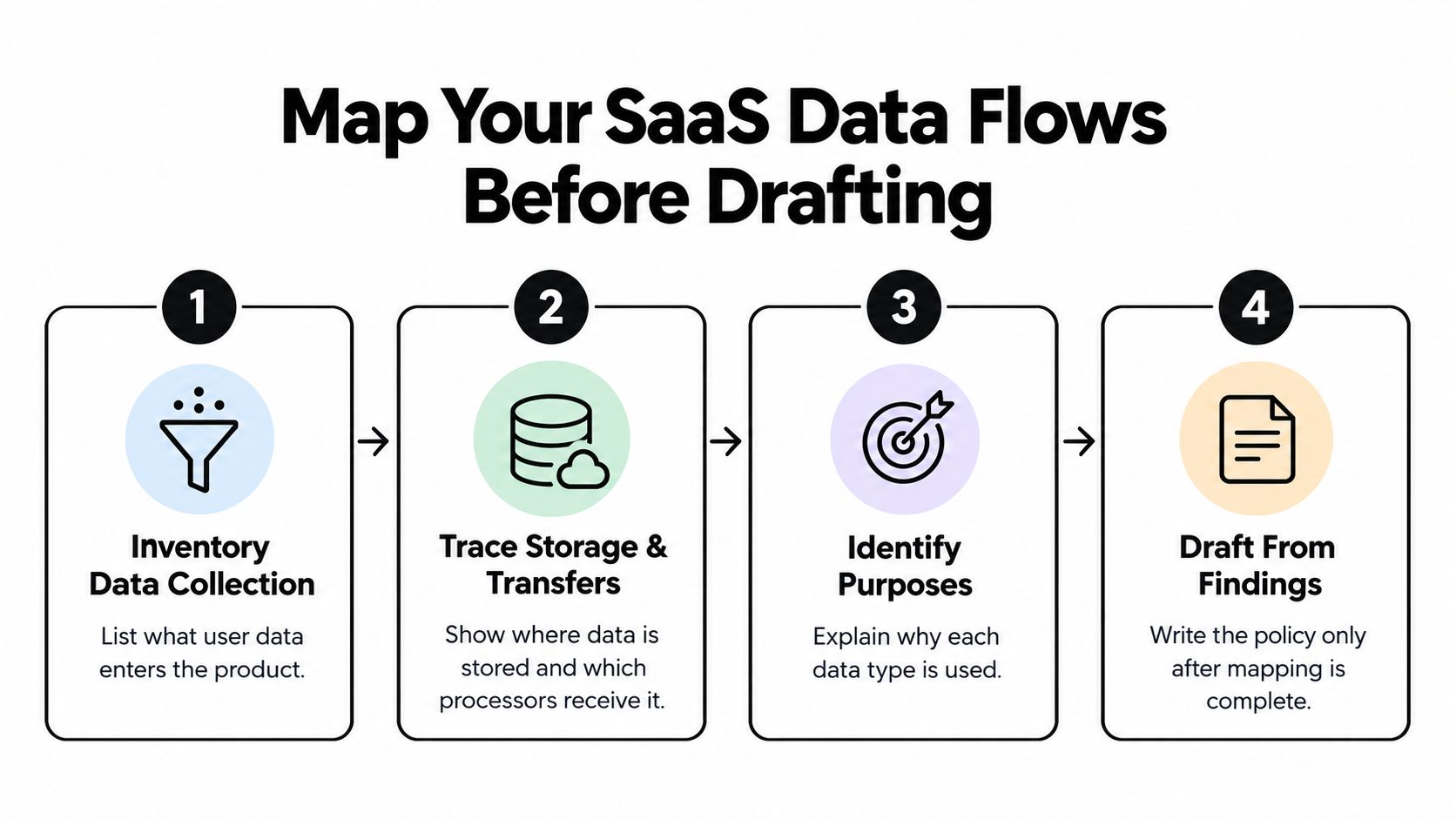
Build the inventory from the product outward
Use interviews and system records together. Ask engineering about application databases, logs, error monitoring, authentication, backups, and feature flags. Ask marketing about forms, pixels, email platforms, advertising audiences, and analytics. Ask customer success about support software and shared documents. Then compare those answers with the tools listed in your vendor register and billing records.
A simple worksheet can expose gaps quickly:
- Data entry point: Identify where a person submits information or where software collects it automatically.
- Data destination: Note the database, cloud region, backup system, or external processor receiving it.
- Purpose: State the specific reason for processing, such as account access, payment handling, fraud prevention, support, or product analytics.
- Access and transfer: Record internal roles, subprocessors, integrations, and any movement between services or regions.
- Retention decision: Define the operational reason for keeping the data and the event that ends that need.
Your policy should never claim that information stays inside your company if a payment processor, analytics platform, support provider, or infrastructure vendor receives it. The user behavior tracking guide can help teams think more precisely about what product and marketing instrumentation is recording.
Turn the map into a Privacy Impact Assessment
Once the inventory exists, conduct a practical Privacy Impact Assessment. For each processing activity, identify the relevant legal authority, the sensitivity of the information, the people affected, the access controls in place, and the gaps that need remediation. Public-sector privacy guidance recommends inventorying data first, performing an assessment, mapping legal authorities and technology gaps, and only then drafting the policy outline and language. The government privacy resources guide describes this stepwise approach.
Practical rule: If the team can't point to the system, owner, purpose, and retention decision behind a sentence in the policy, that sentence isn't ready to publish.
Keep an issue register beside the map. It might show that an analytics tool loads before consent, that a deleted account remains in a support export, or that a vendor contract doesn't reflect the data transmitted. Fixing those operational issues before drafting produces a shorter, more defensible document than adding vague legal language afterward.
Drafting the Core Clauses for Global Compliance
A global SaaS policy needs more than a paragraph saying that the company values privacy. It should let a reasonable user answer practical questions: What do you collect? Why do you need it? Who receives it? How long do you keep it? What can I request? How do I contact you?
Start with the identity and scope of the business. Name the legal entity, relevant websites and applications, contact methods, and the types of users covered. Explain the relationship between your company and the customer. In a B2B SaaS product, the customer may decide what information its organization uploads, while your company processes that information to provide the service. That distinction affects the policy, contracts, support procedures, and rights handling.
Write disclosures from the data map
Organize the main clauses around actual processing activities rather than legal labels alone.
- Information collected: Separate information users provide, information generated through use, device and log information, and information received from integrations or other parties.
- Purposes: Connect each category to a defined purpose. “Business operations” is too broad if you can say account administration, payment processing, support, security, or service analytics.
- Legal bases: For GDPR-covered processing, explain the applicable basis where relevant, such as contract performance, legal obligation, legitimate interests, or consent. Don't use consent as a universal substitute for a considered legal analysis.
- Sharing: Identify categories of recipients and explain why each receives information. Distinguish service providers from independent controllers and describe transfers where they matter to users.
- Retention: Give a period where you can support one, or explain the criteria that determine retention. Tie deletion to account closure, legal duties, fraud prevention, dispute handling, or backup cycles instead of promising immediate erasure when systems can't deliver it.
- Rights: Explain access, correction, deletion, restriction, objection, portability, and withdrawal of consent where applicable. Give users a workable request route and describe verification without creating unnecessary friction.
A policy also needs sections for cookies and similar technologies, security practices, children's privacy where relevant, international transfers, automated decision-making where relevant, and material changes. Security language should describe safeguards accurately without promising that breaches are impossible. A statement such as “we use administrative, technical, and organizational measures” is only useful when it reflects controls the company can explain.
Balance completeness with comprehension
Privacy policies became longer as privacy regimes matured. A longitudinal study of websites found that average policy length increased from 1,146 words in 2000 to 2,159 words in March 2011 and 4,191 words in March 2021, while more than 40% of policies were updated in mid-2018 after the GDPR took effect, as reported in the longitudinal privacy-policy study. Length alone doesn't create compliance. Unsupported detail can make a policy harder to maintain, while missing detail makes it inaccurate.
Use a layered structure. Put a concise explanation near the top, then provide detailed clauses, tables, definitions, and request instructions below. Your SOC 2 compliance checklist may help identify security and vendor-management practices, but don't copy certification language into the privacy policy unless it describes actual controls and their relationship to personal data.
Handling Cookies and Third-Party Integrations
A privacy policy can be perfectly worded and still fail the reality test if the website loads tracking tools before the user makes a choice. Cookies, pixels, session replay, chat widgets, payment tools, customer data platforms, and analytics scripts create a moving technical layer that must match the written notice.
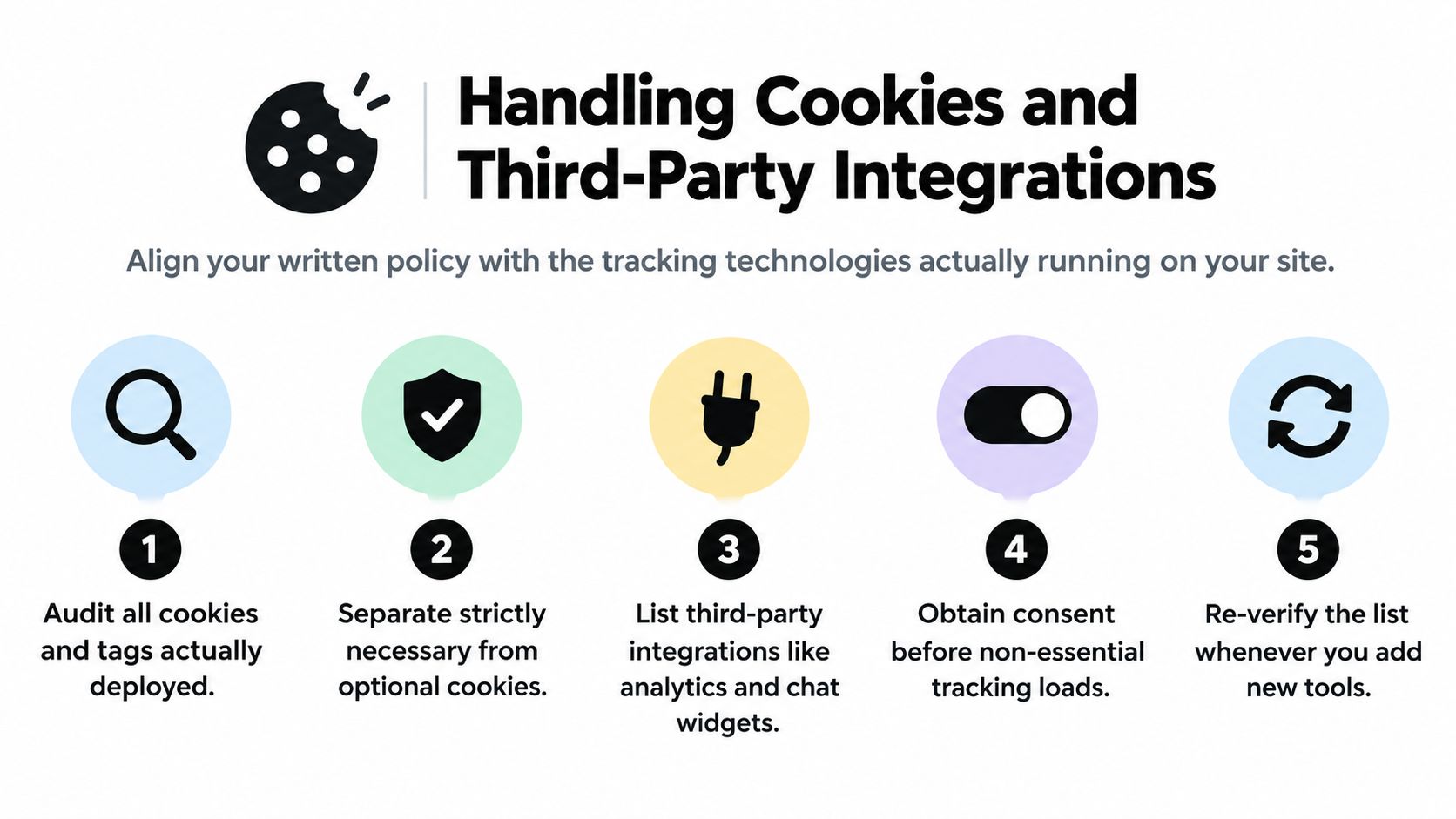
Start with a live technology audit. Inspect the site before consent, after accepting optional cookies, and after rejecting them. Review browser storage, tag-manager configurations, code repositories, consent-platform settings, embedded forms, and vendor documentation. Don't rely only on the list supplied by the marketing team. A forgotten script in an old landing-page template can be just as relevant as a deliberately installed analytics tool.
Separate necessity from optional tracking
Classify each technology by function. Strictly necessary cookies may support authentication, security, load balancing, or a user-requested feature. Optional technologies may measure behavior, personalize experiences, support advertising, or trigger chat and experimentation. The classification should reflect the purpose and jurisdictional context, not the vendor's marketing description.
The policy and consent banner should use the same vocabulary. If the banner says “analytics,” the policy should explain the analytics purpose, the information involved, the provider category, and the user's control. If your system offers a “reject all” choice, it shouldn't hide that choice behind extra screens while presenting acceptance as the prominent option.
A consent banner is not a substitute for an accurate policy. It is the user-choice layer that makes the policy operational.
For every integration, record the data sent, trigger condition, recipient, purpose, retention behavior, and control available to the user. Stripe may process payment information, Mixpanel may receive product events, AWS may host application data, and a chat provider may see conversation content. Those examples aren't a reason to list vendors mechanically. They show why the policy needs to describe the role each service plays in your product.
Test the choice mechanisms
Test opt-in, opt-out, withdrawal, and universal opt-out signals where applicable. Confirm that withdrawing consent changes the behavior of the relevant tags, not just the appearance of the preference center. Revisit server-side tracking too, because a browser-based banner won't necessarily stop events sent directly from the application.
Recent privacy litigation commentary identifies tracking-related claims filed across 315 courts in 45 states against 3,512 unique defendants, with attention on cookies, disclosures, universal opt-out signals, dark patterns, and youth protections, as described in recent data privacy litigation updates. Treat that as an operational warning, not a reason to add dramatic language. The safer approach is to make the written policy, consent tool, code, vendor contracts, and preference records tell the same story.
Teams evaluating their broader tool stack can also review API integration tools for SaaS workflows, then add every new integration to the privacy review before deployment.
A short demonstration can make the relationship between consent and tracking easier to communicate:
Designing the Policy Page for Readability and Trust
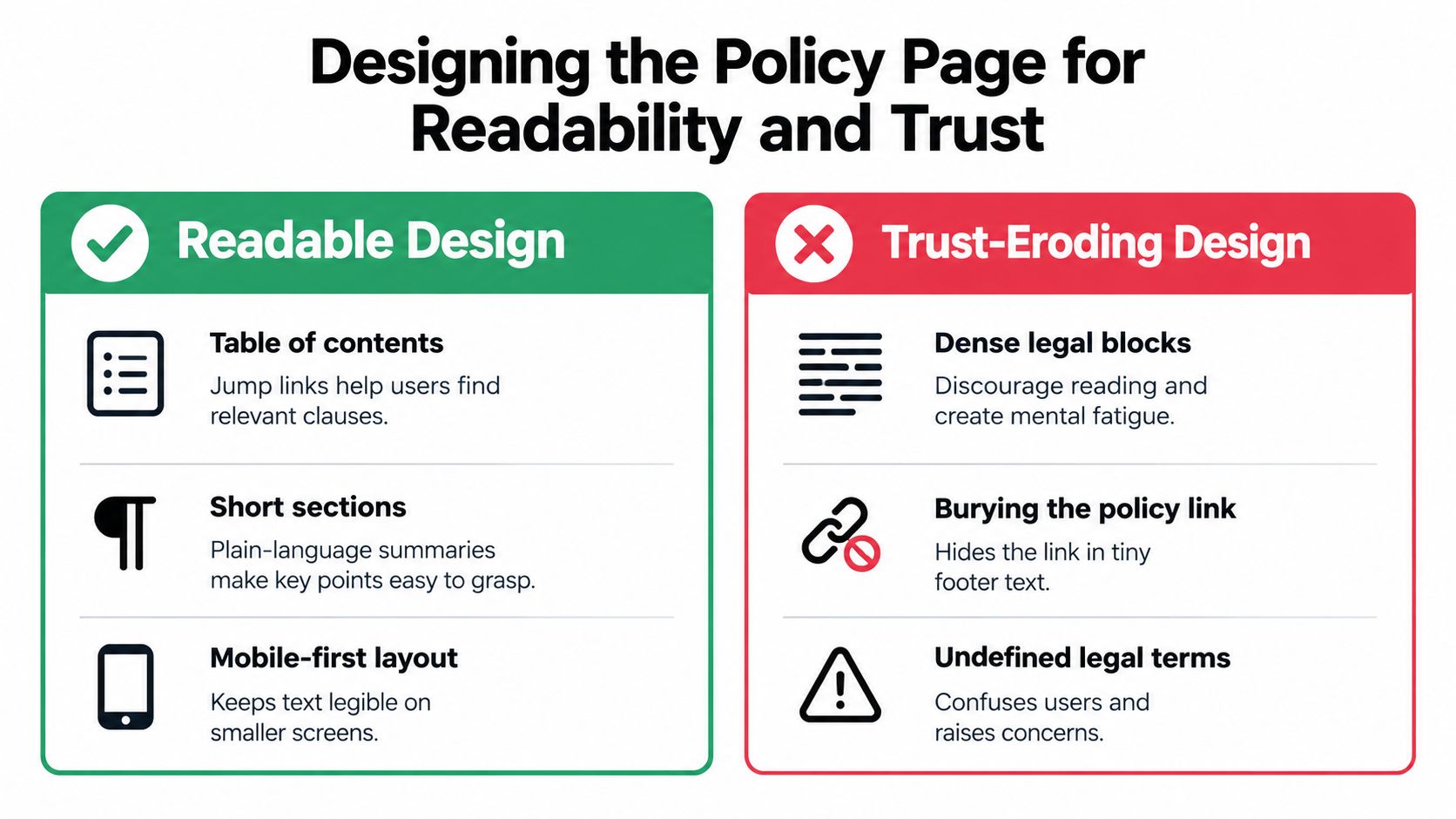
A user opens your privacy policy after a consent prompt, before creating an account, or while investigating how uploaded content is handled. Give that person a clear route to an answer. Dense paragraphs, undefined terms, and buried choices may produce a formally complete document while providing poor notice.
Pew Research found that 56% of Americans frequently click “agree” without reading privacy policies, 61% say policies are ineffective at explaining how companies use data, and 69% view them as something to get past, according to Pew's research on American views of data privacy. The practical implication is direct: page structure affects whether users can understand the company's actual data practices.
Give readers a usable route through the page
Place the effective date and a concise summary near the top. Add a table of contents with jump links, descriptive headings, short paragraphs, and lists for rights and request steps. A layered structure helps a busy reader grasp the main practices quickly while retaining detailed explanations for people who need them.
Nielsen Norman Group identifies five recurring usability problems in privacy and terms pages: poor readability, no high-level summary, weak in-page navigation, bad formatting, and poor placement. Its guidance recommends plain language, layered presentation, and a minimum 14pt text size, as described in its privacy-policy usability guidance.
Write the page around the questions your support team receives:
- What happens to my account data? State the service purpose and identify the systems involved.
- Who can access uploaded content? Explain internal access, processors, and customer-controlled sharing where relevant.
- How do I delete or export information? Give the request path and describe verification requirements or exceptions.
- How do I change marketing preferences? Link directly to the preference control.
Use the information hierarchy guide to order information by user importance. Keep legally required detail, but place the most consequential facts where readers can find them before abandoning the page.
Make mobile reading part of compliance work
Review the policy on a phone as well as a desktop browser. Avoid narrow columns, tiny links, long definitions without breaks, and accordions that hide material information. Check contrast, link labels, semantic headings, keyboard access, and layout behavior without relying on visual styling alone.
A policy can be perfectly worded and still misrepresent practice if the website loads tracking tools before the user makes a choice. Treat the page as one part of an operational control: its descriptions should match the data map, consent settings, vendor arrangements, and product behavior. When those elements change, update the relevant explanation instead of allowing the policy to become a static template.
Plain language does not mean casual language or legal imprecision. Name the actor, action, purpose, and user choice directly. “We send account email addresses to our email delivery provider to send service messages” is easier to understand and maintain than passive wording about broad groups of “affiliates and partners.”
Publishing and Versioning Your Privacy Policy
Publication is a release task, not the final click in a word processor. The policy must be reachable from the public site, visible at the moments when data is collected, and connected to the product's records and change-management process.
Host the current version on a stable, public URL. Link it from the footer, account creation flow, support area, relevant forms, and consent interface. Use a page that can be indexed and read without requiring an account, while keeping sensitive request workflows behind appropriate verification.

Keep an evidence trail
Before publishing, assign an owner and complete a release review with product, engineering, security, and legal input where appropriate. Confirm that the policy matches the data inventory, vendor register, cookie configuration, rights-request process, and customer-facing consent language.
Record the version, effective date, approvers, affected systems, and reason for the change. Maintain an archive of previous versions, but make the current policy unmistakable. A short changelog helps users understand whether a revision concerns a new integration, a changed purpose, a revised retention practice, or a legal update.
Release discipline: Don't publish a revised policy until the product behavior and the notice are ready on the same release plan.
User notification depends on the nature of the change and the obligations that apply. A material change may require direct notice, an in-product message, renewed consent, or another documented communication method. A minor correction may need a changelog and an updated date. Avoid treating every update identically, because excessive notices train users to ignore important ones.
Connect policy changes to product launches
Add a privacy checkpoint to the product-development workflow. A new AI feature, integration, event stream, support channel, or marketing tag should create a review task before launch. The owner should confirm whether the data map, vendor agreement, consent controls, retention logic, request procedures, and policy language all need revision.
Store consent and preference records in a way that supports the choices presented to users. The record should help the team determine what choice was offered, what the user selected, and when the selection occurred, subject to the systems and legal requirements applicable to the business. During launch readiness, verify that the public policy URL works, the effective date is correct, and the page remains accessible under traffic and authentication conditions.
Maintaining Compliance as Your Product Evolves
A privacy policy becomes useful when it functions as an interface between company operations and user expectations. It tells customers what the product does with information, while the data inventory, contracts, consent tools, access controls, and deletion workflows make those statements true.
That relationship matters because the legal environment keeps changing. A 2026 privacy guide for the United States reports that the number of states with broad privacy laws nearly doubled from nine in 2024 to 16 in 2025, with three more taking effect in 2026, and that nine states amended their laws in 2025. Those figures appear in Chambers' 2026 data protection and privacy trends. A policy that was accurate for last year's product and market may not answer today's obligations.
Use a phased maintenance model
Run compliance work in connected phases rather than assigning one annual document review.
- Assess: Recheck the markets served, user categories, processing risks, and legal requirements after meaningful business changes.
- Map: Update the inventory and flow diagrams when teams add features, vendors, environments, data fields, or transfer routes.
- Control: Review contracts, access permissions, rights-request procedures, deletion jobs, consent settings, and opt-out signals.
- Monitor: Watch product releases, vendor changes, incident reports, regulatory developments, and user questions that reveal unclear disclosures.
- Publish: Revise the policy, record the version, communicate material changes, and confirm that the live page matches the deployed systems.
Set review triggers instead of relying only on a calendar. A new payment processor, acquisition, AI provider, advertising campaign, geographic market, customer data field, or retention rule should prompt a targeted review. The business impact assessment guide can help connect operational changes with broader business planning, but privacy decisions still need to follow the actual data flows and applicable legal analysis.
Make ownership explicit
Assign one person to maintain the policy, but don't make that person solely responsible for discovering changes. Product managers should flag new data uses, engineers should document instrumentation, procurement should route vendor reviews, security should report control changes, and support should surface recurring rights or transparency questions.
This is also where privacy work supports growth. Accurate documentation makes enterprise questionnaires easier to answer, reduces contradictions during security reviews, and gives launch teams a clear checklist before they expose a new feature to the market. The policy isn't a shield created after the product is built. It's a living record of how the business handles information, maintained alongside the systems that make the SaaS product work.
SubmitMySaas gives SaaS founders a launch and discovery platform for submitting products to daily launches, trending lists, and monthly roundups. Before you send a new product into wider discovery, use the submission process as a final operational check, then visit SubmitMySaas to publish your launch with an accurate, accessible privacy foundation in place.