By Outrank
Startup Product Marketing: A Practical SaaS Guide
Learn startup product marketing from positioning and launch channels to activation metrics, with a stage-by-stage framework for SaaS teams in 2026.
On this page
36% of SaaS teams still prioritize marketing-qualified leads, while only 22% track pipeline directly, according to the 2025 SaaS marketing survey discussed by Freemius. That's a useful warning for founders: you can build a marketing dashboard that looks busy without knowing whether your work creates customers.
Startup product marketing connects a customer's problem to the product experience that solves it. It includes demand validation, positioning, launch planning, distribution, and adoption. Launch exposure is an input, not the finish line. The practical question is whether the people you attract reach value, keep using the product, and eventually justify what you spent to acquire them.
Startup Product Marketing Stages at a Glance
| Stage | Core question | Key output | Success signal |
|---|---|---|---|
| Validation | Do active users need this? | Survey results and segment notes | Strong disappointment signal supported by retained usage |
| Positioning | Who is it for and why now? | One-sentence value statement | Prospects repeat the message back in their own words |
| Launch | Who hears about it first? | Launch plan and tagged landing page | Visitors complete the first-value action |
| Growth | Which channels bring users back? | Channel scorecard | Stable retention in comparable cohorts |
| Scale | Which motions repeat without founders? | Playbooks and onboarding paths | Payback period within the team's target |
These stages describe different decisions, not departments you need to hire. A founder might interview customers in the morning, revise a landing page in the afternoon, and answer onboarding questions that evening. The important distinction is what each activity should produce.
Validation produces evidence of need. Positioning turns that evidence into a buying argument. A launch puts that argument in front of an initial audience, while growth work identifies repeatable ways to reach suitable customers. Scale begins when someone other than the founder can run those activities without guessing.
Overlap is normal, but dependencies still matter
Small teams often work on adjacent stages together. You can draft positioning while interviewing active users, provided you treat the copy as a hypothesis. You can also prepare a launch while fixing onboarding, provided you haven't committed to sending visitors into an experience that can't deliver its promise.
Skipping validation is the expensive shortcut. If buyers don't care about the problem, polishing the headline or expanding distribution won't resolve the underlying issue. You'll have more acquisition activity and less clarity about why people leave.
Practical rule: Move forward when you have the evidence needed for the next decision, not when every document looks finished.
Keep ownership simple:
- Founder or product lead: Own the customer problem, segment choice, and product limitations.
- Marketing owner: Maintain the positioning, launch assets, and channel scorecard.
- Engineering or analytics owner: Make sure important product events can be measured.
- Customer-facing owner: Collect objections and investigate where new users get stuck.
In a solo business, those roles may all belong to you. They still deserve separate questions on your checklist.
Name your current stage and the single output you're missing. A team without a credible segment needs different work from a team with retained customers but no repeatable distribution.
Validate Demand Before You Position or Launch
An analysis of 483 failed startups by CB Insights found that 42% cited “no market need” as a principal reason for failure, as summarized in Stealth Agents' product-market-fit statistics, which also describes Sean Ellis's benchmark of at least 40% of active users saying they'd be “very disappointed” if a product disappeared. Marketing built on weak demand can spend money efficiently and still fail commercially.
The survey question is straightforward: how would an active user feel if they could no longer use your product? The answer helps distinguish a useful habit from something people merely find interesting.
Give this work the same attention you'd give a launch announcement.

Run the survey without flattering yourself
- Choose active users. Ask people who've experienced the core workflow, not everyone who registered. Record how you defined active so you can interpret future surveys consistently.
- Segment the answers. Separate responses by role, company type, and use case. An overall average can hide a group that gets substantial value.
- Find the strongest relevant segment. Look for concentrated disappointment, but check the response count. A tiny enthusiastic group is a reason to investigate, not a reason to declare victory.
- Read the explanations. Ask what users would miss, what they'd use instead, and what originally brought them to the product.
- Check behavior and revenue. Compare the enthusiastic segment with activation, retained usage, conversion, and payment records.
Say a scheduling tool gets much stronger disappointment responses from team leads than from solo users. Interviews reveal that team leads rely on shared availability to avoid coordination work, while solo users can return to their existing calendar.
The useful conclusion isn't that team leads like the product. It's that shared coordination may be the valuable job, and team leads may be the audience worth investigating further.
Separate disagreement from evidence
Founders can interpret the same interview differently. Keep a decision log with the observation, competing explanations, and the next test. For teams that need a structured discussion about those competing explanations, the Acheloa Wellness playbook for executive teams from Acheloa Wellness, Inc. is a resource to consider alongside the customer evidence.
If you're still deciding which assumptions to test, use our guide on how to validate a startup idea to organize the discovery work.
The disappointment survey doesn't replace cohort analysis. Choose a segment whose stated need agrees with what people do, then use that segment's language and alternatives to shape positioning.
Build a Positioning and Messaging Framework
Positioning is a choice about comparison. You're deciding which buyer should consider your product, what they'd otherwise use, and why your approach deserves a change.
Messaging expresses that choice. A headline can be clear and still communicate the wrong positioning, such as selling convenience to a buyer whose real concern is auditability.
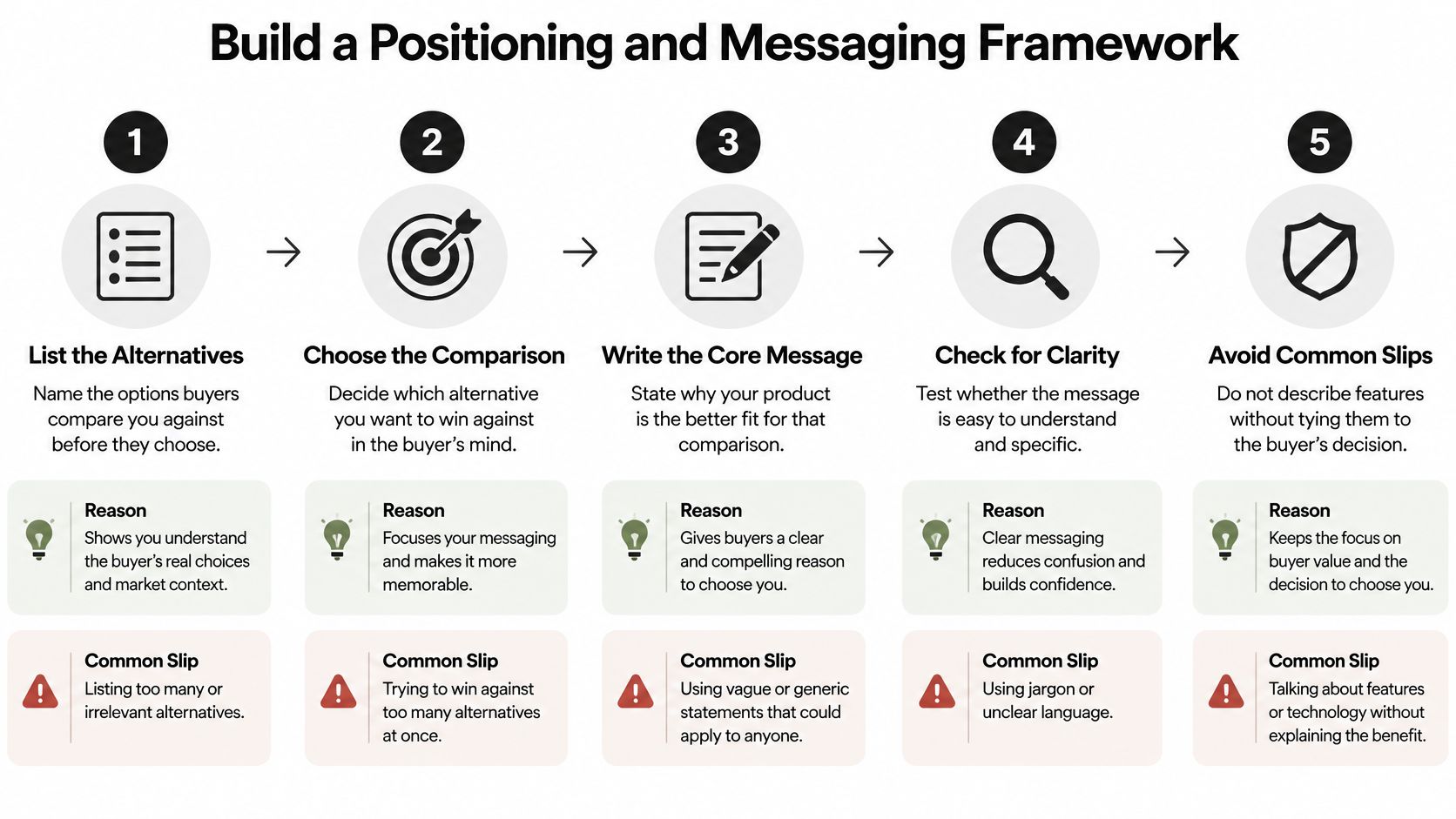
The visual framework keeps the comparison and message connected.
Turn customer evidence into a buying argument
- List the alternatives buyers use today. Include spreadsheets, manual work, an existing vendor, and doing nothing. Listing only named competitors misses the option that may be hardest to displace: a familiar process.
- Choose meaningful differences. Identify attributes your product has that the relevant alternatives lack. Don't include every feature, and don't claim uniqueness without checking the comparison.
- Translate attributes into outcomes. A shared approval history might help an operations manager find who approved a change. The common slip is stopping at the feature and expecting buyers to infer its importance.
- Choose the buyer who feels the problem sharply. Describe their responsibility, workflow, and purchase trigger. A broad label such as small businesses won't tell you which objection to address.
- Select an understandable category. Use a category that helps buyers recognize the job your product performs. Inventing a category can create an education burden before anyone understands the benefit.
- Write the statement and test comprehension. Ask prospective buyers to explain who it's for, what it does, and why they'd consider it. Don't coach them, and don't confuse polite approval with understanding.
A useful working statement is: for this buyer facing this problem, the product is this kind of solution that delivers this outcome, unlike the alternative, because of this relevant difference.
Use our guide to writing a value proposition when you need to turn that working statement into customer-facing language.
Make the promise specific enough to prove
Consider a hypothetical code-review tool initially described as an AI assistant for developers. That label identifies technology but leaves the buyer to discover the task, value, and limits.
A more useful position might be code-review software for engineering managers who want to catch review bugs before merge. This identifies the buyer and workflow without pretending the software replaces engineering judgment. The team should only make that promise if the product can support it.
Build a message hierarchy from the position:
- Headline: Catch review bugs before merge.
- Subhead: Give engineering managers an additional check inside the pull-request workflow.
- Proof point about workflow: Show a real example of a finding attached to the relevant code.
- Proof point about control: Explain how reviewers accept, dismiss, or investigate a finding.
- Proof point about evaluation: Provide a documented example repository or reproducible demonstration.
Proof doesn't have to mean a dramatic performance statistic. A visible workflow, clear limitation, or inspectable output can help a buyer evaluate the claim. If you don't have evidence for a statement, narrow it rather than decorating it with stronger adjectives.
Choose a Go-to-Market Motion Before Channels
Your go-to-market motion describes how a suitable user becomes a paying customer. It should match the buying work your validated segment needs to complete.
| Motion | How a customer progresses | When to consider it |
|---|---|---|
| Product-led | Users evaluate and buy through the product | Value is accessible without extensive assistance |
| Sales-led | A person qualifies, demonstrates, and closes | Buyers need procurement, security, or implementation support |
| Hybrid | Product behavior triggers human assistance | Users can begin alone, but accounts need help expanding or buying |
Don't choose product-led growth just because you offer a free trial. A trial that requires a founder-led setup call is a different operating model from self-serve evaluation.
Document the buying path
Start with an ideal customer profile grounded in your strongest segment. Record company type, buyer role, relevant workflow, and the event that makes the problem urgent, such as a new reporting obligation or a team expansion.
Then compare contract value with the effort required to reach value. A small purchase with a simple setup favors self-service; a complex deployment may need a guided evaluation even when the interface is easy to use.
Define product-qualified behavior from observed usage rather than enthusiasm. A user completing the core workflow may deserve onboarding help, while an account inviting colleagues and asking about permissions may need a commercial conversation.
- For self-serve users: Assign ownership of stalled onboarding and payment friction.
- For sales-assisted accounts: Specify which usage event creates a task and what the salesperson should investigate.
- For every handoff: Name the owner, response expectation, and information that must accompany it.
Keep this on a short operating document alongside pricing and eligibility rules. Our SaaS go-to-market strategy guide can help organize those choices. Channel selection becomes easier when you know whether you're seeking an individual evaluator, a buying committee, or an account already showing useful product behavior.
Choose Channels That Keep Working After Launch
| Channel | Best for | Cost profile |
|---|---|---|
| Founder-led content | Trust with early buyers | Founder time |
| Search-optimized pages | Discovery that compounds | Writing and upkeep |
| Integrations and marketplaces | Users already in a workflow | Build time and listing effort |
| Communities and forums | Early adopters and feedback | Time to take part |
| Third-party reviews and directories | Credibility signals | Low to moderate |
| Paid ads | Fast tests of a message | Ongoing spend |
In a 2023 survey of B2B SaaS ventures, organic growth represented approximately 40% of the marketing channel mix, and 64% of participating companies allocated less than $500,000 annually to marketing, according to Kalungi's B2B SaaS marketing benchmarks. Those findings support considering durable discovery assets rather than assuming paid distribution should carry the whole plan.
They don't mean organic acquisition is free. A comparison page requires research and updates, a community requires participation, and an integration requires engineering and support.
Choose assets with a useful life after publication
A launch announcement matters partly because of what remains accessible afterward. Searchable use-case pages, credible third-party mentions, integration listings, and customer explanations can give later buyers a route to evaluating the product.
Choose assets that answer a purchase or workflow question:
- Comparison pages: Explain who should choose each option, including situations where your product isn't suitable.
- Use-case pages: Show the inputs, workflow, output, and next action for a specific job.
- Integration listings: Explain what connects, which permissions are needed, and how users confirm it works.
- Founder-written articles: Address a difficult customer question with examples rather than a product pitch.
- Review profiles and referral prompts: Help customers describe their actual experience without scripting praise.
Email can support these channels, but delivery problems can make a useful message look ineffective. Before inviting customers or partners to a launch, use Mailwarm to test your email deliverability, then separate delivery issues from offer and audience problems.
Compare buyer fit, effort, and learning speed
Ask where your buyers already look for help. An integration marketplace may fit a workflow-bound product better than broad social posting; a specialist forum may reveal objections that search analytics won't explain.
Next, calculate the work involved. Include writing, engineering, moderation, follow-up, and maintenance rather than recording only cash spending.
Finally, define what counts as an early signal. Community replies can reveal misunderstanding quickly, while search discovery may require patience before commercial outcomes are interpretable. Paid ads can help test a message, but a click alone doesn't prove you've found a sustainable acquisition route.
Pick a channel because it gives the right buyer a credible next step, not because another founder posted an impressive traffic chart.
Choose a small channel portfolio for a bounded test. Write down the intended audience, asset, owner, resource limit, and activation-based success condition for each channel before you start.
Measure Activation Instead of Launch Traffic
| Metric | Benchmark or rule | What it tells you |
|---|---|---|
| Activation within seven days | Define per product and check against retention | Whether launch visitors reach first value |
| Activated users per hundred visitors | Compare landing-page variants | Message-to-product fit |
| Retention at day thirty | Compare with the cohort baseline | Durable value after the launch spike |
| Retention at later checkpoints | Compare equally mature cohorts using the same activity definition | Long-term fit |
| Product-qualified lead conversion | Compare qualified accounts with your own lead baseline | Quality of sales follow-up |
Activation is the primary product-marketing outcome, not registration. In a peer-reviewed study covering 74,871 new contracts at one large B2B SaaS provider, 82% were retained through the end of onboarding, according to the Customer Onboarding Tools statistics guide, which recommends tracking activation within seven days and retention at days thirty, ninety, and 365. That study describes one provider, not a universal retention target.
Instrument the promise you make
Choose an event that demonstrates meaningful value. For a reporting product, opening the dashboard may be too shallow; producing a report from the customer's own connected data is a stronger candidate.
Attach campaign parameters to incoming links, preserve the source on the account record, and send the activation event to an analytics tool such as PostHog. Record the time between signup and the event so you can investigate time-to-value as well as completion.
Use the same eligibility and activity definitions across cohorts. Exclude cohorts that haven't had time to mature from later retention comparisons, and separate account-level behavior from individual user behavior.
Run a landing-page experiment with a generic product promise against a specific first-value action. Keep audience and offer consistent, then compare activated visitors rather than selecting the version with the most button clicks.
Qualify behavior and acknowledge attribution limits
Directional benchmark summaries put product-qualified lead conversion at approximately 25%–30%, versus 5%–10% for marketing-qualified leads, but definitions and samples vary, as noted in SHNO's product-led growth statistics. Use that comparison to motivate testing behavioral qualification, not to set an automatic sales target.
Candidate qualification events include:
- Workflow completion: The user produces the intended output.
- Team participation: A colleague joins and contributes.
- Connected data: The account integrates a relevant source.
- Repeated use: The user returns to perform the valuable action again.
Check whether those events precede payment and retained usage in your product. Don't turn backlinks, launch votes, or page views into commercial intent by assigning them points.
Attribution will remain incomplete when buyers move between search, referrals, communities, and devices. Keep tagged-source reporting alongside a self-reported discovery question and a pre-launch baseline; distinguish directly tracked conversions from assisted revenue rather than awarding every touchpoint full credit.
Measurement safeguard: An increase after launch is evidence to investigate, not proof that every additional customer came from the launch.
Choose an activation measure for the weekly team report. Include its denominator, source cohort, and time window so everyone reads the same result.
Plan the Launch Playbook Week by Week
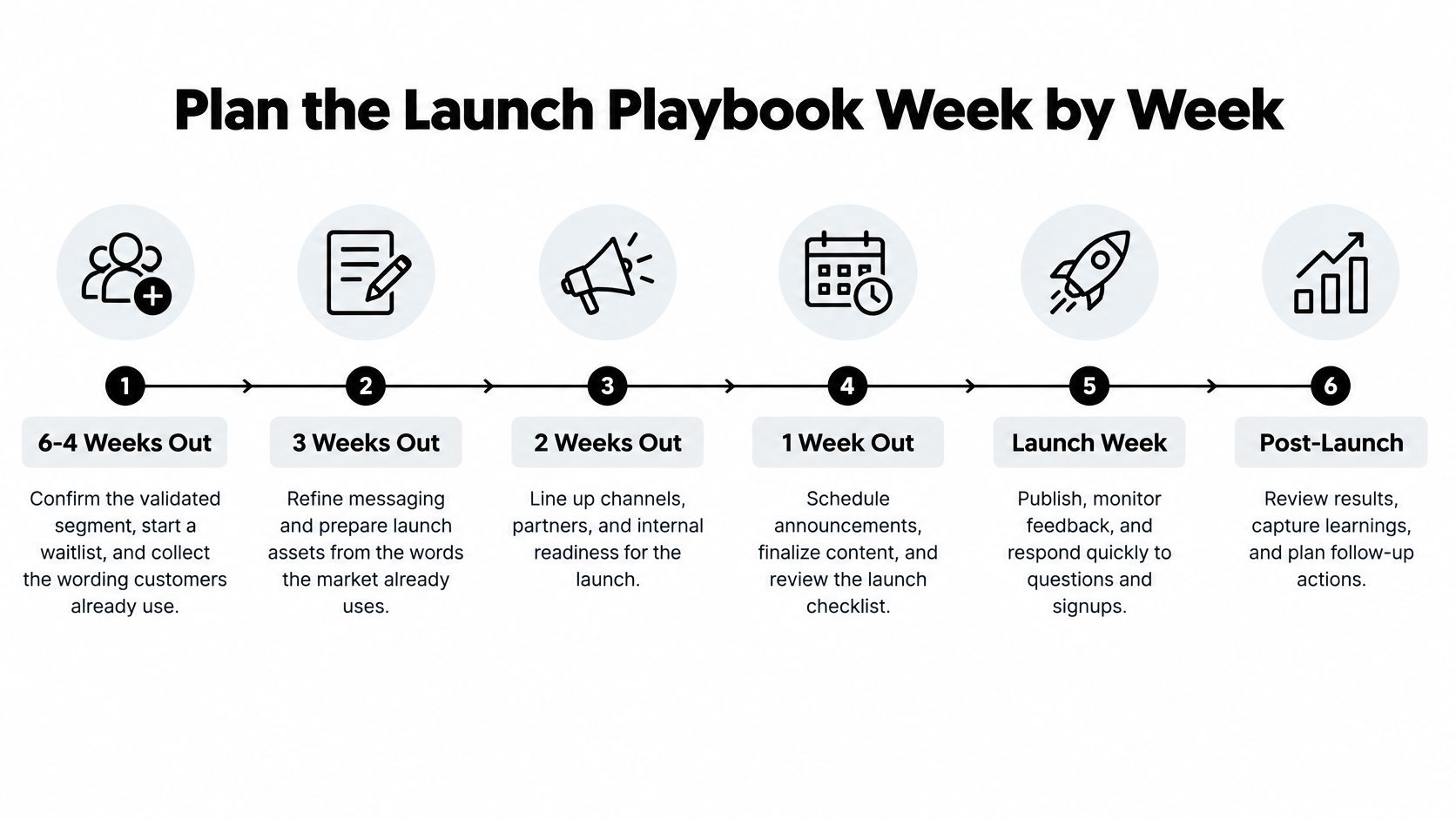
A launch calendar should coordinate customer readiness, product readiness, and measurement. Treat the timing below as a suggested working schedule, not a requirement to delay a smaller release.
Use the timeline to assign owners before you book announcements.
Before the announcement
Early preparation. Confirm the target segment and collect permission to contact interested prospects. A waitlist form should capture the intended use case, not just an email address, so you can distinguish relevant demand from curiosity.
Asset preparation. Publish the positioning page and create separately tagged links for each distribution partner. Prepare accurate screenshots, a short product description, setup instructions, known limitations, and a customer quote only if you have permission to use it.
Final readiness. Brief community contacts, integration partners, and early users with a message relevant to their audience. Don't send everyone the same request to amplify the announcement; explain why their particular audience might care.
Have someone unfamiliar with the release follow the landing-page instructions. Watch for missing permissions, confusing terminology, broken confirmation messages, and assumptions about data the user may not have.
Launch and follow-through
Launch day. Publish in the channels you selected and assign someone to questions. Check the complete acquisition-to-activation path using a real test account, rather than assuming a working page means the product events are arriving correctly.
Initial follow-up. Separate activated users from people who stalled. Ask the former what made the experience useful; offer the latter help with the specific step they haven't completed.
Cohort review. Once the agreed observation window has elapsed, compare the launch cohort with a relevant baseline. Review support effort as well as usage, because a channel that requires extensive founder assistance may not fit your operating model.
The common mistake is launching before the page explains the first-value action. Visitors then have to interpret both the product and the setup process, while the team struggles to tell poor targeting from poor onboarding.
Before choosing a date, have these ready:
- A demonstrable promise: The page names an outcome users can reach.
- A tested measurement path: Source information and product events reach the dashboard.
- A follow-up checklist: Named owners know how to respond to questions, stalled accounts, and defects.
You don't need a cinematic launch campaign. You need a credible promise, a functioning experience, and a way to learn what happened.
What Startup Product Marketing Looks Like in Practice
The following are hypothetical composite scenarios, not customer case studies or reported results. Their outcomes illustrate what a team might learn, not performance you should expect.
These decisions work best when product and marketing owners examine the same customer journey.

A bookkeeping tool narrows its promise
A bookkeeping team markets to all small businesses and attracts registrations from people with very different accounting needs. Many never finish setup because the page hasn't explained which workflow the product handles best.
The team narrows its message to freelancers who invoice regularly and makes creating a usable invoice the immediate goal. In this illustration, the share of visitors reaching that event improves, while total registrations could fall.
Lesson: A smaller audience can be more useful when the promise matches a job the product can complete.
A meeting-notes app changes its discovery route
An AI meeting-notes app gets attention from a launch announcement but struggles to reproduce that interest. The founder moves effort toward calendar and video-tool integration listings, with setup instructions that begin inside the user's existing workflow.
In this scenario, the useful improvement is more connected accounts returning after their initial meeting, not more reactions to the announcement. The trade-off is ongoing integration maintenance and support.
Lesson: Reaching users at a relevant workflow moment can matter more than reaching a broad audience.
The video below offers an additional resource alongside these worked examples.
A design-system tool makes migration easier
A design-system founder participates in a front-end developer community and notices repeated questions about moving existing components. Instead of publishing more feature announcements, the team writes migration guides with code examples and explicit compatibility limits.
In this hypothetical outcome, guide readers become more likely to finish a migration and continue using the tool. The guides require updates when supported frameworks change, so the team budgets maintenance time.
Lesson: Educational content can serve acquisition and implementation when it removes the obstacle preventing adoption.
Across these scenarios, the message, channel, and metric point toward the same user. The team changes a specific part of the journey and evaluates the behavior that change was intended to support.
Run Your First Positioning Sprint This Month
Use this month to produce decisions you can inspect, not a presentation you'll struggle to apply. Put a start date, review date, and owner on a shared sprint document.
Leave the sprint with written outputs
- A dated segment decision. Record the strongest relevant survey segment, response count, customer language, and behavioral evidence. Include what would make you reconsider the choice.
- A tested positioning statement. Put the statement on the launch-page draft and record how prospective buyers interpreted it. Keep misunderstandings beside the copy so revisions address evidence rather than taste.
- A bounded channel plan. Choose the channels your team can maintain and write a measurable success condition beside each. Set a review horizon long enough to observe the behavior you care about.
- A live measurement path. Build the tagged landing page, verify the activation event, and make the dashboard the recurring report.
Set the launch date only after the page and dashboard work and the follow-up checklist has owners. If a deadline forces a trade-off, cut optional creative assets before removing the ability to understand user behavior.
Evaluate launch options against the job
Compare placement, feedback opportunities, and backlink terms with your distribution objective. At SubmitMySaas, our Free Launch costs $0 per launch and lets you choose an available Monday launch with standard placement; our Premium Launch costs $19 per launch and gives priority placement in an available Monday launch. Free Launch receives a dofollow backlink only if the product ranks in the weekly top three and displays our badge, while Premium Launch includes a guaranteed high-authority dofollow backlink.
Choose based on the role launch exposure plays in your plan, not an assumption that placement guarantees adoption. Before closing the sprint document, book the first weekly review with the activation result as its sole agenda item, including a decision about what to investigate next.
SubmitMySaas lets makers submit a product launch for visibility, feedback, and a high-authority backlink. When your landing page and measurement path are ready, visit SubmitMySaas to choose a launch option and connect that exposure to your activation and retention goals.