How to Write a Value Proposition That Actually Converts
Learn how to write a value proposition that turns visitors into customers. Get proven formulas, real-world SaaS examples, and testing frameworks.
Your value proposition is what makes or breaks a first impression. It's that single, powerful statement that tells your ideal customer, "I get your biggest headache, and here's exactly how I fix it." This isn't just marketing fluff; it’s a clear promise of the value someone gets from your product. It’s the very first thing they see, and it’s what decides if they stick around or hit the back button.
Your Value Proposition Is Your Most Important Conversion Tool
Let's get one thing straight: your value proposition is much more than a catchy tagline for your homepage. It's the engine driving your messaging and the single most important factor that determines whether a visitor signs up or bounces. For a SaaS business, especially when you're listed on discovery platforms like SubmitMySaas, it's often your only shot to make an impression.
A truly effective value proposition nails three things:
- It speaks directly to the pains of a specific audience. It immediately shows them you're in their world.
- It clearly articulates how your product makes that pain go away. This is the bridge from their problem to your solution.
- It highlights what makes your solution the best choice. This is your unique edge over the competition.
Why It’s More Than Just Words
So many founders fall into the trap of thinking their product's features will do the selling for them. They'll give you a long laundry list of what their software does, but they completely miss the mark on explaining what the customer gets. This is the classic mix-up between features and real value.
A value proposition isn't about what your product is; it's about what your customer becomes after using your product. It shifts the focus from your company to their success.
This isn't just theory—it has a real impact on the bottom line. Data from B2B sales teams shows that companies using a consistent value proposition saw their win rates jump by 10.3%. One team even achieved a 2.36x higher win rate simply by ditching feature-heavy pitches for outcome-focused messaging.
Before you start writing, it helps to break down what makes a value proposition tick.
Core Components of a Winning Value Proposition
| Component | What It Is | Why It Matters for SaaS |
|---|---|---|
| Headline | A single, attention-grabbing sentence summarizing the core benefit. | This is your hook. It needs to be clear and instantly communicate the primary outcome your customer will experience. |
| Sub-headline | A 2-3 sentence paragraph that expands on the headline. | This adds a bit more detail, explaining who the product is for, what it does, and why it's a better choice. |
| Bullet Points | 3-5 key benefits or features that support your main promise. | These provide scannable, concrete proof of your claims. Focus on the results, not just the technical specs. |
| Visual Element | An image, GIF, or short video showing the product in action. | A visual reinforces the message and helps potential customers picture themselves using your tool and achieving their goals. |
Understanding these pieces gives you a solid framework for building a message that not only grabs attention but also persuades.
The Foundation of Your Marketing Efforts
Think of your value proposition as the source code for all your marketing. It's what you'll use to write your landing page copy, design your ad campaigns, craft your email subject lines, and even guide your sales calls. If it’s weak or confusing, everything else you do will be less effective. But when it’s sharp and compelling, it creates a powerful, consistent message that resonates everywhere.
A strong value proposition is the cornerstone of any high-converting page. If you're building a new site from scratch, you'll want to check out one of the 12 best landing page builders to make sure your message is presented perfectly. And if you're ready for a masterclass on this topic, this guide on how to create a value proposition that actually wins customers is a fantastic resource.
Uncovering Your Customer's Real Pains
Before you write a single word of your value proposition, you have to get inside your customer's head. Trying to craft a compelling message without this deep empathy is like trying to solve a puzzle with half the pieces missing—you might get close, but the final picture will never feel right.
This isn't about running a generic survey or making assumptions from an ivory tower. It's about digging into the real, often unstated, frustrations that keep your target audience up at night. Your goal is to map their problems directly to the solutions you offer, creating a message that doesn't just list features but connects on a gut level.
Become a Digital Anthropologist
To really get what makes your customers tick, you have to see them in their natural habitat. Luckily, the internet is one giant focus group where people are already talking about their problems, unfiltered and honestly.
It’s time to put on your detective hat.
Start by lurking in the online communities where your ideal customers hang out. We're talking about places like:
- Reddit: Industry-specific subreddits are gold mines. Search for posts with words like "rant," "frustrated," or "is there a tool for..." to find raw, emotional feedback.
- Indie Hackers & Hacker News: These forums are packed with builders and early adopters who openly discuss gaps in their workflows and the tools they wish existed.
- Review Sites: Go straight to the 1- and 2-star reviews for your competitors. The complaints section is a detailed blueprint of what not to do and which problems are still painfully unsolved.
When you immerse yourself in these conversations, you start to absorb their language. Pay close attention to the exact words and phrases they use to describe their pain points. These are the words you’ll echo back in your value proposition to show you truly get it.
Run Interviews That Actually Uncover Insights
Online research is great, but nothing beats a real conversation. Customer interviews are your chance to dig deeper and find out the "why" behind what people do. The trick is to avoid questions that lead to simple yes/no answers.
Instead of asking, "Do you find our scheduling feature useful?" try this:
"Walk me through the last time you had to schedule a team meeting. Tell me about the most annoying parts of that process. What weird workarounds did you have to invent?"
This kind of open-ended question encourages storytelling. It bypasses polite, surface-level feedback and gets to the core of their experience. You're not just trying to validate your solution; you're trying to understand the emotional and logistical weight of their problem. The more stories you hear, the sharper your value proposition will become.
Map Out Your Competitors' Messaging
Your competitors are already out there, trying to solve the same problems you are. A quick analysis of their value propositions can reveal huge gaps in the market and help you find your unique angle. Don't just read what they say—look for what they don't say.
Create a simple competitive map:
- List your top 3 competitors. Who are the big players?
- Nail down their core promise. What’s the main benefit they’re screaming from their homepage?
- Find the gaps. Are they focused exclusively on enterprise clients, leaving small businesses out in the cold? Is their messaging all about features, with no mention of emotional outcomes like "peace of mind" or "creative freedom"?
These gaps are your biggest opportunities. A powerful value proposition isn't just about what you promise, but how you set yourself apart from the noise. It’s about finding that unmet need and positioning your SaaS as the only logical choice.
According to a Salesforce State of Sales report, 86% of business buyers are more likely to buy when their goals are understood. This simple insight helped one telecom rep targeting truckers transform her email open rates from a dismal 2%-3% to a stellar 14%-16%. She simply shifted her message to address a direct pain point: "Find your payloads." That small change made her the top salesperson in the U.S. that quarter. You can read more about these findings on the Salesforce blog.
2. Craft Your Message With Proven Formulas
Once you have a solid grasp of your customer's biggest headaches, it's time to move from research to writing. Instead of staring at a blank page, you can lean on a few battle-tested formulas to give your message a solid foundation. These aren't meant to be rigid rules, but they're incredible starting points.
Their real power is that they force you to be clear and brief. The goal is to create a value proposition that someone can read and understand in five seconds or less. Remember, clarity beats cleverness every single time. A witty but confusing message converts absolutely no one.
The Geoffrey Moore Formula for Positioning
One of the most reliable frameworks comes from Geoffrey Moore's classic book, Crossing the Chasm. There's a reason it's still around—it works beautifully for products that are creating a new category or challenging an old way of doing things.
The structure is simple but incredibly effective: For [target customer] who [has this problem], our [product] is a [product category] that [provides this benefit].
Let's see how this works for a familiar SaaS company like Asana, a project management tool.
- Target Customer: Teams juggling complex projects.
- Problem: They're dealing with chaotic communication and constantly missing deadlines.
- Product: Asana.
- Category: A work management platform.
- Benefit: It helps them orchestrate everything from daily tasks to big-picture strategic goals.
Put it all together, and you get something like this: "For teams juggling complex projects who struggle with chaotic communication and missed deadlines, Asana is a work management platform that orchestrates all their work in one place."
That single sentence tells you instantly who it’s for, what pain it solves, and the ultimate benefit.
The Steve Blank Formula for Simplicity
Startup guru Steve Blank offers an even more direct formula. It's punchy, concise, and perfect for a website headline or a quick pitch. It cuts right to the chase.
The structure is dead simple: We help [X] do [Y] by doing [Z].
In this case, X is your ideal customer, Y is the result they're after, and Z is your specific solution. Let's break this down using Slack as an example.
- X (Customer): Businesses of all sizes.
- Y (Outcome): Communicate more effectively.
- Z (Solution): By bringing all their team communication into one place.
Following this framework, Slack’s value proposition could be: "We help businesses of all sizes communicate more effectively by bringing all their team conversations into one place." It’s straightforward, focused on the outcome, and easy for anyone to get. Nailing a message like this is a cornerstone of any good SaaS product marketing strategy, making sure everyone—from prospects to your own team—gets what you do.
A great value proposition doesn't just describe what your product does. It makes your product the hero in your customer's story. These formulas are the fastest way to find that narrative and tell it well.
Don't Settle on Your First Draft—Create Variations to Test
Let's be honest, your first attempt is almost never your best one. The real magic happens when you brainstorm multiple versions of your value proposition using these frameworks. This creates a pool of strong contenders you can test out in the real world.
Imagine we're working on a fictional SaaS tool called "ScribeAI," which uses AI to transcribe meetings.
Here are a few options we could spin up:
- Moore's Formula: "For busy managers who lose track of action items in meetings, ScribeAI is an AI assistant that automatically transcribes and summarizes calls, ensuring nothing gets missed."
- Blank's Formula: "We help project teams stay aligned by automatically creating searchable transcripts and action items from every meeting."
- Benefit-First Approach: "Turn every meeting into actionable insights. ScribeAI transcribes your calls, identifies key decisions, and assigns action items automatically."
See how each one hits the same core problem but from a slightly different angle? The first targets a specific person (the busy manager). The second focuses on a team outcome (alignment). The third leads with a powerful benefit (actionable insights).
Having these variations ready is absolutely critical for the next step: validation. Your goal isn't to find the "perfect" sentence in a vacuum, but to discover which one actually resonates with your audience and gets them to act.
Translating Features Into Tangible Outcomes
It's one of the most common traps for SaaS founders. You live and breathe your product, so you naturally get excited about its capabilities—the "what." But here’s the hard truth: your customers don't buy the "what." They buy what your product does for them. They're shopping for outcomes, not a technical spec sheet.
This is where you need to make the critical shift from feature-focused jargon to benefit-driven storytelling. A feature is just a component of your product, like "AI-powered transcription." The benefit is what that feature does, such as "Automated meeting notes." But the outcome is the real prize. It's the higher-level win the customer gets, like "Never miss an action item and run more effective meetings."
Thinking this way—from feature to benefit to outcome—is the secret to a powerful value proposition. The entire process hinges on understanding who you're talking to and what problem you're solving before you even mention your solution.
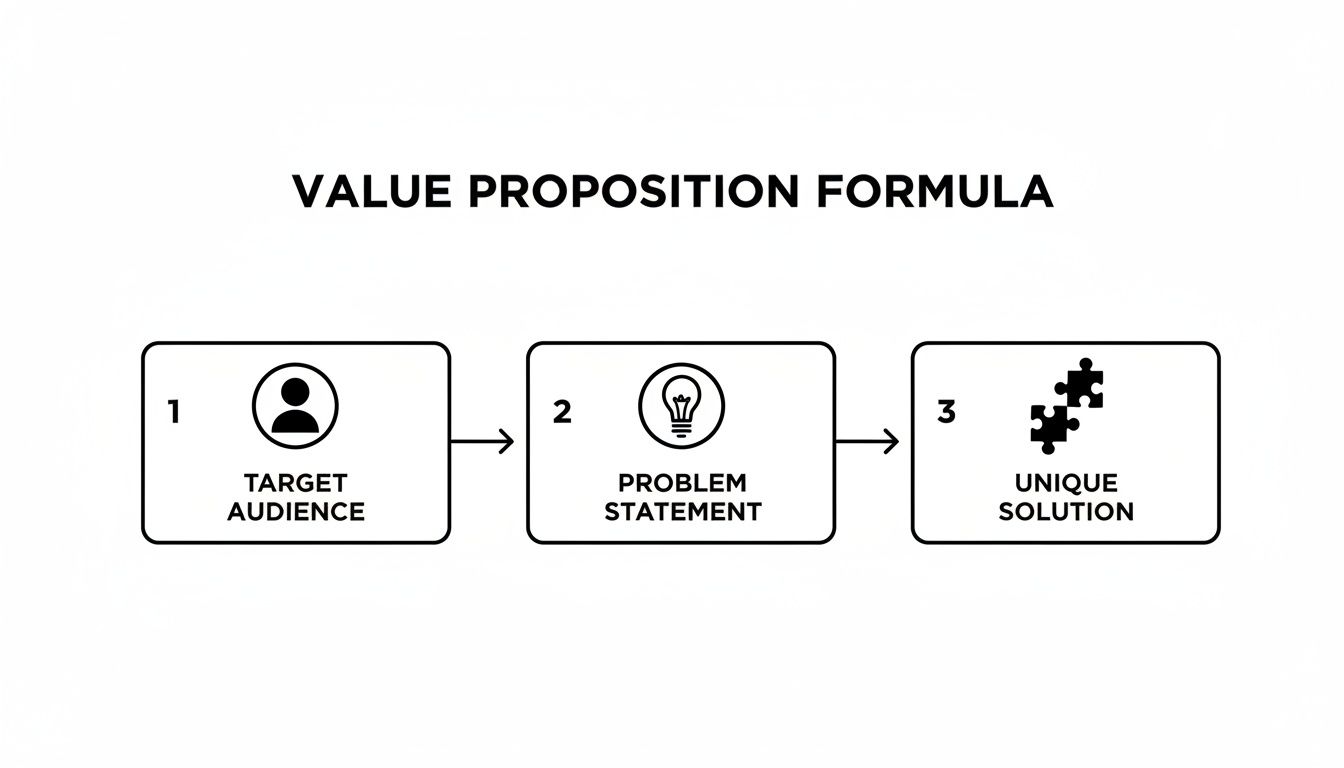
This simple flow reminds us that the solution is the last piece of the puzzle. It only resonates after you've nailed down the audience and their core pain point.
The "So What?" Test
Here's a simple but incredibly effective exercise I use all the time: the "So What?" test. Take every feature you list and ask, "So what?" The answer you get is the benefit. Great. Now, ask "So what?" again. That answer is your outcome.
Let's walk through a quick example for a SaaS tool with collaborative design boards.
- Feature: Real-time cursors for multiple users.
- Ask "So what?": Your team can see what everyone is working on at the same time. (That’s the benefit).
- Ask "So what?" again: You kill version control headaches and slash the feedback loop, finishing projects 30% faster. (That's the tangible outcome).
See the difference? "Real-time cursors" is for the developers on your team. "Finishing projects 30% faster" is for the budget-conscious manager or the stressed-out project lead. That's who holds the credit card.
Your value proposition must speak to your customer's highest aspirations. They aren't just buying software; they are buying a better version of their future selves—more organized, more profitable, and less stressed.
This isn't just a wording tweak; it’s a complete shift in perspective. You stop selling your product and start selling your customer's success. It's the same core principle you'll need when you sit down to figure out how to write product descriptions that genuinely connect with people.
Feature vs. Benefit vs. Outcome Translation
To put this into practice, I always recommend a simple mapping exercise. It forces you to connect every single feature to a meaningful result, giving you a goldmine of outcome-focused language for your value proposition.
| Our SaaS Feature | Benefit (What it does for you) | Outcome (The end result you achieve) |
|---|---|---|
| One-click integrations | Connects to all your existing tools without any code. | You save hours of manual data entry and eliminate human error. |
| Customizable dashboards | Lets you see the key metrics that matter most to your business. | You gain at-a-glance clarity to make faster, data-driven decisions. |
| Automated reporting | Generates and emails weekly performance summaries to your team. | Your team stays aligned on goals without adding another meeting to the calendar. |
Once you complete this exercise, you'll be armed with clear, compelling language that directly answers the only question your customer truly cares about: "What's in it for me?" That "Outcome" column becomes your raw material for a value proposition that doesn't just describe your tool but sells a real solution.
Putting Your Value Proposition to the Test in the Real World
Let's be honest. A value proposition is nothing more than a well-educated guess until it survives contact with actual customers. You can workshop the perfect sentence for weeks, but if it doesn't make real people click, sign up, or open their wallets, it's just a collection of words on a whiteboard.
This is where the rubber meets the road. We need to move from brainstorming sessions to live experiments, gathering hard data that proves our message actually connects with our target audience. The goal isn't to find the "perfect" message in a vacuum; it's to find the one that performs.
The good news? You don't need a massive budget or a dedicated data science team to figure this out.
Setting Up Simple Landing Page Tests
One of the most direct ways to see what works is to run a simple landing page A/B test. This just means creating two (or more) versions of a page, each with a different value proposition, and sending traffic to them to see which one gets more people to act. Tools like Webflow or Unbounce make this surprisingly straightforward.
Here’s how to do it right:
- Isolate the Variable: This is critical. Keep everything else on the page—images, call-to-action buttons, layout—exactly the same. The only thing you should change is the headline and sub-headline that communicate your value proposition.
- Drive Targeted Traffic: Next, get some eyeballs on it. A small, targeted ad campaign on social media or search engines aimed at your ideal customer profile is perfect for this.
- Measure What Matters: Track the one metric that truly counts, which is usually a sign-up or a demo request. This gives you a clear winner based on who took action.
This process removes all the guesswork and internal debate. It lets your audience vote with their clicks, giving you undeniable proof of what message compels them to act.
A value proposition isn't for you, your team, or your investors. It’s for your customer. The only way to know if it works is to put it in front of them and see how they react.
A perfect real-world example of this comes from The Good agency. They A/B tested a client's value proposition, revamping it to spell out the benefits more clearly. The results were immediate: a 16% uplift in shopping actions, 20% more visits to About pages, and another 16% boost in conversions.
Think about that for a second. People didn't just engage more; they started digging deeper into the brand, which is a huge signal of trust. The magic happened because the new proposition shifted from vague features to a clear 'benefit minus cost' equation that just clicked. You can discover more insights about their value proposition testing and see the impact for yourself.
Looking Beyond Conversion Rates
While sign-ups are the ultimate prize, other metrics can tell a much richer story about how your message is landing. These engagement signals help you understand the why behind the numbers.
- Scroll Depth: Are people on one version scrolling further down the page? That’s a great sign that your initial promise was compelling enough to make them want to learn more.
- Time on Page: A longer time-on-page suggests your message is interesting and holds their attention. If one version has a sky-high bounce rate, the value proposition might be confusing or just plain irrelevant.
- Heatmaps: I love using tools like Hotjar for this. They generate visual maps showing where users are clicking and moving their mouse. Are they hovering over the key benefits you listed? This kind of visual feedback is invaluable.
Tracking these secondary metrics helps you build a more complete picture. A proposition might not win on conversions right away, but if it shows significantly higher engagement, it could be a strong contender that just needs a better call-to-action.
Getting Qualitative Feedback for Deeper Insights
Data tells you what is happening, but talking to people tells you why. Qualitative validation provides the human context that raw numbers can never give you.
One of the best low-effort methods I've found is the 5-Second Test. Literally show someone your landing page for just five seconds, then hide it. Ask them three simple questions:
- What does this company do?
- Who is this for?
- What's the main benefit of using it?
If they can't answer these clearly and confidently, your value proposition isn't hitting the mark. It’s a fast, cheap, and brutally honest way to check for immediate clarity.
Another powerful technique is to simply weave your value propositions into your sales calls or customer conversations. When talking to a prospect, frame their problem and your solution using one of your variants. Then, watch their reaction. Do their eyes light up? Do they lean in and say, "Tell me more about that"? That real-time feedback is pure gold. It can guide your messaging far more effectively than any internal debate ever could.
Got Questions About Your Value Proposition? We've Got Answers.
Even with a solid framework, crafting the perfect value proposition can feel tricky. You run into gray areas and "what if" scenarios. Let's tackle some of the most common questions we hear from SaaS founders so you can move forward with confidence.
Value Proposition vs. Slogan: What's the Real Difference?
This one trips people up all the time. Think of it this way: a slogan is for branding, while a value proposition is for selling.
A slogan is a catchy, memorable tagline meant to stick in your head. Nike’s “Just Do It” is the classic example—it’s about an attitude, not the shoe’s features.
Your value proposition, on the other hand, is a direct promise. It clearly answers the customer's question: "What am I going to get out of this?" It’s the convincing argument that makes someone click “Sign Up,” not just remember your name.
How Long Should It Be?
Your primary value proposition needs to land in about five seconds. There isn't a strict word count, but the best ones almost always follow a simple, scannable structure.
- The Headline: One clear, powerful sentence.
- The Sub-headline: A short paragraph (2-3 sentences) that adds crucial context.
- Supporting Bullets: 3 to 5 quick points highlighting the most compelling benefits or features.
The goal here is instant clarity. If someone has to read it twice to get it, you’ve already lost them.
Can We Have More Than One Value Proposition?
Absolutely. In fact, you probably should. While your company will have one main, overarching value proposition, tailoring it for different audiences is a smart move.
Think about a project management tool like Asana. Their message to a marketing team will be completely different from their message to an engineering team.
- For Marketers: The focus might be on collaborating on campaigns and hitting deadlines.
- For Engineers: The pitch would likely center on sprint planning and bug tracking.
The product is the same, but the language speaks directly to the unique problems and goals of each group. That's what makes it resonate.
What if I'm Pre-Launch and Have Zero Customers to Interview?
Ah, the classic startup dilemma. If you don't have customers, how do you validate your value? Simple: you get creative and find proxies.
You can't interview your own users, so go find your target users. Look for people who fit your ideal customer profile perfectly and are currently using a competitor's product or a messy workaround (like a series of spreadsheets). Talk to them. Dig into what frustrates them about their current setup. Their pain points are your treasure map.
You don’t need your own customers to find the market’s problems. You just need to listen to the people already living with them.
Is It Okay to Mention Features?
Yes, but with one huge caveat: you must connect the feature directly to an outcome. So many companies fall into the trap of listing tech specs, forcing the user to do the mental work of figuring out why it matters.
Don't just say, "We have AI-powered analytics." That means nothing on its own.
Instead, frame it as a benefit: "Use AI-powered analytics to get instant marketing insights and make smarter decisions in half the time." The feature ("AI-powered analytics") is now proof that backs up the benefit ("make smarter decisions"). The outcome should always be the hero.
How Often Should I Revisit My Value Proposition?
Your value proposition is a living statement, not a stone tablet. It needs to evolve right along with your product and your market.
A good rhythm is to review it at least once a year, or anytime something big changes.
Be on the lookout for these triggers:
- You're launching a major new feature.
- You're expanding into a new industry or customer segment.
- A disruptive new competitor just showed up.
- Your conversion rates on key pages are starting to dip.
Keeping your message sharp and relevant is how you continue to turn curious visitors into paying customers.
Ready to get your SaaS in front of thousands of early adopters and tech enthusiasts? SubmitMySaas is the discovery platform built to amplify your launch. Get featured, earn valuable backlinks, and start building momentum from day one. Submit your SaaS today!