Local SEO Backlinks: Build Real Authority
Learn how to build local seo backlinks that move the needle. Actionable tactics for citations, partnerships, and measurement without the fluff.
A 2026 local ranking study puts link signals at about 15% of Local Pack influence and roughly 29% of local organic ranking weight, although another summary reports lower figures of approximately 8% and 24% respectively (Moz's local outreach and link-building guide). The disagreement matters less than the practical conclusion: local SEO backlinks help, but geography and relevance determine whether they're worth pursuing.
A link from a neighborhood publication, supplier, chamber, or community organization can reinforce your presence in a market. A large collection of generic directory links may only make your backlink report look busy. Local authority comes from showing that real organizations connected to the same place recognize your business.
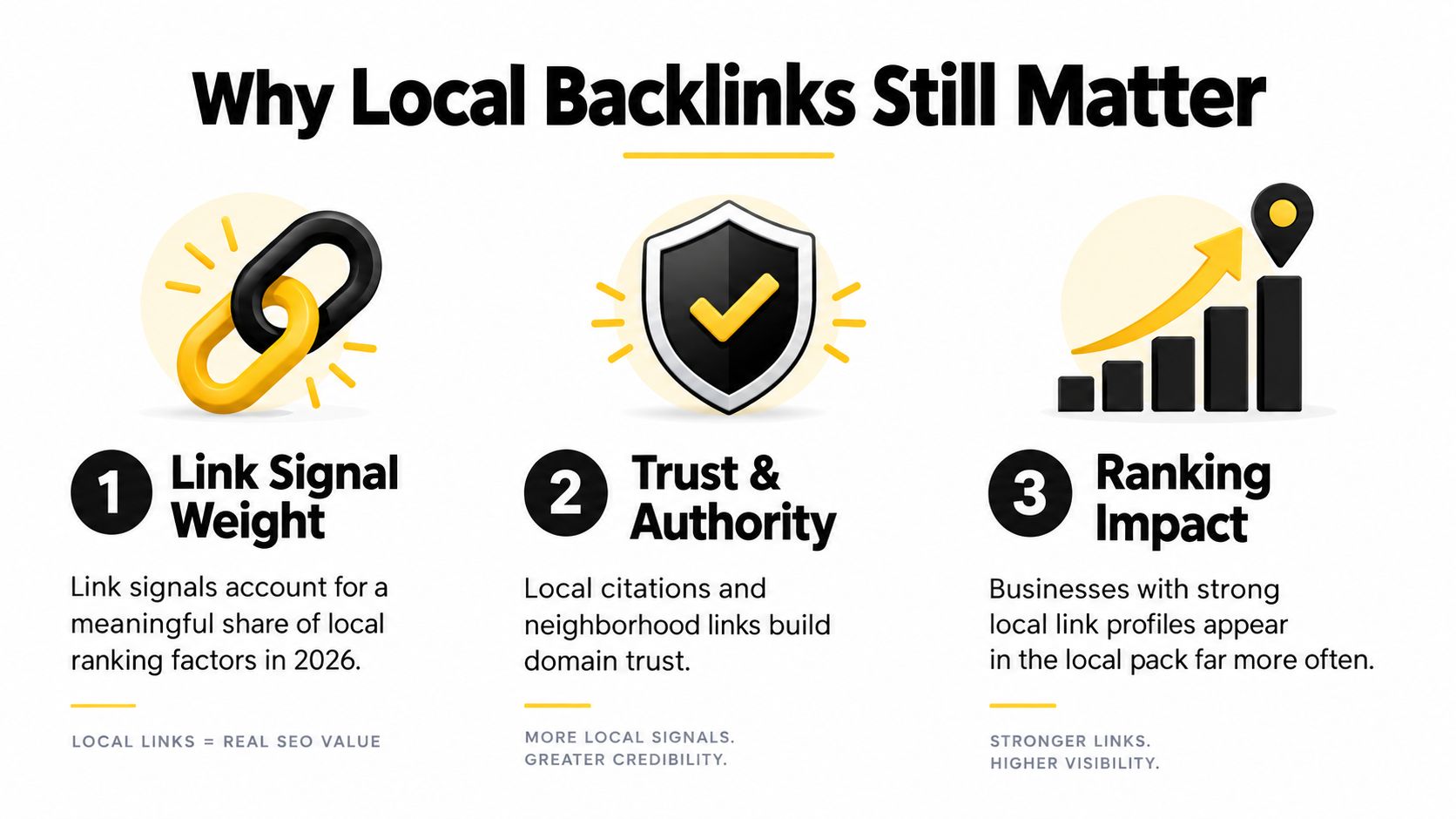
Why Local Backlinks Still Matter
A local backlink can show that your business belongs in a specific market. It adds context to the authority your website earns, especially when the linking organization serves the same residents, businesses, or community. A neighborhood publication, supplier, chamber, or nonprofit can provide stronger local evidence than a larger site with no connection to your area.
The research separates map results from organic results, and that split should shape your effort. Links generally carry more weight for traditional organic pages, while map visibility depends more heavily on proximity and the strength of your Google Business Profile (Moz). A useful local SEO statistics analysis also shows why link volume alone is a poor target: businesses appearing in map results were associated with an average of 993 backlinks and 216 referring domains. Those figures describe the competitive environment, not a quota to chase.
Relevance beats accumulation
Geography changes the value of a link. A source that Google can associate with your service area may reinforce local relevance, while a generic directory can add little beyond another entry in a backlink report. The page itself matters more than the domain's headline metrics.
Ask whether the linking site has a real audience in your market, publishes current material, and chooses which businesses or resources it features. Check whether the surrounding content makes your business a natural fit and whether a visitor could plausibly reach your site through the link. These checks also make domain metrics more useful. Understanding domain authority in SEO can help you assess a site's strength, but its score cannot confirm local relevance.
Because proximity limits how far a business can rank in map results, backlinks will not make one location visible across an entire city. They support the website behind the profile and can strengthen organic visibility when the sources are relevant.
Practical rule: Build fewer, better-connected local links before pursuing a larger volume of generic ones. Keep proximity, accurate business information, reviews, and a complete Google Business Profile in the same plan.
A related resource is RecensioAI B.V.’s first page Google guide for small businesses, which covers aligning website pages with local search intent.
Filtering Links for Real Local Value
The fastest way to waste time on link building is to ask, “Can this site link to me?” The better question is, “Would this site naturally mention my business if I were active in this community?”
Use that question before you pitch, submit, or pay for anything.
Start with geographic relevance
A source is more useful when its audience, organization, or editorial coverage overlaps with your service area. A city newspaper, neighborhood association, regional trade group, local supplier, or nearby nonprofit usually has a clearer geographic relationship than a broad directory with thousands of unrelated businesses.
Check the page, not just the domain. Look for:
- Local audience: Does the site clearly serve residents, businesses, or organizations in your market?
- Relevant context: Would your business fit naturally beside the other companies, events, or resources mentioned?
- Real activity: Does the site publish current material, maintain profiles, or promote genuine community activity?
- Editorial judgment: Does someone choose what gets published, or can anyone create a page instantly?
- Referral potential: Could the link send a relevant visitor, not merely pass a technical signal?
A local source doesn't have to mention your exact neighborhood to be useful. A regional supplier may be relevant because it serves the businesses in your area. A community organization may be relevant because your sponsorship or participation is visible to local residents.
Separate recognition from manipulation
Editorial independence matters. A link earned because you contributed expertise, supported an event, supplied a resource, or received legitimate coverage carries a different meaning from a link created through a coordinated exchange.
Systematic reciprocal linking, undisclosed sponsorships, paid-link schemes, and over-optimized anchors create avoidable risk. The local link-building workflow from SEO Handbook recommends tracking locally relevant referring domains, tier-one local publication coverage, unlinked brand mentions, and sponsorship or partnership links instead of celebrating raw link totals.
Before accepting an opportunity, record the referring domain, page topic, location served, link placement, anchor text, and relationship behind the mention. If you can't explain why the source would mention you to its audience, ignore it. For technical context, learn how a dofollow backlink works, but remember that link attributes don't make an irrelevant source locally valuable.
Turning Local Partnerships Into Links
A neighborhood HVAC company once approached link building as a submission task. The owner had created profiles on broad directories, exchanged links with loosely related businesses, and spent time chasing pages that no local customer would ever visit. The site had links, but little evidence that the company belonged to the community it claimed to serve.

The strategy changed when the owner stopped asking for links and started looking for useful local relationships. The company supplied free safety checks for a neighborhood housing initiative, offered practical advice to a community newsletter, and built a referral relationship with a local property manager. Each activity created a legitimate reason for another organization to mention the business.
No fabricated performance figure is needed to understand why this worked better. The links had place, context, and a real human relationship behind them.
Choose partners with a natural connection
Good prospects often include:
- Chambers and trade groups: Complete a genuine membership profile, contribute to an event, or provide educational material.
- Local publishers: Offer timely expertise, original observations, or commentary connected to a story they're already covering.
- Suppliers and distributors: Ask whether they maintain customer, partner, or project pages, but don't request a link solely because you purchase from them.
- Event organizers: Support a workshop, fair, sports club, or professional gathering where your involvement is visible.
- Nonprofits: Provide resources, volunteer support, or sponsorship that earns a factual description of your contribution.
The outreach email should lead with the relationship. “We're supporting your home-maintenance workshop and can provide a checklist for attendees” is stronger than “Can you give us a backlink?”
A local link should document something that happened, not pretend that something happened.
Build an asset worth citing
Create one useful page that gives partners a reason to link. That might be a local maintenance checklist, a permit guide, a map of service coverage, an event resource, or a clear explanation of a recurring customer problem. The page should help the partner's audience first.
For broader prospecting ideas, Keyword Kick's guide to backlink building sites can broaden your research, but filter every opportunity through local relevance. You can also review partnership opportunities for ideas that turn cooperation into a genuine business relationship.
After earning a mention, check that the linked page is useful, the business name is accurate, and the anchor text reads naturally. Don't pressure a partner to use an exact-match phrase such as “best plumber in [city].” A branded or descriptive link usually reflects the relationship more naturally.
Citations, Directories, and Launch Platforms
Citations can establish consistency, but they rarely deserve the same attention as a strong local editorial relationship. A directory listing may confirm your business name, address, phone number, category, and website. That foundation matters, especially when inaccurate listings confuse customers or create conflicting information.
Choose directories selectively. Start with platforms that local customers, professional organizations, or industry participants use. A respected chamber profile, trade association listing, or regional business directory has a clearer purpose than a network of thin sites accepting every submission.
Audit the listing before you submit
Check each platform for:
- Audience fit: Does it serve your city, region, profession, or customer type?
- Business quality: Are listed companies genuine and relevant, or does the site contain obvious spam?
- Page control: Can you correct your business details and remove outdated information?
- Duplicate risk: Will the submission create another version of an existing profile?
- Link purpose: Does the link help users find or evaluate your business?
Keep your core business information consistent across important profiles. Use the same real-world name, address, phone number, hours, and primary website wherever appropriate. Don't create location pages for places you don't serve, and don't stuff city names into descriptions to manufacture relevance.
A useful directory is discoverable, maintained, and connected to a real audience. A poor directory is often easy to join precisely because it has no quality control.
Use launch platforms with a clear fit
Technology companies have another route to legitimate exposure through curated launch and discovery platforms. For a SaaS product with a genuine local business audience, a focused product listing can create a link, referral path, and public record of the launch. The local relevance won't come from the platform alone. It comes from the product's market, founder story, customer base, or coverage in a specific business community.
SubmitMySaas is one example of a launch and discovery platform for SaaS, AI, productivity, marketing, and design tools. Its offering includes product listing and launch-page placement with a backlink to the maker's website. Use it as part of a broader promotion plan, not as a replacement for local editorial relationships.
For more directory research, consult this curated SEO list of directories, then remove any platform that looks irrelevant, inactive, or overloaded with low-quality submissions.
Balancing Backlinks With Reviews and Mentions
A backlink is only one form of local recognition. Customers may discuss your business without linking to it, and review platforms can influence how people judge you even when they don't pass traditional link authority. Recent 2026 commentary argues that reviews can outweigh backlinks for many small-business Local Pack outcomes, while links remain more important for classic organic results (Revio Reputation).
That creates a more useful question than “How many local backlinks do I need?” Ask instead: Which signals prove that this business is real, trusted, and active in this market?
Treat mentions as relationship assets
An unlinked mention in a local article, event recap, supplier page, podcast description, or community post can still expose your name to relevant people. Track those mentions and look for appropriate opportunities to request a link. The request should correct or improve the page, not demand an artificial endorsement.
For example, you might say that the article already mentions your workshop and offer a useful checklist for readers. If the publisher adds the resource, the link serves a clear editorial purpose. If they decline, the mention can still support recognition and future relationships.
Connect the signals operationally
Use one simple workflow:
- After a successful project: Ask the customer for an honest review, without scripting the wording.
- After community involvement: Save event pages, sponsor acknowledgments, and media mentions.
- After press coverage: Check whether the article links to the most relevant service or resource page.
- After a review trend appears: Create content that answers the recurring customer question.
- During monthly reporting: Separate locally relevant referring domains, reviews, mentions, and referral visits.
social proof in marketing becomes practical here. Reviews, citations, sponsorships, mentions, and backlinks should reinforce the same entity, location, and service story. A business that earns links but receives weak customer feedback has an incomplete authority profile. A business with strong reviews but no useful website content may struggle to capture organic demand.
Common Local Link Mistakes to Avoid
Local link building fails most often through shortcuts. The warning signs are usually visible before the link goes live.
- Directory accumulation: If a site accepts every business in every industry, it probably offers little local differentiation. Keep only directories with a clear audience or geographic purpose.
- Paid links without disclosure: Sponsorship can be legitimate, but hiding a commercial arrangement or creating systematic paid links increases risk. Make the relationship transparent and follow the publisher's link guidance.
- Exact-match anchor pressure: Repeatedly requesting the same city-and-service phrase looks manufactured. Let partners use your brand name or natural descriptive text.
- Low-quality reciprocal exchanges: “You link to me, and I'll link to you” becomes problematic when it's systematic or unrelated. Build links around real collaboration instead.
- Fake location signals: Don't create locations, addresses, or community relationships that don't exist. Local SEO depends on accurate representation.
- Ignoring existing links: Review your referring domains for obvious spam, irrelevant pages, and outdated business information. Document suspicious patterns and seek qualified advice before removing or disavowing anything.
The durable profile is usually less dramatic than the spammy one. It contains links from organizations, publishers, suppliers, and communities that can explain why your business belongs in the local market.
SubmitMySaas helps SaaS and technology makers submit products for featured launch and discovery pages that include a backlink to the maker's website. If you're building a local SEO tool, agency product, or business platform, visit SubmitMySaas to review the submission options and decide whether its audience fits your launch and authority strategy.