How to Improve Search Engine Rankings A Practical Guide
Learn how to improve search engine rankings with actionable SEO strategies. This guide covers technical audits, content creation, backlinks, and performance.
When it comes to climbing the search rankings, everything really boils down to two things: a technically sound website and content that genuinely helps people. You need to make it dead simple for Google to find and understand your pages, and those pages have to be the best possible answer for whatever someone is searching for. Nail both of those, and you're well on your way.
Building Your Foundation for Higher Rankings
Before you even think about keywords or backlinks, you have to make sure your own website isn't sabotaging your efforts. I’ve seen countless SEO strategies fall flat because they were built on a shaky technical foundation. It's like trying to build a house on quicksand—it just won't work.
That’s why a deep, meaningful SEO audit is the first, most critical step you'll take.
This isn't just about ticking boxes on a checklist. It's a full-blown investigation to uncover all the hidden issues that are stopping search engines from properly crawling, indexing, and ultimately, ranking your site. The whole point of this exercise is to learn how to increase organic traffic to your website, and a solid audit gives you the roadmap to do just that.
Pinpointing Critical Technical Issues
First things first, you need to hunt down anything that's getting in Google's way. Search engines use automated bots, often called "crawlers" or "spiders," to explore the web and find content. If they hit a snag on your site, some of your most important pages might as well be invisible.
Here's what to look for:
- Crawl Errors: Dive into Google Search Console and look for pages Google couldn't access. These are often broken links (404 errors) or server problems (5xx errors).
- Site Architecture: Is your site structured logically? A visitor—and a crawler—should be able to get to any key page within three clicks from your homepage. A confusing site structure dilutes your authority and makes it harder for Google to understand what’s important.
- Robots.txt File: This simple text file tells search engines where they can and can't go. A tiny mistake, like a misplaced
Disallowcommand, can accidentally tell Google to ignore your entire site. It happens more than you’d think.
A classic mistake I see is founders obsessing over keywords while their site is riddled with hundreds of broken internal links. Fixing these technical gremlins is often the quickest win for an early rankings boost because you're literally removing roadblocks.
Auditing Core Web Vitals and Mobile Experience
User experience isn't just a "nice-to-have" anymore; it's a direct ranking factor. Google wants to send people to websites that are fast, stable, and easy to use—especially on a phone.
The numbers don't lie. With over 60% of searches happening on mobile, a clunky mobile experience is a non-starter. Google even measures this with a set of metrics called Core Web Vitals, which directly assess the quality of a user's experience. They include:
- Largest Contentful Paint (LCP): How fast does the main content load?
- Interaction to Next Paint (INP): How quickly does the page respond when someone clicks or taps?
- Cumulative Layout Shift (CLS): Does the page jump around unexpectedly while loading?
To give you a quick, actionable overview, I've put together a checklist of the core technical areas I always review first. This isn't exhaustive, but it covers the high-impact items that can really move the needle for a SaaS site.
Core Technical SEO Audit Checklist
| Audit Area | Key Metric/Tool | Why It Matters for Rankings |
|---|---|---|
| Crawlability & Indexing | Google Search Console (Coverage Report) | If Google can't find or access your pages, they can't rank. This is ground zero. |
| Mobile-Friendliness | Mobile-Friendly Test | With over 60% of searches on mobile, a poor experience is a major ranking penalty. |
| Page Speed (Core Web Vitals) | PageSpeed Insights | Slow load times hurt user experience and are a direct, measurable ranking factor. |
| Secure Site (HTTPS) | Browser URL bar (look for the lock) | Security is non-negotiable. Google prioritizes secure sites for user trust and safety. |
| Broken Links (404s) | Ahrefs or Semrush (Site Audit tools) | Broken links create a poor user experience and waste your site's "link equity." |
| XML Sitemap | yourdomain.com/sitemap.xml |
Your sitemap is a direct roadmap for Google, helping it discover all your important content. |
This audit essentially builds your technical roadmap. Once these foundational issues are sorted, every other SEO effort you make—from content creation to link building—will be far more effective.
Crafting a Content Strategy That Ranks
A technically sound website is a great start, but it's like a perfectly built car with no gas. To actually go anywhere and climb the search rankings, you need high-octane content—stuff that genuinely solves problems for the people you want to reach. Real, lasting SEO success isn't about gaming the system; it's about deeply understanding what your audience needs and giving it to them.
This is exactly where so many SaaS startups stumble. They spot a keyword like "project management software" with its massive search volume and throw their entire budget at it. The result? They get completely lost in the noise made by established giants. The real secret is to sidestep that direct competition and find the specific, nagging problems your audience is actually trying to solve.
A winning content strategy always starts with this critical shift in thinking: stop obsessing over what people search for and start focusing on why they're searching in the first place.
Uncovering High-Intent Keywords
Keyword research isn't about collecting a list of single, high-volume terms. It's about discovering the real language your customers use when they're actively hunting for a solution like yours. The goal is to unearth long-tail keywords—those longer, more specific phrases that signal someone is much closer to making a decision.
Think about it. A person searching for "project management" is just kicking tires. But someone searching for "best project management tool for small marketing teams"? That person has a specific pain point and is actively evaluating their options. That's your sweet spot.
So, how do you find these little gems?
- Analyze Your Competitors' Blind Spots: Fire up a tool like Ahrefs or Semrush and look at what long-tail keywords your smaller, scrappier competitors are ranking for. These are often underserved topics where you can swoop in and become the go-to resource.
- Hang Out Where Your Customers Are: Dive into Reddit, Quora, and industry-specific forums. The questions people ask are a direct line into their biggest headaches, phrased in their own words. A thread titled, "How do you guys handle scope creep with freelance clients?" is pure content gold for a project planning tool.
- Listen to Your Own Team: Your sales and support teams are on the front lines, talking to prospects and customers all day. What questions pop up constantly? What problems are people trying to solve with your product? Turn those real-world conversations into your next blog posts.
Don't get hypnotized by search volume. A keyword with just 50 monthly searches that perfectly matches your product's core value is infinitely more powerful than a generic term with 50,000 searches that attracts tire-kickers.
Building Topical Authority with Content Clusters
Once you've got your list of high-intent keywords, don't just start writing a random collection of articles. To prove to Google that you're an expert in your space, you need to build topical authority. The best way I've found to do this is with the topic cluster model.
It's a simple but powerful framework: you create one massive, in-depth "pillar page" on a broad topic. Then, you surround it with several "cluster pages" that dive deeper into specific subtopics, all linking back to that central pillar.
Let's say you have a productivity SaaS that helps people focus.
- Pillar Page: The Ultimate Guide to Deep Work for Remote Teams. This would be a monster piece of content, the kind of resource people bookmark and come back to again and again.
- Cluster Pages: These are more focused articles that support the pillar. They'd link back to it and cover things like:
- How to Block Distracting Websites and Apps for Good
- 5 Time-Blocking Techniques That Actually Work
- Setting Up a Distraction-Free Workspace (Even in a Tiny Apartment)
- The Best Pomodoro Timer Apps We Tested This Year
This structure is brilliant for two reasons. First, it creates a much better, more organized experience for your readers. Second, it sends a powerful signal to Google that you have deep expertise on the entire topic of "deep work," which helps your whole cluster of content rank higher. If you're looking to go deeper on this, our guide on how to increase website traffic organically really unpacks these authority-building strategies.
Mapping Content to the User Journey
Finally, the best content strategies don't just exist in a vacuum; they map directly to the customer's journey. Someone just realizing they have a problem needs something very different from someone who's ready to pull out their credit card.
You need to meet them where they are at each step:
- Awareness (Top of Funnel): The user knows they have a problem but isn't aware of the solutions yet. Your content here should be purely educational and helpful. Think "how-to" blog posts, downloadable checklists, and simple guides. No hard selling.
- Consideration (Middle of Funnel): Okay, now the user is actively exploring solutions. This is where you can start to introduce your product. Content like competitor comparison pages, detailed case studies, and expert-led webinars works wonders here.
- Decision (Bottom of Funnel): The user is on the verge of making a choice. Your content now needs to build trust and make it easy to buy. This is the place for crystal-clear pricing pages, in-depth feature breakdowns, and glowing customer testimonials.
When you align your keyword research and content creation with this journey, you're not just chasing rankings. You're building a seamless experience that guides curious searchers all the way to becoming happy, loyal customers.
Executing Flawless On-Page SEO
Alright, you've got your keyword list and a content plan. Now it's time for the real work: optimizing every single page. This is what we call on-page SEO, and it’s all about making it crystal clear to search engines what your content is about and why it’s the best result for a given search.
This isn't just about sprinkling keywords around—that's old-school thinking. Instead, we're focused on creating a clear, logical, and trustworthy experience for both people and search engine crawlers. Every little piece, from your page title to your image alt text, needs to work together to prove you deserve that top spot.
Think of your content strategy as the blueprint and on-page SEO as the actual construction. The map below shows how it all connects—keywords inform your content, which is then structured perfectly on the page.
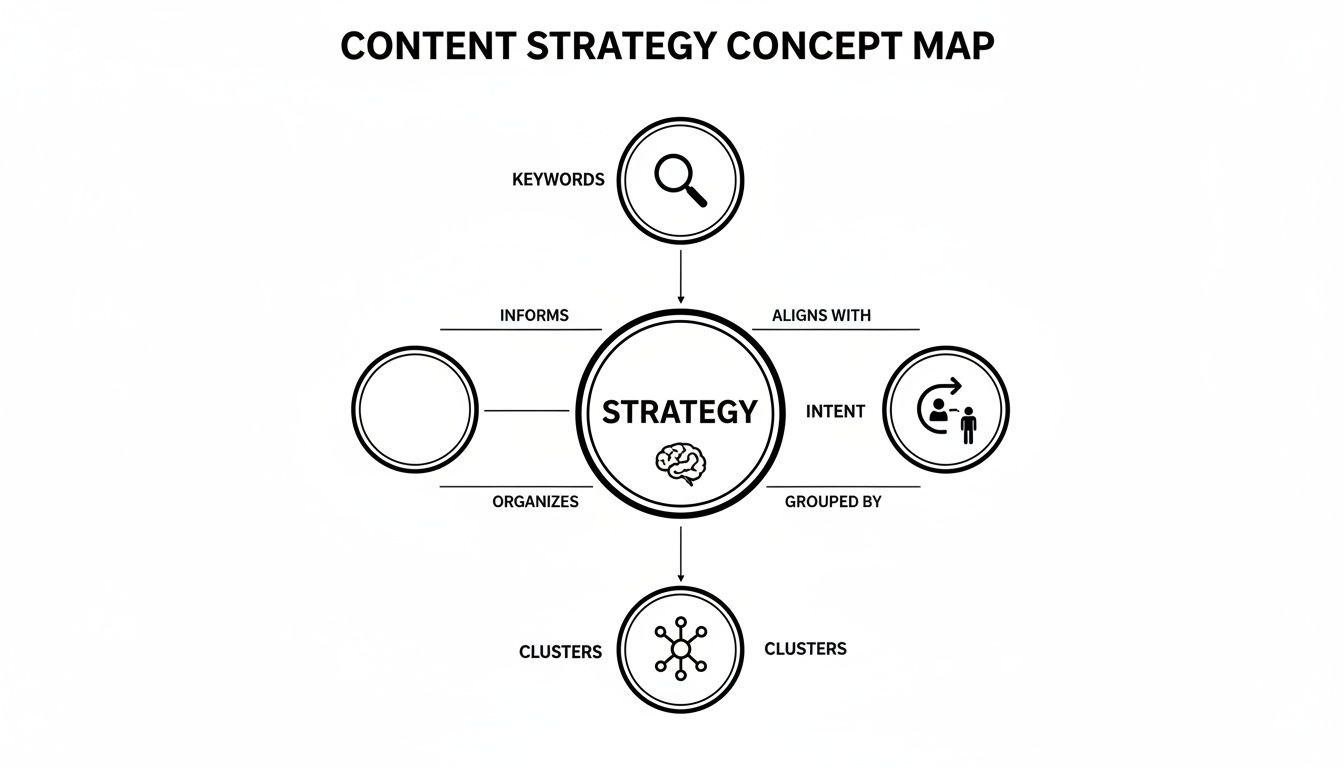
As you can see, solid on-page optimization is where your strategy comes to life, turning ideas like "user intent" into tangible page elements that Google can understand and reward.
Mastering Titles and Meta Descriptions
Your title tag and meta description are your first—and sometimes only—chance to make an impression in the search results. A great one can skyrocket your click-through rate (CTR), which is a huge signal to Google that your page is a good match.
A compelling title needs to grab attention and include your primary keyword, ideally near the front. Keep it snappy, aiming for the 50-60 character range so it doesn't get awkwardly cut off in the results.
While your meta description doesn't directly influence rankings, it absolutely influences clicks. It’s your 1-2 sentence pitch to the searcher. Summarize the page's value, make it enticing, and stick to around 160 characters.
I see this all the time: people let their CMS auto-generate a bland title like "Blog Post #12." Taking just two minutes to write a benefit-driven title like "5 Time-Blocking Apps That Actually Work" can make an enormous difference.
Structuring Content with Header Tags
Header tags (H1, H2, H3, etc.) are your best friends for organization. They create a clear hierarchy that guides readers down the page and gives search engine crawlers a neat outline of your content. A well-structured page just feels more authoritative.
Here's the simple hierarchy I stick to:
- H1 Tag: This is your headline. There should only be one H1 per page, period. It should feature your main keyword and declare the page's core topic.
- H2 Tags: Use these for the main sections of your article. They break up the content into digestible, scannable chunks.
- H3 Tags: Need to break down a point within an H2 section? That's what H3s are for. They let you add more detail without making the page look cluttered.
This structure isn't just for appearances. It gives search engines a machine-readable skeleton of your article, helping them understand the main topics and sub-topics you cover.
Leveraging Internal Linking for Authority
Internal linking is probably the most powerful and underused on-page tactic out there. It’s simply the act of linking from one page on your site to another, and it’s a fantastic way to show Google how your content is related and to pass authority around your site.
When you link to another relevant page using descriptive anchor text (the actual clickable words), you’re sending a strong signal. For example, using the phrase "topic cluster model" to link to your in-depth guide on the subject tells Google you have a deep well of knowledge on that concept.
This simple practice delivers three major wins:
- Improves Crawlability: Helps Googlebots find and index more of your content.
- Boosts Page Authority: Passes "link equity" from your high-performing pages to newer ones.
- Enhances User Experience: Guides visitors to more helpful information, keeping them on your site longer.
Finally, a quick note on images: never upload one without descriptive alt text. This text tells search engines what the image shows, which is crucial for image search rankings. It also makes your site more accessible for users with screen readers—a win-win.
Building Authority with Strategic Backlinks
If great content is the engine of your SEO strategy, then backlinks are the high-octane fuel that makes it go. Think of every backlink as a vote of confidence. When another website links to you, they're essentially telling their audience—and Google—that your site is a valuable, trustworthy resource. The more of these endorsements you collect from high-quality, relevant sites, the more authority your own site builds.
But let's be clear: not all links are created equal. A single, hard-earned link from a respected industry publication will do more for you than a hundred low-quality links from spammy directories. The real goal isn't just to get links; it's to earn the right links. This is fundamental to building a lasting presence in search results.
Quality Over Quantity Always Wins
It’s tempting to get caught up in the numbers, but a link-building strategy focused purely on volume is a one-way ticket to an SEO penalty. Google's algorithms are smarter than ever at spotting manipulative link schemes.
Instead, every link you build or pursue should be filtered through three critical criteria:
- Relevance: Is the linking site in your neighborhood? A link from a major tech blog to your new SaaS product is a powerful, relevant signal. A random link from a pet grooming blog? Not so much.
- Authority: How reputable is the website linking to you? Metrics like Domain Rating (DR) or Domain Authority (DA) are useful shorthand for a site's reputation. Links from high-authority sites simply carry more weight.
- Context: Where does the link appear on the page? A link woven naturally into the body of an article is infinitely more valuable than one buried in a footer or a massive list of other links.
Earning links is a slow grind, but it's one of the most durable competitive advantages you can build in SEO. A strong backlink profile acts as a moat, making it much harder for new competitors to outrank you, even if they have great content.
Kickstarting Momentum for a New Launch
For a brand-new SaaS product, you're starting at the bottom of a very steep hill. Your domain authority is zero, and in Google's eyes, you're an unknown quantity. This is where a strategic, launch-focused link-building push can completely change your trajectory.
Launch platforms can be a game-changer here. A service like SubmitMySaas, for example, offers a launch package that can secure 35+ high-DR backlinks from established tech directories and startup communities. This gives you an immediate injection of credibility and accomplishes two things perfectly:
- It puts your product directly in front of early adopters and tech enthusiasts who are actively looking for new tools.
- It sends a wave of positive authority signals to Google, helping your new site get indexed and start ranking far faster than it ever could on its own.
Think of it as jumpstarting a cold engine. This initial burst of authoritative links tells search engines your new site is legitimate and worth paying attention to, laying a solid foundation for everything that comes next.
High-Impact Backlink Strategies for SaaS
While a launch push is fantastic for getting off the ground, you need a mix of strategies for sustained growth. Different tactics require different levels of effort but can yield very different results, especially when you're just starting out.
Here's a quick comparison of some go-to methods:
| Strategy | Effort Level | Potential SEO Impact | Best For |
|---|---|---|---|
| Product Directories | Low | Medium | Gaining foundational links and initial traction for a new launch. |
| Guest Posting | Medium | High | Building topical authority and driving targeted referral traffic. |
| Original Research/Data | High | Very High | Becoming a go-to source and attracting passive, high-authority links. |
| Broken Link Building | Medium | Medium | Finding quick wins on authoritative pages by providing value. |
Ultimately, a balanced approach works best. Start with the low-effort, foundational strategies to build an initial base, then layer on higher-impact, more intensive methods as you gain momentum.
Sustainable Strategies for Earning Links
Once your launch is over, the real work of building long-term authority begins. Here are a couple of proven methods that consistently deliver high-quality backlinks without ever veering into spammy territory.
Create Link-Worthy Original Research
One of the single most effective ways to earn top-tier links is to become the source. Run a survey with your users, analyze proprietary data from your product, or compile industry statistics into an insightful report. When journalists, bloggers, and other companies cite your findings, they have to link back to you as the original source.
This creates a powerful flywheel. A single, well-executed report can continue generating high-quality links for months or even years as it gets discovered and referenced across the web.
Strategic Guest Posting
Guest posting is the classic art of writing an article for another website in your niche. In return for your expertise, you typically receive an author bio with a link back to your site. The key here is to be incredibly selective.
Don't just write for anyone. Focus on reputable sites that your ideal customers actually read and respect. A single, well-placed guest post on a top industry blog not only earns a powerful backlink but also drives qualified referral traffic and builds your reputation as an expert. For a much deeper dive, our guide on how to get backlinks for SEO breaks down the entire process.
By combining an initial launch boost with these value-driven, long-term strategies, you can build a powerful and defensible backlink profile that will steadily lift your search rankings over time.
Getting User Experience and Site Performance Right
Let's be blunt: Google's job is to deliver the best, most relevant results to its users. That means the search engine cares deeply about what happens after someone clicks on your link. If they land on your site and have a frustrating, slow, or confusing experience, it's a huge red flag for Google.
This is why user experience (UX) and raw site performance aren't just "nice-to-haves" anymore; they're table stakes for modern SEO. When people stick around, engage with your content, and find what they need without a headache, they're sending powerful positive signals back to the algorithm.
Cracking the Code on Core Web Vitals
To take the guesswork out of measuring user experience, Google rolled out a specific set of metrics called Core Web Vitals. These aren't just fluffy concepts—they're concrete data points that directly influence your search visibility. Think of them as a technical report card on how your site feels to a real person.
The three main pillars you need to know are:
- Largest Contentful Paint (LCP): This is all about loading speed. It measures how long it takes for the biggest piece of content (like a hero image or a block of text) to appear. You're aiming for an LCP under 2.5 seconds.
- Interaction to Next Paint (INP): This one's about responsiveness. It tracks the time between a user's action—like a click or a tap—and the moment the page visually responds. A low INP score makes your site feel snappy and interactive.
- Cumulative Layout Shift (CLS): This measures visual stability. We've all experienced this: you go to click a button, and an ad loads, shifting the layout and making you click the wrong thing. A low CLS score means your page is stable and predictable.
A slow site doesn't just annoy people; it actively hurts your bottom line. Research has shown that even a one-second delay in page load time can cause a 7% drop in conversions. For a SaaS company fighting for every trial signup, that's a massive leak in the funnel.
Actionable Fixes for a Faster, Happier Site
The good news is that you don't need to rebuild your entire site to see improvements. A few targeted optimizations can make a world of difference. Your first stop should be Google’s free PageSpeed Insights tool to get a baseline score.
From there, here are some high-impact changes I always recommend:
- Crush Your Images: Huge, unoptimized images are the number one killer of page speed. Use modern formats like WebP and run everything through a tool like TinyPNG to shrink file sizes without losing visual quality.
- Minify Your Code (HTML, CSS, JavaScript): Your code files are often bloated with extra spaces, comments, and long variable names that browsers don't need. Minification tools strip all that out, making the files smaller and quicker to download.
- Use Browser Caching: Caching tells a visitor's browser to save static parts of your site, like your logo, fonts, and stylesheets. When they visit again, the browser just loads the saved files instead of re-downloading everything. It's a simple way to create a dramatically faster experience for repeat visitors.
It's Not Just About Speed—Engagement Is King
While speed is a huge piece of the puzzle, a fantastic user experience goes much deeper. Is your navigation intuitive? Can people find your pricing page easily? Are your calls-to-action (CTAs) clear and compelling?
These elements directly impact engagement metrics like bounce rate (how many people leave after seeing just one page) and dwell time (how long they stay on your site). A high bounce rate is a clear signal to Google that your page didn't satisfy the user's search query. This is why designing clean, logical user journeys is so critical. For inspiration, our guide on the best landing page builders highlights tools that excel at creating user-friendly designs.
Measuring SEO Success and Refining Your Approach
Getting your product launched and your content live is a massive win, but don't pop the champagne just yet. The real work in SEO begins now. The secret to long-term success is building a feedback loop where you're constantly measuring what works, what doesn't, and letting that data guide your next move.
Without good data, you’re just guessing. You’re throwing content at the wall and hoping something sticks, which is a surefire way to waste time and money. This process of analyzing and tweaking is what separates the sites that stall after launch from the ones that steadily climb the rankings.
The idea isn't to just stare at dashboards full of numbers. It’s about learning to read the story those numbers are telling you. Why did that one blog post blow up while the other fell flat? Which keywords are actually bringing in people who sign up for a trial? Answering questions like these is how you turn raw data into a real growth strategy.
Setting Up Your SEO Dashboard
Your two best friends on this journey are a couple of free tools from Google itself: Google Search Console (GSC) and Google Analytics 4 (GA4). They’re non-negotiable. Together, they give you a complete view of your SEO health, from how you look on Google to what people do once they get to your website.
Google Search Console: Think of this as your direct line to Google. It shows you exactly how the search engine views your site, what search queries you're appearing for, your click-through rates (CTR), and your average ranking positions. It’s invaluable for spotting technical issues and understanding your visibility.
Google Analytics 4: This tool picks up where GSC leaves off. It tells you what happens after someone clicks your link. You can see how much organic traffic you're getting, how engaged those visitors are, and—most critically—whether they're converting into trial sign-ups or demo requests.
Here’s a simple way to think about it: GSC tells you how you’re performing on Google’s property, and GA4 tells you how you’re performing on your own. You need both to see the full picture and make smart decisions.
Key Metrics That Actually Matter
It’s incredibly easy to get overwhelmed by all the available data. To keep your sanity, you need to zero in on the metrics that actually impact your business goals. For any SaaS launch, these are the vital signs you should have your eyes on.
Primary Performance Indicators:
- Organic Traffic: This is your top-of-the-funnel number. How many people are finding you through search? Look for a steady month-over-month increase.
- Keyword Rankings: Don't track everything. Pick a core group of high-intent keywords—the ones most likely to lead to a sale—and obsess over their movement. Are you moving from page three to page one for the terms that count?
- Click-Through Rate (CTR): This tells you how compelling your search snippet is. If 1,000 people see your page in the results but only 10 click, you have a 1% CTR. A low CTR is often a sign that your title tags and meta descriptions need a serious rewrite.
- Organic Conversions: This is the bottom line. It’s the metric your CEO actually cares about. How many of your organic visitors are signing up for a trial, booking a demo, or becoming paying customers?
When you focus on these metrics, you can act quickly. See a topic driving a ton of conversions? Write more content around it. Got a page with great rankings but a terrible CTR? It’s time for an on-page refresh. This cycle of measuring, learning, and refining is what drives real, sustainable growth long after your launch day.
Common Questions About Improving Search Rankings
Founders always seem to circle back to the same few questions when we start talking about SEO. It makes sense—there's a lot of noise out there. Let's cut through it and get you some straight answers.
How Long Does It Take to See SEO Results?
I'll be blunt: SEO is a long game. If you're launching a brand-new website, you should realistically expect to wait 6 to 12 months before you see any significant, stable traffic from search engines.
Why so long? It's a mix of things. Your industry's competitiveness plays a huge role, as does the quality of your content and your ability to earn quality backlinks.
That said, you can give yourself a running start. Using a launch service to get an initial burst of high-authority backlinks can signal to Google that you're a serious player. This can sometimes shave a bit of time off that initial "sandbox" period and help you build momentum right out of the gate.
Should I Focus on On-Page SEO or Backlinks First?
This one's easy: on-page and technical SEO, every single time.
Think of it like building a house. You wouldn't start building roads (backlinks) to a property with a crumbling foundation, right? The same logic applies here. A technically sound website that gives users a great experience is the foundation. It ensures every backlink you work so hard to get actually delivers its full potential.
Fix your site first. Then build the bridges. Your link-building efforts will be infinitely more effective this way.
There's no magic bullet or single "most important" ranking factor. Google's algorithm looks at hundreds of different signals. The most consistently winning formula is a combination of high-quality content that actually helps people and a strong, authoritative backlink profile.
Great content answers the user's question. Strong backlinks prove you're a credible source. Nail both, and you're well on your way to earning and keeping those top rankings.
Ready to give your new SaaS the launch it deserves? SubmitMySaas provides the high-DR backlinks and targeted exposure you need to start climbing the rankings from day one. Get your launch package at https://www.submitmysaas.com.