How to Build online community: A Guide to Thriving and Growing
Discover how to build online community from the ground up with practical strategies, platform picks, and growth tactics for SaaS founders and creators.
An online community is more than just a chatroom—it’s a living, breathing space where your most passionate users can connect with each other, share their wins, and learn together. It’s about intentionally creating a home for them, choosing the right platform, and then consistently showing up with valuable content and genuine interaction.
When you get it right, you transform a group of individual customers into a powerful ecosystem that fuels feedback, support, and organic growth.
Why a Community Is Your Unfair Advantage

Before we jump into the "how," let’s get clear on the why. A thriving community isn't just another item on your marketing checklist; it's a powerful strategic asset. It's the kind of competitive moat that’s incredibly difficult for anyone else to build.
Think of it as a direct line to the people who care most about what you're building. These are the folks who will give you brutally honest feedback, evangelize your product on social media, and help onboard the next wave of users. It completely changes the dynamic from a one-way broadcast to a lively, ongoing conversation.
The Shift from 'Nice-to-Have' to Essential
The way we think about online communities has totally flipped. Just a few years ago, having one was a bonus. Now, for many businesses, it’s the core engine for growth.
The 2026 Community Trends Report from Circle, which surveyed over 750 community builders, highlights this exact point. People are craving authenticity, and that deep connection drives a kind of loyalty that paid ads could never buy.
This isn't just a feeling; it's a strategic move driven by tangible business results. For SaaS founders and indie makers, the benefits hit the bottom line directly.
A well-run community becomes your:
- Feedback Engine: You have a built-in focus group ready to validate new ideas and test prototypes. They actually want you to succeed.
- Support Scaler: Power users start answering questions for newcomers, which not only lightens the load on your support team but also creates a searchable knowledge base over time.
- Retention Multiplier: When users build real relationships within your ecosystem, the cost of switching to a competitor becomes much higher than just a subscription fee. They're leaving their people behind.
- Authentic Marketing Channel: Nothing beats genuine testimonials, user-generated content, and word-of-mouth referrals from trusted peers. It's marketing gold.
A community transforms your product from a simple tool into a shared identity. When people feel like they are part of something bigger, their loyalty transcends features and pricing, creating a bond that is incredibly difficult for competitors to break.
Real-World Impact for Founders
Let’s make this real. Imagine you're about to ship a huge new feature. Instead of launching it into the void, you drop a beta version into your community. Within hours, a handful of members spot a critical usability flaw you and your team completely missed. That single piece of feedback just saved you from a wave of negative reviews and a costly post-launch scramble.
Here’s another one: a new user is totally stuck on a complex workflow. Before they even think to submit a support ticket, an experienced community member jumps in with a quick screen recording that solves their problem instantly. That’s not just a support ticket closed—it's a moment that builds immense goodwill and makes that new user feel seen.
This is the power of a dedicated community. In a crowded market, it really is your unfair advantage.
Defining Your Community's Purpose and Culture
Before you even think about picking a platform or sending that first invite, you have to do the foundational work. This is the stuff that makes or breaks a community. Without real clarity, you're just building an empty room online, hoping people show up and talk. They won't.
This is the strategic deep-dive where you figure out not just what your community is, but why it absolutely needs to exist. Is it a place for new users to get un-stuck? A brain trust for your most passionate customers to help shape your product? Or maybe a professional network for people in your niche to get ahead? Answering this is non-negotiable.
Nail Down Your Community's Core Mission
Think of your mission statement as your community's north star. It needs to be sharp enough to pull the right people in and politely push the wrong people away. It’s a filter. A mushy mission like "a place for users to connect" is a recipe for a ghost town.
Get specific. Let's look at a few examples:
- For a design tool: "A space where UI/UX designers can share feedback on projects, discover new techniques, and master our software together."
- For a developer API: "A technical hub for developers to solve complex integration challenges, share code snippets, and get direct access to our engineering team."
- For a project management SaaS: "A network for team leads to exchange productivity workflows, learn advanced project management strategies, and find accountability partners."
See the difference? Each one instantly tells a potential member what they'll get out of it. The value is front and center, which is how you start building online community engagement from the moment they land on your page.
Go Beyond Demographics to Build Your Member Persona
Okay, you know the why. Now you need to get crystal clear on the who. Building an ideal member persona is key, but you have to go way beyond basic demographics like age or location. The real gold is in understanding what makes them tick.
I always focus on these three areas:
- Motivations: What are their biggest career goals or personal dreams? What's the real reason they'd even bother looking for a community like yours?
- Challenges: What specific, nagging problems keep them up at night? What's standing between them and their goals?
- A 'Win' State: If they joined your community and it was a massive success for them, what would that look like? If they could wave a magic wand, what outcome would they wish for?
Knowing this stuff lets you talk to them in a way that truly connects. You’re not just offering a forum; you’re offering a shortcut to solving their problems and a clear path to becoming the person they want to be.
A strong community isn't built for everyone. It's built for someone specific. The more deeply you understand that 'someone,' the more magnetic your community becomes.
Establish the Culture and Set the Tone Early
The vibe of your community starts with you. Seriously. The tone you set from day one will be copied by your first members, and that creates a ripple effect that defines the entire culture. Do you want it to be helpful and supportive? Innovative and edgy? Playful and fun? Or deeply analytical?
Your community guidelines are the blueprint for this culture. But don't think of them as just a list of "don'ts." Frame them as "how we do things around here" to keep the space valuable and safe for everyone.
Your guidelines absolutely must cover:
- Promotion Rules: Be brutally clear about self-promotion. A great starting point is a "give more than you take" policy.
- Code of Conduct: Lay out what respectful interaction looks like. This is about making sure everyone feels welcome and safe.
- Content Quality: Gently nudge people on how to ask great questions or share useful insights. This keeps the signal high and the noise low.
Putting in this work upfront—defining your purpose, deeply understanding your members, and setting the cultural tone—is the single most important thing you'll do. It's what ensures that when your first members walk through the digital door, they feel like they’ve finally found their corner of the internet. This foundation is what separates a thriving ecosystem from another digital dead end.
Choosing the Right Platform for Your Members
Think of your community platform as the digital home for your members. It's where they'll connect, share, and grow. This is one of the most critical decisions you’ll make because it shapes everything from the user experience to your own sanity as a community manager. It's not just a software choice; it's an environment choice.
And it’s a decision that’s only getting more important. The market for these tools is exploding—from a value of $408.587 million in 2021, it’s projected to hit a staggering $2,396.94 million by 2033. That’s a compound annual growth rate of 15.886%, which tells you just how central community has become. You can dig into the numbers in this full market research on online community platforms.
With so many options, where do you even start? It all comes back to your community's purpose. What are you actually trying to achieve?
This decision tree should help clear things up.
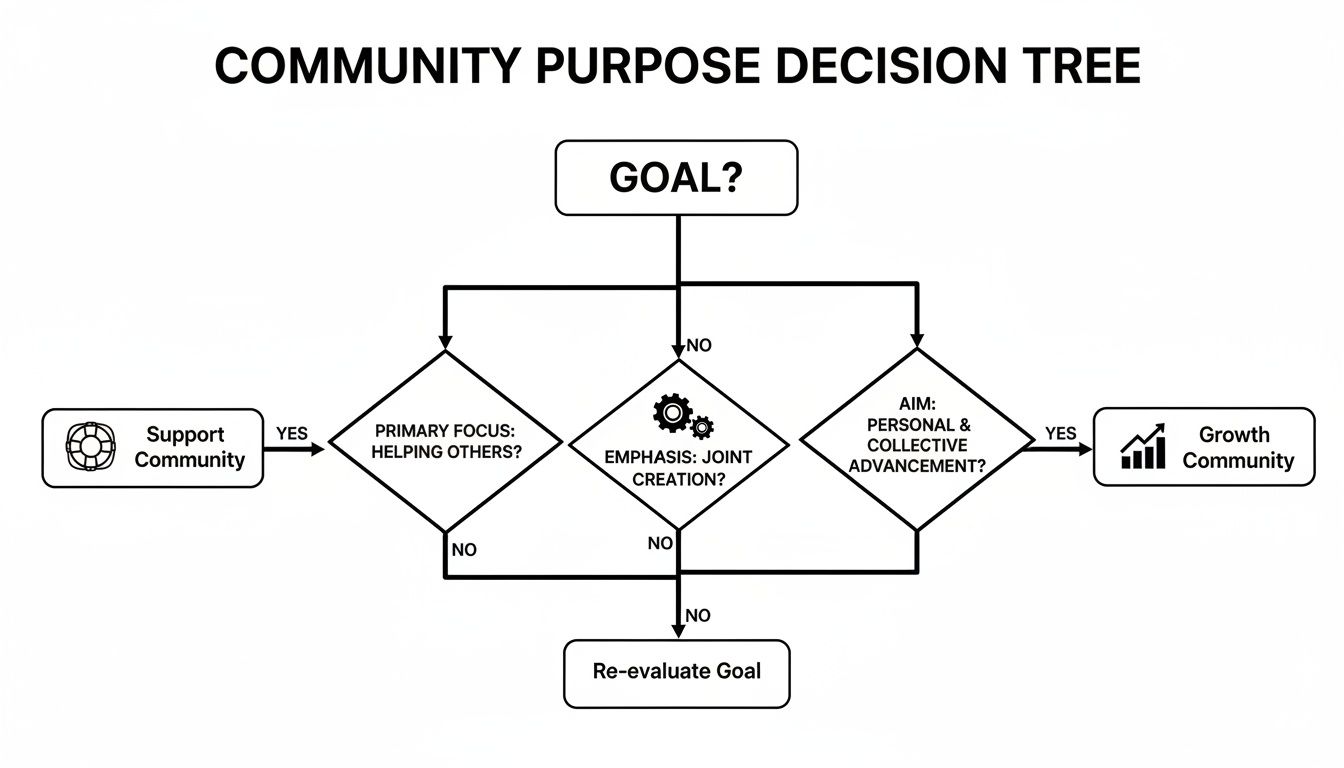
As you can see, the "why" behind your community—whether it's world-class customer support, product co-creation, or pure growth—points you toward the right type of platform.
Dedicated Community Platforms
For most founders building a community around their product, dedicated platforms are the way to go. I'm talking about tools like Circle, Mighty Networks, or Tribe. These are purpose-built for community, packing in features designed for genuine engagement and giving you total control.
They give you a clean, brandable space that feels like a true extension of your product, not just a random group on a noisy social network.
A few key benefits really stand out:
- Deep Integration: Many offer robust APIs and webhooks, letting you create a seamless experience between your SaaS and your community. Think single sign-on or triggering events based on user activity.
- Monetization Ready: Planning to offer a paid membership or exclusive content? These platforms have subscriptions and payment processing built right in.
- Real Analytics: You get access to meaningful data on member activity, post engagement, and overall community health—all essential for proving ROI.
The catch? They're not free. But for a serious community-led company, the subscription cost is an investment that pays for itself through a better member experience and saved administrative time.
Communication-First Tools
Then you have platforms like Slack and Discord, which have become incredibly popular, especially in the tech world. Their strength is real-time, synchronous chat. They create a feeling of immediacy, like everyone is in the same room.
Slack's professional, workplace-like interface makes it a natural fit for B2B or professional networking communities. Discord, born from the gaming world, has a more casual vibe with powerful voice and video features, making it a favorite for developers and creators.
Choosing a communication-first tool is a bet on conversational depth over structured content. It works best when your goal is rapid-fire Q&A, real-time collaboration, and a feeling of being constantly "in the loop."
But you need to be aware of the trade-offs. The fast-paced nature of chat makes it tough to find valuable information later on; knowledge gets buried quickly. The constant pings can also lead to notification fatigue if you don't set clear expectations. If you're exploring different ways to foster this kind of real-time connection, you might find some good ideas in our guide on Gather Town alternatives and similar platforms.
Social Media Groups
Going with a Facebook or LinkedIn Group is often the path of least resistance. It’s free, and your members are probably already there, which makes joining incredibly easy. That low barrier to entry is their biggest selling point.
But this convenience comes with some serious compromises, especially for a SaaS founder.
- You're on Rented Land: You don’t own the space. The platform controls the algorithm, your data, and the user experience. A sudden change can wreck your community overnight.
- The Distraction Economy: Your group is competing for attention with baby photos, political rants, and endless memes. It’s hard to foster deep focus.
- Limited Customization and Data: You get almost no branding control and very little meaningful data about how your members are actually behaving.
A social media group can be a great "starter" community or a channel at the top of your funnel to attract people. But if you’re trying to build a strategic asset that’s deeply connected to your product, you’ll outgrow it—fast.
To help you weigh these options, here's a quick comparison of the most common platform types from a SaaS founder's perspective.
Community Platform Comparison for SaaS Founders
| Platform Type | Best For | Key Strengths | Potential Drawbacks |
|---|---|---|---|
| Dedicated Platforms | SaaS companies building a core, branded community asset around their product. | Full ownership, deep analytics, monetization tools, brand control, integrations. | Monthly subscription cost, requires effort to attract initial members. |
| Communication Tools | Tech-focused communities needing real-time chat, Q&A, and a sense of immediacy. | High engagement, synchronous conversation, feels casual and connected. | Knowledge gets lost, can be noisy/distracting, risk of member burnout. |
| Social Media Groups | Getting started quickly, testing an idea, or as a top-of-funnel discovery channel. | Free to use, massive existing user base, low friction to join. | No ownership, algorithmic risk, constant distractions, limited data. |
Ultimately, there's no single "best" platform—only the best platform for your community's specific purpose and your members' needs. Choose the digital home that will help you achieve your goals, not one that works against them.
Developing a Content and Engagement Strategy

An empty community is a quiet one, and quiet communities die fast. Your platform is just the container; the real magic—the lifeblood—is the content and the conversations you spark within it. This is where you stop thinking about building a space and start building a habit for your members, giving them a real reason to show up every single day.
A solid plan turns random posts into a reliable rhythm of engagement that delivers tangible value. It’s not about blasting people with noise. It's about creating consistent, high-signal interactions that get to the heart of why your community exists in the first place.
And this isn't just a nice-to-have. A massive 90% of social media marketers globally agree that building an active community is essential for a winning strategy. This insight, highlighted in HubSpot's comprehensive State of Marketing Report, shows this is a fundamental shift in how brands connect with people.
Establish Your Content Pillars
Stop scrambling for post ideas. Instead, anchor your entire content plan around three to five core "pillars." Think of these as the main themes and recurring formats your members can come to expect and rely on.
Let's say you're running a community for a SaaS product. Your pillars might look something like this:
- Product Insider Access: Make members feel like they're on the inside track. This means weekly product updates, behind-the-scenes looks at your dev process, and exclusive access to beta features before anyone else gets them.
- Expert Knowledge Sharing: Position your community as a place to learn. You could host "Ask Me Anything" (AMA) sessions with your engineers, invite industry experts for Q&As, or even have members run tutorials on how they use your product.
- Member Showcase and Collaboration: Put the spotlight on your people. This is where you feature member-led projects, share their success stories, and create threads for peer-to-peer feedback.
- Industry Trends and Discussion: Look beyond your own product. Spark conversations about relevant industry news, new tech on the horizon, or debates about best practices in your members' fields.
Having these pillars gives you a framework. When you sit down to plan your content for the week, you’re not starting from a blank page; you're just deciding which pillar to lean into that day.
Create Community Rituals and Catalysts
Rituals are the heartbeat of an engaged community. These are the scheduled, recurring events that create a predictable rhythm members can depend on. They are the key to turning passive lurkers into active participants by giving them a specific reason to check in and contribute.
For example, you could easily roll out:
- Feedback Friday: A dedicated weekly thread where members share product feedback, and your team is there, ready to listen and respond.
- Wins Wednesday: A feel-good space for members to post personal or professional wins from the week, which builds an incredibly positive and supportive vibe.
- Tutorial Tuesday: Each week, a different member shares a short tip or a quick tutorial on how they use a specific feature.
Alongside these rituals, you need catalysts—simple prompts designed to get a conversation going right now. Polls are fantastic for this; think simple questions like, "What feature are you most excited about?" Challenges are another great catalyst, like a "30-day design challenge" using your tool.
A great community doesn't just happen; it's designed. Rituals build the habit of returning, while catalysts provide the spark for interaction. Together, they create a self-sustaining cycle of engagement.
Implement Simple Gamification
Forget about complex leaderboards and point systems. You can make members feel recognized and valued with simple, thoughtful gamification that encourages the right behaviors. The goal is to acknowledge and reward the actions you want to see more of.
For a SaaS community, this can be incredibly straightforward:
- Contributor Badges: Assign a special badge or flair to members who consistently answer questions or provide helpful feedback. It’s a visual cue that signals their expertise and value to others.
- Early Adopter Flair: Give a unique, permanent flair to your first 100 or 500 members. This creates a sense of pride and acknowledges their role in building the community from the ground up.
- Bug Squasher Role: Create a special role for members who identify and report critical bugs. This small touch turns a potential support headache into a moment of public recognition.
And don't forget to have a little fun. Leaning into current trends, like using popular meme templates, can inject a shared sense of humor and personality. Mixing these lighter touches with your structured pillars and rituals ensures your community feels both valuable and human. If you're looking for tools to help juggle all these moving parts, check out our deep-dive into social media management tools and their features.
Growing and Scaling Your Community the Right Way
You’ve got a solid foundation and a handful of dedicated members. Now what? It’s tempting to floor it and chase vanity metrics, but trust me, that's a mistake. Growing too fast can completely torch the culture you've worked so hard to build.
Sustainable scaling isn’t about a massive, overnight influx of users. It’s about creating thoughtful pathways that bring in the right people—those who are already bought into your mission. The real magic happens when your community becomes a natural extension of your product, not just a marketing channel.
Leverage Your Product Touchpoints
Forget expensive ad campaigns for a moment. Your single most powerful growth channel is your own product. The people already using your software are your best bet for high-quality community members. They’re invested, they get it, and they’re the most likely to contribute something meaningful.
Start weaving invitations into moments where users are feeling good about your product.
- During Onboarding: After a new user nails a key setup step, slide a friendly invitation into their next email. This isn't a sales pitch; it's an offer to join a circle of peers for support and insider tips.
- With In-App Notifications: Did a user just hit a major milestone or finish a big project? That’s the perfect time for a pop-up: "Awesome work! Share your success with other pros in our community."
- In Success Messages: Even the simple "Your export is complete!" message is an opportunity. Why not add, "P.S. Looking for more ways to use this feature? See how the experts do it in our community."
These moments work because they’re contextual. You aren't interrupting their flow; you're offering the perfect next step right when they’re most receptive.
Sustainable community growth isn't a separate campaign—it's a product feature. When you embed invitations into moments of user success, you create a natural, continuous pipeline of your best possible members.
Turn Product Launches into Community Events
Your next big launch isn't just a launch—it's a massive community-building opportunity. For founders using platforms like SubmitMySaas, a launch brings in a wave of early adopters and tech enthusiasts actively hunting for cool new tools. Don't let that energy just fade away.
This is your chance to create a flywheel where product discovery fuels community growth.
- Prep Your Insiders: Before you go live, give your current community members a sneak peek. Treat them like co-conspirators. Give them the links, the talking points, and the inside track so they feel invested in the launch's success.
- Make the Community the CTA: On your launch pages and social posts, don't just say "Buy Now." Make "Join the Community" a primary call to action. Frame it as the place to get direct access to you, influence the roadmap, and connect with other pioneers.
- Funnel New Users In: As signups roll in from the launch, make sure your onboarding flow points them directly to the community. This immerses them in the culture from day one and shows them they’ve found more than a tool—they’ve found a home.
This approach turns a one-time traffic spike into a long-term asset. You’re capturing that initial momentum and channeling it into a space you actually own. To get a better handle on generating that initial surge, check out our guide on how to increase website traffic organically, as those tactics pair perfectly with a launch push.
Pursue Strategic Collaborations
Finally, look for friends in your space. Find partners who serve the same audience but aren’t direct competitors. A smart collaboration with a complementary product, a trusted influencer, or a popular newsletter can be a game-changer.
But don't just swap logos. Create something valuable together.
- Co-Host a Webinar: Team up with another SaaS to teach something your shared audience cares about. At the end, invite everyone to your community to keep the conversation going.
- Run a Joint Challenge: Partner with an influencer to run a 7-day challenge for their audience. The challenge can be hosted in your community and require the use of your tool, creating a win-win.
- Guest on Podcasts: Find podcasts your ideal members listen to. Go on as a guest and offer a special, community-only resource to listeners who sign up.
By focusing on these integrated, sustainable methods, you’ll grow a community that isn't just bigger—it's stronger, more engaged, and deeply woven into the success of your product.
Measuring Community Health and Proving ROI

So, how do you know if all this community-building effort is actually paying off? To justify the time, money, and energy you're pouring in, you have to connect the dots between community activity and real business outcomes. This is where we move past "vanity metrics" like the total member count and dig into data that proves tangible value.
Without a solid way to measure success, your community can easily be mistaken for a cost center. But when you track the right things, you can show it's the powerful growth engine you know it can be.
What Does a Healthy Community Actually Look Like?
Before we talk about money, let's take your community's pulse. A truly vibrant community is a mix of hard numbers and that hard-to-define "vibe." Start by tracking a few core metrics that show you if people are sticking around and getting value.
- Engagement Rate: Don't obsess over the total member count. Focus on who's showing up. A simple formula is (Daily Active Members / Total Members). You want to see this number climbing steadily.
- Member Retention: What percentage of new members are still active after 30, 60, or 90 days? If people are coming back week after week, you're doing something right.
- Time to First Response: When someone asks a question, how long does it sit there unanswered? A fast response time, especially when it comes from another member, is a fantastic indicator of a healthy, helpful culture.
Think of these as your internal health check. They tell you if the day-to-day engagement is strong enough to start driving bigger business goals.
Connecting the Dots to Business ROI
Now for the fun part: let's connect that healthy engagement to cold, hard business results. This is how you prove your community’s worth to stakeholders and get the budget you need to grow. The goal is to draw a straight line from community activity to key SaaS metrics.
Here are a few high-impact areas to track:
- Reduced Support Costs: Look at the number of support tickets from community members versus non-members. One software company I know saw a 28% drop in ticket volume simply because members started getting answers from each other first.
- Increased Product Adoption: Are your community members digging deeper into your product? You can track this by surveying them or tagging users in your analytics tools to see if community participation correlates with higher feature usage.
- Higher Customer Lifetime Value (LTV): This is a big one. Compare the LTV of your active community members to those who aren't involved. That sense of belonging often leads directly to lower churn and more revenue over the long haul.
Proving ROI isn't just about spreadsheets and charts; it's about telling a compelling story. The story is this: bringing your best customers together creates a flywheel that cuts costs, deepens product engagement, and builds a fiercely loyal user base.
Keeping the Fire Going for the Long Haul
As your community grows up, your strategy needs to mature with it. In the beginning, you’re the one sparking every conversation. Over time, your role should shift to empowering your members to take the lead.
This means creating programs that recognize and reward your most passionate contributors.
- Launch an Ambassador Program: Find your super-users and give them the VIP treatment. This could be early access to new features, a direct line to your product team, or some exclusive swag. It makes their status official and shows you value their contributions.
- Empower Member Moderators: Let's be real: you can't be everywhere at once. Train a few trusted members to help with moderation, welcome newbies, and keep discussions on track. This not only scales your efforts but gives members a real sense of ownership.
By measuring what matters from day one and continuously investing in your core members, you can build a community that doesn't just survive—it becomes an appreciating asset that delivers incredible value for years to come.
Your Community Building Questions, Answered
How Long Does This Actually Take?
Everyone wants to know when they'll see the payoff. While you might see some initial chatter and engagement within the first few weeks, the real business impact—like a noticeable drop in customer churn—usually takes a good 6-12 months to materialize.
It’s a long game. In the early days, forget about explosive growth and focus on providing daily, tangible value. That consistent effort is what builds the foundation for compounding growth later on.
Should I Charge for Access?
This is a classic dilemma. For most SaaS companies, my advice is to start with a free community. Think of it as a powerful, free extension of your product that enhances the customer experience and builds loyalty.
A paid model can work, but only if you're offering something truly exclusive and high-value, like expert coaching, premium content, or a private mastermind. When in doubt, start free. You can always introduce paid tiers later once you have a thriving user base.
What are the Common Pitfalls I Should Avoid?
I see founders make the same mistakes over and over. The biggest one? A total lack of a clear "why." If you don't know the purpose of your community, no one else will either.
Other classic blunders include inconsistent engagement from the founders (you have to show up!) and trying to scale way too fast. Seriously, stop worrying about getting to 10,000 members and focus obsessively on creating an incredible, unforgettable experience for your first 100. That's how you build a strong culture that lasts.