How to Build Brand Awareness for Your SaaS Startup
Learn how to build brand awareness for your SaaS with our expert guide. We cover positioning, channel selection, launch strategies, and measurement for growth.
Building a brand people recognize and trust is all about creating a memorable identity and showing up consistently where your customers are. For SaaS startups, that usually means a smart mix of great content, active social media, and a killer launch on platforms like Product Hunt to get on your ideal customer's radar.
Why Brand Awareness Is Your SaaS Growth Engine

In a SaaS market that gets more crowded by the day, brand awareness isn't some fluffy, nice-to-have metric. It's the engine that powers real, sustainable growth. Think of it as the invisible force that makes every dollar you spend on marketing work harder.
When a potential customer has already heard of you—maybe they read a blog post or saw your founder on a podcast—they're far more likely to trust you. They'll click your ad, open your email, and actually listen to what you have to say. A strong brand directly speeds up user acquisition because you aren't starting from zero with every conversation. You're building on a foundation of familiarity, which lets you command better pricing and protect your spot in the market.
The Pillars of a Powerful Awareness Strategy
So, how do you go from being just another tool to a go-to name in your space? It all comes down to a solid strategy built on four key pillars, which we'll break down in this playbook:
- Define Your Position: First, you have to decide what you want to be known for. This means getting crystal clear on your ideal customer and crafting a message that hits home for them.
- Pick the Right Channels: Don't try to be everywhere at once—it’s a fast track to burnout. The real secret is to focus your energy on the platforms where your audience actually hangs out.
- Nail Your Launch: A well-planned launch on product directories and discovery sites can create a massive, concentrated burst of attention right when you need it most.
- Measure What Matters: Forget vanity metrics. Tracking real indicators like direct website traffic and the number of people searching for your brand name tells you what’s actually working.
A brand is the set of expectations, memories, stories, and relationships that, taken together, account for a consumer’s decision to choose one product or service over another. It's the reason a user chooses your SaaS over a nearly identical competitor.
The impact of a strong brand is impossible to ignore. The Brand Finance Global 500 2024 report showed NVIDIA rocketing past giants like Facebook and Walmart in brand value, all because of its central role in the AI boom. We also saw OpenAI show up in the rankings for the first time, proving you can turn a tech advantage into serious brand power. If you want a deeper dive, a comprehensive guide on how to create brand awareness is a great place to start.
Key Brand Awareness Channels for SaaS Startups
To get started, you need to choose the right channels to invest your time and resources in. Not all channels are created equal, especially when you're just starting out. Here’s a quick overview of the most effective options for SaaS startups.
| Channel | Primary Function | Key KPIs |
|---|---|---|
| Content & SEO | Building authority; capturing search demand | Organic traffic, keyword rankings, branded search volume |
| Social Media | Engaging with your audience; distribution | Engagement rate, reach, follower growth, website clicks |
| PR & Media | Gaining credibility; reaching new audiences | Media mentions, referral traffic, social sentiment |
| Partnerships | Tapping into existing communities | Co-marketing leads, referral signups, integration usage |
| Community | Fostering advocacy and loyalty | Active members, user-generated content, support queries |
| Paid Ads | Accelerating reach and targeting specific segments | Impressions, click-through rate (CTR), cost per acquisition |
Focusing on two or three of these channels at the beginning will yield far better results than trying to do everything at once. Pick the ones that best align with your target audience's habits and your team's strengths.
Defining What Your Brand Stands For
Before anyone can become aware of your brand, you have to decide what you actually want to be known for. This isn't about fluffy mission statements or corporate buzzwords. It's about building a clear, consistent story that becomes the foundation for every blog post, tweet, and product launch.
Think of your brand's position as its unique space in a crowded market. It’s what cuts through the noise and makes your ideal customer think, "Wow, they built this just for me." Without that clarity, your marketing will feel random and disconnected, never gaining any real traction.
Pinpoint Your Ideal Customer
You can't be everything to everyone, especially when you're just starting out. The goal is to define your Ideal Customer Profile (ICP) with laser precision. This goes way beyond basic demographics. You need to get inside their head and understand their pains, their goals, and what their day-to-day work life actually looks like.
A sharp ICP becomes your true north for everything you do. It guides your messaging, the channels you show up on, and even the features you decide to build next.
To get started, dig into these practical questions:
- What's their exact role? Don't just say "marketer." Get specific: "Content Marketing Manager at a B2B SaaS with 50-200 employees."
- What are their biggest daily headaches? What tasks are a total time-suck? What's holding them back from getting that next promotion?
- Where do they hang out online? Are they in specific LinkedIn groups, Slack communities, or lurking on subreddits like r/SaaS?
- What tools are already in their tech stack? Knowing their existing software helps you figure out how your product fits into their world.
Find the Gaps in Competitor Messaging
Okay, you know who you’re talking to. Now it's time for a little friendly espionage. See what your competitors are saying. The goal here isn't to copy them—it's to find the openings they've left for you. Dive into their websites, social media feeds, and ad copy.
You'll start to see patterns. Are they all just screaming about features? Maybe you can stand out by focusing on a specific outcome or a ridiculously good user experience. Do they all sound like a corporate robot? A more human, authentic voice could be your secret weapon.
The strongest brand positions come from owning a single, powerful idea in the customer's mind. For example, tons of project management tools existed, but Monday.com came in and claimed "Work OS." They positioned themselves not as just another tool, but as the entire operating system for a team's work.
This analysis helps you find that sweet spot—the intersection of what your customers desperately need and what your competitors are completely ignoring.
Articulate a Resonant Value Proposition
Now it's time to put it all together. Combine what you know about your ICP and your competitors into a value proposition that actually hits home. This is your core promise. It needs to be clear, short, and all about the benefit they get.
Here’s a great way to stress-test your value proposition. Try to answer these two prompts:
- "What's the one problem you solve that makes your customers' lives 10x easier?" This forces you to zero in on the single most important outcome.
- "How would a happy user describe your tool to their boss?" This gets you out of feature-speak and into the language of real-world business value.
This isn't just about listing what your product does. It's about telling a compelling story of what your customer can achieve. Crafting a detailed SaaS product marketing strategy is the perfect next step to formalize this value prop and make sure it’s woven into everything you do.
Choosing Your Battlegrounds for Brand Awareness
Trying to be everywhere at once is a surefire way to end up nowhere. Spreading your limited time and money too thin will stall your growth before it even gets going. The real key to building brand awareness isn't about shouting from every rooftop; it's about finding the few, specific places where your ideal customers are already hanging out and listening.
For SaaS founders, this boils down to picking a strategic mix of channels that build authority, create a community, and get your product discovered. Forget the scattergun approach. You need a focused plan that plays to your strengths and aligns with how your audience actually behaves. It’s all about making smart, deliberate choices.
Before you can pick your channels, you need to know what story you're telling. This decision tree helps map the path from understanding your audience to cementing your core brand story.
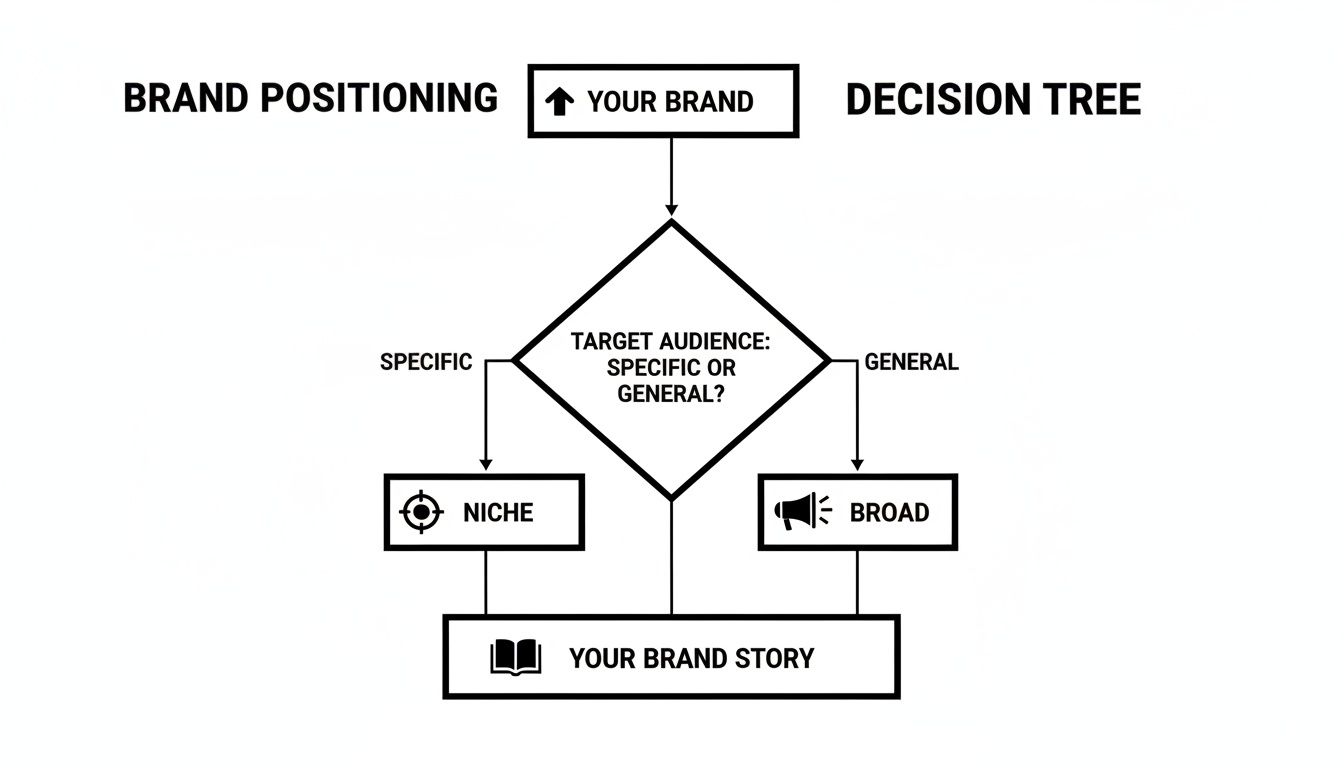
Whether you’re targeting a tiny niche or a broad market, it all starts with a well-defined brand story. That’s your foundation.
To help you decide where to focus your efforts, here’s a quick comparison of the most common channels for early-stage SaaS.
Brand Awareness Channel Comparison for SaaS
Choosing the right marketing channels is a balancing act. Each one demands a different level of investment in time and money, and the payoff can range from immediate to months down the road. This table breaks down the essentials to help you make a more informed decision for your startup.
| Channel | Resource Investment (Time/Money) | Time to Impact | Best For... |
|---|---|---|---|
| Content & SEO | High time, low-to-medium money | Medium-to-long (6-12+ months) | Building long-term authority and creating a sustainable, organic lead engine. |
| Social Media | High time, low money (organic) | Short-to-medium (1-6 months) | Engaging directly with users, building community, and showing brand personality. |
| PR & Partnerships | Medium time, low-to-medium money | Short-to-medium (1-4 months) | Quickly borrowing credibility and reaching new, relevant audiences. |
| Community | High time, low money | Medium-to-long (6-18+ months) | Fostering deep user loyalty, gathering feedback, and creating brand advocates. |
| Paid Ads | Low time, high money | Short (Immediate) | Driving targeted traffic quickly and validating messaging, especially for launches. |
| Launch Platforms | Medium time, low money | Short (Immediate burst) | Generating initial buzz, user feedback, and early adopters. |
As you can see, there's no single "best" channel. The right mix depends entirely on your product, your audience, and your immediate goals—whether that's long-term authority or a quick burst of sign-ups.
Master Content and SEO to Own Your Niche
For sustainable, long-term brand awareness, nothing beats content and SEO. I’m not talking about churning out generic, soulless blog posts. The real goal is to become the definitive resource for the specific problems your Ideal Customer Profile (ICP) struggles with every single day. You want to own the conversation around their pain points.
The foundation of this strategy is targeting long-tail keywords. These are the longer, more specific search queries that signal someone is close to making a decision. Think about what a frustrated user would type into Google just before they give up and start looking for a tool. For a project management tool aimed at creative agencies, instead of targeting "project management software," you'd go after something like "how to track client project profitability."
This approach delivers two massive wins:
- You attract the right people. You get in front of users who are actively hunting for a solution, not just window shopping.
- You build real authority. By consistently providing deep, valuable answers, you build trust long before they ever see your pricing page.
The real magic of SEO for brand awareness isn't just about traffic; it's about owning a piece of your customer's mind. When they have a problem in your domain, your brand should be the first one they think of because you’ve answered their questions a dozen times before.
By creating genuinely helpful content, you’re not just trying to rank on Google. You’re aiming to become an indispensable part of your industry's knowledge base. If you want to go deeper, we've broken down several smart techniques to help you increase website traffic organically.
Engage Authentically on the Right Social Platforms
Social media is where your brand stops being a logo and starts being a personality. But trying to maintain a presence everywhere is a classic rookie mistake that leads to mediocre results. The trick is to pick one or two platforms where your ICP lives and go all-in. For most B2B SaaS, that means focusing where business conversations are already happening.
- LinkedIn for Authority: Think of this as your professional stage. It’s the perfect place for sharing insightful articles, breaking down case studies, and posting short video demos that show off your product's "magic moment." It’s less about viral fluff and more about systematically building credibility with decision-makers.
- Twitter (X) for Community: This is where you can be human. Jump into real-time conversations, share your journey while you build in public, and connect directly with other founders and potential customers. It’s all about authentic, unpolished interaction.
Don't underestimate the power of social. With 77% of consumers saying they're more likely to buy from brands they follow, building a community is essential. Data also shows 64% of consumers tag brands or use brand hashtags, creating powerful organic reach—perfect for makers sharing new features on platforms like SubmitMySaas. It’s no surprise that 13% of marketers plan to invest in brand awareness for the first time in 2025, largely because the ROI from social is becoming impossible to ignore.
Leverage PR and Partnerships for Credibility
Public relations and partnerships are your credibility accelerators. They’re a shortcut that lets you borrow the trust and audience that other established brands, podcasts, and creators have spent years building. This is especially potent for early-stage startups that need to prove they’re legitimate in a noisy market.
Instead of chasing a feature in a major tech publication, focus on high-impact, niche opportunities where your audience is already engaged.
- Podcast Tours: Find the podcasts your ICP religiously listens to and pitch your founder as a guest. A 30-minute conversation where you share real expertise can build more trust than a dozen ads ever could.
- Guest Articles: Writing for respected industry blogs puts your name—and your company’s name—in front of a pre-qualified audience. It's a win-win: they get fantastic content for their readers, and you get exposure and a valuable backlink.
- Integration Partnerships: Teaming up with a non-competing tool that serves the exact same customer is a brilliant move. A well-designed integration feels like a natural product discovery, not a sales pitch.
Executing a High-Impact SaaS Launch
Your product launch isn’t just about flipping a switch and hoping for the best. Think of it as a concentrated burst of energy—a golden opportunity to create a massive surge in brand awareness that can really set the tone for your first year of growth.
A well-orchestrated launch puts your SaaS in front of thousands of early adopters, tech enthusiasts, and even potential investors. This is your moment to make a powerful first impression. The goal is to move beyond a simple announcement and create an event that people talk about. A coordinated, multi-platform push is what generates that initial traction and invaluable user feedback.
Leverage Product Directories and Discovery Platforms
For an early-stage SaaS, product directories are non-negotiable. Platforms like Product Hunt, BetaList, and SubmitMySaas are ready-made communities of people actively looking for new tools. Getting featured here is like opening a pop-up shop in the busiest part of town.
Instead of spending weeks trying to get the attention of a single journalist, these platforms give you direct access to a curious and engaged audience. They're built for discovery, making them one of the most efficient ways to build brand awareness from day one.
The real, often overlooked, value here is the immediate SEO boost. Securing a feature on a platform like SubmitMySaas can deliver over 35 high-Domain Rating (DR) backlinks almost overnight. This isn't just about referral traffic; it's a powerful signal to Google that your new brand is credible and worth paying attention to.
Your Pre-Launch Checklist
Success on launch day is determined by the work you do in the weeks leading up to it. A chaotic launch feels unprofessional and completely wastes the opportunity. Use this checklist to make sure you’re truly prepared.
Prepare Your Launch Assets: Don't just rely on screenshots. Create a library of compelling visuals that tell your product's story quickly. This includes high-quality product GIFs showing key features in action, a short and punchy demo video (under 90 seconds), and a well-designed press kit.
Refine Your One-Liner: You'll need to describe your SaaS hundreds of times. Nail down a clear, concise, and benefit-driven tagline. It should immediately answer the question, "What is this and why should I care?"
Prime Your Community: Your existing network is your launch-day army. Weeks before you go live, start warming up your email list, social media followers, and any online communities you're a part of. Let them know the date and how they can support you.
Write Your "First Comment": On platforms like Product Hunt, the maker's first comment is crucial. It sets the stage for the entire conversation. Prepare it in advance—tell the story behind your product, the problem it solves, and why you're so passionate about it.
Your launch isn't just about the product; it's about the story. People connect with founders who are solving a real problem they've experienced themselves. Be authentic and share your journey—it's your biggest competitive advantage.
Consistency is everything. Research shows that elite brand consistency delivers a 39.7% average increase in recognition. For SaaS founders, using a service like SubmitMySaas to unify their presence across directories is key. Why? Because "elite" brands can command premiums and see 60% higher repurchase rates driven by strong awareness. The badges and high-DR links you get provide instant credibility, amplifying your visibility. Find out more about the impact of branding statistics on business growth.
Coordinating a Multi-Platform Launch
Don't put all your eggs in one basket. While one platform might be your primary focus (like Product Hunt for launch day), you need to coordinate your efforts across multiple channels to maximize your reach.
This means planning your content calendar around the launch. Schedule your email announcement, social media posts, and any guest articles to go live simultaneously. This creates a surround-sound effect, making your brand feel like it's everywhere at once. The goal is to drive a wave of traffic and social proof to your primary launch page. A well-executed launch plan is one of the most powerful tools for learning how to launch a SaaS product successfully.
By treating your launch as a strategic campaign, you do more than just release a product. You create a memorable event that builds a strong foundation for your brand, attracting the first wave of users who will become your most valuable advocates.
Measuring Brand Awareness: Is Any of This Actually Working?
Let’s be honest. Measuring brand awareness can feel like trying to nail Jell-O to a wall. How do you actually prove all this effort is making a difference? It’s easy to get buried in dashboards full of vanity metrics that don't mean much for the bottom line.
The key is to cut through the noise. Forget chasing likes and impressions for their own sake. Instead, we're going to focus on a handful of tangible signals that show more of the right people know who you are, trust you, and are actively looking for you. This is how you prove your brand-building is delivering a real ROI.
Direct Traffic: Your North Star for Brand Recall
If you only track one thing, make it direct traffic. This is the gold standard. You can find it right inside Google Analytics. It counts the people who didn’t click a link from Google or social media—they deliberately typed your URL into their browser or used a bookmark.
They came to you because your brand was already top of mind. That’s it.
Seeing your direct traffic trend upwards over a few months is a fantastic sign that your brand recall is growing. It means when someone in your market has a problem you solve, your name is the one that pops into their head. That's the endgame for any awareness campaign.
I always think of direct traffic as the digital version of word-of-mouth. It’s a pure, unfiltered signal that your positioning and messaging are sticking.
Unlike other metrics that can be skewed by algorithm updates or ad spend, this one is a clean, direct line to your brand's mindshare.
Keep an Eye on Mentions and Search Volume
Your brand is what people say about you when you're not in the room. Luckily, on the internet, you can listen in. The goal is to track how often your name is popping up across the web.
- Set up Google Alerts: This is a no-brainer. It’s free, simple, and will send you an email every time your brand name gets mentioned on a blog, in an article, or on a forum. It’s a low-effort way to keep a pulse on the chatter.
- Monitor Social Mentions: People won't always tag you. Use the built-in tools on your social platforms or a dedicated app to find those "untagged" mentions. This is where you'll find some of the most honest customer feedback.
Another powerful indicator is your branded search volume. This is simply the number of people typing your company name directly into Google. You can find this data in Google Search Console. If that number is climbing month over month, it's undeniable proof that more people are actively seeking you out.
Don't Forget to Just Ask People
Numbers on a dashboard only tell half the story. The most powerful insights often come from having actual conversations and asking simple questions. This qualitative feedback provides the "why" behind the data.
Here are a few simple ways to gather it:
- The "How did you hear about us?" question: This is an oldie but a goodie. Add this one simple, open-ended question to your signup form or a welcome email. The answers will often surprise you and can reveal a marketing channel that's performing way better than you thought.
- Gauge the vibe on social media: Look past the sheer number of mentions and pay attention to the tone. Are people excited? Confused? Frustrated? This helps you understand the emotional connection—or disconnection—people have with your brand.
- Talk to your customers: Seriously, just get on a call with a few of your ideal customers. Ask them how they see your brand and, just as importantly, who they think your main competitors are.
When you blend the hard data with these real-world conversations, you get the full picture. You'll be able to see that your brand isn't just reaching more people—it's building something that people genuinely remember and connect with.
SaaS Brand Awareness FAQ
Building a brand can feel like a mystery when you’re laser-focused on your product and hunting for those first few users. I get it. Let’s cut through the noise and tackle the questions I hear most often from SaaS founders.
How Much Should an Early-Stage SaaS Really Budget for Brand Awareness?
There’s no magic formula, but a good rule of thumb is to dedicate 10-20% of your overall marketing budget to pure awareness efforts. But let's be real—for most bootstrapped founders, the "budget" is sweat equity, not cash.
So, where do you put that precious time? Start with low-cost plays that have a big upside.
- Niche Content: Forget broad topics. Go after the long-tail keywords your ideal customer is frantically typing into Google when they're stuck. It's a time investment that pays dividends for years.
- Focused Social: Don't try to be a star on every platform. Pick one or two where your audience actually hangs out. Is it building authority on LinkedIn? Or is it genuine conversations on X (formerly Twitter)? Master one.
- Smart Launches: A launch isn't just a one-day spike. Using a service like SubmitMySaas gets you that initial burst of attention, sure, but it also provides crucial user feedback and a serious SEO boost from quality backlinks.
Once you have some revenue trickling in, you can start feeding that cash back into paid channels or bigger content bets. The principle is simple: start lean, see what works, and then pour gasoline on that fire.
What Are the Most Common Mistakes Founders Make?
I see founders make the same few mistakes over and over. They’re completely avoidable if you know what to look for.
The absolute biggest killer is inconsistency. One minute your website looks like a million bucks, the next your social media posts look like they were made in a rush. This creates a jarring experience that quietly erodes trust.
Another classic error is spreading yourself too thin. Trying to be active on every single social platform is a recipe for burnout and mediocre results. It’s far more powerful to dominate a single channel than to be a ghost on five.
So many founders get trapped talking about features. Nobody cares about your features. They care about what your features do for them. Your messaging has to be relentlessly focused on the painful problem you solve.
And finally, don't forget that brand building is a two-way street. It’s not about shouting into the void; it's about starting a conversation. Creating a space where your users can connect with you—and each other—is how you turn passive customers into passionate advocates.
How Long Until I Actually See Results?
Patience is the name of the game here. Building a brand is a marathon, not a sprint. A big launch on a discovery platform can give you a fantastic, immediate spike in traffic and sign-ups, but creating a brand that people remember and recommend takes time.
Think of it like planting a tree. You won’t get shade tomorrow.
- SEO & Content: With consistent, quality work, you should start seeing a real impact on your organic traffic and rankings within 6 to 12 months.
- Community: Nurturing an engaged following or a real community takes months of showing up every single day and providing value.
That said, you should see early signs of life within the first 3 to 6 months. Keep an eye out for more people typing your URL directly into their browser, an uptick in Google searches for your brand name, and more social media mentions where you aren't even tagged. These are the green shoots that tell you you're on the right track.
Ready to get your brand off the ground? SubmitMySaas is built for SaaS founders who need to get discovered. We'll get you featured, score you over 35+ high-DR backlinks, and put your product in front of thousands of early adopters. Submit your SaaS today!