By Outrank
How Can I Market a Product: A Step-by-Step Guide for 2026
Wondering how can I market a product? Follow this step-by-step plan: find your buyer, position the product, choose channels and measure real growth.
On this page
Why do so many founders ask how can I market a product, then spend their first month posting on social feeds where none of their buyers are looking? Most early marketing stalls because teams treat distribution as a loudness contest rather than a research problem.
Long before anyone lands on your homepage, they've already started investigating alternatives. In the Google and Shopper Sciences 2011 Zero Moment of Truth study of 5,000 shopping occasions, the average shopper consulted 10.4 information sources before buying, nearly double the 5.2 sources from earlier research, and 84% relied on online search results, reviews, ratings, and comparison pages along the way.
That habit hasn't faded. Buyers still verify claims across third-party pages, communities, and now AI-generated summaries before they ever click a signup button. Effective product marketing starts by answering their real questions, publishing checkable proof where they look, and judging every channel by measured incremental growth instead of platform-reported clicks.
Five Steps to Market Any Product
You don't need a massive launch calendar to build early traction. You need five steps executed in order: define the buyer, position the product, choose your channels, launch and test, then measure and adjust.
The sequence matters more than the tactics inside each step. If you pick channels before naming your buyer, you'll burn budget talking to people who don't feel the pain you solve. If you launch without a defined activation event (the first moment a user gets real value from the product), your analytics dashboard will fill up with vanity clicks that never convert into paying customers.
The visual breakdown below shows how each stage hands a concrete artifact to the next one.
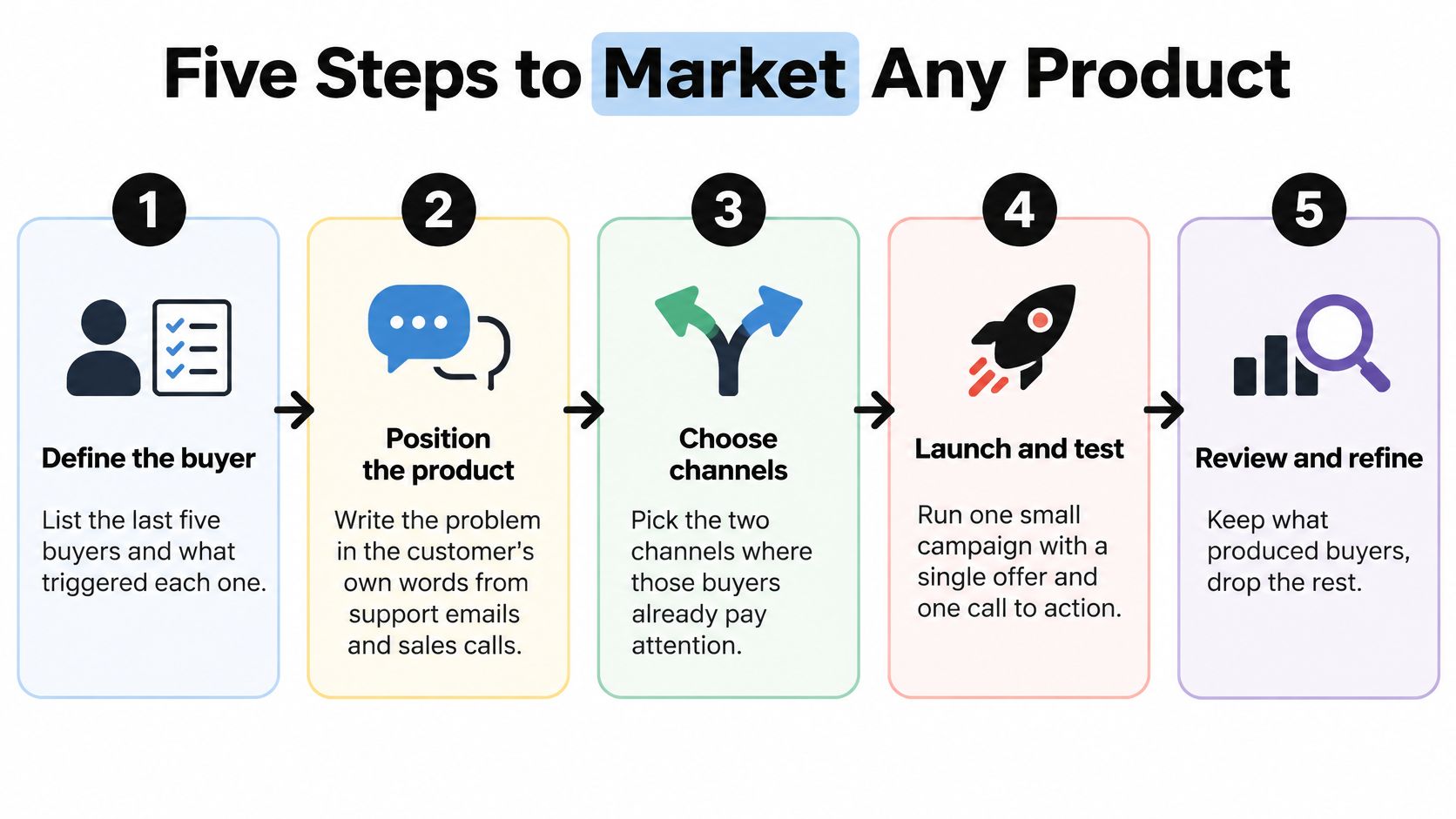
A solo maker can usually complete the first three stages in about a week because there's no internal debate over wording or audience. A small team often needs closer to two weeks to align product, sales, and marketing around one target segment and one message.
| Step | Question It Answers | Output You Should Have | Typical Time |
|---|---|---|---|
| 1. Define the buyer | Who has this problem right now? | One named segment with a buyer question | 1 to 2 days |
| 2. Position the product | Why choose this over the alternatives? | One-sentence positioning and a proof list | 1 to 3 days |
| 3. Choose channels | Where do buyers already research? | Two or three channels with a test plan | 2 to 4 days |
| 4. Launch and test | Does the message work in the market? | Live campaign with tracked sign-ups | 4 weeks per channel |
| 5. Measure and adjust | Which activity creates real growth? | Activation rate and cost per activated account | Ongoing, reviewed monthly |
If you're starting from scratch today, skip the logo tweaks and ad accounts. Open a blank document and write one plain sentence naming the exact buyer and the problem keeping them stuck right now, because every landing page, post, and experiment ahead depends on it.
Find the Buyer Before You Pick a Channel
Guessing who might like your product produces polite compliments and empty funnels. Start with real evidence from the people who have already shown intent, even if that list is tiny.
Here's a quick look at how customer research begins right inside your existing inbox and notes.

Work through these five steps before you touch a single ad platform or content calendar:
- Audit your last five buyers or near-buyers. Write down each person's job title and the exact event that pushed them to look for a solution. Past triggers tell you far more about future demand than demographic guesses ever will.
- Copy the problem in their own words. Pull verbatim phrases from support tickets, sales calls, G2 reviews, and Reddit threads so your future copy mirrors how prospects think. Using their vocabulary prevents you from writing vague tech jargon nobody searches for.
- Group the list by role or trigger. Split contacts into clear buckets, such as founders preparing for a product release, marketers who need qualified leads, or operations managers stuck reconciling manual spreadsheets. Each group evaluates software against a different benchmark.
- Commit to one primary segment for 90 days. Park the other buckets in a backlog so your messaging stays sharp instead of trying to please three audiences at once. If you want a structured breakdown of this selection process, our guide on finding your target audience walks through narrowing broad markets into reachable groups.
- Write one specific buyer question per segment. Frame it around their immediate deadline, like whether your tool can replace a messy client tracker before Friday's billing cycle. That question becomes the spine of your landing page and outreach.
Saying your product is for "anyone who wants better productivity" isn't a segment. Run a simple size check instead: you should be able to locate around 100 matching people right now inside a Slack community, a niche forum, or a specialized directory. For example, if you sell bid-compliance software to federal contractors, scanning a government RFP database lets you inspect real solicitation language and see the exact requirements triggering buyers to search for tools.
Consider how narrowing changes everything. Say a solo developer builds a time-tracking app and focuses exclusively on freelance designers who currently invoice inside shared Google Docs. Instead of competing with enterprise project suites on generic keywords, every headline, onboarding email, and template speaks directly to unbilled revision hours and late invoices.
Build a One-Page Buyer Card
Before moving to positioning, capture your research on a single page you can reference every time you draft copy:
- Role and budget owner: Who feels the daily friction, and who approves the credit card charge?
- Buying trigger: What calendar event, error, or growth milestone forces them to look today?
- Research hangouts: Which two or three forums, newsletters, review sites, or communities do they check first?
- Exact phrases: List five verbatim sentences they use to describe the annoyance and the desired outcome.
This walkthrough demonstrates how practical buyer interviews uncover the motivations behind a purchase decision.
Position the Product in One Sentence
"An all-in-one AI workspace that streamlines workflows for modern teams." You've read a hundred headlines like that, and you probably can't remember a single company attached to them. Generic positioning forces prospects to do mental math to figure out why they should care, and busy buyers close the tab.
Rebuild that sentence using a strict formula: For [segment] who [problem trigger], [product] is a [category] that [outcome], unlike [alternative they use today].
Compare the vague headline above with this focused version: "For freelance consultants who lose track of unpaid client hours, LedgerBit is a lightweight invoice tracker that logs billable work and sends payment reminders automatically, unlike manual spreadsheets." Notice which piece does the heaviest lifting. Naming the current alternative (a spreadsheet, a legacy competitor, or a slow manual habit) instantly anchors your value in something the buyer already dislikes.
Back the Sentence With a Proof Stack
A sharp claim earns attention, but only verifiable evidence earns sign-ups. According to Nielsen's 2015 Global Trust in Advertising study, 83% of respondents across 60 countries trusted recommendations from friends and family, while 66% trusted consumer opinions posted online. Unsupported hype from a brand they've never heard of sits far lower on their trust ladder.
Stack four pieces of concrete proof directly underneath your positioning statement, and mirror them on review sites, forums, and comparison pages where buyers check you out:
- One named customer: A real person with a verifiable role or company, never "Sarah M., Marketing Manager."
- One measurable result: A specific before-and-after outcome tied to time saved, errors cut, or revenue recovered.
- One real interface screenshot: Show the actual workflow in action rather than abstract vector illustrations.
- One independent mention: A third-party review, podcast appearance, or community thread confirming your claim outside your own domain.
Skip any claim you can't substantiate with a link, a screenshot, or a named user. If you need help sharpening the core benefit before you assemble proof, check our walkthrough on writing a clear value proposition.
The repeat-back test: Write three versions of your positioning sentence, show them to five people in your target segment, and ask each person to explain what your product does in their own words. If they hesitate or miss the core outcome, rewrite it until they nail it on the first read.
Choose Channels Where Buyers Already Look
Most founders pick channels based on what they enjoy creating rather than where their segment researches solutions. Flip that habit: list the places your buyer card says prospects go when they're comparing alternatives, then pick two or three channels to test side by side.
Paid placements deserve extra caution early on. Global digital advertising spending is forecast to reach $678.7 billion in 2025, accounting for 68.4% of total advertising spending according to dentsu's June 2025 ad spend forecast. When you buy clicks in a market that crowded, you're bidding against funded incumbents with optimized funnels, so keep any paid search or social experiment small until your message is proven.
Lower-cost channels often reach buyers closer to a decision with far less competition. Here's how the six primary acquisition options stack up for a new product.
| Channel | Best For | Cost Pattern | First Metric to Track |
|---|---|---|---|
| Founder communities and forums | Early feedback and first users | Time, little cash | Replies that turn into trial sign-ups |
| Product directories and launch platforms | Discovery at launch time | Listing fee or free queue | Sign-ups per listing visit |
| Search content and comparison pages | Buyers researching alternatives | Writing time, slow to compound | Organic visits to comparison pages |
| Customer referrals and reviews | Trust at the decision stage | Time to ask, possible incentives | Referral-source activation rate |
| Paid search or social ads | Fast tests of a message | Daily spend per click | Cost per activated account |
| Email to an opted-in list | Nurturing trial users | Low, list building takes time | Activation after the email sequence |
A launch directory works best as one structured channel inside this mix rather than your entire growth plan. Makers submit their product through the Submit Product option on the SubmitMySaas site to get launch-time discovery and a permanent product page that stays searchable long after release day. Treat that listing with the same rigor you'd apply to an ad campaign: use the exact same positioning sentence, tag every outbound link with campaign parameters, and measure activated users rather than raw page views.
Stick to a Four-Week Testing Rule
Channel hopping kills more small products than bad software does. Run each chosen channel for four full weeks using the same core message, and define your minimum activation threshold before day one.
Say a bootstrapped scheduling app runs a launch-day push alongside a focused comparison page targeting its biggest competitor. Four weeks later, the comparison page delivers twice as many paying trials as launch day did, giving the founder clear evidence to spend the next quarter building bottom-of-funnel search pages. Keep the channels that beat your threshold, cut the underperformers, and never add a fourth channel until your first two are cleanly measured.
Earn Citations in AI Answers and Recommendations
Search behavior is no longer just ten blue links. According to the HubSpot Marketing Industry Trends Report, 50% of consumers use AI-powered search, 50% of Google searches include an AI overview, and 40.6% of marketers say they're updating their SEO to adapt. If a buyer asks ChatGPT, Perplexity, or Google AI Overviews for tools in your category, your product needs to be easy to quote and easy to verify.
AI systems rely on clear, consistent facts they can corroborate across multiple domains. Don't hide your core product details inside clever taglines, images, or gated PDFs. Publish plain-text pages that both crawlers and skeptical humans can parse in seconds:
- Explicit product specs: State what the product does, who it's built for, supported integrations, current pricing tiers, and honest limitations.
- Fair comparison pages: Compare your tool against named alternatives accurately, noting where a competitor is the better fit.
- Public documentation and changelogs: Keep help articles and release updates crawlable so answer engines reflect what your product does today, not two years ago.
- Matching third-party references: Ensure your descriptions on directories, review platforms, and editorial features align with your homepage facts. Building those durable external signals is closely tied to SaaS link building, where independent mentions reinforce both rankings and entity credibility.
Solve the AI Trust Penalty With Human Proof
Showing up inside an AI summary is only half the job, because buyers don't blindly accept what a chatbot recommends. In Capgemini's consumer research brief on generative AI, 64% of respondents were open to purchasing products recommended by AI, yet only 58% trusted content written by generative AI (down from 72% two years earlier). Even more telling, 58% of consumers cross-check AI-generated recommendations, 49% said AI-generated imagery reduces brand trust, and 53% worried that AI shopping tools may be pay-to-play.
That skepticism hands small teams a real edge over bloated content farms. Use AI to organize outlines or summarize interview transcripts, never to fabricate product claims or generic blog posts. Put a real author's name on technical guides, explain how customer quotes were collected, and use authentic product screenshots instead of synthetic AI visuals.
Before you call your product ready for AI discovery, check off this baseline: five verified product facts stated in plain text on your site, two honest comparison pages, three checkable third-party references, and one named customer outcome for your primary segment.
Measure Growth With Experiments, Not Clicks
Dashboards love to take credit for users who were going to sign up anyway. Across the industry, measurement discipline is still surprisingly rare: in Nielsen's 2025 Annual Marketing Report surveying 1,400 marketing professionals, only 32% of marketers globally said they measure media spending across digital and traditional channels together.
Start by defining five exact funnel events once and never changing the goalposts mid-quarter: visit, signup, activation, paid conversion, and retained use. Tag every link across directories, newsletters, communities, and ads with consistent UTM parameters so every channel feeds into the same yardstick. Once your links are live, verify that your tracking fires cleanly so you can see campaign visits in Analytics before spending real money.
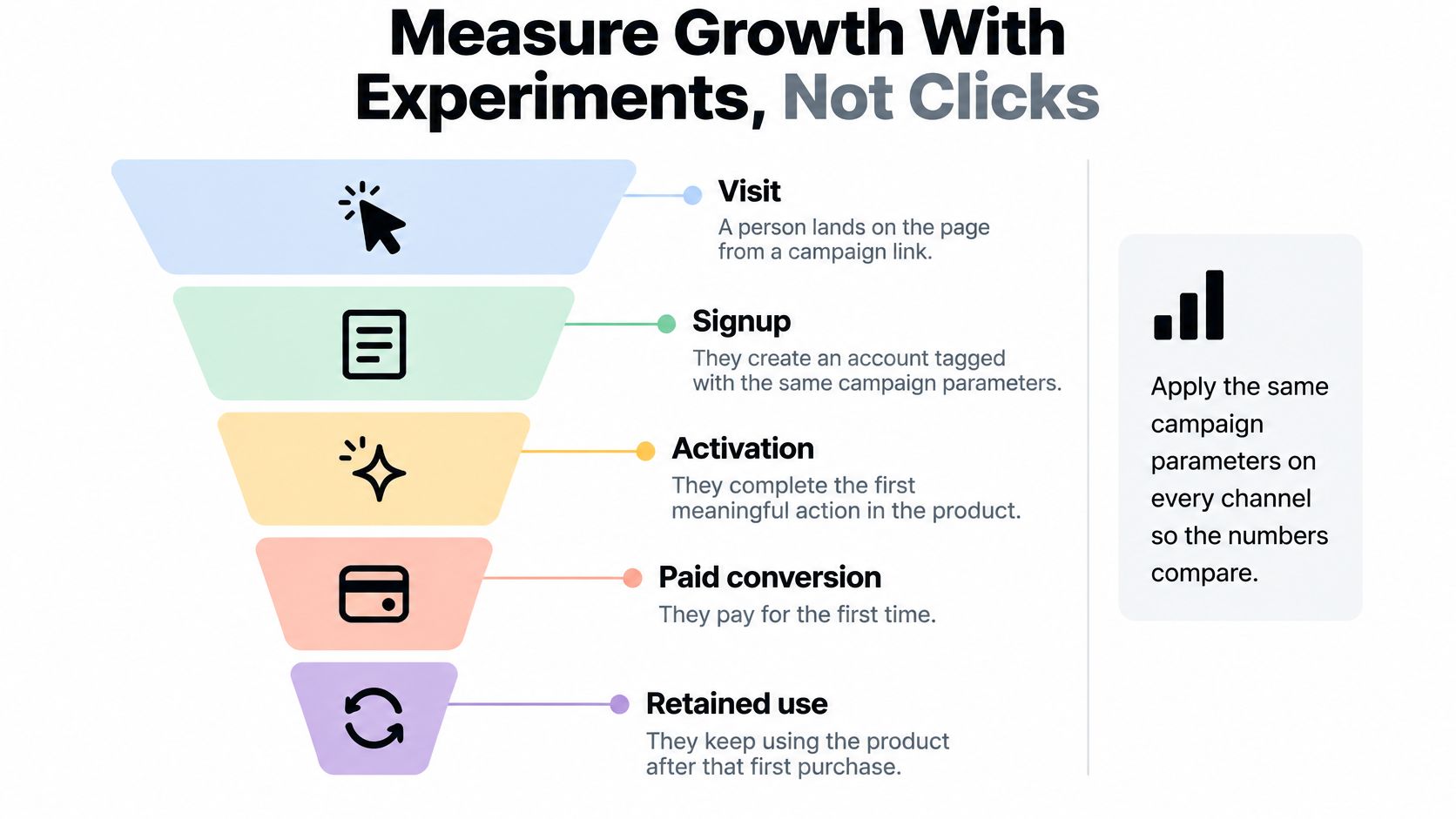
Once your funnel is instrumented, separate two ideas that marketers routinely confuse. As Google Analytics measurement guidance explains, attribution assigns credit to touchpoints associated with a conversion, while incrementality isolates the conversions causally driven by marketing that wouldn't have happened otherwise. Google recommends pairing incrementality testing with attribution and marketing-mix modeling instead of trusting any single report on its own.
Run a Simple Holdout Test
You don't need a data science team to check whether a channel creates new demand or merely harvests existing interest. Follow five steps:
- Set a matched control group. Pick a comparable region, email cohort, or audience slice that won't see the campaign.
- Predefine one primary outcome. Choose either incremental activated users or incremental paid revenue, never raw clicks.
- Hold the audience steady. Run the full test window without tweaking targeting or stopping early because week one looks exciting.
- Record full test health. Track confidence intervals, exposure compliance (whether the test group saw the campaign), and payback period.
- Check retention before shifting budget. Confirm the newly activated cohort sticks around before you double spend.
Use these five metrics to diagnose channel health every month.
| Metric | How to Calculate It | Warning Sign |
|---|---|---|
| Activation rate | Activated users divided by signups | Signups rise while activation stays flat |
| Cost per activated account | Channel spend divided by activated accounts | Cheap signups that never activate |
| Qualified pipeline rate | Qualified leads divided by channel visits | Traffic with no demos or trials |
| 30-day retention | Users active at day 30 divided by activated users | Activation spike followed by drop-off |
| Incremental activated users | Test group minus holdout group | Attributed credit with no measured lift |
Say a B2B team runs branded search ads that show impressive attributed sign-ups in the ad platform. When they pause those ads in half their target regions for a month, total activated sign-ups barely budge because buyers just click the organic listing instead. Watch out for the classic measurement traps: stopping tests early, changing audiences mid-run, double-counting the same buyer across laptop and mobile, and assuming high attributed credit equals real lift. Scale only what the holdout proves.
Fix the Mistakes That Stall Most Launches
Which buyer question is your launch failing to answer, and which claim can a stranger check?
Founders often blame the algorithm or assume they need far more traffic. Extra visitors only burn budget faster when the sentence is generic, the first session never shows a result, or the proof cannot be verified.
Match the symptom in your analytics to one cause, then change that one thing.
| Symptom | Likely Cause | Fix |
|---|---|---|
| Traffic arrives, no sign-ups | Generic positioning sentence | Rewrite around one segment and one problem |
| Sign-ups stay high, few activate | Onboarding does not show the outcome | Shorten the path to the first useful result |
| Sign-ups come from one channel only | Message fits only that community | Test the same proof in a second channel |
| Good reviews, no referrals | Asking too vaguely | Ask activated users for one specific outcome |
| Spend rises, cost per activated account rises | Targeting a broad audience | Narrow to your primary buyer segment |
| Results look strong, no growth | Attributed credit without lift | Run a holdout test before scaling |
Three habits also stall early launches:
- Interchangeable launch copy: If you can drop a competitor's name into the announcement and every sentence still works, buyers have nothing specific to quote or compare.
- Unverifiable testimonials: "Great tool, love the team!" gives a reviewer nothing to check. A named buyer citing a real time or cost reduction does.
- Unsolicited email blasts: Scraped lists and generic pitches damage domain reputation and trust. In Nielsen's 2021 Trust in Advertising study, recommendations from people respondents know ranked as the most trusted format at 88% globally (and 89% in the U.S.).
I would ship the single most common symptom first, and I would leave paid spend alone unless it is already draining the account. Keep the revised message fixed, then compare that same metric with the prior window of equal length. A busy launch only counts when new users stay and can point to a result someone else can verify.
Launch a 30-Day Test This Week
Planning forever feels productive, yet real buyer feedback only starts once your positioning meets the market. Use the next 30 days to run one clean, disciplined experiment:
- Pick one segment and one channel. Pull your highest-intent buyer group and match them to a single channel where they already look for tools.
- Lock in your positioning and three proof items. Finalize your one-sentence pitch alongside one named customer, one measurable result, and one independent mention.
- Configure tracking before launch. Define your activation event, set your holdout group or baseline, and confirm your primary metric before the first post goes live.
- Run the test untouched for 30 days. Keep the audience and core message fixed so you learn what worked.
- Make a binary decision on day 30. Compare incremental activated users against your cost per activated account, then keep, cut, or expand the channel based on the numbers.
If you choose a product directory as your test channel, treat the listing with the same tracking discipline as any paid or organic campaign. On SubmitMySaas, our Free Launch plan includes a standard launch queue, a featured spot on the homepage, and a website link on the product page, while advertising a product on our platform costs $79 per product for a month. Tag the destination URL, watch how listing visitors activate inside your product, and judge the listing on real user outcomes.
Keep the goal of month one in perspective. Your first 30 days won't prove whether your company is a runaway hit, and they don't need to. They tell you whether your message holds up with real buyers so your next quarter compounds instead of guessing.
Find the buyer, prove the claim, test the channel, and trust the measured result.
When you're ready to put a focused positioning statement and real product proof in front of early adopters, founders, and tech buyers, we built SubmitMySaas for exactly that first measured launch test. You can publish your product page, join our daily launch feed, and earn a durable, searchable listing that supports both direct discovery and third-party credibility. Visit SubmitMySaas to submit your product and start tracking real sign-ups this week.