How to Find Your Target Audience A Guide for SaaS Founders
Discover how to find your target audience with this guide for SaaS founders. Learn practical research methods, persona building, and validation techniques.
Before you can find your audience, you have to know who you’re looking for. It all starts with a single, high-value problem your SaaS solves. From there, your job is to figure out which group of people feels that pain most intensely.
This isn't about guesswork; it's about forming an initial, educated hypothesis about your ideal customer. This is your starting line—a theory you'll test and refine with real research. Resist the temptation to go broad. The key is to start with a narrow, well-defined niche to build a solid foundation.
Laying The Groundwork For Audience Discovery

The classic mistake I see founders make is thinking, "My product is for everyone." While the dream of a massive user base is appealing, this scattered approach just leads to muddled messaging and a burned marketing budget. You can't hit a target you haven't defined.
This early stage isn't about finding concrete answers. It’s about building a sharp, testable hypothesis you can take into the field.
From Vague Problems to Sharp Hypotheses
Let’s get specific. Saying your tool "improves productivity" is far too vague. Does it help freelance designers wrangle client feedback? Or does it help remote sales teams log their calls in half the time? Each of these is a distinct problem felt by a very different group of people. This kind of focus is the bedrock of a strong SaaS go-to-market strategy.
Before you dive deep into customer interviews or surveys, you need to create your first draft of an Ideal Customer Profile (ICP). Think of it as a living document, not a stone tablet. It’s your best guess right now, and you’ll update it as you learn more.
An ICP is your compass, not a map. It gives you a direction to start walking, but you should expect the terrain to change as you gather real-world intelligence.
To really nail this, you need a process. Learning how to identify a target audience isn't just about demographics; it’s about a deliberate cycle of discovery, validation, and iteration that starts with your core business goals. This is how you move from assumptions to evidence.
To help you get started, use a simple framework to organize your thoughts before you start digging in. It’s a great way to put your initial ideas on paper.
Initial Audience Hypothesis Framework
| Hypothesis Component | Guiding Question | Example (For a Productivity App) |
|---|---|---|
| Industry/Vertical | Which specific industry feels this pain most acutely? | Tech startups, specifically those in the B2B SaaS space. |
| Company Size | Are we targeting solo founders, small teams, or enterprises? | Small to mid-sized teams (10-50 employees). |
| Job Role | Who is the end-user? Who is the decision-maker? | User: Product Managers. Buyer: Head of Product. |
| Core Pain Point | What is the exact problem they face daily? | "We waste hours manually updating roadmaps and chasing status updates from engineering for our weekly stakeholder meetings." |
This framework isn't the final answer, but it gives you a much clearer starting point for your research. Now you know who to talk to and what to ask them.
Actionable First Steps for Founders
Before you spend a dime on ads or an hour on outreach, just listen. See who's already out there looking for a solution like yours.
- Analyze Launch Platforms: Spend some time on sites like SubmitMySaas. Look at the AI and productivity tools getting traction. Read the comments. Who are these early adopters? What features are they genuinely excited about?
- Define The Core Pain Point: Get brutally honest. Write down the single biggest frustration your SaaS eliminates. Is it saving 5 hours a week on a tedious task? Or is it preventing costly errors in data entry?
- Brainstorm Who Feels This Pain: Now, who really suffers from this problem? A solo developer's daily frustrations look nothing like those of a project manager at a Fortune 500 company. List out 3-5 potential user groups that immediately jump to mind.
This initial work sets the stage for everything else. The data backs this up: SaaS companies that effectively segment their audience see organic traffic increase by an average of 17.3%, far outpacing the 11.5% for those with a broad approach.
With the SaaS market expected to hit $1,482.44 billion by 2034, carving out your specific niche isn't just a good idea—it's essential for survival and growth. This initial focus is your first, most important step toward building something people will actually pay for.
Getting to the "Why" with Qualitative Research

Numbers tell you what's happening, but they never tell you why. That's where you have to roll up your sleeves and talk to real people. Qualitative research is all about uncovering the human stories, the deep-seated frustrations, and the real motivations behind the data.
This is how you get from a vague idea to truly understanding your customer's world.
Your mission here isn't to get someone to say they like your feature idea. It's to validate the problem itself. You need to become an expert on their pain long before you ever whisper a word about your solution. It's a simple distinction, but it’s what separates founders who build something people need from those who build something for an audience of one.
The Art of the Customer Interview
Nothing beats a direct conversation for speed of learning. You'd be amazed what you can uncover from just 5 to 10 well-run, 30-minute chats. The patterns start showing up surprisingly fast.
The trick is to treat these like discovery sessions, not sales pitches. Start by tapping your own network. A simple, honest message on LinkedIn or a cold email often works wonders. Explain you're doing research on a specific problem and you value their expertise. People are usually happy to help when you respect their time and show genuine curiosity.
Once you’re on the call, your main job is to listen. Seriously.
- Ask about the past. Don't ask hypotheticals like, "Would you use a tool that did X?" Humans are terrible at predicting their own behavior. Instead, get them to tell a story: "Tell me about the last time you had to chase down a project update. What actually happened?"
- Use open-ended prompts. Avoid simple yes/no questions. Instead of, "Is updating your roadmap a pain?" try, "Can you walk me through your process for updating the roadmap last week?" Then just stay quiet and let them talk.
- Hunt for workarounds. This is a big one. Ask what they're doing right now to solve this problem. Is it a nightmarish spreadsheet? A frankenstein's monster of three different apps? Or are they just gritting their teeth and dealing with it? This tells you how much the problem really hurts. Understanding their search intent also gives you clues about the solutions they're already looking for.
The gold is in hearing someone describe a problem in their own words. You're collecting stories, vocabulary, and emotion—not just data points.
Becoming a Digital Anthropologist
What if you don't have anyone to interview just yet? No problem. Go where your audience already hangs out and just listen. Think of it as being a "fly on the wall" in their digital world, giving you completely unfiltered access to their daily conversations.
You're looking for their digital watering holes. Where does your ideal customer spend their time online?
- Reddit: Subreddits like r/sysadmin, r/freelance, or r/productmanagement are absolute goldmines. Search for keywords related to your problem and look for post titles like, "How do you all handle...?" or "I'm so fed up with..."
- LinkedIn Groups: Find and join groups for the specific industry or role you're targeting. Watch for the questions people ask and the complaints that bubble up over and over again.
- Slack & Discord Communities: Niche professional communities are incredible. You'll find candid discussions about the tools they love, the workflows that are broken, and the clever hacks they've created just to get through the day.
When you immerse yourself in these places, you start absorbing the exact language they use to talk about their pain. That vocabulary is what you’ll use to write landing page copy and product messaging that actually connects.
The entire point is to build something that feels like it was designed specifically for them—a step that becomes much clearer once you learn https://submitmysaas.com/blog/how-to-build-an-mvp based on this kind of deep empathy. Keep a running log of everything you find. Every quote, every complaint, every makeshift solution. This raw material is the true foundation for a product people will line up to use.
Building Actionable Customer Personas
All those qualitative insights you’ve gathered are pure gold. But sitting in a spreadsheet, they’re useless. Now comes the fun part: weaving those stories, quotes, and frustrations into something your whole team can actually use. This is where we build customer personas, but not the kind that get created once and then collect digital dust in a forgotten folder.
We're focused on building actionable personas—living, breathing documents that should actively guide everything from your product roadmap to your marketing copy and sales outreach. These aren't just demographic checklists; they are rich archetypes of your ideal users.
The idea is to transform that raw, messy feedback into a clear user archetype, which then fuels every decisive action you take.
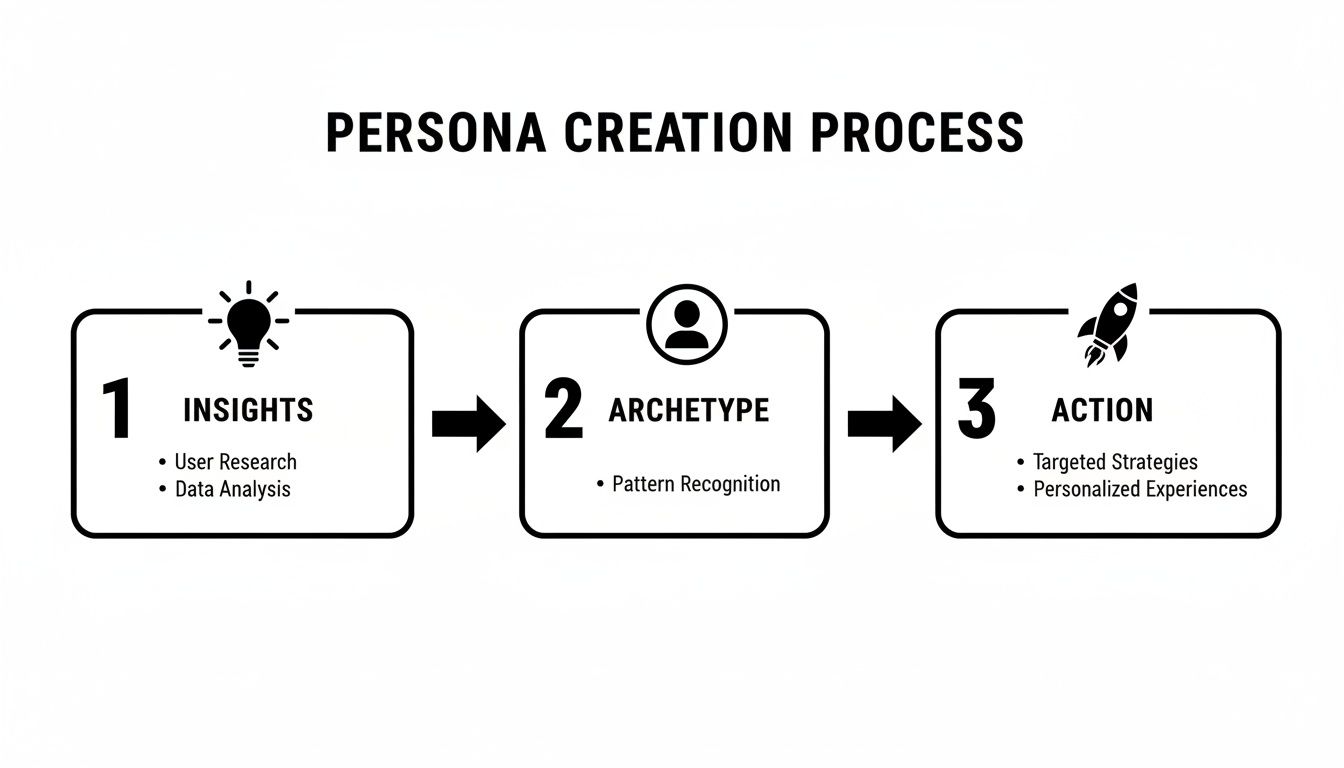
This simple flow shows how unstructured feedback can evolve into a powerful strategic tool that directly impacts your growth.
My advice? Forget creating five or six vague personas. Instead, laser-focus on just one to three that are incredibly detailed. A single, well-defined persona is far more potent than a handful of generic ones. If you try to build for everyone, you inevitably end up building for no one.
Go Beyond Demographics To Find True Motivation
The classic mistake is stuffing a persona with superficial details like age, location, and education level. While that can add a bit of color, it tells you nothing about why someone would actually open their wallet for your product. The most effective personas are built on a bedrock of psychographics and real behavioral drivers.
To get to that deeper level, dig through your research and synthesize the answers to these core questions:
- Goals: What is this person desperately trying to achieve in their role? What does a "win" look like for them?
- Frustrations: What are the specific, recurring roadblocks that drive them crazy? What's the one task they absolutely dread?
- Buying Triggers: What event or circumstance would light a fire under them to actively search for a new solution right now?
- Watering Holes: Where do they hang out online to get information? Which blogs, communities, or influencers do they genuinely trust?
Answering these questions shifts the entire focus from "who they are" to "what they want to accomplish," which is a much more valuable perspective for any SaaS founder.
Frame Everything with the Jobs To Be Done Framework
A brilliant way to nail your persona's core motivation is the Jobs to be Done (JTBD) framework. The core concept, pioneered by Clayton Christensen, is simple: customers don't "buy" products; they "hire" them to do a specific job.
Think about it. Someone doesn't buy a project management tool because they're passionate about Gantt charts. They "hire" it to get the job of "providing clear project visibility to anxious stakeholders" done. It’s a subtle reframing, but it’s a game-changer.
When building your persona, define the primary "job" they would hire your SaaS for. This job becomes your North Star for feature prioritization and marketing messages. It ensures you're always solving the real, underlying problem.
By focusing on the job, you create a persona that is fundamentally tied to the value your product delivers. It helps you write copy that speaks directly to their desired outcome, not just a bland list of features.
Assembling Your First Persona
Alright, let's put it all together. Take out your research notes and start grouping patterns. Look for recurring phrases, shared frustrations, and common goals. From these clusters, an archetype will start to take shape.
Give this persona a name and a face (a stock photo works perfectly). This simple step makes them feel more like a real person your team can rally around and build for.
Let's imagine we're building a persona for a SaaS tool that automates client reporting for marketing agencies.
Example Persona Snippet: "Agency Allie"
- Role: Account Manager at a small digital marketing agency (10-20 employees).
- Core Goal: Keep her 5-7 high-value clients happy and prove the agency's ROI so they keep renewing their contracts.
- Main Frustration: Spends 8-10 hours every single month manually pulling data from Google Analytics, various social media platforms, and ad accounts into a clunky spreadsheet for client reports. She hates how this tedious, error-prone task eats into her time for actual strategic work.
- Job To Be Done: "Help me create professional, data-rich client reports in minutes, not hours, so I can spend more time on strategy and really impress my clients."
- Buying Trigger: Just lost a major client who complained about inconsistent and delayed reporting.
- Watering Holes: Reads The Moz Blog, listens to the "Social Media Marketing Podcast," and is active in a private Slack community for agency professionals.
See how actionable that is? You know Allie's precise pain point (mind-numbing reporting), the job she needs done, and exactly where to find her online. This clarity helps you prioritize a "one-click report generation" feature and dream up a blog post titled "How to Create Client Reports That Don't Steal Your Weekend." This is how a great persona moves from a theoretical exercise to a direct line to revenue.
Validating Your Audience With Data
Okay, so your customer personas feel real. They're built on solid conversations and you have a gut feeling you're on the right track. That's a great start, but a gut feeling won't pay the bills.
Now we need to prove your ideal customer actually exists in large enough numbers to build a real business around. This is where we stop guessing and start measuring. It’s time to shift from the qualitative why to the quantitative how many.
Think of this step as a cheap insurance policy. By pressure-testing your assumptions with real data before you write a single line of code, you can avoid the soul-crushing experience of building something nobody is willing to pay for.
Low-Cost Ad Campaigns as Validation Tools
One of the fastest ways to get a reality check is to run a few small, highly-targeted ad campaigns. You don't need a huge budget. Platforms like LinkedIn, X (formerly Twitter), or even Facebook are perfect for this kind of reconnaissance.
The goal here isn't to get sign-ups; it's to gather data. You're testing whether your message resonates enough to make someone stop scrolling and click.
Let's say you're building a SaaS for product managers. You could spin up a LinkedIn campaign with just $150. Target users specifically by their job title ("Product Manager"), industry ("Computer Software"), and maybe even company size ("11-50 employees").
Your ad doesn't need to go to a polished, finished product. A simple landing page is all you need. It should have three things:
- A killer value proposition: "Stop wasting hours updating roadmaps. Get stakeholder buy-in faster."
- A quick visual: A mockup or a simple demo video is perfect for showing, not just telling.
- One clear call-to-action: Something like "Join the private beta" or "Get notified on launch day."
Watch your click-through rate (CTR) and conversion rate (how many people actually enter their email). A low CTR probably means your headline or ad copy is missing the mark. A high CTR but almost no email sign-ups? That’s a red flag that your landing page isn't delivering on the promise you made in the ad.
Using Surveys to Validate Pain Points
Surveys can be incredibly powerful, but they have a fatal flaw: it's way too easy to ask leading questions. If you're not careful, you'll just end up confirming your own biases instead of discovering the truth.
The trick is to focus your survey entirely on validating the problem, not pitching your solution. Don't ask, "Would you use a tool that automates client reporting?" That’s a useless question. Instead, ask about their current reality.
Your survey's job is to measure the size and intensity of the pain. If the pain isn't significant, the demand for a painkiller will be weak.
Here are a few questions that actually get you useful data:
- On a scale of 1-5, how frustrating is creating monthly client reports?
- About how many hours did you spend on this task last month?
- Which of the following, if any, have you used to manage reporting in the past year? (List competitors, but also include "Manual spreadsheets" and "None").
These questions give you hard numbers on the pain's severity (frustration score), its cost (hours wasted), and what (if anything) people are already doing about it. A high frustration score paired with a lot of time spent is a giant green light that you've found a problem worth solving.
Sizing the Market with Keyword Research
Finally, let's see if people are actually out there searching for a solution to the problem you solve. This is where keyword research tools like Ahrefs or Semrush come in handy. They give you a direct line into the collective consciousness of your market.
Don't just search for your product's name—nobody knows it yet. Put yourself in your persona's shoes. When "Agency Allie" is pulling her hair out over another late-night reporting session, what is she typing into Google?
She’s probably not searching for your brand. She’s searching for her problem:
- "client reporting template"
- "how to automate marketing reports"
- "best client dashboard software"
The search volume for these "problem-aware" keywords is your signal. If you find thousands of searches per month for terms like these, you have concrete evidence of an existing, active market. But if the volume is near zero? That’s a tough sign. It means you’ll have to spend a ton of time and money just convincing people they have a problem in the first place—a much harder and more expensive mountain to climb.
Audience Validation Methods Comparison
Each validation technique offers a different piece of the puzzle. An ad campaign tests your messaging, a survey quantifies the pain, and keyword research gauges existing demand. Here's a quick look at how they stack up against each other.
| Validation Method | Typical Cost | Time to Insight | Best For Validating |
|---|---|---|---|
| Targeted Ad Campaign | $100 - $500 | 1-2 weeks | Messaging resonance & initial interest. |
| Customer Survey | $50 - $300 | 1-3 weeks | The severity and frequency of the pain point. |
| Keyword Research | $0 - $150 | 1-2 days | Existing search demand for a solution. |
| Landing Page Test | $50 - $200 | 1-2 weeks | The appeal of your core value proposition. |
Ultimately, using a mix of these methods gives you the most complete picture. The data you gather here will either give you the confidence to move forward or the critical insight to pivot before you've wasted precious resources.
Finding and Engaging Your Audience

Okay, so you’ve identified your audience. That’s a huge milestone, but it’s really only half the battle. A perfect persona is totally useless if you don't know where those people actually live online. Now, we’re going to connect your research to the real world by meeting your audience where they already are.
This isn’t about just blasting your message everywhere and hoping something sticks. We're talking about surgical precision—finding the exact digital "watering holes" where your ideal customers hang out, ask questions, and complain about the very problems you solve.
Identify Your Audience's Digital Watering Holes
The persona research you just did should give you a fantastic head start. Remember that "Watering Holes" section in your persona document? It’s time to put it to work. Your mission is to find the specific subreddits, LinkedIn groups, Slack communities, and niche forums where your users gather.
For example, if you're building a tool for freelance video editors, your prime spots are probably places like r/videography, specific Discord servers for Adobe Premiere pros, or maybe a few LinkedIn groups focused on post-production. Don't just join these places—lurk. Seriously. Absorb the culture, the inside jokes, and the recurring problems that pop up in every other thread.
The key is to listen way more than you talk. You’re looking for patterns in their language and the products they already trust. This is pure gold; it’s what helps you craft a message that feels like it belongs in the community, not like a spammy ad dropped from another planet.
Engaging Authentically (Without Being That Guy)
Once you’ve found these communities, the temptation to jump in and start pitching your SaaS is immense. Resist it. The absolute fastest way to get banned and torpedo your reputation is to lead with a sales pitch.
Your only goal at the beginning is to add value and build a bit of social capital. Think like a helpful expert, not a desperate founder.
- Answer Questions: Find threads where people are struggling with the exact problem your SaaS solves. Offer genuine advice and share your expertise. Don't even mention your product at first.
- Share Cool Stuff: Found an amazing article or a useful tutorial that could help them? Share it. Become known as the person who posts genuinely helpful content.
- Ask for Feedback (The Right Way): When the time feels right, you can introduce your project, but frame it as a request for help. Something like, "Hey everyone, I've been tinkering with a tool to help with [specific problem]. Would anyone be open to giving me some brutally honest feedback on the concept?"
This approach completely changes the dynamic. You're not selling; you're co-creating with the community, and people are far more receptive to that.
"Trying to reach everyone usually means resonating with no one. The more specific your targeting, the more impactful your marketing efforts will be."
A great tactic is to find groups with designated "self-promo" days or specific channels for it. This gives you an approved space to share what you're building without breaking any rules. Knowing the landscape, including the little tricks for finding the right communities, can make a huge difference. For instance, our guide on how to search groups on Facebook offers some practical tips for this.
Choosing Your Channels For Maximum Impact
As a founder, your time and money are incredibly limited. You simply can't be everywhere at once. The goal is to pick just 1-2 channels where your ideal customer is most concentrated and pour your energy into those.
Before you commit, run each potential channel through this quick mental checklist:
- Audience Fit: Is my ideal customer highly active here? Not just "a member," but someone who posts, comments, and engages regularly.
- Engagement Style: Does the vibe of the platform match my brand? The professional tone on LinkedIn is worlds away from the casual, meme-heavy culture of Reddit.
- Scalability: If this works, is there a way to grow here? Can I eventually run ads or scale my organic efforts?
- Effort vs. Reward: Realistically, how much time will it take to get any traction here? What's the potential upside?
By going deep instead of wide, you build a meaningful presence that actually attracts your first wave of users. This focused, deliberate approach is exactly how you turn all that audience research into your first paying customers.
Common Questions About Finding Your SaaS Audience
Even with a solid playbook, finding your target audience can feel messy. It's totally normal to hit roadblocks or second-guess your approach. Let's dig into some of the most common questions that pop up for founders during this make-or-break discovery phase.
Think of these questions not as problems, but as signposts. Each one is a chance to sharpen your focus and build a much more resilient business from the ground up.
What If My Product Could Serve Multiple Audiences?
This is a great "problem" to have, but it’s also a classic startup trap. It’s so tempting to believe your new social media scheduler could work for massive enterprise marketing teams, solo creators, and small businesses all at once.
The hard reality? Chasing everyone from day one stretches your already limited resources dangerously thin.
Your messaging becomes bland and generic. Your feature roadmap gets completely muddled. Your marketing budget vanishes into thin air. A message designed to hook a Fortune 500 marketing director will sound totally alien to a freelance content creator, and vice-versa.
The solution is to pick one single segment and make it your "beachhead market."
- Who feels the pain you solve most intensely? Go after them.
- Which audience can you most easily reach through your existing network or channels? Start there.
- Focus on the group whose need for a solution is urgent right now.
For instance, if your social media tool is amazing at handling complex, multi-platform campaigns, the enterprise team is probably your best bet. They have the budget and the acute pain point. The solo creator can likely make do with a simpler, cheaper tool for now.
Conquering one niche first gives you the revenue, testimonials, and crucial product feedback you need to thoughtfully expand later. Trying to be everything to everyone at launch is the fastest way to become nothing to anyone.
How Much Should I Spend On Audience Research?
This question trips up so many first-time founders. We often picture expensive focus groups and massive, pricey survey panels. The good news is your most valuable early-stage research costs time, not a ton of money.
The goal isn't to spend a lot; it's to spend just enough to de-risk the far bigger investment of your time and energy in building the actual product.
Your initial budget should be incredibly lean. Your primary investment is the hours you put into conducting customer interviews, lurking in online communities, and analyzing your competitors. These qualitative insights are worth their weight in gold, and they're practically free.
When you’re ready for some quantitative validation, you can get powerful signals with a surprisingly small budget.
- A $100-$200 targeted ad campaign on LinkedIn can quickly tell you if your value prop makes C-level execs in the finance industry actually click.
- A $50 boosted post on X (formerly Twitter) can reveal if your messaging resonates with the indie developer community.
Remember, these small-scale tests aren't about acquiring customers. They are about acquiring data. A low click-through rate tells you your message is off. A high click-through rate but zero beta sign-ups tells you the landing page isn't delivering on the ad's promise. This is critical feedback you can get for less than the cost of a fancy dinner.
My Initial Audience Hypothesis Was Wrong. What Do I Do Now?
First off, congratulations. I'm serious. Discovering your initial assumption was wrong is a massive win for your research process. It's infinitely better to learn this now than after burning a year and thousands of dollars building a product for an audience that doesn't exist or just doesn't care.
This isn't failure; it's a successful pivot point. This moment is precisely why you do the research in the first place. Now, it's time to go back to your notes with fresh eyes.
- Re-examine Your Interview Notes: Were there other user groups or pain points that came up in your conversations that you initially dismissed? Maybe you were so fixated on "project managers" that you didn't notice how excited "event planners" got when you described a certain feature.
- Listen to Their Language: Did your target audience describe their problem differently than you did? Often, the right audience reveals itself when you spot a mismatch between your solution's language and their problem's vocabulary.
- Embrace the Unexpected: The market is telling you something important. Your job is to listen and adapt, not to stubbornly force your original vision. This agility is what separates successful founders from the ones who build things nobody wants.
Update your personas based on this new evidence. Tweak your messaging to reflect the language of the audience that showed genuine interest. Then, run new, small-scale validation tests targeting this new group. Finding out you were wrong is the very first step toward getting it right.
Ready to get your SaaS in front of the right audience from day one? Join the community of founders launching on SubmitMySaas and connect with thousands of early adopters actively looking for new tools.