How to Build an MVP Your First 100 Customers Will Love
Learn how to build an MVP that gets real traction. This guide offers actionable strategies for validation, feature prioritization, and launch.
The fastest path to a successful MVP starts long before you write a single line of code. It begins with defining a very specific problem for a niche audience, turning that into a testable hypothesis, and then getting out there to see if real people actually care. This early validation is what separates the products people use from the ones that just collect digital dust.
Your First Move Before You Write Any Code
It’s tempting, I know. You’ve got a killer idea, and you can already picture the final product. The urge to jump straight into development is powerful, but it’s also the number one reason so many startups crash and burn.
The reality is, most startups don’t fail because of bad code or a lack of funding. They fail because they build something nobody needs. So, before you even think about a tech stack or UI design, your most important job is to fall in love with a problem, not your solution.
This is a crucial mindset shift. Stop thinking, "I have a great idea for an app." Instead, start thinking, "I've found a painful, recurring problem for a specific group of people." An idea is just a guess; a validated problem is a foundation you can build on.
Formulating a Sharp Hypothesis
Your starting point isn’t a feature list. It's a clear, testable hypothesis that will act as your North Star for all your initial research. It doesn't need to be complicated, but it absolutely must be specific.
A solid hypothesis has three key ingredients:
- Target Audience: Who are you building this for? "Small businesses" is way too broad. "Etsy sellers struggling with inventory management" is getting much warmer.
- The Problem: What’s their main pain point? You're looking for something they are actively aware of and are already trying to solve, even if it's with a clunky spreadsheet.
- The Proposed Value: What's the core benefit your solution will offer? This isn't a feature; it's the outcome. Think "save 10 hours per month on manual data entry."
Let's look at an example. A weak hypothesis is something like, "Businesses need better social media tools." A strong, testable one sounds more like this: "Solo freelance graphic designers struggle to consistently post portfolio work on Instagram, and a simple scheduling tool with visual templates will help them attract more clients." See the difference?
Uncovering Insights Through Customer Interviews
Once you have your hypothesis, it's time to get out of the building (or off Slack) and talk to actual humans. The goal of these first interviews is not to pitch your idea. Your job is to listen and learn. Be a journalist trying to understand their world, their workflow, and their frustrations.
Stick to open-ended questions that focus on past behavior, not future predictions. People are notoriously bad at guessing what they might do or pay for.
Here are a few questions that really get people talking:
- "Tell me about the last time you dealt with [the problem]."
- "What was the hardest part of that?"
- "What have you tried to do to solve this?" (This is gold!)
- "If you had a magic wand to fix this, what would it do?"
Key Takeaway: You're not looking for people to say, "Yes, I'd buy that!" You're hunting for evidence of deep-seated frustration. When someone shows you a complicated spreadsheet they built or walks you through a multi-step manual process they hate, you've struck gold. You've found real pain.
This upfront validation work isn't just a nice-to-have; it dramatically tilts the odds in your favor. Startups that follow a lean MVP approach have a 60% higher success rate than those who go all-in on a full product from day one. This directly combats the grim statistic that 42% of startups fail simply because they built something with no market need.
It's easy to get excited about your solution and jump the gun. Founders often blur the lines between confirming a problem exists and asking if people like their specific idea. These are two very different—and equally important—stages.
Here’s a quick guide to keeping them straight:
Problem Validation vs Solution Validation
| Focus Area | Problem Validation (Do This First) | Solution Validation (Do This Later) |
|---|---|---|
| Main Goal | Does this problem actually exist? Is it painful enough for people to want a solution? | Does my proposed solution actually solve the problem in a way people will use and pay for? |
| Key Question | "Tell me about your struggles with X." | "If you had a tool that did Y, how would that fit into your workflow?" |
| Your Role | Be a journalist. Listen, learn, and dig for pain points. | Be a collaborator. Show a prototype and gather feedback on its usability and value. |
| What to Avoid | Don't mention your idea or pitch a solution. | Don't defend your design choices. Listen to where users get stuck or confused. |
Getting this right from the start is what separates a successful launch from a frustrating one. The insights you gain in the problem validation phase are the bedrock of your entire product.
This simple flowchart breaks down how these early steps connect, moving from a hypothesis to customer feedback and finally to a value proposition that truly fits.
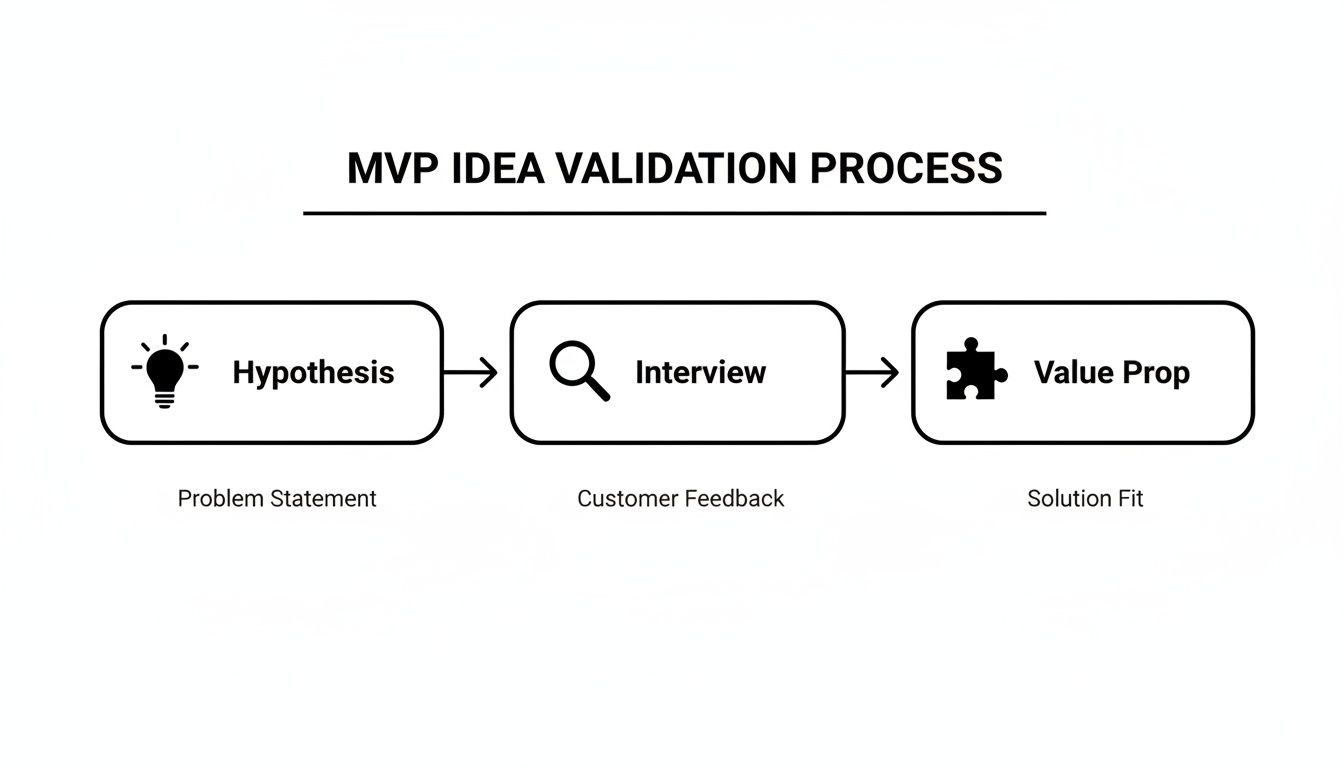
This process ensures your development is guided by real customer needs, not just your assumptions. As you plan this phase, understanding the core benefits of Agile software development can give you a great framework for staying flexible and responsive.
Once you’ve collected and synthesized all this feedback, you'll be ready to craft messaging that truly connects. For more on that, check out our guide on https://submitmysaas.com/blog/how-to-write-product-descriptions that resonate with your target audience.
How to Ruthlessly Prioritize Your MVP Features

So, you've talked to potential users and confirmed your idea isn't crazy. Great. The problem now is that you’re probably drowning in ideas. Your notebook is overflowing with feature requests, user suggestions, and a dozen "wouldn't it be cool if..." moments.
This is the first major trap where founders get stuck.
The impulse is to build a Swiss Army knife—a product that does everything for everyone. But a winning MVP isn't about the quantity of features. It's about the precision of the solution. Your most important job right now is to say "no" more often than you say "yes."
This discipline is your primary defense against feature creep, that insidious process where small additions slowly bloat your product, drain your budget, and push your launch date into oblivion. You need a system to decide what to build now, what to tackle later, and what to ignore completely.
Using Frameworks to Make Hard Decisions
Gut feelings get you started, but a structured framework gets you launched. Prioritization models are designed to take the emotion out of the equation, forcing you to stack every feature idea against a set of objective criteria.
For early-stage products, two frameworks stand out: MoSCoW and RICE.
The MoSCoW method is a beautifully simple way to sort features by necessity. It forces you to put every idea into one of four buckets:
- Must-have: These are the absolute, non-negotiable essentials. If you launch without these, the product simply doesn’t work or solve the core problem.
- Should-have: These are important and add serious value, but the product can still function without them for the initial launch. Think of them as the next logical additions.
- Could-have: These are the "nice-to-haves." They would improve the experience but offer a much lower impact than the Must-haves and Should-haves. You can safely punt these down the road.
- Won't-have (this time): This bucket is your secret weapon for scope control. It explicitly names the features you are not building, which creates crystal-clear boundaries for your team.
If you were building a basic productivity app, "creating a task" and "marking a task as complete" are obvious Must-haves. Features like "setting due dates" or "adding notes" are likely Should-haves. Things like "custom themes" or "calendar integration" are easy to classify as Could-have or Won't-have for now.
The RICE framework, on the other hand, gives you a quantitative scoring system. It’s perfect when you have several competing ideas and need a more data-informed way to compare them. You score each feature on four factors:
- Reach: How many people will this feature impact over a set period? (e.g., 500 users per month)
- Impact: How much will it help those users? (Assign a score: 3 for massive, 2 for high, 1 for medium, 0.5 for low)
- Confidence: How sure are you about your estimates? (100% for high confidence, 80% for medium, 50% for low)
- Effort: How much of your team's time will this consume? (Estimate in "person-months" or "developer-weeks")
The formula is simple: (Reach x Impact x Confidence) / Effort. The highest score wins. This process forces a real conversation about both the potential upside and the actual cost of every idea.
MoSCoW vs RICE A Practical Comparison
So which framework should you use? It really depends on your team's style and the complexity of your feature list. Here's a quick breakdown to help you decide.
| Framework | Best For | Key Benefit | Example Metric |
|---|---|---|---|
| MoSCoW | Early-stage MVPs and teams needing clear, simple categories. | Creates unambiguous buckets of priority, making it easy for everyone to understand what is non-negotiable. | A feature is either a "Must-have" or it isn't. |
| RICE | Data-driven teams with multiple competing features to evaluate. | Forces objective analysis by balancing user value against implementation cost, removing personal bias. | A calculated score like "1250" or "800". |
Ultimately, you don't have to pledge allegiance to just one. Many successful teams use MoSCoW first to get a high-level view of what's absolutely essential, then apply RICE to the "Should-have" and "Could-have" lists to prioritize their roadmap for the next few sprints.
Pro Tip: Your "Won't-have" list is just as important as your "Must-have" list. It protects your team's focus and prevents scope creep before it starts. Communicate it clearly and stick to it.
The Power of the One Thing MVP
Here's an even more focused way to think about it: build your MVP around a single, critical action.
Ask yourself this question: "What is the one thing a user must be able to do to get the core value from my product?"
This isn't about building a single button. It's about designing a complete, albeit minimal, user journey that delivers on one core promise. For Dropbox, that was syncing one file between two devices. For our task manager example, it's creating and completing a single task.
This "one thing" mindset is your best tool for achieving ruthless focus. It forces you to build an entire, end-to-end experience that is genuinely viable, not just a pile of half-baked features. By concentrating all your energy on perfecting that one core loop, you'll get to market faster and start the all-important feedback cycle long before your competitors.
Choosing the Right Tech and Tools for Speed

Let's get one thing straight: when you're building an MVP, technical debt is a problem for tomorrow. Not shipping your product is a problem for today. The tech decisions you make now should be laser-focused on a single question: What gets a working product into users' hands the fastest?
This isn't the time to architect the perfect, infinitely scalable system that will one day serve a million users. It’s about finding the "good enough for now" stack that lets you test your core idea without getting stuck in a bog of complex engineering. The name of the game is speed.
Every single hour you spend debating frameworks is an hour you’re not getting feedback from the only people who matter—your users. A rapid, iterative approach is what separates the MVPs that take off from the over-engineered projects that never see the light of day.
No-Code vs. Custom Code: A Founder's Dilemma
One of the first big forks in the road is deciding between a no-code platform and writing custom code from scratch. There isn’t a single right answer here, but there's definitely a right answer for you, and it depends entirely on your team's skills, your budget, and how quickly you need to launch.
Platforms like Bubble, Webflow, or Adalo have completely changed the game, allowing founders to build surprisingly sophisticated apps with visual, drag-and-drop interfaces.
- The upside? Blazing fast speed to launch, much lower upfront costs, and it puts the power to build directly into the hands of non-technical founders.
- The downside? You might hit scaling walls later, you'll have less flexibility for truly unique features, and you're ultimately tied to the platform's ecosystem.
On the flip side, custom code gives you complete freedom. Classic frameworks like Ruby on Rails are famous for developer productivity, while more modern stacks using Next.js and Supabase offer a killer combo of frontend power and backend simplicity.
- The upside? Total control over features and performance, a clearer path to scaling, and you own every line of your codebase.
- The downside? It requires serious technical chops (or the money to hire them), and it's almost always a slower and more expensive path to your first version.
The right choice is the one that gets you to market the fastest. If you can build a functional prototype on Bubble in two weeks that would take a developer three months to code, no-code is the clear winner for your MVP. You can always rebuild it later once the idea is proven.
Don't Reinvent the Wheel: Use APIs
Your MVP needs to be a lean, mean, value-delivering machine. That means focusing your precious development time only on what makes your product unique. For everything else, lean heavily on third-party APIs. There's simply no reason to build common features from the ground up when battle-tested solutions are just a few clicks away.
Adopting an "API-first" mindset can save you hundreds of development hours. Think about it:
- Payments: Don't you dare build your own billing logic. Just integrate Stripe or Paddle.
- AI Features: You're not going to train your own models at this stage. Use the OpenAI or Anthropic APIs.
- User Authentication: Forget coding your own login system. Services like Auth0 or Clerk have you covered.
- Communications: Need to send emails or texts? Plug in SendGrid or Twilio.
By stitching these services together, you can assemble a feature-rich application without getting bogged down in the underlying infrastructure. This is the secret to building an MVP that feels robust without needing a massive engineering team. And for managing all those user communications, check out this list of the best marketing automation software to get your outreach running smoothly from day one.
Prototype in Figma Before You Build Anything
The single biggest waste of engineering time is building something users don't understand, don't want, or can't figure out how to use. This is precisely why rapid prototyping tools like Figma are non-negotiable.
Before a single line of code gets written, you should have your entire user flow mapped out in a clickable prototype. This lets you put something that looks and feels like a real app in front of actual users, testing your core assumptions for a tiny fraction of the cost of building the real deal.
This approach is the heart of the MVP methodology. Research from Stanford's Entrepreneurship Research Center even found that founders using MVP methods have a 42% lower failure rate. Why? Because they quickly learn that up to 60% of the features they thought were essential are actually unnecessary after getting real user feedback.
Your Go-to-Market Playbook for Early Traction
Building a lean, focused MVP is a huge milestone, but let's be honest—the work is just getting started. A brilliant product with zero users is just a cool side project. What you need now is a smart, scrappy plan to get your creation in front of the right people and start building that critical early momentum.
Forget about renting a billboard in Times Square. Your early go-to-market strategy should be as lean and focused as your product itself. The real goal here is to find high-impact, low-cost channels that deliver your first wave of passionate users—the ones who will give you the feedback you desperately need to survive and evolve.
Use Launch Platforms for Instant Visibility
One of the most powerful moves you can make on day one is submitting your MVP to discovery platforms. Think of these sites as daily hangouts for early adopters, tech junkies, and journalists who are actively hunting for the next big thing. A successful launch here can deliver a powerful trifecta: immediate traffic, a firehose of user feedback, and a serious SEO boost.
Platforms like Product Hunt, BetaList, and our own SubmitMySaas are built for exactly this moment. Getting featured puts your product under a curated spotlight, potentially driving hundreds or even thousands of highly relevant visitors to your site in a single day.
My Two Cents: Don't just submit your link and walk away. That’s a rookie mistake. You have to engage with the community. Answer every single question, respond to all feedback (especially the tough stuff), and thank people for checking you out. A launch day is just as much about building relationships as it is about getting sign-ups.
This initial burst of attention is priceless. It's your first real-world test for your messaging, your onboarding flow, and your core value prop. The insights you'll gather will directly inform your next development sprint. For a more detailed guide on this, check out our complete product launch strategy template that breaks down the whole process.
The Overlooked SEO Power of an MVP Launch
Beyond the immediate traffic spike, a coordinated launch gives you a foundational SEO advantage that will pay dividends for months and years. So many founders miss this, but it’s one of the smartest long-term plays you can make right out of the gate.
When you launch on a platform like SubmitMySaas, you're not just getting eyeballs; you're also acquiring high-quality backlinks. Getting a link from a site with a high Domain Rating (DR) is a massive signal to search engines that your brand-new domain is credible and worth paying attention to.
This screenshot of the SubmitMySaas homepage shows how new products get immediate, prominent placement.
This kind of visibility translates directly into SEO authority. It helps your site start ranking for relevant keywords far faster than it ever could on its own.
Think of these early backlinks as a kickstart for your domain authority. They help you escape the dreaded "Google sandbox" more quickly and build a long-term organic growth engine while you're still grinding for your first users.
Go Where Your Users Live: Niche Communities
While launch platforms are fantastic for broad exposure, you also need to go deep. You have to find the digital watering holes where your ideal customers already spend their time. This isn’t about spamming links—it’s about becoming a genuine, contributing member of the conversation.
- Reddit: Find relevant subreddits (like r/saas or r/smallbusiness) and just be helpful. Answer questions, share what you know, and only bring up your product when it’s the perfect solution to a problem someone is actively discussing.
- Indie Hackers: This is a community of builders just like you. Share your journey—the wins, the losses, the ugly bugs. People connect with authentic stories, not slick sales pitches.
- Facebook & LinkedIn Groups: Hunt down groups focused on your specific industry or customer profile. Offer advice and build a reputation for being an expert long before you ever drop a link to your landing page.
The golden rule is to give more than you take. Become a trusted resource first. Then, when you finally do share what you’ve built, the community will actually be excited to check it out because they already know you provide value. This grassroots approach is how you find your first true fans.
Measuring What Matters and Planning Your Next Move
Alright, your MVP is live. The sign-up form works, the first users are trickling in, and you’re officially in the wild. Take a moment to celebrate—you’ve just finished the first mile of a marathon. Now the real work starts: turning that fragile MVP into a durable business.
The whole point of an MVP isn't just to launch something; it’s to create a learning machine. Every click, every sign-up, every action a user takes is a data point. But you have to be measuring the right things. It's so easy to get hooked on vanity metrics like total sign-ups or page views. They might give you a nice little ego boost, but they tell you next to nothing about whether you’re actually solving a real problem for anyone.
What you really need are the signals that point to genuine user value. This is the feedback loop that will fuel every decision you make from here on out.
Beyond Vanity Metrics: What to Actually Track
To figure out if your product is getting any real traction, you have to look at what people do, not just how many of them show up. Forget the high-level dashboard for a minute and let’s get into the nitty-gritty, action-oriented KPIs.
Your initial setup doesn't need to be some complex, enterprise-grade analytics suite. A simple tool like Mixpanel or Amplitude will do the trick—both have generous free tiers that are perfect for getting started.
Here are the core metrics that truly matter for an early-stage MVP:
- Activation Rate: What percentage of people who sign up actually complete the "one thing" your product is supposed to do? If you built a task manager, did they create their first task? A low activation rate is a massive red flag. It screams that your onboarding is confusing or your value proposition just isn't landing.
- User Retention: Of the users who sign up, how many are still around a day later? A week later? A month later? Your retention curve is the most brutally honest feedback you will ever get. If it flatlines, it means users tried your product and didn't find a good enough reason to come back.
- Qualitative Feedback: Numbers tell you what is happening, but talking to people tells you why. You absolutely need a direct line to your users. This could be a simple chat widget, an email survey, or even just manually reaching out to your first handful of sign-ups to ask for a quick chat.
A classic rookie mistake is waiting to set up analytics. You should have your basic tracking and feedback loops in place before your first user ever signs up. Flying blind, even for a week, means you’re throwing away your most valuable resource: learning opportunities.
The Litmus Test for Product-Market Fit
So, how do you really know if you're onto something big? The most powerful indicator I’ve ever seen comes from a simple question popularized by Sean Ellis, the growth genius who helped scale companies like Dropbox and Eventbrite.
It’s known as the Sean Ellis Test, and it's brutally effective. You just ask your most active users a single, critical question:
"How would you feel if you could no longer use this product?"
The potential answers are:
- Very disappointed
- Somewhat disappointed
- Not disappointed
- N/A - I no longer use the product
According to Ellis's research, if at least 40% of your users say they’d be "very disappointed," you've hit a strong signal of product-market fit. This is the magic number. It means you’ve built something that has become essential to a core group of people. If your score is below that benchmark, you haven't found your killer feature yet, and your top priority needs to be figuring out why.
This method is so much more powerful than just building in a vacuum. Some of the smartest founders validate this kind of demand before a single line of code is written. Back in 2007, Drew Houston, the founder of Dropbox, famously created a simple demo video explaining his idea for file syncing. That low-effort MVP exploded his waitlist from 5,000 to 75,000 people overnight, giving him a crystal-clear mandate for what to build. It's a strategy that laid the groundwork for a company that now earns over $3 billion a quarter. You can read more about this pioneering MVP strategy and its incredible impact.
By combining hard data like activation and retention with the powerful qualitative insights from the Sean Ellis Test, you get the full picture. This is how you build an MVP that evolves based on what users actually need, turning that initial spark of an idea into a product people can’t live without. Your next move is no longer a guess; it's a calculated step forward.
Your MVP Questions, Answered
Building your first product is a messy, exciting process, and it always brings up a ton of questions. You're constantly weighing tough choices about scope, cost, and the right strategic moves. This section is designed to tackle the most common questions founders have, giving you straight-up answers to help you navigate the journey.
Think of this as your guide to making smarter decisions, avoiding the classic rookie mistakes, and getting to the most important part faster: learning from your users.
How “Minimum” Does My MVP Really Need to Be?
Your MVP needs to be just minimum enough to build quickly but viable enough to solve a real, nagging problem for a user. It's a delicate balance.
A great way to think about it is the "cupcake" analogy. Instead of building one layer of a massive wedding cake (like just the database for a complex app), you build a complete cupcake. It's small, but it’s a full experience that delivers a taste of real value.
For a SaaS tool, this means a user can sign up, perform the core action, and walk away with a tangible result. If your product is so stripped-down that it's confusing or feels broken, it’s not viable. The goal is a focused solution, not an incomplete one. For some great real-world inspiration, check out these 7 Minimum Viable Product Examples PMs Can Learn From.
What’s the Real Cost to Build an MVP?
There’s no single price tag. The cost to build an MVP can swing from a couple of hundred dollars to tens of thousands, and it all comes down to the path you choose.
We can generally break it down into three tiers:
- No-Code Platforms: Using tools like Bubble or Adalo, you could get a functional MVP running for $100 - $500 in monthly subscription fees. This is easily the fastest and most budget-friendly route.
- Freelance Developers: Hiring a solid freelancer from a platform like Upwork will likely run you somewhere between $5,000 and $15,000, depending on how complex the project is.
- Development Agency: Going with a professional agency gives you more structure and a full team, but it’s a bigger investment. Expect to see costs in the $25,000 to $50,000+ range.
The key here is to match your spending to your learning goals. The point of an MVP isn't to build the final product; it's to learn. Start with the leanest option that lets you test your core idea.
What if My MVP Fails to Get Any Traction?
First off, let’s redefine "failure." An MVP that gets zero traction isn't a disaster—it's a critical piece of data that just saved you from wasting months or years building something nobody wants. It's actually a successful experiment. You learned what the market doesn't want.
When this happens, your job is to put on your detective hat. Dig into the "why" behind the silence.
- Was the problem you aimed to solve just not painful enough for people to bother with a solution?
- Was your solution confusing, buggy, or just plain hard to use?
- Did your marketing message fall flat or attract the wrong crowd entirely?
Go back to your initial user interviews. Look at the data you gathered. An MVP's "failure" is a loud and clear signal to either pivot toward a new problem, iterate on your current solution, or shelve the idea and move on, armed with invaluable knowledge.
The Takeaway: The goal of an MVP is to get the most learning for the least effort. If you learn your core hypothesis was dead wrong, the MVP did its job perfectly.
When Is It Time to Move Beyond the MVP to a Full Product?
You're ready to move on from the MVP phase when you have clear, undeniable signs of product-market fit. This isn't one single moment; it's a collection of green lights telling you that you've built something people genuinely value and rely on.
Keep an eye out for these key signals:
- Users Stick Around: A solid chunk of your users are coming back day after day, week after week, to use your product's main feature.
- You Pass the "Sean Ellis Test": At least 40% of your users say they would be "very disappointed" if your product disappeared tomorrow.
- The Feedback Changes: The conversation shifts from users reporting bugs ("This is broken") to requesting new features ("I wish it could also do this").
- Word-of-Mouth Kicks In: People are starting to recommend your product to friends and colleagues without you having to ask.
When your biggest challenge flips from "What should we build?" to "How do we handle all this growth?", you're ready to start building the full-fledged product.
Ready to get your new MVP in front of thousands of early adopters and build critical backlinks from day one? At SubmitMySaas, we help you launch with impact. Submit your SaaS today and start building the traction you need.