The 12 Best CRM Software for Startups in 2026: An In-Depth Guide
Discover the 12 best CRM software for startups. Our guide covers pricing, pros & cons, and use cases to help you choose the right platform for growth.
For a startup, choosing a CRM is more than just picking software; it's about building the foundational engine for your go-to-market strategy. The right Customer Relationship Management (CRM) platform can mean the difference between chaotic, missed opportunities and a streamlined, scalable sales and marketing process. But with countless options flooding the market, how do you find the best fit for your specific stage, budget, and team structure without getting locked into an expensive, overly complex system?
This guide cuts through the noise. We provide a detailed analysis of the top CRM software for startups, moving beyond generic feature lists to offer actionable insights. You will find specific recommendations categorized by startup profile, whether you're a bootstrapped team needing a free, all-in-one solution, a sales-first organization focused on high-velocity deals, or a product-led company tracking user engagement.
As you scale customer acquisition, combining the right CRM with effective outreach becomes critical. A well-defined LinkedIn strategy, for example, can be a primary engine for B2B lead generation, and your CRM is where you'll manage those relationships. This resource is designed to help you make an informed choice. Each option below includes screenshots, direct links, and a clear breakdown of pros and cons based on real-world use cases. Let's find the CRM that will help you build, manage, and scale customer relationships effectively from day one.
1. HubSpot CRM (Sales Hub)
HubSpot offers arguably the best CRM software for startups looking for a tool that can grow with them. Its forever-free CRM provides a robust foundation, covering essential needs like contact, deal, and company management, along with a unified reporting dashboard. The user interface is exceptionally clean and intuitive, making adoption nearly frictionless for teams without dedicated IT support.
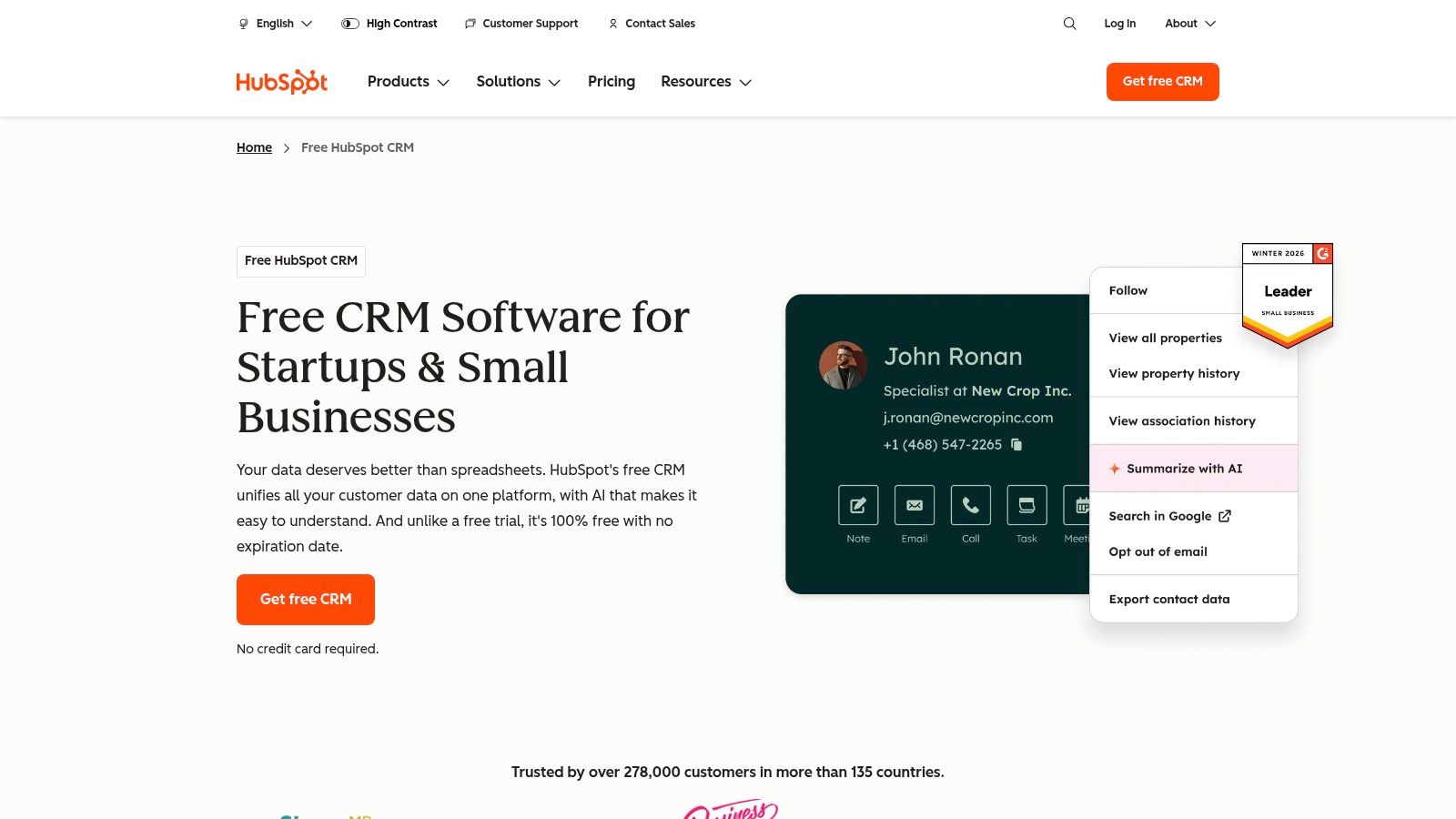
The platform’s key advantage is its unified ecosystem. As your startup scales, you can add paid "Hubs" for Sales, Marketing, and Service without ever needing to migrate data. This eliminates a significant operational headache down the road. The Sales Hub Starter plan begins at $15 per user/month, introducing more advanced automation and reporting features. For startups heavily focused on inbound strategies, HubSpot's seamless integration with its marketing tools is a game-changer. You can find more details in our comparison of the best marketing automation software available.
Why It's a Top Choice for Startups
- Free and Powerful Foundation: The free tier is not a limited trial. It offers enough functionality for an early-stage team to manage its entire sales pipeline effectively.
- Scalability without Migration: Transitioning from the free CRM to paid Sales, Marketing, or Service Hubs is seamless. Your data, properties, and history remain in one place.
- Exceptional Onboarding Resources: HubSpot Academy provides free, high-quality courses that help teams master the platform and sales best practices, reducing the training burden.
- Extensive Integration Marketplace: Connect HubSpot with hundreds of other tools like Slack, Zapier, and Google Workspace to create a unified tech stack.
Ideal Startup Profile: Bootstrapped or seed-stage startups that prioritize ease of use and plan to scale their sales and marketing efforts in tandem.
2. Salesforce Starter Suite (Salesforce Sales)
Salesforce Starter Suite is the company's answer for startups needing a streamlined, all-in-one CRM without the complexity of its enterprise-level products. It packages sales, marketing, and service tools into a single, simplified application designed for small teams. The platform provides a clear and powerful path for growth, ensuring that as your startup matures, you can scale into the broader Salesforce ecosystem without a painful data migration.
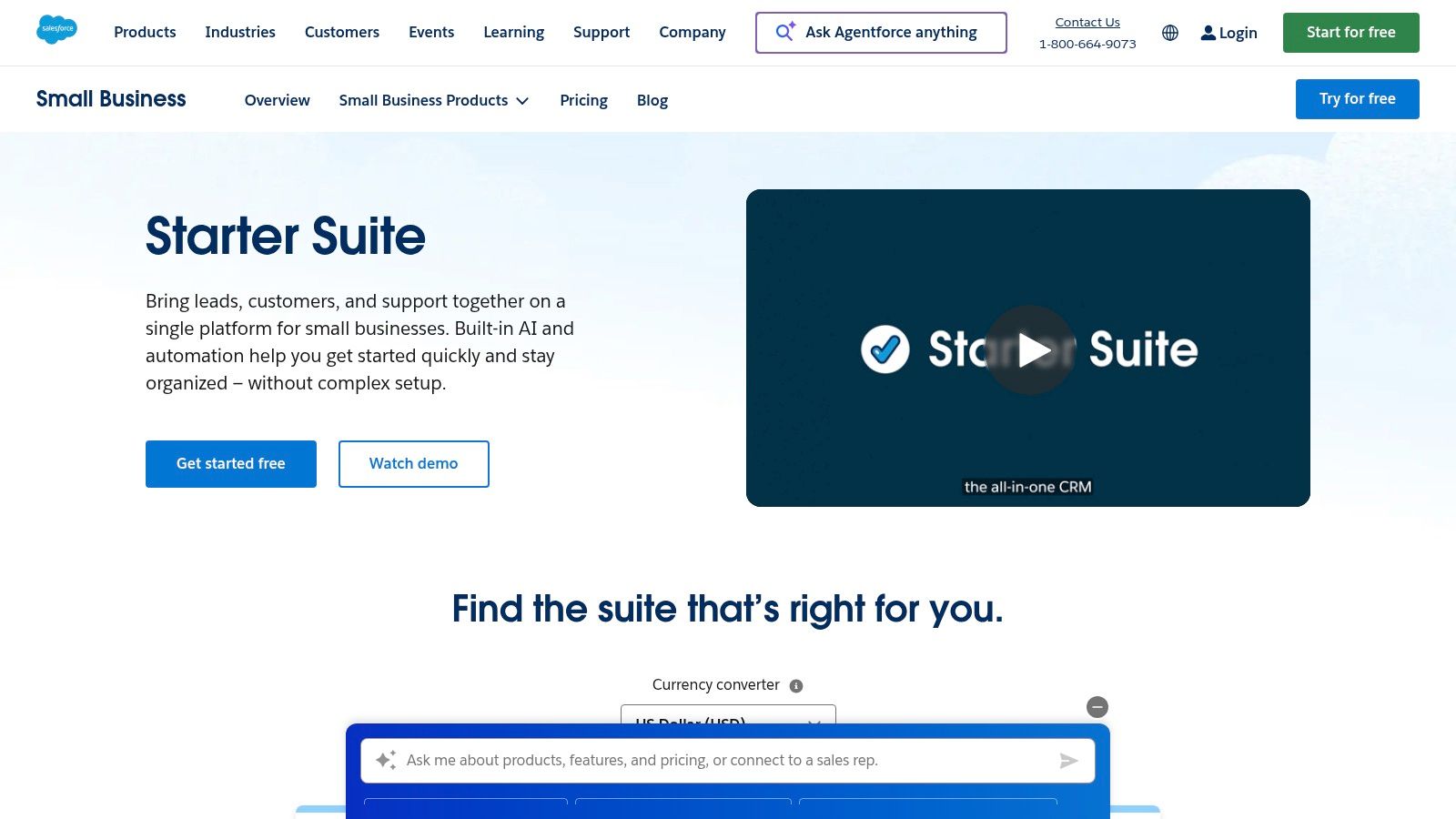
The suite includes core CRM functionalities like lead, account, contact, and opportunity management, enhanced with built-in automation for tasks like lead routing. It also integrates Slack for team collaboration and offers basic email marketing capabilities. Pricing begins at $25 per user/month, with a valuable free trial for up to three users. As your needs expand beyond sales into customer service, the unified platform is a significant advantage, which is a key consideration when evaluating the best customer support software for your growing business.
Why It's a Top Choice for Startups
- Unified Platform: Combines sales, service, and marketing tools in one simplified interface, preventing data silos from the start.
- Enterprise-Grade Scalability: Offers a direct, painless upgrade path to the full Salesforce platform and the massive AppExchange marketplace as your company grows.
- Guided Onboarding: The platform includes built-in guidance and setup assistance, helping small teams get up and running quickly without needing a dedicated administrator.
- Powerful AI Features: Even in the starter package, Salesforce includes AI-assisted activity capture and email insights to boost productivity.
Ideal Startup Profile: Ambitious startups that anticipate rapid growth and want to build their foundation on a platform with near-limitless scalability and customization potential.
Visit Salesforce Starter Suite
3. Pipedrive
Pipedrive is a sales-first CRM designed for startups that prioritize a visual and intuitive sales pipeline. Its core strength lies in its simplicity and focus on activities, making it incredibly easy for lean sales teams to adopt and see immediate value. The platform is built around a customizable drag-and-drop pipeline, helping founders and sales reps visualize their deal flow and focus on the next actions needed to close.
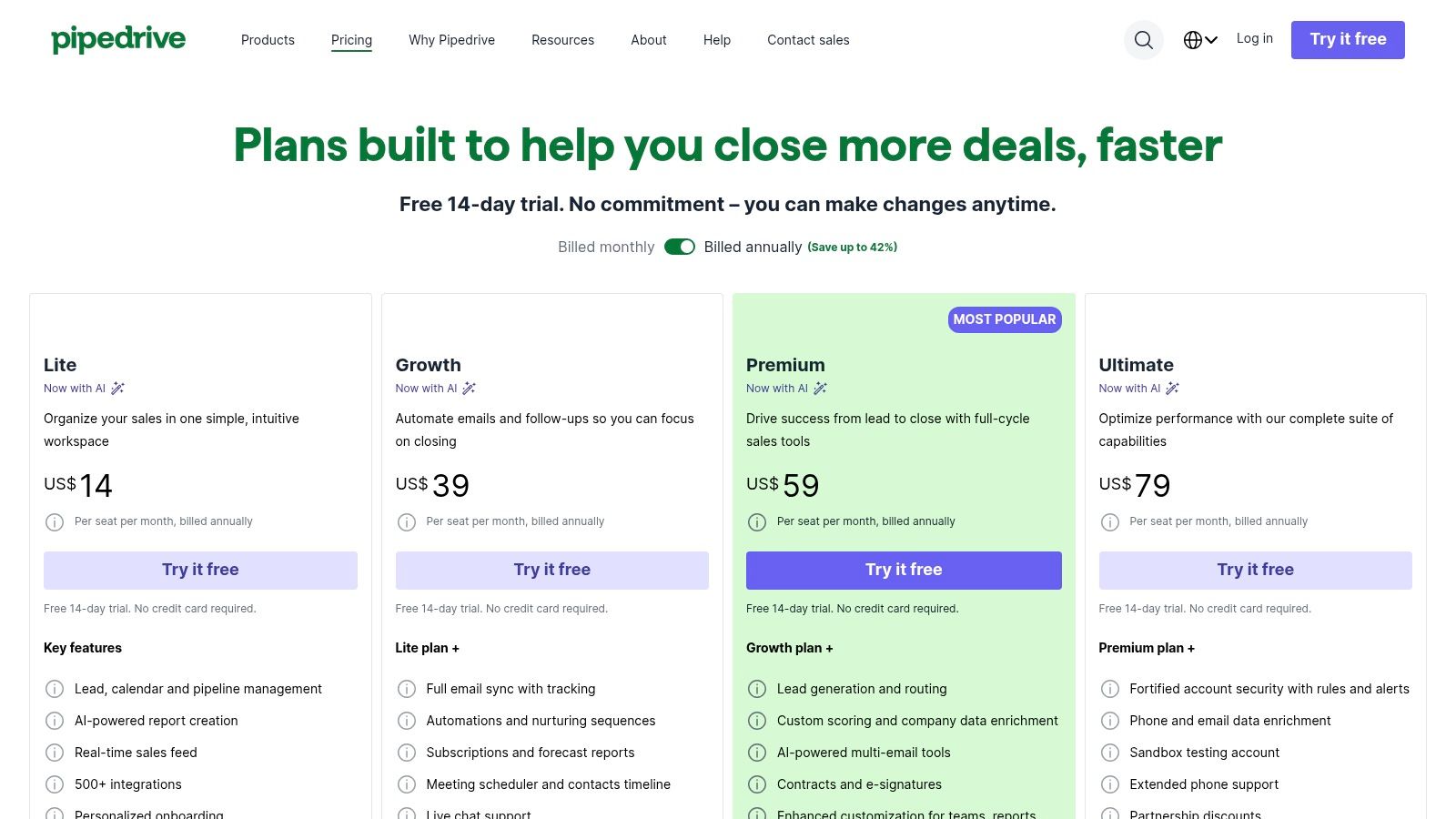
The platform offers full email sync, scheduling tools, and a marketplace with over 500 integrations to connect your existing tech stack. Pipedrive's pricing is transparent, starting with the Essential plan at $14 per user/month, which provides the core pipeline management features. As you grow, you can add more advanced capabilities like workflow automation or optional add-ons for lead capture and web visitor tracking. This focus on sales execution makes it a strong contender for the best CRM software for startups that need a tool without a steep learning curve. The clear value proposition aligns well with a strong SaaS product marketing strategy focused on solving a specific pain point.
Why It's a Top Choice for Startups
- Visual Pipeline Management: The intuitive drag-and-drop interface gives a clear, real-time overview of the sales funnel, promoting proactive sales activities.
- Fast Time-to-Value: Pipedrive requires minimal setup. A small team can be up and running, tracking deals and activities within hours, not days.
- Activity-Based Selling Focus: The CRM prompts users to schedule their next action for every deal, reinforcing a disciplined sales process that drives results.
- Transparent and Modular Pricing: Startups can begin with an affordable plan and add features or dedicated add-ons for projects and lead generation as their needs evolve.
Ideal Startup Profile: Early-stage startups with a dedicated (but small) sales team that needs a straightforward, action-oriented tool to manage and accelerate their deal flow.
4. Zoho CRM
Zoho CRM delivers an impressive suite of features at a price point that is highly attractive to budget-conscious startups. It stands out by offering a comprehensive, all-in-one solution that extends beyond traditional sales pipeline management into marketing, support, and even inventory control. The platform's free edition supports up to three users, providing a no-cost entry point for small teams to manage leads, deals, and contacts effectively.
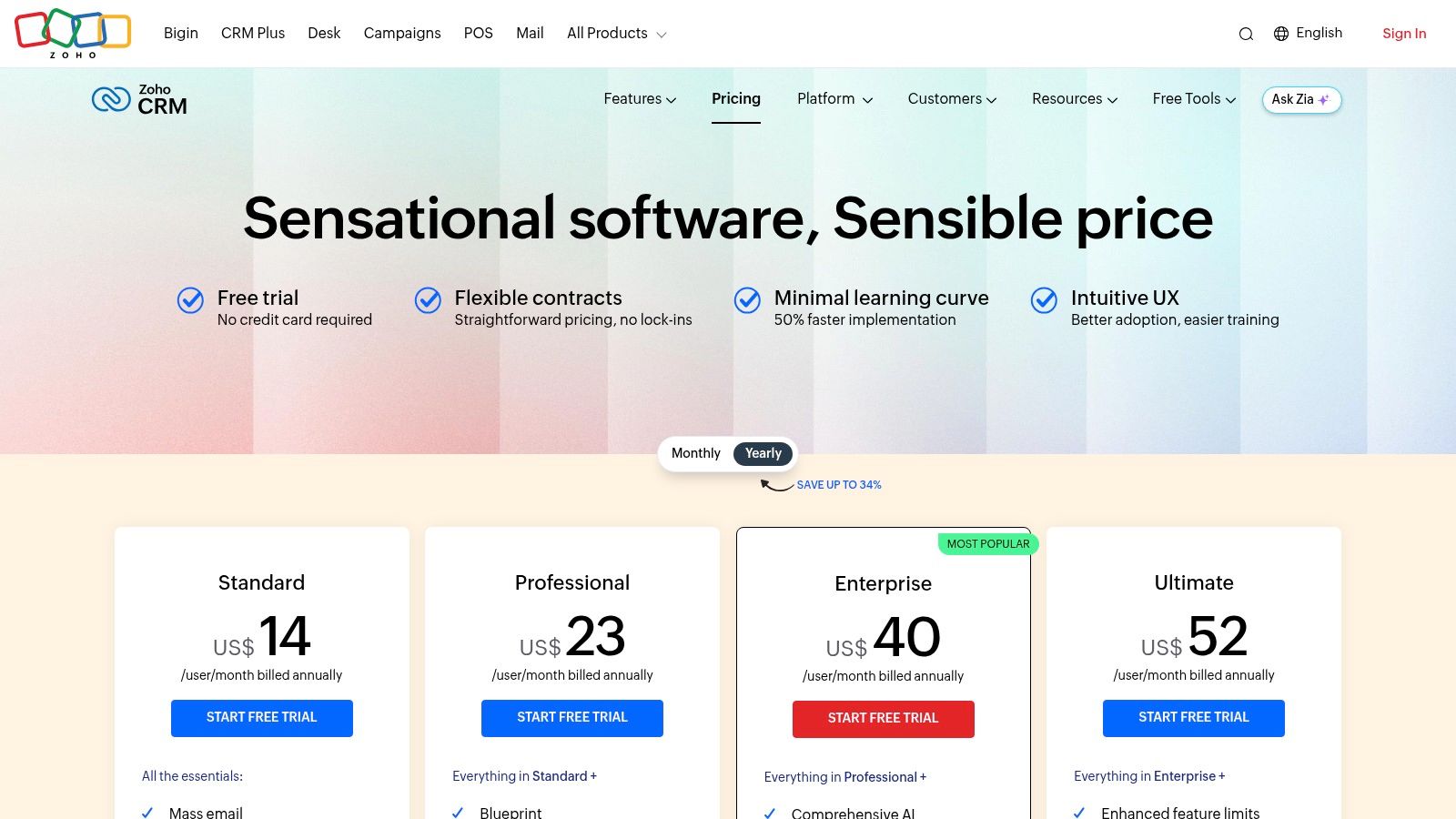
What makes Zoho one of the best CRM software for startups is its unparalleled value proposition. The paid plans are competitively priced, starting from $14 per user/month, and unlock powerful tools like workflow automation (Blueprints), advanced analytics, and AI-powered sales assistance. Zoho’s strength lies in its vast ecosystem of over 40 integrated business apps (Zoho One), allowing startups to build a completely unified operational stack on a single platform as they grow, minimizing integration complexities and costs.
Why It's a Top Choice for Startups
- Exceptional Value for Money: Zoho offers an extensive feature set, including enterprise-grade tools like workflow automation and advanced analytics, at a fraction of the cost of its competitors.
- Generous Free Tier: The forever-free plan for up to three users is robust enough for early-stage startups to get started without any financial commitment.
- Unified App Ecosystem: As your needs evolve, you can easily integrate other Zoho products like Books, Campaigns, and Desk, creating a single source of truth for your entire business.
- Flexible and Transparent Pricing: With both monthly and annual billing options and clearly defined tiers, startups can choose a plan that fits their current budget and scale predictably.
Ideal Startup Profile: Bootstrapped or cost-sensitive startups that need a feature-rich, all-in-one platform and are willing to invest some time into learning a more complex system.
5. Freshsales by Freshworks
Freshsales is a sales-focused CRM from the Freshworks ecosystem, designed for startups that want to consolidate their communication tools into one platform. It stands out by offering built-in phone, email, and chat functionalities, reducing the need for separate subscriptions and integrations. The platform is highly accessible, with a free plan for up to three users and a low entry price for paid tiers, making it a strong contender for the best CRM software for startups on a budget.
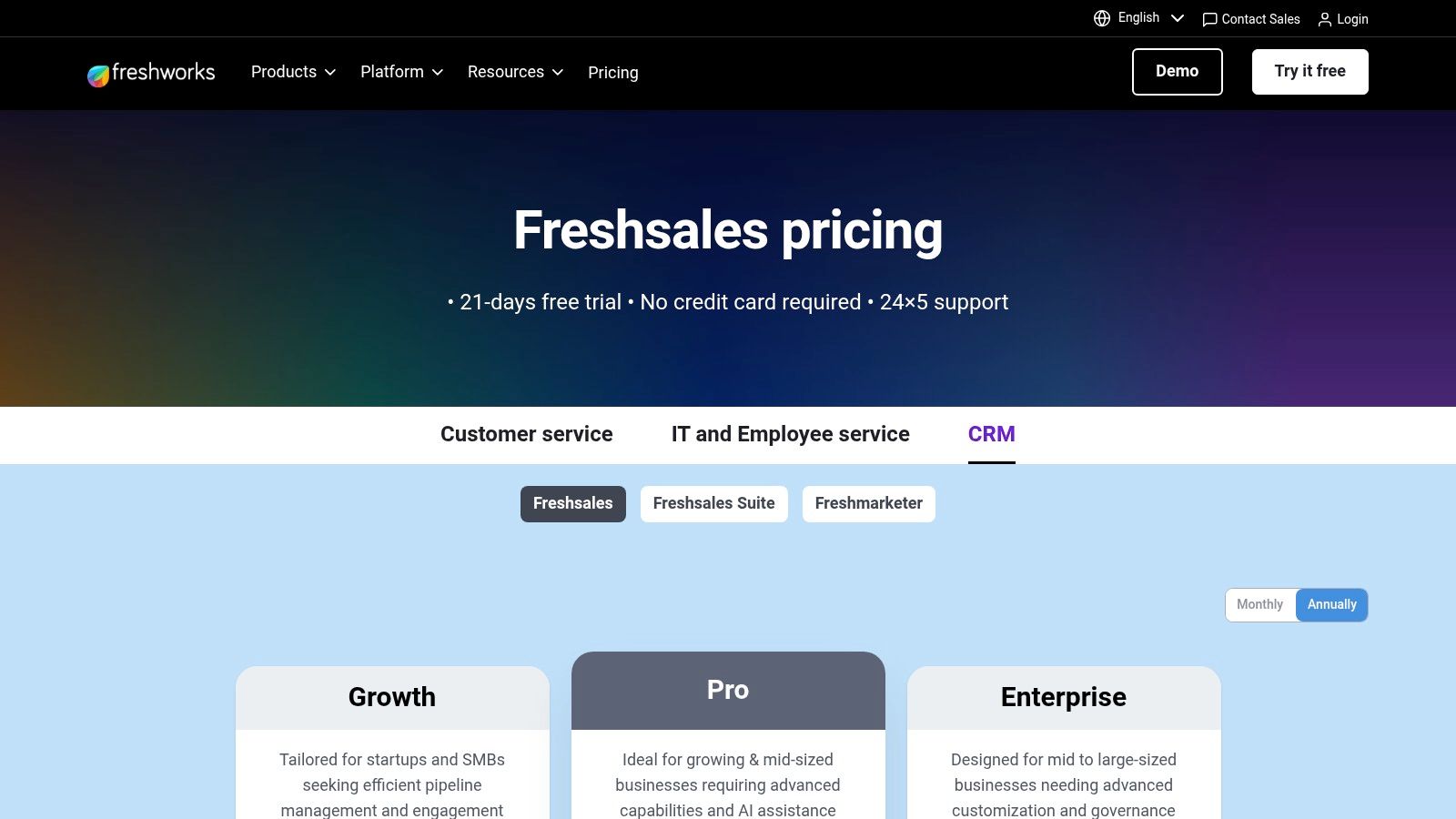
A key advantage for growing teams is the inclusion of Freddy AI, which provides AI-powered lead scoring, deal insights, and even email generation on mid-tier plans. This brings powerful automation capabilities within reach for early-stage companies. The user interface is clean and helps sales reps manage multiple pipelines and conversations from a single screen. Paid plans start at $9 per user/month (billed annually), offering a significant feature set for the price.
Why It's a Top Choice for Startups
- Integrated Communication Suite: The built-in phone, SMS, WhatsApp, and chat features help startups reduce tool sprawl and manage all customer interactions in one place.
- Accessible AI Features: Freddy AI offers predictive lead scoring and deal insights, helping small sales teams prioritize their efforts effectively without a hefty price tag.
- Low Entry Cost: With a generous free plan and affordable paid tiers, Freshsales provides a low-risk, high-value option for budget-conscious startups.
- Unified Platform Potential: As part of the Freshworks ecosystem, it can easily connect with Freshdesk (customer support) and Freshmarketer (marketing automation) for a cohesive customer lifecycle platform.
Ideal Startup Profile: Sales-driven startups that need an all-in-one communication and sales CRM to consolidate their tech stack and keep costs low.
6. Close
Close is the best CRM software for startups that live and die by their outbound sales efforts. It’s purpose-built for high-velocity inside sales teams, integrating all essential communication channels directly into the CRM. This eliminates the need for reps to constantly switch between a dialer, email client, and their contact database, drastically improving efficiency.
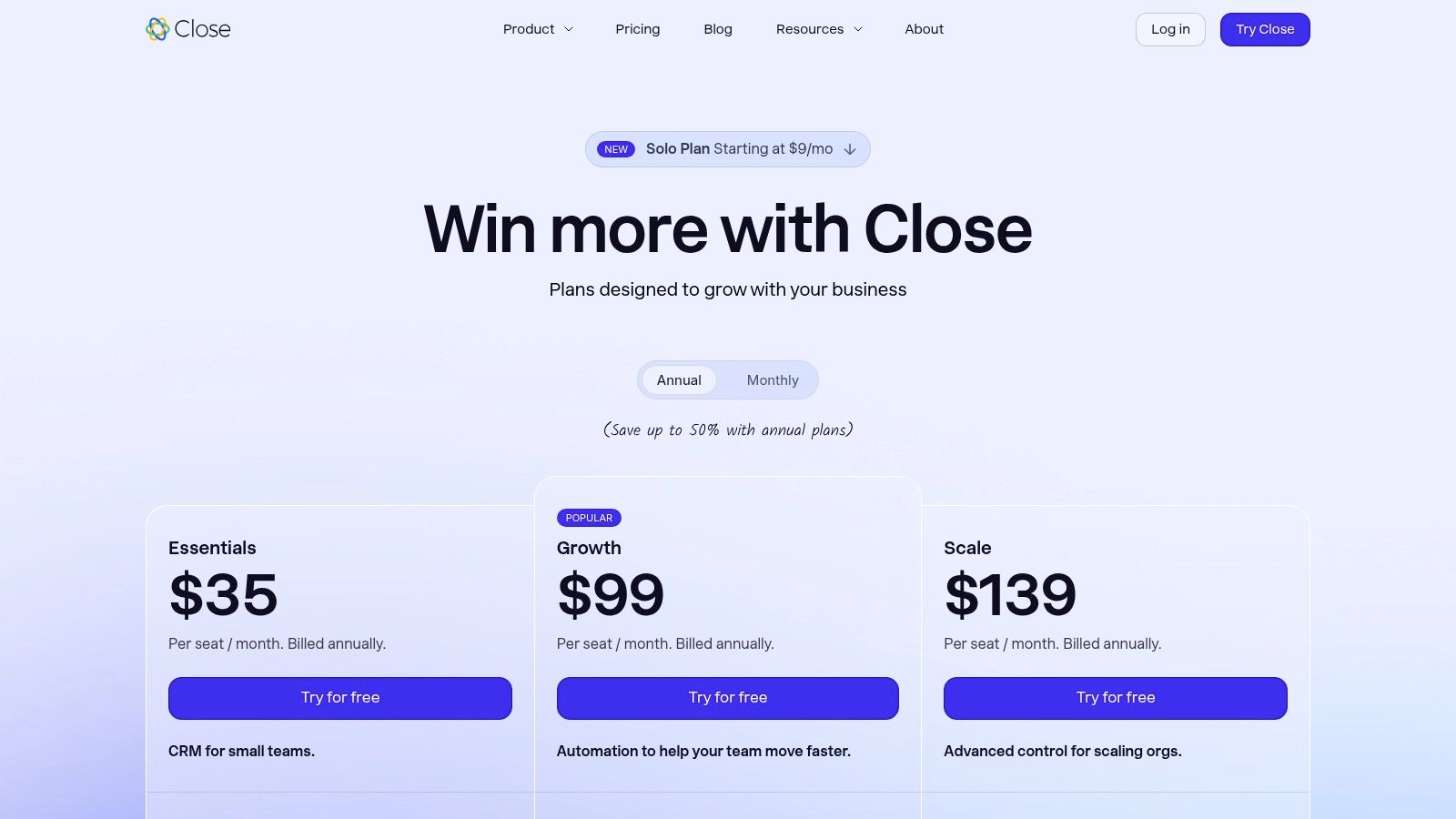
The platform’s core strength is its all-in-one communication hub. Native calling, two-way SMS, and email are built-in, allowing for seamless multi-touch sequences and a unified timeline of every prospect interaction. Features like the power dialer and call recording are designed to maximize rep productivity. Pricing starts with the Startup plan at $49 per user/month, but most teams will opt for the Professional plan at $99 per user/month to access the power dialer and email sequences.
Why It's a Top Choice for Startups
- Integrated Communications: Native calling, SMS, and email are built-in, creating a single source of truth and reducing the need for multiple subscriptions.
- Outbound Efficiency: Features like the power dialer and multi-channel sequences are designed to maximize the number of conversations a sales rep can have each day.
- Focus on Action: The user interface is lean and prioritizes the next action, making it easy for founder-led sales teams and new SDRs to stay on task.
- Helpful AI Features: Recently added AI assistants can summarize call transcripts and help draft effective outreach emails, saving valuable time.
Ideal Startup Profile: Seed to Series A startups with a dedicated inside sales team focused on high-volume outbound prospecting and closing deals quickly.
7. monday sales CRM
monday sales CRM is built on the flexible monday.com Work OS, offering a unique blend of CRM and lightweight project management. This makes it an excellent choice for startups needing to manage both sales pipelines and post-sale activities like onboarding or project delivery in one centralized, visual platform. Its drag-and-drop interface and customizable templates allow teams to quickly design workflows that match their specific processes without needing a developer.
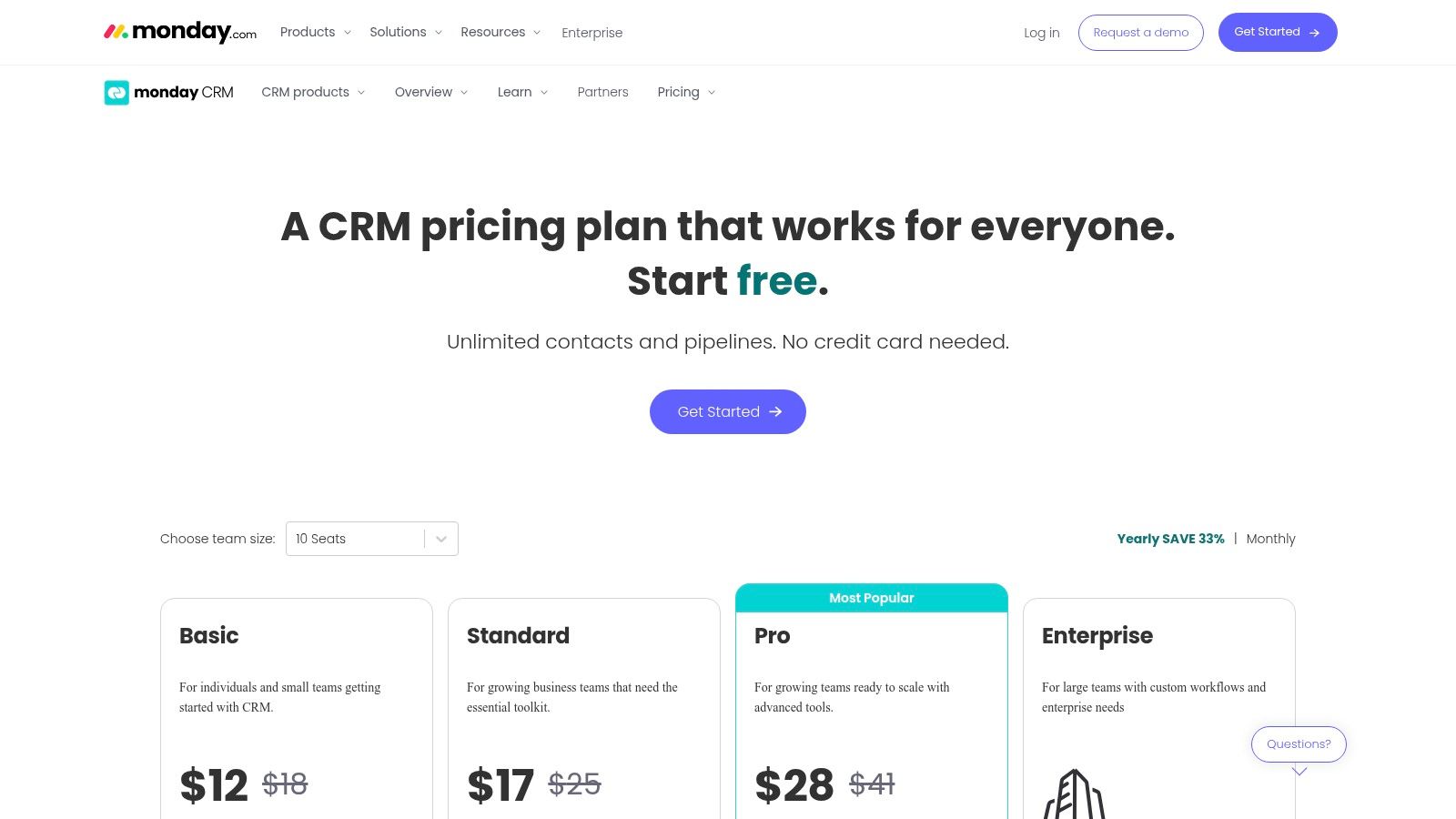
The platform shines with its powerful automations and visual dashboards that make tracking leads, deals, and projects incredibly intuitive. Pricing for the Basic CRM plan starts at $10 per seat/month, but it requires a three-seat minimum, which can be a hurdle for very small teams. However, for startups where sales, account management, and project teams collaborate closely, the unified workspace can significantly improve efficiency and data visibility, making it a strong contender for the best CRM software for startups that value process flexibility.
Why It's a Top Choice for Startups
- Unified Workspace: Combines CRM with project management, allowing teams to manage the entire customer lifecycle from lead to project completion in one place.
- Highly Visual and Customizable: The board-based interface is easy to understand and can be tailored to fit any unique sales or operational workflow without code.
- Robust Automation and Integration: Automate repetitive tasks and connect with essential tools like Gmail, Outlook, Slack, and Zapier to streamline operations.
- Template-Driven Setup: Get started quickly with a large library of pre-built templates for sales pipelines, contact management, and more.
Ideal Startup Profile: Startups that require a high degree of process customization or manage post-sale projects and client onboarding directly from their CRM.
8. Copper
Copper is the best CRM software for startups that operate almost exclusively within Google Workspace. Its core value proposition is its deep, native integration with Gmail, Google Calendar, and Google Drive, allowing teams to manage relationships without ever leaving their inbox. This Google-centric design drastically reduces friction and speeds up user adoption, as the interface feels like a natural extension of tools the team already uses daily.
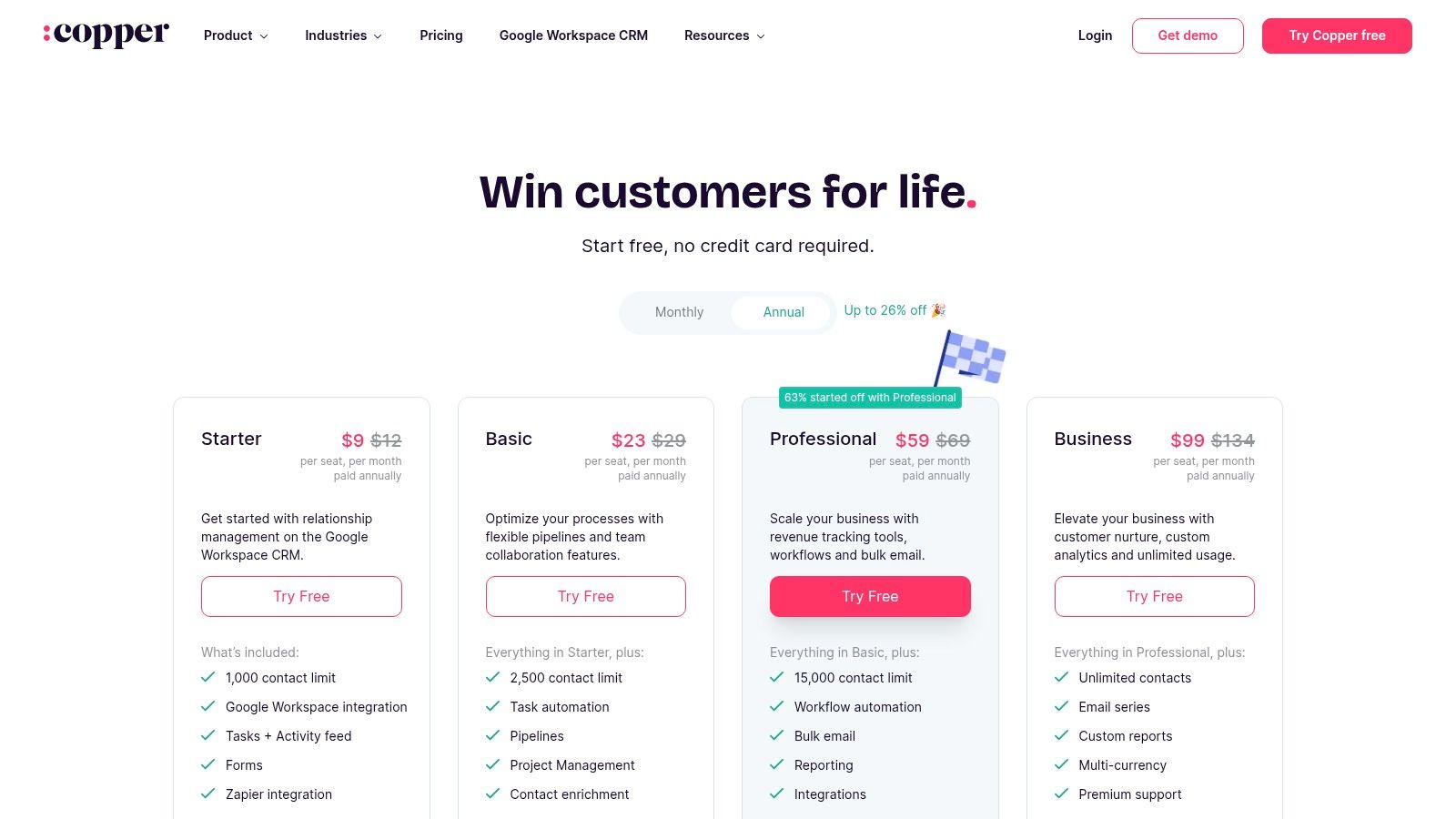
Implementation is nearly instant for any company using Google Workspace. The Copper Chrome extension overlays contextual CRM data directly onto your Gmail conversations, automatically logs emails, and allows you to update opportunities on the fly. Its visual pipelines and project boards are intuitive for managing sales and even client onboarding processes. Pricing starts with the Basic plan at $23 per user/month, with more advanced automation and reporting features reserved for the Professional and Business tiers.
Why It's a Top Choice for Startups
- Zero-Friction Adoption: By living inside Gmail, Copper eliminates the need to switch tabs or learn a completely new system, making it incredibly easy for teams to adopt.
- Automated Data Entry: The platform automatically captures and logs emails, meetings, and files associated with contacts, saving significant administrative time.
- Google Workspace Native: It’s built for Google users first. If your startup runs on Google Workspace, the integration is seamless and powerful.
- Visual and Intuitive: The drag-and-drop pipeline management is straightforward, providing a clear view of your sales process without complex configurations.
Ideal Startup Profile: Early-stage to growth-stage startups that are deeply embedded in the Google Workspace ecosystem and want a CRM that requires minimal training and context switching.
9. Streak (CRM for Gmail)
Streak is the best CRM software for startups that want to manage their entire sales process without ever leaving their inbox. It transforms your Gmail account into a flexible, fully-featured CRM, making adoption incredibly simple for founders and small teams. By embedding pipelines, contacts, and tasks directly within the familiar Gmail interface, it eliminates the need to learn and switch between separate applications.
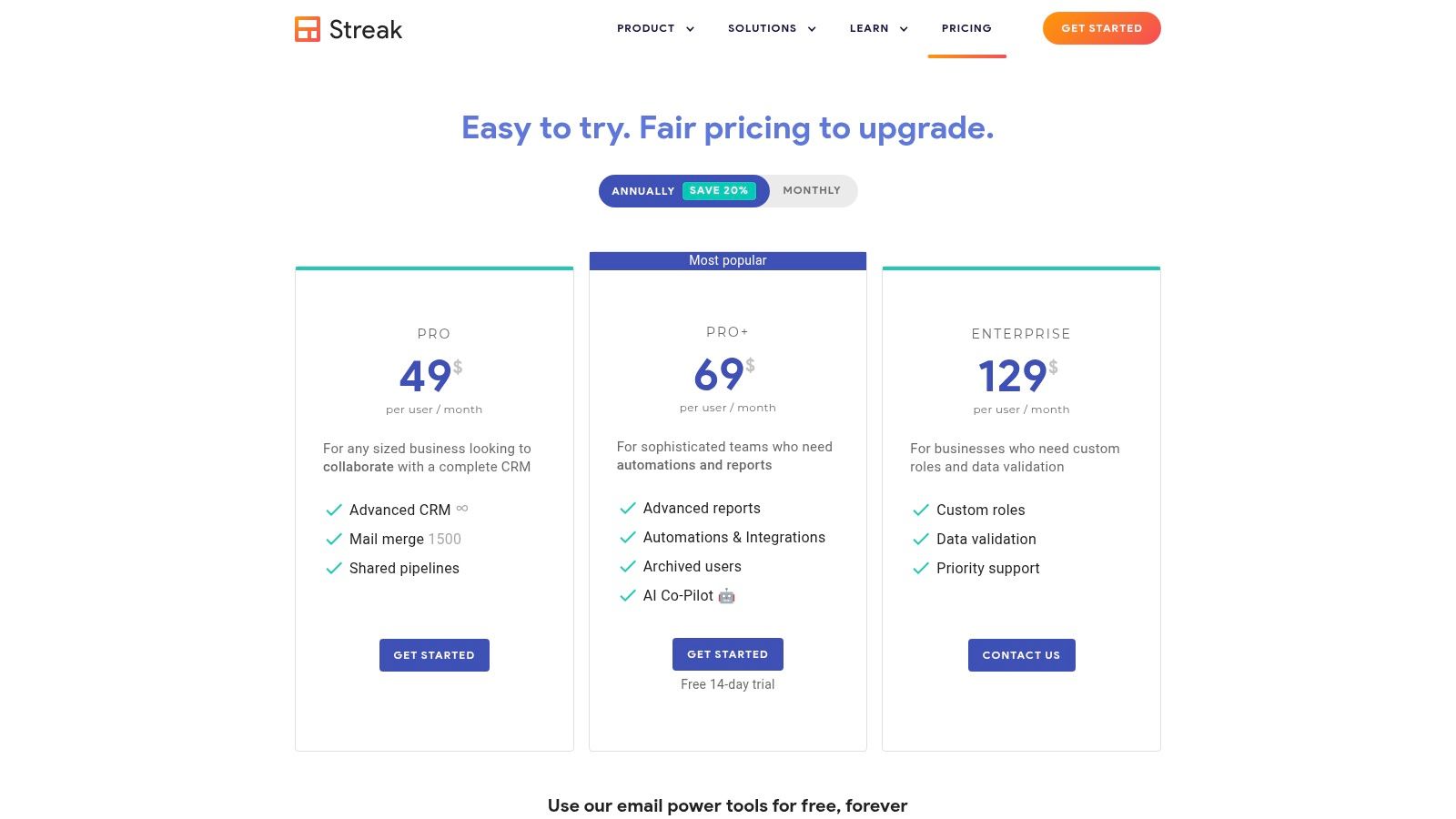
This email-centric approach is perfect for workflows driven by outreach and communication. Features like mail merge and link tracking are built-in, streamlining core sales activities. While a free plan exists for individual use, the Pro plan starts at $49 per user/month, unlocking shared pipelines and more advanced features. For teams that live and breathe Gmail, Streak's zero-friction setup offers a uniquely efficient way to manage customer relationships from day one.
Why It's a Top Choice for Startups
- Lives Inside Gmail: There is no separate app to learn or manage. The CRM is seamlessly integrated into the Gmail UI, resulting in near-instant adoption for your team.
- Email Power Tools: Includes powerful native features like email tracking, mail merge, and snippets to help automate and optimize your sales outreach directly from your inbox.
- Flexible Pipelines: Easily create and customize pipelines for sales, fundraising, hiring, or any other business process that can be managed in stages.
- Simple to Start: The free plan provides enough features for a solo founder to get started immediately, with paid plans offering essential team collaboration tools.
Ideal Startup Profile: Early-stage, email-heavy startups and solo founders who use Google Workspace and prioritize simplicity and speed over complex, feature-rich platforms.
10. Nutshell
Nutshell is an excellent choice for startups that need a sales-focused CRM but also want foundational marketing and engagement tools built directly into the platform. It eliminates the immediate need to stitch together multiple applications by bundling features like email marketing, forms, landing pages, and even a live chat/AI chatbot. This all-in-one approach simplifies the tech stack for small, resource-constrained teams.
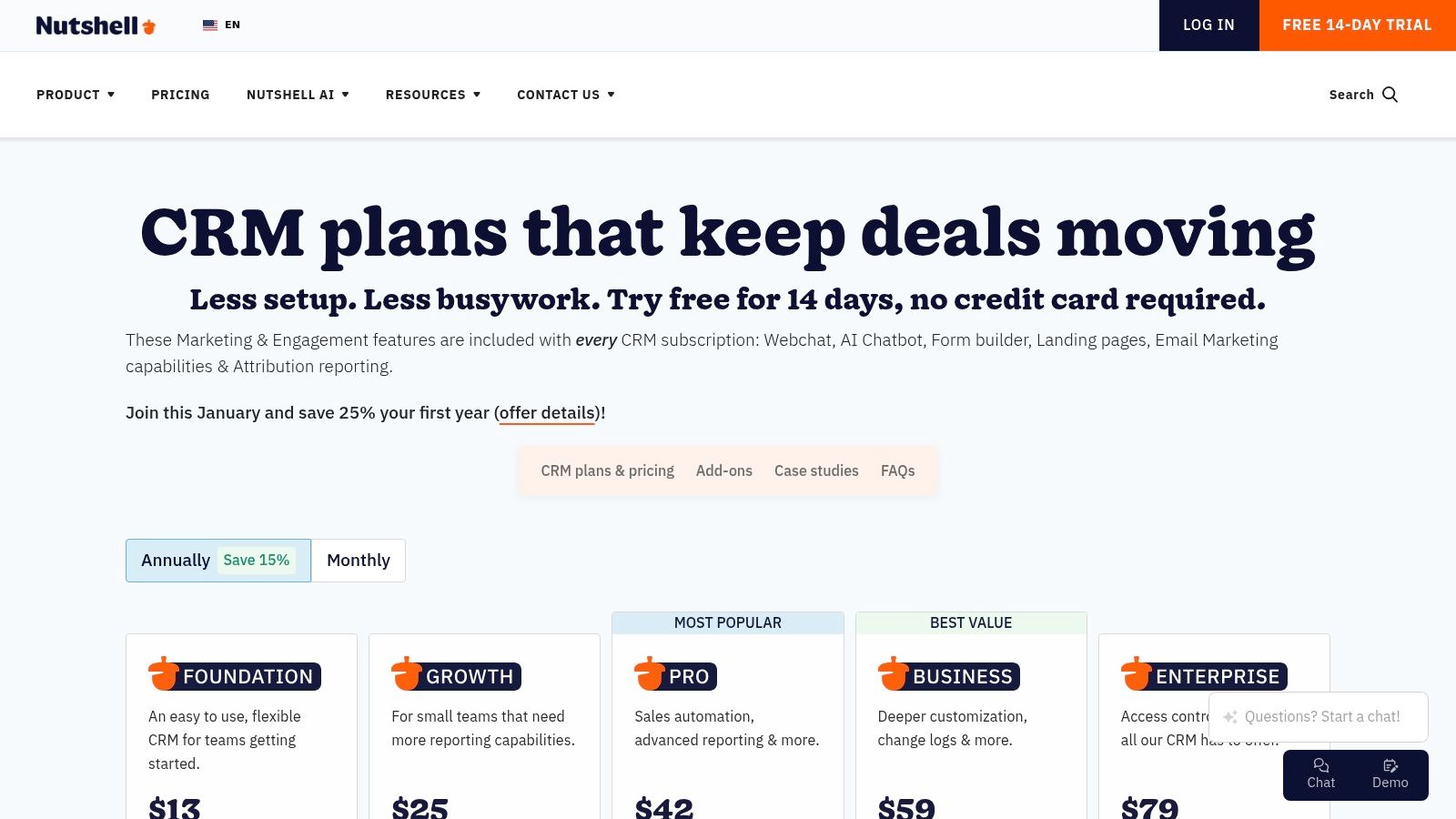
The platform is known for its user-friendly interface and highly-praised customer support, which is a significant plus for startups without dedicated IT staff. Pricing starts at $16 per user/month for the Foundation plan, which includes unlimited contacts, sales automation, and reporting. A key differentiator is that even the base plan includes email marketing capabilities, making it a strong contender for the best CRM software for startups wanting to consolidate tools and costs.
Why It's a Top Choice for Startups
- Consolidated Toolset: The inclusion of email marketing, web forms, and live chat reduces the need for separate subscriptions to other marketing tools, saving money and complexity.
- Unlimited Contacts: Unlike many CRMs that tier pricing by contact count, Nutshell offers unlimited contacts and accounts on all its plans, providing predictable costs as you grow.
- Friendly and Accessible: The platform is designed to be straightforward, with award-winning support available to help teams get up and running quickly.
- Flexible Add-ons: While the core product is robust, you can add specific capabilities like quoting, advanced prospecting, and visitor tracking as your needs evolve.
Ideal Startup Profile: Small, sales-driven teams that want an affordable, all-in-one CRM with built-in marketing features to simplify their tech stack from day one.
11. Attio
Attio presents a modern, flexible alternative to traditional CRMs, built for startups that don't fit into a standard sales mold. Its unique object-based architecture allows teams to design a data model that mirrors their specific business logic, making it a strong contender in the race for the best crm software for startups, especially those with product-led growth (PLG) motions. The platform excels at real-time contact syncing and automatic data enrichment, reducing manual data entry for fast-moving teams.
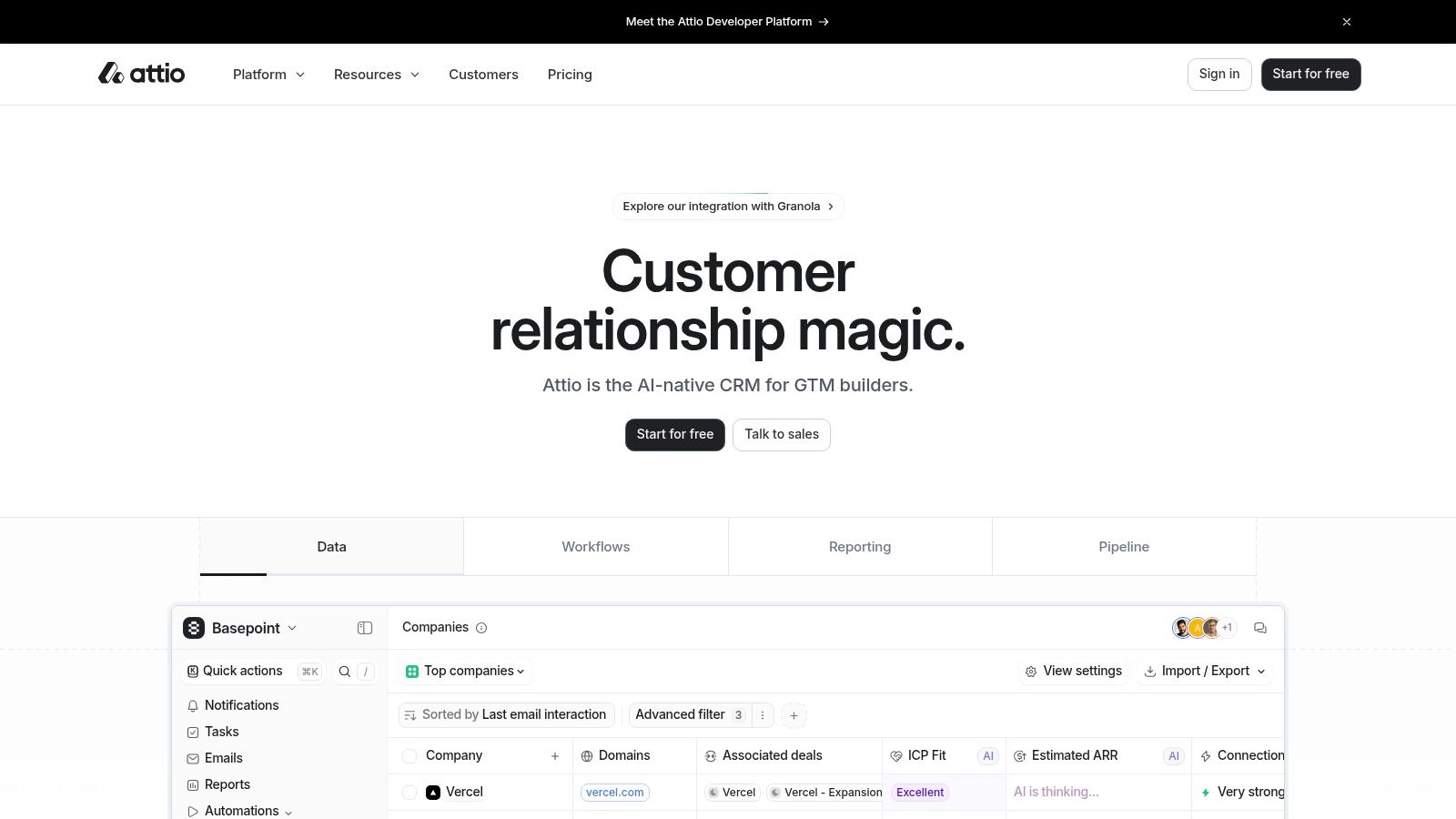
The platform is designed for customization without complexity, offering powerful features like AI-driven workflows and custom objects. Its free plan is notably generous, providing up to 3 seats and allowing teams to fully test its capabilities before committing. Paid plans like Pro (starting at $29 per user/month) unlock advanced AI features and higher limits. The interface is clean and collaborative, feeling more like a modern productivity tool than a legacy CRM.
Why It's a Top Choice for Startups
- Highly Flexible Data Model: Create custom objects and relationships that perfectly match your go-to-market strategy, whether it’s user-based, workspace-based, or something entirely unique.
- Powerful Automation and Enrichment: Attio automatically enriches contact and company data, saving significant time. Its AI and workflow engine can automate complex processes beyond simple follow-ups.
- Generous Free Tier: The free plan offers substantial functionality, making it easy for startups to validate if Attio’s unique approach is the right fit for their operational needs.
- Collaborative by Design: Features like real-time updates, comments, and a shared inbox make it feel more like a modern collaborative workspace than a rigid database.
Ideal Startup Profile: Product-led growth (PLG) startups, venture capital firms, or any team that needs a CRM that can adapt to a complex or non-traditional customer relationship model.
12. Capterra – Small Business CRM Category
While not a CRM itself, Capterra’s small business category is an indispensable resource for any startup navigating the crowded software market. It functions as a comprehensive research and comparison engine, allowing you to discover, vet, and shortlist potential CRM solutions based on your specific needs. The platform aggregates hundreds of tools, presenting them with user reviews, pricing snapshots, and feature lists in a standardized format.
This meta-approach saves startups countless hours of manual research. Instead of visiting dozens of individual vendor websites, you can use powerful filters to narrow down options by features (like email marketing or project management), price point, and deployment type. While platforms like Capterra offer great insights, it's also valuable to consult other expert analyses, such as this guide to the 12 Best CRM for Small Business Options, to get a well-rounded view. Capterra’s strength lies in its ability to help you build an informed shortlist before committing to demos or trials.
Why It's a Top Resource for Startups
- Efficient Comparison: The side-by-side comparison tool allows you to evaluate up to four different CRMs on features, pricing, and ratings, dramatically speeding up the decision-making process.
- Verified User Reviews: Access thousands of reviews from real users, providing candid feedback on usability, customer support, and value for money, which is crucial for finding the best CRM software for startups.
- Advanced Filtering: Quickly find free or low-cost tools and filter for niche features essential to your business model, ensuring you don’t waste time evaluating irrelevant options.
- Curated Shortlists: Capterra provides pre-vetted shortlists and buyer guides that can serve as an excellent starting point for your research, especially if you’re new to CRM software.
Ideal Startup Profile: Startups in the initial research phase that need to efficiently compare a wide range of CRM options and build a data-backed shortlist for further evaluation.
Visit Capterra – Small Business CRM Category
Top 12 CRMs for Startups
| Product | Core features ✨ | UX / Quality ★ | Value & Price 💰 | Target 👥 | Standout / USP 🏆 |
|---|---|---|---|---|---|
| HubSpot CRM (Sales Hub) | Free CRM: contacts, deals, dashboards, email tracking; large app marketplace | ★★★★☆ Fast adoption + HubSpot Academy | 💰 Free tier (no expiry); scales to paid Hubs | 👥 Startups & teams planning scale | 🏆 Unified ecosystem + upgrade path across hubs |
| Salesforce Starter Suite | Lead/account/opportunity mgmt, flows, AI email sync, Slack integration | ★★★★ Enterprise-grade; steeper setup | 💰 Free 2-user trial; annual billing; can be costly at scale | 👥 Startups aiming for enterprise growth | 🏆 Path to full Salesforce + AppExchange |
| Pipedrive | Visual pipelines, email sync, scheduling, 500+ integrations, add-ons | ★★★★ Simple, fast time-to-value | 💰 Clear tiers; add-ons for lead gen/projects | 👥 Lean sales teams & founders | 🏆 Pipeline-first UX for rapid adoption |
| Zoho CRM | Workflows/Blueprints, analytics, multi-channel Signals, free 3-user plan | ★★★★☆ Feature-rich; steeper UI learning curve | 💰 Generous free plan; competitive paid tiers | 👥 Budget-conscious SMBs | 🏆 Broad feature set at low cost |
| Freshsales (Freshworks) | Built-in phone/chat, AI scoring (Freddy), multi-pipeline CPQ options | ★★★★ Native channels reduce tool sprawl | 💰 Low entry; 21-day trial; free up to 3 users | 👥 Teams needing telephony + AI | 🏆 Built-in telephony + AI insights |
| Close | Native dialer, SMS, sequences, shared inbox, AI assistants | ★★★★ Optimized for high-velocity outbound | 💰 Usage fees for calling/SMS; mid-high TCO | 👥 Founder-led sales & SDR teams | 🏆 Integrated calling/SMS for outbound cadence |
| monday sales CRM | Boards, automations, templates, dashboards, many integrations | ★★★★ Visual & highly customizable | 💰 Per-seat (3-user min); monthly pricier than annual | 👥 Teams wanting sales + post-sales ops | 🏆 Work OS that combines CRM + ops workflows |
| Copper | Deep Gmail/Calendar/Drive integration, pipelines, Chrome extension | ★★★★ Gmail-first UX; minimal setup | 💰 Google-native pricing; contact limits on lower tiers | 👥 Google Workspace-centric teams | 🏆 Native Google Workspace experience |
| Streak (CRM for Gmail) | Pipelines, mail merge, in-Gmail automations, link tracking | ★★★★ Zero-friction adoption inside Gmail | 💰 Free/basic for solo users; paid Pro for teams | 👥 Solo founders & micro teams on Gmail | 🏆 CRM fully inside your inbox (no separate app) |
| Nutshell | Unlimited contacts, sales automation, built-in email marketing & chat | ★★★★ Simple UI; built-in marketing tools | 💰 Affordable tiers; add-ons may raise cost | 👥 Small teams wanting marketing + CRM | 🏆 All-in-one sales + basic marketing stack |
| Attio | Custom objects, real-time sync, enrichment, AI workflows, templates | ★★★★☆ Flexible modern UI for custom schemas | 💰 Generous free plan; some custom/pricing in-product | 👥 PLG startups & teams needing custom data models | 🏆 Highly flexible object-based CRM & enrichment |
| Capterra – Small Business CRM | Filtered listings, reviews, side-by-side comparisons, buyer guides | ★★★★ Useful marketplace for discovery & validation | 💰 Free to use; sponsored placements possible | 👥 Buyers shortlisting CRMs | 🏆 Centralized reviews + comparison tools |
Making Your Final Decision and Preparing for Launch
Choosing the right CRM is a pivotal decision, one that moves your startup from managing relationships in spreadsheets to building a scalable, data-driven growth engine. We've navigated a complex landscape, from the all-in-one power of HubSpot and Salesforce to the laser-focused sales execution of Pipedrive and Close. We've seen how tools like Copper and Streak embed themselves into your existing workflows, and how modern platforms like Attio are redefining what a CRM can be. The journey from evaluation to implementation is where the real work begins, and making a confident, well-informed choice is your first major step.
The core lesson is simple: there is no single "best CRM software for startups." The perfect tool is a myth. Instead, the best choice is the one that aligns with your specific context: your team's size, your sales process complexity, your budget, and, most critically, your immediate growth trajectory for the next 18 to 24 months. Over-investing in a complex system too early can stifle agility, while under-investing in a tool you'll outgrow in six months creates a costly migration headache down the road.
From Shortlist to Selection: Your Action Plan
Analysis paralysis is the enemy of progress. The goal now is to transform this comprehensive guide into a decisive action. Don't let the sheer number of options overwhelm you. It's time to commit to a process and move forward with conviction.
Here is a practical, step-by-step framework to guide your final decision:
Revisit Your Startup Profile: Were you a Bootstrapped Founder drawn to Zoho CRM's value or a Sales-First Team considering Pipedrive's intuitive pipeline? Did the Product-Led Growth model of Attio resonate, or are you an Enterprise-Ready Startup eyeing the scalability of Salesforce? Start by re-confirming which category best describes your current reality.
Build a Hyper-Focused Shortlist: Based on your profile, select no more than three CRMs from our list. Having too many options in the trial phase leads to shallow evaluations and decision fatigue. Three is the magic number for a deep, comparative analysis.
Run Structured, Time-Boxed Trials: Sign up for free trials for your top three contenders. This is non-negotiable. Don't just click around; simulate your actual daily workflows.
- Import a small, representative sample of your contacts.
- Create and move a few deals through the pipeline.
- Have at least two team members (e.g., a founder and a sales rep) execute the same set of tasks in each CRM and compare their experiences.
- Test a key integration (like email or calendar) to ensure it works as expected.
Evaluate Beyond Features - Focus on Adoption: During the trial, ask your team critical questions. Which interface feels the most intuitive? Which tool reduces friction rather than adding it? The CRM with the most features is useless if your team avoids using it because it's too complicated. Prioritize user experience and ease of adoption above all else. A simple, consistently used CRM is infinitely more valuable than a powerful, neglected one.
Preparing for a Successful CRM Launch
Once you've made your choice, your focus must shift from selection to implementation. A successful launch is not about flipping a switch; it's about preparing your team and processes for a new way of working.
- Define Your "Single Source of Truth": Before you import a single contact, establish clear rules. The CRM must become the undisputed source of all customer information. Document what data needs to be captured, who is responsible for entering it, and when.
- Start Small and Iterate: Don't try to implement every advanced feature on day one. Begin with the core essentials: contact management, deal tracking, and activity logging. Master the fundamentals first. You can roll out more advanced features like automation, reporting dashboards, and complex integrations in later phases as your team gets comfortable.
- Invest in Onboarding: Even the most intuitive CRM requires training. Block out time for dedicated team onboarding sessions. Use the vendor's help documentation, watch tutorials, and ensure everyone understands the "why" behind this new tool, not just the "how."
Ultimately, selecting and implementing the best CRM software for your startup is an investment in your future. It's about building the operational backbone that will support your customer relationships, streamline your sales process, and provide the data-driven insights you need to scale effectively. Make your choice, commit to it, and start building.
Once you've chosen your CRM and are ready to accelerate your growth, getting your SaaS product in front of the right audience is the next critical step. SubmitMySaas helps you get discovered by listing your startup on over 40+ top-tier SaaS directories and review platforms, saving you hundreds of hours of manual work. Supercharge your launch and start building early traction by visiting SubmitMySaas today.