Best AI Tools Directory: 10 Places to Find AI Tools
Explore the best ai tools directory options for discovery, research, pricing checks, use cases, and product submissions in 2026.
The biggest AI tools directory isn't automatically the best one. A massive catalog can help you scan a market, but it may be the wrong resource when you need a tool for a specific job, an editor's judgment, a pricing filter, early user feedback, or launch exposure for your own product. The useful question isn't which directory lists the most software. It's which discovery job are you trying to complete?
That distinction matters because the market is both large and fragmented. One directory dataset tracked 2,227 AI tools across 16 categories and 30 industries as of September 23, 2026 (Tool Discovery). Another dataset estimated roughly 51,242 consumer AI tools across curated directories by July 17, 2026, while an industry analysis reported that about 50 new AI tools launch every day (AI tools statistics). Static “best of” lists struggle to keep pace with that rate of change.
This comparison therefore ranks directories by their practical role: broad market scanning, task-based selection, editorial filtering, workflow planning, and launch exposure. For each platform, the test is the same: catalog breadth, search and category structure, listing depth, curation, use-case usefulness, limitations, and value for makers. If you want a wider starting point, this guide to top AI directory sites provides additional context.
1. SubmitMySaas
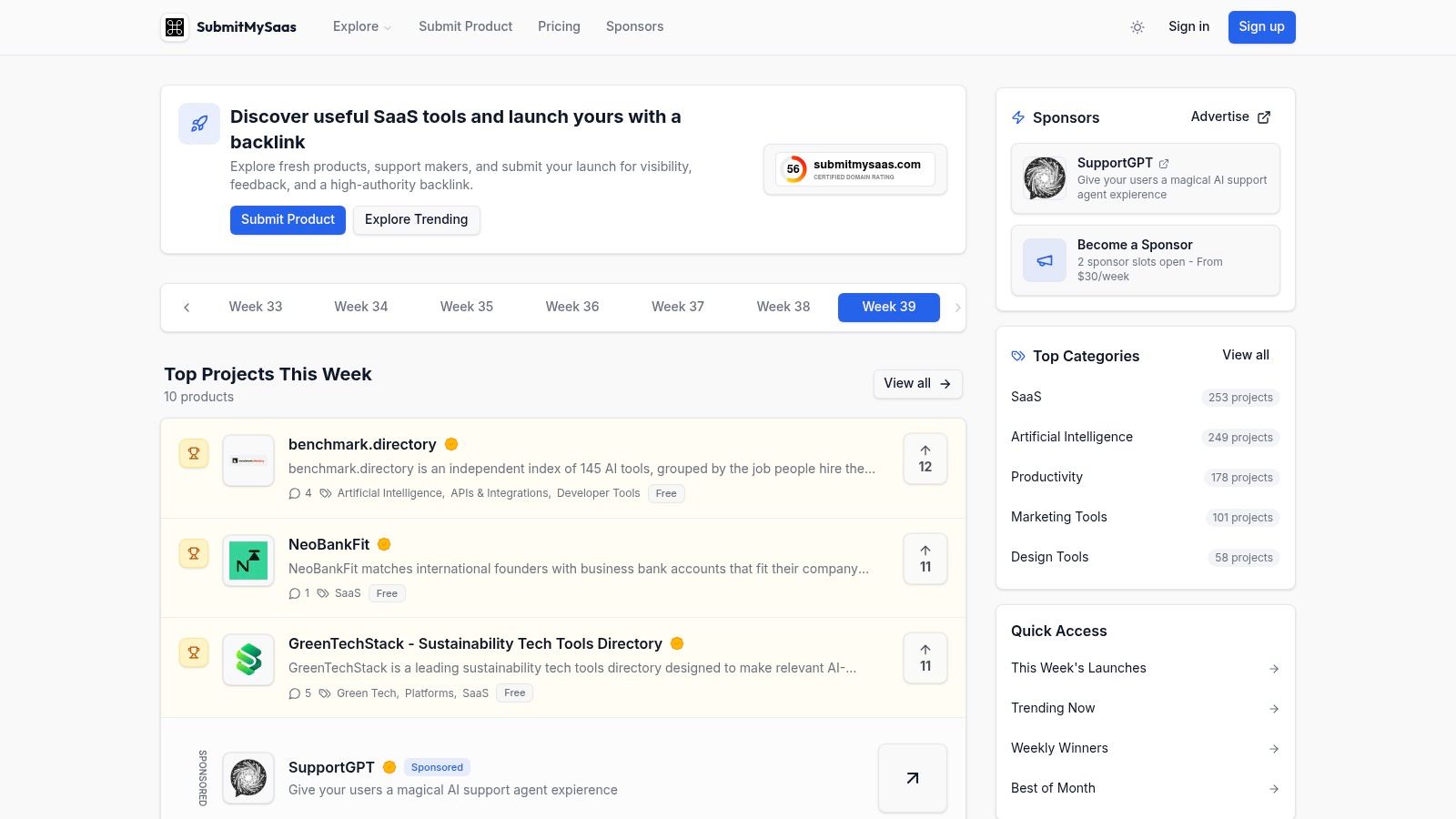
SubmitMySaas serves a narrower discovery job than a large AI index. It combines launch exposure with ongoing product discovery across SaaS, AI, productivity, marketing, and design tools. Daily launches, trending feeds, category pages, and recurring roundups give makers several routes to visibility instead of relying on a single permanent listing.
That structure also helps users monitor emerging products. Visitors can browse newly launched tools, review trending products, explore category collections, and inspect highlighted projects. The editorial presentation supplies more context than a name and outbound link, while the submission process is built for founders preparing a launch.
Best fit: Founders seeking launch exposure, continued discoverability, and organized category placement rather than a one-time directory entry.
Why makers may choose it
SubmitMySaas connects organic discovery with optional promotion. Its launch package includes a branded badge and 35+ domain-rating backlinks (launch package), according to the publisher's product information. Those deliverables should be assessed individually. Backlink relevance, domain quality, and editorial context matter more than the stated quantity, so founders should review the participating domains before treating the package as an SEO result.
The site also presents advertising and sponsorship options, including site mentions advertised at approximately $79 per month and sponsor slots from approximately $30 per week (SubmitMySaas). Prices and package terms may change, and the public information does not fully specify every launch deliverable. Confirm the current offer before purchase.
Trade-offs for founders
A submission does not guarantee viral reach, rankings, or conversions. Concurrent launches create competition, while placement can depend on timing, editorial selection, listing quality, and audience fit. A concise positioning statement, accurate category choice, and useful product page give the listing a better chance of supporting broader distribution.
For users, the trade-off is focus over exhaustive coverage. SubmitMySaas may produce a more relevant stream of new products and clearer launch signals, while a mega-index is better for broad market scanning. For makers, category placement, roundups, trending visibility, newsletters, and referral links can create several discovery paths, provided the product page remains current and specific.
2. Futurepedia
Futurepedia is a strong first stop for broad AI market scanning. Its directory combines a large catalog with deep categories, tool summaries, outbound links, and an education layer that includes wiki-style material and courses. That combination is useful when you don't yet know which subcategory contains the right solution.
The main advantage is navigational breadth. Instead of searching only for a product name, users can move through categories and use cases to identify competing products, adjacent workflows, and unfamiliar vendors. For a marketer researching AI writing, video, sales, or productivity software, that category depth can turn an unstructured search into a workable map.
Where it works best
Futurepedia is better suited to building a longlist than making a final buying decision. Its scale helps reveal market patterns, common positioning language, and clusters of similar products. It can also show how tools describe their capabilities, which is useful for competitive research and content planning.
The education content adds another layer. A user who doesn't understand a category can learn the basic terminology before comparing products, while an experienced buyer can move directly to the relevant index.
Makers may benefit from the directory's visibility and category association, but a listing still needs a clear product description and a current destination page. Directory inclusion alone won't establish product-market fit or prove that a tool is better than its alternatives.
The limitation
Breadth creates noise. Large indexes can include overlapping tools, uneven listing depth, or products that require additional checking. Before recommending a product internally, verify its current features, availability, data handling, and pricing on the vendor's own website. A focused shortlist of new AI tools can complement Futurepedia when the objective shifts from market coverage to timely discovery.
Futurepedia is therefore best used as a market map, not as the sole authority for a final selection.
3. There's An AI For That
There's An AI For That, often abbreviated as TAAFT, organizes discovery around the user's task. That changes the search experience from “show me AI tools” to “show me products that help me complete this job.” For people who already know the outcome they want, this is often more useful than browsing a broad category tree.
Its task-based indexing supports fast discovery, while leaderboards and trending signals help users scan for products attracting attention. Founders and marketers also use the platform as a launch channel, especially when they want early adopters to encounter a product in the context of a specific problem.
The value of task-first search
A task label can expose competitors that a product-category search misses. Someone looking for help with meeting notes, image editing, customer support, or code generation may find several distinct product types serving the same job. That gives the user a better basis for comparison and gives makers a clearer view of how their positioning fits into demand.
The leaderboard is useful for rapid scanning, but it shouldn't replace validation. Popularity signals can identify momentum, yet they don't tell you whether a tool meets a particular team's security, integration, workflow, or budget requirements.
Search by the result you need, then verify the product against the constraints your team can't compromise.
Limits for buyers and makers
TAAFT's volume can feel overwhelming. Category quality and editorial depth may vary, so two listings that appear beside each other aren't necessarily comparable in maturity, documentation, or reliability. Users should open the product pages, test the core workflow, and confirm current terms before adopting anything.
For makers, the platform offers valuable visibility because a new product can be discovered through a task rather than through brand awareness. That benefit depends on precise categorization and a concise description. A founder researching adjacent opportunities can also compare the positioning of products in an AI agents directory.
There's An AI For That is the best choice here for fast, task-oriented discovery, with the caveat that users still need to separate relevance from momentum.
4. TopAI.tools
TopAI.tools is aimed at users who want more than a flat list. Its core strength is the connection between a task, a recommended tool, and an execution path. That makes it particularly useful for professionals who know what they need to accomplish but also want guidance on how the selected product fits into the work.
The distinction is important. A directory can tell you that several tools exist. A workflow-oriented directory helps you think through the next step after discovery, such as which tool to use first, what output to create, and how the process might continue.
From selection to execution
TopAI.tools supports search and category browsing, so users can still filter the market conventionally. Its professional positioning makes the platform more practical for concrete work, including content, marketing, productivity, and operational tasks where the final decision depends on the full sequence rather than one isolated feature.
This approach can reduce the gap between tool discovery and adoption. A product may look attractive on a directory page but prove awkward once someone tries to use it in a real workflow. Execution-path guidance encourages the reader to ask what happens after the click.
Why it won't replace a broad index
The trade-off is catalog size. TopAI.tools has a smaller inventory than the largest aggregators, so it may not surface every niche product or newly launched competitor. That isn't necessarily a weakness for a user seeking an actionable shortlist, but it limits the platform's value for exhaustive market research.
Makers should view workflow placement as a positioning test. If a product can't be described naturally within a useful sequence, its value proposition may need clarification. A maker preparing broader research can pair the platform with an AI tools list, then return to TopAI.tools to assess practical use.
TopAI.tools is best for workflow planning and execution-oriented selection, not for proving that you've found every available option.
5. Toolify.ai
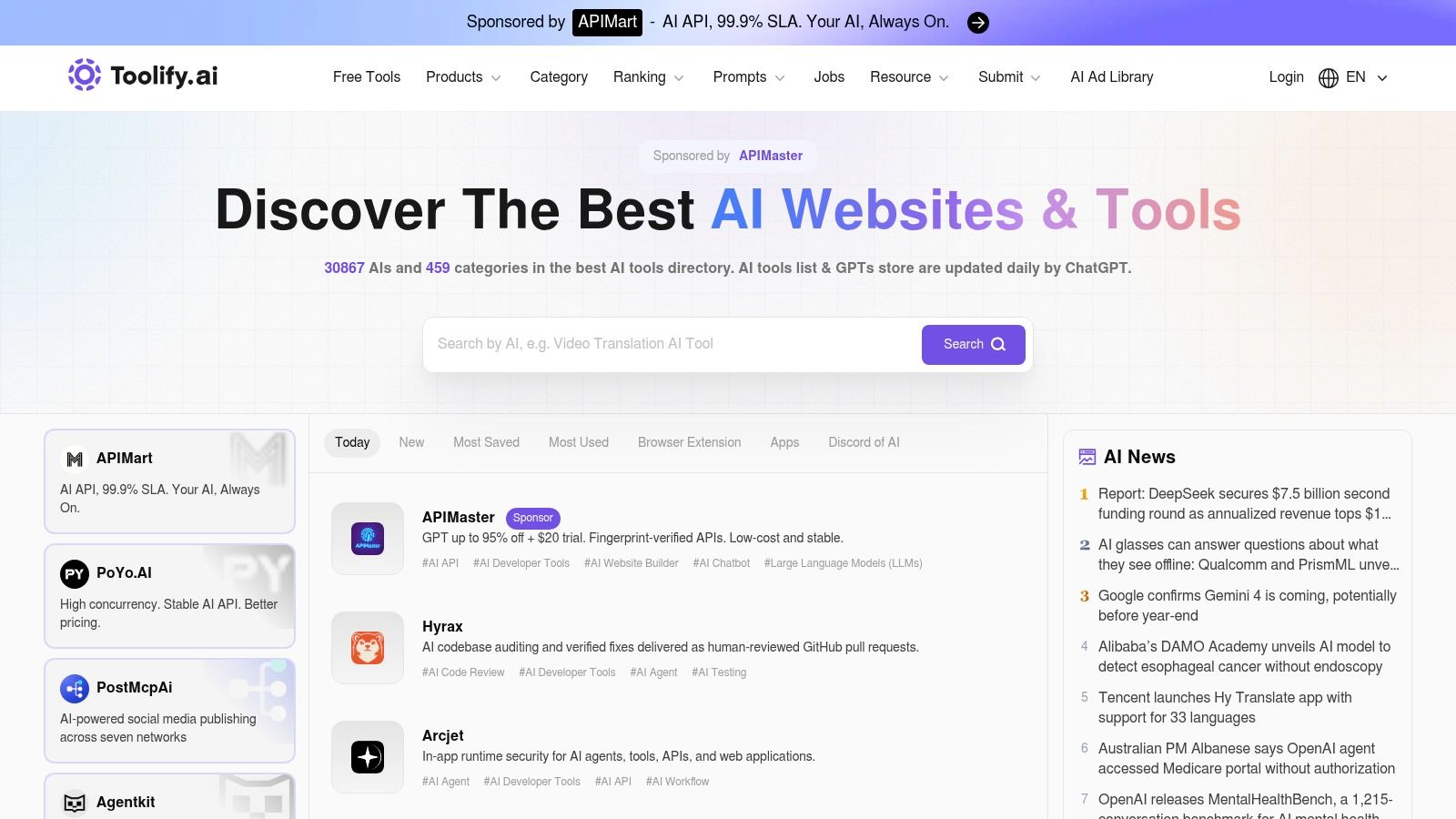
Toolify.ai is designed for large-scale scanning. Its categories, trending and new-tool views, and adjacent GPT application index support broad market research rather than editorial judgment. This makes it useful for mapping competitors, comparing alternatives, and identifying products that deserve closer review.
The platform answers discovery questions that narrower directories may leave open: which products occupy a category, how tools cluster around a task, and which recent listings warrant investigation. Analysts and marketers can use that breadth to build a research set before testing individual products.
Why breadth matters
Category structure matters in a fragmented AI market. Toolify.ai reported that AI Business Tools contained 789 tools as of September 23, 2026 (Toolify categories). The category count illustrates the platform's scanning role, but it does not by itself show whether listings are current, distinct, or useful for a particular workflow.
Trending and new-tool views add a time-based filter. A static directory shows what has been listed, while a current view helps determine what to inspect first. Neither view replaces checks of product quality, reliability, or long-term relevance.
A practical workflow is to select candidates by category, compare their stated use cases, then verify each product on its own website. Check current features, integrations, availability, security information, and pricing. Also look for duplicate entries, discontinued services, and descriptions that no longer match the live product.
Makers can use Toolify.ai as a category and positioning reference. The strongest listing makes its audience, use case, and core differentiator clear without unsupported promises. That information helps buyers decide whether a second click is worthwhile.
Toolify.ai suits high-volume market research, provided users treat its catalog as a discovery layer rather than a final evaluation.
6. Future Tools
Future Tools takes the opposite approach to a mega-index. It emphasizes human curation, editorial reviews, categories, and a newsletter, making it more useful for readers who want someone to filter the market before they invest time in evaluation.
That editorial layer changes the question from “what tools are listed?” to “which tools appear worth attention?” It can help users who feel overwhelmed by endless alternatives, especially when a category includes products with similar landing pages and overlapping feature claims.
Editorial judgment as a filter
The reviews and newsletter provide context that a short directory description can't. A reader can discover a tool through a category, then use editorial material to understand its intended audience, practical role, and relationship to wider AI developments. This is valuable for professionals who want informed recommendations rather than raw inventory.
The audience also overlaps with people following AI news and workflows, which can make editorial placement relevant for makers. Paid placements and advertising opportunities may provide additional visibility, but promotional exposure should be assessed separately from editorial judgment.
Editorial filter: Use a curated directory to decide what deserves testing, not to skip the testing itself.
The deliberate limitation
Future Tools has a smaller catalog than the largest indexes by design. That reduces noise but also means some specialist or newly launched products may not appear. Buyers conducting a thorough market scan should supplement it with a broader directory, while makers should recognize that editorial relevance matters more here than just submitting a product.
The platform is a good fit for users who value opinionated selection, ongoing coverage, and category context. For teams researching workplace use cases, a curated collection of AI productivity tools can provide a faster route to a testable shortlist than an undifferentiated catalog.
Future Tools is best for editorial filtering and informed discovery, especially when the buyer wants context before comparing products directly.
7. AI Tool Hunt
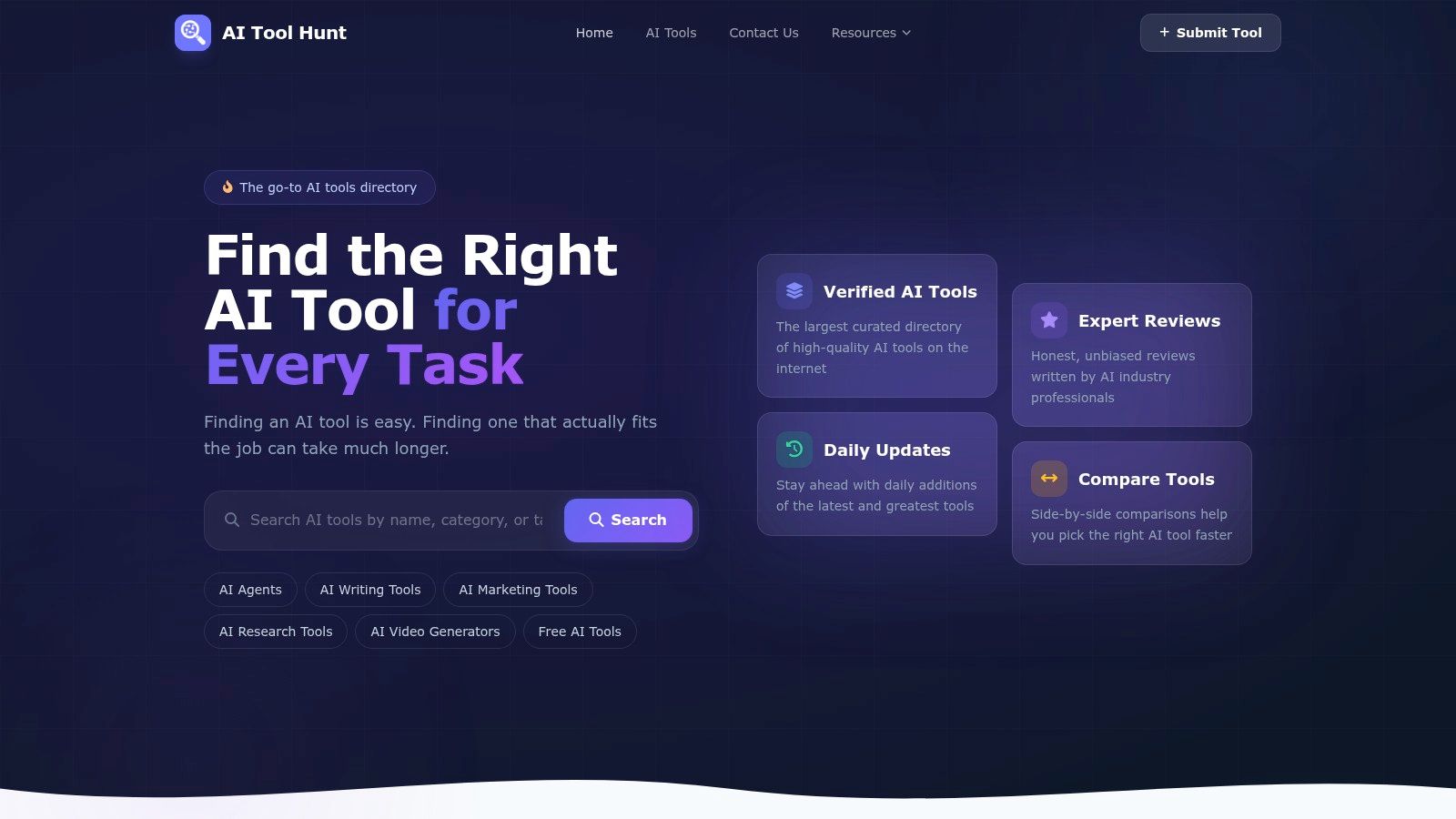
AI Tool Hunt is designed for practical comparison. Users can browse by use case and pricing model, including free, freemium, and paid options, then narrow the field around common startup workflows such as marketing, coding, and design.
That pricing-oriented structure solves an immediate discovery problem. A founder may not need the theoretically strongest tool. They may need something that handles a defined task within a constrained budget, or a free option suitable for an initial experiment. Filtering by both job and commercial model makes that first shortlist more realistic.
Useful filters for fast shortlists
AI Tool Hunt is particularly helpful when a team is comparing familiar workflow categories. It provides a straightforward route from “we need help with design” to “which products fit our preferred pricing model?” That doesn't answer every procurement question, but it removes irrelevant options early.
The submission flow also gives makers a low-friction route to listing a product. A founder should still prepare accurate information before submitting, because a simple intake process doesn't eliminate the need for clear positioning or external validation.
Why secondary checks remain essential
AI Tool Hunt has a smaller brand footprint than the largest directories. That can mean less discovery volume, but it may also make the browsing experience more focused. The right way to use it is as a shortlist builder, followed by checks on the live product site.
Confirm whether the stated pricing model reflects current access, whether the free tier has meaningful limits, and whether the product supports the use case selected. Those details change quickly across AI software, and directory labels can lag behind vendor updates.
AI Tool Hunt is a sensible option for budget-aware task discovery, while makers benefit from its clear submission path and workflow-oriented categories.
8. AITools.fyi
AITools.fyi keeps discovery simple. Its categories cover business, creative, developer, productivity, image-generation, and agent-related work, while its search-first layout supports quick lookups. For a user who already knows the broad type of tool they need, that low-friction structure can be more useful than a dense editorial interface.
The directory also gives makers an accessible submission route. That matters in a market where new products need to appear in relevant category pages quickly, but accessibility shouldn't be confused with endorsement. The user still needs to verify the product independently.
A clean route to category discovery
AITools.fyi works well for basic orientation. A marketer can browse a creative category, a developer can look through relevant technical segments, and a buyer can use the search interface to identify candidates without learning a complicated navigation system.
Its categories also support a useful semantic shift. Buyers increasingly search for workflows and jobs rather than generic “AI.” A directory that groups tools around practical tasks gives users a better starting point than an alphabetical catalog.
The curation trade-off
Listing depth and editorial review are lighter than on platforms built around detailed evaluations. That means the directory is efficient for finding candidates, but weak as a standalone source for deciding between them. Check the vendor's site for current functionality, pricing, integrations, support, and data policies before recommending a tool.
For makers, the low-friction submission process is helpful, but the listing must do the explanatory work. State what the product does, who it's for, and which task it replaces or improves. Avoid broad claims that can't be demonstrated on the destination page.
AITools.fyi is best for quick category lookups and accessible listing discovery, with external validation required before adoption.
9. Toolnest
Toolnest is more evaluative than a simple link directory. It combines tool discovery with reviews, alternative comparisons, an “Ask AI” assistant, and “Top tools this month” snapshots. That makes it useful when the user has already found a possible solution but needs help narrowing the alternatives.
The comparison angle is especially practical. AI products often overlap, and a buyer may struggle to understand whether a second tool adds meaningful value or merely repeats the first tool's features. A page that surfaces alternatives supports a more disciplined shortlist.
Context for the second decision
Toolnest's assistant can help users describe a need in natural language and identify matching options. Its monthly top-tool views add a momentum signal, which can help researchers notice products receiving attention. Those signals remain directional. They don't establish reliability, suitability, or performance for a particular organization.
The platform is therefore strongest in the middle of the buying journey. It isn't necessarily where you begin if you need exhaustive coverage, and it shouldn't be where you stop before checking the vendor's current terms. It helps answer, “What else should I compare?”
What smaller inventory means
Toolnest has a smaller overall inventory than mega-indexes. That limits its value for thorough analysis, but it can make the evaluation experience more manageable. Makers may find value in being presented alongside alternatives because the comparison context shows how clearly the product occupies a distinct position.
Use Toolnest when you need context, alternatives, and a narrower decision set. For the strongest result, write down the task and firm constraints before using the assistant, then verify every recommendation against the product website.
10. Product Hunt Artificial Intelligence Topic
Product Hunt's Artificial Intelligence topic is a living launch feed, not a conventional AI-only catalog. Daily launches, rankings, comments, maker questions, and public discussion make it valuable for finding products at the point of release and reading early reactions from an active startup and early-adopter audience.
The discussion layer is the differentiator. A conventional directory may tell you what a product claims to do. Product Hunt comments can reveal what users liked, what confused them, and which objections appeared during launch. That feedback is informal, but it gives buyers more context than a polished feature list.
Why launch-day evidence matters
For makers, Product Hunt offers a public moment to explain the product, answer questions, and observe how the market interprets the positioning. For buyers, launch pages can reveal whether the product's promise is clear enough for people outside the founding team.
Historical browsing and AI topic filters also help researchers track how product categories develop over time. The platform can expose new entrants that haven't yet appeared in established directories, making it useful for early market sensing.
The important caveat
Exposure depends on launch-day performance and community engagement. Product quality varies, and a successful launch conversation doesn't prove long-term usefulness. Product Hunt also covers technology broadly, so users looking for a complete AI catalog should pair it with a dedicated directory.
Product Hunt's AI topic is best for day-zero discovery, public feedback, and launch observation. Makers preparing for that environment may also want to review Product Hunt alternatives rather than relying on one launch channel.
Top 10 AI Tools Directories Comparison
| Platform | Key features ✨ | Visibility & Quality ★ | Price & Value 💰 | Target & USP 👥/🏆 |
|---|---|---|---|---|
| 🏆 SubmitMySaas | Daily launches, trending, curated categories, launch package (badge + 35+ DR backlinks) | 4.5★, strong targeted reach + SEO/backlink boost | 💰 $, sponsor slots ~$30/wk; ads ~ $79/mo; launch pkg (contact) | 👥 Founders, makers, product-hunters, USP: immediate SEO credibility & launch-day exposure |
| Futurepedia | Massive taxonomy, wiki/education, courses | 4★, excellent breadth for market scans | 💰 $, mostly free; high research value | 👥 Researchers, broad AI audience, USP: huge indexed coverage + learning layer |
| There's An AI For That (TAAFT) | Task-first indexing, leaderboard, fast search | 4★, popular with indie builders; high discoverability | 💰 $, free listings common | 👥 Indie founders, marketers, USP: task-oriented search + trending leaderboard |
| TopAI.tools | Task → recommended tool → execution path guidance | 4★, actionable discovery, practical UX | 💰 $, free/varies | 👥 Professionals needing execution plans, USP: workflow & execution guidance |
| Toolify.ai | Massive coverage, trending snapshots, GPT-store index | 4★, broad comparability & quick vetting | 💰 $, free/varies | 👥 Market scanners, researchers, USP: GPT apps index + category counts |
| Future Tools | Human curation, reviews, newsletter | 4.5★, high editorial quality & signal-to-noise | 💰 $, paid placements available | 👥 AI-savvy users seeking curated picks, USP: opinionated reviews & newsletter audience |
| AI Tool Hunt | Browse by use case & pricing, maker submission | 3.5★, practical filters for shortlists | 💰 $, free listings; budget-friendly | 👥 Startups & budget-conscious teams, USP: pricing filters + simple submission |
| AITools.fyi | Category taxonomy, maker submission, search-first | 3.5★, easy navigation, fast lookups | 💰 $, low-friction/mostly free | 👥 Makers & quick-search users, USP: very low barrier to list tools |
| Toolnest | Comparisons, "Ask AI" assistant, monthly top lists | 4★, evaluative, research-friendly | 💰 $, free/varies | 👥 Researchers & pros, USP: built-in assistant for shortlist recommendations |
| Product Hunt, AI Topic | Daily launches, rankings, comments, maker Q&A | 4★, high community engagement & sentiment signals | 💰 $, free; visibility depends on launch performance | 👥 Early adopters, US startup community, USP: public discussions + launch-day feedback |
Turn Directory Discovery Into a Shortlist
The best AI tools directory is the one that matches your next decision. If you're still defining the problem, start with a task-based platform such as There's An AI For That or TopAI.tools. These directories translate a job into possible products or workflows, which is more efficient than browsing a broad category without a clear outcome.
Next, broaden the search through a large index such as Futurepedia or Toolify.ai. This step catches alternatives, adjacent products, and newer entrants that a narrower recommendation may miss. Broad scanning is particularly important because directory counts and launch activity show how quickly the market changes. One 2026 analysis estimated about 14,200 active AI tools worldwide in early 2026, up 68% year over year, while broader directory counts are higher because they can include dormant or duplicated listings (AI tools directory analysis).
Then use curated sources such as Future Tools or Toolnest for context. Editorial reviews and comparison features can reduce noise, but they don't eliminate the need to check the live product. Confirm the current pricing, limits, integrations, privacy terms, export options, support model, and availability on the vendor's own website. Directory data is useful for discovery, not a substitute for procurement research.
A practical validation sequence looks like this:
- Define the job: Write the desired outcome in plain language, such as “turn customer interviews into searchable notes,” rather than “find an AI productivity tool.”
- Build a mixed shortlist: Include task-based, broad, curated, and launch-oriented sources so you don't inherit one directory's blind spots.
- Check current facts: Verify pricing, feature access, integrations, and availability on each product's website.
- Test the core workflow: Use a realistic input and judge the output, editing effort, speed, and fit with existing processes.
- Record the decision: Note why each candidate passed or failed, so the team doesn't repeat the same research later.
The scale of the audience makes relevance more important than catalog size. One 2026 roundup reported that 35.49% of people use AI tools every day, while another summary reported more than one billion people use standalone AI tools each month (AI adoption overview). Those figures are from industry roundups, not a guarantee that every directory reaches that audience. They do show why search intent, current information, and clear fit signals matter to both buyers and makers.
Makers need a separate submission workflow. Start with category fit. A tool listed under a vague or inaccurate category may receive less relevant attention, even if the directory has reach. Write a concise positioning statement that identifies the user, the task, and the product's distinct value. Keep feature descriptions, pricing labels, screenshots, and destination links accurate, and check whether the platform requires a particular image format, review process, or launch schedule.
Launch timing also matters. SubmitMySaas, Product Hunt, and similar platforms can expose a product near release, but visibility isn't guaranteed. Traffic, feedback, backlinks, and conversions depend on audience fit, presentation, timing, editorial decisions, and the product itself. Treat directory submission as a distribution experiment, not a promised growth outcome.
For a broader view of how people discover software, the Fundl guide to app discovery is a useful complement to directory research. The central lesson is simple: use multiple discovery jobs, then validate the final shortlist where the product operates.
SubmitMySaas gives SaaS and AI makers a focused place to launch, appear in curated categories, and build ongoing discovery through daily launches, trending lists, and roundups. If you want to pair directory research with launch exposure and backlink opportunities, visit SubmitMySaas and review the current submission options before publishing your product.