The 12 Best New AI Tools and Discovery Platforms for 2026
Tired of the hype? Discover the 12 best new AI tools and platforms that actually deliver. Our curated list helps you find, test, and launch what's next.
The AI landscape is exploding, with thousands of new tools launching every month. For users, it's a constant challenge to separate groundbreaking tech from fleeting trends. For founders, getting noticed in this crowded market is harder than ever. This guide cuts through the noise. We've curated a definitive list of the 12 best platforms and directories where you can discover, evaluate, and even launch the best new AI tools.
This article is your starting point for what's new and what's next in AI. Instead of a generic list, we provide a strategic guide to the discovery process itself. We'll show you exactly where to look, whether you are a builder seeking your first users or a professional hunting for a productivity breakthrough. Each platform review includes screenshots, direct links, and an analysis of its core strengths, so you can quickly pinpoint the right discovery channel for your specific goals.
Navigating the vast landscape of AI innovation becomes more manageable when you focus on specific categories and reviews, such as those dedicated to specialized AI video tools, to quickly identify solutions relevant to your needs. This curated approach helps you filter out irrelevant options and concentrate on the tools that can truly impact your workflow. Our comprehensive list covers everything from community-driven launchpads like Product Hunt to enterprise-grade marketplaces from AWS and Microsoft, ensuring you find exactly what you're looking for. Let’s dive into the platforms that matter most.
1. Product Hunt — Artificial Intelligence
For anyone hunting for the best new AI tools fresh out of development, Product Hunt's dedicated Artificial Intelligence topic hub is an essential daily resource. It's not a single tool but rather a dynamic launchpad where founders and makers debut their creations to an engaged community of early adopters. This platform provides a real-time pulse on what's trending in the AI space, making it invaluable for discovering innovative applications before they hit the mainstream.
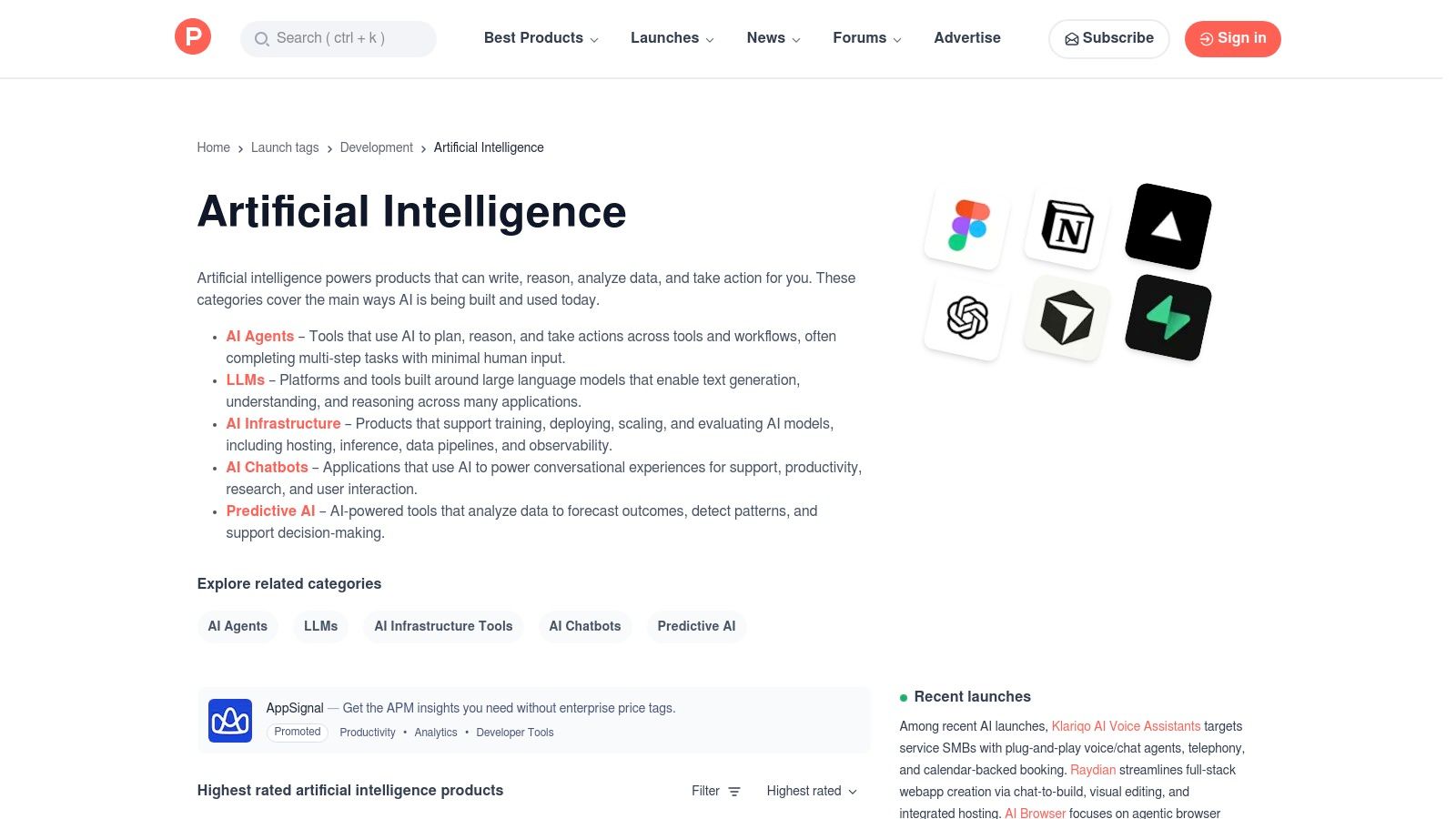
The platform’s strength lies in its community-driven curation. Users upvote products they find promising, pushing the most compelling tools to the top of the daily leaderboard. This social proof, combined with genuine user comments and reviews, offers a layer of validation that a simple directory cannot.
Key Features & User Experience
Navigating the AI section is straightforward. You can filter the feed by subcategories like AI Agents, LLMs, and Chatbots, or sort by recent launches versus the highest-rated tools. This makes it easy to drill down into specific areas of interest. The interface is clean, focusing on the products themselves, with direct links to their official websites for immediate access or purchase.
- Pros: It’s updated daily, offering the most current view of the AI landscape. The community votes and discussions provide crucial social proof and initial user feedback.
- Cons: Visibility can be influenced by marketing hype rather than just product quality. Detailed enterprise pricing or deep technical specifications are often not available directly on the listing.
Product Hunt is completely free to access and browse. It’s an indispensable discovery platform for founders seeking inspiration, marketers looking for the next big thing, and anyone eager to experiment with cutting-edge AI technology. For those interested in similar platforms, exploring some Product Hunt alternatives can provide additional avenues for discovering new software.
Visit Product Hunt - Artificial Intelligence
2. G2 — Artificial Intelligence Software
While Product Hunt is the launchpad for brand new tools, G2's Artificial Intelligence Software category is the definitive marketplace for established, business-ready solutions. It serves as a critical resource for mid-market and enterprise buyers who need to conduct due diligence. Instead of focusing on initial hype, G2 provides a deep repository of verified user reviews, detailed feature comparisons, and comprehensive buyer guides to help organizations make informed purchasing decisions.
The platform’s core strength is its structured data and verified feedback. G2’s proprietary Grid reports visually map out market leaders based on satisfaction and market presence, offering an at-a-glance understanding of the competitive landscape. This rigorous, data-driven approach is invaluable for teams comparing vendors for complex, high-stakes deployments.
Key Features & User Experience
Navigating G2’s AI ecosystem is built for business buyers. Users can filter listings by company size, industry, and specific features, ensuring the results are relevant to their organizational needs. The taxonomy is frequently updated with emerging categories like Agent Builders and AppSec Assistants, reflecting the rapid evolution of AI technology.
- Pros: The sheer volume of verified user reviews and in-depth feature comparisons is unmatched. Its powerful filtering capabilities allow users to narrow down the best new AI tools for their specific use case and company profile.
- Cons: Sponsored placements can influence the visibility of certain products. The platform often favors established enterprise vendors, so the newest indie tools might not be featured prominently.
G2 is free to browse for buyers. It is an essential platform for decision-makers who need to vet and compare AI software based on real-world performance and peer experiences, moving beyond launch-day excitement to practical implementation.
Visit G2 - Artificial Intelligence Software
3. Capterra — Artificial Intelligence Software
For SMB teams and non-technical decision-makers, Capterra’s Artificial Intelligence Software directory offers a structured and business-centric approach to discovering the best new AI tools. Unlike community-driven launchpads, Capterra functions as a comprehensive software marketplace, complete with verified user reviews, detailed buyer guides, and transparent pricing overviews that simplify the procurement process. It excels at helping users evaluate established and emerging AI solutions side-by-side.
The platform's value lies in its moderated and organized environment. Each listing is vetted, and user reviews provide practical insights from real-world business applications. This makes it a reliable resource for teams needing to shortlist AI software based on specific operational requirements and budget constraints, rather than just industry hype.
Key Features & User Experience
Navigating Capterra's AI section is highly efficient for comparison shopping. You can sort tools by Highest Rated or Most Popular and apply filters for specific features, pricing models, or company sizes. The interface presents concise feature summaries and clear pricing snippets directly on the listing cards, allowing for rapid evaluation.
- Pros: Clear pricing information and feature summaries enable quick, at-a-glance comparisons. It is an excellent resource for non-technical teams looking to shortlist vetted tools.
- Cons: Sponsored listings are integrated with organic results, which can influence visibility. The platform features fewer "brand-new today" tools compared to community launch sites.
Capterra is free for users browsing and comparing software. It is an ideal platform for business leaders who need to make informed purchasing decisions and want a clear, comparative view of the AI software market without the noise of daily product launches.
Visit Capterra - Artificial Intelligence Software
4. OpenAI — GPT Store / ChatGPT App Directory
For those already integrated into the OpenAI ecosystem, the GPT Store represents a pivotal evolution, turning ChatGPT from a singular tool into a multifaceted platform. It functions as a curated marketplace directly within the ChatGPT interface, where developers and enthusiasts can build and share custom GPTs designed for specific tasks. This direct integration makes discovering and deploying specialized AI applications incredibly seamless.
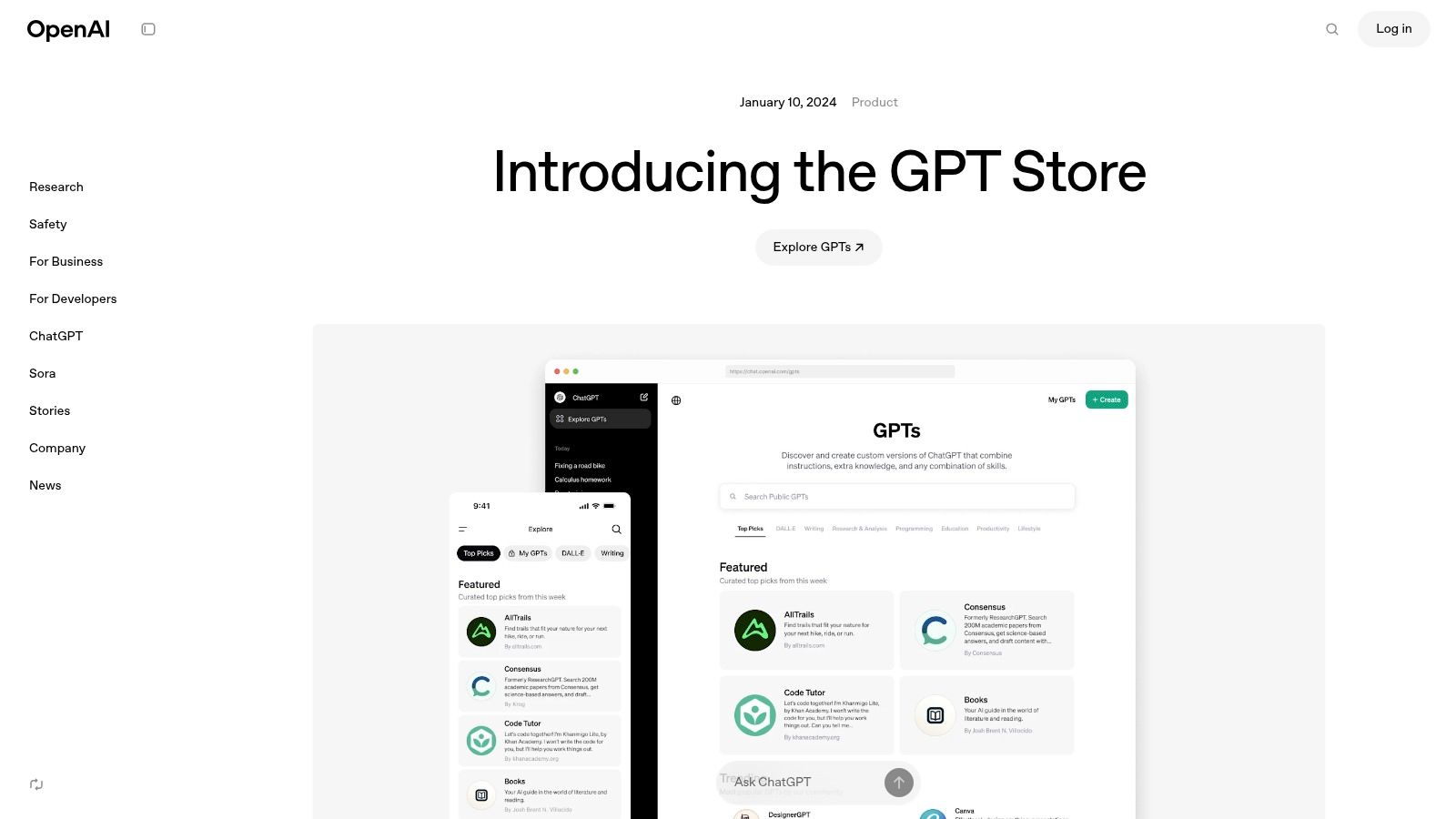
The store’s main advantage is its low-friction user experience. You can find a GPT for almost any niche, from creating presentation slides to analyzing complex code, and use it instantly without leaving your chat window. This accessibility makes it one of the best new AI tools for both casual users and professionals seeking to augment their workflows with targeted AI capabilities.
Key Features & User Experience
Navigating the store is simple, with leaderboards highlighting trending and featured GPTs across categories like Writing, Productivity, and Education. Enterprise and Team workspaces can also create private, secure sections for internal-use GPTs. For hands-on experimentation and prompt engineering with OpenAI models, delve into resources like the OpenAI Playground.
- Pros: Directly usable inside ChatGPT, offering a frictionless way to try new tools. Features strong curation and regular featured picks to highlight quality applications.
- Cons: Monetization and analytics for builders have been inconsistent, creating a varied experience for creators. Access requires a ChatGPT account, with full access often dependent on a Plus, Team, or Enterprise subscription.
While browsing is free, using the custom GPTs requires a ChatGPT Plus subscription or higher-tier plan. It stands as a powerful, integrated discovery engine for anyone looking to unlock the full potential of customized AI assistants.
Visit OpenAI - GPT Store
5. Hugging Face — Spaces and Models Hub
For developers, researchers, and AI enthusiasts wanting direct access to cutting-edge models, Hugging Face is the definitive open-source hub. It's less of a curated business tool directory and more of a massive, collaborative library where the global AI community shares models, datasets, and runnable demos called "Spaces." This platform is unparalleled for exploring the raw, innovative power of the latest research-grade AI tools.
The platform’s core strength is its transparency and reproducibility. Users can not only test AI applications directly in their browser via Spaces but also inspect the underlying code, models, and datasets. This open approach makes it an essential resource for anyone looking to build upon the latest advancements or verify the capabilities of a specific model.
Key Features & User Experience
The platform is divided into key areas: Models, Datasets, and Spaces. The Spaces directory is particularly useful for discovering the best new AI tools, allowing you to filter by trending, most liked, or recently updated demos across text, image, video, and audio generation. The interface is technical but highly functional, providing deep documentation, versioning, and deployment options via Gradio or Docker.
- Pros: It’s extremely current with research-grade and indie projects. The open-source nature ensures transparent code and high reproducibility.
- Cons: Quality varies widely since many demos are experimental. It offers less business-oriented packaging (like security or SLAs) unless you opt for paid enterprise hosting plans.
Accessing and exploring Hugging Face is free. It’s an indispensable platform for anyone needing to find, test, and deploy state-of-the-art AI models, from indie developers experimenting with new ideas to large teams integrating foundational models into their products.
Visit Hugging Face - Spaces
6. AWS Marketplace — Machine Learning and Generative AI
For teams building AI applications within the Amazon Web Services ecosystem, the AWS Marketplace for Machine Learning is a critical procurement hub. It’s less a discovery platform for consumer apps and more an enterprise-grade catalog where developers can find, subscribe to, and deploy hundreds of pre-trained models and algorithms directly into their existing AWS infrastructure. This makes it one of the best new AI tools for businesses needing compliant, secure, and scalable solutions.
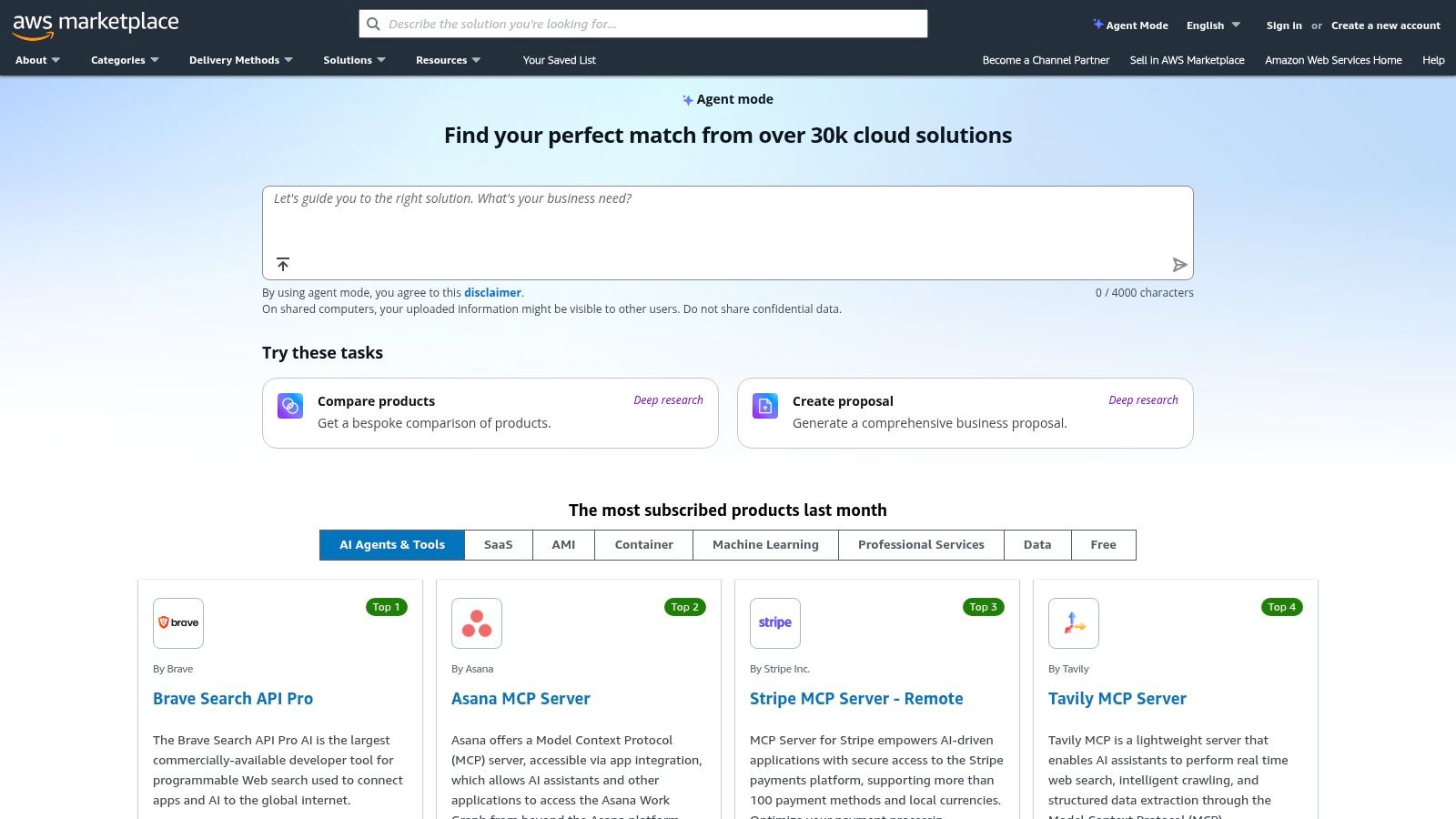
Its primary strength is its seamless integration with Amazon SageMaker and other AWS services. This allows for one-click deployments and consolidated billing, removing significant friction from the procurement and implementation process for organizations already invested in AWS. The marketplace provides a trusted environment where models are vetted for security and performance.
Key Features & User Experience
Navigating the marketplace feels familiar to any AWS user. You can filter solutions by categories like Natural Language Processing (NLP), Computer Vision, and Speech Recognition, or by provider. Each listing includes detailed documentation, pricing models (often usage-based), and user reviews, enabling informed decision-making before deployment.
- Pros: It offers enterprise-ready procurement with robust security, governance, and integrations. Everything is consolidated under your existing AWS bill, simplifying accounting.
- Cons: It requires an AWS account and a good degree of cloud expertise to manage and deploy the models effectively. The focus is strictly on back-end models, not user-facing applications.
Access to browse the AWS Marketplace is free, but deploying models incurs costs based on usage and subscription fees. It's an essential resource for engineering teams that need to quickly integrate powerful, third-party AI capabilities into their products without building from scratch.
Visit AWS Marketplace - Machine Learning
7. Microsoft Marketplace — AI Apps and Agents
For organizations deeply integrated into the Microsoft ecosystem, the unified Marketplace is a critical hub for discovering enterprise-grade AI solutions. Its dedicated "AI Apps and Agents" category serves as a curated catalog of vetted applications designed to seamlessly extend the functionality of Microsoft 365, Dynamics 365, and Azure. This is the go-to destination for businesses seeking compliant, integrated, and scalable AI tools that align directly with their existing technology stack.
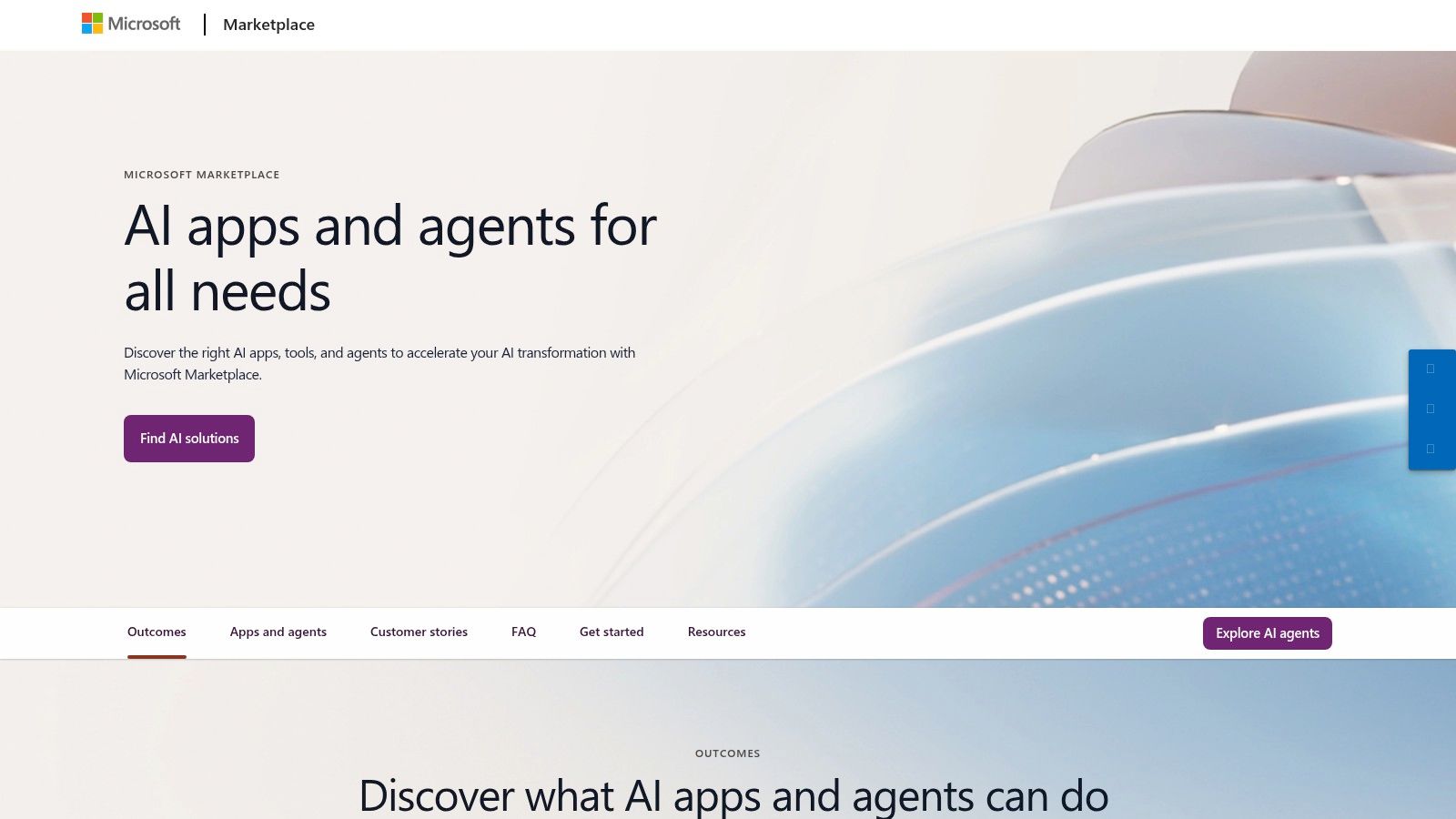
The platform’s core strength is its focus on enterprise readiness. Unlike public launchpads, every application listed has passed Microsoft's validation process, ensuring a higher standard of security, compliance, and integration. This makes it one of the best sources for new AI tools that are built for professional environments, offering solutions that leverage familiar platforms like Copilot and the Power Platform.
Key Features & User Experience
Navigating the marketplace is straightforward, with powerful filtering options to narrow down solutions by product compatibility (e.g., Teams, Power BI), publisher, or pricing model. The interface is clean and professional, providing clear pathways to trial or purchase applications directly through existing Microsoft billing arrangements. Many apps can be discovered and deployed from within the Microsoft products themselves, creating a cohesive user experience.
- Pros: It provides enterprise-ready vetting and seamless Microsoft billing/integration. The wide catalog features partner AI apps built specifically for the Microsoft stack.
- Cons: It is heavily focused on business scenarios, with fewer indie or consumer tools. Some offers require tenant or administrator permissions to try or install.
Access to browse the Microsoft Marketplace is free. However, the AI applications listed come with various pricing models, from free trials to subscription-based and pay-as-you-go licenses, managed through your organization's Microsoft account.
Visit Microsoft Marketplace - AI Apps and Agents
8. SubmitMySaas — Launch & Discovery Platform
For founders and indie makers, getting initial visibility for their new AI tools is a significant challenge. SubmitMySaas offers a purpose-built launch and discovery platform focused specifically on SaaS and AI, providing a streamlined path to early traction. Unlike massive marketplaces, it acts as a curated directory where new products can gain exposure through featured listings, daily launches, and monthly roundups.
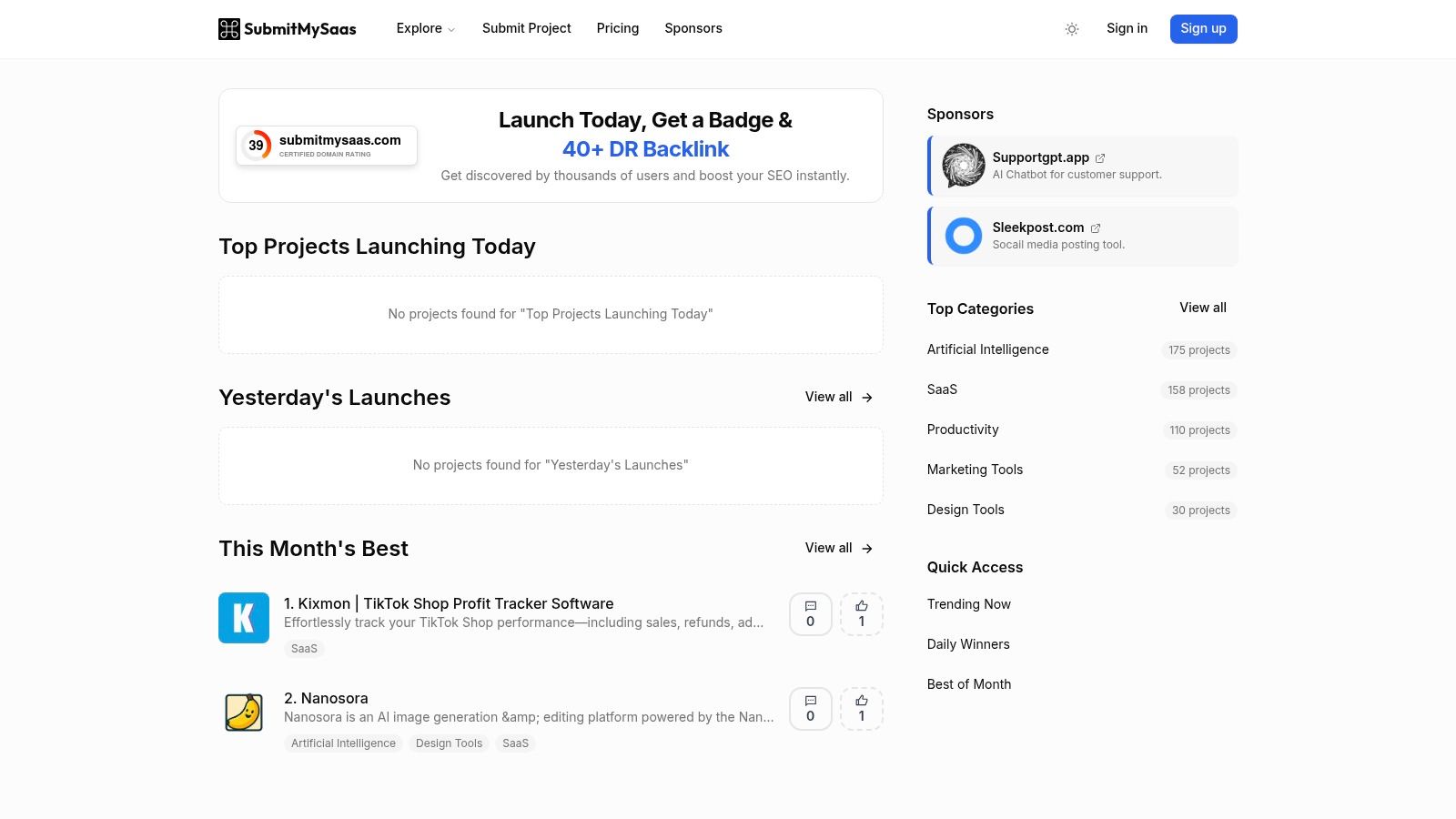
The platform’s core value lies in its focus on discoverability for new entrants. By submitting a tool, makers can secure valuable backlinks and get their product in front of an engaged audience of early adopters, tech enthusiasts, and marketing professionals actively searching for the best new AI tools to solve specific problems.
Key Features & User Experience
Navigating SubmitMySaas is simple, with clear categories for Artificial Intelligence, Productivity, and Marketing. Users can quickly browse trending tools or view the daily winners, making it easy to see what’s currently capturing attention. The product write-ups are practical and concise, highlighting core features and use cases without overwhelming marketing fluff.
- Pros: It's purpose-built for new tools, making it easier to achieve early discovery versus competing on larger platforms. The write-ups are practical and focus on core utility.
- Cons: The platform has a smaller catalog compared to mega-directories. The SEO and backlink benefits depend on the site's ongoing authority and your tool's specific niche.
While browsing is free for users, makers can choose from various submission packages to get listed. It’s an effective resource for founders needing a launchpad and for anyone interested in discovering under-the-radar AI software. For makers, understanding the launch process is key, and resources explaining how to launch a SaaS product can complement the platform's offerings.
Visit SubmitMySaas — Launch & Discovery Platform
9. Futurepedia — AI Tools Directory and Newsletter
Futurepedia has established itself as one of the largest and most referenced AI tool directories available today. For anyone looking to get a comprehensive overview of the AI landscape, it serves as a massive, categorized library. Its primary value is in its sheer scale, offering a searchable database of thousands of tools that can be filtered across dozens of specific use cases, from marketing and design to coding and productivity. This makes it an excellent resource for broad discovery and market research.
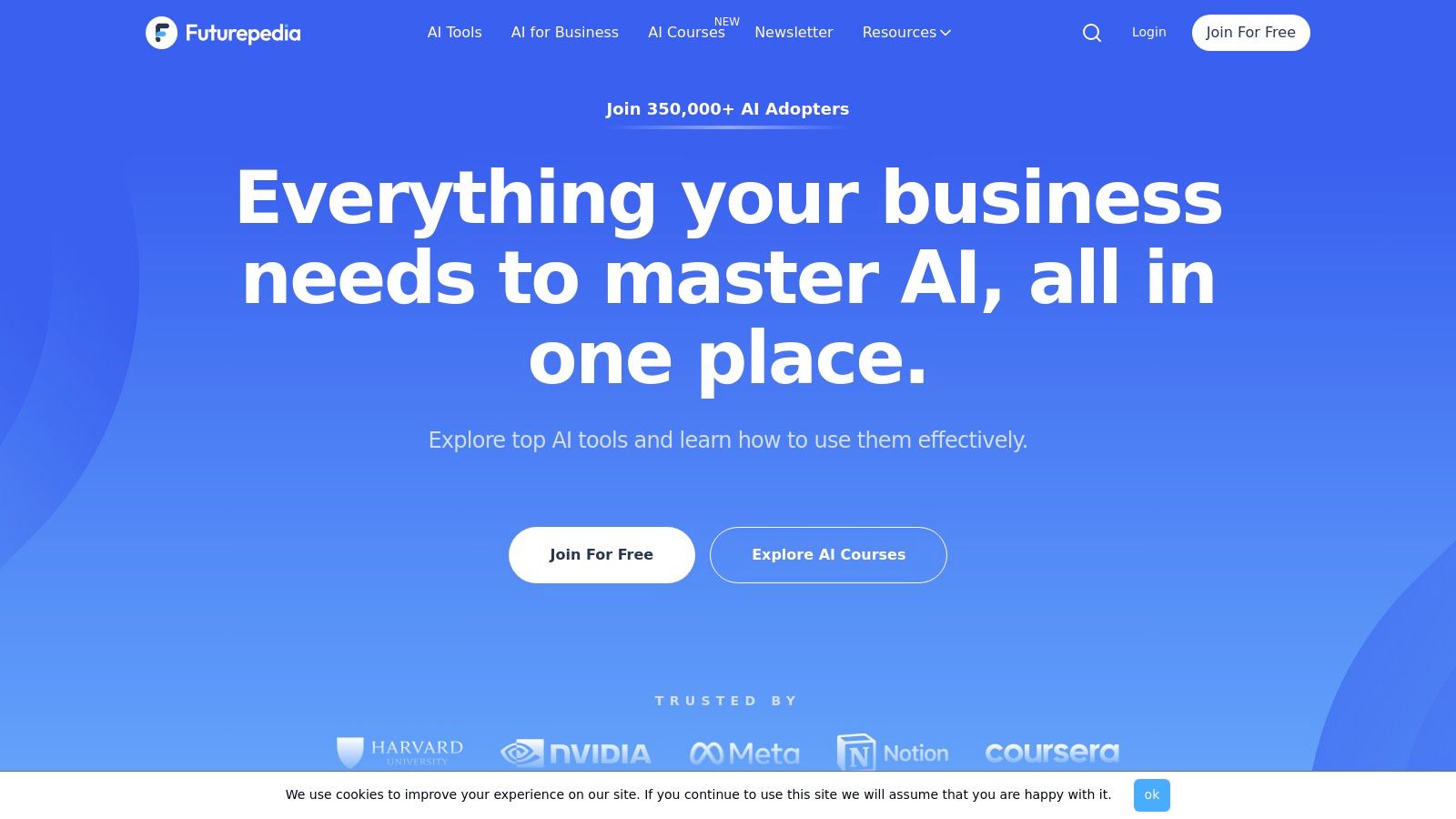
Beyond its directory function, Futurepedia curates a popular newsletter that highlights new and noteworthy tools, providing editorial visibility that can significantly boost a new product's launch. This dual approach as both a passive directory and an active promotional platform makes it a key destination for founders and users alike.
Key Features & User Experience
The user interface is built for rapid discovery. You can quickly browse categories like Image Generation or Video Editing, or use the search bar to find specific solutions. For founders, the platform offers submission tiers, including a "Verified Listing" option that guarantees promotional perks, which is a common strategy for gaining traction on a high-traffic website to promote a new SaaS.
- Pros: The massive, well-categorized database is extremely useful for finding tools for almost any niche. The newsletter provides valuable editorial exposure for new tools.
- Cons: The presence of paid submission tiers can sometimes crowd out organic discovery, potentially favoring tools with a marketing budget over those with superior technology. Actual referral traffic from a listing can vary widely.
Accessing and browsing Futurepedia is free for users. Founders can submit their tools for free, with paid options available for enhanced visibility. It’s a go-to platform for anyone searching for the best new AI tools and for makers seeking a large audience.
Visit Futurepedia
10. There’s An AI For That (TAAFT)
For those overwhelmed by the sheer volume of AI tools and unsure where to start, There’s An AI For That (TAAFT) provides a solution. Instead of focusing on brand names, TAAFT is a massive aggregator that maps AI capabilities to specific tasks. It’s built for use-case-driven discovery, allowing anyone to find the right tool by simply describing what they need to accomplish, making it one of the best new AI tools for practical problem-solving.
The platform’s core strength is its task-first approach. Rather than browsing endless lists, you can search for "create a logo," "summarize a PDF," or "generate a marketing slogan," and TAAFT will present a curated list of tools designed for that exact purpose. This makes it incredibly accessible for non-technical users who care more about the outcome than the underlying technology.
Key Features & User Experience
Navigating TAAFT feels like using a search engine built exclusively for AI. The homepage features a prominent search bar inviting users to state their needs. The database is vast, covering everything from professional applications like Code Assistants and SEO to creative pursuits like Music Generation and Video Editing. The interface is minimal, prioritizing quick access to tool listings and their primary functions.
- Pros: The task-based mapping is brilliant for non-experts, and its sheer breadth covers countless niche use cases. The database is updated frequently with new submissions.
- Cons: The level of detail for each tool listing can be inconsistent. Quality control varies, as it relies heavily on maker submissions and community reporting.
TAAFT is free to use, serving as an essential directory for anyone looking to leverage AI for a specific job. Its focus on function over form makes it a highly efficient resource for finding the perfect AI assistant for virtually any task imaginable.
Visit There’s An AI For That
11. Toolify.ai — AI Tools Directory
For those seeking a comprehensive encyclopedia of AI tools, Toolify.ai serves as a massive, actively updated directory. It functions less like a launchpad and more like a library, cataloging thousands of applications across a wide spectrum of categories. This makes it an excellent resource for anyone performing deep research or looking for the best new AI tools to solve a very specific problem, from text-to-video generation to specialized coding assistants.
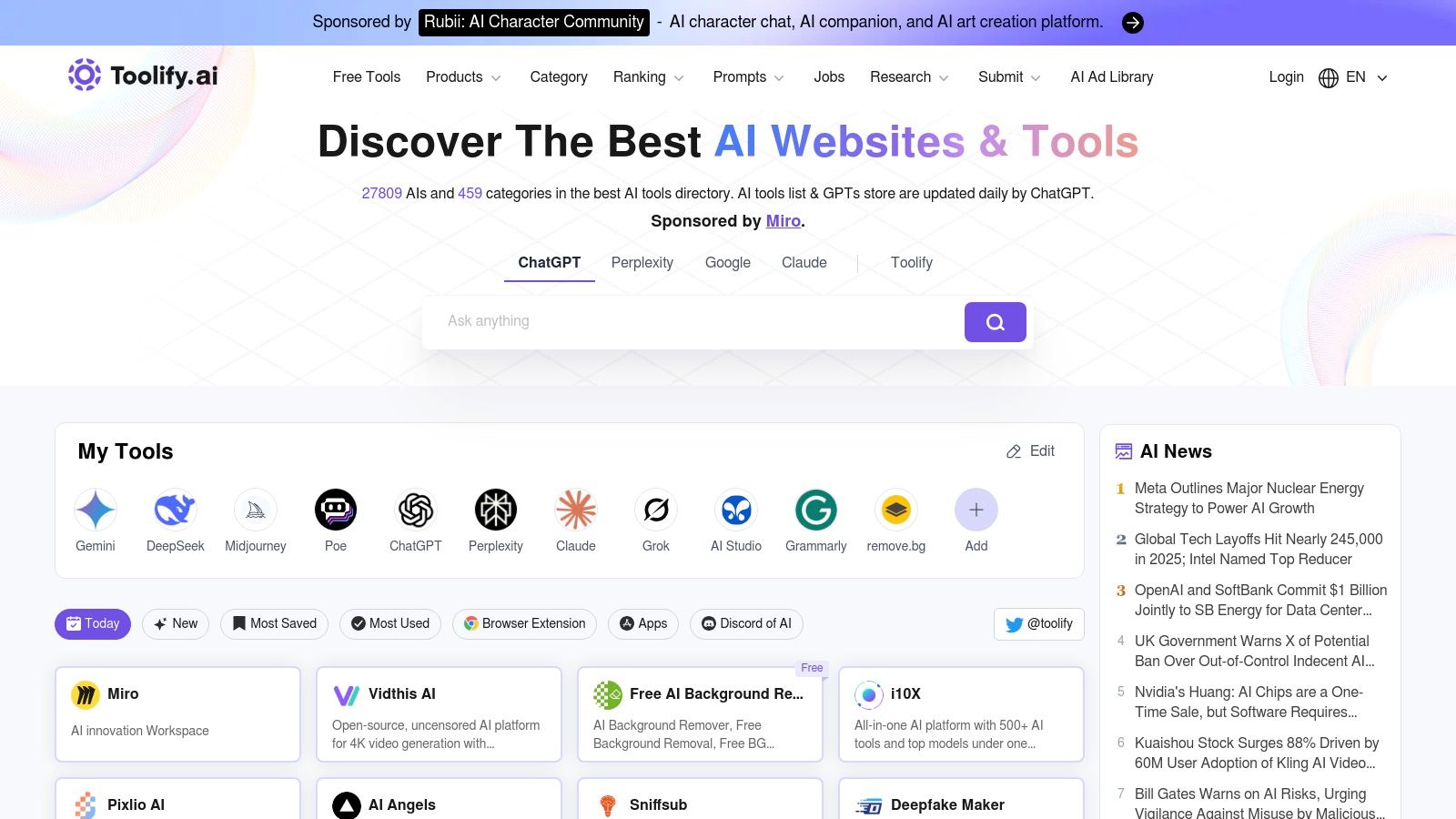
The platform’s primary strength is its sheer scale, claiming to list over 19,000 tools. Its "Just Launched" section provides a constant stream of new entries, while rankings and news posts offer additional context on what's gaining traction in the AI landscape. This breadth of coverage ensures you can find niche solutions that might not appear on more curated platforms.
Key Features & User Experience
Navigating Toolify.ai is a straightforward process built around search and categorization. Users can browse over 200 distinct categories like SEO, Image Editing, and Productivity, or use keyword searches to pinpoint specific functionalities. The interface is simple and utility-focused, designed for quick discovery and direct navigation to the tool's official website.
- Pros: Its massive catalog and frequent updates make it ideal for exhaustive searches. The simple, category-based navigation allows users to quickly find relevant tools.
- Cons: The quality of listings can be inconsistent, as many are submitted by the community or added automatically. The ranking methodology isn't always transparent, making it hard to judge a tool's true popularity or effectiveness.
Toolify.ai is free for browsing and discovery. It also offers paid submission and advertising options for developers who want to get their tools listed or featured more prominently. This makes it a useful platform for both finding new tools and for founders looking to gain visibility.
Visit Toolify.ai - AI Tools Directory
12. FutureTools — Community-Run Directories and Deals Hubs
For those hunting for the best new AI tools with a keen eye on savings, FutureTools and similar community-run hubs serve as invaluable resources. Rather than a single launchpad, these sites act as comprehensive aggregators, often curating thousands of tools and, crucially, exclusive discounts. They are particularly useful for early adopters and bootstrapped founders looking to experiment with powerful AI technology without a significant financial commitment.
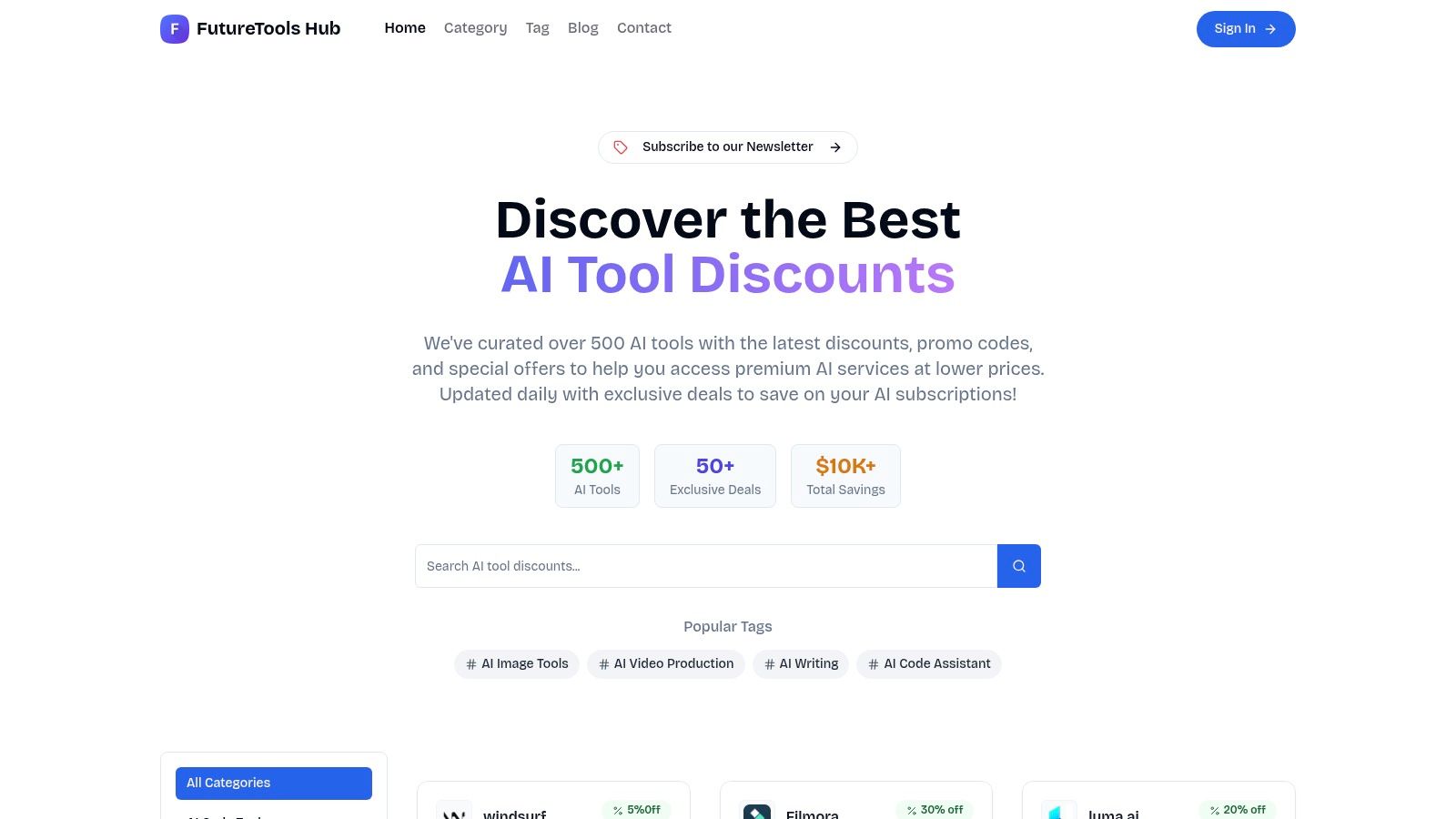
The primary appeal of these directories is their focus on deals. While showcasing a broad spectrum of AI applications, they often feature dedicated sections for promo codes and limited-time offers, giving users a direct path to cost-effective solutions. This deal-centric approach distinguishes them from platforms focused purely on discovery and community voting.
Key Features & User Experience
Navigating FutureTools is typically managed through a tag-based system. Users can filter extensive lists by categories like Writing, Image Generation, and Coding, making it simple to find relevant tools. The interface is utilitarian, prioritizing function over form to quickly display tool descriptions, pricing information, and direct links to available discounts.
- Pros: An excellent resource for discovering limited-time deals and promo codes. The broad aggregation provides a quick overview of tools across many AI categories for initial comparisons.
- Cons: The decentralized nature means quality and completeness can vary. Some listings may be mirrors or aggregations, so users should always verify official tool URLs before purchasing.
Most of these directories are free to browse. They are ideal for anyone wanting to explore the AI landscape on a budget or find the most cost-effective solution for a specific need.
Visit FutureTools
Top 12 AI Tool Directories — Features & Discovery Comparison
| Platform | Core focus & features | UX / Quality (★) | Value / Pricing (💰) | Target audience (👥) | Unique strength (✨) |
|---|---|---|---|---|---|
| Product Hunt — Artificial Intelligence | Daily launch hub; subcategories, community votes | ★★★★ — real-time discovery, variable signal | 💰 Free discovery; paid promotions possible | 👥 Makers, early adopters, product scouts | ✨ Real-time launches & strong community feedback |
| G2 — Artificial Intelligence Software | Verified reviews, comparative grids, buyer guides | ★★★★★ — deep review volume & comparisons | 💰 Free for buyers; vendor-paid features | 👥 Mid-market & enterprise buyers | ✨ Robust filtering & vendor benchmarking |
| Capterra — Artificial Intelligence Software | Buyer guides, pricing snippets, sorted lists | ★★★★ — SMB-friendly clarity | 💰 Free browsing; sponsored listings mixed | 👥 SMB teams evaluating options | ✨ Clear pricing snippets for quick shortlists |
| OpenAI — GPT Store / ChatGPT App Directory | In‑ChatGPT GPTs, leaderboards, dev onramps | ★★★★★ — low-friction trials inside ChatGPT | 💰 Varied (free → paid); ChatGPT account req. | 👥 Builders & ChatGPT users | ✨ Try-in-context GPTs with featured curation |
| Hugging Face — Spaces and Models Hub | Models, datasets, runnable Spaces, deploy options | ★★★★ — research-grade, experimental demos | 💰 Mostly free OSS; paid hosting available | 👥 Researchers, ML engineers, indie builders | ✨ Open-source models + reproducibility focus |
| AWS Marketplace — ML & Generative AI | Procureable models, SageMaker deploy, governance | ★★★★★ — enterprise-ready, secure flows | 💰 Paid subscriptions; AWS billing/integration | 👥 Enterprises & cloud teams | ✨ One-click deploy + enterprise governance |
| Microsoft Marketplace — AI Apps & Agents | AppSource+Azure listings; Copilot/Power alignment | ★★★★★ — vetted, integrated with MS stack | 💰 Paid offers; tenant billing & compliance | 👥 Microsoft-centric orgs & partners | ✨ Seamless Microsoft product integrations |
| SubmitMySaas — Launch & Discovery Platform 🏆 | Focused SaaS/AI launches; trending, badges, backlinks | ★★★★ — tailored launch exposure for makers | 💰 Launch packages with SEO & backlink benefits | 👥 Founders, makers, early-stage products | ✨ 🏆 Immediate featured launches + 35+ DR backlinks |
| Futurepedia — AI Tools Directory & Newsletter | Large categorized directory + editorial newsletter | ★★★★ — broad discovery; traffic varies | 💰 Free listings; paid promotional tiers | 👥 Founders, discoverers, newsletter readers | ✨ Newsletter highlights + large indexed catalog |
| There’s An AI For That (TAAFT) | Task-to-tool mapping; use-case driven search | ★★★★ — task-first discovery for non-experts | 💰 Free; submission options available | 👥 Non-experts seeking task-specific tools | ✨ Extensive task-based mappings for quick matches |
| Toolify.ai — AI Tools Directory | Big catalog, "Just Launched", rankings & news | ★★★ — large coverage; quality varies | 💰 Free; paid inclusion/ads for faster listing | 👥 Tool researchers & early observers | ✨ Active "Just Launched" & ranking pages |
| FutureTools — Community Directories & Deals | Aggregated tools, promo codes, deals hubs | ★★★ — deal-focused, decentralized quality | 💰 Free; deal/discount aggregations | 👥 Early adopters & deal hunters | ✨ Promo codes & curated deal pages |
Your Next Steps in AI Discovery and Launch
The landscape of artificial intelligence is no longer a distant frontier; it's a dynamic, ever-expanding ecosystem of practical tools and platforms. As we've explored, the journey to finding the best new AI tools is not about a single destination but about navigating a rich network of discovery hubs. From the community-driven validation of Product Hunt to the enterprise-grade solutions on AWS and Microsoft marketplaces, each platform serves a distinct purpose and audience.
We've seen how specialized directories like Futurepedia and There’s An AI For That offer curated, comprehensive libraries for rapid exploration. Meanwhile, technical hubs such as Hugging Face and the OpenAI GPT Store provide direct access to the underlying models and custom applications that power this revolution. The key takeaway is that the "best" tool is entirely contextual, defined by your specific goals, technical requirements, and budget.
How to Choose the Right AI Tool or Platform
For early adopters and product teams, the primary task is to move from passive discovery to active implementation. To navigate this process effectively, consider a structured approach to evaluation.
- Define Your Core Problem: Before you get lost in a sea of features, clearly articulate the exact problem you need to solve. Are you trying to automate customer support, generate marketing copy, analyze complex datasets, or build a unique product feature? Your use case is your compass.
- Match the Platform to Your Needs: For cutting-edge, experimental applications, start with Hugging Face or the OpenAI GPT Store. For business-ready, vetted solutions with support and security guarantees, turn to G2, Capterra, or the major cloud marketplaces like AWS. For community sentiment and emerging trends, Product Hunt is your go-to.
- Evaluate Beyond the Hype: It's easy to be swayed by a slick demo. Dig deeper by assessing the tool's integration capabilities (APIs, webhooks), documentation quality, and community support channels. A powerful tool with poor integration is often less valuable than a simpler one that fits seamlessly into your existing workflow.
- Start with a Pilot Project: Resist the urge to overhaul your entire process at once. Select a small, low-risk project to test a new AI tool. This allows you to measure its true impact, understand its limitations, and build internal expertise before committing to a larger-scale deployment.
For the Builders: Gaining Traction in a Crowded Market
If you are on the other side of the equation as a SaaS founder or indie maker, the challenge is not discovery but visibility. Your innovative solution is just one of thousands vying for attention. Getting your product listed on the right platforms is not just a marketing tactic; it's a fundamental strategy for survival and growth.
Targeting curated launch platforms and directories is crucial. A feature on a respected site provides more than just a backlink; it offers social proof, user feedback, and a critical injection of early-stage traffic. Platforms like SubmitMySaas are designed specifically to bridge this gap, connecting builders with the audiences and authority needed to stand out. Strategic submission is your first step toward transforming an unknown product into one of the best new AI tools on the market.
The AI revolution is here, and it’s accessible to everyone. Whether you are seeking a tool to solve a specific problem or building the next great AI application, the platforms we've covered are your gateways to innovation. The next step is yours to take. Begin exploring, start experimenting, and if you're building something amazing, start sharing it with the world.
Ready to get your new AI tool in front of thousands of early adopters and tech enthusiasts? Stop waiting for users to find you. List your product on SubmitMySaas to gain instant visibility, powerful backlinks, and the early traction needed to grow. SubmitMySaas is the launchpad for ambitious founders looking to make their mark in the AI space.