Why Most Product Launches Fail and How to Fix It
Learn why most product launches fail, how to distinguish weak demand from poor distribution, and which fixes help SaaS and indie founders build durable
The most popular launch advice tells you to build anticipation, ship loudly, and iterate in public. It's incomplete in a dangerous way. It treats attention as evidence, and that confusion is central to why most product launches fail. A crowded launch day can hide a product nobody needs urgently, a message nobody understands, or a workflow nobody returns to.
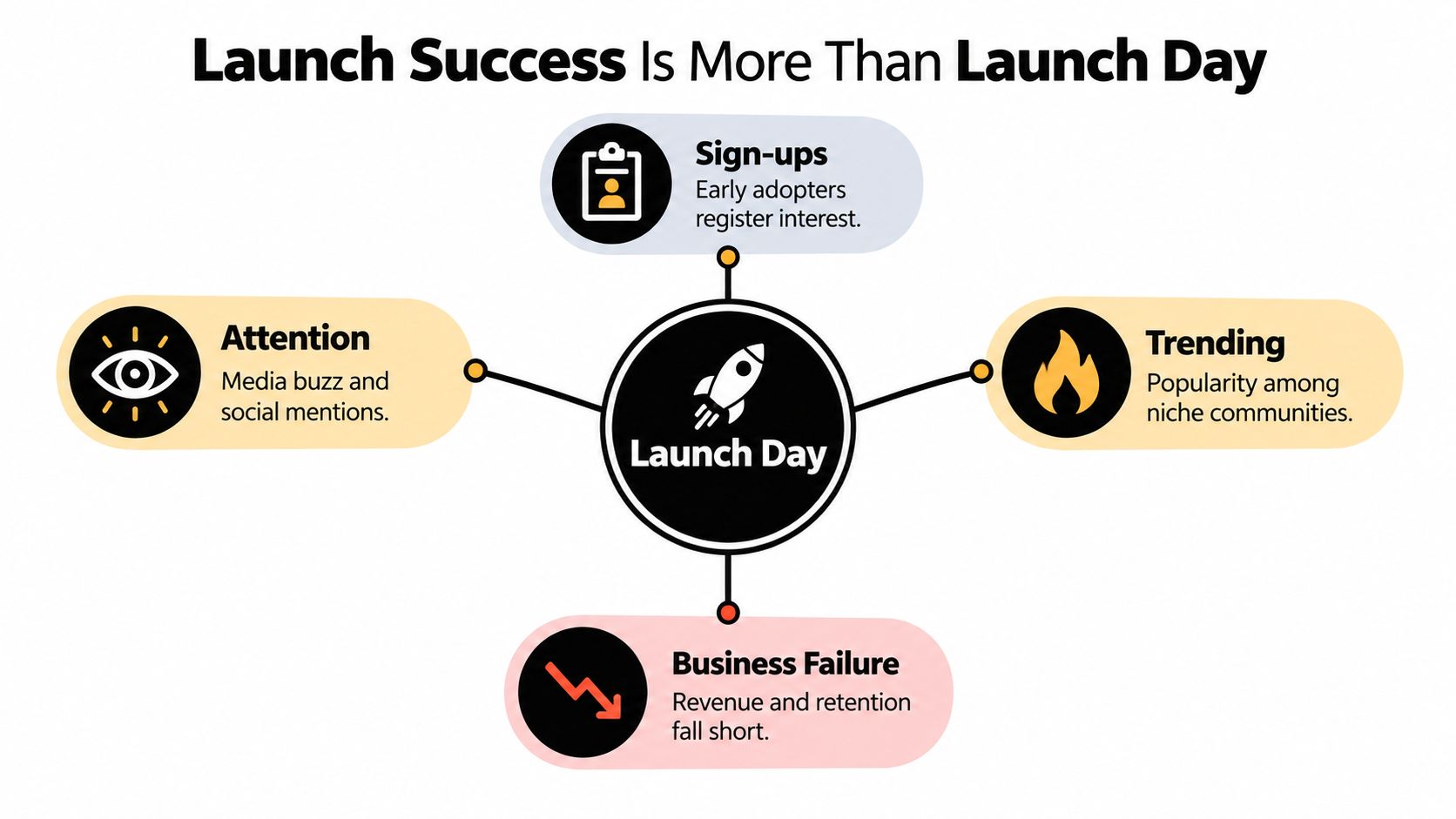
Launch Success Is More Than Launch Day
A product can trend in a maker community, collect sign ups, and fill your inbox with congratulations while producing almost no retained customers. That isn't a contradiction. Launch day measures curiosity, while a business depends on repeated value. Those are different events, separated by weeks of behavior you can't compress into a leaderboard result.
Think of a launch as exposure of assumptions, not proof of them. Before launch, you've assumed a problem is painful, your solution beats the current workaround, your wording explains the difference, and your channels reach people already looking. Launch day only puts those assumptions in front of strangers. What they do next tells you which assumption was wrong.
The Chain That Has to Hold
A durable launch follows a causal chain, and a break anywhere looks like failure at the end. A validated need produces a credible product. A differentiated message helps the right buyer recognize fit quickly. Distribution puts that message where buyers already search, compare, and ask peers. A useful core workflow then converts a trial into habit and revenue.
Founders usually debug the chain backwards. Revenue is weak, so they buy more traffic. Traffic arrives, so they assume the page is the problem. They rewrite copy, add features, and chase another channel, all without knowing whether the original need was strong enough to support paid adoption.
A launch is a diagnostic event. It doesn't create demand, clarity, or retention. It reveals whether you had them.
That distinction changes the response to disappointing results. Weak demand calls for returning to the problem, not louder promotion. Weak positioning calls for message testing with a narrow audience. Weak discoverability calls for better placement in search, communities, directories, and review surfaces. Weak retention calls for fixing recurring utility before you spend on acquisition.
Most launch advice merges those failures into one verdict, usually poor product market fit or poor marketing. That label is too blunt to act on. You need to locate the broken layer first, because each layer has a different fix, a different cost, and a different point where stopping is the honest decision.
What Product Launch Failure Actually Means
Failure isn't a quiet launch day. It's missing the commercial outcome the product was built to produce, within a defined window, for a defined audience. If you never set that outcome in advance, every result can be rationalized later, and your postmortem becomes storytelling instead of analysis.
The scale is not trivial. McKinsey research published in 2017 found that more than 50% of product launches failed to hit their business targets, while average failure rates exceeded 40% across industries. The same research found no correlation between launch investment and success rate, which should end the reflex to fix a weak launch by spending more on it.
What correlated with stronger outcomes was less glamorous. McKinsey identified collaboration, systematic use of market insight, rigorous planning, and deliberate talent development. None of those is a launch day tactic. All of them shape whether the product, message, and team are aligned before strangers evaluate you.
A Working Definition
Use four layers to define success before you ship. Each layer answers a different question, and passing one doesn't excuse failing the next.
| Failure layer | Diagnostic question | Useful evidence | Primary response |
|---|---|---|---|
| Demand | Do target users have an urgent, recurring problem? | Pilots, preorders, repeated use of a prototype | Return to problem research or narrow the audience |
| Message | Can qualified buyers state why you are different? | Landing page conversion, comprehension in interviews | Rewrite positioning and proof around one outcome |
| Distribution | Can buyers find and evaluate you during research? | Qualified impressions, branded search, conversion by source | Improve placement in channels buyers already use |
| Retention | Does first value turn into habitual use? | Activation cohorts, repeat use, trial to paid conversion | Fix onboarding, reliability, or workflow fit |
This framing also clarifies why a single failure percentage misleads. Categories differ, targets differ, and measurement windows differ. A consumer product judged on early revenue, a SaaS tool judged on retained teams, and a hardware product judged on delivery are not running the same test.
Crowdfunding offers a useful parallel because backers commit money before delivery, which makes weak assumptions visible early. The patterns described in crowdfunding campaign failures echo the same upstream errors, unclear value, weak preparation, and poor audience fit. The channel changes, but the diagnostic logic doesn't.
Set your target as a sequence, not a spike. Qualified discovery should lead to activation, activation should lead to retained use, and retained use should support revenue. If the sequence breaks, name the layer. That precision is what separates a fixable launch from a product you should stop funding.
Demand Problems Hidden Behind Launch Activity
A working product is not a wanted product. Your SaaS can load fast, integrate cleanly, and pass every internal test while your target customer shrugs. They don't adopt because the problem isn't urgent, the advantage isn't obvious, or switching from a spreadsheet, a manual process, or an incumbent tool costs more effort than your benefit repays.
That gap is where many launches die. A separate McKinsey analysis of new ventures found that only 20% of startups successfully launched in the meaningful sense of reaching product market fit and scaling, while 24% of corporate new ventures became viable businesses. It concluded that failure usually came from flawed assumptions about customer desirability, not technical infeasibility.

Feasible Is Not Desirable
Compare two launches. The first team ships a polished reporting tool with dashboards, exports, and role permissions. Prospects say it looks useful, sign up, click around, and don't return because reporting pain hits once a month and their current template already works. The product is feasible. The demand is thin.
The second team ships a rough tool that solves one daily bottleneck, such as reconciling failed payments before a support shift starts. Users tolerate rough edges because the pain is frequent and visible. They return without reminders, invite teammates, and ask about pricing. That behavior, not polish, signals desirability.
Stated enthusiasm misleads because it's free. People praise demos, join waitlists, and upvote launches to support makers or explore novelty. You need costlier signals before you scale promotion.
- Behavioral commitment: A pilot, design partner agreement, preorder, or migration of real data into a prototype.
- Core workflow completion: Users finish the one action that delivers value, without your team guiding every step.
- Unprompted return: Users come back on the cadence the problem naturally occurs.
- Willingness to pay: A trial converts, or a buyer asks about procurement, limits, and rollout.
Practical rule: Treat compliments as hypotheses and repeated behavior as evidence. Budget should follow the second, not the first.
Finding that evidence starts with a narrow audience definition. If you can't name who feels the pain first, your interviews will average conflicting needs into a vague persona. Work through defining your target audience before launch so your tests measure a specific buyer, not a market sized in a spreadsheet. Regional context matters too, and founders building for specific markets may find the guide for UAE founders on PMF useful for grounding desirability tests locally.
McKinsey's recommendation is direct in spirit. Build a workable minimum viable product and watch real behavior around pain points, value propositions, and calls to action. If behavior contradicts your assumptions, believe the behavior. Distribution can amplify demonstrated desirability. It can't manufacture it.
How Weak Validation Becomes a Failed Launch
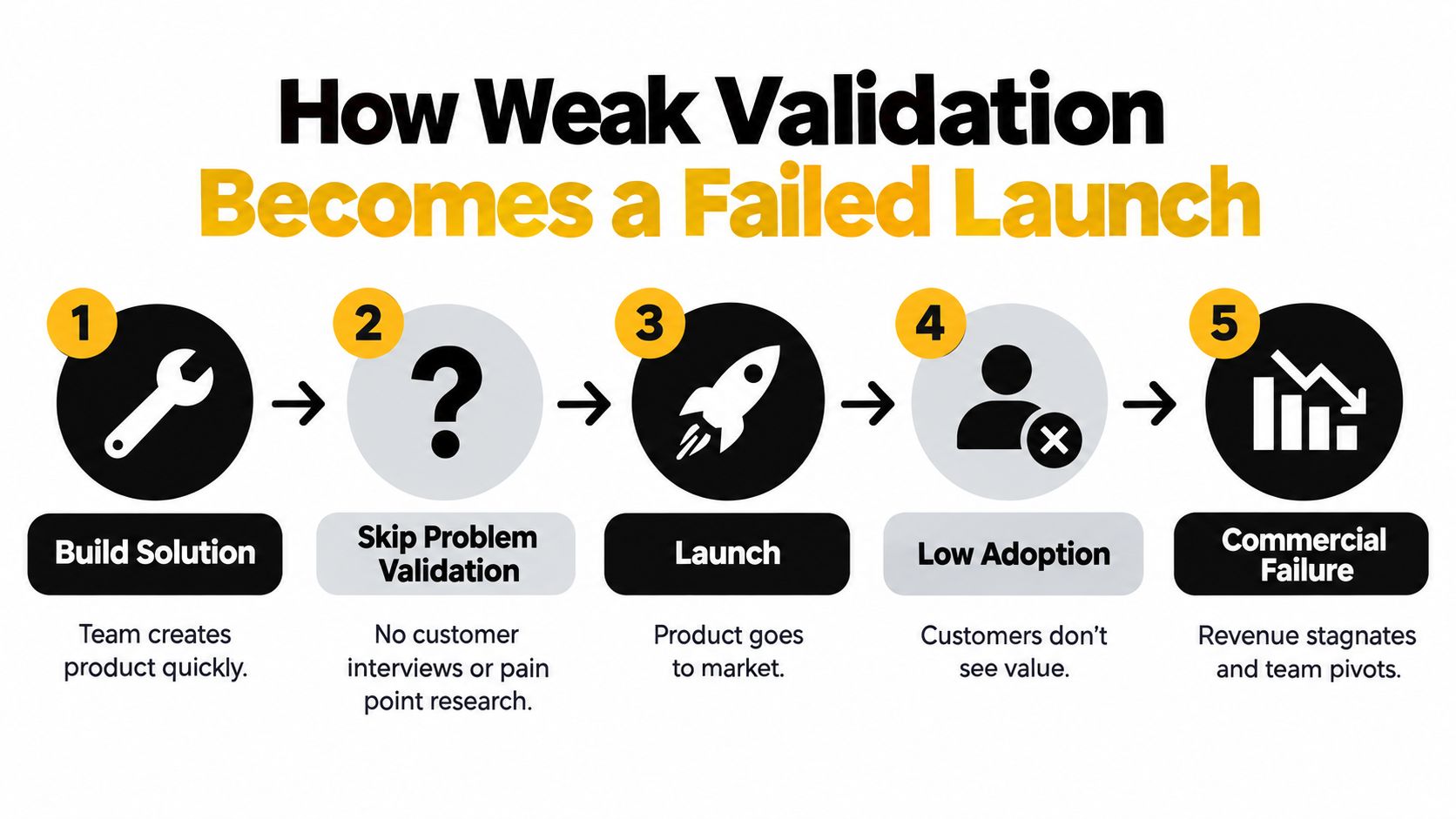
Most launches fail upstream, weeks or months before anyone sees a landing page. The sequence is familiar in postmortems. A team validates its solution before validating the problem, misreads customer priorities, and then encodes those errors into the roadmap, pricing, and launch message. By launch day, engineering quality is defending a requirements mistake.
The historical evidence is blunt. In a study of 114 industrial product failures, 22% of projects conducted no market research and another 46% performed it poorly. Across three Conference Board studies spanning 25 years, inadequate market analysis was the leading failure cause, while validation activities across 203 launches were strongly correlated with outcomes.
A Composite SaaS Failure
Consider a team building automation for small agencies. Five friendly interviews produce encouraging quotes about saving time, so the founders build broad workflow automation, templates, integrations, and a dashboard. The landing page leads with features because the team built many of them. Launch traffic arrives from communities, trials start, and then usage stalls.
Follow up conversations reveal the actual problem. Agency owners don't want another system to configure. They want one painful handoff, client approval chasing, handled reliably without training their staff. The broad product solved a category, not a moment. Overengineering raised complexity, weak positioning hid the one useful outcome, and onboarding asked for setup effort before delivering relief.
That chain shows how risks interact. Technical overengineering increases cost and cognitive load. Poor positioning makes the benefit hard to grasp in seconds. Ineffective marketing planning sends broad traffic instead of buyers with the specific pain. Mistimed commercialization can push the product out after a budget cycle, a platform shift, or a competitor has already set expectations.
Where to Interrupt the Chain
You interrupt it by requiring evidence before scope expands. Interview users about their current workflow, not your concept. Quantify how often the problem occurs and what it costs in time, errors, or delayed revenue. Test a narrow prototype with representative users, then ask for commitment.
For B2B products, watch buying behavior rather than polite interest. The buying cues outlined in signals for B2B service sales are relevant here because a prospect involving colleagues, asking about implementation, or sharing internal constraints is giving you stronger evidence than praise. Pair those observations with a structured process for validating a startup idea with real evidence before you commit serious build time.
If interviews are warm but nobody will pilot, return to problem research. If users pilot one narrow workflow but ignore the rest, cut scope. Late polish can't repair an early misunderstanding, but early honesty can still save the launch.
Distribution Failure Is Different From Demand Failure
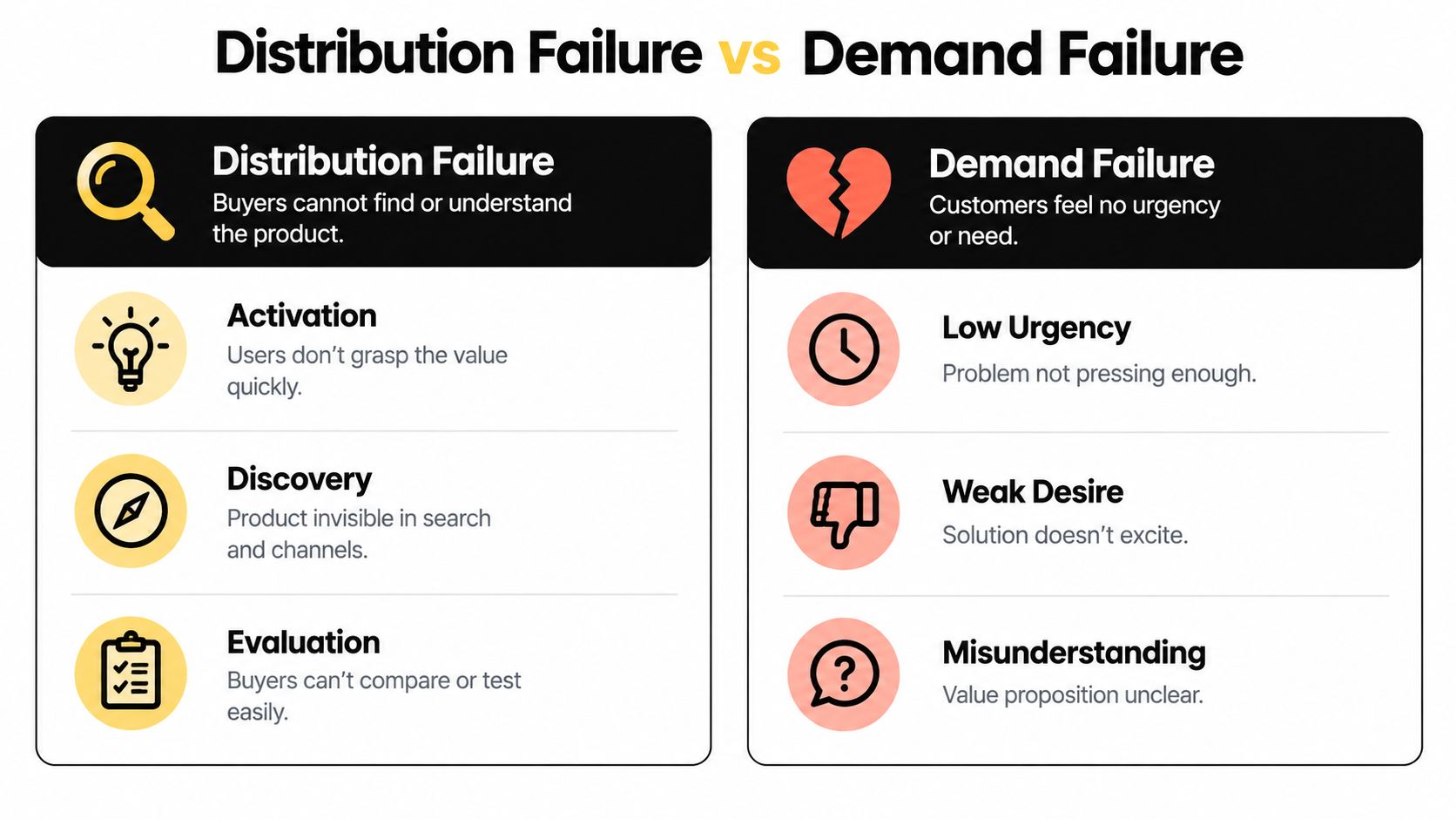
Some products fail because nobody wants them. Others fail because the right buyers never encounter them during research, or encounter them without enough proof to evaluate. Founders often merge those outcomes, kill a useful product, or keep promoting a weak one. You need separate signals for demand and exposure.
The financial pressure makes the distinction urgent. Available analysis of venture backed shutdowns reports that 70% involved running out of capital, while poor product market fit affected 43% and bad timing or macro conditions affected 29%. It also identifies invisibility during pre contact research, unclear measurement, and fragmented ownership as problems that can precede cash exhaustion.
Two Signal Sets, Two Decisions
Demand signals appear after a qualified user tries the product. Look at activation of the core workflow, repeat use on the natural cadence, retention after first value, referrals, and paid conversion. When those are healthy among people who reach the product, you likely have something worth distributing harder.
Exposure signals appear before and during evaluation. Look at qualified impressions, branded and category search visibility, review and comparison coverage, backlinks from relevant publications, directory presence, and conversion by acquisition source. When those are weak, buyers can't choose you, even if they'd value you.
Read the combinations, not isolated metrics.
- Strong activation, weak qualified traffic: Your constraint is discoverability. Invest in search presence, partnerships, communities, and launch surfaces where buyers compare tools, guided by choosing content distribution channels deliberately.
- Strong traffic, weak activation: Your constraint is message or onboarding. Visitors expected something else, or first value takes too long.
- Strong activation, weak retention: Your constraint is recurring utility. The first win doesn't repeat, reliability fails, or the workflow doesn't fit daily habits.
- Weak signals everywhere: Don't scale spend. Return to audience and problem evidence.
A failed launch may be a failed information distribution system, not a failed product. You can't know until you separate reach from resonance.
This matters more in crowded SaaS and AI categories, where launch day attention decays quickly. Buyers research asynchronously. They search a problem, scan comparisons, check reviews, ask peers, and shortlist before they ever talk to you. If you're absent from that pre contact phase, your launch spike has nowhere to compound.
Fragmented ownership worsens the blind spot. Product owns activation, marketing owns traffic, and nobody owns the handoff between discovery and first value. Assign one owner for the full diagnostic sequence. Validate the problem, test message market fit, inspect qualified discovery, then judge retention. Only conclude demand is absent after qualified buyers found you, understood you, tried the core workflow, and still didn't return.
Build a Launch Around Measurable Customer Value
A better launch isn't a bigger launch. It's a staged experiment where each phase earns the next phase's budget. You move from problem evidence to a narrow product, from a clear promise to controlled exposure, and from exposure to measured retention. Promotion comes after value is observable, not as a substitute for it.
The stakes justify that discipline. Research on new product commercialization reports failure rates often reaching 50% or more and identifies faulty understanding of customer needs, not technical shortcomings, as the main culprit. It recommends instrumenting the funnel and treating a launch as an experiment with predefined thresholds and rapid iteration.
Stage One and Two
Start by documenting the customer's current workflow in plain language. Who does the task, how often, with what tools, and where does it break? Write down the cost of the break, even qualitatively, and the evidence you'll require to proceed, such as design partners using real data or a buyer committing time from their team.
Then test the smallest version that delivers the core outcome. For a SaaS product, that's usually one workflow completed end to end, not a settings page and a promise. Watch where users hesitate, what they skip, and whether they reach value without a guided call. If they need you present to succeed, your onboarding or product logic is the launch risk.
Stage Three and Four
Define the differentiated promise before you scale exposure. A buyer should be able to repeat who it's for, what outcome changes, and why your approach beats their current workaround. Use writing a value proposition buyers can repeat to force that clarity, then test the wording on landing pages and in sales or community conversations.
Add proof next to the promise. Proof can be a short product walkthrough, a design partner outcome shared candidly, a comparison against the manual process, or a transparent limitations note. Unsupported superlatives weaken trust, especially in AI categories where buyers have heard identical claims repeatedly.
During launch, instrument the full funnel and set thresholds in advance.
- Qualified landing page conversion: Are the right visitors starting a trial or joining for a clear reason?
- Activation: Do new users complete the core value action quickly?
- Time to value: How long passes between sign up and the first meaningful result?
- Retention after first use: Do users return when the problem recurs?
- Trial to paid conversion: Does retained use support a purchase decision?
Respond to Combinations, Not Vanity Totals
Each metric should trigger a decision. If acquisition is healthy but activation is weak, don't buy more traffic. Shorten setup, preload a useful template, remove optional steps, or fix the moment where users must import data before seeing value.
If activation is healthy but retention is weak, look at recurring utility. Maybe the problem is episodic, the output isn't reliable enough to trust, or your product sits outside the tools where work already happens. Integrations, notifications tied to real events, and reliability fixes may matter more than new features.
If retention is healthy in a small cohort but discovery is thin, then distribution deserves investment. Choose channels based on buyer research behavior, not founder habit. Search content fits active problem solving, communities fit peer validation, directories and launch platforms fit comparison shopping, and partnerships fit adjacent workflows.
Keep the loop short. Review cohorts weekly during launch, interview users who activated and users who didn't, and change one constraint at a time. A launch plan that can't tell you what to fix next is just a calendar of announcements.
Turn Launch Lessons Into Better Decisions
A postmortem should produce a decision, not a morale speech. Compare intended outcomes with observed cohort behavior, classify the primary constraint, and state which evidence supports that classification. If your team can't agree on the layer, you don't have a learning problem. You have an instrumentation problem.
Keep expectations calibrated. Available research on new product goal attainment indicates that only 61% of new products meet their business goals and that nearly nine ideas are needed, on average, to produce one success. The same source notes a 2025 SaaS benchmark in which 70% of surveyed SaaS companies had launched AI features and another 22% had them on their roadmap, a reminder that shipping volume is rising faster than differentiation.
A Compact Postmortem
Run the review around the durability test. Qualified discovery should produce activation, activation should produce habitual use, and habitual use should support paid or otherwise sustainable value. Use a clear set of product launch metrics to keep the review anchored in cohorts rather than launch day totals.
- Demand check: Did target users show urgency through pilots, repeat prototype use, or payment?
- Message check: Could qualified visitors explain the difference after viewing the page?
- Distribution check: Which sources sent users who activated, and which sent only curiosity?
- Retention check: Did activated users return, expand use, or churn for repeatable reasons?
- Ownership check: Who owned each handoff, and where did timing or accountability break?
Review timing and support burden too. A launch that retains users but overwhelms a small team with manual onboarding hasn't proven a scalable model yet. A launch with modest traffic and strong retained teams may be healthier than a viral spike you'll spend months trying to reproduce.
Then choose one of three defensible paths. Persevere when behavioral evidence is strong and the constraint is execution or reach. Reposition when a narrow cohort gets value but discovery or messaging points at the wrong buyer or outcome. Stop when repeated behavioral tests with qualified users show inadequate desirability, because continued promotion only spends credibility and cash.
That discipline won't guarantee success, and no honest framework can. It will stop you from treating every failure as a marketing problem or every spike as validation. Over multiple launches, that clarity is the asset. You'll ship fewer announcements and make better decisions about what deserves to exist.
If your product has validated demand and a clear message but buyers still can't find it, SubmitMySaas gives SaaS and AI founders a launch and discovery surface through daily launches, trending lists, category pages, and monthly roundups. Submit your product, present its core value clearly, and measure whether qualified discovery turns into activation by visiting SubmitMySaas.