By Outrank
Who Are Early Adopters? Traits and How to Engage Them
Discover who are early adopters, their traits and motivations, and how to spot and engage them for your product launch.
On this page
Say you're launching an invoicing tool. A freelance designer signs up while you're still fixing the onboarding flow. She isn't collecting new apps for fun. Late payments are disrupting her cash flow, and she wants a better way to chase invoices. Your challenge is finding more people like her, rather than attracting visitors who open the product once and disappear.
Early Adopters in Plain Terms
Early adopters are people who start using an innovation after the pioneers but before the mainstream. The label is relative to a particular product, population, and launch window. Someone can adopt invoicing software early while waiting years to change their design tools.
Think of a new restaurant. Innovators are like the chef's adventurous friends who'll try an unfamiliar menu before the kitchen has settled into a routine. Early adopters arrive soon afterward, find something worth returning for, and tell other diners. The late majority waits until plenty of reassuring reviews appear.
The useful distinction isn't arrival time. It's what happens after that first visit.
What adoption looks like in practice
Our freelance designer imports real client details, sends an invoice, and comes back when payment is due. She might accept an awkward import process because automated reminders address a problem she already feels.
Look for this combination:
- Expected personal value: The person has a meaningful reason to change their current approach.
- Tolerance for friction: They'll accept some setup work or unfinished functionality in exchange for getting the benefit sooner.
- Peer influence: They can explain their experience to people who face similar problems.
A visitor who clicks through a demo may be curious. A user who changes a working routine is making a more consequential commitment.
A useful test: Who feels this problem strongly enough to accept a rough first version?
When founders ask who are early adopters, that question is more productive than asking who loves technology. It directs attention toward people with a reason to stay, not merely a reason to browse.
Where Early Adopters Sit on the Adoption Curve
Everett Rogers's diffusion-of-innovations framework classifies people by when they adopt relative to others in the same social system. The approximate shares below come from the U.S. Navy CHIPS explanation of Rogers's model.
Adoption categories and their share of a population
| Category | Share of population | Role in adoption |
|---|---|---|
| Innovators | 2.5% | Test first and carry the highest uncertainty |
| Early adopters | 13.5% | Opinion leaders who validate the idea for others |
| Early majority | 34% | Adopt once the product has proven value |
| Late majority | 34% | Adopt when risk is low and the market is settled |
| Laggards | 16% | Adopt last, often when tradition or necessity demands it |
These are model proportions, not a forecast that every launch will follow the same curve. Real markets can have larger or smaller early groups, and your initial audience may be unusually concentrated in enthusiastic users.
Early adopters are the first substantial group after the pioneering innovators. Their strategic importance comes from their position within peer networks: they help other people judge whether an unfamiliar idea deserves attention.
Use the model for planning, not promises
Applied to a hypothetical market of 10,000 potential users, the model implies:
- Innovators: Roughly 250 potential users.
- Early adopters: Roughly 1,350 potential users.
- Early majority: Roughly 3,400 potential users.
- Late majority: Roughly 3,400 potential users.
- Laggards: Roughly 1,600 potential users.
Again, these counts illustrate the model, not an acquisition target or a guarantee of demand.
You can apply the early-adopter share to a clearly defined addressable population to create a rough planning estimate. The important work comes before the calculation: decide whose adoption you're measuring. Independent designers using invoicing software form a more useful population than everyone who might someday need a business app.
Don't confuse the estimated early group with people you can immediately reach. Some may never encounter your launch; others may already have an acceptable alternative or lack purchasing authority.
Use the estimate to decide how narrowly to recruit, how much onboarding support to prepare, and which communities deserve attention. Size the relevant early group before planning outreach, then replace assumptions with observed activation and continued use.
Traits and Motivations That Set Early Adopters Apart
Expected personal value explains why someone accepts a product that another person considers too inconvenient. An MIT Bitcoin field-experiment paper connects early adoption with greater initial benefits and a willingness to bear higher adoption costs. That's a more useful starting point than assuming early adopters enjoy risk.
Their motivation can take different forms. A buyer may want relief from an expensive problem, an advantage over competitors, or the satisfaction of exploring something unfamiliar. Novelty can attract attention, but a practical benefit gives someone a reason to make room for the product.
The same friction can feel very different
Consider a developer evaluating a deployment tool. If it removes a recurring release bottleneck, repairing a broken integration may feel worthwhile. Another developer with a stable deployment process may see exactly the same repair as wasted effort.
Or consider a marketing lead whose current tools can't connect campaign activity with customer outcomes. She might accept a rough reporting interface if it answers a question she otherwise has to investigate manually. She isn't necessarily more adventurous than her colleagues; she has more to gain.
The trade-off needs boundaries:
- Acceptable inconvenience: Manual setup, limited templates, or a missing convenience feature.
- Commercial uncertainty: Pricing that may change, an evolving roadmap, or a supplier that hasn't established longevity.
- Unacceptable exposure: Risks to sensitive data, required compliance, or business continuity.
Don't interpret willingness to endure inconvenience as consent to unreliable security or unclear billing.
Demographics provide context, not a verdict
Adoption patterns do differ across populations. In a nationally representative April 2025 survey, 64% of U.S. adults aged 60 and over were AI non-users, according to NORC's AI adoption report.
That finding describes broad AI use, not whether a particular older customer will quickly adopt your product. A person with modest technical confidence may move quickly when the benefit is obvious and the setup feels manageable.
Ask prospects about consequences rather than identity:
What does this problem cost you today, and what would you be willing to change to fix it?
Listen for an existing workaround, a missed opportunity, or a task they actively dislike. Those answers give you something concrete to test. Enthusiasm alone doesn't.
How to Spot Early Adopters Before Your Launch
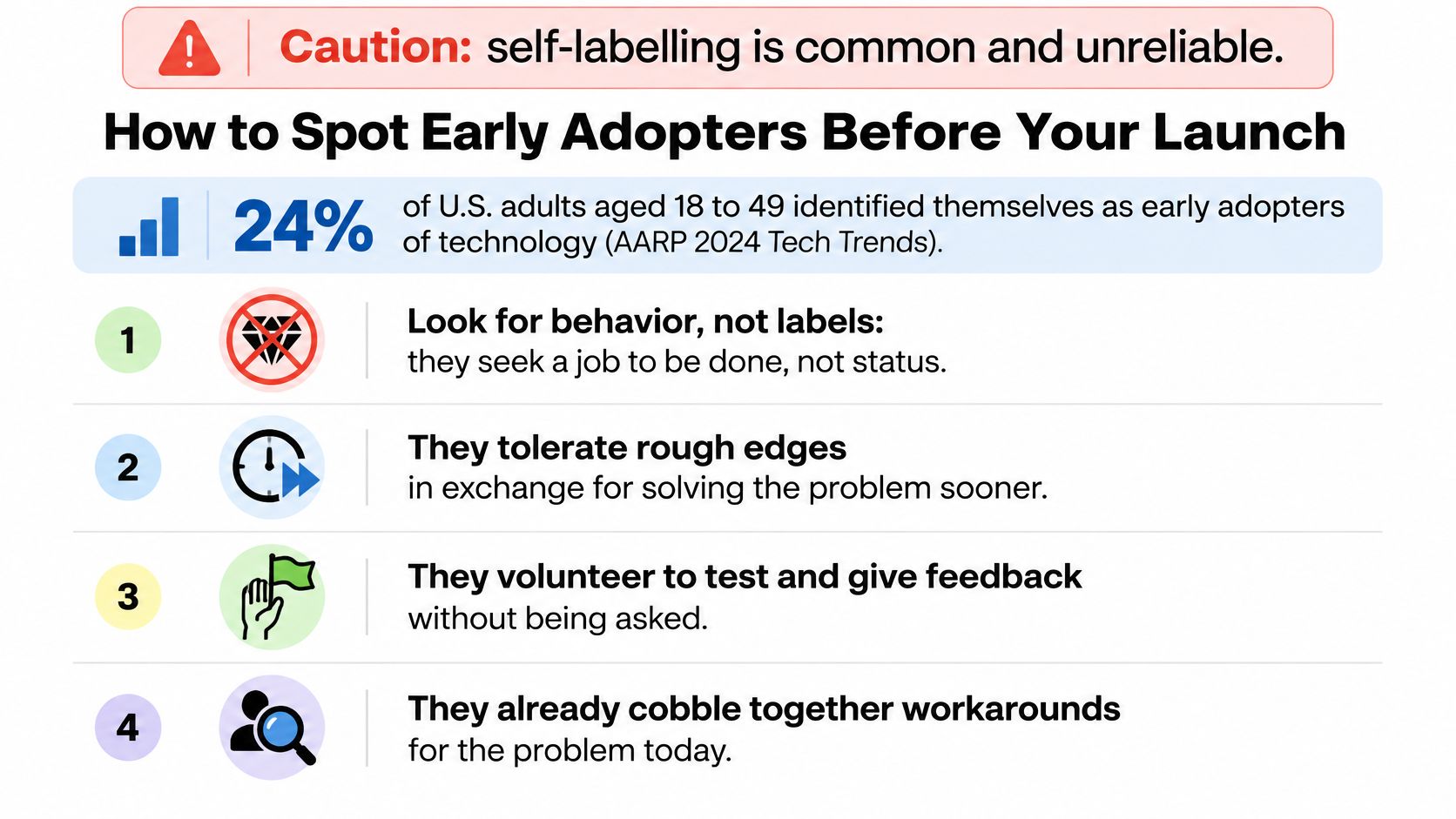
Self-description is a starting point, not proof of commitment. In 2024, 24% of U.S. adults aged 18–49 identified themselves as early adopters of technology, according to AARP's 2024 Tech Trends report summary. That label doesn't tell you who'll complete your onboarding or use the product for real work.
Use the following checklist to guide recruitment conversations.
Track actions you can verify
Start by defining the relevant audience and workflow. Our guide to finding your target audience can help you narrow recruitment before you interpret product activity.
Early-adopter signals and what they reveal
| Signal | What to look for | What it tells you |
|---|---|---|
| Speed of first use | Signs up or tries the product within the first days | Suggests willingness to encounter early friction |
| Clarity of use case | Names a specific problem and what it costs them | Expects high personal value |
| Quality of feedback | Gives specific, actionable critique | Is invested enough to investigate the experience |
| Repeat use | Returns within a week without prompts | May be converting a trial into a habit |
| Peer influence | Shares, refers, or brings a colleague | Spreads awareness beyond their own use |
Treat the timing in this checklist as a proposed test window, not a universal benchmark. A daily writing assistant and an occasional tax-preparation tool require different observation periods.
For an initial recruitment exercise, you could flag people who demonstrate at least three of these five signals. That's a practical scoring heuristic, not a validated research threshold. Keep notes about the evidence behind each score rather than relying on a salesperson's impression.
Separate activity from progress
Record events that represent meaningful work: importing a live project, completing a deployment, sending an invoice, or inviting a teammate into an active workspace. Opening the dashboard isn't necessarily activation.
A large waitlist can mislead if visitors never reach the outcome you promised. Equally, a quiet user who completes the same valuable task repeatedly may deserve more attention than someone who posts enthusiastic launch comments.
For an additional explanation of early-adopter identification, watch this video.
At the end of your initial observation window, create a working shortlist of users who returned and supplied concrete feedback. Contact them about the task they completed, the obstacle they encountered, and what would make the next attempt easier. Recruit your next cohort around those patterns rather than around the loudest reactions.
Why Early Adopters Matter for Launch Momentum
An early customer can contribute more than a purchase. Their implementation notes, recommendations, and public examples can help another buyer understand how a product works outside a polished demo.
A Scientific Reports analysis of adoption patterns found that early adoption concentrated in large towns and increased superlinearly with population. Diffusion initially connected distant large cities, while later adoption became more locally concentrated.
The practical implication isn't that you should target a city because it's large. Find connected groups whose members share the problem you solve. A specialist developer community spanning several countries may be more useful than a broad local business audience.
Build density around a shared workflow
Prioritize startup hubs, technical communities, and professional groups when their members match your use case. Check how people exchange recommendations: Slack discussions, GitHub repositories, newsletters, meetups, and public workflow posts can each reveal a different route to discovery.
Say a deployment-tool launch attracts a small group of infrastructure engineers. Some publish configuration examples, while others document how they connected the tool to GitHub Actions. A later buyer can inspect those examples and judge compatibility without starting from a blank page.
That's stronger evidence than a feed full of launch congratulations. It gives prospective customers a way to answer practical questions about effort, limitations, and fit.
A useful recommendation shows another person how to succeed, not just where to click.
Pay attention to shares that lead to qualified visits, referrals that activate, published integrations, and returning visitors. Don't treat every social impression as evidence that adoption is spreading.
Timing matters operationally, too. Coordinate outreach when you can support the people arriving from a connected community. If their first attempts fail and nobody replies, concentrated attention won't help you learn much.
Before launch day, make these distribution moves:
- Choose a reachable cluster: Identify a community where the workflow problem is discussed openly and product sharing is permitted.
- Prepare something reusable: Publish a setup guide, integration example, or sample workflow that members can pass along.
- Assign response ownership: Name the person who'll answer implementation questions and track where qualified referrals originate.
The objective is useful exposure among connected buyers, not uniform exposure everywhere.
How to Engage Early Adopters Step by Step
Give participants a clear working relationship: what they can try, what remains unfinished, and how you'll respond. Don't make them guess whether they're customers, testers, or unpaid consultants.
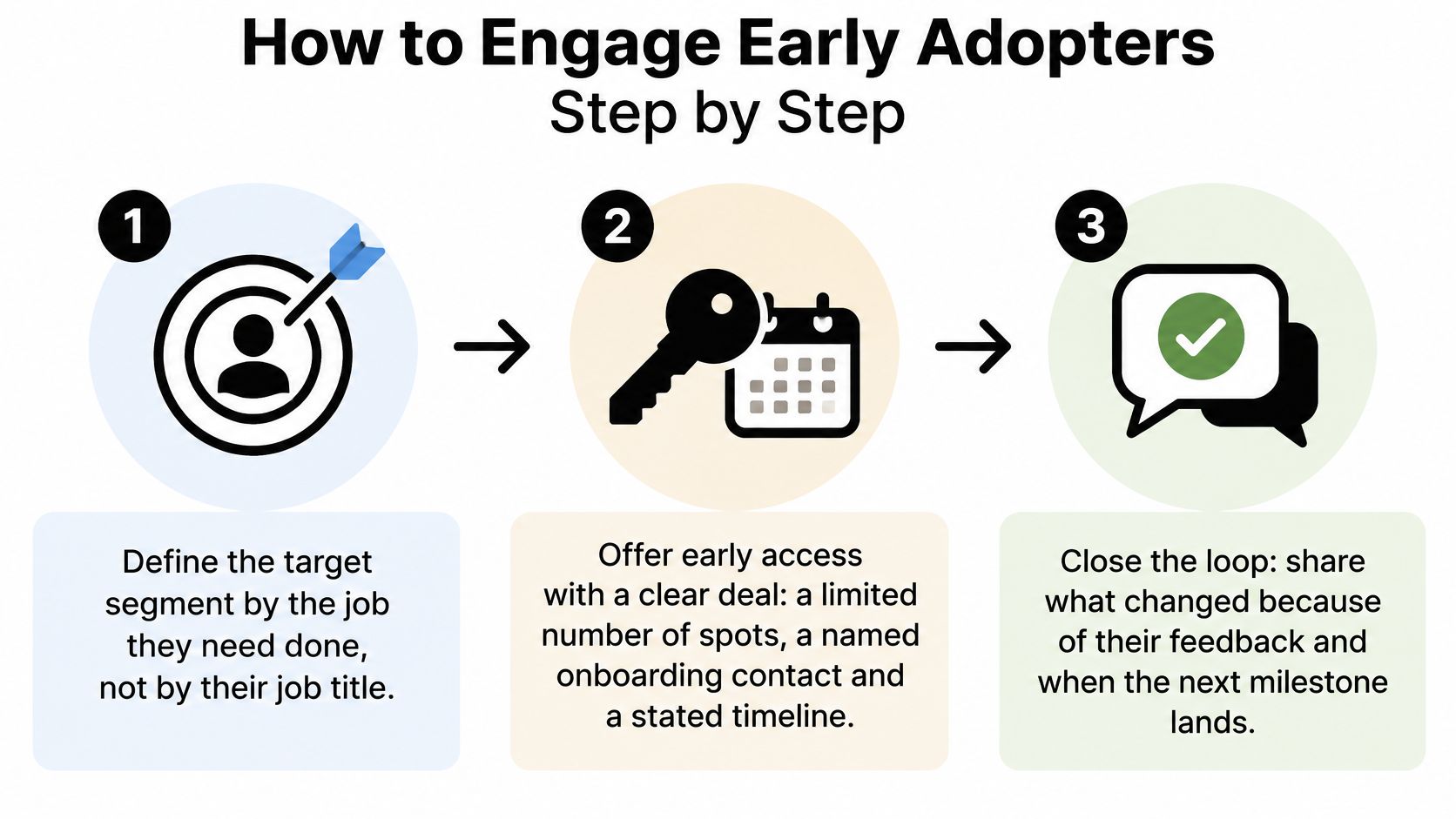
Use this visual as a compact reminder of the engagement process.
Recruit around an outcome
Define the job, not merely the title. Recruit people who need to reconcile campaign results across disconnected tools, rather than everyone called a marketing manager. A title describes organizational position; it doesn't establish urgency, so don't use it as your only qualification filter.
Offer early access with explicit terms. State the capacity you can support, name an onboarding contact, and give a realistic timeline for the first fixes. Avoid artificial scarcity and promises about distant features that users need immediately.
Give users a bounded feedback task. For a proposed weekly check-in, ask them to attempt a specific workflow and answer a focused question, such as where they had to leave the product to finish. Don't send a vague request for thoughts, and don't ask them to repeat information you already captured.
For recruitment, consent, and feedback organization, use our guide to beta testing programs. When an issue needs design exploration before development, Figr's guide to rapid prototyping for product teams offers a relevant resource for testing an alternative interaction.
Make participation lead somewhere
Compare initial activation with later use. As a suggested review schedule, inspect activity during the first week and again around the fourth week, adjusting for the product's natural usage cycle. Don't count accounts as successful just because they still exist; check whether users completed the intended job.
Close the feedback loop visibly. With permission, explain what changed, which requests you deferred, and why. Acknowledge reports even when you can't ship a fix, because silence leaves users unsure whether anyone read their message.
Offer recognition without creating obligations. Credit useful contributions, offer early-supporter status if appropriate, and make sharing straightforward with a copyable invitation or referral action. Don't pressure people into public endorsements or publish their names without consent.
Turn successful use into evidence for more cautious buyers. Build short case studies around the original problem, implementation effort, observed outcome, and remaining limitations. Use customer-approved measurements, and never convert an estimate of time saved into a measured result.
For your proposed fourth-week review, look for continued use across much of the core cohort and unsolicited feedback from some participants. These are directional health checks, not universal retention benchmarks.
If people engage only when you personally prompt them, investigate whether the product fits a recurring job. If they're succeeding but reporting the same obstacle repeatedly, prioritize removing that obstacle before expanding recruitment.
Pick Your Early Adopter Segment Before Launch Day
Choose a segment with an urgent problem, a visible cost of leaving it unresolved, and a community you can reach. Use a segmentation strategy to make the boundary explicit.
A useful profile might be technical founders who regularly release software but still assemble customer reports manually. That gives you a workflow to investigate and a recognizable group to recruit.
Turn the profile into a recruiting plan
- Build a small candidate list: For a practical exercise, choose twenty prospects and note the behavioral evidence you have for each. Mark unknown signals as unknown rather than assuming that a relevant job title proves fit.
- Prepare decision-ready launch material: Explain technical differentiators, integrations, migration effort, pricing, and how users can evaluate time savings. State limitations plainly so suitable customers can assess the trade-off.
- Start a manageable feedback routine: Send a focused task and question, then assign someone to acknowledge every response by the next working day.
Our Premium Launch costs $19 per launch and gives priority placement in an available Monday launch. Placement can support discovery, but your recruitment criteria still determine which responses deserve follow-up.
After the initial trial window, review your candidate list against actual use. Keep repeat users in the active cohort, and investigate why others stopped before deciding whether to recruit more people like them.
We let makers submit their product launch for visibility, feedback, and a high-authority backlink. Visit SubmitMySaas with a clear early-adopter profile and a listing that explains the problem your product solves, so interested users can judge whether it belongs in their workflow.