What Is Product Differentiation and How SaaS Founders Win
Learn what is product differentiation and how SaaS founders use feature, design, and pricing moves to stand out in crowded AI and software markets.
Product differentiation started as an economic idea in 1933, when Edward Chamberlin formalized why similar products can still win different buyers because people value different characteristics. In plain founder terms, product differentiation is what makes someone choose your product over a close substitute, and the trap is thinking that means you just need more features.
You're probably in the same spot most SaaS founders hit at launch. You open a launch directory, search your category, and find three AI products with the same promises, the same glossy dashboard, and the same “faster workflow” headline. Nobody loses because their product is unknown. They lose because buyers can't tell why it deserves to exist.
That's why “what is product differentiation” is the wrong question if you stop at a dictionary answer. The useful question is this: what difference can you build that still matters after copycats ship the same UI, the same prompts, and the same integrations? In crowded AI markets, differentiation isn't novelty. It's defensibility.
Product Differentiation in Plain Founder Language
Launch week makes this painfully obvious. You scroll past three near-identical AI dashboards, all claiming automation, insight, and productivity. The logos differ. The screenshots barely do.
Product differentiation is any combination of product, design, packaging, service, or brand choices that makes a specific buyer choose you over a functionally similar alternative. Not click. Choose. Pay. Stay.
The idea isn't new. Modern industrial organization theory has treated differentiation as the reason products in the same category can be imperfect substitutes, which is why companies compete on design, features, service, quality, and branding instead of only on price, as summarized in this product differentiation overview. That's still the right foundation for founders.
The trap founders fall into
Most explainers reduce differentiation to “being different.” That's lazy advice. If your difference is easy to copy, it's not strategy. It's a temporary screenshot advantage.
In AI SaaS, visible product features age fast. A clever copilot, recommendation panel, or chatbot workflow can help you get attention, but it rarely protects you for long. Durable differentiation comes from assets underneath the feature layer.
- Proof: Buyers trust evidence that your product works in their workflow.
- Data depth: Clean, proprietary, or hard-to-assemble data gives your product an edge competitors can't clone overnight.
- Brand authenticity: A sharp point of view makes your product memorable before a demo even starts.
If you're fuzzy on the difference between the product itself and how the market perceives it, read what product positioning actually does.
Practical rule: Don't aim to be different. Aim to be the product a specific buyer can justify choosing twice.
What founders should optimize for instead
The right operating question is simple. What can you make true about your product that a serious buyer will repeat to someone else in one sentence?
Good answers sound like this:
- Workflow-specific: Built for RevOps teams cleaning CRM data before forecasting.
- Risk-specific: The AI note taker that legal teams can approve.
- Outcome-specific: The eval tool serious LLM teams use before pushing prompts to production.
That's product differentiation in founder language. It's not decoration. It's a reason to win.
The Five Core Types of Product Differentiation
Founders usually lean on one type of differentiation without naming it. That's fine until the market shifts and you're defending the wrong thing. These are the five core types worth knowing.
The five types at a glance
| Type | What Buyer Pays For | SaaS/AI Example | Moat Strength |
|---|---|---|---|
| Functional | Better capability or output | An AI research tool with cited answers instead of generic text | Medium to high if tied to data or workflow |
| Emotional | Identity, taste, trust, status | A tool associated with craft, speed, or founder ethos | Medium if consistently reinforced |
| Price | A pricing model that feels smarter for the buyer | Usage-based access where rivals force per-seat plans | Low to medium unless economics are hard to match |
| Design | Superior interaction quality and usability | A product people prefer because it feels fast and obvious | Medium when design shapes habit |
| Service | Better support, onboarding, and implementation | White-glove setup for teams that can't afford failure | High in complex B2B workflows |
Functional differentiation
This is the one founders love because it feels concrete. Your product does something another product can't, or it does the same job materially better.
In SaaS, this works when the buyer can verify the gap quickly. Think of the difference between a generic chat wrapper and a product with deep workflow logic, retrieval quality, or eval tooling built for one use case. If the capability is obvious and repeatable, functional differentiation sells.
Emotional differentiation
Some products win because buyers identify with them. Not because they're irrational, but because software sends signals. Teams buy tools that match how they want to work and who they think they are.
Linear is a clean example of this kind of pull versus heavier systems like Jira. The product says something about speed, taste, and discipline. That matters. Emotional differentiation becomes real when buyers use your product to express standards, not just complete tasks.
Price differentiation
Price isn't only “cheaper” or “more expensive.” It's how you package risk, usage, and commitment.
A generous free tier, a usage cap instead of feature gating, or a premium tier that signals compliance and reliability can all differentiate. Tailscale-style generosity in a rigid per-seat market says, “We understand adoption friction.” Premium pricing can also say, “We solve a more expensive problem.”
Design differentiation
Design gets dismissed as polish. That's a mistake. In software, design shapes comprehension, trust, and speed to value.
Arc changed how many people thought a browser should feel. Dia is pushing on the same instinct now. In SaaS, strong design means the user gets the point faster, forms a habit sooner, and resists clunkier alternatives even when feature lists look similar.
Service differentiation
Service is underrated by product-first founders because it doesn't show up in screenshots. Buyers care anyway.
Retool and Vercel have both benefited from being associated with strong developer experience, responsiveness, and support around real implementation problems. In crowded categories, being the company that helps customers succeed can beat being the company with one more checkbox on a roadmap.
Most early-stage founders already have a dominant type. The mistake is pretending they're differentiated on all five.
If your current product only wins because it's cheaper, say that. If buyers rave about onboarding, lean into service. Clarity beats fake breadth.
Why Features Stop Being Differentiation in the AI Era
AI founders still over-invest in visible features because shipping feels like progress. It often isn't. In the current market, many features that used to look differentiated, including AI dashboards, smart recommendations, and chatbots, have become table stakes, while the harder question is what remains defensible beyond features, as noted in Clutch's discussion of product differentiation in the AI era.
That should change how you build.
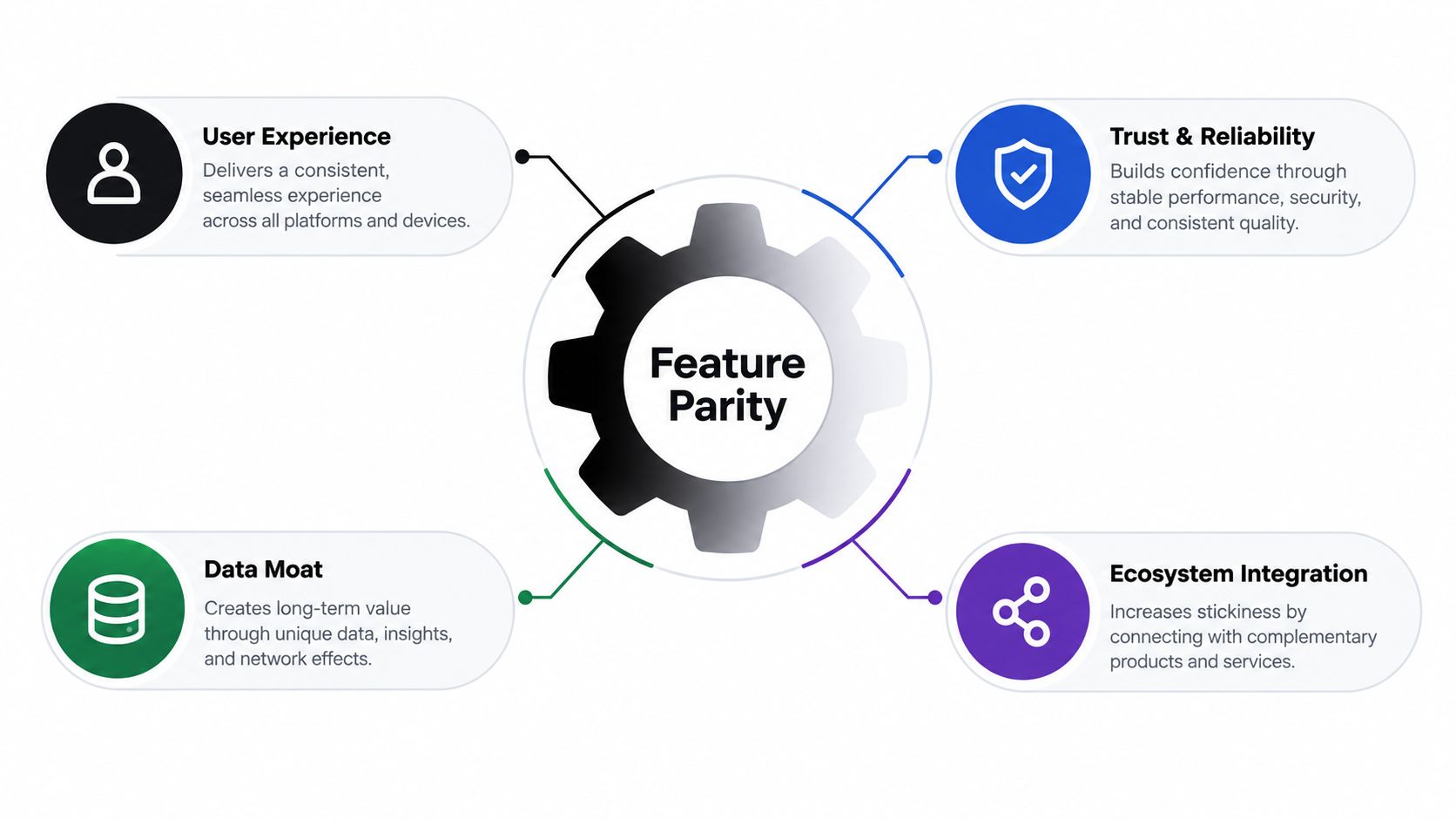
What survives feature parity
When everyone can ship the same surface-level capability, four layers matter more.
- User experience: Not “pretty UI.” Fast setup, clear outputs, fewer wrong turns.
- Trust: Reliability, privacy posture, and evidence that the product won't embarrass the buyer internally.
- Data moat: Inputs, labels, history, or workflow context competitors don't have.
- Ecosystem integration: The product becomes harder to replace when it sits inside systems of record.
These are the layers that keep working after a competitor copies your launch video.
What to build instead of another parity sprint
I'd rather see a founder spend a sprint on proof than on a minor AI feature. Add the case snippet. Publish the before-and-after workflow. Instrument the onboarding path so the differentiated value appears early. Build the integration that gives your model better context than generic competitors.
Brand matters here too. Not empty brand work. A point of view. Anthropic's Claude, for example, isn't just “another model.” Its positioning tells buyers what kind of tradeoff they're making. Strong vertical AI tools do the same. Their edge isn't just the model. It's the mix of context, trust, workflow fit, and evidence.
If you're designing products where humans still need judgment around model output, this guide to human and AI collaboration is a useful companion.
If a rival can copy your differentiator by watching your demo, you don't have differentiation. You have a backlog item.
Horizontal Versus Vertical Differentiation for SaaS
A lot of founders mix up preference with superiority. Economics has cleaner language for this. By the late twentieth century, the distinction between horizontal and vertical differentiation became standard: horizontal means buyers prefer different options at the same price, while vertical means buyers generally agree one option is better on quality dimensions, as outlined in this Oxford academic treatment of product differentiation.
The practical difference
| Dimension | Horizontal | Vertical |
|---|---|---|
| Buyer logic | “This fits my taste or workflow better” | “This is better on quality, depth, or assurance” |
| Typical SaaS battleground | Interface, philosophy, team style, feature emphasis | Compliance, reliability, security, auditability, output quality |
| Price sensitivity | Higher if differences feel cosmetic | Lower when improvement is measurable and risky to downgrade |
| Winning motion | Match a persona tightly | Prove capability and reduce perceived risk |
Horizontal differentiation is common in SaaS. Linear, Asana, and ClickUp can all appeal to different teams because preferences differ. One team wants speed. Another wants breadth. Another wants structure. Nobody is universally wrong.
Vertical differentiation is different. Enterprise SSO, audit logs, governance controls, stronger evals, or better reliability create a ladder where buyers usually agree that more is better, even if not everyone can pay for it.
How to diagnose your market
A cheap AI writing tool fighting another cheap AI writing tool is usually stuck in a horizontal fight. The buyer asks, “Which one do I like more?” That's a dangerous place if your story depends on obvious superiority you can't prove.
A clinical-note AI built for regulated healthcare workflows has a shot at vertical ground. Buyers can judge compliance readiness, workflow fit, implementation burden, and trust requirements more objectively.
If your product serves a narrow industry, this explanation of vertical SaaS will sharpen your thinking.
The key decision is simple. If your market rewards taste, build a product people love using. If your market rewards assurance, build a product buyers can defend purchasing.
Tactical Differentiation Moves for Launch-Stage SaaS
A founder launches on Product Hunt, posts a polished demo, gets a spike of signups, and hears the same feedback all week: “Cool product. We already have something close.” That is the default outcome in AI SaaS now. Buyers expect competent features. They pay for a reason they can defend six months later, after three competitors copy your UI and another model release closes the raw capability gap.
Launch-stage differentiation should answer one question: what gets stronger after competitors copy the surface layer? If the answer is “not much,” fix that before you spend on distribution.
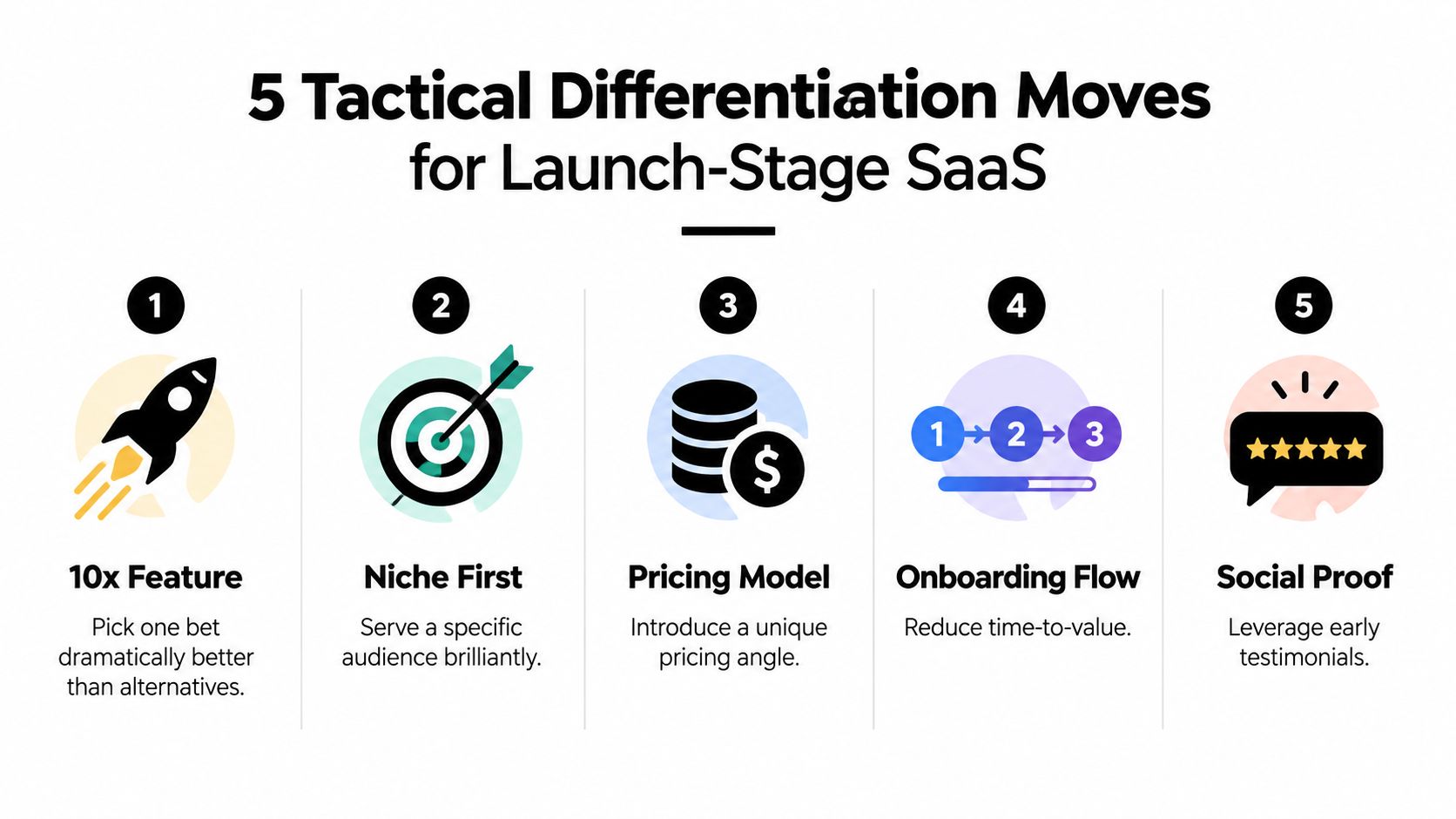
Five moves that actually change buyer behavior
Build one hard-to-dismiss advantage
Pick the part of the workflow where buyers feel risk, delay, or rework, then make that part clearly better. In AI, a shiny feature gets copied fast. A better outcome inside a painful workflow lasts longer. Strong evals, cleaner handoffs, better reliability, stronger citations, faster time to usable output, or deeper system context all beat a long feature list.
Choose a narrower buyer with a sharper pain
Broad positioning sounds bigger than it converts. A homepage for “teams using AI” says nothing. A homepage for RevOps leaders fixing CRM data decay, legal teams reviewing vendor contracts, or clinic operators handling intake volume gives buyers a reason to stop scrolling. Narrow beats vague at launch because it creates recognition, and recognition beats curiosity.
Package around the moat, not around generosity
Packaging should make your strongest buyer self-select. Put the defensible parts of the product where serious customers expect them. That might mean usage limits for casual users and paid access to governance, collaboration, auditability, eval visibility, or workflow controls. Good packaging teaches the market what your product is really for.
Before you lock the launch page, pricing, and onboarding, use a product launch strategy template for SaaS teams so your message and product choices point at the same buyer.
A short walkthrough helps teams pressure-test these choices before launch.
Use price to signal seriousness
Price shapes perception. If your product reduces expensive mistakes or saves expert time, cheap pricing weakens the story. If adoption speed matters more than immediate revenue, offer a free entry point with clear limits and make the upgrade path tie directly to the problem getting bigger. Price should reinforce who the product is for.
Make onboarding prove the difference fast
Generic tours waste your best moment. The first session should drive users straight into the thing that makes replacement less attractive. If your edge is implementation speed, get them to output fast. If your edge is quality, show the quality gap early. If your edge is workflow fit, preload the exact use case they came for.
One practical stack for launch week
Use this checklist:
- Homepage message: Write a headline that would repel the wrong buyer and feel precise to the right one.
- Demo asset: Show the defensible moment in the first minute, not at the end.
- Proof artifact: Add a before-and-after output, a workflow screenshot, or a customer quote tied to a concrete outcome.
- Launch distribution: Put the product where early adopters browse new SaaS and AI tools. SubmitMySaas is one option for founders who want a structured launch listing and discovery placement.
- Post-signup flow: Remove any step that delays the first proof point.
Hard truth: Early-stage SaaS rarely loses because the feature set is too small. It loses because buyers cannot tell why this product stays worth choosing after the market catches up.
How to Measure Whether Your Differentiation Is Working
Founders love to say they're differentiated. Buyers usually give the answer faster than founders admit. You can see it in behavior before you see it in revenue.
Use a simple dashboard
| KPI | Type | Target Threshold | Trigger If |
|---|---|---|---|
| Free-to-paid conversion by source | Leading | Higher conversion from the audience you explicitly target | Paid traffic converts the same as everyone else |
| Time to aha moment | Leading | Users reach the differentiated value quickly | New users wander before seeing the product's edge |
| Branded search interest | Leading | More people search for your product by name over time | Demand stays generic and comparison-led |
| Activation rate | Leading | Signups complete the key setup path | Many users sign up and stall before first value |
| Net revenue retention | Lagging | Existing customers stay and deepen usage | Customers churn once novelty wears off |
| Expansion revenue | Lagging | Teams buy more seats, usage, or controls | Accounts stay flat because value feels replaceable |
| Full-price acceptance | Lagging | Buyers accept listed pricing without heavy discounting | Deals only close when price drops |
What the signals usually mean
If organic or referral traffic converts better than broad paid traffic, that's often a sign your message resonates with the people you built for. If every source converts about the same, you may not be differentiated. You may just be understandable.
Support tickets are another giveaway. If new users keep asking what your product is for, your positioning is weak. If prospects compare you to the wrong category, your differentiation isn't landing.
Review this weekly, not quarterly
This doesn't need a giant analytics setup. A founder can review this in a short weekly session.
Focus on three questions:
- Are the right people converting?
- Do they experience the difference fast?
- Will they still pay when the novelty wears off?
If the answer to any of those is no, don't rush back to the roadmap. Re-check the positioning first.
How Differentiation Protects Margin and Demand
Differentiation isn't just a branding concept. It changes the demand curve you face. In industrial organization terms, making substitutes less close reduces direct price competition and can increase market power. Empirical grocery retail work also finds more differentiated products show different pass-through behavior for industry-wide versus firm-specific cost shocks, consistent with market segmentation and less elastic demand, as discussed in this analysis of differentiation and pass-through.
What this means for founders
If your analytics tool is just “another dashboard,” buyers compare price first. If your tool is “privacy-first analytics for EU Shopify stores,” buyers compare fit, trust, and switching risk before they compare price.
That's the whole game. Better differentiation gives you more room to price for the problem you solve instead of the category you resemble.
| Metric | Generic SaaS ($49/mo) | Differentiated SaaS ($129/mo) |
|---|---|---|
| Buyer comparison frame | “Looks similar to alternatives” | “Built for my exact risk and workflow” |
| Price pressure | High | Lower |
| Churn risk | Higher when a cheaper tool appears | Lower when replacement creates workflow pain |
| Sales narrative | Feature checklist | Outcome, fit, and trust |
| Margin protection | Weak | Stronger |
A founder-friendly pricing test
Take your current product and rewrite it as a vertical offer. Not fake vertical copy. Real narrowing.
Then ask:
- Would a buyer pay more because this sounds safer or more precise?
- Would switching away feel disruptive?
- Can we prove that claim in the first session?
If the answer is yes, you have the beginnings of pricing power. If not, you're still selling a category participant.
If you need to turn that into an actual packaging and monetization decision, use a practical SaaS pricing framework.
Founder Action Checklist for Your Launch Week
You do not need another brainstorm. You need decisions.
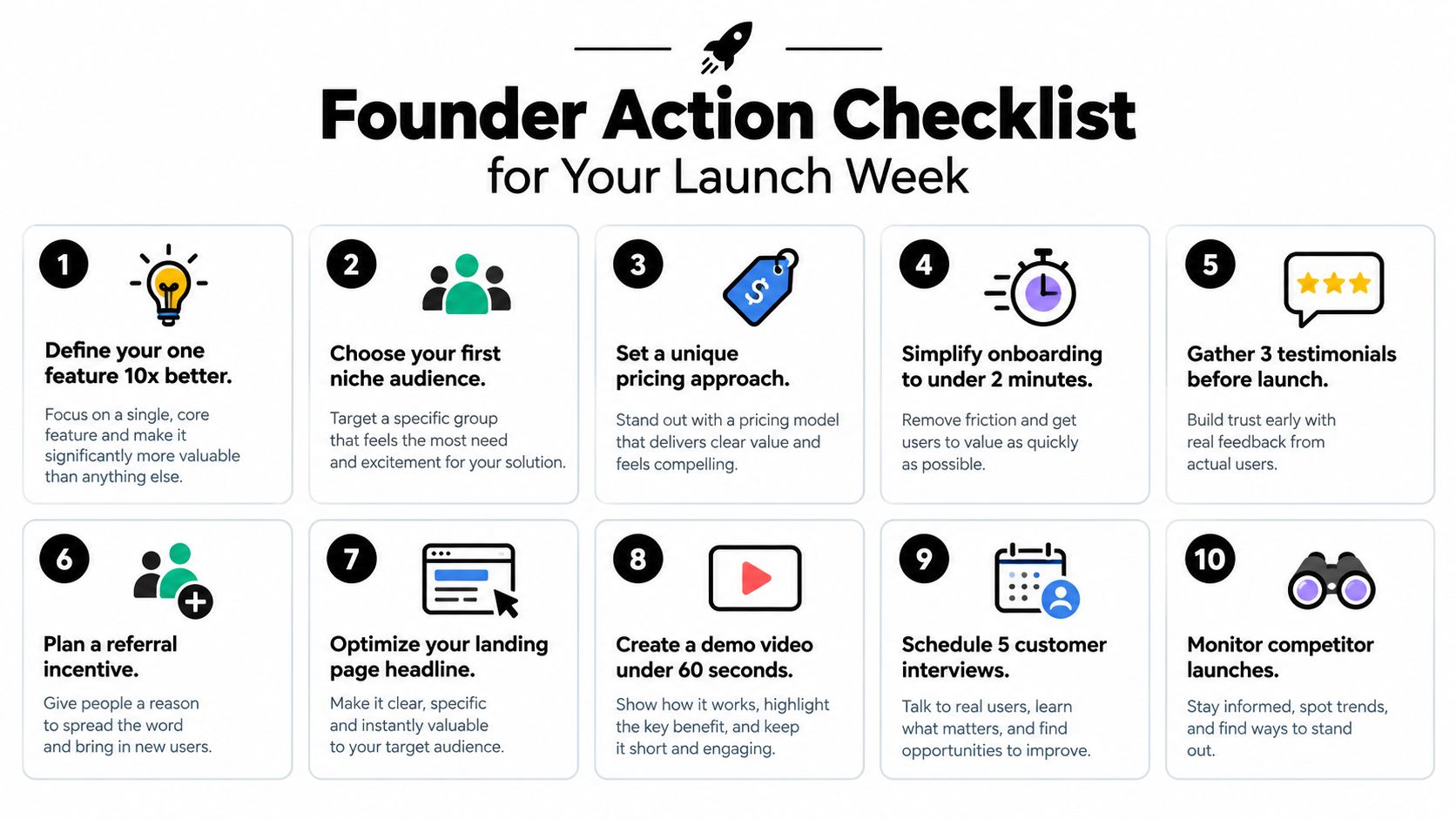
Ten moves to make this week
- Name the one customer you're for and make it narrow enough that some people should clearly self-disqualify.
- Write the one-sentence claim only that buyer would care about and remove every broader, softer version.
- Choose one differentiated capability that you can demonstrate in minutes.
- Cut any feature from your homepage that doesn't support that core claim.
- Add one proof asset that reduces buyer doubt, such as a workflow example, output sample, or customer result story.
- Set pricing to match the problem seriousness instead of matching the nearest competitor by reflex.
- Package plans so the right buyer sees themselves immediately without reading a maze of toggles.
- Build onboarding around the first undeniable win instead of a generic product tour.
- Track one metric that proves the right users get the point fast and review it every week.
- Write the comparison line against the obvious alternative so prospects don't do the framing for you.
The standard to hold yourself to
Buyers don't reward effort. They reward clarity. The product that wins in a crowded AI market usually isn't the one with the longest roadmap. It's the one that makes a specific buyer say, “This is for us,” and then backs it up.
Different is easy. Defensible is hard. Build for defensibility.
If you're launching into a crowded market, distribution and credibility matter almost as much as the product story itself. SubmitMySaas helps founders get new SaaS and AI tools in front of early adopters through launch listings, discovery surfaces, and curated visibility at release time. If your differentiation is real, getting the right people to see it early makes the rest of your launch a lot easier.