By Outrank
SEO Backlinks Strategy: A Step-by-Step Guide for SaaS
A practical SEO backlinks strategy for SaaS launches: ranked tactics, outreach templates, placement rules, link audits and KPIs that show real results.
On this page
Your launch page is live, your product works, and your outreach spreadsheet is filling with directories, guest-post offers, and publishers promising authority. The difficult part isn't finding somewhere to put a link. It's deciding which placements deserve your time, which deserve your money, and which could create a cleanup job later.
A useful SEO backlinks strategy treats every link as a placement decision. Record why it exists, whether a commercial relationship needs disclosure, and what business outcome you expect. A relevant mention that sends qualified buyers can be worthwhile without ranking credit. A paid followed link on an unrelated page can be a poor investment even when the seller advertises an impressive domain score.
Backlink Tactics Ranked for SaaS Launches
Start with the tactic your product gives you a credible reason to pursue, not the one promising the most links.
Backlink tactics compared for SaaS launches
| Tactic | Link type | Effort | Typical yield | Best fit |
|---|---|---|---|---|
| Digital PR around original data | Editorial | High | High when the story is newsworthy | Teams with survey or usage data |
| Guest posts on niche publications | Editorial, contextual | Medium | Accepted articles with useful contextual citations | Founders with a teachable expertise angle |
| Resource or roundup page inclusions | Editorial | Medium | Inclusions where the asset fills a clear gap | Products with a free tool or template |
| Integration and partner pages | Partner or editorial | Low to medium | Coverage from active integration partners | Products with a live integration |
| Expert commentary requests | Editorial | Low per request | Selected quotes, not guaranteed links | Founders who can answer fast |
| Customer and community case studies | Editorial or partner | Medium | Approved stories with attributable evidence | Products with named customers |
| Launch directory listings | Directory | Low | Discovery, sometimes a followed link | Launch-week visibility |
| Badge or link programs | Sponsored or conditional | Low | Links governed by package terms and attributes | Launch packages with clear terms |
In 2025, 48.6% of SEO professionals rated digital PR as the most effective link-building tactic, according to RockingWeb's analysis of SEO industry surveys and studies. That makes it a sensible first test when you have a newsworthy dataset, not a reason to manufacture a survey nobody needs.
Match the tactic to the asset
Digital PR needs a finding an editor can explain to readers. Publish the methodology, acknowledge sampling limitations, and provide a usable chart. Aggregated product usage can work, but only when you have permission to publish it and can protect customer privacy.
Guest posts need practical expertise rather than a disguised product pitch. A founder explaining webhook retry handling has a stronger angle for a developer publication than a generic article about productivity.
Resource-page outreach works best with something readers can use immediately. A calculator, migration checklist, or maintained template gives the editor a clear reason to add your page. Integration outreach is narrower but often easier because a working integration already establishes relevance.
Expert commentary requires speed and a distinctive answer. Customer stories require permission and evidence. Neither works well when the founder supplies polished marketing language instead of useful detail.
Keep discovery separate from editorial coverage
Launch directories can introduce your product to buyers and writers, but inclusion isn't equivalent to an independent recommendation. Use our guide to SEO directory lists to assess candidate destinations rather than submitting everywhere.
If submission administration would displace product or editorial work, manual startup listings with StartupSubmit are an option to evaluate against handling submissions yourself. Review destination relevance and placement terms before delegating.
At SubmitMySaas, we rank products weekly under Top Projects and Last Week's Best, and monthly under This Month's Best. Treat those lists as launch-discovery channels to pair with editorial work.
Choose two tactics for your next 90-day work cycle based on asset strength and team capacity. The qualitative yield descriptions aren't forecasts. Judge each tactic using your own tracked placements and business outcomes.
How to Run a Five-Stage Outreach Campaign
Don't start by purchasing a prospect database. Start by deciding what an editor would gain by linking to you.
Build the asset and qualify the audience
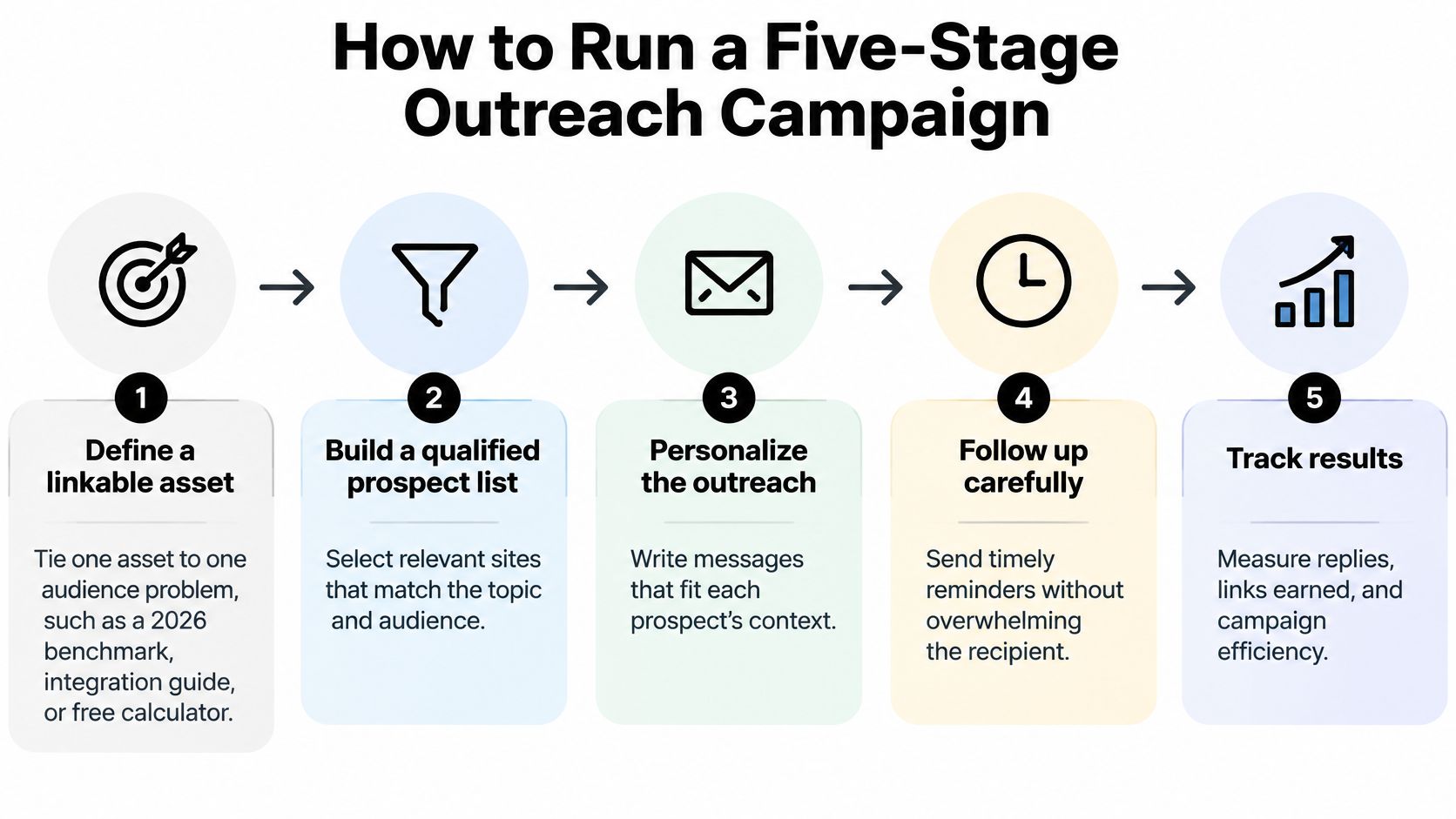
Define a linkable asset. Tie it to a specific audience problem: an integration guide that resolves a difficult setup, a transparent benchmark, or a free calculator that replaces spreadsheet work. Publish it on a stable, indexable URL with clear authorship and supporting methodology. The common mistake is pitching a homepage when the publisher needs evidence or a useful resource.
Build a manually qualified prospect list. Check topical relevance, audience overlap, editorial standards, and whether you've already earned coverage from that domain. Inspect the actual destination page, not just the site's authority score. Remove sites whose only route to publication is buying a post from your earned-outreach list; commercial placements belong in a separate workflow.
Personalize around a content gap. Name the relevant article and explain the missing example, outdated reference, or unanswered question. Connect your asset to that gap without asking the editor to invent the angle. Generic compliments followed by a link request signal that you haven't understood the page.
Our explanation of media outreach is useful when the opportunity is a journalist relationship rather than an immediate insertion request.
Track the funnel without hiding the failures
Record each stage separately. Maintain columns for delivered emails, replies, qualified opportunities, placements, and unique referring domains. A bounce isn't a rejection, and a friendly reply isn't a placement. Keep follow-ups in the same thread, add something useful, and stop when the recipient declines.
Evaluate the published result. Check the surrounding paragraph, destination URL, link attribute, and whether the citation accurately represents your work. Then assess destination-page engagement and qualified referral activity. Counting a directory listing as editorial coverage makes a weak campaign look stronger without improving it.
For planning, Ahrefs' link-outreach guide gives a 1–5% outreach-to-link conversion benchmark, meaning 100 targeted emails may produce roughly 1–5 links. Treat that as a workload estimate rather than a commitment; the asset and prospect fit determine whether outreach deserves expansion.
Practical rule: Scale a message only after the replies show that recipients understand its relevance.
A useful response explains what the publisher needs next. Repeated requests for payment suggest the list is commercially oriented. Repeated confusion about the asset suggests the pitch or landing page needs work.
I would start with a small, manually reviewed batch that the founder can comfortably answer. Read every response before expanding. Low personalization, weak newsworthiness, and premature volume waste more effort than a carefully rejected prospect ever will.
Outreach Email Templates That Earn Replies
An editor should be able to understand your request without opening an attachment or booking a call. Use a named founder or team member whose role and expertise are easy to verify.
Template A for a content gap
Subject: Missing implementation detail in [article title]
Hi [name], Your [article title] explains [specific process], but the section on [topic] doesn't address [specific limitation]. That leaves readers without a way to [important task].
We've published [asset name], including [verified sample size or measurement from your asset] and the method used to collect it.
Would the underlying table help with your next update?
[Name and role]
Replace the bracketed measurement only with something you can substantiate. An adaptable line is: “Your article cites [existing figure and source]; our newer dataset measures [same subject and unit], and I can share the collection method.”
This works because it identifies an editorial task. It doesn't assume that newer automatically means better.
Template B for a resource-page addition
Subject: A working resource for [resource-list title]
Hi [name], Your [exact resource list] helps [audience] with [task]. Our [free tool or template] fits the section on [specific need] because readers can [concrete action] without [relevant obstacle].
Suggested description: [Asset name] helps [reader] complete [task] using [distinctive feature].
Would you consider it for the list?
[Name and role]
Provide a description the editor can paste without removing sales claims. Don't call a trial free if readers must pay to complete the advertised task.
Template C for a data offer
Subject: [Finding] for your coverage of [topic]
Hi [name], Our analysis found [verified finding], which could inform your coverage of [specific issue].
The material is available under embargo until [date, time, and time zone], if you agree to those terms.
I can share the raw table, methodology, limitations, and a plain-language explanation. Would you like access?
[Name and role]
Use an embargo only when there's a genuine release schedule. Don't impose one retroactively.
Make the response easier than ignoring the message.
Follow up with a new fact or clarification rather than a reminder alone. Close the thread politely if there's no interest. After acceptance, send the exact destination URL, suggested description, and descriptive image alt text when an image is relevant.
Placement Rules That Keep Links Safe
Google's link-spam guidance identifies links created primarily to manipulate rankings as link spam, including ranking-purpose purchases, product or service exchanges, and excessive reciprocal linking. Advertising, sponsorship, and affiliate relationships can exist, but their links should use rel="sponsored" or rel="nofollow" rather than pass ranking credit.

Placement types, ranking credit and required attributes
| Placement | Passes ranking credit | Required attribute | Action |
|---|---|---|---|
| Editorial mention earned on merit | Eligible, not guaranteed | None required | Keep it and thank the writer |
| Guest post with contextual link | Eligible if genuinely editorial | None when there's no payment or product trade | Confirm no compensation |
| Sponsored review or paid feature | Shouldn't | rel="sponsored" |
Disclose and tag the link |
| Affiliate or referral link | Shouldn't | rel="sponsored" or rel="nofollow" |
Tag every affiliate URL |
| Product received for review | Shouldn't when tied to the review | rel="sponsored" or rel="nofollow" |
Disclose the product |
| Launch directory listing | Inspect attributes and commercial terms | Qualify compensated links | Count it as discovery |
| Badge-linked launch package | Assess the exchange and attributes | Qualify commercially conditional links | Confirm terms in writing |
| Reciprocal link swap | No assurance; excessive exchanges create risk | No attribute makes a manipulative exchange safe | Limit to reader-useful pages |
| Sitewide footer or forum signature | Don't rely on it | Qualify paid links; avoid manipulative placements | Remove or change promotional patterns |
Disclosure belongs on the page
Label sponsored articles visibly, qualify affiliate URLs, and disclose products supplied for review. An internal spreadsheet entry doesn't tell a reader about the relationship.
An editorial mention without ranking credit can still support referral traffic and brand discovery. Don't pressure a writer to remove an attribute just to satisfy an SEO report.
We aren't responsible for the content, policies, or practices of third-party websites or services we link to, including projects. Vet the destination before associating your product with it.
Test intent before approving a placement
- Reader usefulness: Would the reader want this link without the payment or product exchange?
- Visible relationship: Is the commercial relationship disclosed on the page and reflected in the link attribute?
- Independent value: Does the placement still make sense without ranking credit?
If the reader wouldn't benefit or the relationship is hidden, restructure it as a clearly qualified sponsorship or skip it. Exchange links only when both pages help their respective readers, never because a site exists to trade links.
Auditing Your Existing Link Profile
Investigate first, request changes second, and reserve disavowal for a credible problem you can't resolve. A tool's warning isn't enough reason to discard a link.
Google's link-spam policy identifies manipulative practices such as automated placements, excessive exchanges, and paid links that pass ranking credit. Use those behaviors to guide review rather than treating every unfamiliar domain as dangerous.
Build an evidence-based review queue
Export known backlinks from Google Search Console and supplement them with Ahrefs or Semrush when available. Deduplicate the exports, preserve the referring-page URL, and record the date you checked it.
- Classify the placement. Record topical relevance, surrounding content, indexability, domain history, anchor naturalness, and whether the link is editorial or compensated. Open the page and inspect the rendered link.
- Review anchor patterns. Look for natural branded, URL, and descriptive anchors. Clusters of identical commercial phrases deserve investigation, especially when they appeared through the same vendor.
- Flag coordinated behavior. Examine automated placements, irrelevant directories, repeated footer links, promotional forum comments, and unqualified paid links. A pattern matters more than an isolated oddity.
A small industry association can be a better source than a large unrelated publisher. Our guide to domain rating explains why a domain-level metric shouldn't replace page-level judgment.
Decide what actually needs changing
For each suspicious placement, ask who created it and why. Review invoices, agency reports, launch-package terms, and previous outreach records before assuming it was unsolicited.
- Keep: Relevant editorial coverage, even when the site looks modest.
- Correct: Inaccurate descriptions, broken destinations, or commercial links missing appropriate qualification.
- Remove: Placements your team commissioned primarily to manipulate rankings.
- Escalate: Uncontrollable links that still present credible risk after investigation.
Don't upload a blanket disavow file based on a toxicity label. If you're considering disavowal, document the evidence and assess whether the situation warrants it rather than ordinary monitoring.
A clean audit trail is more useful than a spreadsheet full of red warning icons.
Repeat the review quarterly and after changing agencies or buying promotional distribution. Keep evidence of requested changes and the final outcome. Once search systems neutralize manipulative links, leaving those URLs online doesn't guarantee that their former ranking benefit will return.
Measuring Backlinks by Outcome and Cost
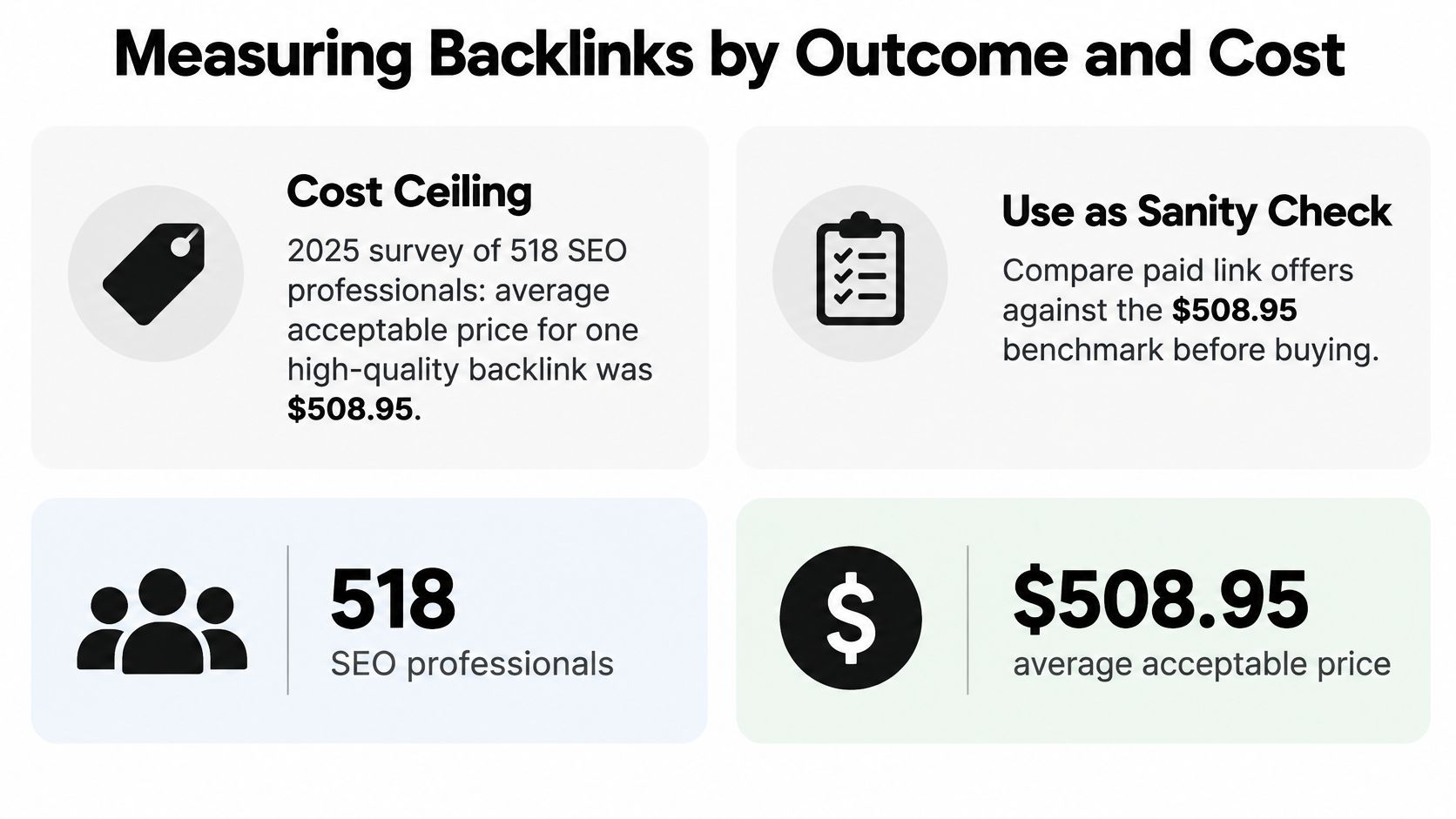
Set a cost ceiling before approving outreach or promotional spend. According to BlogWithMo, as reported in uSERP's link-building statistics, a 2025 survey of 518 SEO professionals found an average acceptable price of $508.95 for acquiring one high-quality backlink.
That's a sanity check on acquisition economics, not a recommended purchase price or permission to buy ranking credit. Your own ceiling should reflect audience fit, expected commercial value, and the work involved.
Backlink KPIs, what they show and how to read them
| Metric | What it tells you | Benchmark or counting rule |
|---|---|---|
| Unique referring domains | Breadth of earned coverage | Count each site once |
| Outreach-to-link conversion | Quality of list and pitch | Use delivered outreach as a consistent denominator |
| Editorial share of links | Whether coverage was earned | Separate earned and paid placements |
| Referral sessions to target page | Whether placements send visitors | Compare against the page's baseline |
| Ranking movement for target queries | Search visibility changes | Review over several months |
| Cost per editorial link | Acquisition efficiency | Compare with your approved cost ceiling |
| Toxic link share | Tool-flagged review workload | Investigate flags; they're not Google penalty thresholds |
Count decisions, not duplicate URLs
Use unique referring domains as the primary breadth measure because multiple links from the same publication may represent the same editorial decision. Preserve individual URLs for inspection, but don't let repeated placements inflate acquisition reporting.
Calculate cost per editorial link by dividing campaign spend by editorial placements from unique domains. Include staff time at an internal hourly cost, asset production, outreach software, and external support.
Track discovery spending separately so paid distribution doesn't make earned acquisition appear cheaper. In GA4, examine referral visitors' meaningful actions, such as starting signup or viewing integration documentation, rather than stopping at session counts.
Ranking changes need context. Compare target queries and destination pages against their own baselines, recording substantial content changes or technical fixes that could also explain movement.
If a tactic exceeds your ceiling without delivering better prospects or strategic coverage, move budget toward the lowest-cost source of relevant editorial domains. Cheap irrelevant placements aren't an efficiency improvement.
Confirm Your Launch Link Plan for the Next 90 Days
Put a start date on the campaign and assign an owner to each checkpoint. A bounded work cycle makes it easier to stop an unproductive tactic.
- Week one: Classify existing links, inspect commercial placements, and request changes to manipulative sitewide or undisclosed paid links.
- Weeks two and three: Select your tactics, publish the asset, and qualify prospects manually.
- Week four onward: Send manageable batches, log outcomes separately, and review acquisition costs fortnightly.
- Campaign close: Compare tactics by relevant unique domains, qualified visitors, and documented placement risk.
Make launch terms part of the decision
For launch week, read our terms before choosing a SubmitMySaas placement. Free Launch gets a dofollow backlink only if your product ranks in the top 3 weekly and displays the SubmitMySaas badge on its site.
Premium Launch includes a guaranteed high authority dofollow backlink, skip-the-free-queue priority access, priority weekly placement, and featured homepage placement. Advertising costs $79 per product for a month. These are commercial offer terms, not a guarantee of search-ranking improvement; assess link qualification against the relationship.
Treat launch listings as discovery support for editorial coverage. Keep a reviewable record of each placement's purpose, disclosure, attribute, cost, and outcome.
SubmitMySaas lets makers submit product launches for visibility, feedback, and a high-authority backlink. Visit SubmitMySaas to review the launch options and decide whether a listing fits your discovery plan alongside earned editorial outreach.