What Is Media Outreach for SaaS Launches
Learn what is media outreach and how SaaS founders can earn independent coverage. Discover the step-by-step process, pitch templates, and key metrics.

Most advice about media outreach starts in the wrong place. It tells SaaS founders to write a press release, collect a large journalist list, and send the announcement as widely as possible. That approach treats newsrooms like email databases. It also ignores the question that determines whether anyone responds: why would this story matter to this audience, from this source, right now?
Media outreach works better as a focused exchange of useful information. You bring verified data, a credible expert, a timely perspective, or access to a story. An independent publisher decides whether that material deserves attention. For a small SaaS company without a large PR budget, that distinction is the difference between earning coverage and adding another ignored message to a crowded inbox.
Redefining Media Outreach for Modern SaaS
So, what is media outreach? It's the deliberate process of presenting newsworthy information, expert commentary, or story ideas to journalists, editors, broadcasters, podcasters, and other influential publishers in order to earn independent coverage. The organization supplies the information and access. The publisher makes the editorial decision, as described in the Reuters Institute's 2025 Digital News Report.
That definition matters because outreach isn't advertising. You can't purchase editorial independence with a well-written email, and a journalist isn't obligated to cover a product because you sent a press release. A newsroom evaluates relevance, credibility, timing, and usefulness for its audience. Your job is to make that evaluation easy, not to pressure the editor into approving your launch.
A newsroom has a supply problem
Journalists need story ideas, supporting evidence, expert sources, images, charts, and video. They also work under tight deadlines. A useful pitch supplies some of those ingredients in a form that can be checked and used quickly.
An irrelevant pitch creates more work. It forces the journalist to determine what the story is, whether the claims are credible, whether the product fits the beat, and whether the proposed angle offers anything beyond promotion. That's why a founder's product announcement usually isn't enough. “We launched a new workflow tool” describes the company's event, not the reader's reason to care.
Practical rule: Treat every pitch as a newsroom resource, not a request for a favor.
A stronger story might connect the product to a documented shift in AI adoption, a new workflow problem affecting a defined group, original usage data, or a founder who can explain a complicated issue clearly. The product can appear in the story, but it shouldn't carry the entire editorial burden.
Relevance beats distribution
Broad distribution feels efficient, but it usually weakens the message. A reporter covering developer infrastructure needs different evidence from a newsletter writer focused on startup finance. A podcast host may value a thoughtful expert conversation, while a technology editor may need data, screenshots, and a clear news hook.
Use outreach as one part of a wider distribution system. Your content distribution channels can support owned and community-led visibility, while media outreach adds independent editorial judgment. The strongest campaigns don't send one identical message everywhere. They adapt the story, evidence, format, and contact to the audience.
How Earned Coverage Differs from Paid and Owned Media
Media outreach sits between promotion and editorial validation. Paid media buys attention, owned media publishes your own claims, and earned media depends on an independent publisher deciding that your story deserves coverage. Each channel has a legitimate role, but they solve different problems.
A paid campaign can give you predictable placement and control over the message. Your blog can build a searchable library of product education and customer guidance. A directory submission can put a new product in front of people actively browsing for tools. Media outreach is less predictable, but it can introduce your company through a source your audience already trusts.
| Channel Type | Primary Benefit | Cost Model | Trust Level |
|---|---|---|---|
| Paid media | Controlled reach and placement | Pay for distribution or exposure | Depends on the audience's view of advertising |
| Owned media | Long-term education and search visibility | Internal production cost | Based on your own authority |
| Directory submission | Product discovery and launch visibility | Submission or package cost | Useful for discovery, but not independent editorial coverage |
| Earned media | Third-party validation and new audience access | Time, preparation, and relationship work | Higher when the publisher is credible and independent |
The trade-off is control. Paid and owned channels let you decide exactly what appears. Earned coverage gives the publisher control over the framing, timing, wording, and even whether the product appears at all. That uncertainty can feel uncomfortable, but it's also what makes a genuine mention more credible to early adopters, partners, and investors.
Where directories fit
A directory launch isn't the same thing as media outreach. A directory helps people discover a product and can support launch visibility, search exposure, and backlink acquisition. It doesn't mean an editor independently investigated the company or selected it for a reported story.
That doesn't make directories less useful. A SaaS launch stack can use a directory for immediate discoverability, owned content for education, paid campaigns for controlled reach, and earned outreach for authority beyond the company's existing network. For a broader view of how these channels work together, see this guide to what is SaaS marketing.
Measure the right outcome
Earned media measurement gets distorted when teams assign value to every mention or treat estimated reach as revenue. A more disciplined approach separates coverage, audience response, and business contribution. The guide on how to avoid pitfalls in earned media measurement is useful when you're deciding which outcomes deserve credit.
Track where the story appeared, whether the outlet matched your target audience, which links or mentions drove visits, and whether those visitors became meaningful prospects. A prominent placement with no relevant audience may be less valuable than a smaller specialist publication that reaches the people who understand and need your product.
Navigating the Fragmented News Ecosystem
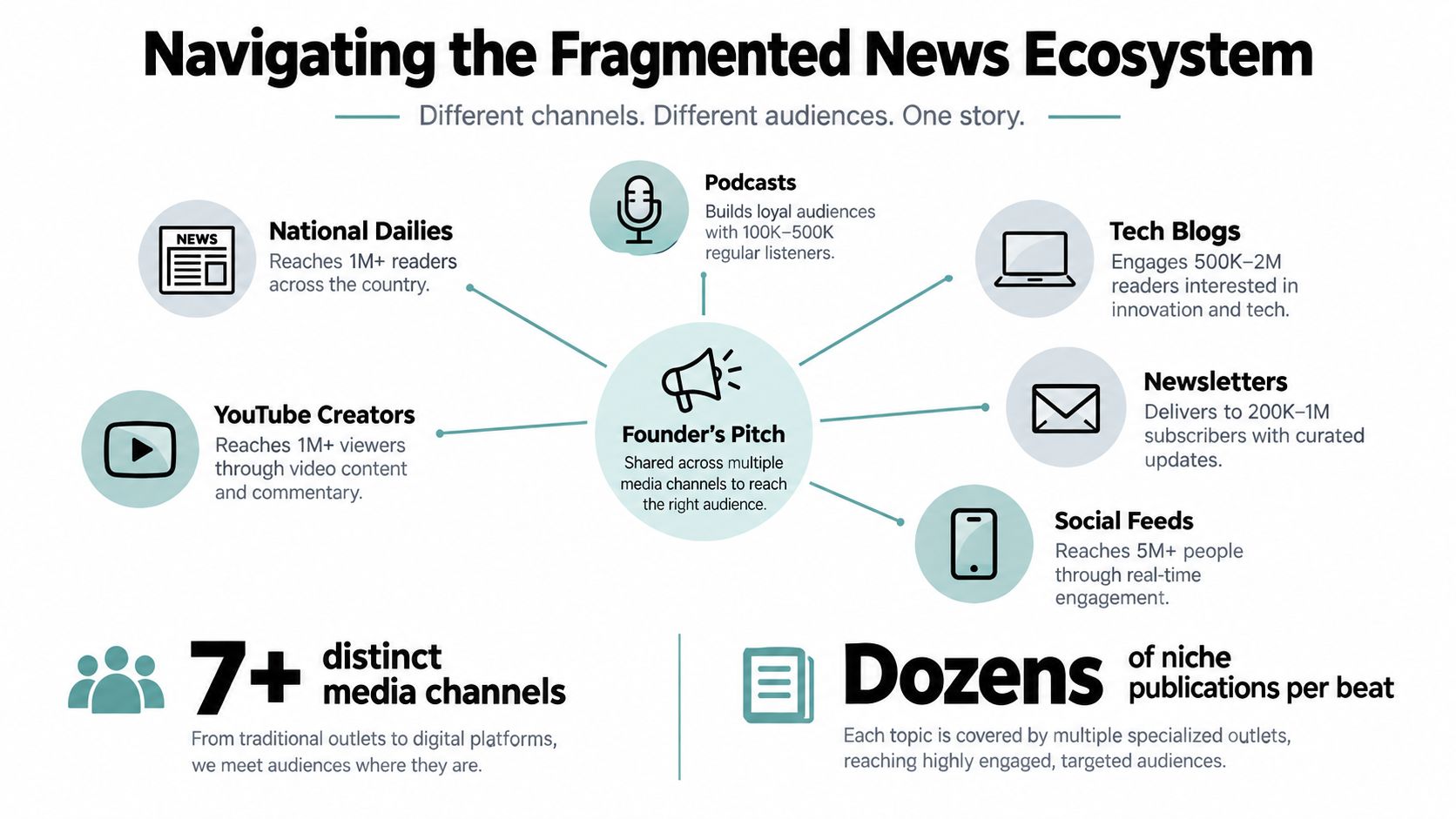
The modern news audience no longer gathers around a small group of newspapers, television channels, and major technology websites. The Reuters Institute's 2025 Digital News Report surveyed more than 97,000 online news consumers across 48 markets and found that six online networks reached more than 10% of respondents weekly with news, compared with only two networks a decade earlier. The practical lesson is simple: a launch needs channel research, not just a media list.
Across those markets, 36% used Facebook for news each week, 30% used YouTube, 19% used Instagram, 19% used WhatsApp, 16% used TikTok, and 12% used X, according to the Reuters Institute executive summary. In the United States, 54% accessed news through social media and video networks, compared with 50% through television news and 48% through news websites or applications, from the same source.
Expand your definition of a media contact
For SaaS founders, a relevant contact might be a traditional technology reporter, a specialist newsletter editor, a podcast host, a YouTube creator, or a credible commentator who explains a narrow technical subject. These people don't all produce the same format, and they don't all need the same pitch.
The report also found that 44% of people aged 18 to 24 identified social media and video networks as their main news source, compared with 38% of those aged 25 to 34. Those figures don't mean every startup should chase social creators. They mean you need to understand where your specific users encounter trustworthy information.
Build a beat map
Start with the problem your product addresses, not the product category in your homepage navigation. An AI meeting assistant might fit workplace technology, productivity, future-of-work, or accessibility coverage. A developer tool could belong with software infrastructure, open-source communities, engineering newsletters, or technical podcasts.
For each angle, record:
- Audience fit: Who reads, watches, or listens to this contact?
- Editorial fit: What topics does the person regularly cover?
- Evidence fit: Would they need data, an interview, a product demonstration, or customer access?
- Format fit: Can you provide a concise quote, a visual explanation, a technical walkthrough, or a conversation?
A fragmented ecosystem rewards precision. One strong specialist relationship can matter more than a large list of contacts who have no reason to care about the story.
Building a Newsworthy Angle and Asset Package
A product launch is an event for the company. It becomes a story only when it connects to a problem, trend, conflict, decision, or change that matters beyond the company itself.
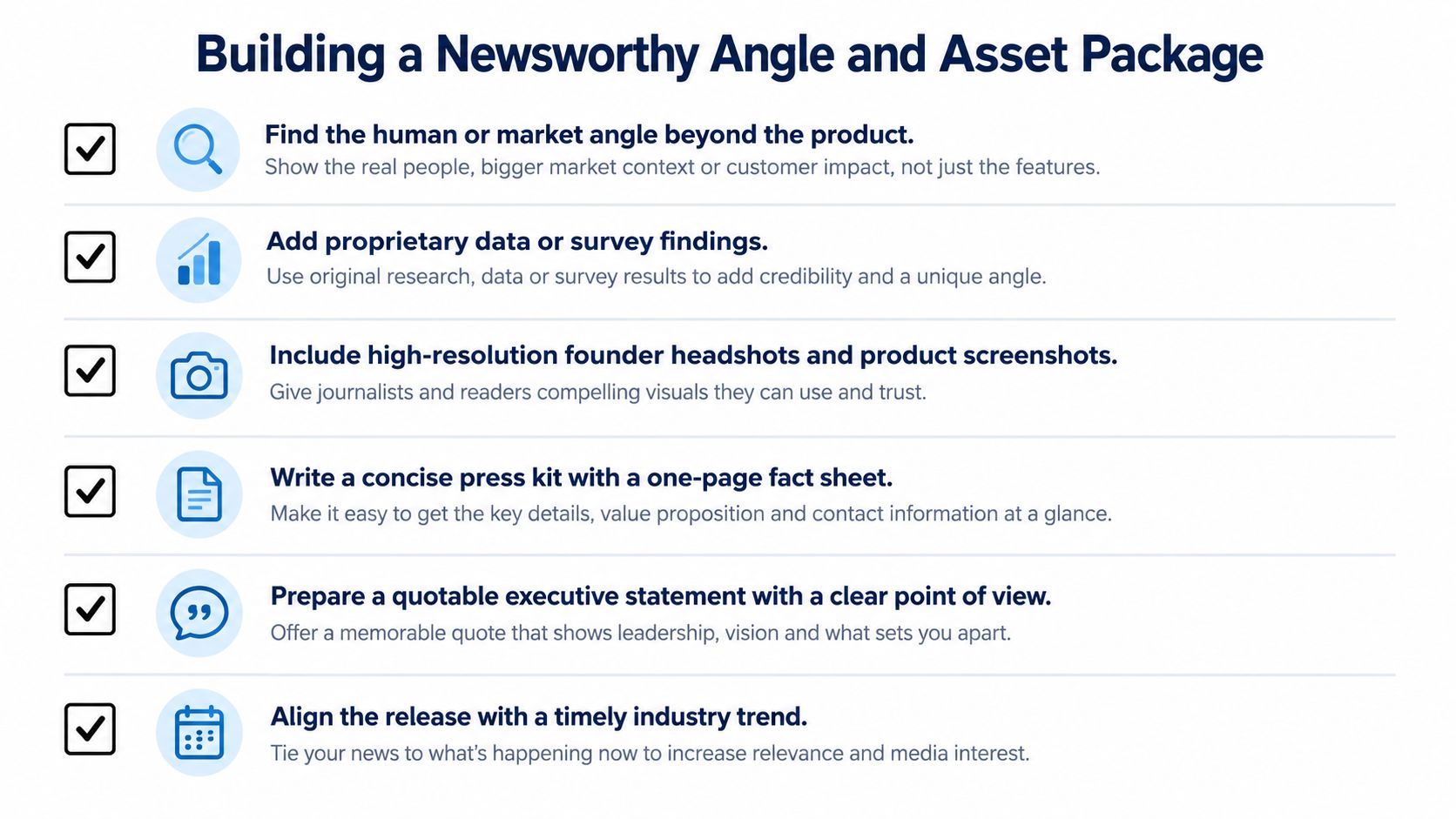
Start by writing the launch in one sentence without using the product name. If the sentence becomes impossible, the announcement probably lacks an external angle. Rewrite it around the customer problem, a market observation, original data, a useful expert, or a timely event.
Turn the angle into evidence
A credible angle needs proof. That proof may be product data, a transparent benchmark, a customer problem documented through interviews, or an expert who can explain the wider issue without turning the conversation into a sales pitch.
The asset package should answer the journalist's practical questions before they need to ask:
- What happened? Provide a concise release with the launch date, product description, relevant context, and contact details.
- Why does it matter? State the market or human problem in plain language.
- What can be verified? Include documented product facts, methodology notes, and clear distinctions between measured results and forecasts.
- Who can explain it? Name a founder or subject-matter expert and specify the topics they can discuss.
- What can the newsroom use? Offer labeled screenshots, founder headshots, product visuals, charts, and video.
Cision's worldwide 2024 survey of 3,016 media professionals across 19 markets reported that 72% preferred receiving press releases from PR professionals, while 87% used supplied multimedia assets such as images, data visualizations, or video, according to Cision's 2024 State of the Media report. The point isn't to attach every possible file. It's to remove avoidable production work while keeping every claim accurate and clearly labeled.
For a practical structure covering the essentials, use this resource on how to create a media kit. Then keep the package easy to follow. One folder should contain the release, fact sheet, approved images, data notes, spokesperson details, and contact information. Don't make a journalist search through a maze of assets to find the one screenshot they need.
A press release writing guide can help with structure, but the release shouldn't replace the customized pitch. The release supplies the factual record. The email explains why this particular journalist's audience may care.
Crafting Pitches That Journalists Actually Read
A pitch earns attention by reducing uncertainty. The recipient should understand the proposed story, its relevance to their beat, the evidence available, and the next easy step without decoding a marketing slogan.
In a 2025 survey covering journalists in the United States, United Kingdom, Canada, and India, 47% said they seldom or never receive pitches relevant to their coverage, while 86% said irrelevant pitches are immediately disregarded, according to BuzzStream's PR trends research. Personalization therefore means more than inserting a first name. It means showing that you understand the journalist's coverage and have a reason for contacting them.
Use a simple pitch architecture
A strong email can follow this sequence:
- Subject: State the specific story or evidence, not “Exciting SaaS launch.”
- Opening: Reference the beat or a relevant recent article without flattery.
- Angle: Explain the issue in one or two sentences.
- Proof: Offer the data, expert, customer context, or demonstration available.
- Action: Ask whether the topic is useful, then make access easy.
A data-driven trend pitch might read:
Subject: New workflow data on how small teams handle AI adoption
Hi [Name],
Your recent coverage of [specific topic] examined [specific issue]. We analyzed [clearly defined source or dataset] and found [verified observation]. I can share the methodology and connect you with [named expert] to discuss what the result means for [audience]. Would that angle fit your upcoming coverage?
A founder expertise pitch should lead with the issue, not the founder's biography:
Subject: Expert source on the operational cost of fragmented SaaS workflows
Hi [Name],
Your work on [beat] has covered [relevant subject]. [Founder name], who leads [company], can explain how teams handle [specific problem], including the trade-offs behind [specific decision]. They can provide concrete examples without requiring a product feature story. Is that useful for a future article or interview?
For a product launch, make the external relevance explicit:
Subject: New tool addresses [specific problem] for [specific audience]
Hi [Name],
[Company] is launching [product], built for [audience] facing [problem]. The news angle is [market or customer relevance], supported by [evidence]. I've included a one-page fact sheet and can arrange a short briefing with [spokesperson]. Would you like the details?
Follow up without becoming noise
Send a follow-up that adds information, not pressure. You might provide a newly available chart, clarify a claim, or offer a different expert. If you have nothing useful to add, a short confirmation is better than a sequence of increasingly urgent messages.
Study the journalist's publishing rhythm before choosing timing. A launch connected to a known industry event may require advance preparation, while a reactive comment may need to arrive while the issue is active. Keep a record of what you sent, which angle you used, and whether the contact requested a different format. A cold email example for potential clients can help with tone and structure, but editorial outreach still needs a genuine news reason.
Measuring Outreach Success Beyond Open Rates
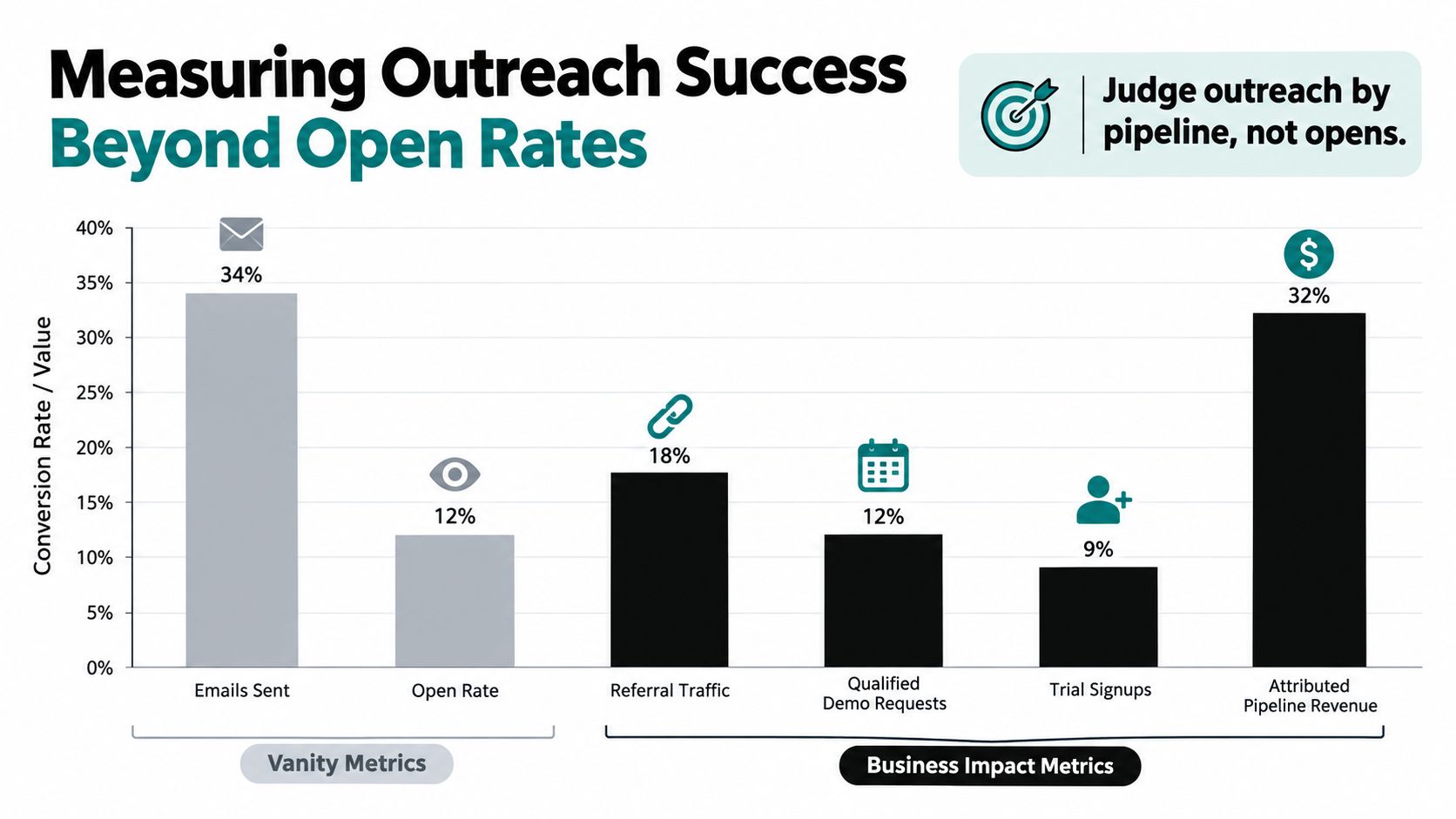
Open rates don't tell you whether a journalist found the story relevant, whether the outlet reached your intended audience, or whether coverage produced a qualified visit. They can also be distorted by email clients, previews, and automated security systems. Treat them as a delivery diagnostic at most, not a business outcome.
A better measurement system follows the journey from editorial response to commercial contribution:
| Measurement layer | What to track | Why it matters |
|---|---|---|
| Contact quality | Qualified replies and briefing acceptance | Shows whether the angle fits the recipient |
| Editorial outcome | Independent mentions, interviews, and asset usage | Confirms that the story earned attention |
| Audience response | Referral sessions and engaged product visits | Connects coverage to real interest |
| Search impact | Branded search and relevant editorial backlinks | Captures discoverability that may compound |
| Commercial contribution | Trial signups, demo requests, and assisted conversions | Shows whether attention supports growth |
Cision found that relevance was the dominant characteristic of an effective pitch, while 68% of journalists reported that fewer than 25% of pitches they receive are relevant to their work, based on a global survey of more than 3,000 journalists in its State of the Media findings. That makes qualified response quality more useful than raw send volume.
Connect coverage to behavior
Use distinct, sensible tracking links for campaigns and publications where appropriate. Record referral sessions in analytics, annotate the dates of published stories, and compare the quality of visitors from each outlet. Watch whether prospects return through direct visits, branded search, or later content interactions.
Backlinks deserve careful interpretation. An editorial link can support discovery and authority, but it isn't automatically valuable because a publication has a recognizable name. Assess topical relevance, placement, indexability, referral behavior, and whether the page is likely to remain available. A resource discussing the top Meltwater competitor for SEO can help teams think more broadly about monitoring, discovery, and competitive visibility.
Review the angle, not just the outlet
When a campaign underperforms, don't conclude that media outreach doesn't work. Ask whether the angle solved a newsroom problem, whether the contact covered the topic, whether the evidence was sufficient, and whether the assets were usable. A high-profile publication may produce little business value if the audience is wrong. A focused specialist outlet may generate stronger conversations with fewer visible impressions.
The Role of AI in Modern Media Relations
AI can make outreach operations faster, but it can't decide whether a launch deserves coverage. It can organize a contact spreadsheet, summarize a journalist's previous articles, identify repeated themes, suggest alternative subject lines, and help a founder compare pitch drafts. Those tasks reduce preparation time without replacing editorial judgment.
The danger starts when a team uses AI to generate one generic pitch and distribute it automatically. Journalists have learned to recognize vague claims, unnatural personalization, and emails that imitate relevance without demonstrating it.
A 2025 global survey of more than 1,500 journalists found that 44% viewed PR professionals' use of AI negatively, compared with only 12% who viewed it positively, according to MarketingProfs' report on journalist attitudes toward AI. Those figures don't mean founders should avoid AI. They show why disclosure, review, and human accountability matter.
Keep human judgment at the center
Use AI for organization and variation, then assign people the decisions that affect trust:
- Research support: Group contacts by beat, summarize relevant coverage, and flag missing context.
- Drafting support: Create alternative openings, shorten a release, or adapt a technical explanation for a different audience.
- Verification: Check every product fact, number, name, quote, date, and attribution against a reliable source.
- Editorial judgment: Decide whether the angle is genuinely useful or merely promotional.
- Relationship context: Determine whether the contact prefers email, interviews, data, product access, or expert commentary.
- Final approval: Ensure the message sounds like a knowledgeable human who understands the publication.
Don't ask AI to invent customer outcomes, fill gaps in research, or imply that a journalist has covered a topic when they haven't. Don't hide material AI involvement when a publisher asks how content or data was produced. The safest workflow treats AI as a preparation assistant, while the founder or PR lead remains responsible for truth and relevance.
For adjacent writing tasks, a comparison of best AI writing tools can help you choose where automation is useful. Media relations still requires restraint. A shorter, manually checked pitch is usually more credible than a polished sequence that proves nobody reviewed it.
SubmitMySaas gives SaaS founders a practical launch and discovery channel for getting new products in front of early adopters, makers, and technology audiences. Submit your product to SubmitMySaas, then use the resulting launch visibility and product information as a clean foundation for targeted outreach to journalists who cover your category.