Product Launch Plan That Actually Drives Growth
Build a product launch plan that drives real growth with proven goals, timelines, channels, KPIs, and a launch-day playbook built for SaaS teams.
You've got a launch date, a landing page, a product that is almost ready, and a growing list of promotional tasks. The team is discussing launch posts, directories, email, and social content, but nobody can answer the question that matters most: what should a new user do after signing up, and how will you know they received enough value to stay?
That gap is why many launches create activity without creating durable growth. A product launch plan should coordinate demand validation, positioning, distribution, onboarding, analytics, and post-launch learning. Launch day is only one point in that system.
What a Modern Product Launch Plan Actually Does
The most common launch mistake is treating launch day as the finish line. Teams count announcements, visits, sign-ups, and rankings, then move on before they know whether users reached a meaningful outcome. For SaaS and AI products, the finish line is further downstream, when a qualified visitor activates, returns, and eventually becomes a paying or retained user.
The commercial stakes justify that broader view. McKinsey reported that new-product launches generated more than 25% of total revenue and profits across industries, while more than 50% of launches missed their business targets and average failure rates exceeded 40% across sectors. The research also found no meaningful correlation between launch investment and success rate. Spending more can amplify a clear proposition, but it can't rescue weak demand, confusing onboarding, or poor coordination.
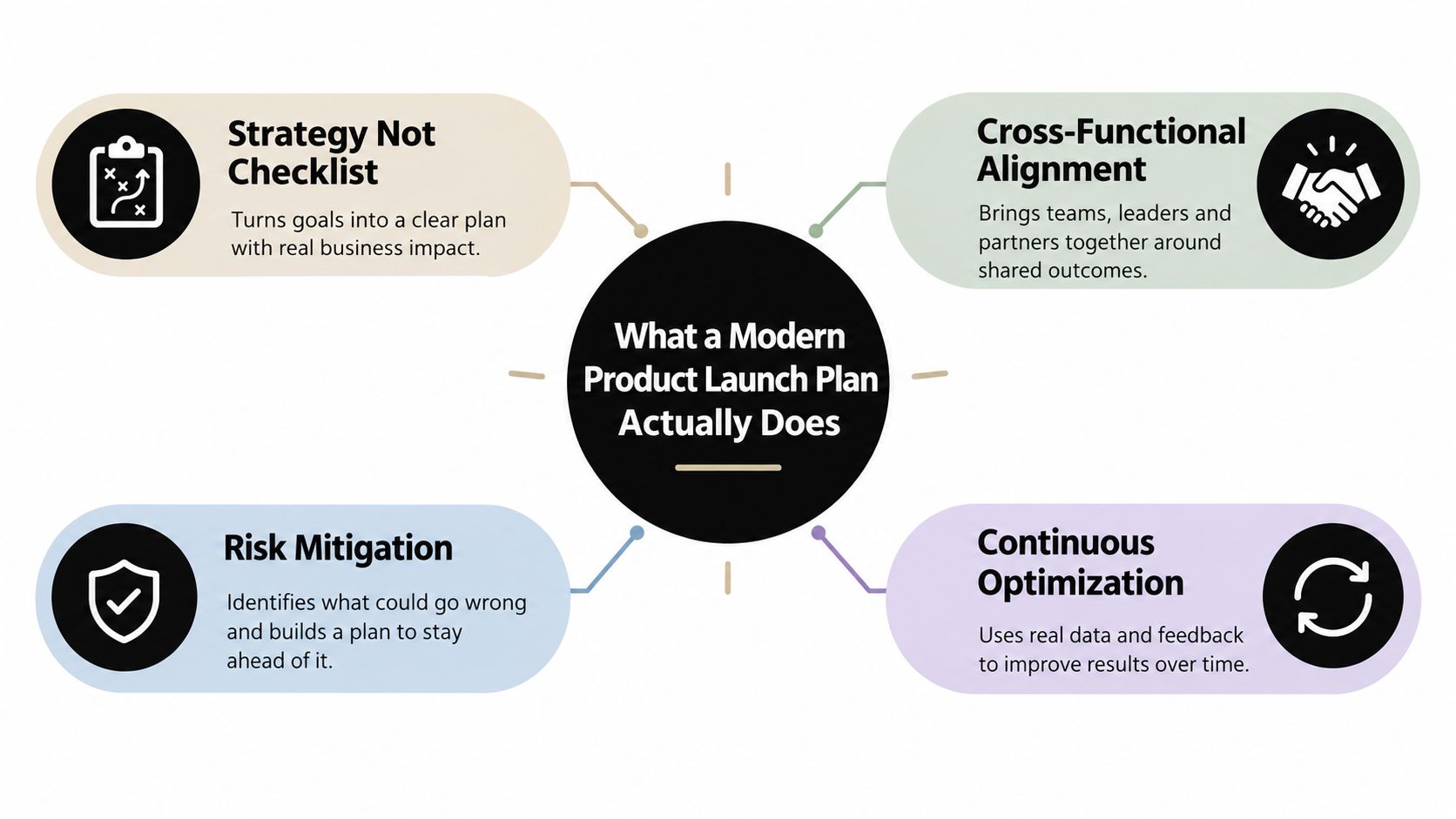
Treat the plan as a control system
A working product launch plan answers four operational questions:
- Who needs this? Define the ideal customer profile, urgent problem, buying context, and reason to act now.
- What must be true before release? Set evidence-based gates for demand, reliability, onboarding, pricing, analytics, and support.
- How will qualified people find and understand it? Coordinate channels, partners, directories, content, sales, and product messaging.
- What happens after attention arrives? Instrument the path from visit to signup, activation, retained usage, and revenue.
McKinsey identified collaboration, market insight, rigorous planning, and talent development as stronger launch capabilities than increasing spend. That changes the role of the plan. It isn't a calendar of promotional tasks. It is a shared operating document that makes ownership visible, forces decisions early, and gives the team a way to stop or change course before an expensive release.
Practical rule: If the plan stops at “publish announcement,” it isn't a growth plan yet. Add the first user outcome, the retention signal, and the owner responsible for improving both.
A strong plan also separates learning milestones from promotion milestones. Interviews, prototype tests, controlled access, and onboarding experiments reduce uncertainty. Email sends, directory placements, partner posts, and paid campaigns distribute the message once the team has enough evidence to scale attention. Keeping those jobs distinct prevents marketing volume from disguising product risk.
Validating Demand Before You Build the Plan
A launch date shouldn't be the first firm decision. The first decision should be whether the product has earned a broader launch at all.
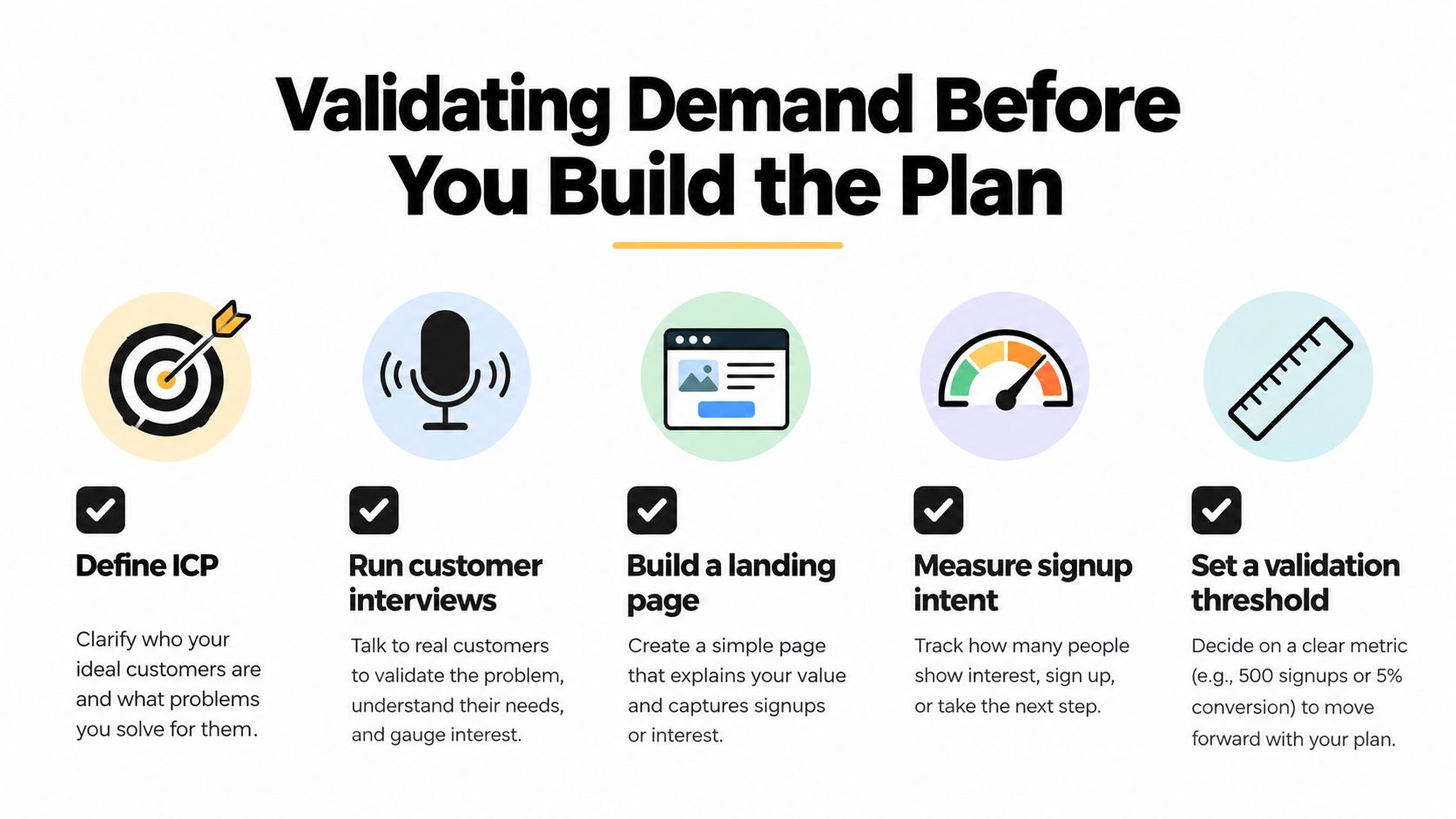
Start with an ideal customer profile, not a broad market label. Define the role, company context, workflow, trigger event, current workaround, and cost of leaving the problem unsolved. “Small businesses that need automation” isn't useful enough to guide messaging. “Operations leads at growing agencies who manually reconcile client reports before monthly reviews” gives product, marketing, and sales a shared target.
Then test the problem in conversations with potential customers. Ask how they handle the workflow today, what breaks, which alternatives they've tried, and what would make a change worth the effort. Don't lead with a feature list. You want evidence about the job, the current behavior, and the threshold for switching.
A practical guide to validating a startup idea can help turn those conversations into a repeatable discovery process, but the principle is simple: collect behavior and commitments, not compliments. A person saying the concept sounds interesting is weak evidence. A person agreeing to test a prototype, share sample data, or schedule a buying conversation is stronger.
Use stage gates before promotion
Research on 203 industrial launches found that products with well-defined and well-executed predevelopment activities achieved a 75% success rate, compared with slightly above 31% when those activities were weak. The same research identified inadequate market analysis as the leading cause of product failure. The OpenStax summary of that research supports a clear operational conclusion: discovery belongs inside the launch process, not in a forgotten research folder.
Use gates that produce decisions:
- Problem gate: The target segment and painful job are specific enough to recognize in interviews and product usage.
- Evidence gate: Potential users confirm the problem and show willingness to test a proposed solution.
- Feasibility gate: Engineering and commercial owners document material technical, pricing, support, and data risks.
- Activation gate: Early users can complete the first meaningful workflow without extensive hand-holding.
- Launch gate: The team has written criteria for reliability, onboarding, measurement, support, and controlled distribution.
The Harvard Business School case summary notes that two-thirds of startups never show a positive return, with false starts and insufficient customer-needs research recurring among the problems. Its recommended discovery process includes defining the problem precisely, gathering one-on-one feedback, and validating concepts with real customers in real-world settings.
Don't set a public launch date until the team can answer what would cause a delay, a narrower release, or a stop. A controlled cohort is often more valuable than a broad announcement when the product still has unanswered questions. The launch date should be the consequence of evidence, not a deadline that evidence must serve.
Core Building Blocks of a Strong Launch Plan
A useful product launch plan fits on a working document that every owner can use. It should be detailed enough to coordinate execution, but short enough that a busy team can find the current decision without searching through meeting notes.
Begin with the business outcome. “Create awareness” is too vague to prioritize work. Choose an outcome such as qualified adoption in a defined segment, paid conversion from a specific channel, or evidence that a new workflow deserves further investment. Pair that outcome with leading indicators, including activation and time to value, so the team can act before revenue data catches up.
Define the audience and message
Write the audience in operational terms, then write a positioning statement that survives contact with real users:
For [specific customer] who struggles with [recognizable problem], [product] is a [category or approach] that helps them achieve [valuable outcome] without [important alternative or pain].
For example, an analytics product might position itself for agency operators who need client-ready reporting without rebuilding dashboards manually. The statement is only a starting hypothesis. Test the language against interview transcripts, landing-page behavior, sales objections, and onboarding questions. A resource on product positioning can help teams separate a product description from a meaningful market position.
The plan should also record the three to five critical decisions that drive the outcome, following the structure emphasized in McKinsey's launch research. These might include the first segment to target, the use case to lead with, the release model, the primary distribution channel, and the proof required before expansion. Assign one owner and one decision date to each. A crowded task list hides priority. A short decision register exposes it.
Turn strategy into execution
Build the remaining blocks around those choices:
- Objectives: State the business result, activation outcome, and learning objective separately.
- Channel mix: Match each channel to a job. Email can activate known prospects, while a directory listing or partner post can create discovery.
- Timeline: Include dependencies, review windows, technical freezes, and rollback points.
- Owners: Name one accountable person for product readiness, analytics, messaging, distribution, support, and incident response.
- Budget envelope: Decide where paid reach is justified and where organic, partner, or community distribution is sufficient.
- Measurement: Define events, cohorts, attribution rules, and reporting cadence before traffic arrives.
Teams often separate positioning from measurement, then discover too late that the message attracted the wrong users. Connecting positioning to post-launch metrics helps keep the promise, audience, and observed behavior in the same operating conversation.
Your Four-Week Pre-Launch Timeline
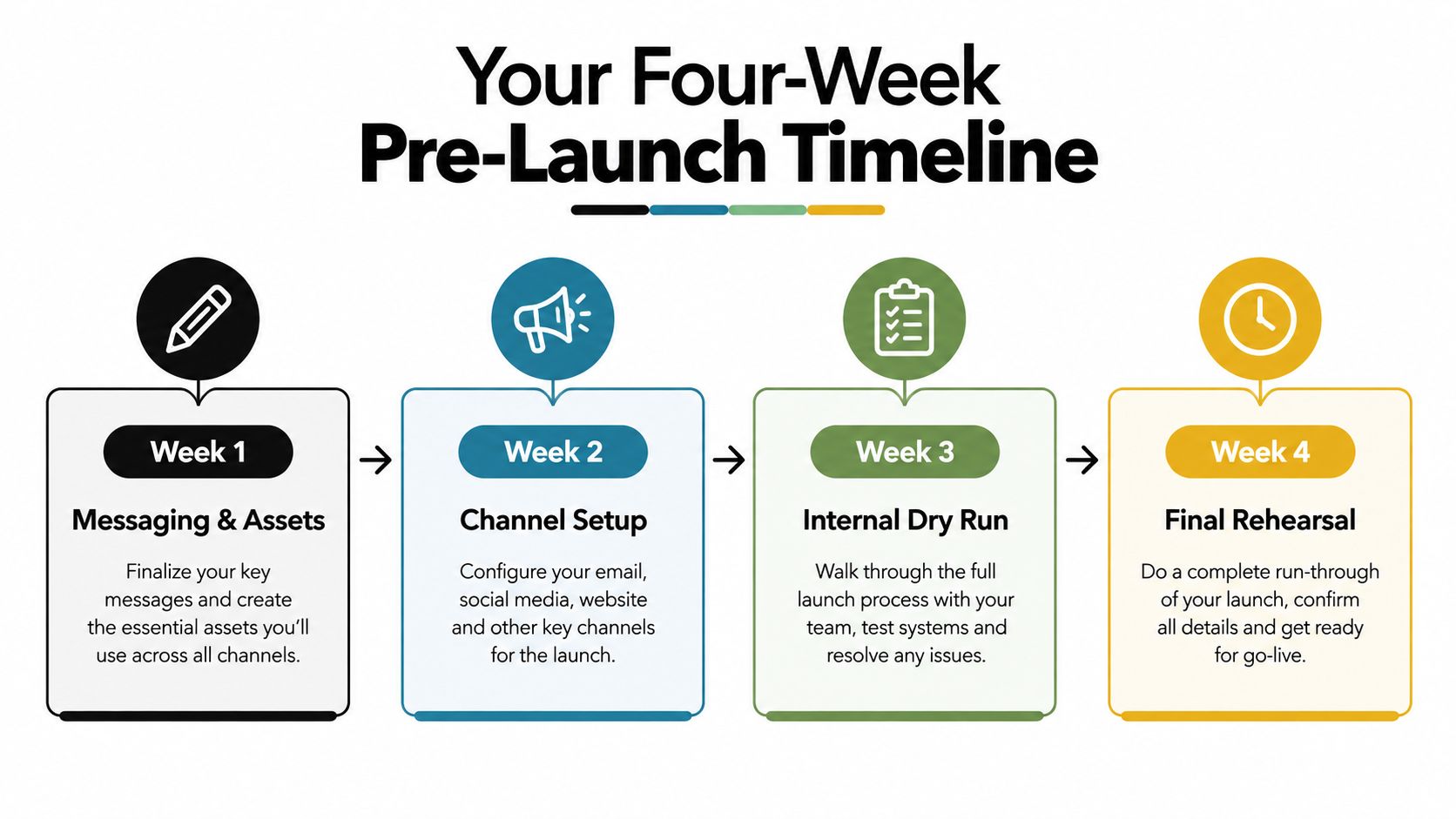
A four-week schedule works when the product has already cleared meaningful discovery and the team understands the remaining risks. It isn't a substitute for validation. It is the execution rhythm that turns a defensible release decision into coordinated action.
Four weeks before launch
Confirm the audience, positioning, launch approach, and go/no-go criteria. Review the strongest customer evidence and the unresolved risks. If the team still disagrees about who the product is for or what first value means, pause promotional work and resolve that disagreement.
Lock the message architecture next. Write the landing-page headline, supporting proof, call to action, objection handling, launch email, product-directory description, partner brief, and sales or support talking points. Every asset should express the same core promise, adapted to its channel.
Three weeks before launch
Build and review the assets. The landing page should make the next action obvious, while the demo should show the complete path from entry to value. Configure signup, onboarding, billing if relevant, help content, confirmation emails, and event tracking in a test environment.
Use this week to remove claims that cannot be demonstrated. A shorter page with representative evidence is more useful than a long page filled with broad benefits.
Two weeks before launch
Coordinate distribution. Confirm partner posts, directory submissions, newsletter placements, community participation, customer previews, and internal amplification. Give collaborators the final copy, links, timing, product description, and a clear explanation of whom they should send.
This is also the right time to review a pre-launch marketing strategy and cut channels that don't have an owner or a credible audience fit. A launch doesn't need every channel. It needs enough coordinated reach to produce useful learning.
One week before launch
Run the full journey as a new user. Test the announcement link, landing page, account creation, onboarding, core workflow, payment path, emails, analytics events, support routing, and cancellation or rollback process. Have someone outside the launch team attempt the flow without assistance.
Prepare the launch-day playbook, incident contacts, response templates, dashboard links, and decision thresholds. If the schedule slips, protect reliability, analytics, and onboarding first. Cut decorative creative, extra variants, and low-confidence channels before cutting the checks that protect users.
Launch Day Playbook and Channel Coordination
Launch day should feel like mission control, not a group chat waiting for something to happen. Assign one launch lead, one product or engineering incident owner, one distribution owner, one support lead, and one person responsible for the live dashboard. Everyone else should know which decisions they can make without approval.

Use a sequence rather than sending everything simultaneously. First confirm that the product, tracking, and support queue are healthy. Then publish the owned announcement and activate the primary audience. Follow with partner and directory distribution once the team has confirmed that the destination works. Social updates should reinforce the same message, not introduce a different promise.
Assign work by operating window
- Before release: Run smoke tests, confirm the status page or incident channel, check billing and authentication, and give support the known-issues list.
- At release: Publish the landing page, enable the product access path, send the first owned message, and verify events in the analytics tool.
- After the first response: Review qualified visits, signups, activation starts, error logs, support questions, and source quality. Don't optimize from raw traffic alone.
- During the active window: Respond to useful questions, correct broken links, pause a channel that sends poor-fit users, and keep partners updated.
- Before close: Record incidents, customer language, activation friction, and outstanding follow-ups while the details are still fresh.
A product launch marketing workflow should include a communications tree. If checkout breaks, the launch lead pauses promotion while the incident owner investigates. If analytics fails, the team records the release impact and fixes instrumentation before interpreting results. If support volume spikes, the support lead publishes a clear response and routes recurring questions into onboarding or documentation.
The rollback plan matters because public momentum can make teams reluctant to pause. A broken signup flow isn't a marketing inconvenience. It corrupts the funnel and damages the first impression. Stop the source, repair the path, and resume only after a fresh test.
After the operational window, keep the team focused on evidence rather than celebration metrics. Capture screenshots, event counts, support themes, and channel notes. The launch report should tell the next team what happened and what to change, not prove that messages were sent.
Choosing KPIs That Reflect Activation Not Vanity
Traffic and sign-ups are useful inputs, but they aren't proof of product value. They tell you that a message or channel generated a response. They don't tell you whether users completed the workflow that justifies returning.
An activation event should be a meaningful product action, not a generic account creation. For a reporting tool, activation might involve connecting a data source and producing a first report. For an AI writing product, it might involve generating, reviewing, and exporting an output inside a real workflow. Define the event with enough precision that two analysts would classify the same user consistently.
The activation-first case is strong. An analysis of more than 2,600 companies found that 69% of products with strong early activation also achieved strong three-month retention, while the median three-month retention rate was 3.8% and as many as 91% of new users became inactive within 14 days. The analysis is summarized here. The practical implication is not that one activation event guarantees retention. It is that early behavior deserves more attention than launch-day volume.
Compare the signals
| Metric Type | Example Metrics | What It Tells You | Limitation |
|---|---|---|---|
| Vanity metrics | Impressions, visits, social reactions, raw sign-ups | Whether distribution created attention | Doesn't show product value or user quality |
| Acquisition metrics | Qualified visits, source-level signup rate, cost per qualified lead | Which channels attract relevant prospects | Can still overstate success before activation |
| Activation metrics | Completion of the core workflow, time to first value, onboarding completion | Whether users reached an initial outcome | Requires a well-defined event and reliable instrumentation |
| Retention metrics | Return usage by cohort, retained workflow completion, paid continuation | Whether value persists after first use | Needs time and fixed cohort definitions |
| Business metrics | Qualified pipeline, paid conversion, revenue | Whether the launch supports commercial outcomes | Lagging indicators can hide early friction |
Report a compact leadership view, then keep a richer operating dashboard for the team. Leadership usually needs qualified acquisition, activation, retained usage, commercial conversion, material incidents, and the decision that follows. Operators need event-level paths, cohort cuts, source comparisons, onboarding drop-off, support themes, and experiment results.
For teams building a sales or pre-sales motion, sample metrics for PreSales reporting can provide useful context for structuring a reporting layer. Keep the denominator stable. Decide before launch whether retention means returning to the product, completing the core workflow again, or remaining paid, then don't change that definition because one channel looks weaker.
A launch report should answer, “Which users received value, and what evidence supports that conclusion?” Visits are context, not the conclusion.
Launching AI Products With a Trust-and-Proof Plan
AI changes the proof burden. A novelty claim may earn a click, but a buyer evaluating an AI feature wants to know what it produces, where it fails, what data it uses, and when a human must review the result.
The trust gap is visible in buyer research. A 2025 study found that only 48% of buyers trust vendor messaging about the capabilities and reliability of AI agents, while separate B2B research found that more than two-thirds consider AI capabilities when selecting software and would pay a premium only when vendors clearly demonstrate the value or productivity improvement. The buyer research is available here. Stronger claims can therefore create more skepticism if the product doesn't show its boundaries.
Build proof into the launch assets
An AI product needs evidence beside the announcement:
- Representative outputs: Show normal results from realistic inputs, not only a polished showcase.
- Evaluation criteria: Explain what quality means for the target workflow and how the team tests it.
- Failure modes: Demonstrate unsuitable inputs, uncertainty, refusal behavior, and likely error patterns.
- Human controls: Identify where users review, edit, approve, or override generated work.
- Data disclosures: State how customer data is handled, what is retained, and what users can control.
- Workflow evidence: Tie the benefit to a job, such as triaging candidates, drafting a report, or classifying support requests.
For example, a staffing workflow that uses AI for candidate operations should show the review steps and the boundary between automation and recruiter judgment. A resource on AI lead generation for staffing firms illustrates why the use case matters more than a generic “AI-powered” label. Buyers need to see how the feature fits the work they already understand.
Security and governance content belongs in the launch path, not buried after purchase. Teams selling to security-conscious buyers can use a SOC 2 compliance checklist to organize the questions that arise around controls, evidence, access, and vendor review. Don't promise autonomous performance when the product depends on review. Clear limits often make a trial feel safer.
Convert launch week into a 30-day learning loop
The release is the beginning of the evidence cycle:
- Day 1: Check signup integrity, activation events, failed workflows, support questions, and source quality.
- Day 7: Compare activated and non-activated cohorts, review time to value, and interview a small mix of users who progressed and stalled.
- Day 14: Look for inactivity, repeated errors, confusing claims, and differences between referral sources.
- Day 30: Review retained usage, commercial conversion, qualitative feedback, and the experiments that deserve another cycle.
Refresh the landing page and onboarding based on observed objections, not internal preference. Thank partners with specific performance or learning feedback. Write a retro that records what the team expected, what users did, which assumptions changed, and what enters the roadmap.
The best product launch plan compounds because each launch improves the next one. It creates cleaner evidence, sharper positioning, stronger onboarding, and a more honest trust story. That is how a launch becomes an operating capability rather than a one-day spike.
SubmitMySaas helps founders submit SaaS and AI products for launch visibility through product listings, scheduled launches, featured placement, and discovery-oriented exposure. If your plan is ready for a measured distribution channel, visit SubmitMySaas and choose a submission path that fits your launch timing.