10 Essential Pre Launch Marketing Strategies for SaaS in 2026
Discover 10 actionable pre launch marketing strategies for SaaS and indie makers. Learn how to build a waitlist, leverage influencers, and master your launch.
A successful SaaS launch isn't a single event; it's the culmination of months of strategic, deliberate effort. Too many founders build in silence, only to launch their product to an audience of none. The key to avoiding this all-too-common fate lies in executing a robust set of pre launch marketing strategies that build anticipation, validate your idea, and line up your first wave of customers well before Day One. This isn't just about creating buzz; it's about building a foundational asset of engaged users, valuable feedback, and brand recognition that will fuel your growth long after the launch-day confetti settles.
This guide provides a prioritized, actionable roundup of the 10 most effective strategies used by successful companies to ensure a powerful market entry. We'll move beyond generic advice, providing clear tactics, timelines, success metrics, and real-world examples to help you build unstoppable momentum. Each strategy is a building block in your overall launch plan. For a comprehensive approach to preparing your product for the market, you can also refer to a founder's playbook for the launch of a product.
Inside, we will cover everything from a detailed Product Hunt launch plan and strategic waitlist building to leveraging influencer partnerships and establishing SEO pre-positioning. You’ll find checklists and templates for community engagement, PR outreach, early access beta programs, and even initiating referral loops. Let's get started and ensure your launch day is a celebration, not a question mark.
1. Product Hunt Launch Strategy
A Product Hunt launch is a highly effective pre-launch marketing strategy focused on gaining significant, concentrated exposure within the tech community. It involves a coordinated effort to debut your product on the platform, aiming to secure a top spot on the homepage for maximum visibility among early adopters, investors, and potential customers. A successful launch can drive thousands of visitors to your site in a single day, providing invaluable feedback and initial user traction.

This strategy is particularly potent for SaaS products and indie projects because the platform’s audience is actively seeking new tools. Companies like Slack and Notion leveraged Product Hunt to accelerate early growth, while Figma and Loom used it to gain critical mass in competitive markets. The key is treating it not just as a submission, but as a full-day event centered on community engagement.
How to Implement a Product Hunt Launch
Executing a successful launch requires meticulous planning and coordination. The goal is to build momentum quickly and maintain it throughout the 24-hour launch window.
- Prepare Your Assets: Your launch page is your digital storefront. Create high-quality screenshots, a compelling demo video (under 2 minutes), and an engaging first comment from the maker that tells your story and asks for feedback.
- Build an Early Supporter List: Before launch day, gather a list of 50-100 supporters (from your network, email list, or social media) who are willing to check out your page and provide an upvote within the first couple of hours. This initial traction is crucial for visibility.
- Time Your Launch: Launch at 12:01 AM PST to maximize the 24-hour window. This ensures you are live for the entire day, capturing audiences across different time zones.
- Engage Actively: Be present all day. Respond to every comment, answer all questions, and thank users for their feedback. This shows you are an engaged founder and builds trust.
Key Insight: Your tagline is the first thing users see. It must be crystal clear and communicate your value proposition in 60 characters or less. Avoid jargon and focus on the problem you solve. For example, instead of "AI-Powered Synergy Platform," try "Automate Your Team's Meeting Notes."
While Product Hunt is a powerhouse, it's wise to diversify your launch efforts. You can learn more about other platforms by exploring some of the top Product Hunt alternatives to maximize your reach.
2. Waitlist Building and Teaser Campaign
A waitlist and teaser campaign is a foundational pre-launch marketing strategy designed to build anticipation and capture potential user interest before your product is publicly available. It involves creating a simple, high-converting landing page to collect email addresses, often enhanced with referral mechanics and strategic email sequences. This method generates early demand, creates a sense of scarcity, and builds momentum that can be converted into a powerful launch day surge.
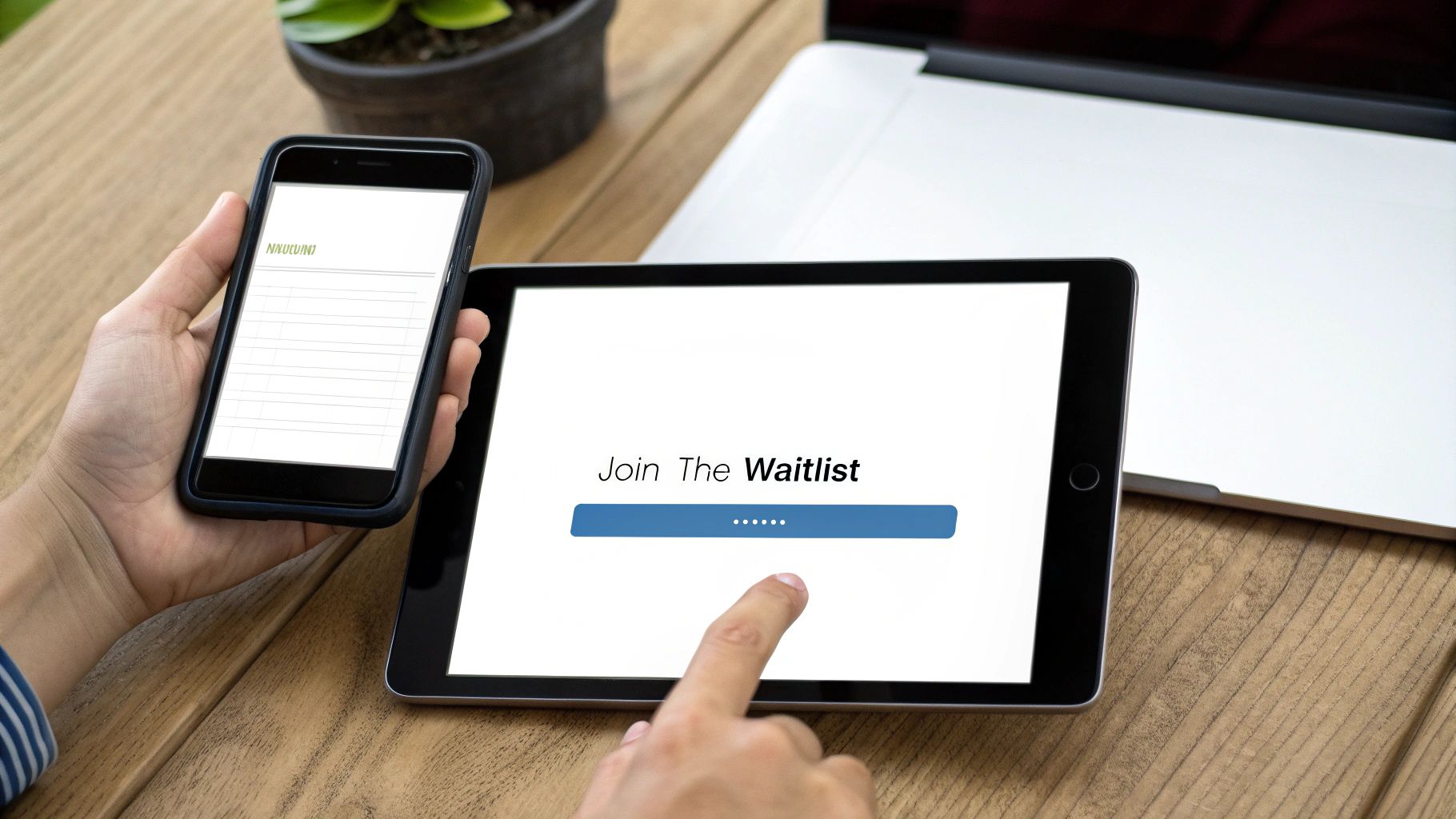
This approach is highly effective for SaaS and consumer apps because it validates demand while building a captive audience. Superhuman famously built a waitlist of over 200,000 people by creating an exclusive, high-touch onboarding experience. Similarly, Slack leveraged an invitation-only system to grow its initial user base, turning early sign-ups into advocates. The goal is not just to collect emails but to nurture a community that is eager to use and share your product from day one.
How to Implement a Waitlist and Teaser Campaign
Executing a successful waitlist campaign requires a clear value proposition and consistent engagement to keep your audience warm until launch. The focus is on converting passive interest into active anticipation.
- Create a Compelling Landing Page: Design a simple page with a single, clear call-to-action: "Join the Waitlist." Your headline should instantly communicate your product's core benefit. Include social proof like founder backgrounds or early media mentions to build credibility.
- Implement Referral Mechanics: Encourage viral growth by offering tangible rewards for referrals. Bonuses could include earlier access, lifetime discounts, or exclusive premium features. This turns early subscribers into active marketers for your product.
- Nurture Your List: Don't let your waitlist go cold. Send weekly or bi-weekly "behind-the-scenes" emails showcasing progress, sharing sneak peeks, or telling your founder story. This maintains engagement and builds a relationship with your future users.
- Offer Exclusive Launch-Day Bonuses: Reward your earliest supporters. Announce a special, time-sensitive offer available only to waitlist members, such as a significant discount or extra features, to incentivize immediate conversion upon launch.
Key Insight: Your value proposition must be exceptionally clear and desirable to convince someone to sign up for something that doesn't exist yet. Focus on the ultimate outcome or "dream state" your product provides, not just its features. For example, instead of "AI-powered scheduling tool," try "Never schedule a meeting manually again."
3. Influencer and Advocate Partnerships
Influencer and advocate partnerships are one of the most powerful pre-launch marketing strategies for building trust and reaching targeted audiences at scale. This approach involves collaborating with credible industry voices, such as content creators, thought leaders, and enthusiastic early adopters, to amplify your launch message through authentic endorsements. A well-executed partnership can accelerate credibility, generate high-quality leads, and create a groundswell of support before your product is even live.
This strategy is effective because it leverages the established trust between influencers and their followers. Companies like Notion partnered with productivity YouTubers to showcase its unique features, while Loom worked with creators like Ali Abdaal to reach a massive audience interested in efficiency tools. The goal is to move beyond a simple paid promotion and build genuine relationships that result in co-created content, honest reviews, and long-term advocacy.
How to Implement Influencer and Advocate Partnerships
A successful influencer campaign requires careful selection, clear communication, and a focus on mutual value. It's about empowering creators, not just paying for a shout-out.
- Identify the Right Partners: Look for influencers whose audience perfectly matches your ideal customer profile. Focus on engagement rates over follower counts. Micro-influencers (1k-50k followers) often have more dedicated communities and are more cost-effective.
- Provide Early Access and Creative Freedom: Grant your partners exclusive access to your product 2-4 weeks before launch. Give them key talking points but allow them the creative freedom to present it in their own authentic style.
- Create Tiered Partnership Packages: Develop different offers for various levels of influencers. This could range from free lifetime access for micro-influencers to affiliate commissions or flat fees for mid-tier and macro-influencers.
- Incentivize Their Audience: Provide each partner with a unique discount code or special offer for their followers. This not only drives conversions but also makes tracking the ROI of each partnership straightforward.
Key Insight: The most effective partnerships feel like a natural discovery, not a forced advertisement. Vet potential partners thoroughly by analyzing their past collaborations. If their sponsored content feels authentic and generates positive community discussion, they are likely a strong fit.
Building these relationships takes time but pays dividends in authentic promotion. A coordinated push with multiple creators on launch day can create a powerful echo chamber effect, making your product feel ubiquitous within your niche from day one.
4. Content Marketing and SEO Pre-Positioning
Content marketing and SEO pre-positioning is a long-term strategy focused on creating valuable, search-optimized content before your product is even live. This approach establishes your brand as an industry authority, builds domain authority with search engines, and captures organic traffic from potential users actively searching for solutions your product will offer. By the time you launch, you have a foundational audience and a warm pipeline.
This strategy is a cornerstone of sustainable growth because it builds an asset that appreciates over time. Companies like HubSpot pioneered this model by creating extensive educational content on inbound marketing, while Zapier published thousands of integration guides to capture search traffic for specific app combinations. Similarly, Notion created guides on productivity systems, attracting users searching for better ways to organize their work and life.
How to Implement Content and SEO Pre-Positioning
Executing this strategy requires a forward-thinking approach, focusing on user problems rather than your yet-to-launch product. The goal is to become the go-to resource in your niche.
- Conduct In-Depth Keyword Research: Identify the problems your target audience is trying to solve. Focus on informational and comparison keywords, such as "how to automate team reports" or "best tools for project management," instead of branded terms.
- Create Evergreen Pillar Content: Develop 10-20 high-quality, evergreen content pieces like comprehensive guides, tutorials, or "best practices" articles. These should address core user pain points that your product will eventually solve.
- Build Foundational Backlinks: Secure guest posts on 5-10 relevant industry publications to build initial authority. A strong backlink profile signals to Google that your content is trustworthy and authoritative.
- Establish Internal Linking: Create a logical internal linking structure that connects your content pieces and funnels authority toward the core pages you will use for the launch, like your future homepage or pricing page.
Key Insight: Your pre-launch content should sell the problem, not your product. Focus 100% on educating and helping your audience with their existing challenges. When you do launch, they will already see you as a trusted expert with the perfect solution.
By investing in SEO early, you set yourself up for long-term success. You can explore further tactics and learn how to increase website traffic organically to build on this foundation.
5. Community Building and Engagement Strategy
A community building strategy focuses on creating a dedicated space where potential users can connect with your team and each other before your product is even live. This pre-launch marketing strategy transforms passive followers into active advocates by fostering authentic relationships, gathering invaluable feedback, and building a loyal base ready to support you on day one. A strong community becomes a powerful engine for organic word-of-mouth marketing.
This approach is highly effective for products that benefit from network effects or user-generated content. Figma famously built a thriving designer community by integrating user feedback directly into their development process. Similarly, Notion cultivated passionate communities around productivity and custom templates, while Zapier grew its user base by actively engaging with users in forums to solve automation challenges. The goal is to build with your audience, not just for them.
How to Implement a Community Building Strategy
Building an engaged community requires consistent effort and a genuine desire to connect. The focus should be on providing value long before you ask for a sale.
- Choose Your Platform: Launch a dedicated Discord or Slack community 2-3 months before your product launch. These platforms are ideal for real-time interaction, feedback sessions, and fostering member-to-member connections.
- Set Clear Guidelines: Establish clear community values and moderation rules from the start. This ensures a safe, respectful, and productive environment for everyone involved.
- Share Behind-the-Scenes Progress: Provide regular development updates, share early mockups, and be transparent about your journey. This makes members feel like insiders and builds trust.
- Host Founder AMAs: Run weekly or bi-weekly "Ask Me Anything" sessions. This direct access to the founding team is a powerful way to build relationships and gather unfiltered feedback.
- Incentivize Engagement: Recognize and reward active members publicly. Offer exclusive launch-day pricing or lifetime discounts to your early community supporters as a thank-you for their contribution.
Key Insight: Your first 100 community members are your foundation. Don't focus on vanity metrics; instead, prioritize deep engagement with a small, dedicated group. Their feedback and advocacy will be far more valuable than a large, silent audience.
6. Strategic Launch Platform Submissions
Strategic Launch Platform Submissions involve a coordinated campaign to list your product on multiple discovery websites simultaneously or in a planned sequence. Instead of relying on a single platform, this approach diversifies your reach by targeting different early-adopter communities on sites like Product Hunt, BetaList, Indie Hackers, and AppSumo. This pre-launch marketing strategy creates a powerful ripple effect, maximizing visibility and driving traffic from various sources.
This method is essential for SaaS and indie projects because each platform attracts a unique user demographic. Cal.com, for example, launched across Product Hunt, SubmitMySaas, and Hacker News to capture developers, marketers, and the broader tech community. Similarly, Loom coordinated its debut on Product Hunt, Indie Hackers, and BetaList to build momentum across different segments of the early-adopter market.
How to Implement Strategic Launch Platform Submissions
A successful multi-platform launch requires careful planning and customized messaging for each community. The goal is to create a wave of excitement that builds on itself.
- Create a Launch Calendar: Plan your submissions over one to two weeks. Start with a high-impact platform like Product Hunt on a Monday, followed by submissions to sites like SubmitMySaas for SEO benefits, and Indie Hackers later in the week to engage the maker community.
- Tailor Your Messaging: Do not copy and paste. Customize your product description, screenshots, and value proposition for each platform's audience and format. Create unique discount codes to track which channels drive the most conversions.
- Engage Authentically: Be present on every platform during its launch day. Respond to comments, answer questions, and thank users for their feedback. This builds trust and encourages more engagement.
- Monitor and Repurpose: Track analytics to identify which platforms perform best. Repurpose the momentum and social proof from your most successful launches to promote submissions on second-wave platforms a week or two later.
Key Insight: The order of your submissions matters. Lead with platforms that generate high, concentrated traffic (like Product Hunt) to build initial buzz, then follow up with platforms that offer sustained, long-term exposure and SEO value (like SaaS directories) to maintain momentum.
Maximizing your launch requires knowing where to submit. You can discover more high-impact platforms by exploring a comprehensive list of websites to promote your startup to ensure you don't miss any key opportunities.
7. PR, Media Outreach, and Founder Personal Branding
This pre-launch marketing strategy combines traditional public relations with the modern influence of a founder's personal brand. It involves building relationships with journalists to secure earned media coverage while simultaneously establishing the founder as a credible, authentic voice in their industry. This two-pronged approach amplifies your message, builds audience trust, and generates significant buzz before your product is even available.
This strategy is highly effective because it humanizes your brand and provides third-party validation. Paul Graham’s influential essays established credibility for Y Combinator long before it became a household name. More recently, Notion's founders complemented their media coverage in Forbes and TechCrunch by sharing their journey and insights, creating a powerful narrative that resonated deeply with their target audience.
How to Implement a PR and Personal Branding Strategy
A successful execution requires a long-term vision for both media relations and personal brand development, with efforts starting months before launch.
- Build Your Media List & Relationships: Identify 20-30 relevant journalists and publications covering your market (e.g., TechCrunch, VentureBeat). Follow them on social media and engage with their work authentically for several months to build rapport before you pitch.
- Develop a Newsworthy Angle: A product launch isn't always news. Frame your story around a compelling founder journey, unique data, or an innovative solution to a widespread problem. Create a media kit with high-resolution assets and founder bios.
- Craft a Strong Personal Brand: Begin building your social media presence (especially on X/Twitter and LinkedIn) 6-12 months pre-launch. Post 3-5 times a week, sharing insights, behind-the-scenes content, and lessons learned to establish thought leadership.
- Send Personalized Pitches: When ready, send highly personalized pitches to your curated media list. Explain why the story is relevant to their audience and offer an exclusive to a top-tier reporter to increase your chances of a feature.
Key Insight: Your founder's story is your most unique PR asset. Journalists are more interested in a compelling human narrative than a list of product features. Frame your pitch around the "why" behind your company, the problem you overcame, and the vision you're building.
8. Early Access Beta Program and Feedback Loops
An early access beta program is a strategic pre-launch marketing strategy where you release your product to a select group of users to gather crucial feedback. This controlled release allows you to identify bugs, refine features, and validate your value proposition with your target audience before a public launch. It transforms early users into invested advocates and provides invaluable data to ensure your product is market-ready.
This methodology is a cornerstone of the lean startup approach, allowing for rapid iteration based on real-world usage. Companies like Slack and Superhuman famously used extensive private betas to meticulously refine their user experience, creating polished, highly-desired products at public launch. Figma also leveraged an extended beta phase to gather deep insights from designers, building a tool that perfectly fit their workflow.
How to Implement an Early Access Beta Program
A successful beta program is more than just giving people early access; it's a structured system for collecting and acting on user feedback. The goal is to create a tight feedback loop that drives product improvement and builds a community.
- Recruit Your Cohort: Identify and invite 30-100 ideal users from your target market. You can find them through your email list, social media channels, or communities where your audience gathers.
- Create a Structured Feedback Channel: Set up a dedicated Slack or Discord channel for beta testers. This centralizes communication, fosters a sense of community, and makes it easy for users to report issues and suggest features.
- Gather Both Quantitative and Qualitative Data: Track key metrics like feature adoption, onboarding completion, and user retention. Supplement this data with 1-on-1 interviews with your most active users to understand the "why" behind their behavior.
- Iterate and Communicate: Implement quick wins from feedback within 1-2 week sprints. Announce updates and fixes to the beta group to show you are listening and making progress, which keeps them engaged.
Key Insight: Don’t just collect feedback; close the loop. When a user reports a bug or suggests a feature that you implement, personally notify them. This small action makes them feel heard and valued, turning a beta tester into a passionate brand advocate.
9. Paid Advertising and Retargeting Campaign
A paid advertising and retargeting campaign is a powerful pre-launch marketing strategy that uses performance marketing to build a targeted audience and validate messaging before you officially go live. Instead of relying solely on organic reach, this approach uses platforms like Google, LinkedIn, and social media to drive qualified traffic to your landing page, capture leads, and create a warm audience pool for launch day. It provides measurable, scalable results that complement your content and community-building efforts.
This strategy is ideal for reaching specific professional demographics and testing value propositions with real-time data. For example, Superhuman invested heavily in targeted LinkedIn ads to reach its ideal customer profile of power users and executives. Similarly, Notion built a massive pre-launch audience by running YouTube and TikTok ads that targeted users interested in design and productivity, establishing a strong foothold before launch.
How to Implement a Paid Advertising and Retargeting Campaign
Executing a successful pre-launch ad campaign requires a clear budget, precise targeting, and a focus on iterative testing to optimize performance and maximize your return on investment.
- Set an Initial Test Budget: Start with a modest budget of $500 to $1,000 around 2-3 months before launch. This is enough to gather data on messaging, creatives, and audience performance without a significant upfront cost.
- Create Ad Variations: Don't rely on a single ad. Test at least 10 different creative variations, experimenting with different headlines, images, and calls-to-action to identify what resonates most with your target audience.
- Implement a Retargeting Pixel: Install a tracking pixel (like the Meta Pixel or LinkedIn Insight Tag) on your landing page from day one. This allows you to build a custom audience of site visitors. A powerful component of this is leveraging remarketing with Facebook to re-engage interested users who didn't sign up initially.
- Track Key Conversions: Set up conversion tracking for crucial actions like email signups or waitlist registrations. This data helps you measure campaign effectiveness and optimize your ad spend for the highest-performing channels and creatives.
Key Insight: Your primary goal pre-launch isn't sales; it's audience building and message validation. Focus your ad campaigns on driving high-quality email signups. You can then build lookalike audiences from your most engaged subscribers to scale your reach efficiently.
10. Referral Program and Viral Loop Mechanics
A referral program is a powerful pre-launch marketing strategy that transforms your initial users into a dedicated sales force. By incentivizing them to invite others, you create a viral loop, a self-sustaining cycle where each new user brings in more users, dramatically lowering customer acquisition costs and accelerating growth through trusted, word-of-mouth recommendations.
This strategy is highly effective because it leverages social proof. A recommendation from a friend is far more persuasive than a traditional ad. Dropbox famously achieved exponential growth by offering extra storage space for both the referrer and the new user. Similarly, Superhuman uses referrals to manage its waitlist, creating a sense of exclusivity and desirability that drives demand.
How to Implement a Referral Program
Building a successful viral loop requires making the referral process seamless, valuable, and rewarding for everyone involved. The key is to remove friction and amplify motivation.
- Offer Compelling Two-Sided Rewards: Motivate both parties. Offer a tangible benefit to the existing user (the referrer) and the new user (the referee). This could be a discount, feature credit, or early access.
- Make Sharing Effortless: Embed a unique referral link directly into the user’s dashboard. Include one-click social sharing buttons for email, Twitter, LinkedIn, and Slack to make spreading the word as easy as possible.
- Integrate into Key Touchpoints: Don't hide your referral program. Promote it during the onboarding process, in email newsletters, and after a user has a positive experience with your product.
- Gamify the Experience: Introduce leaderboards, milestone badges, or progressive rewards to encourage continued participation. Publicly celebrating your top referrers can also create a competitive and engaging community dynamic.
Key Insight: The most effective referral programs feel like a natural extension of the product experience, not a tacked-on marketing gimmick. For example, Figma and Zoom's core "invite your team" or "share meeting link" functionalities are themselves powerful, built-in viral loops.
Pre-Launch Marketing: 10-Strategy Comparison
| Strategy | Implementation 🔄 | Resources ⚡ | Expected outcomes 📊 | Ideal use cases 💡 | Key advantages ⭐ |
|---|---|---|---|---|---|
| Product Hunt Launch Strategy | High coordination, time-sensitive (single-day peak) | Moderate people time; low direct ad spend; strong community outreach | Quick visibility spike, social proof; effectiveness: ⭐⭐⭐⭐ | New SaaS seeking early adopters and press attention | Fast credibility; built-in maker audience; potential virality |
| Waitlist Building and Teaser Campaign | Moderate (landing page + referral setup) over weeks | Low–moderate budget; email tooling and landing page | Validated demand and day-one users; effectiveness: ⭐⭐⭐⭐ | Pre-launch products needing validation and scarcity | Validates demand; reduces CAC at launch; viral referrals |
| Influencer and Advocate Partnerships | High (relationship building, coordination) | Variable budget (low for micro to high for macro); time for outreach | Amplified reach and conversions via trust; effectiveness: ⭐⭐⭐⭐ | Consumer-facing or niche B2B products with clear audiences | Authentic endorsements; access to engaged audiences |
| Content Marketing and SEO Pre-Positioning | High-long term (3–6+ months) | Significant content, SEO, and link-building effort | Sustained organic traffic and authority; effectiveness: ⭐⭐⭐⭐⭐ | Products needing long-term discovery and lower CAC | Compounding traffic; long-term credibility; low ongoing CAC |
| Community Building and Engagement Strategy | High ongoing commitment (moderation, events) | Moderate time investment; community tools (Discord/Slack) | Strong retention, advocates, and UGC; effectiveness: ⭐⭐⭐⭐ | Developer/designer tools or collaborative products | Deep product feedback; loyal advocates; reduced churn |
| Strategic Launch Platform Submissions | Moderate-high (multi-platform tailoring) | Time for platform-specific assets; low direct cost | Broader early-adopter reach and backlinks; effectiveness: ⭐⭐⭐⭐ | Startups wanting multi-audience exposure and SEO lift | Diversified visibility; reduced single-platform risk |
| PR, Media Outreach, and Founder Personal Branding | High (months of relationship building) | Moderate budget or agency; high founder time commitment | High-trust earned coverage and backlinks; effectiveness: ⭐⭐⭐⭐ | Companies seeking investor attention or prestige press | High credibility; SEO and investor signal; lasting brand gains |
| Early Access Beta Program and Feedback Loops | Moderate (cohort management + analytics) | Product-manifested resources: support, analytics, time | Improved PMF and onboarding; testimonials; effectiveness: ⭐⭐⭐⭐ | Complex products needing UX validation before wide release | Bug reduction; compelling case studies; invested advocates |
| Paid Advertising and Retargeting Campaign | Moderate (setup) to high (scale) | High budget required for meaningful reach; ad ops expertise | Fast audience building and measurable conversions; effectiveness: ⭐⭐⭐ | Products that convert well with paid channels | Rapid scale; precise targeting; A/B testable messaging |
| Referral Program and Viral Loop Mechanics | High design and integration effort | Development and reward budget; analytics | Sustainable organic growth if viral; effectiveness: ⭐⭐⭐⭐ | Network-effect or collaboration-first products | Low CAC at scale; high retention; user-driven growth |
From Pre-Launch to Post-Launch Momentum
The journey to a successful product launch doesn't begin on launch day. It starts weeks, and often months, earlier with a deliberate and well-executed game plan. The ten pre-launch marketing strategies we’ve explored are not just a checklist of tasks to complete; they are interconnected components of a single, powerful momentum-building engine. Each tactic, from building an engaged waitlist to pre-positioning your brand with SEO, is a gear in a larger machine designed to turn your launch from a hopeful coin toss into a predictable, impactful event.
The core insight is that these strategies compound. Your content marketing efforts don't just attract organic traffic; they provide the fuel for your email campaigns and the social proof needed for your PR outreach. The community you build doesn't just offer feedback; its members become your most passionate evangelists on Product Hunt and your first wave of referral program participants. Viewing these as isolated channels is a common mistake; seeing them as a cohesive ecosystem is the secret to a blockbuster launch.
Weaving Your Pre-Launch Tapestry
The most successful founders don't try to do everything at once. They strategically select, sequence, and integrate a handful of these strategies that best fit their product, audience, and personal strengths. A developer-focused SaaS might prioritize building a community on Discord and an early access beta program, while a consumer-facing app might lean heavily into influencer partnerships and a viral referral mechanic.
Your task now is to move from learning to action. Don't let this comprehensive list lead to analysis paralysis. Instead, focus on the "why" behind each strategy:
- De-Risking Your Launch: A growing waitlist, positive beta feedback, and early media mentions are all powerful signals that you’ve built something people want. This is your ultimate validation.
- Building Your "Launch Army": You cannot launch alone. Your pre-launch period is your opportunity to recruit a dedicated cohort of early adopters, advocates, and community members who will amplify your message when it matters most.
- Creating Unfair Advantages: While competitors are building in silence, your SEO efforts are already capturing search intent. Your founder brand is building trust. Your waitlist is creating a captive audience. These are the advantages that ensure you launch with a running start.
Your Actionable Path Forward
To translate this knowledge into results, start small and build from there. Pick two or three strategies from this guide that resonate most with you. Perhaps it's a combination of waitlist building, content pre-positioning, and a strategic platform launch. Commit to executing them with consistency and excellence over the next 90 days.
Remember, the goal of your pre-launch marketing strategies isn't just to have a successful launch day. It's to create a sustainable flywheel that propels your growth long after the initial excitement fades. By investing in these foundational efforts, you are not just launching a product; you are launching a business with the momentum it needs to thrive, adapt, and ultimately win in a competitive market. Your future self will thank you for the groundwork you lay today.
Ready to amplify your reach and get your SaaS in front of the right audience? SubmitMySaas simplifies one of the most crucial pre-launch marketing strategies by helping you submit your product to over 45 essential startup directories and platforms in just a few clicks. Stop wasting time on manual submissions and start building the backlinks and visibility your launch deserves.