10 No-Code AI Agent Builder Tools for 2026
Compare 10 no-code ai agent builder tools by use case, features, pricing, integrations, pros, cons, and implementation fit.
The popular advice is to find the “best” no-code AI agent builder. That advice misses the decision that matters most: where the agent will live, what it can touch, and who remains responsible when it fails. A support agent running across web chat and voice has different requirements from an internal assistant tied to Microsoft 365, an AWS workload operating inside a private environment, or a marketing workflow that coordinates several tools.
The market is ready for more practical builders, but deployment is far from uniform. PwC's 2025 survey of 308 U.S. business executives found that 79% said AI agents were already being adopted, while only 17% said agents were fully adopted across almost all workflows and functions. The gap is where builders compete. Buyers need faster configuration, but they also need permissions, testing, auditability, reliable integrations, and predictable operating costs.
This list evaluates each no-code AI agent builder by the decisions buyers face: target use case, visual building experience, integrations and model flexibility, governance, deployment responsibility, pricing approach, and implementation friction. Use it alongside this guide to AI agent platforms, then narrow your requirements before comparing individual products. SubmitMySaas can help you explore additional AI and SaaS products once you know which operating model fits your team.
1. Google Vertex AI Agent Builder
Google Vertex AI Agent Builder is the strongest fit for teams that already treat Google Cloud as their operating environment. It combines visual agent design with managed runtime capabilities, Gemini model access, Google Search grounding, and connections to Google Cloud data services through Vertex AI.
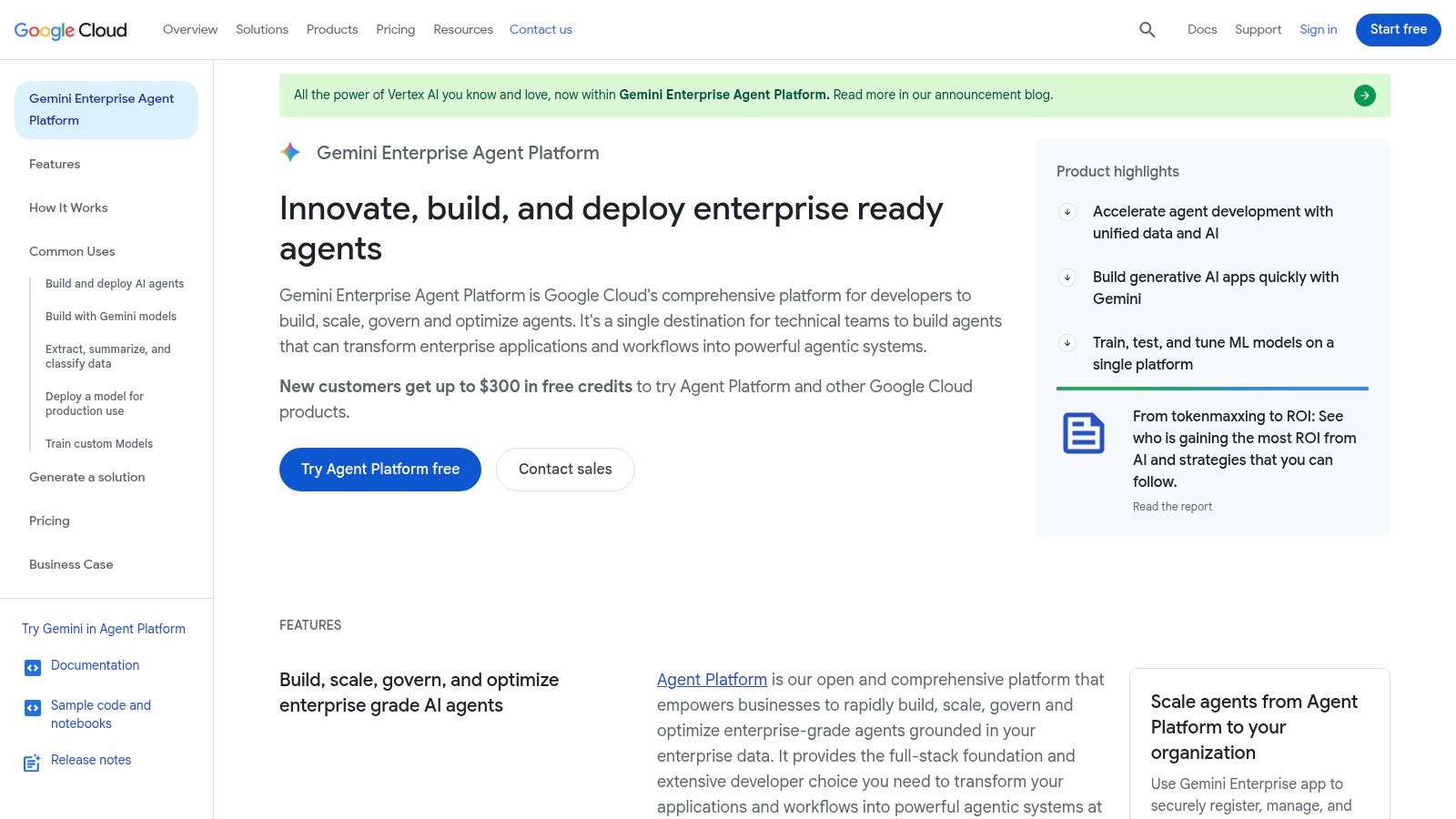
Best for governed GCP deployments
The platform's appeal isn't just that it can produce an agent visually. Agent Designer supports building and testing, while Agent Engine provides a managed path toward runtime governance. Tool policies, access controls, grounding, and integrated cloud services make it better suited to production environments than a lightweight prompt-and-connector tool.
That depth creates a deployment trade-off. A team already using GCP can reuse existing data, identity, and operational practices. A startup without cloud infrastructure experience may spend more time understanding services, permissions, environments, and billing than it expected from a no-code product.
Practical rule: Choose Vertex AI when cloud alignment and governance matter more than having the shortest possible path to a first demo.
Pricing can become difficult to forecast because several services and usage dimensions may contribute to the final bill. That doesn't make the platform unsuitable for startups, but it does mean buyers should model realistic workloads before committing. Teams seeking more product-oriented discovery can also browse SubmitMySaaS's AI agents directory for adjacent tools and alternatives.
2. Microsoft Copilot Studio
Microsoft Copilot Studio is a logical starting point for organizations whose work already runs through Microsoft 365, Teams, Power Platform, and Microsoft data sources. Its visual builder combines agent instructions, knowledge, actions, connectors, flows, and computer-use capabilities, allowing an agent to complete tasks through connected systems or user interfaces. Explore the platform directly at Microsoft Copilot Studio.
The advantage is tenant alignment
The important distinction is not only ease of use. Copilot Studio benefits from tenant-level administration, Microsoft 365 grounding, and governance practices that many Microsoft-centric teams already understand. That reduces the organizational friction of introducing an agent because identity, access, and collaboration can remain within familiar administrative boundaries.
Its visual experience also suits teams that need more than a conversational assistant. A builder can combine knowledge retrieval with actions and Power Platform flows, then publish the resulting experience across Microsoft channels or the web. Teams investigating how a no-code product can become a customer-facing or internal tool may also find this guide to building an AI tool useful.
The main drawback is commercial and conceptual complexity. Consumption is measured through Copilot Credits, and the model requires buyers to estimate how frequently agents will reason, retrieve information, invoke actions, or use more advanced capabilities. The estimator and rate documentation help, but finance and operations teams still need a usage model rather than a simple per-seat assumption.
Copilot Studio is therefore a strong choice when Microsoft alignment is already a strategic advantage. It's less compelling when a team wants broad model neutrality or a deployment model independent of the Power Platform.
3. Amazon Bedrock AgentCore
Amazon Bedrock AgentCore suits teams that want managed agent infrastructure without leaving the AWS ecosystem. The platform brings together runtime, identity, gateway, memory, tool indexing, enterprise integrations, knowledge resources, and guardrails around Bedrock models. Its foundation is documented through Amazon Bedrock.
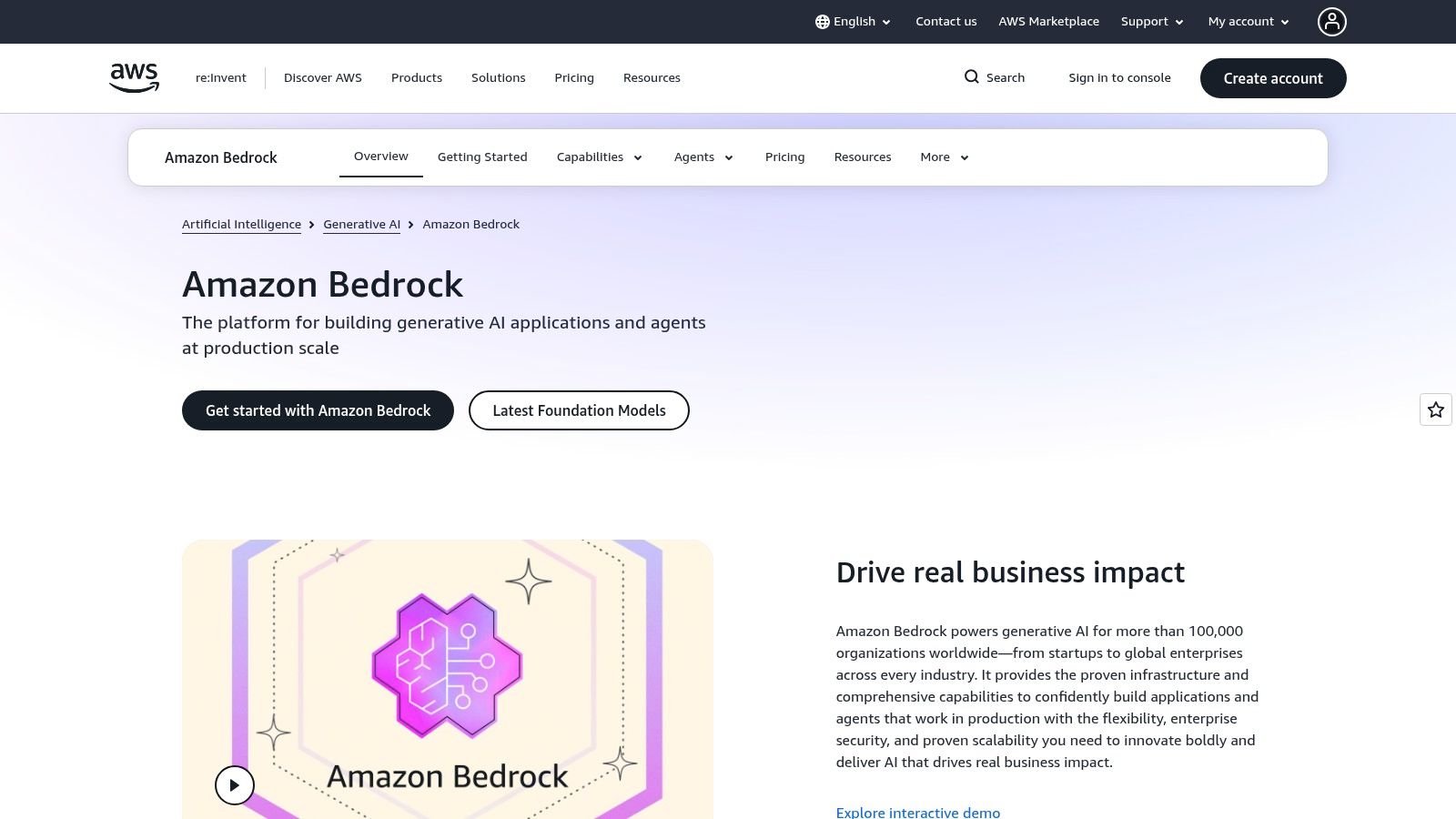
Strong control for AWS-native teams
Bedrock AgentCore is best understood as an operational platform rather than a simple visual chatbot maker. Identity integrations can connect agents to enterprise systems such as Okta, Entra, and Cognito. Gateway and tool capabilities help teams expose business actions in a controlled way, while memory and runtime services support agents that need continuity across tasks.
That makes it attractive for organizations with existing AWS security, observability, and deployment practices. An AWS team can treat the agent as another governed workload instead of introducing an isolated SaaS dependency.
The cost trade-off is unusually important. Runtime, memory, web search, gateway use, and related services create separate pricing dimensions. Detailed pay-as-you-go documentation and solution examples help with planning, but the buyer still needs metering and observability to understand what a production workflow consumes.
Operational test: Don't evaluate Bedrock only by whether an agent can call a tool. Evaluate whether your team can identify every tool call, permission boundary, retry, and usage driver after deployment.
Bedrock is not the easiest choice for a small team seeking a polished first workflow. It is a better choice when deployment control, AWS identity, and scalable infrastructure outweigh the learning curve.
4. Relevance AI
Relevance AI takes a business-process view of agent building. Instead of treating an agent as a single assistant, it emphasizes AI workforces, tools, actions, knowledge, and collaboration between specialized agents. The platform's visual agent and workforce builder is aimed at sales, marketing, operations, and support teams that need agents to execute connected workflows.
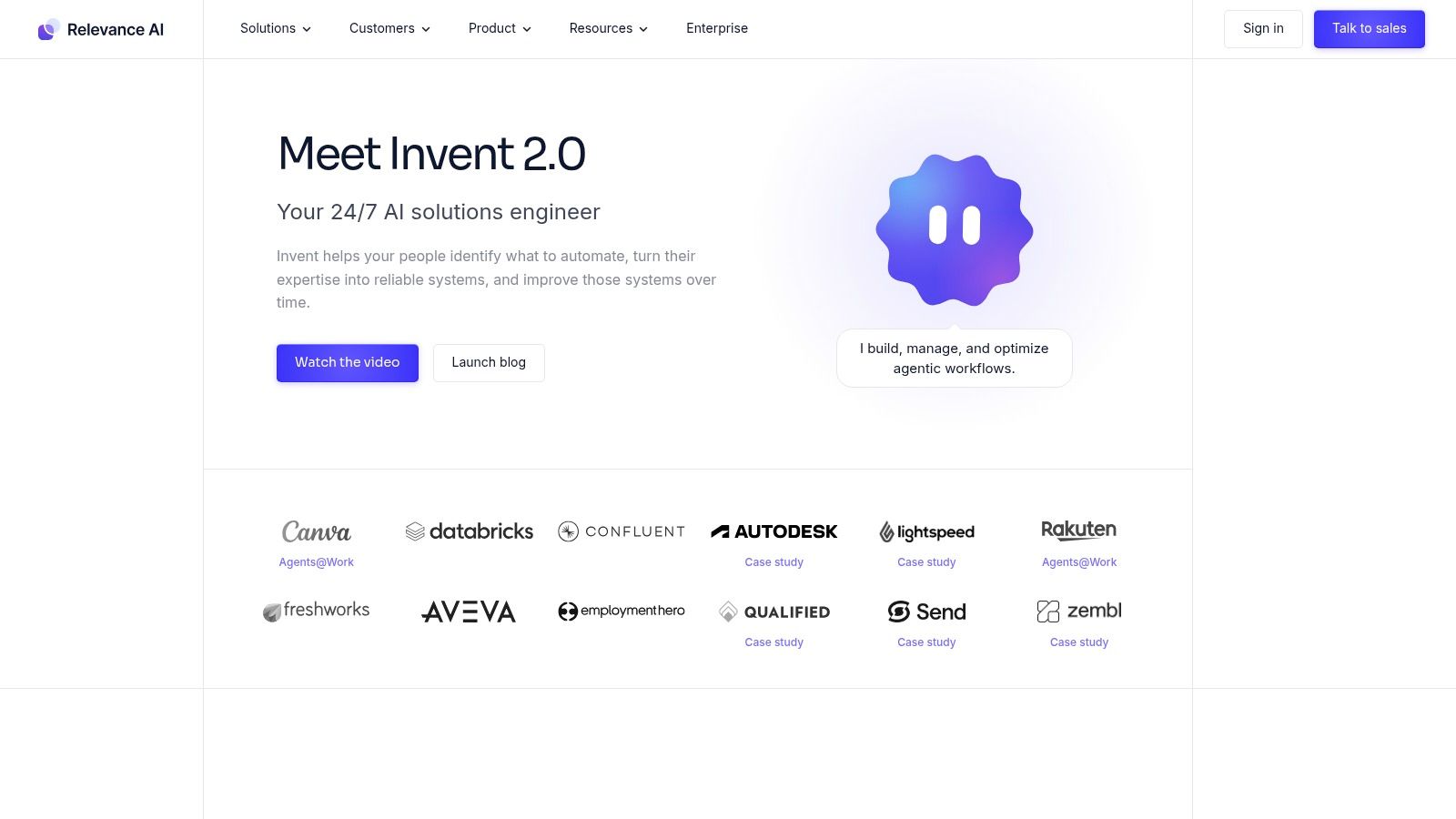
Best for operational multi-agent workflows
The platform's central strength is its abstraction. A team can define agents, equip them with tools, give them knowledge, and coordinate their work through a Workforce rather than assembling every interaction as a disconnected automation. Built-in chat, retrieval capabilities, templates, and observability support faster movement from an idea to an operational workflow.
That model is particularly useful for tasks such as lead research, data enrichment, campaign operations, or internal request handling. The buyer isn't only configuring responses. They're deciding which agent owns each task, which action it can invoke, and how the workflow passes context between roles.
The trade-off is that teams need to adopt Relevance AI's mental model. A straightforward deterministic automation may feel more complicated if it's forced into a workforce structure. Conversely, a multi-step process may become easier to reason about once agents and actions are separated.
Pricing also requires careful review. Platform Actions and pass-through model or vendor credits are treated separately, which improves conceptual transparency but still requires buyers to understand plan limits and usage behavior before scaling.
Relevance AI is a good fit when the business problem involves several coordinated operational roles. It's less suitable when the requirement is a tightly governed assistant inside an existing cloud or productivity ecosystem.
5. Stack AI
Stack AI is designed for buyers who want a visual experience without giving up private deployment options. Its builder supports LLM chains, retrieval-augmented generation, tools, and application interfaces, while deployment can extend into a company's own cloud or virtual private cloud through Stack AI.
Private deployment changes the buying question
For regulated or security-sensitive teams, the key benefit is not the drag-and-drop interface by itself. It's the possibility of keeping networking, data boundaries, and deployment decisions closer to the organization's existing controls. Audit readiness and enterprise compliance are central to the product's positioning, which makes it relevant where procurement and security review can determine whether a project launches at all.
The private model also transfers responsibility. A company choosing its own cloud or VPC must understand who manages availability, upgrades, secrets, monitoring, incident response, and model-provider connections. No-code removes workflow coding, but it doesn't remove operational ownership.
Stack AI's commercial path deserves particular scrutiny. Self-serve paid tiers were removed in 2026, creating a steeper transition from Free to Enterprise. Public information about exact per-unit running costs is limited, so a buyer should request a workload-specific proposal rather than infer affordability from the visual builder.
Private deployment is valuable only when the buyer has a clear owner for the controls that private deployment makes necessary.
Stack AI makes the most sense for teams with compliance requirements, security resources, and a genuine need for deployment flexibility. It's likely excessive for a small startup that only needs an internal draft-generation workflow.
6. Dify
Dify combines an approachable no-code and low-code workflow experience with open-source control. Its Workflow Studio supports visual workflows, retrieval pipelines, model management, observability, and Agent applications that can use tools or run code. Teams can use Dify as a cloud service or self-host it.
The practical middle ground
Dify is compelling because it doesn't force a binary choice between a polished SaaS platform and a fully custom application. A team can prototype quickly in the cloud, use multiple model vendors, bring its own API key, and later take on more deployment responsibility if self-hosting becomes worthwhile.
That flexibility is valuable for founders testing several use cases. The team can compare model behavior, build a retrieval workflow, expose a small application interface, and observe runs without committing immediately to one model provider or cloud architecture.
Self-hosting changes the economics and the workload. The organization gains more control over data boundaries and infrastructure, but it also becomes responsible for hardening, upgrades, backups, access controls, monitoring, and reliability. Complex automations may still require scripting or technical knowledge, despite the visual surface.
Dify is therefore a strong option for teams that want ownership without starting from a blank codebase. It's less appropriate for buyers who expect a vendor to handle every production concern or for nontechnical teams with no support for deployment operations.
The most sensible pilot is a bounded workflow with a clear output, such as internal knowledge retrieval or structured document processing. That reveals whether the team values model flexibility enough to justify the operational responsibility that comes with it.
7. FlowiseAI
FlowiseAI is an open-source visual builder for agents and LLM workflows based around transparent flows, connectors, APIs, and deployment on infrastructure the team controls. Its FlowiseAI platform is aimed at makers and technical teams that want to see how the workflow is assembled rather than treating the agent as a sealed service.
Control comes with self-reliance
FlowiseAI's visual Chatflows and Agents make experimentation tangible. Teams can inspect the sequence of components, connect tools, expose a REST API, and explore multi-agent patterns without paying a software license fee for the open-source layer. That transparency can be more useful than a highly abstract builder when developers need to understand why a workflow behaves a certain way.
The same transparency exposes the limits of no-code. A team may need deployment knowledge to secure the instance, manage credentials, configure observability, handle updates, and respond to failures. The platform doesn't automatically provide the governance posture of a managed enterprise service. The organization has to build that posture around it.
The commercial project has also signaled a future-of-Flowise or sunset direction, while the code remains open source. Buyers should treat that as a continuity consideration. They may be comfortable maintaining the project, forking it, or supporting their own deployment, but teams seeking a predictable vendor roadmap should investigate carefully.
Deployment question: If the hosted experience disappeared, could your team still operate the agent safely from the code and documentation available?
FlowiseAI is a strong fit for technical makers, internal prototypes, and teams that value inspectable workflows. It's less suitable for a business department that needs turnkey support, formal governance, and a single accountable vendor. Teams comparing adjacent automation products can also review SubmitMySaas's AI workflow automation tools.
8. Botpress
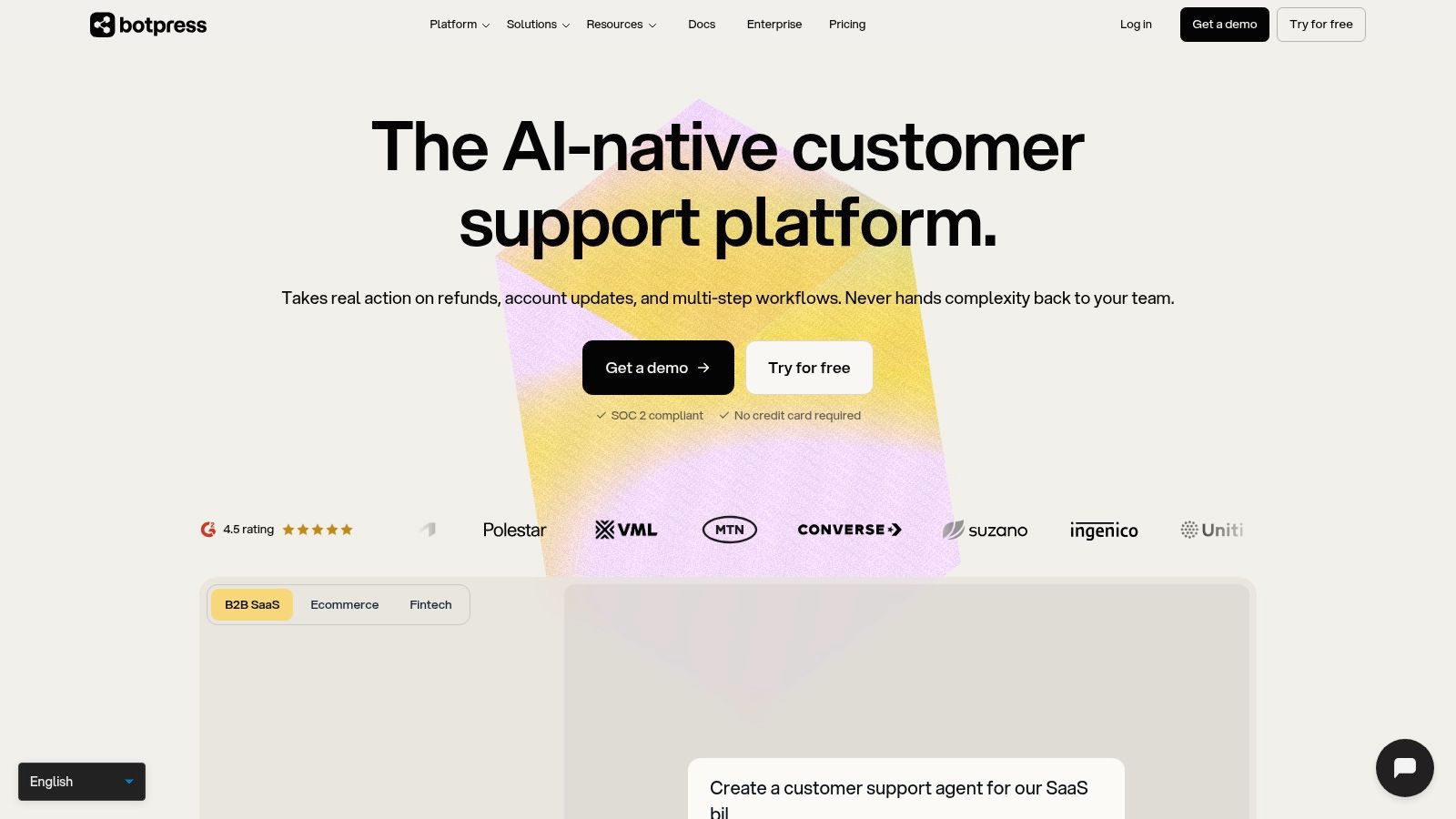
Botpress targets customer experience rather than broad enterprise orchestration. Its visual builder combines knowledge bases, multi-channel delivery, chat, voice, and helpdesk workflows. The Botpress platform also includes Desk, giving support teams a shared environment for agent and human-service operations.
A focused choice for support teams
Channel coverage is Botpress's clearest buying advantage. A support team can build an agent around customer questions, connect relevant knowledge, deploy it across customer-facing channels, and keep human support work in the same operating environment. Desk extends the product into the surrounding helpdesk process, which matters when escalation and handoff are part of the target workflow.
The pricing model follows the customer-experience use case. Conversation-based billing can be easier for a support leader to explain than seat-based pricing when interaction volume is the main operating measure. Paid Team plans provide unlimited agents and seats, while smaller plans impose conversation caps that require monitoring and may lead to top-ups.
Cost estimates still depend on usage details. Teams need to understand what counts as a conversation and account for spikes, retries, escalations, and testing. A representative support sample should precede any production budget. Teams mapping Botpress actions to external systems can compare options in this API integration tools guide.
Botpress fits customer-support programs with clear channel and handoff requirements. Sales operations or finance teams building complex back-office automation may need custom work beyond its support-oriented strengths. Its focused scope can reduce implementation effort for companies automating customer questions while retaining human oversight.
Shortlist Botpress when conversation volume across chat, voice, and helpdesk is a metric your team already reports on.
9. Voiceflow
Voiceflow is built for teams delivering customer-facing agents across web, applications, SMS, WhatsApp, voice, and telephony. It combines an agent builder, knowledge base, deterministic workflow builder, functions, and API blocks, with model flexibility across vendors. The current product is available through Voiceflow.
Strong when channels and release control matter
Voiceflow's differentiator is the balance between agentic behavior and explicit workflow design. A CX team can let an agent interpret a request, then route sensitive or deterministic steps through functions and API blocks. That structure is useful when a customer experience needs both natural conversation and predictable business actions.
Production pipelines for development, staging, and production add a release discipline that many quick builders lack. Observability, evaluation tools, session state, enterprise access controls, and security features help teams manage an agent after launch rather than treating deployment as the finish line.
The platform's breadth can create implementation work. Advanced actions, custom integrations, and advanced voice behavior may require engineering involvement even when the initial flow is created visually. Pricing also changes frequently, so buyers should verify current entitlements and usage terms directly before building a financial model.
Voiceflow is a strong fit for product and CX teams that need to coordinate web, messaging, and voice experiences without locking themselves to one LLM vendor. It's less attractive for a small internal workflow where a simple automation or knowledge assistant would be easier to operate.
Teams evaluating it should test escalation, session continuity, API failure, and handoff behavior, not only the quality of the happy-path conversation. For more ideas on product-led agent experiences, see this guide to building an app without code.
10. Kore.ai Agent Platform
Kore.ai targets complex enterprise service environments where a single assistant is unlikely to meet the requirement. Its Agent Platform supports multi-agent orchestration, guardrails, governance, analytics, and the Agent Blueprint Language, while the XO Platform provides no-code and low-code intelligent virtual assistant delivery across channels. Learn more at Kore.ai.
Built for service complexity
Kore.ai's value appears when an enterprise needs more than a single customer-facing bot. Multi-agent orchestration can separate service responsibilities, while guardrails and governance provide a framework for controlling how those agents operate. XO extends the delivery layer across channels, and enterprise analytics helps service owners examine performance and operational behavior.
The Agent Blueprint Language is a strategic signal. Kore.ai is positioning agents as systems that can be designed and governed through structured definitions, not just prompts. That may appeal to organizations building repeatable service capabilities across departments, regions, or channels.
The downside is onboarding. The feature set is broad, and smaller teams may spend significant time understanding the platform before they reach a useful production workflow. Pricing is primarily enterprise and custom, with limited public per-unit transparency, so procurement needs to engage early.
Kore.ai should be shortlisted when service complexity, channel breadth, governance, and analytics outweigh the desire for a quick self-serve deployment. It isn't the natural first pick for an early-stage founder building an internal assistant, but it can be a credible fit for large service organizations with established implementation teams.
Top 10 No-Code AI Agent Builders: Feature Comparison
| Product | Core features | 👥 Target audience | 💰 Pricing / Value | ★ Governance & Reliability | ✨ Unique selling point |
|---|---|---|---|---|---|
| Google Vertex AI Agent Builder | Visual Agent Designer & Engine, Gemini models, Search grounding, tool governance | Enterprise GCP teams, data‑centric apps | 💰 Multi‑SKU enterprise billing; forecasting required | ★★★★★ Enterprise security, compliance & SLAs | ✨ Deep GCP integration & Search grounding 🏆 |
| Microsoft Copilot Studio | No‑code visual builder, M365 grounding, connectors, "computer use" automation | Microsoft‑centric orgs, M365 admins | 💰 Copilot Credits consumption model | ★★★★ Tenanted governance & admin controls | ✨ Native M365/Teams access & orchestration 🏆 |
| Amazon Bedrock AgentCore | Agent runtime, Identity, Memory, Tool Indexing, Bedrock models | AWS teams needing scalable agent infra | 💰 Pay‑as‑you‑go (runtime, memory, search, gateway) | ★★★★★ Fine‑grained IAM & enterprise security | ✨ First‑class AWS ecosystem integrations 🏆 |
| Relevance AI | Visual builder, multi‑agent Workforces, chat UI, marketplace templates | GTM teams (sales, ops, marketing, support) | 💰 Tiered plans; separates platform Actions vs model credits | ★★★★ Observability & action/model separation | ✨ Multi‑agent orchestration for operational workflows |
| Stack AI | Visual LLM chains, RAG, on‑prem/VPC deploy, audit features | Regulated buyers & compliance‑sensitive teams | 💰 Enterprise‑focused (self‑serve tiers removed) | ★★★★ Audit‑readiness, private networking options | ✨ No‑code + private deployments for compliance 🏆 |
| Dify | Workflow Studio, RAG pipelines, agent strategies, OSS runtime | Makers & teams prototyping → self‑hosting | 💰 OSS free; Dify Cloud paid for production | ★★★ DIY operational hardening when self‑hosted | ✨ Open‑source + BYO API key flexibility |
| FlowiseAI | Drag‑drop Chatflows/Agents, LangChain/LlamaIndex roots, REST API | Makers wanting self‑hosted control & learning | 💰 Free OSS (self‑host); commercial future uncertain | ★★★ Community‑driven; security/ops are self‑managed | ✨ Zero license fee, highly customizable |
| Botpress | Visual agent builder, KB, multi‑channel, Desk product | Customer support & CX teams | 💰 Conversation‑based billing; unlimited agents on Team | ★★★★ Predictable conv. billing; CX feature set | ✨ Conversation‑centric pricing + integrated Desk |
| Voiceflow | Agent & workflow builder, voice/omnichannel, prod pipelines, observability | CX teams needing voice & multi‑channel scale | 💰 Enterprise plans (entitlements vary) | ★★★★ Production pipelines, security & eval tools | ✨ Strong voice & multimodal CX capabilities 🏆 |
| Kore.ai Agent Platform | Multi‑agent orchestration, Agent Blueprint Language, XO IVA, analytics | Large enterprises with complex service scenarios | 💰 Enterprise/custom pricing | ★★★★ Enterprise governance; onboarding for complex use | ✨ Agent Blueprint Language + broad channel analytics |
Choose the Operating Model, Not Just the Builder
The right no-code AI agent builder is determined less by the quality of its demo than by the system surrounding the agent. A visually impressive workflow can still become an expensive liability if the team can't restrict permissions, trace tool calls, recover from an integration failure, or identify who approved a high-risk action.
Governance deserves special attention because no-code expands access to deployment. Research cited by Digital Commerce 360's analysis of AI-agent security risks found that 69% of enterprises were piloting or running AI agents in early production, while only 21% maintained a complete, current inventory of agents, tools, and connections. The implication is practical: a builder should be judged by whether it makes identities, permissions, approvals, logs, and shutdown procedures visible to the people operating it.
Integration quality is just as important as connector count. A 2025 global survey on AI agents and no-code adoption found that data quality and system integration were cited as a barrier by 51% of decision-makers, compared with 26% for change management and 18% for unclear return on investment. Test duplicate records, missing fields, schema changes, rate limits, multilingual inputs, revoked permissions, and partial outages before treating a successful demo as evidence of readiness.
Use this decision map:
- Choose Vertex AI, Copilot Studio, or Bedrock when ecosystem alignment, identity, cloud controls, and governed production are more important than platform independence.
- Choose Relevance AI when the workflow involves several operational agents coordinating actions across sales, marketing, support, or operations.
- Choose Stack AI when private networking, compliance review, and deployment control are central procurement requirements.
- Choose Dify or FlowiseAI when self-hosting, model flexibility, inspectable workflows, and infrastructure ownership justify more technical responsibility.
- Choose Botpress or Voiceflow when the product must serve customer experience channels and support human handoff across chat, messaging, or voice.
- Choose Kore.ai when enterprise service environments require broad channel delivery, multi-agent orchestration, analytics, and formal governance.
Before signing a contract, run a realistic pilot with representative data and a defined approval boundary. Validate model and usage costs, data residency and access boundaries, integration failure behavior, observability, human handoff, deployment ownership, support response, and the process for exporting or terminating an agent. A deterministic workflow with validation and human review may be better than a highly autonomous agent when source systems are inconsistent.
Agent adoption is moving beyond experimentation, but the scaling stage remains fragmented. McKinsey's 2025 State of AI research found that 23% of respondents said their organizations were scaling an agentic AI system in at least one business function, while 39% had begun experimenting. That combination creates room for builders, but it also rewards buyers who select an operating model deliberately instead of chasing the longest feature list. For broader context on improving how AI products are discovered and evaluated, consult this AI visibility guide from 100Signals.
SubmitMySaas helps founders launch and promote SaaS, AI, productivity, marketing, and design products through daily launches, trending lists, curated categories, and monthly roundups. If you're building an AI agent platform or a tool that helps teams deploy one, SubmitMySaas gives you a practical route to reach buyers, early adopters, and technology teams actively looking for their next product.