How to Promote Software: A Launch-to-Growth Playbook
Learn how to promote software from launch day to steady growth, with channel choices, messaging, PR, growth loops, and measurement that proves results.
You've shipped the product, your launch post got a decent spike, and a week later signups have flatlined. That gap isn't usually a product problem. It's a promotion problem, because you treated launch day as the campaign instead of the start of one. Knowing how to promote software means building a system that keeps putting your product in front of the right buyers long after that first announcement fades.
Why Software Promotion Works Like a Discovery System
Launch day feels great. You post everywhere you're allowed to post, friends upvote, traffic jumps, and then the graph slides back toward zero. Founders often read that slide as failure. It's the normal shape of a spike without a system behind it.
Software promotion became almost entirely digital during the 1990s and 2000s, when internet adoption turned marketing from offline distribution into searchable, measurable demand generation, a shift traced in MarTech's overview of marketing technology history. Buyers can now discover products without speaking to sales. Search visibility, once earned, keeps working while you're asleep, shipping features, or answering support tickets.
That history explains why a single announcement can't carry a product. Your website is always open. A directory listing, a comparison page, or a helpful forum answer can be found months after publication, while a social post disappears within hours.
Different Assets Work at Different Moments
Each part of your promotion does a separate job. Product pages explain what the tool does and who it's for. Educational content answers the problem a buyer is researching before they know your name. Email reaches people who showed interest but weren't ready. Social proof, reviews, testimonials, logos, reduces risk at the moment of decision.
- Search-indexed pages: They capture ongoing demand from buyers actively looking for a category or a use case.
- Third-party references: They lend credibility you can't give yourself, and they send referral visitors.
- Email and lifecycle messages: They bring back people who visited, tried, or stalled during onboarding.
- Launch coverage: It creates the initial burst that feeds the other three.
Watch how this plays out outside SaaS, too. A roundup like best free garden design software from OutdoorBrite keeps sending readers to tools long after any launch, because it answers a recurring search question. Your category works the same way if you earn placements in the pages buyers read.
Practical rule: Judge every promotional asset by whether it still sends you qualified visitors in six months, not by what it did on day one.
One Channel Can't Do Every Job
Paid ads can rent attention, but they stop when you stop paying. Community posts build trust slowly and don't scale on demand. SEO compounds, but it won't save a launch happening next Tuesday.
That's why effective promotion combines launch, search, public relations, community, and lifecycle email into one system. Each channel covers a weakness in the others. Your job as a founder is to connect them so a buyer who finds you anywhere can move toward trying the product.
Mapping the Buyer Journey Before Choosing Channels
Most channel decisions go wrong before any channel is chosen. Teams pick tactics first, then wonder why traffic doesn't turn into trials. Start instead with what your buyer does between first hearing about a problem and paying for a solution.
The numbers make the case clearly. Benchmark data on B2B buyers conducting self-directed research shows 83% of B2B buyers research on their own before contacting sales, and 57% of decision-makers begin that research with search engines. By the time someone talks to you, they've already formed an opinion from your pages, your reviews, and your competitors' comparisons. If your product isn't discoverable and understandable at that stage, you never enter the conversation.
Exposure alone doesn't close the gap. The same benchmarks put average B2B SaaS SEO conversion at about 2.1% and average email click-through at 3.1%, with a median free-to-paid conversion of 8% reported across 200 B2B software products. Read together, those figures describe a funnel where visitors often don't act, so every stage needs a deliberate next step rather than a hopeful homepage link.
Reported B2B Software Promotion Benchmarks
| Metric | Reported Figure |
|---|---|
| Buyers doing self-directed research before sales contact | 83% |
| Decision-makers starting research with search engines | 57% |
| Average B2B SaaS SEO conversion | 2.1% |
| Average email click-through | 3.1% |
| Median free-to-paid conversion | 8% |
Define One Primary Conversion
Pick a single action that counts as success for now. For most early SaaS products that's an activated trial, meaning the user completed setup and did the core action, not just created an account. A demo request or a qualified signup works if your product needs onboarding help. Write it down and make every channel point at it.
Then work backward through three stages:
- Discovery: The buyer encounters you in search results, a directory, a roundup, or a community thread. Your goal here is a qualified visit, not a signup.
- Evaluation: They read your product page, check pricing, compare alternatives, and look for proof. Your goal is a trial start or an email signup.
- Activation: They use the product and reach the first meaningful result. Your goal is that primary conversion you defined.
This mapping only works if you know who the buyer is, which is why a structured approach to finding your target audience should come before any channel budget. A solo indie maker and an operations manager research differently, trust different sources, and need different proof. Guessing at this stage makes every later decision more expensive.
If you can't describe the one action your promotion exists to produce, you'll end up optimizing for pageviews because they're easy to count.
With one conversion defined, you can judge channels fairly. A directory listing that sends fewer visitors but more activated trials beats a viral post that sends curious people who never return. Hold onto that standard as you compare where to show up.
Comparing Launch Channels and Where SubmitMySaas Fits
Small teams can't run every channel well. The practical question is which two or three channels you'll execute properly this month, given your time and budget. Here's how the main options compare.
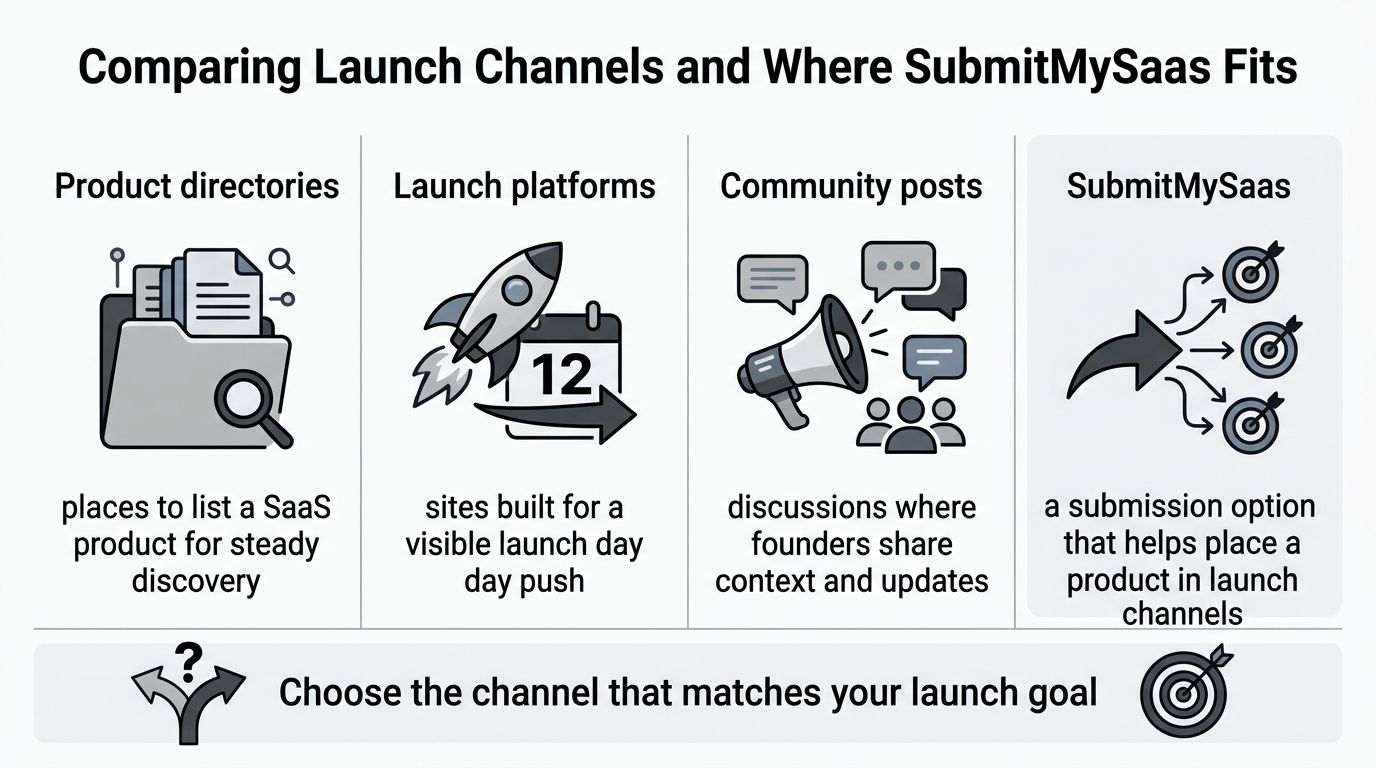
Product directories give you steady, searchable presence in your category. They're cheap and durable, but traffic arrives slowly and depends on the directory's own ranking. Treat them as foundational, not exciting.
Launch platforms concentrate attention into a short window. A strong launch day can bring signups, feedback, and backlinks in one burst. The trade-off is preparation time and the risk of a quiet result if your audience doesn't overlap with the platform's voters and browsers.
Community participation in places like relevant subreddits, Slack groups, and Indie Hackers builds trust that paid placements can't buy. It's also slow, hard to delegate, and easy to damage with self-promotion that ignores community norms. Show up to answer questions first, and mention your product only when it's genuinely the answer.
Email to people who opted in converts better than cold channels because you're talking to demonstrated interest. Building that list takes time, though, and early-stage products often don't have one yet. Start collecting addresses from day one with a useful lead magnet or a launch waitlist.
Paid acquisition gives you speed and control. It also exposes weak conversion fast, because you're paying for every visitor your landing page fails to convince. Most early teams should test paid only after organic visitors already convert at a workable rate.
Where a Launch Platform Fits in the Mix
SubmitMySaas operates as a launch and discovery platform for SaaS, AI, productivity, marketing, and design tools, with daily launches, trending lists, and monthly best roundups. Its prominent launch package includes a badge and 35+ DR backlinks. For a founder without an audience, that combination addresses two gaps at once, immediate exposure to product hunters and the external references that support search visibility later.
It's a sensible first step when you have a finished product page, a clear category, and no existing distribution. It isn't a substitute for the other channels. Pair a launch placement with community posts that add context, and use a social media scheduler from iHatePosting if you're spreading announcements across platforms and don't want posting logistics to eat your launch day.
Choosing well matters more than choosing many, and a fuller breakdown of content distribution channels can help you sequence them. My working rule for small teams is simple. Pick one launch channel for the spike, one searchable channel for compounding discovery, and one relationship channel for trust. Run those three properly before adding a fourth.
Writing Messaging and Earning Third-Party Mentions
Channels deliver attention. Messaging decides whether attention turns into trials. Most launch copy fails because it describes features the founder is proud of instead of the outcome the buyer wants.
Start your messaging work with the people who'll read it, as this look at planning a launch together shows.

Write the Sentence Everything Else Copies
Draft a one-sentence value proposition with this shape: who it's for, what outcome they get, and how you deliver it. "Scheduling for clinics that cuts no-shows with automatic reminders" beats "an AI-powered scheduling platform" every time. Test it on someone outside your team. If they can't repeat what the product does, rewrite it.
Build your product page around one specific use case, not every use case. Lead with the problem, show the workflow in screenshots or a short demo, name the price plainly, and add proof near the call to action. Buyers researching on their own won't book a call to learn basic facts.
Then adapt the same facts to each channel. A directory listing needs category clarity and short feature bullets. A launch post can tell the story of why you built it. A comparison page needs honest differences, including where a competitor is stronger. The tone changes. The facts, pricing, positioning, and use-case language don't.
Why Consistency Now Matters More Than One Great Page
Buyer research on how AI search has changed research habits found that nearly 8 in 10 B2B decision-makers say AI search has changed how they research, and 29% begin research through platforms such as ChatGPT more often than Google. AI assistants assemble answers from many sources. If your pricing, category, and capabilities are described inconsistently across the web, those answers will be wrong or vague.
That's why earned mentions do double duty. Reviews, comparison pages, customer stories, and independent references persuade human readers and corroborate your product facts for AI answers. Earning them takes deliberate outreach, and understanding what media outreach involves helps you pitch something more useful than "please feature us."
- Offer reviewers a real trial: Give extended access and answer questions, but don't script their conclusions.
- Give customers the words: After a successful onboarding, ask for a short story with their before and after, and make approval easy.
- Publish machine-readable facts: Keep pricing, integrations, and use cases on stable pages that other sites can cite accurately.
The short video below walks through how positioning shapes this kind of messaging work in practice.
One founder describing the same invoice tool might write "invoicing for freelancers" in a directory, tell the late-payment story in a launch post, and compare payment fees on a comparison page. Three formats, one consistent product. That consistency is what lets strangers, and AI assistants, recommend you accurately.
Turning One Launch into Repeatable Growth Loops
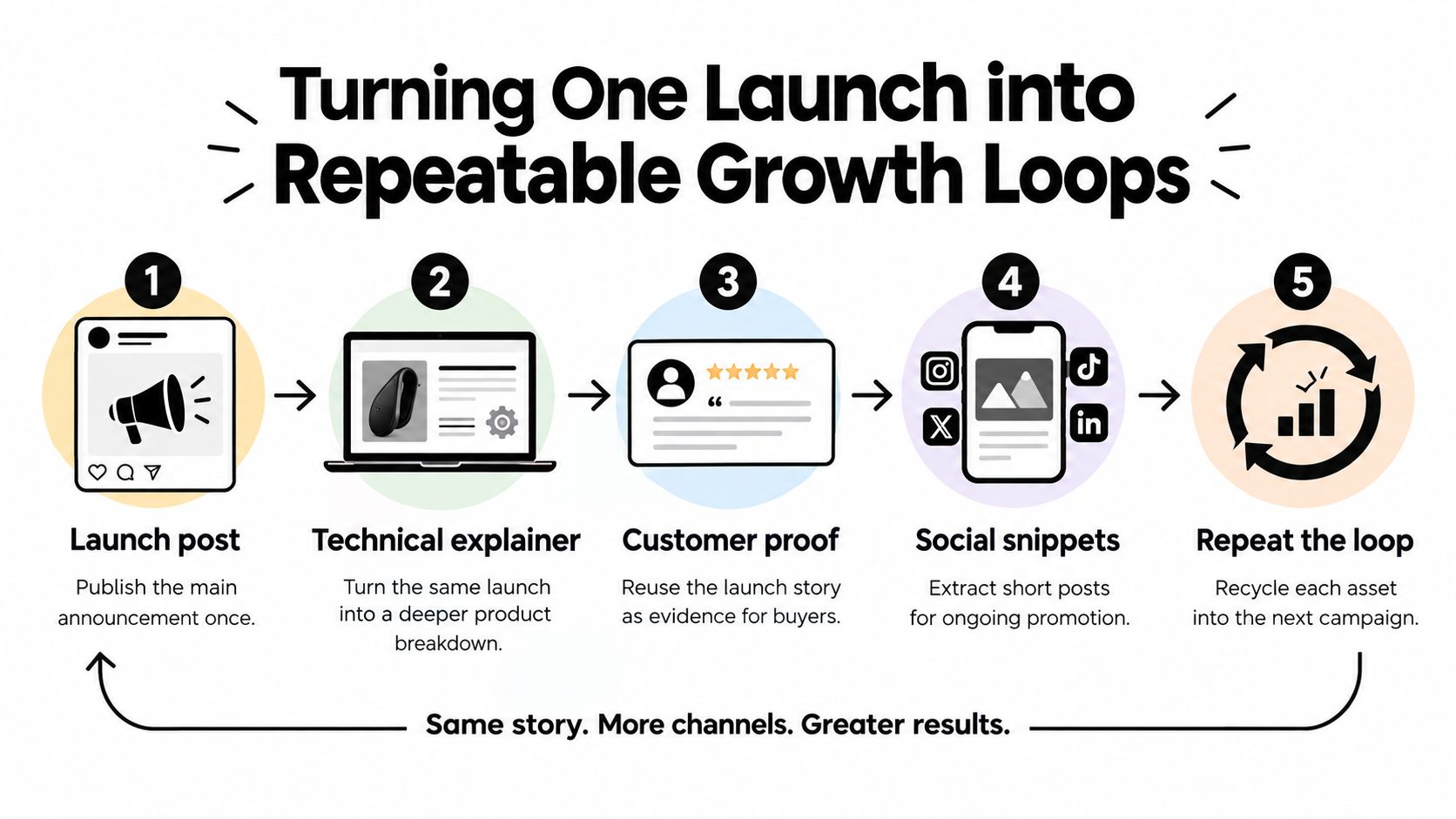
A launch produces raw material that many teams waste. The announcement, the screenshots, the founder story, and the first user reactions can each become assets that keep working. The shift is from campaign thinking, one big effort then silence, to loop thinking, where every output feeds the next round of discovery.
The flow below shows how a single launch can be recycled into compounding assets instead of a one-day event.
Repurpose With a Point of View, Not Duplication
Measurable promotion combines audience research, technical SEO, distribution, and conversion tracking, and each core asset should be repurposed into launch posts, technical explainers, customer proof, email sequences, and community discussions, as set out in CMI's reporting on how B2B marketers measure content performance. The same reporting notes B2B marketers commonly use conversions at 73%, email engagement at 71%, and website traffic at 71% as performance metrics, yet only 46% agree their organization measures content performance effectively.
Repurposing doesn't mean pasting the same text everywhere. A technical explainer derived from your launch post should go deeper, with setup steps, limitations, and answers to objections from your first users. A community discussion should ask a real question your launch raised. Duplicate low-value syndication wastes the placement and teaches you nothing about which format works.
Here's a simple loop a small team can run monthly:
- Ship something worth announcing: A feature, integration, template, or meaningful improvement.
- Publish the core asset: One strong page or post explaining the change and who it helps.
- Derive three outputs: A technical explainer, a customer proof story, and an email to your list.
- Feed reactions back in: Turn questions and objections into the next explainer or FAQ update.
Build Clusters Around High-Intent Use Cases
Group your content around the use cases closest to purchase. A cluster might include a comparison page, an implementation guide, relevant documentation, and your conversion page, all linked together with descriptive anchor text. A buyer arriving at any one page can reach the trial in one or two clicks, and search engines can understand what the product is for.
Loops also run through people. Satisfied users who invite teammates or refer peers reduce your dependence on rented attention, which is why the mechanics of referral marketing belong in your loop design once activation is healthy. Don't add referral incentives before users reach value, though. Nobody recommends a product that didn't work for them.
A useful test: If you stopped posting for a month, would new buyers still find you? If not, you have campaigns, not loops.
Review each loop by source and cohort, not in aggregate. A comparison page that sends activated trials every week deserves more investment than a launch post with impressive views and no downstream action. That review habit turns scattered promotion into a system you can improve.
Measuring Incremental Activation and Your Next Step
Here's an uncomfortable truth about promotion analytics. The channel that gets credit in your dashboard is often not the channel that did the persuading. If you're judging spend by last click, you're probably cutting channels that work and doubling down on channels that merely close.
Buyers increasingly encounter products through AI answers, social content, review pages, videos, communities, and branded searches before converting later through a direct visit, which makes last-click attribution unreliable, a pattern described in coverage of how measurement is shifting toward first-party data and incrementality. Teams are responding with first-party data, consented measurement, and incrementality tests. You don't need an enterprise budget to apply the same logic.
A Low-Budget Measurement Method That Works
- Unique landing pages or referral codes: Give each major channel its own URL or code so signups carry their origin with them.
- Self-reported attribution: Add a "How did you hear about us?" field at signup and review the free-text answers weekly.
- Branded search lift: Watch whether searches for your product name rise after a launch, review, or community push.
- Small holdout tests: Pause one channel for a defined period, or run it in one segment only, and compare activated signups.
Connect anonymous pre-signup activity to consented accounts where your tooling allows it, so you can see the path rather than only the endpoint. Then score each channel across five columns, exposure, qualified visits, activation, retention, and assisted influence, and note your confidence in each number. A channel with modest visits but strong activation and frequent mentions in signup answers is doing real work.
For the mechanics of setting this up, a guide to product launch metrics covers what to instrument before you spend. Set it up before your next push, not after. Retroactive measurement usually means guessing.
Judge promotion by incremental activated users, the people who tried your product and reached value because of that channel, not by traffic or backlinks alone.
Your next step this week is concrete. Define your primary conversion, add unique URLs and the signup attribution question, then submit your product to one launch channel and watch what activates. You'll learn more from one measured launch than from a month of unmeasured posting.
If you're ready to put this playbook into practice, submit your SaaS, AI, or productivity tool to SubmitMySaas to appear in daily launches, trending lists, and monthly best roundups in front of founders, makers, and early adopters. Pair that launch exposure with the measurement setup above, and you'll know within weeks whether your promotion is producing activated users or just traffic.