By Outrank
How to Delegate Effectively: A Startup Playbook
Learn how to delegate effectively with a keep-or-hand-off filter, one-page briefs, and metrics that show work stayed delegated.

On this page
Delegation is an operating skill, not an automatic result of becoming a manager or founding a company. Handing off a task is only the start. The person needs enough decision-making authority and capacity to complete it without sending every choice back to the founder.
How to delegate effectively means defining the outcome, setting clear limits on the decisions someone can make, and deciding what existing work will pause to make room. Otherwise, tasks move, but decision rights and capacity stay where they were. The founder remains the bottleneck, with more messages to answer.
Why Founders Who Delegate Grow Faster
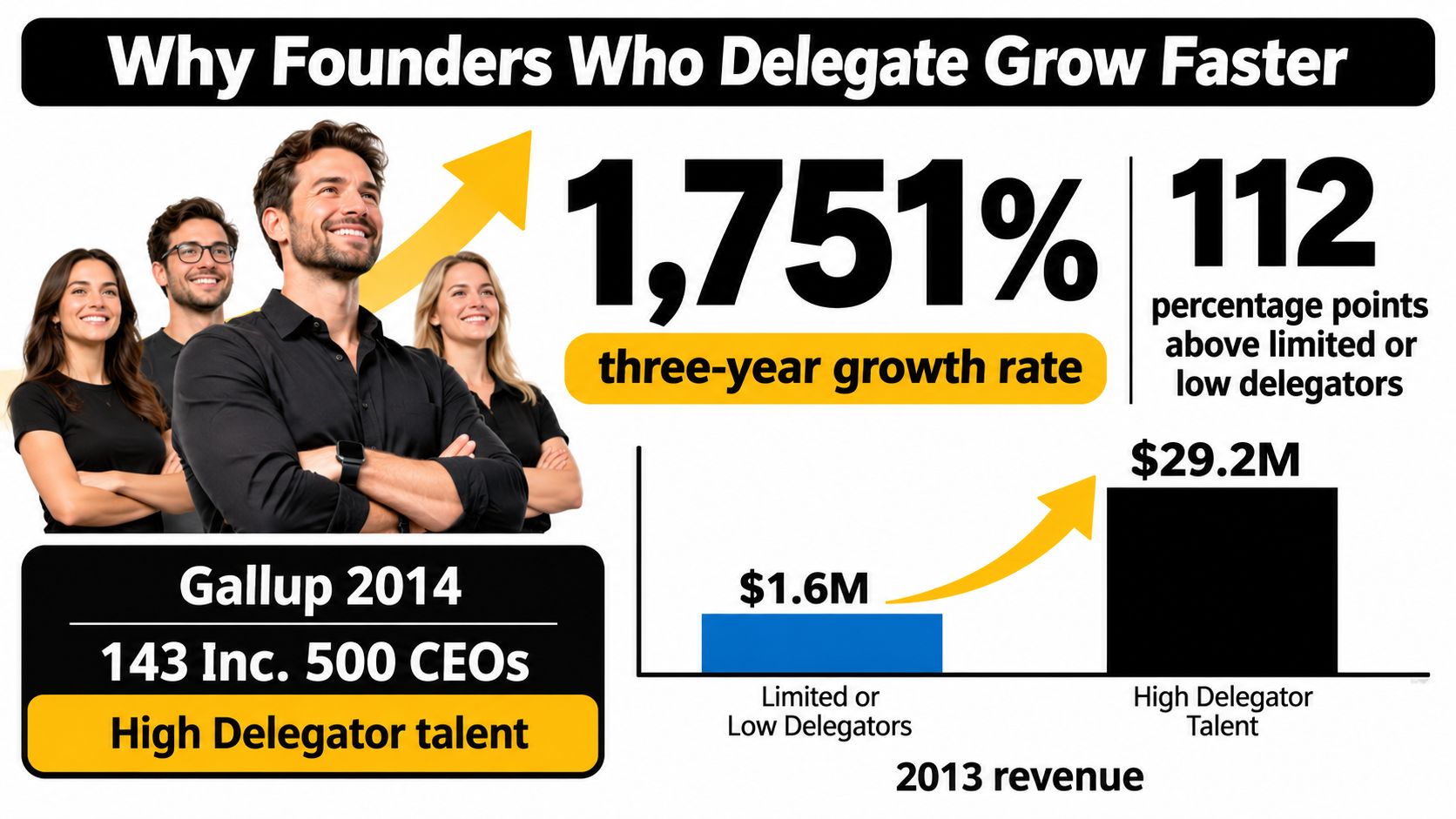
In a 2014 Gallup study of 143 CEOs from the Inc. 500 list, CEOs with high Delegator talent achieved an average 1,751% three-year growth rate, 112 percentage points above CEOs with limited or low delegation talent. That's an association, not proof that handing off work causes growth. It does challenge the idea that founders protect performance by keeping every decision.
The comparison is striking when viewed side by side.
The launch that still needs the founder everywhere
Consider a small SaaS team preparing a directory launch. A teammate writes the listing, checks the links, chooses a category, and prepares the launch-day posts. Yet every choice returns to the founder: approve this sentence, choose between these categories, decide whether this redirect is acceptable.
The teammate performs the activity. The founder still owns the queue of decisions.
Effective delegation transfers an outcome and enough authority to finish it. It doesn't require the founder to disappear, and it doesn't remove the founder's responsibility for choosing sensible boundaries. It changes who makes the operational calls inside those boundaries.
For the launch, that means the owner can correct formatting, reject a broken destination, and select an approved category without waiting for permission. The founder keeps decisions that change the product promise.
Build a system, not a longer task list
Start with tangible working documents rather than a general intention to trust the team:
- A keep-or-hand-off list separates founder judgment from work another person can own.
- A short outcome brief records the result, limits, acceptance criteria, and capacity trade-off.
- An early checkpoint catches misunderstandings while they're still cheap to fix.
- A decision log makes it possible to see whether authority moved.
For a complementary handoff checklist, Approved Lux Personal Assistant's delegation guide is a useful resource to review while preparing instructions. The practical test is whether your instructions let someone finish, not merely get started.
Treat delegation as part of operational efficiency improvement, rather than an isolated leadership habit. Removing unnecessary approvals matters more than transferring typing, formatting, or scheduling.
Delegation increases capacity only when the founder stops making the operational calls that belong to the owner.
What to Delegate and What to Keep
Keep or delegate filter for startup work
| Work type | Keep or delegate | Authority | Launch example |
|---|---|---|---|
| Irreversible or strategic | Keep | Founder decides | Pricing, brand promise, partnership terms |
| Brand-critical one-off | Keep or co-own | Escalate before it ships | Homepage claim or launch headline |
| Reversible operational | Delegate with guardrails | Owner decides inside a written threshold | Category fit, launch reschedule, quality-fail on a link |
| Recurring execution | Delegate fully | Named owner decides and ships | Broken-link checks, social posts, listing formatting |
| Low-risk AI draft | Delegate the draft only | Human owns the outcome and approves | Research notes or a first-pass listing blurb |
Risk and capacity come before convenience. A decision isn't suitable for delegation merely because you dislike making it. Another person must be able to reach the required quality, and the consequences of a mistake must fit the authority you're granting.
A Stealth Agents management-research summary, citing other management publications rather than presenting a primary study, reports that 64% of CEOs acknowledge retaining decisions direct reports could make without quality loss. Use that as a prompt to inspect your approval habits, not as a benchmark for your startup.
Inventory decisions, not just activities
Review your calendar, project board, and recent messages. Write down the decisions you repeatedly make: selecting publication dates, approving routine copy changes, checking category fit, or deciding whether a failed link should block submission.
Then classify each decision as strategic and hard to reverse, reversible operational, or routine. Move the latter categories toward a named owner, provided that person has the skill, access, and time to deliver.
This distinction avoids a common mistake: delegating a large project while retaining every small choice inside it. Someone can own directory preparation without owning positioning, pricing, or a new partnership commitment.
For example, the founder keeps the claim about what the product does. The listing owner can adapt that approved claim to a directory's character limits, provided the meaning doesn't change.
Write thresholds that someone can use
A guardrail must resolve a real choice. Permission to use good judgment sounds enabling but doesn't tell the owner what happens when the product fits several categories.
For a launch, practical thresholds could say:
- Category selection: Choose from the approved shortlist using the product's primary use case; escalate if no approved category fits.
- Link quality: Correct a known destination error independently; stop publication if the destination cannot be verified.
- Scheduling: Reschedule within the agreed launch window; escalate any move that affects another public commitment.
- Copy changes: Edit structure and length freely; seek approval before changing a capability or promise.
There's a trade-off between development and delivery. If nobody can yet meet the acceptance bar, don't pretend the whole outcome is ready to leave your desk. Assign a bounded draft, explain the missing capability, and retain the accept-or-reject decision while the person learns.
Use resource allocation strategies to make the staffing trade-off explicit. Mark a routine item and a reversible decision to move this week, while leaving strategic calls on the founder's list.
Choosing the Right Person
Start with the acceptance bar, not the org chart. A listing owner needs to produce copy that matches the approved claim, select a defensible category, and verify the destinations. Being available doesn't establish readiness for those decisions.
Match capability before availability
Skill fit comes first. A teammate who understands product messaging is a stronger candidate for listing copy than a generalist whose only advantage is an open afternoon. Look at a relevant work sample, or ask for a bounded draft when the capability is uncertain.
Then inspect capacity. Ask the candidate to identify the commitment that would move if they accepted this outcome. If nothing can pause and the current work already fills the week, you've found a scheduling conflict, not an owner.
Use these checks in order:
- Relevant skill: Can the person perform the quality test, not merely operate the tool?
- Available capacity: What work can stop, slip, or transfer before this assignment begins?
- Decision readiness: Which listed choices will they make independently, and where do they need support?
- Accountability: Will they take responsibility for the finished result and flag threats before the deadline?
Ask about authority directly
Some people welcome discretion over category selection but want support interpreting product claims. Others can write confidently but haven't handled publication dependencies. Ask which decisions feel clear and which don't, then adjust the scope instead of assuming confidence means competence.
Accountability also needs a name. Contributors can share the work, but the person responsible for bringing it to acceptance must be identifiable. Otherwise, each contributor can finish their piece while nobody resolves the remaining gap.
When the required skill isn't available internally, define the role before searching externally. For teams considering regional hiring, support for employers hiring LATAM talent from LatoJobs is a relevant resource to consult alongside that role definition.
Don't recruit around a vague need for help. Specify the outcomes, authority, working overlap, and quality checks the role requires, whether the owner is a teammate, contractor, or new hire.
How to Brief One Outcome
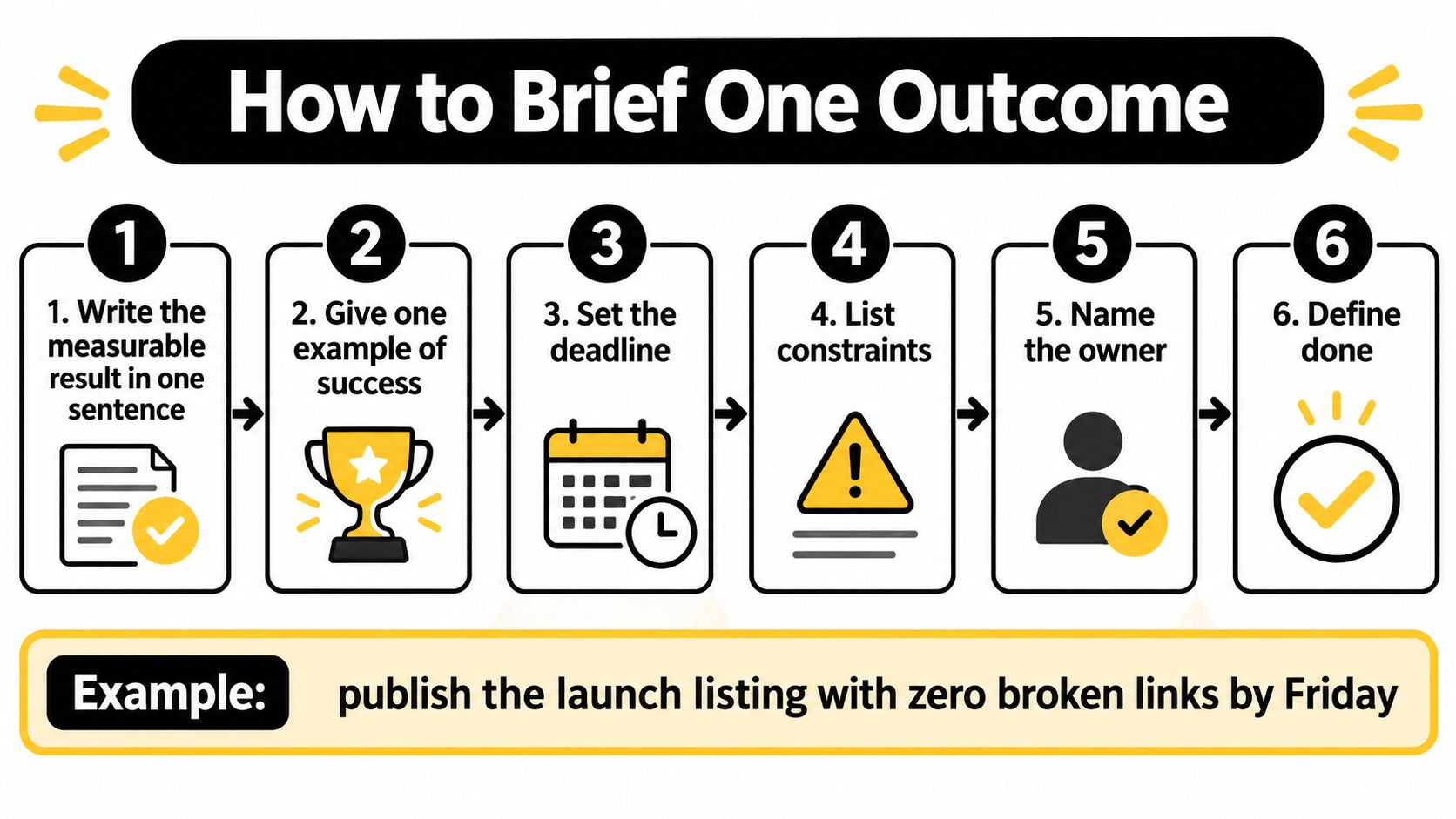
A usable brief should fit on a page without forcing the owner to reconstruct essential context from chat. Include the approved claim, destination links, access permissions, and a finished example alongside the instructions.
Use this visual as a compact handoff checklist, then add the authority and capacity details below.
Write the operating agreement
State the measurable result.
In a hypothetical listing brief, write: publish the launch listing with zero broken links by Friday. This describes a finished state and a deadline, rather than an invitation to participate.Name the accountable owner.
Put a person's name beside the outcome. Identify contributors separately, so getting help doesn't blur responsibility for completion.Specify decision rights.
Let the owner choose within the approved category shortlist, adjust formatting, and correct verified link destinations. Require escalation for any change to the product claim or a publication conflict outside the agreed window.Define acceptance and review.
State what will be checked: destinations work, the category matches the product, and copy preserves the approved claim. For this example, schedule a Thursday afternoon review so the owner has time to correct failures before Friday.Authorize the capacity trade-off.
Record that the weekly metrics report pauses while the listing is prepared, with the founder approving that pause. A new priority isn't actionable until someone has permission to change an existing commitment.Book an early checkpoint.
A check-in near 25% completion is a practical option described in Leaders Adapt's delegation guidance. Use it to inspect the owner's interpretation before they repeat the wrong approach across the deliverable.
Avoid this brief: Own the launch. Keep me posted.
That instruction leaves the owner guessing about scope, authority, quality, timing, and workload. More status messages won't repair the missing agreement.
Make the differences visible
Vague brief versus usable brief
| Brief field | Vague version | Usable version |
|---|---|---|
| Outcome | Help with the launch | Publish the listing with zero broken links by Friday |
| Accountable owner | The team | One named owner |
| Authority | Own the launch | Owner picks category within the approved shortlist; escalates any change to the product claim |
| Acceptance criteria | None | Links checked, category matches product, copy matches approved claim, reviewed Thursday afternoon |
| Capacity trade-off | None | Weekly metrics report pauses; founder approves the pause |
| Check-in | Running commentary | One early check-in, followed by the agreed review |
Store the brief where the owner works, such as the relevant Notion page, Trello card, or GitHub issue. Use async communication tools to keep decisions attached to the deliverable instead of scattering approvals across private messages.
Ask the owner to restate the outcome and describe a decision they can make without you. If their interpretation differs, fix the wording before work begins. This is a comprehension check, not a request to repeat your instructions verbatim.
For an additional delegation walkthrough, use the video alongside your written agreement.
Copy the result, owner, authority, acceptance, capacity trade-off, and checkpoint into your next handoff. Keep the document short, but don't remove the details that let someone act independently.
Fixes When Work Bounces Back
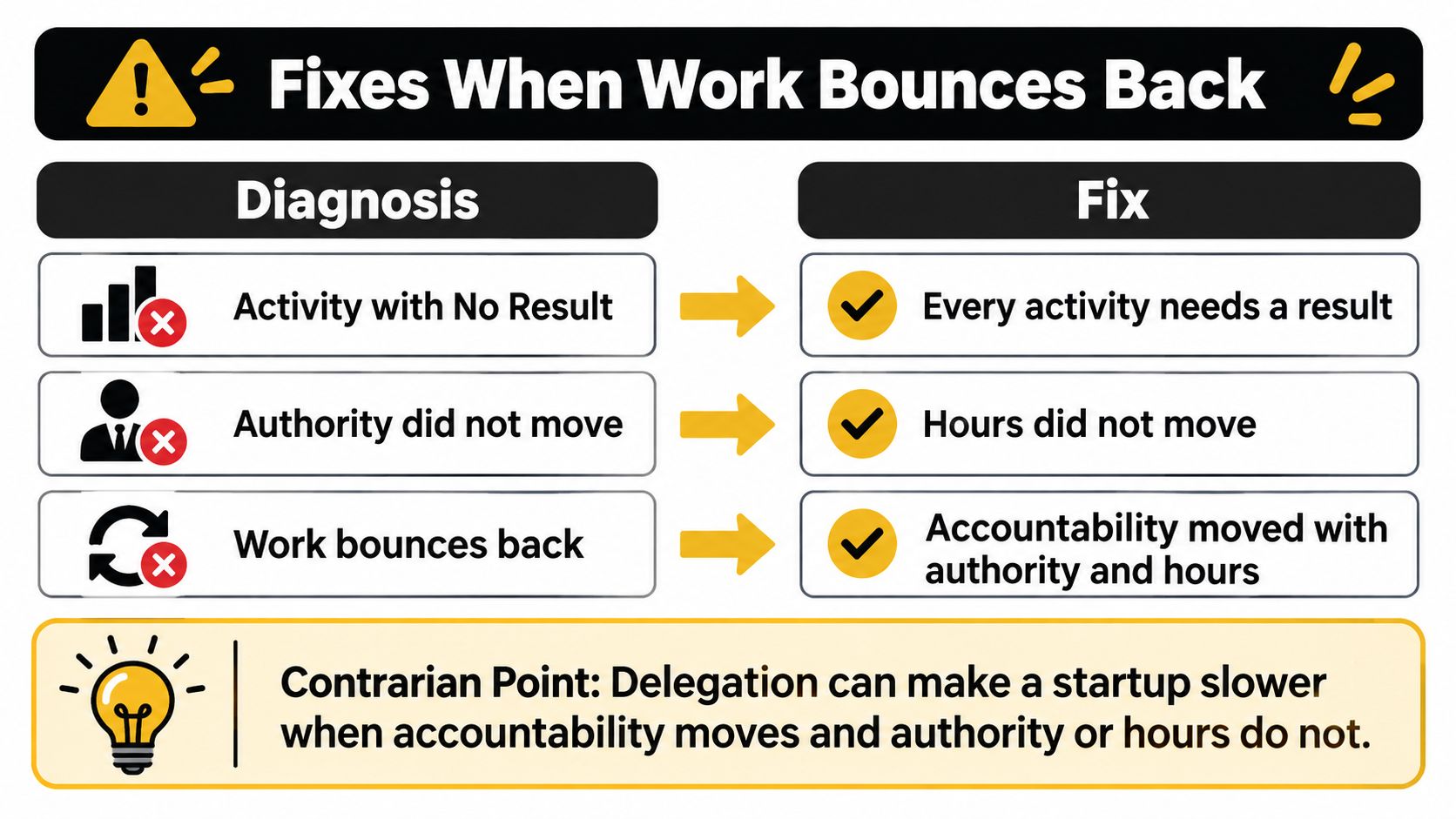
Delegation can make a startup slower when accountability moves but authority or available hours don't. The owner now has another commitment, the founder still approves the decisions, and both spend time coordinating work neither can finish cleanly.
Diagnose the failed handoff before concluding that the person needs closer supervision.
Delegation failures and the fix
| Symptom | Likely cause | Fix |
|---|---|---|
| Work finishes but the founder still decides | A task moved, not an outcome | Rewrite the brief as a measurable result with an acceptance metric |
| Decisions return every week | Authority never moved | List independent decisions and the few escalation triggers |
| New urgent work piles onto a full week | No capacity trade-off | Name what pauses and who may approve that pause |
| Founder edits throughout | Check-ins replaced autonomy | Use the early checkpoint, then the agreed review |
| AI output ships with errors | No human owner or audit | AI drafts only; a person approves; expand after low rework |
| Rework and missed deadlines | Done was never defined | Agree acceptance criteria before work starts |
A founder's intervention can also create the behavior they're trying to eliminate. If you rewrite every acceptable social post because you prefer another opening, the owner learns to seek approval before writing the next one.
Separate a failed criterion from a different preference. Correct the former. Leave the latter alone unless you're willing to make it an explicit standard for future work.
The diagnostic pattern is easier to recognize when cause and repair sit together.
Treat AI as an authority decision
A study of 885 product managers at Microsoft found that willingness to delegate to generative AI reflected identity, accountability expectations, and social dynamics, not only perceived capability. Being able to produce an answer isn't the same as being authorized to release it.
For a launch team, an AI-generated listing blurb is a draft, not evidence that its claims are correct. A human owner must compare it with approved product information and inspect anything the system inferred.
Use a staged policy:
- Begin with reversible preparation. Allow research organization, copy alternatives, and draft formatting, rather than publication or commercial commitments.
- Assign human accountability. Name who verifies factual claims, destinations, and category fit before release.
- Keep an audit trail. Save the relevant inputs, output, corrections, and approval in the work item.
- Record review burden. Track errors and rework, including time spent checking plausible but unsupported statements.
- Reserve consequential approvals. Require human approval for brand claims, pricing, and actions that are difficult to undo.
Expand AI use only when the human reviewer can demonstrate reliable output under the same checks. Faster drafting isn't a gain if verification and correction consume the time saved.
If the founder is still the decider on every operational choice, the task wasn't delegated.
Choose the diagnostic row that best matches your last failed handoff. Apply that repair before changing the owner, adding meetings, or assigning more work.
Check-Ins, Metrics and the Seven-Day Cycle
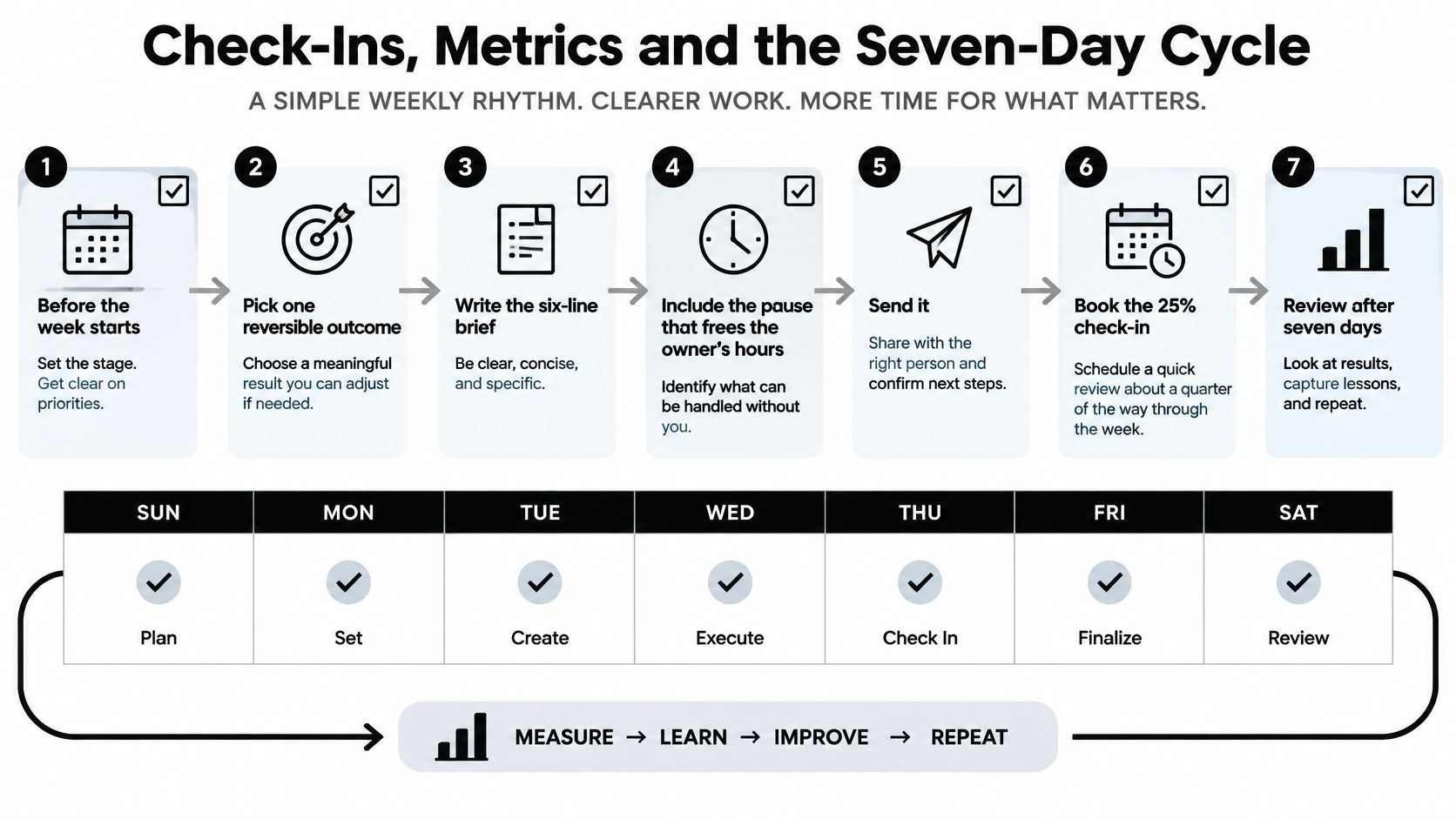
Run delegation as a weekly operating rhythm, not a permanent experiment with unclear results. Start with a reversible outcome whose completion you can inspect, and record what happened without turning measurement into another administrative project.
Gallup's employee-engagement analysis estimates that managers account for approximately 70% of the variance in team-level employee engagement; its 2022 manager-development findings also report that teams led by participating managers improved engagement by up to 18% more than teams led by nonparticipants. Those findings support investing in expectations and coaching, but they don't establish a prescribed checkpoint schedule.
Use the weekly rhythm below as a practical operating choice.
Before and during the week
Before work starts, send the completed brief and confirm that the paused commitment has moved off the owner's schedule. Grant access to the publishing account, approved copy, and link destinations. Calendar the checkpoint and final review so neither depends on an interruption.
During execution, answer the escalations the agreement reserves for you. When the owner asks about something already within their authority, ask for their recommendation and let them act rather than reclaiming the decision.
At the checkpoint, keep the conversation focused:
- Outcome: Is the intended result still appropriate?
- Blocker: Which decision or dependency is stuck?
- Forecast: What will be late if nothing changes?
Coach against an example of the acceptance bar. If a category choice is weak, ask the owner to compare it with the primary use case; don't take over the account and change it yourself.
Review completion and retained authority
At the final review, score each acceptance criterion as met or not met. Distinguish a quality failure from a dependency the owner couldn't control, and give the owner responsibility for agreed corrections.
Track these indicators across successive weekly cycles:
| Indicator | What to record |
|---|---|
| Ownership retention | Share of delegated outcomes completed by their original owner |
| Returned decisions | Decisions sent back to the founder, separated into required and unnecessary escalations |
| Independent decisions | Choices made within the owner's authority without upward approval |
| Delivery quality | Cycle time, rework rate, and missed-deadline rate |
Don't reward fewer escalations in isolation. An owner who conceals a product-claim change hasn't demonstrated autonomy; they've crossed a boundary. Review decision quality alongside decision volume.
For a directory-launch slice, inspect copy, category, destinations, and prepared posts while keeping the founder's positioning and launch authorization separate. If link failures repeatedly need a founder ruling, write the missing resolution threshold instead of asking the owner to be more proactive.
Expand authority after consistent clean delivery, not merely after time has passed. Delegation worked when the same owner can ship a similar outcome with fewer unnecessary returned decisions and the required quality intact. If that doesn't happen, repair the agreement before increasing the workload.
SubmitMySaas gives founders a way to submit tech products for discovery through launches, categories, and curated roundups. Put your listing preparation under a named owner, keep the product claim with the founder, and visit SubmitMySaas to prepare your product's submission.