What Is Monthly Recurring Revenue a Guide for SaaS Founders
Understand what is monthly recurring revenue (MRR), how to calculate it with clear examples, and why it's the most important metric for your SaaS business.

Monthly Recurring Revenue (MRR) is, quite simply, the predictable income your business can count on every single month. It's the total revenue you generate from all your active subscriptions, making it the lifeblood for any subscription-based company.
Understanding Your Business Heartbeat

Think about your revenue like personal income. One-time sales are like freelance gigs—great when they happen, but you can't rely on them. MRR, on the other hand, is like a steady paycheck. You know it's coming. This predictability is precisely why we call it the pulse of any subscription business, whether you're running a huge SaaS platform or a small, paid newsletter.
Tracking MRR gives you a clean, real-time snapshot of your company's financial health and growth trajectory. Unlike a simple total revenue figure, which can get distorted by one-off projects or big annual payments, MRR smooths everything out. This clarity is what allows you to stop guessing and start making sharp, data-backed decisions.
Why MRR Is a Critical Metric
Keeping a close eye on your MRR is crucial for just about every important function in your business. It allows you to forecast future income with a high degree of accuracy, which is the bedrock of solid budgeting and long-term planning.
When you have a stable MRR, you can move forward with confidence. You'll know when it's the right time to:
- Hire new people to handle growth.
- Put more money into marketing to bring in new customers.
- Invest in building out new features or upgrading your infrastructure.
The data backs this up. Recent industry reports show that MRR for subscription businesses jumped by 7%, pointing to healthy growth across the board. This isn't just a fluke; it shows the power of holding onto your existing subscribers while consistently bringing in new ones. You can find more details on this trend in the latest subscription economy statistics.
Of course, to really see how MRR fits into the bigger picture, it helps to understand your financials as a whole. Getting a handle on your income statement is a great place to start, and you can learn more by Understanding Profit and Loss Statements.
By focusing on MRR, you shift from simply chasing sales to building a truly sustainable and scalable business. It's the single most important metric for measuring the health and trajectory of a recurring revenue company.
In short, MRR isn't just another number on a spreadsheet. It’s a story about your company’s stability, its momentum, and its future potential.
To get started, let's break down the key concepts you'll need to master.
MRR Concepts at a Glance
This table provides a quick overview of the essential MRR components we'll be diving into throughout this guide. Think of it as your cheat sheet for understanding the different forces that shape your recurring revenue.
| Concept | What It Measures | Why It Matters for Founders |
|---|---|---|
| New MRR | The additional MRR from brand-new customers in a month. | Shows the effectiveness of your customer acquisition and marketing. |
| Expansion MRR | The extra MRR from existing customers upgrading or adding services. | Highlights customer satisfaction and successful upselling strategies. |
| Contraction MRR | The decrease in MRR from existing customers downgrading their plans. | Pinpoints where your product or pricing might be missing the mark. |
| Churned MRR | The total MRR lost from customers who cancelled their subscriptions. | The ultimate measure of customer retention and product-market fit. |
| Net New MRR | The overall change in your MRR for the month (New + Expansion - Contraction - Churn). | Your true monthly growth rate, telling you if you're moving forward or backward. |
Each of these pieces tells a different part of your growth story. By understanding them all, you can get a complete picture of what's working, what isn't, and where you need to focus your efforts.
Calculating Your Foundational MRR
Alright, now that you know why Monthly Recurring Revenue is such a big deal, let's roll up our sleeves and get into the numbers. You don’t need a fancy finance degree or complicated software to figure out your foundational MRR. At its heart, the calculation is surprisingly simple and gives you a clear baseline of your company's health.
The easiest way to get started is with one core formula. Think of this as the 10,000-foot view of your recurring revenue.
MRR = Total Number of Active Customers × Average Revenue Per Customer
It's really that straightforward: multiply the number of paying customers you have by the average amount they pay you each month. Let’s walk through a couple of examples to see this in action.
Example 1: The Single-Plan SaaS
Imagine you run a simple tool called "TaskFlow" that has just one subscription plan for $25 per month. This clean model makes calculating MRR a piece of cake.
If you have 100 active, paying customers this month, the math looks like this:
- 100 Customers × $25/month = $2,500 MRR
In this scenario, your Average Revenue Per Customer (often called ARPU) is just the price of your plan. That $2,500 is your predictable monthly income—the lifeblood of your business.
Example 2: The Multi-Tiered Subscription Model
Of course, most SaaS companies don't have just one plan. Offering multiple pricing tiers is a common approach, and for good reason—smart SaaS pricing strategies cater to different types of users. This adds a couple of steps to the calculation, but it’s still totally manageable.
Let’s look at another company, "DataSync," which has three subscription plans.
Here's how their customer base is distributed:
- Basic Plan: 150 customers paying $20/month
- Pro Plan: 80 customers paying $50/month
- Enterprise Plan: 20 customers paying $150/month
To get the total MRR, you just calculate the revenue from each plan and then add it all up.
| Plan | Number of Customers | Monthly Price | Monthly Revenue |
|---|---|---|---|
| Basic | 150 | $20 | $3,000 |
| Pro | 80 | $50 | $4,000 |
| Enterprise | 20 | $150 | $3,000 |
| Total | 250 | $10,000 |
By summing up the revenue from each tier, you can see that DataSync's total MRR is $10,000.
This foundational number is your starting point. It's a critical snapshot, but the real magic happens when you start digging into why this number moves up or down each month. That's where you find the insights that drive growth.
Decoding the Story Behind Your MRR Changes
Your total Monthly Recurring Revenue is a powerful headline, but it doesn't tell the whole story. To really get a feel for your business's momentum, you have to dig into the different forces that push this number up or down each month.
Think of your total MRR as the final score of a game. It tells you if you won or lost, but the individual components—the plays, the fumbles, the touchdowns—reveal how you played.
This deeper look helps you answer the questions that actually matter. Are you growing because you’re a new customer acquisition machine, or are your existing customers finding more value and spending more? Are you losing customers entirely, or are they just scaling back a bit? Each answer points you toward a completely different strategic move.
The relationship here is pretty straightforward: your revenue is a direct result of how many customers you have and what they pay you on average.
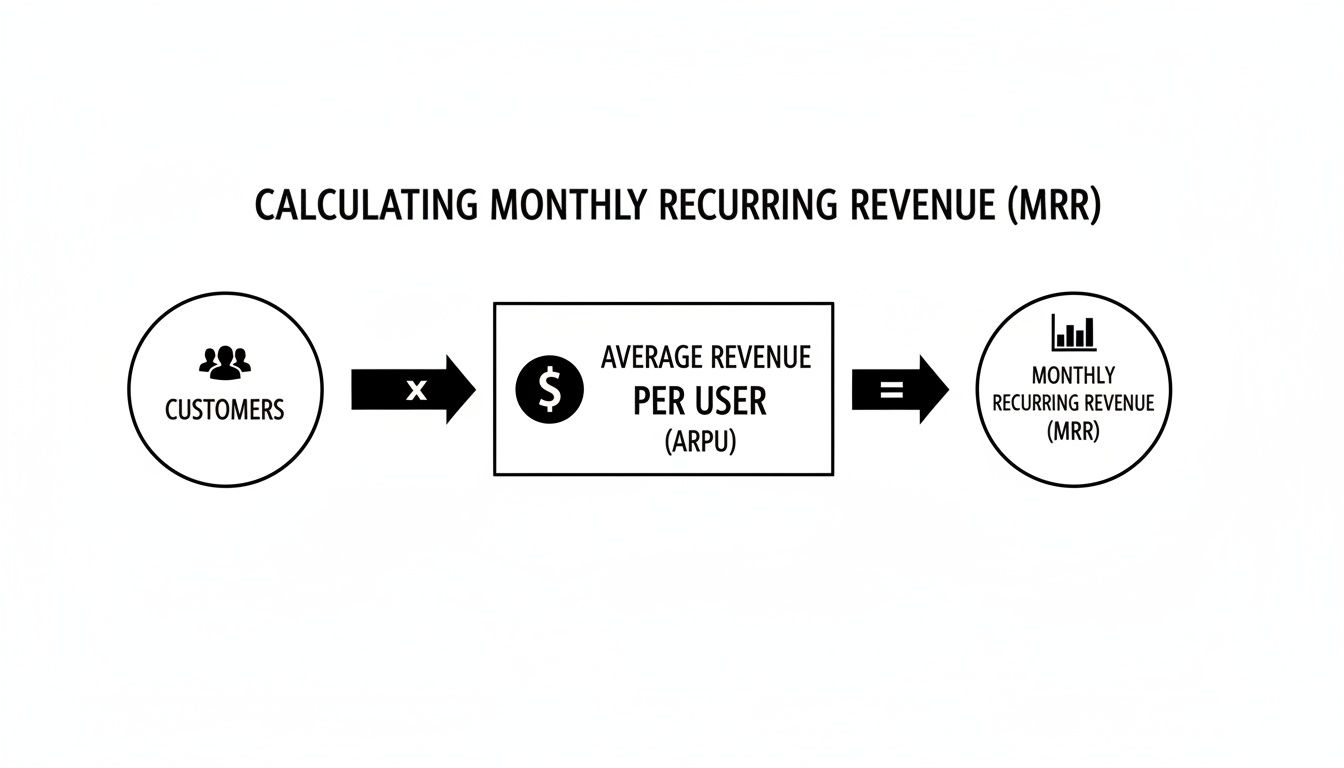
Any change in your customer count or their spending habits sends ripples straight to your bottom line. Let's break down the specific types of changes you'll see every month.
The Four Forces of MRR Movement
Every single month, four key activities are shaping your recurring revenue. When you understand each one individually, it's like having a diagnostic tool for your business health. It shows you exactly where you're winning and where you're struggling to keep up.
- New MRR: This is the lifeblood from brand-new customers. It’s a clean, direct measurement of how well your sales and marketing efforts are landing.
- Expansion MRR: This is the extra cash from existing customers who upgrade, add seats, or buy more services. It’s a huge vote of confidence, showing that your product is delivering real value.
- Contraction MRR: This is the revenue you lose when existing customers downgrade to a cheaper plan. It can be a warning sign that your higher-tier plans are priced too high or aren't justifying their cost.
- Churned MRR: This is the total revenue lost when a customer cancels their subscription entirely. High churn is a five-alarm fire, often pointing to serious issues with your product, support, or overall market fit.
Your goal isn't just to make the total MRR number go up. It's about building a healthy balance. Strong Expansion MRR can be even more valuable than New MRR because it proves your product is sticky and grows with your customers.
Breaking MRR down this way turns a static number into a dynamic story about customer loyalty, product value, and the true momentum of your business.
Let's see how these pieces come together in the real world.
The Components of MRR Movement
This table breaks down each type of MRR with a simple, everyday example. It’s a great way to visualize how these changes might show up in your own reporting.
| MRR Type | Definition | Example Scenario |
|---|---|---|
| New MRR | Additional monthly revenue from newly acquired customers. | A design agency signs up for your project management tool's $50/month Pro plan. Your New MRR for that customer is $50. |
| Expansion MRR | Increased monthly revenue from existing customers upgrading. | That same agency loves the tool and upgrades from the $50/month Pro plan to the $120/month Business plan. Your Expansion MRR is $70. |
| Contraction MRR | Decreased monthly revenue from customers downgrading. | A different customer finds they don't need all the features and moves from a $100/month plan to a $40/month plan. Your Contraction MRR is $60. |
| Churned MRR | Total monthly revenue lost from customers who cancel. | A startup using your $80/month plan goes out of business and cancels their subscription. Your Churned MRR is $80. |
By tracking these four metrics separately, you get to stop asking "Is our revenue growing?" and start asking the much better question: "Why is our revenue changing?" That deeper level of insight is where smart, sustainable growth strategies are born.
Measuring Your True Growth Momentum
While looking at each piece of MRR—new, expansion, churn—is great for diagnosing specific parts of your business, the real magic happens when you put them all together. That's where Net New MRR comes in. Think of it as the single most important compass for your month-over-month growth. It cuts through the noise and answers one critical question: are you actually growing?
Net New MRR is simply the sum of all your monthly gains minus all your losses. It gives you a complete picture, reflecting how well your sales, marketing, and customer success teams are working together.
The formula for Net New MRR is: (New MRR + Expansion MRR) - (Churned MRR + Contraction MRR)
This single number tells the story of your company's trajectory. If it’s positive, you're on the upswing. If it’s negative, you’ve got some leaks to plug. It’s the ultimate health check for your subscription business.
A Story of Growth: SaaSify
Let’s make this real with a quick example. Imagine a company called "SaaSify" that sells a project management tool. They finished last month with a solid $20,000 in total MRR.
Here’s what happened at SaaSify this month:
- New MRR: The sales team crushed it, signing up 10 new customers on the $100/month plan. That’s +$1,000 in fresh revenue.
- Expansion MRR: The customer success team convinced five existing customers to upgrade to a better plan, adding another +$500 to the pile.
- Churned MRR: It wasn't all good news. Two customers on the $100/month plan decided to cancel, which means they lost -$200.
- Contraction MRR: One of their larger customers downgraded their plan to save money, reducing their monthly payment by -$150.
Now, let's plug these numbers into the formula to see how SaaSify really did.
Calculating The Net Change
First, let's tally up the good and the bad.
Total MRR Gained: $1,000 (New) + $500 (Expansion) = $1,500
Total MRR Lost: $200 (Churned) + $150 (Contraction) = $350
With these totals in hand, the final step is simple subtraction.
Net New MRR = $1,500 (Gained) - $350 (Lost) = +$1,150
SaaSify ended the month with a Net New MRR of $1,150. This is a huge insight. Even though they lost some revenue to churn and a downgrade, their efforts to acquire new customers and expand existing ones paid off big time, more than making up for the losses.
Their new total MRR is now $21,150 (the starting $20,000 + $1,150 in net new revenue). This little story shows that growth isn't just about celebrating new logos; it's about mastering the delicate balance between winning new business and keeping your current customers happy and engaged.
Placing MRR in Your SaaS Metric Toolkit
Monthly Recurring Revenue is the heartbeat of your SaaS business, but it doesn't tell you the whole story. Think of it as the speedometer in your car—it tells you how fast you're going right now, but not how much fuel you have or if the engine is healthy. To get a complete picture, you need to look at it alongside other critical metrics.
This is where a lot of founders get tripped up. They see MRR as the be-all and end-all, but that's a surefire way to misread the health of your business. It’s the central gear, sure, but other gears must turn with it for the machine to work.
MRR vs. ARR: What's the Difference?
The most common point of confusion is between MRR and Annual Recurring Revenue (ARR). The distinction is actually quite simple and comes down to your planning horizon.
- MRR is your tactical, month-to-month metric. It's what you use for operational planning, like setting monthly budgets, seeing how a new pricing plan is performing, and tracking immediate growth momentum.
- ARR is just your MRR multiplied by 12. This is your strategic, long-term metric. It’s favored by enterprise SaaS companies or anyone dealing mostly with annual contracts, as it smooths out monthly fluctuations and gives a clearer picture for high-level forecasting.
Connecting MRR to Deeper Business Insights
Beyond ARR, your MRR is the foundation for two other metrics that ultimately decide if your business will sink or swim: Customer Lifetime Value (CLV) and Customer Acquisition Cost (CAC).
A healthy, growing MRR is what fuels a high CLV. The more recurring revenue a customer generates, the more valuable they are over their lifetime. This, in turn, tells you how much you can afford to spend on your CAC to acquire new customers. When your CLV is significantly higher than your CAC, you have a sustainable, profitable business model. It's that simple. To get a real grip on your financial future, you need to actively increase customer lifetime value.
This balance is exactly what investors look for. They want to see that your growth isn't just smoke and mirrors—it's profitable.
By placing MRR alongside ARR, CLV, and CAC, you move from just tracking revenue to building a comprehensive dashboard that tells a complete story about your company's performance and long-term potential.
This holistic view isn't just good practice; it's essential for survival. The subscription economy is booming, with some projections showing the market could hit an incredible $1.5 trillion by 2033. For SaaS founders, this is a massive opportunity, but only for those who understand their numbers inside and out. Nailing your metrics tracking is the first step to claiming your piece of that pie.
Avoiding Common MRR Calculation Mistakes

On the surface, calculating MRR seems easy enough. But I’ve seen countless companies get it wrong, and even small mistakes can completely skew your numbers and lead to some seriously bad business decisions. Frankly, a wrong MRR figure is often worse than no MRR at all—it gives you a false sense of security and hides the real story of your growth.
The key is discipline. You have to be ruthless about what you include and what you leave out. If you remember one thing, make it this: if it's not predictable, recurring revenue from a subscription, it has no business being in your MRR calculation.
Mistake 1: Including One-Time Fees
The most common trap people fall into is lumping one-time payments into their MRR. It’s an easy mistake to make, but it pads your numbers in a way that’s completely misleading.
Here’s a quick list of what you must exclude:
- Setup or Implementation Fees: That initial charge to get a customer onboarded? It's a one-off. Keep it out.
- Consulting or Training Charges: Any professional services you bill for are separate from the subscription itself.
- Credit Packs or Pay-As-You-Go Usage: These payments are variable by nature, not a fixed, predictable part of a subscription.
Tossing these into your MRR will make this month’s revenue look great, but it will throw your forecasts way off and could mask problems with customer churn.
Your MRR should only reflect the committed, predictable revenue you can expect from subscriptions every single month. Everything else is a different type of revenue.
Mistake 2: Mishandling Annual Contracts
This one trips up a lot of founders. When a customer pays for an entire year upfront, it's tempting to book that big chunk of cash right away. For example, if a customer pays $1,200 for a yearly plan, you absolutely do not add $1,200 to your MRR for that month.
You have to normalize it to get a true monthly value. Just divide the total contract value by the number of months in the term. So, for that $1,200 annual deal, the correct amount to add to your MRR is $100 ($1,200 / 12 months). This keeps your monthly reporting consistent and gives you a clear, apples-to-apples view of your growth.
Answering Your Top MRR Questions
Once you start digging into monthly recurring revenue, a few specific questions almost always pop up. Getting the details right on these is crucial if you want metrics that actually reflect the health of your business. Let's clear up some of the most common points of confusion.
Should I Include Trial Users in My MRR Calculation?
That's a hard no. While users on a free trial are fantastic leads, they haven't made a financial commitment yet. Counting them would inflate your MRR and give you a dangerously rosy picture of your current revenue stream.
Think of trial users as potential income, not actual income. They only become part of your MRR once they pull out their credit card and convert to a paid subscription. Your MRR must only include customers who are actively paying you.
How Is MRR Different From Cash Flow?
This is another critical distinction that trips people up. MRR measures the predictable, recurring revenue you can expect on a normalized monthly basis, while cash flow tracks the actual money moving in and out of your bank account. They tell you two very different, but equally important, stories.
For example, if a new customer pays you $1,200 upfront for an annual plan, your cash flow for this month just shot up by $1,200. Great! However, your MRR only increases by $100 (that's the $1,200 annual fee divided by 12 months). MRR smooths out these lumpy payments to give you a true sense of monthly momentum.
MRR is a measure of your business's momentum. Cash flow is a measure of your operational liquidity. Both are vital, but confusing them can lead to some seriously flawed financial planning.
What Is a Good MRR Growth Rate for a Startup?
Honestly, it depends. The answer changes based on your company's stage, market, and how big you are to begin with. A startup jumping from $1,000 to $2,000 MRR just hit a 100% growth rate. An established company growing from $100,000 to $120,000 MRR has a 20% growth rate—and both of those scenarios can be fantastic.
That said, many venture capitalists and investors do look for certain benchmarks to gauge a company's trajectory:
- Early-Stage Startups (under $1M ARR): VCs often want to see consistent month-over-month growth of 15-20% or even higher.
- Growth-Stage Companies (over $1M ARR): At this scale, maintaining a 5-10% monthly growth rate is considered very strong and sustainable.
Ultimately, the real goal is to have consistent, positive Net New MRR. Focusing on building a sustainable growth engine is far more important than chasing an arbitrary percentage.
Ready to get your SaaS product in front of thousands of early adopters and tech enthusiasts? At SubmitMySaas, we provide the platform to launch your tool, gain immediate traction, and build critical backlinks. Stop waiting for users to find you—put your product in the spotlight. Submit your SaaS today!