What Is Hyper-Personalization and How It Actually Works
What Is Hyper-Personalization. Learn what hyper-personalization is, how it differs from standard personalization, what data and AI it requires, and how SaaS
Hyper-personalization is real-time, AI-driven tailoring of content, offers, and timing to an individual using behavioral and contextual signals rather than broad segments, and the global market was estimated at USD 18.74 billion in 2025. A prospect who abandoned your SaaS trial shouldn't receive the same “still deciding?” email as ten thousand other users, because their behavior may already tell you what they need next.
They may have completed setup, invited a colleague, explored one advanced feature, and then stopped at the pricing page. Another prospect may have created an account but never reached the first useful action. Treating both people as “trial users” hides the context that should shape your next message.
That mismatch is where hyper-personalization becomes useful. It can select a different message, offer, interface, or delivery moment for each person, based on what that person is doing and what the system predicts they may need.
The concept sounds simple. The implementation isn't. A SaaS team needs reliable first-party data, identity resolution, decision rules or models, channel coordination, privacy controls, and a measurement plan that looks beyond clicks.
This guide explains what hyper-personalization means, how it differs from ordinary personalization, what powers it technically, and where SaaS teams can apply it. It also addresses the part many explainers skip: how to govern the experience so it feels helpful rather than intrusive, and when simpler segmentation is the smarter investment.
Introduction to Hyper-Personalization
A SaaS founder often sees the problem first in lifecycle marketing. A user visits the product several times, watches an onboarding video, ignores one email, and then returns from a search ad. Yet the automation platform still sends the same generic sequence because the campaign was built around signup date rather than individual behavior.
That campaign may be perfectly operational and completely irrelevant. The user doesn't need another introduction to the product. They may need a guided example, a comparison with a familiar tool, help with an integration, or a prompt to invite the teammate who controls the purchase decision.
Hyper-personalization uses signals from that individual journey to choose the next-best experience. The signals can include product activity, purchase history, device, location, time of day, content engagement, and other contextual information. AI or machine-learning models can help decide which content, offer, or action is most appropriate, while an orchestration layer delivers it through the right channel.
The important distinction is that this isn't just inserting a first name into an email. It isn't only showing different content to companies in different industries. Those techniques can be useful, but they generally operate at the level of attributes or audience groups.
A practical hyper-personalized flow might work like this:
- Observe: Record meaningful events, such as completing setup, using a feature, or returning after inactivity.
- Interpret: Combine those events with account, transaction, and context data.
- Decide: Select the next message, product prompt, offer, or sales action.
- Coordinate: Prevent email, in-app messaging, paid ads, and human outreach from contradicting one another.
- Measure: Compare business outcomes against a suitable control or holdout group.
The final step matters most. Relevance is valuable only when it supports activation, retention, expansion, or another meaningful business outcome. Timing and trust decide whether the experience feels like assistance or surveillance.
Hyper-Personalization Explained Simply
Think of three ways a customer might encounter a coffee business.
A billboard speaks to a broad audience. That's similar to a standard campaign aimed at all trial users.
A barista who remembers your name uses known information to make the interaction more relevant. That's ordinary personalization. The barista may know your usual order or recognize that you're a returning customer.
A concierge notices that you're arriving late, remembers that you usually avoid dairy, and suggests a fast alternative that fits the situation. That's the useful analogy for hyper-personalization. It combines identity, history, current behavior, and context to decide what would help now.
Three properties define the difference:
- Individual-level targeting: The system can make a decision for one person instead of assigning everyone to a broad segment.
- Real-time reaction: The decision can change when the person clicks, browses, purchases, pauses, changes device, or returns at a different time.
- AI-driven decisioning: Models can estimate propensity, relevance, or likely next action, rather than relying only on fixed campaign rules.
A buyer-persona document still has a place in this system. It helps your team understand needs and language at the audience level, but it shouldn't become a substitute for observing what an individual does. You can use this buyer persona guide to establish the strategic foundation, then add live behavioral signals when the journey justifies it.
The market context shows why this idea has moved beyond a narrow marketing tactic. One estimate valued the global hyper-personalization market at USD 18.74 billion in 2025 and projected it to reach USD 82.95 billion by 2034, implying an 18.3% compound annual growth rate. Another estimate placed the market at USD 25.73 billion in 2025 and forecast USD 30.38 billion in 2026, reflecting 18.1% annual growth. These estimates differ, but both describe a category connected to AI, data analytics, and real-time customer decisioning across retail, BFSI, IT, telecom, and healthcare. Fortune Business Insights provides the market context behind the category's expansion.
Practical definition: Hyper-personalization means using live individual signals and automated decisioning to choose what a person should see, receive, or do next.
For a visual explanation of how personalized experiences fit into broader AI-led marketing workflows, this video on hyper-personalization provides another useful introduction.
Personalization vs Hyper-Personalization
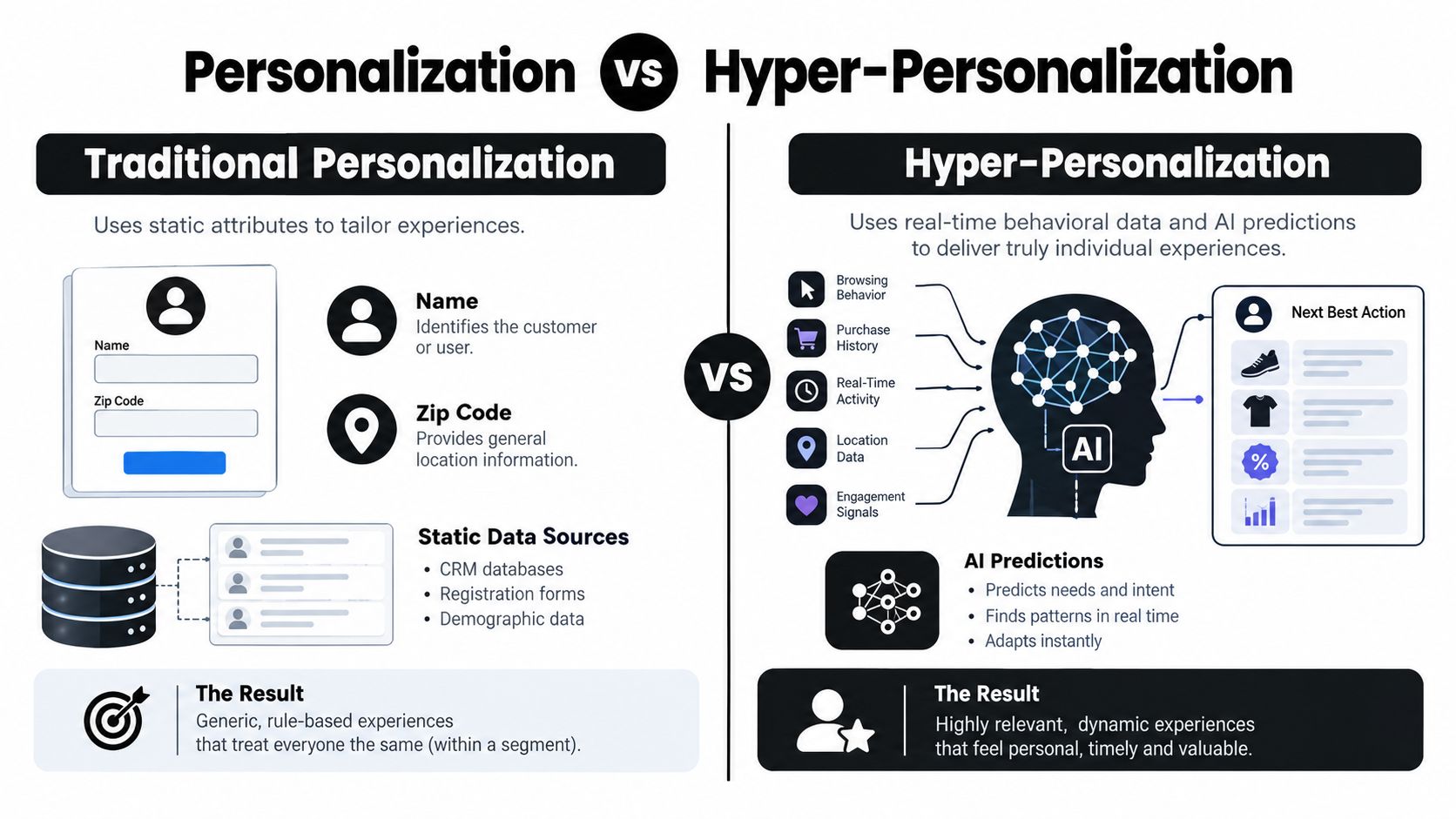
The distinction becomes clearer when you compare the decision-making process.
A SaaS company might personalize a landing page for an agency, a startup, or an enterprise account. It might display the user's first name, recommend a plan based on company size, or send one email to active accounts and another to inactive accounts. Those are sensible applications of rules and segmentation.
Hyper-personalization goes further by combining many signals into an evolving customer view. A model may consider clickstream activity, purchase history, location, device, time of day, product usage, and recent response to messages. It then helps select the next-best content, offer, or action for that individual.
| Dimension | Standard Personalization | Hyper-Personalization |
|---|---|---|
| Data inputs | Profile fields, industry, plan, or declared preferences | Behavioral, transactional, contextual, and first-party signals |
| Decision maker | Marketer-defined rules and segments | AI or machine-learning scoring combined with business rules |
| Timing | Scheduled or batch campaigns | Real-time or event-triggered responses |
| Granularity | Audience cohort or segment | Individual customer or account |
| Typical example | An enterprise onboarding email | An in-app prompt selected after a user's live product behavior |
The technology stack also explains why the terms get blurred. A campaign can contain highly specific copy and still be ordinary personalization if one message is sent to a predefined group. The question isn't how customized the words look. The question is what data drove the decision, how quickly the system reacted, and whether the decision changed for one person.
The Grou glossary of AI personalisation is useful when your team needs a broader vocabulary for discussing AI-assisted relevance, targeting, and customer experiences.
Use this litmus test on your current stack:
- If you select an audience once and send a fixed sequence, you're using segmentation.
- If you change content based on a small set of known attributes, you're using personalization.
- If the system continuously evaluates individual behavior and context, then selects and coordinates the next action, you're approaching hyper-personalization.
That doesn't make the third option automatically better. A strong segmentation strategy may deliver more value than a complex model when your data is sparse or your journey has few meaningful decision points.
The Data AI and Orchestration Stack Behind It
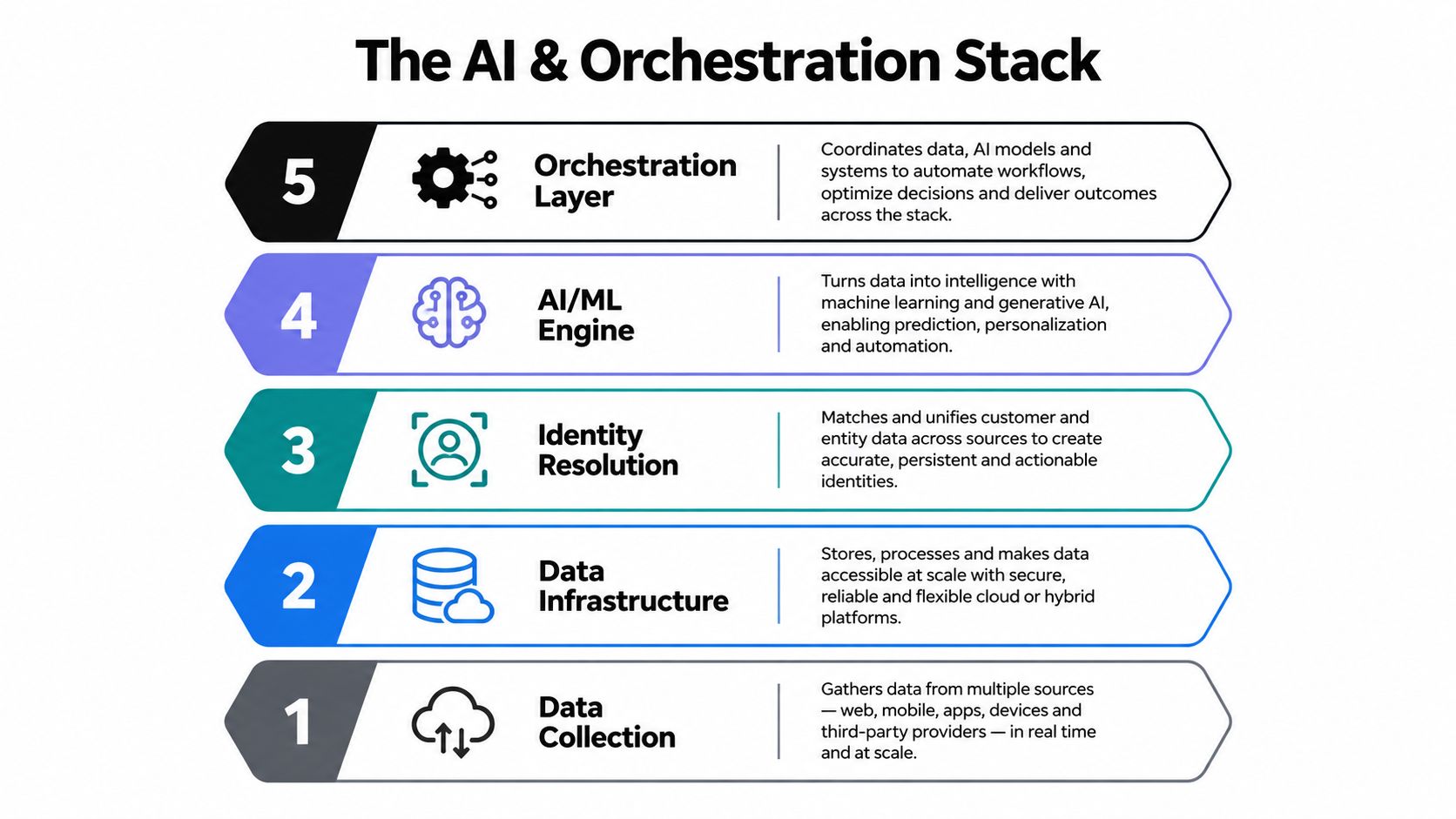
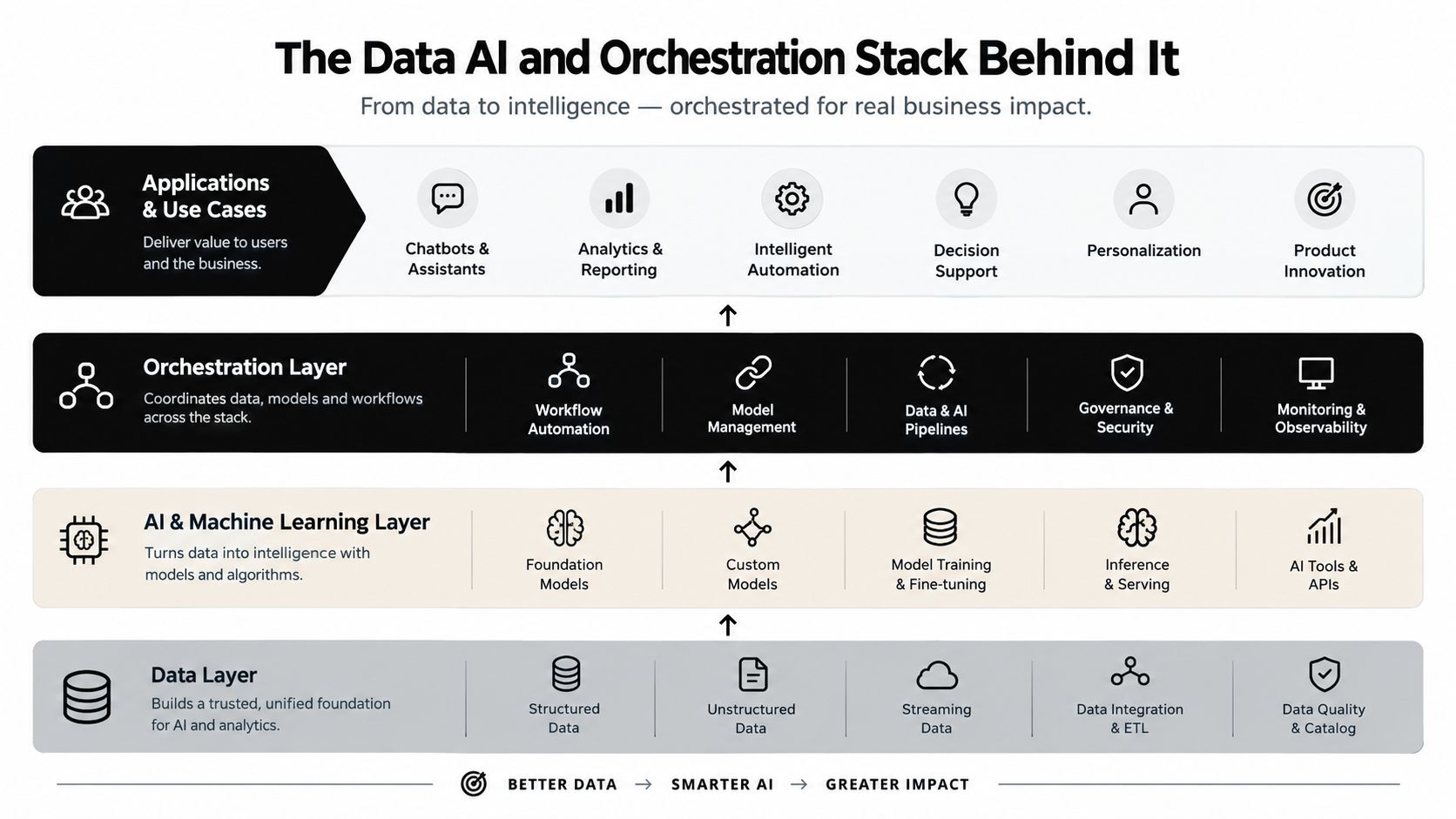
Hyper-personalization is less like adding a feature to an email platform and more like building a decision system. Each layer must pass accurate, timely information to the next one.
Data collection
Start with signals that reflect intent. These can include product events, page visits, content interactions, purchases, support activity, device information, location, and time context. First-party signals are particularly important because they come from a direct relationship with the customer rather than from an uncertain external profile.
Don't collect every possible event without a use case. A founder should first define the business decision, then identify the minimum signals needed to make it.
Processing and identity resolution
Raw events aren't useful if the same person appears as several anonymous visitors, users, and account records. The processing layer cleans, normalizes, and joins those inputs into a usable customer view.
For a SaaS company, that view may need both user and account identities. One user's behavior can indicate a product need, while the account's plan, seats, contract status, or sales stage determines what the company can responsibly offer.
Model scoring and decisioning
A model can score likelihood, fit, urgency, or risk. It might help distinguish a user who is exploring casually from one who has reached a meaningful activation threshold. The model shouldn't operate without constraints. Business rules still need to block unsuitable offers, respect consent, and prevent conflicting actions.
Delivery and orchestration
The final layer activates the decision through email, an in-app experience, a website, advertising, customer success, or sales. Orchestration is what keeps those channels aligned. If a user has just received a personal sales call, an automated discount email may undermine the relationship.
The technical requirement that causes the most trouble is real-time processing. A pipeline that only updates overnight can't respond coherently to a live product action. It may still improve segmentation, but calling it hyper-personalization would overstate what the system can do.
A mid-market SaaS team doesn't need an enterprise wishlist on day one. It needs a reliable event taxonomy, a customer data store, identity matching, one decision surface, and one activation channel. A warehouse, product analytics tool, CRM, and lifecycle platform can form a workable foundation if the data moves consistently between them.
Instrumenting the right events comes before selecting an advanced model. A practical user behavior tracking framework can help your team separate useful product signals from noisy activity.
SaaS Use Cases and the Metrics That Matter
A product-led SaaS company can apply hyper-personalization wherever the next action depends on what a user has already done.
Adaptive onboarding is a natural starting point. A user who imports data but hasn't invited a teammate needs a different prompt from someone who has invited colleagues but hasn't used the core workflow. The relevant metric isn't email engagement. It may be activation rate, defined by the meaningful product action that predicts continued use.
In-app recommendations can surface a feature when the user's behavior suggests a genuine need. An analytics user who repeatedly exports reports may benefit from a dashboard workflow. A team that shares files manually may need collaboration guidance. Track feature adoption, account expansion, or retained usage, depending on the role of the recommendation.
Lifecycle messaging can react to behavior rather than elapsed time. A trial user who returns after a pricing visit may need proof of value or a plan comparison. A paid customer whose usage falls may need assistance before an upgrade prompt. Measure retention, reactivation, or expansion revenue, not just opens and clicks.
Offer selection can also be individualized, but governance matters here. The system might recommend a plan aligned with actual usage instead of showing every user the same upgrade. The business should test whether the offer produces durable expansion and customer value, rather than rewarding short-term conversion at the expense of trust.
Consumer expectations create pressure for this work. Industry research cited by market analysts reports that over 70% of consumers expect personalized experiences and become frustrated when they don't receive them. The same research says 56% of 5,000 surveyed consumers reported that a personalized experience would motivate them to become repeat buyers, an increase of 7 percentage points from 2022. The Business Research Company provides that consumer context.
Broader benchmarks cited in the same source associate personalized experiences with an average revenue lift of 10% to 15%, with some companies reporting 5% to 25% revenue gains. Personalized marketing has also been associated with 29% higher unique open rates and 41% higher unique click-through rates than non-personalized mailings. These figures are benchmarks, not a promise for your funnel. Your own holdout test should determine whether the added infrastructure pays off.
For teams building an acquisition and retention system around content, SaaS SEO services can complement personalization by bringing qualified users into the journey before behavioral signals are available. Once those visitors become known users, connect acquisition context to product and lifecycle measurement. A clear SaaS lifetime value framework then helps you judge whether personalization improves the economics of the relationship.
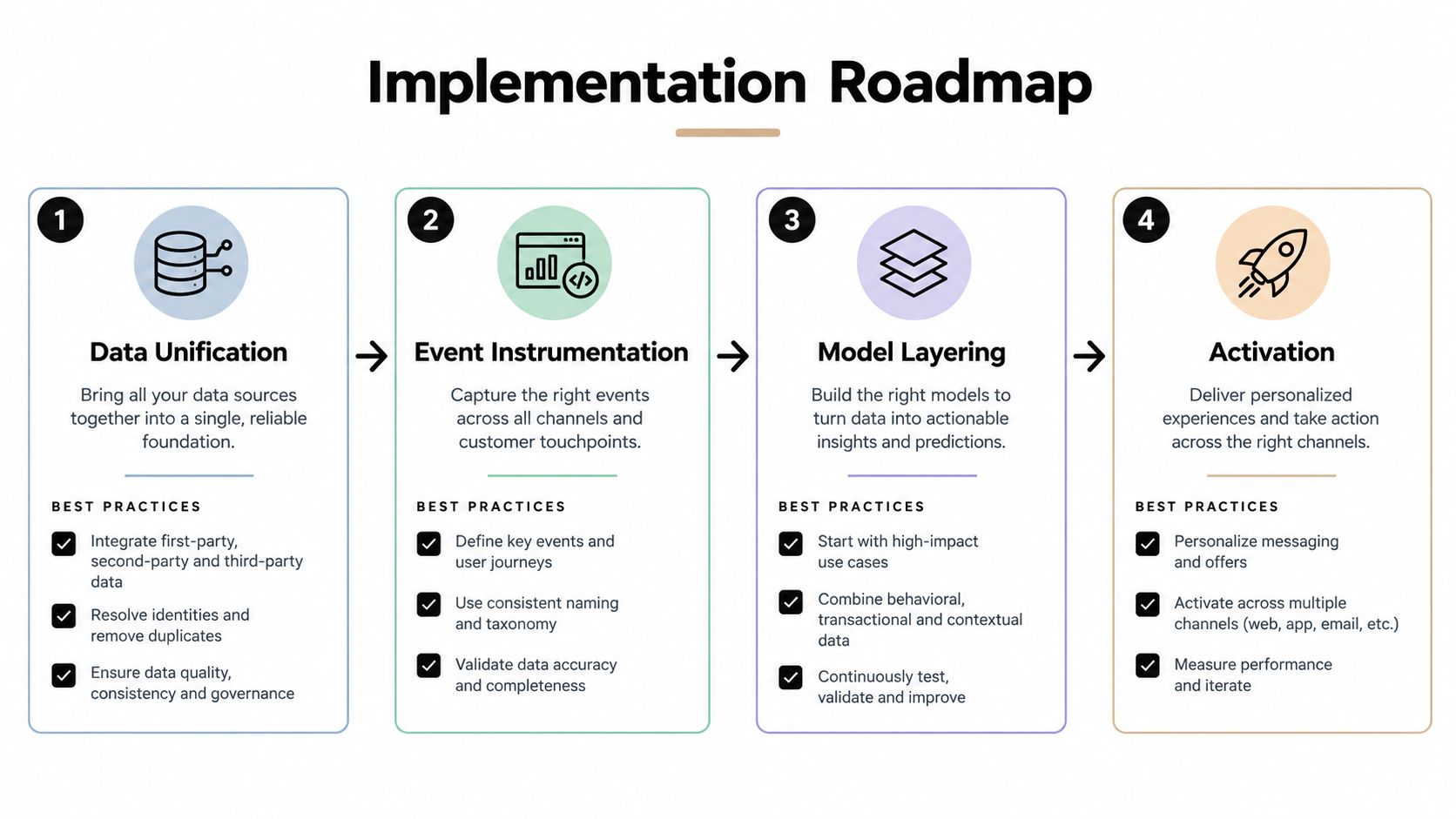
Implementation Roadmap and Best Practices
A sensible implementation starts with one valuable journey, not every channel at once. The first goal is to make one decision better and measure it accurately.
Phase one, unify the customer view
Bring together the first-party records needed for one journey. Resolve user and account identities, document consent status, define ownership, and agree on the events that matter. Remove duplicate fields and decide which system is authoritative for plan, lifecycle stage, and customer status.
Checklist
- Choose one journey: Select onboarding, expansion, or churn-risk messaging.
- Define the outcome: Name the business behavior that signals success.
- Audit permissions: Record what data can be used and for which purpose.
- Set data ownership: Assign a person to fix broken or ambiguous fields.
Phase two, instrument behavior
Create an event taxonomy that product, marketing, sales, and analytics can understand. Track meaningful actions rather than every hover and page load. Confirm that events arrive with the correct user, account, timestamp, and context.
At this stage, a simple rule may be enough. If a user completes setup but doesn't use the core feature, show a relevant guide. You don't need a model until the decision has enough variation and data to justify one.
Phase three, add scoring and decisioning
Layer in model scoring only after the underlying signals are trustworthy. Start with one prediction or ranking task, such as identifying the next best onboarding action. Keep eligibility rules separate from model output so the team can inspect and override decisions.
Run a holdout group whenever the journey allows it. Compare activation, retention, expansion, or another durable outcome. A click may indicate curiosity, but it doesn't prove that the experience created business value.
Phase four, activate consistently
Connect the decision to one channel first. Then add other channels only when you can define priority and suppression rules. A customer shouldn't receive three versions of the same intervention because email, in-app messaging, and sales automation each act independently.
A practical first-90-days sequence might look like this:
- Early period: Choose the journey, map data, define consent, and establish the success metric.
- Middle period: Instrument events, validate identity matching, and launch a rules-based experience.
- Final period: Add scoring if justified, test against a holdout, review edge cases, and document channel controls.
Keep a human review loop while the system learns. A marketer, product manager, or customer success lead should inspect recommendations, unusual outputs, and complaints before automation expands. Your marketing automation best practices should include suppression, frequency limits, fallback content, and a clear way to stop an experience.
Privacy belongs in the design, not in the final approval step. Explain the value of personalization, minimize collection, respect consent, and avoid using sensitive context merely because it is technically available. Trust is part of the product experience.
Common Pitfalls and When Simpler Wins
More personalization isn't automatically better. A system can become so eager to react that customers receive contradictory messages, overly specific recommendations, or an offer that exposes how closely the company is watching them.
The main failure modes are operational as much as technical:
- Over-automation: A model removes human judgment from a high-stakes sales or support moment.
- Creepiness: The brand uses a signal the customer never expected it to use.
- Fragmentation: Each channel optimizes independently and creates a disjointed journey.
- Weak economics: The infrastructure costs more to run than the measured improvement is worth.
Trust and control are decisive. Twilio's global survey of 7,640 consumers and 637 business leaders found that AI alone isn't enough and placed trust at the center of customer engagement across 18 countries. Twilio's 2025 research announcement supports a restrained approach.
Simple segmentation often wins when your dataset is small, traffic is limited, the journey has few decision points, or the sales cycle depends on human judgment. B2B buyers may value a knowledgeable person who understands their account more than a perfectly timed automated prompt.
The return also varies by sector and maturity. BCG's 2025 personalization analysis surveyed brands and used mystery shopping to examine differences in personalization maturity, reinforcing that results aren't universal. Start with the least complex system that can answer your business question.
Key Takeaways for Getting Started
Hyper-personalization is individual, real-time, AI-assisted decisioning for content, offers, and timing, powered by behavioral and contextual signals.
Start this week by choosing one high-value journey, such as onboarding or expansion. Unify the first-party data that feeds it, define the meaningful outcome, and run a targeted experience against a holdout group. If the data is incomplete, begin with transparent rules rather than pretending a model can compensate for unreliable inputs.
Revisit a larger investment only after you can show that the experience improves a durable business metric and operates consistently across the channels involved. If segmentation produces the same result with less cost and less privacy risk, keep segmentation.
Consent, restraint, and control aren't compliance chores added after growth work. They help customers understand the experience and give them a reason to trust your product. Build that foundation first, then let better data and better decisioning earn the right to become more advanced.
SubmitMySaas helps SaaS founders and makers launch their products through daily features, trending lists, and curated roundups that put new tools in front of relevant audiences. Visit SubmitMySaas to submit your product, improve discovery, and build the visibility that gives your personalization strategy more qualified journeys to work with.