By Outrank
SEO High Quality Backlinks: How to Earn Links That Last
Learn how to earn SEO high quality backlinks with linkable assets, outreach templates, link quality checks and launch directories, and keep them over time.
On this page
The most popular backlink advice is still "get links from high domain rating sites, and get a lot of them." That advice fails SaaS founders in a predictable way. A high score doesn't tell you whether an editor chose the link, whether money changed hands, or whether the URL will exist next year.
I judge SEO high quality backlinks by three things: editorial intent, disclosure, and durability. A link inside a relevant paragraph, placed because the page helps the reader, beats a footer on a famous domain. A sponsored launch can still be worth paying for if it sends visitors. It isn't an authority signal unless the relationship is qualified. A link that dies after a redesign never belonged in the win column.
Judging Whether a Backlink Is Worth Earning
A high domain rating link can still be worthless. The test that matters is whether the linking page would still make sense to a real reader if search engines didn't exist. If the page only exists to host outbound links, you're looking at a placement, not a citation.
Domain rating and raw counts miss intent. A project management tool earns more from a productivity blog than from an unrelated niche site with a prettier score. One hundred links from a single domain also don't match the breadth of links from one hundred independent sites.
Google's spam policies judge links by whether they exist mainly to manipulate rankings. Buying or selling ranking links, excessive reciprocal linking, automated link services, low-quality directories, and widely distributed template links are named as manipulative practices. Sponsored placements, paid reviews, and links received in exchange for a product should use rel="sponsored" or rel="nofollow" when they aren't meant to pass ranking credit. Vary the anchor text. Don't hammer one commercial keyword.
What to inspect on the page
| Check | Strong signal | Red flag |
|---|---|---|
| Topical relevance | Page covers your SaaS category or a closely related topic | Page covers an unrelated niche with no shared audience |
| Editorial context | Link sits inside a paragraph that references your product or resource | Link sits in a sidebar, footer or template on every page |
| Indexation and crawlability | Linking page is indexed and the link is a plain HTML anchor | Page is not indexed or the link depends on scripts to appear |
| Real audience | Visitors come from your target market and return | Traffic is negligible or clearly artificial |
| Outbound links | Few outbound links, all relevant to the topic | Dozens of unrelated outbound links on one page |
| Disclosure | Paid or sponsored placements use rel=sponsored or nofollow | Paid link passes ranking credit with no qualification |
Practical rule: If you wouldn't send a customer to that page, don't ask it to vouch for your product.
When a suspicious link appears, don't disavow the whole profile. Prioritize recent or high-volume sources, ask for removal or a qualifying attribute, and disavow only links that break policy and can't be removed. Score your three most likely targets against the table before you spend an hour on outreach. Drop anything that fails relevance or disclosure.
Building a Linkable Asset Writers Want to Cite
Writers cite explanations far more often than they cite pricing pages. In 2025, 68% of surveyed marketers focused on earning backlinks to blog content, compared with 41% who prioritized product or commercial pages, according to Citation Labs' reporting of a BuzzStream survey. A product URL asks for a recommendation. A resource gives the writer a fact they can stand behind.

These four assets earn citations for SaaS, in the order writers reach for them.
- Original usage data: Pull a figure from your own product that isn't public anywhere else. Say how many teams create workflows per week, split by company size. Segment it. A single blended average is easy to ignore.
- A benchmark with a method: State who was measured, over what period, and what you excluded. Editors trust a boring methodology more than a dramatic headline.
- An integration guide: Document how your product connects to a tool people already write about. Other writers can point readers at your steps instead of rewriting them.
- A technical study: A load test or a comparison of export speeds gives engineers a number they can quote. Keep the setup short enough that a reviewer can repeat the logic.
The test is one number or finding nobody else has published. If three other posts already carry the same figure, you don't have a citation. I would ship one strong asset per quarter rather than five thin posts. Publish the raw table next to the write-up so a skeptical editor can check the claim without emailing you.
Outreach Steps and Templates That Get Replies
A good outreach email earns attention by identifying a specific gap on a specific page. If the pitch could be sent unchanged to dozens of sites, it is too generic.
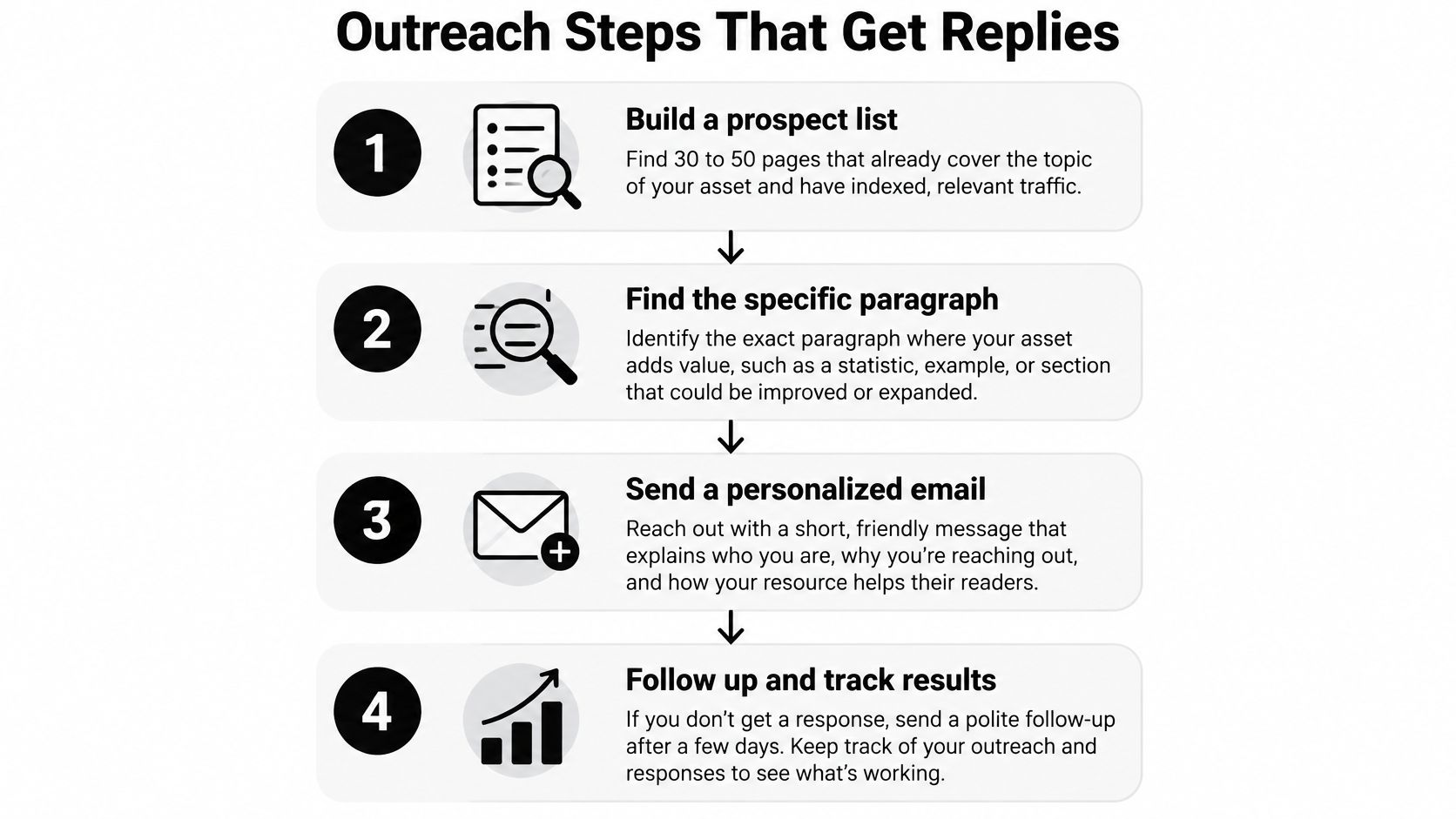
- Build a list of 30 to 50 pages that cover your asset's topic, rank for related queries, and are indexed. Exclude sites that fail your quality checks.
- Find the paragraph where your asset fills a factual gap or replaces an outdated number. Save the page URL and the relevant sentence.
- Write a first email of four or five sentences. Name the paragraph, explain the gap, link the asset, and offer one detail the writer can reuse.
- Follow up once after five to seven days. Add a new data point rather than sending a generic reminder.
- Record replies and live links, including each anchor and destination.
- Recheck links after 60 to 90 days. Track whether they remain live.
The walkthrough below shows how to shape a focused pitch before writing your own.
The four-part email
Write the first email in your own words. Open with the exact paragraph and its URL. State the factual gap in the prospect's terms, then link your asset, give its headline number, and point to the raw data. Close by offering one specific detail they can reuse.
Keep the follow-up brief. Add a new data point and explain what changed since your first email. If you have nothing new to offer, stop.
In one documented campaign, 515 outreach emails produced 36 backlinks from 32 websites, and 27 contacted websites linked to the asset, according to an Ahrefs link building case study. Treat these counts as a benchmark, not a promise. Track unique referring domains alongside total links, and check that each link uses a descriptive anchor and points to a useful destination. Confirm it is a normal <a href> in crawlable HTML. Keyword-stuffed anchors are a warning. Paid ranking links, automated link creation, and template footers create cleanup risk.
| Metric | Benchmark | What it tells you |
|---|---|---|
| Emails sent | 515 | Campaign outreach volume |
| Backlinks earned | 36 | Links earned across the campaign |
| Websites that linked | 32 | Unique sites linking to the asset |
| Contacted websites linking to asset | 27 | Sites that cited the asset after outreach |
| Links live after 60 to 90 days | Check each link | Whether the links remained live |
Unlinked Mentions and PR Tactics That Earn Links
A mention without a link can be more useful than a weak backlink. Judge the opportunity by editorial intent, disclosure and whether the page is likely to remain useful, not by domain rating alone.
Start with pages that already name your product or category. Check whether a link would help readers reach a relevant source, then ask the publisher to add one. A product mention on a trusted page is a stronger prospect than an unrelated site offering a link.
Expert commentary works when it gives a journalist a specific, supportable point to quote. Provide the evidence and a relevant source page. If the article publishes your quote without a link, it can still help readers understand and find your brand.
Technical citations are harder to earn. Look for developer documentation, integration galleries and API references where a link would help engineers complete a task. A useful setup guide is more likely to stay relevant than a passing mention.
Recent Ahrefs research suggests total backlink counts correlate less with rankings than they once did, while branded web mentions correlate more strongly with AI Overview visibility. These are correlations, not evidence that mentions cause visibility or rankings.
A relevant editorial link can support competitive and informational queries. A trusted unlinked mention may be more useful when the goal is to shape how AI answers describe a brand.
Track both outcomes. Record the date found, page URL, whether the mention is linked, branded search volume that week and referral sessions from the page. Review the figures quarterly. More mentions without referral visits may indicate the pages are not sending readers; more links without a rise in branded searches may indicate little change in brand demand.
Launch Directories and Sponsored Placements Worth Trusting
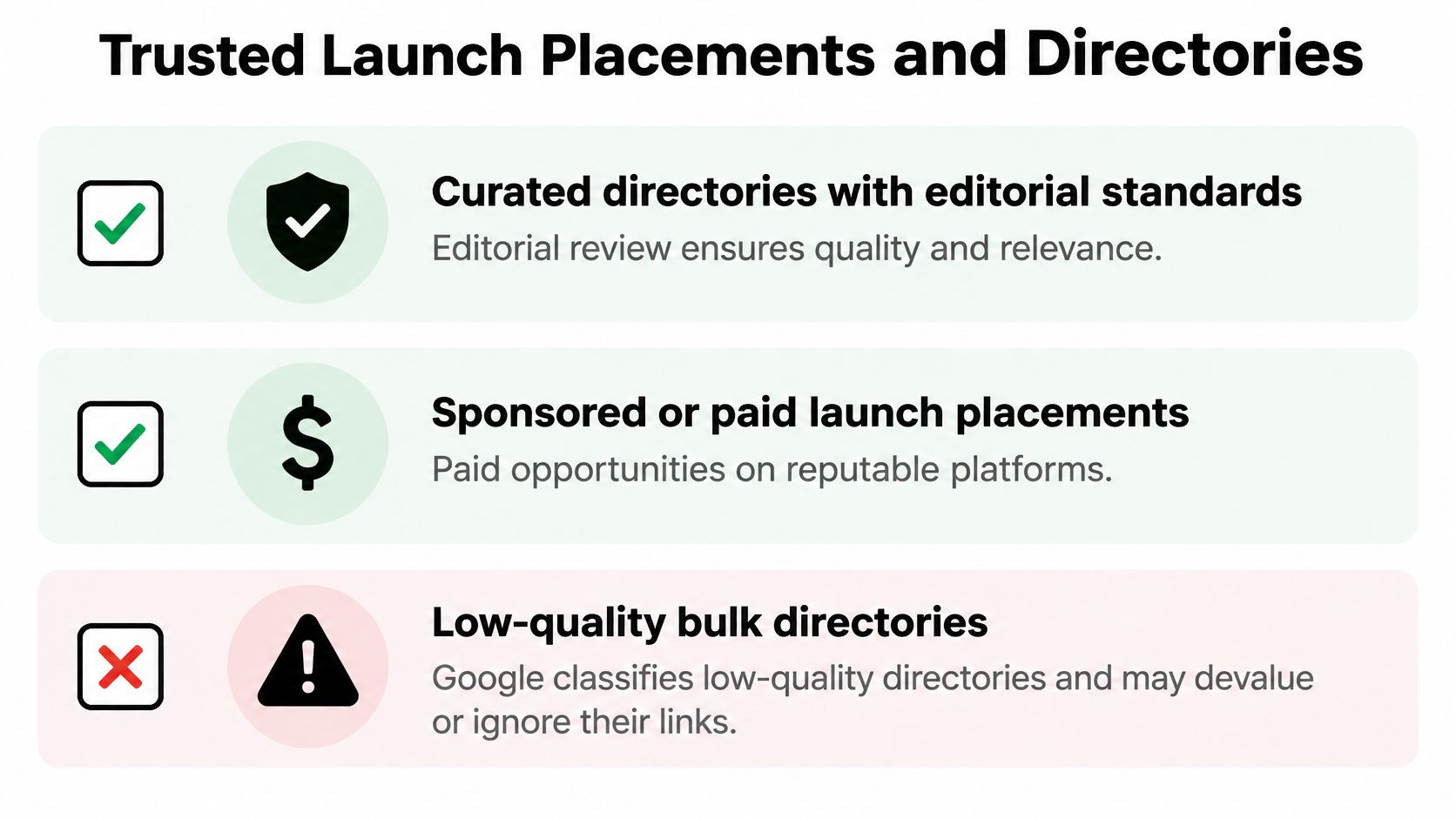
Bulk directories are a waste of time. A thin listing that accepts nearly everything, then sprays template links, is the pattern Google's outbound link guidance treats as spam when the intent is to manipulate rankings. That includes buying coverage, exchanging links, or handing over a product in return for a ranking link. If systems strip the effect of those links, the ranking benefit is gone, and waiting doesn't bring it back.
A curated directory is a different object. It earns a submission when someone reviews the product, publishes a real description, and the listing can send people who might use the tool. Judge that link on relevance, the same way you'd judge a blog citation.
A sponsored launch can be worth the fee when the goal is discovery and referral traffic. Google's qualification guidance says paid placements should use rel="sponsored" or rel="nofollow", and user-generated links should use rel="ugc" or rel="nofollow". Don't describe that URL as an organic authority signal. In 2025, the average acceptable price for a high-quality backlink was $508.95, based on a survey of 518 SEO professionals conducted by Editorial.link and reported by Rocking Web. A launch fee has to be justified by visitors you can measure, not by the link alone.
Before you submit, answer six questions. Does the site curate? Is the listing page substantive? Does the link disclose its relationship? Does it bring real visitors? Will it stay live? Would the listing make sense if the link weren't there? We aren't responsible for the content, policies, or practices of third-party websites, including the projects those sites feature, so a shiny neighbor doesn't make a bad listing safe.
| Listing type | Editorial standard | Link treatment | Worth it when |
|---|---|---|---|
| Curated directory | Reviews submissions and publishes a substantive listing | Editorial link judged on relevance | It sends visitors who might use the product |
| Sponsored launch placement | Paid placement sold by the platform | Must carry rel=sponsored or nofollow | The goal is discovery and referral traffic, not ranking |
| Low-quality bulk directory | Accepts nearly everything with a thin listing | Templated or reciprocal links, often unqualified | Never, because Google classes these as link spam |
Monitoring Links So They Last
A backlink only retains value while its page and destination remain useful. An Ahrefs study of 2,062,173 websites found that 66.5% of links pointing to those sites since January 2013 were dead by 2022. A further 6.45% returned temporary errors. Publishers redesign sites, remove pages, change URLs, and drop external references. Product rebrands and site migrations can break links from your side, too.
Track each backlink in one sheet: linking URL, anchor text, destination page, and referring domain. Add the link's status and the date you last checked it. That record makes it easier to spot whether a link disappeared, moved, or now points to an irrelevant page.
The monthly pass
Check referring domains monthly. For a lost link, confirm whether the source page still exists. If your destination changed, restore the old page or redirect its URL to the closest relevant replacement. Review unfamiliar new links before treating them as a win.
Paid links need appropriate qualification. Ask the publisher to use nofollow or sponsored; if they refuse, request removal rather than counting the placement as an ordinary editorial link.
| Task | Frequency | Action when triggered |
|---|---|---|
| Check referring domains | Monthly | Record lost links and changed source URLs |
| Verify destination pages | Monthly | Restore the page or redirect the old URL |
| Review new suspicious links | Monthly | Request removal or qualification |
| Disavow policy-breaking links | Only when needed | Use only for links you cannot remove |
| Measure link results | Quarterly | Track indexed referring pages, referral visits, live links, and rankings |
Each quarter, compare indexed referring pages, referral visits, surviving links, and rankings for the linked page. A growing link count alongside flat referrals and broken URLs can signal that you are accumulating links without maintaining their usefulness.
Start Your First Quality Link Sprint This Week
Run one month, not a vague "link building initiative."
Week one: Score three to five likely targets with the quality checks. Drop any that fail relevance or disclosure.
Week two: Pick one asset that contains a number nobody else has published. Make the method and the raw data obvious on the page.
Week three: Email 30 to 50 relevant prospects with the four-part note. Log every reply and every live URL.
Week four: Submit to one curated directory or launch platform. Pursue a sponsored placement only if you can disclose it and measure the referral traffic. Then put the monthly check on the calendar.
A launch tier has to pass the same test. On our platform, a Free Launch gets a dofollow backlink only if the product ranks in the top 3 weekly and displays our badge, which is a reciprocal arrangement, not a free pass. Premium Launch includes a guaranteed high authority dofollow backlink, skip-the-free-queue priority, priority weekly placement, and homepage placement. Verify the current tier terms before you buy, because they change. Any paid tier that promises a dofollow link is a disclosure risk under Google's guidance, not a ranking guarantee. Treat it as a sponsored placement unless an editor earned the link on the merits. I would take the placement for visitors only after the week-one score says the page is relevant and the relationship will be qualified.
SubmitMySaas is a launch and discovery platform where makers submit a product for visibility, feedback, and a high-authority backlink, with free and premium options you can weigh against the same editorial and disclosure checks in this guide. If you're shipping a SaaS, AI, or productivity tool and want a curated place in front of early users, start with the quality test, then see current launch options on SubmitMySaas. Pick the tier only if the listing would still be worth it for the visitors, not for the link alone.