7 SaaS Product Launch Examples to Learn From
Study 7 saas product launch examples with timelines, tactics, metrics, lessons, and repeatable playbooks for founders and SaaS teams.
Most advice about saas product launch examples treats launch as a single event, usually a Product Hunt ranking, a social announcement, or a spike in website traffic. That framing hides the harder work. A launch has to connect preparation, positioning, distribution, conversion, measurable traction, and follow-through. A platform can produce attention without activation, while a smaller channel can produce fewer visits but better-qualified opportunities.
The seven sources below are more useful when read as evidence rather than as success stories. Each exposes a different part of the system, from channel-native execution and founder metrics to landing-page assets, launch sequencing, and post-launch discovery. The strongest sources provide concrete tactics, available performance data, lessons learned, and a playbook a founder could adapt. Good visual preparation still matters, especially for funded teams working under launch pressure, as this SaaS launch design checklist makes clear.
SubmitMySaas belongs in that mix as a targeted discovery and SEO amplification channel. Its model combines daily launches, trending lists, monthly roundups, badges, and backlink options for SaaS and adjacent technology products. The question isn't whether one platform can replace a launch strategy. The better question is which evidence each channel gives you, and how the pieces work together.
1. SubmitMySaas
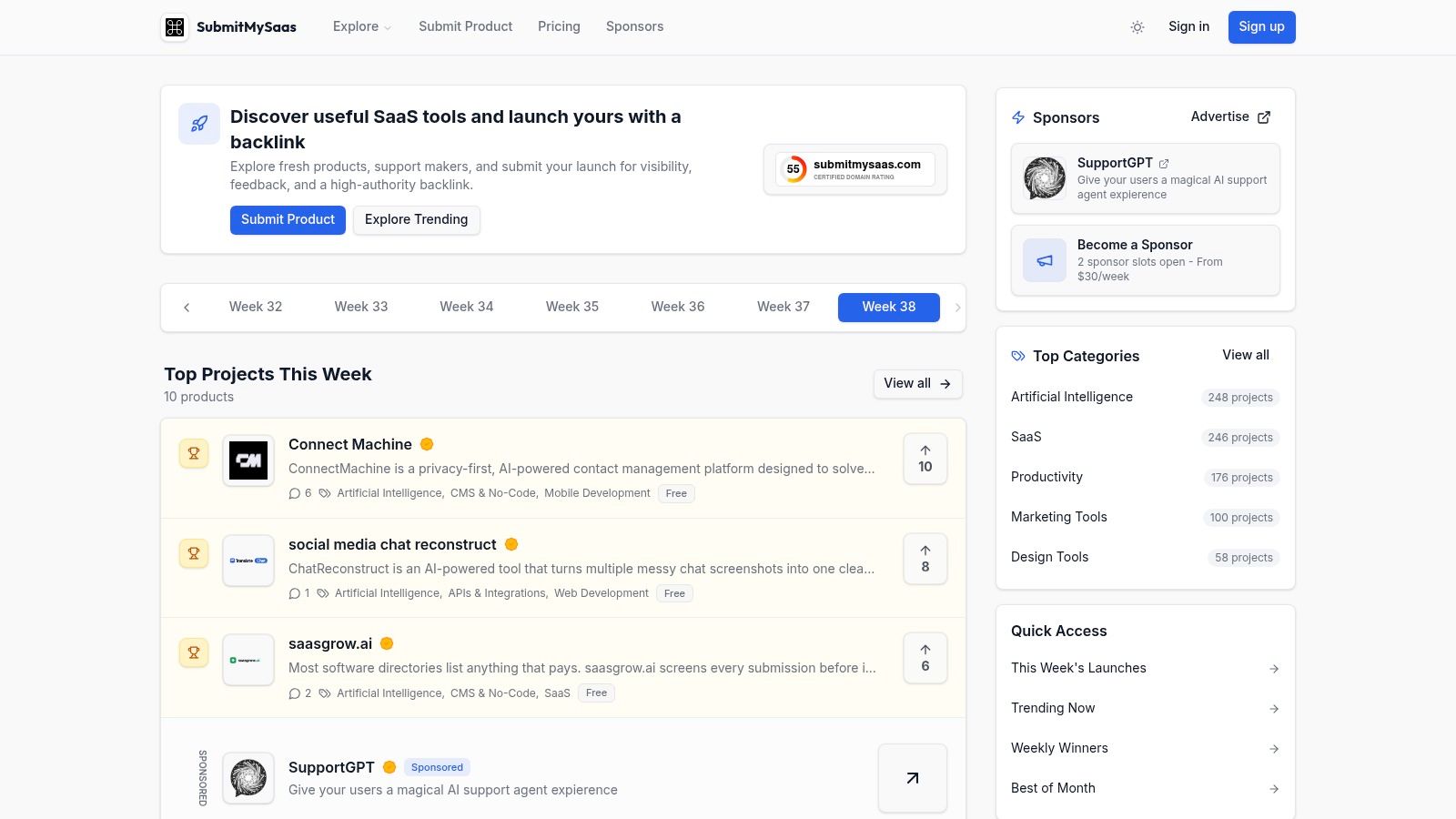
SubmitMySaas is the most focused source in this list because it puts SaaS, AI, productivity, marketing, and design tools in front of an audience already looking for new products. Founders can submit a project for a daily launch, pursue visibility through trending lists, and remain discoverable through monthly best-product roundups. That creates more than one release-day opportunity. It gives a product several possible discovery moments after the initial submission.
The platform also surfaces practical information buyers need before they click through, including product categories, key features, pricing, and social links. Editorial highlights and clear navigation help visitors compare tools without forcing them to interpret a generic directory page. The supplied publisher information describes an active catalog with hundreds of listings across major categories, including roughly 200 or more projects in both AI and SaaS. Those category figures are presented by the publisher, not as an independently audited audience or conversion benchmark.
The prominent launch package combines a branded badge with 35+ high-DR backlinks, according to the supplied publisher information. That makes the offer relevant to teams treating launch as both distribution and search-engine visibility. The platform also lists paid promotional options, including $79 per product for a month of advertising and sponsor slots starting at approximately $30 per week, as stated in the supplied product notes. A standard Monday launch option is described as available at $0 per launch, subject to placement availability.
What the evidence supports
SubmitMySaas offers a practical way to extend discovery beyond a single announcement. Its daily and recurring placements can support a product page that continues attracting relevant visitors, while the badge and backlink package can add credibility and SEO assets to the launch campaign. The platform's own SaaS product launch strategy guide also supplies a sample multi-channel launch-day timeline, which makes the listing more useful when it sits inside a broader campaign.
The trade-off is measurement transparency. Exact performance metrics aren't fully visible on every listing page, and editorial curation or sponsor placement isn't automatically guaranteed. Teams should therefore treat the platform as a targeted discovery and amplification layer, then measure it with tagged links, trial starts, activation events, demo requests, and qualified pipeline.
Practical rule: Use SubmitMySaas when you need a focused discovery surface and durable launch assets. Don't mistake placement for proof of product-market fit.
2. Product Hunt
Product Hunt's Launch hub is strongest as a platform-native guide to preparing, running, and extending a public launch. It provides step-by-step playbooks, checklists, a glossary, and links to launch case studies connected to products that earned Product of the Day, Week, or Month recognition. That makes it particularly useful for founders who need to understand the mechanics of a high-visibility, community-driven release rather than inventing a launch-day process from scratch.
The evidence is also intentionally channel-specific. Product Hunt shows how makers should work inside its own ecosystem, including preparation, launch-day participation, and post-launch community growth. The examples can help a team understand what a launch page needs, how platform conventions shape attention, and why founder participation matters after publication.
The limitation is equally clear. Product Hunt's hub can't tell you whether the same messaging will work in a niche B2B community, through founder-led outbound, or in a search-led acquisition strategy. Depth also varies across the linked examples, so readers shouldn't assume every featured launch includes complete acquisition, activation, or revenue data.
What founders can reproduce
Use Product Hunt's material to build a platform-specific runbook, then add the parts it doesn't cover:
- Prepare the launch page: Align the product name, tagline, visuals, maker profile, and call to action before launch day.
- Plan founder participation: Reserve time to answer comments, clarify use cases, and collect objections while attention is concentrated.
- Extend the conversation: Turn useful questions and feedback into follow-up content rather than allowing the launch page to become an isolated event.
- Add independent distribution: Pair Product Hunt with email, community outreach, search content, or a focused directory such as Product Hunt alternatives for SaaS launches.
The insight isn't that Product Hunt is universally best. It's that a channel can publish its own operating manual, and founders should extract those mechanics without confusing them with a complete go-to-market plan.
3. Indie Hackers
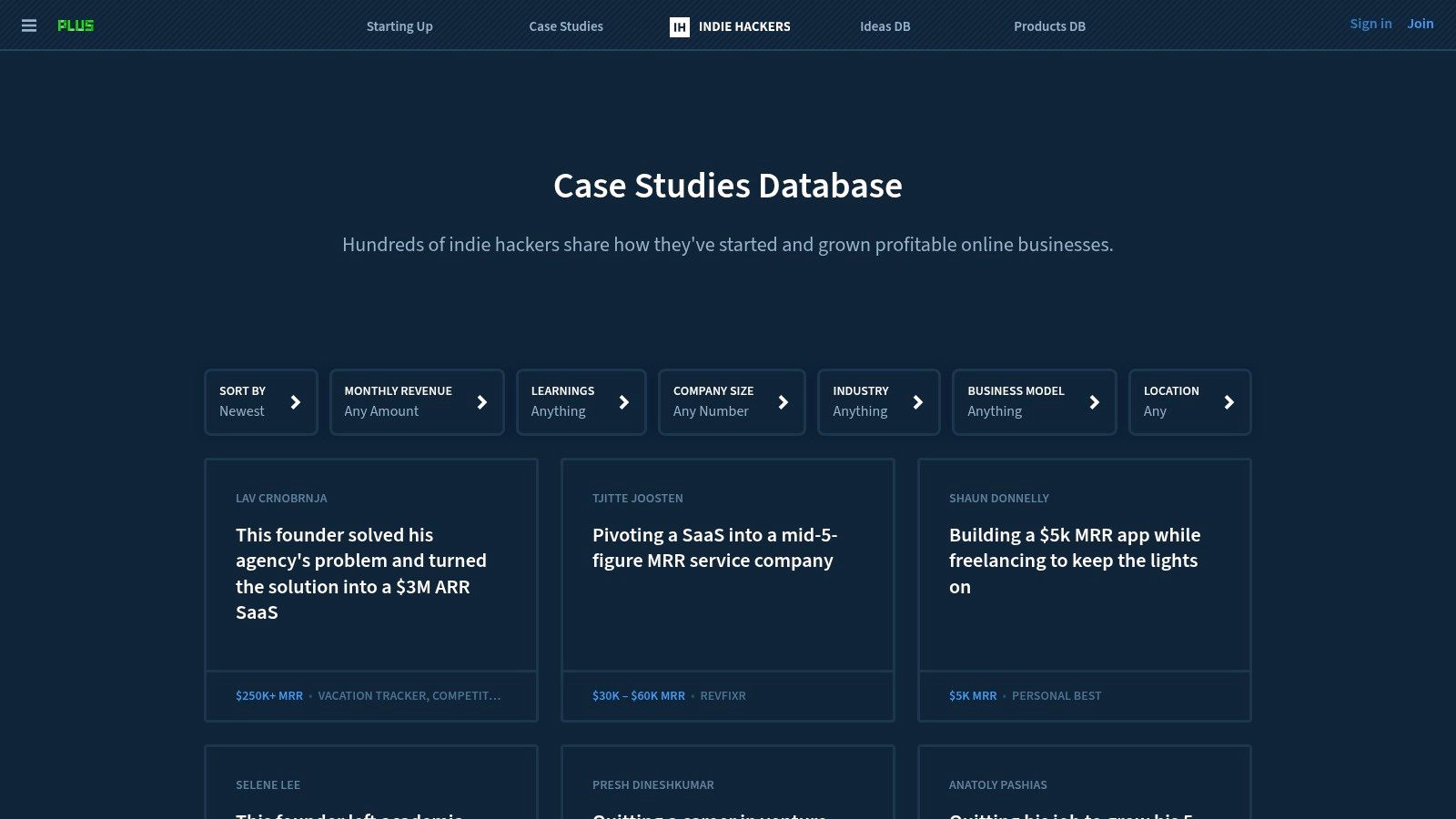
Indie Hackers gives launch research a different kind of evidence. Its founder story archive is built around operator-written accounts, so readers often find the messy sequence behind a product rather than a polished campaign summary. Stories can include signups, MRR snapshots, acquisition channels, experiments, and timelines, although the quality and completeness vary from post to post.
That variation is part of the value. A solo maker's launch constraints look different from those of a venture-backed company, and the archive spans different SaaS categories, customer types, and stages. Comments and questions can add context that the original post leaves out. A founder may explain why a channel failed, how an early offer changed, or which activity produced qualified conversations rather than merely attracting attention.
The weakness is searchability at the precise moment of research. The archive is broad, and it can be difficult to isolate launch-week actions from months of subsequent growth. A reader also needs to separate a documented result from a personal interpretation. One founder's MRR outcome doesn't establish a benchmark for every SaaS business.
Read the story as an operating record
The most useful approach is to extract five fields from each relevant post:
- Audience: Who did the founder target, and what problem did that audience already recognize?
- Offer: What did early users receive, and what commitment did the founder ask for?
- Channel: Where did the first conversations, signups, or customers originate?
- Activation: What behavior indicated that a signup had reached meaningful product value?
- Continuation: What happened after the initial announcement stopped attracting attention?
This method turns build-in-public material into a comparable research set. The build-in-public guide is a useful companion for founders who want to document those decisions while the product is still changing.
Indie Hackers is best for generating hypotheses about founder behavior and channel fit. It isn't a controlled benchmark, and readers shouldn't copy a tactic without checking whether the original product had the same audience, price model, sales motion, or stage.
4. Marketing Examples
Marketing Examples is less useful as a performance database and more useful as a creative production library. Harry Dry's Marketing Examples collection breaks campaigns into short, visual teardowns with screenshots, copy, landing-page structures, pricing presentations, and launch-adjacent tactics. For a team preparing assets, that format reduces the distance between research and execution.
The source is especially valuable when a launch message feels technically accurate but commercially flat. A SaaS founder can compare how real companies frame a problem, present a benefit, structure a landing page, or use proof near a call to action. The examples also cover positioning, email, public relations, and conversion-oriented page design, so they help connect the launch announcement to the destination page.
The trade-off is evidence depth. Not every teardown includes hard performance numbers or a complete sequence from preparation through post-launch growth. Short examples can show what an asset looks like without explaining how the team produced it, distributed it, tested it, or measured downstream revenue.
Turn inspiration into a controlled asset sprint
A useful workflow starts with one documented problem, not a collection of attractive screenshots. Select a relevant teardown, identify the mechanism behind it, and create a version that matches your own buyer and product promise. For example, a team might study how a landing page makes a benefit concrete, then rewrite its hero section around the workflow it removes instead of listing features.
Use the library to produce specific launch components:
- A message hierarchy: Problem, promised outcome, proof, and next action.
- A visual demonstration: A screenshot or short product walkthrough that makes the value legible before a visitor reads every detail.
- A page structure: Headline, use case, product evidence, objection handling, and conversion path.
- A follow-up asset: An email, social post, or customer-facing explanation derived from the same core promise.
The relevant product launch examples can broaden that inspiration beyond one creative library. The key analytical distinction is simple. Marketing Examples helps you decide what to make, but it usually won't tell you whether the asset drove activation or qualified pipeline.
5. Launchpedia
Launchpedia narrows the field to Product Hunt launch case studies from indie founders and SaaS teams. Its Product Hunt case-study collection focuses on the tactics makers used to earn attention, traffic, upvotes, badges, and downstream effects from a Product Hunt launch. That narrow scope makes the source easier to apply than a broad founder archive when your immediate question is how to operate inside Product Hunt.
The interview-style format is valuable because it connects actions to outcomes. Readers can look for outreach patterns, community participation, launch-page decisions, and the founder's explanation of what happened afterward. The case studies can also expose the difference between winning a platform badge and converting that attention into useful product activity.
Its main constraint is channel concentration. Launchpedia provides fewer examples outside Product Hunt, and the archive is smaller than larger publications. A tactic that works for a platform-native audience may not translate to enterprise buyers, a developer community, or a category where prospects don't browse launch sites.
Use it to model sequence, not applause
Read each case study as a timeline. Identify what happened before launch, which people were contacted directly, what the founder did during the live period, and how the team handled the traffic afterward. Then ask whether the documented outcome was visibility, visits, signups, activation, or revenue. Those are different results and shouldn't be treated as interchangeable.
A repeatable outreach model might include:
- Warm participation: Contribute to relevant communities before asking members to inspect a product.
- Specific requests: Ask people to review a use case or provide feedback instead of reducing the launch to a vote request.
- Founder availability: Respond quickly and personally where the case study shows that conversation influenced attention.
- Post-launch capture: Route visitors toward a clear trial, waitlist, demo, or feedback action.
The website promotion guide offers a broader discovery perspective for teams that don't want a Product Hunt-only launch. Launchpedia's best lesson is not that upvotes equal success. It's that channel mechanics, outreach timing, and follow-through need to be studied together.
6. First Round Review
First Round Review's Launching hub offers the most process-heavy material in this group. Its long-form interviews and case studies examine launch strategy, sequencing, messaging, common pitfalls, and operating decisions through the experiences of founders, product marketers, and growth leaders. The stories often cover stealth periods, betas, public releases, and the path toward product-market fit.
That makes the hub useful for teams whose launch has dependencies beyond a public announcement. A complex software product may need internal enablement, customer communication, sales coordination, onboarding preparation, and a clear answer to what changes for existing users. First Round's longer narratives are better suited to turning those decisions into standard operating procedures than to producing a quick list of launch-day posts.
The trade-off is time and metric density. These articles generally provide fewer day-one metrics than founder-written growth diaries, so they may not answer a narrow question about traffic or conversion. They do, however, help explain why a launch sequence was chosen and what teams needed to coordinate before exposing the product to a wider audience.
Extract the process layer
Read First Round case studies for decisions that survive beyond one platform:
- Positioning decisions: Which customer and problem receive priority at launch?
- Sequencing decisions: What happens in stealth, beta, internal preparation, public release, and follow-up?
- Messaging decisions: Which promise appears consistently across product, sales, support, and marketing?
- Readiness decisions: What must work operationally before attention arrives?
- Learning decisions: How does the team turn early objections and behavior into the next iteration?
A launch plan is stronger when it explains what the team will learn, not only where the team will post.
This evidence is particularly useful when founders are tempted to copy a visible launch tactic without copying the underlying preparation. A badge, ranking, or announcement can attract visitors. It can't compensate for unclear positioning, weak onboarding, or an unprepared support process. First Round Review supplies the strategic context that shorter launch stories often omit.
7. Product Case Studies
Product Case Studies is useful for teams that need to connect launch work with product management. Its product case-study catalog includes a dedicated Product Launch and Strategy category, alongside themes such as onboarding, pricing, and product-led growth. That structure lets PM and PMM teams compare a launch decision with the user experience and commercial model that follow it.
The catalog mixes B2B and B2C software examples, which broadens the range of product patterns but also increases the need for filtering. A consumer onboarding lesson may illuminate activation design without translating directly to an enterprise sales cycle. Likewise, a pricing example may help frame a launch offer while remaining unsuitable for a product with a high-touch implementation process.
Depth varies across the collection. Some entries are detailed case studies, while others are shorter summaries that provide an idea or framework without full performance evidence. Not every story includes traffic, conversion, retention, or revenue numbers. Readers should use the catalog to find relevant mechanisms, then verify whether the source documents the result they care about.
Connect launch to the product experience
A launch creates an expectation. Onboarding either confirms that expectation or introduces friction. Pricing either reinforces the promise or makes the original message harder to believe. Product Case Studies is valuable because it encourages teams to review those elements together rather than assigning launch entirely to marketing.
A practical reading sequence is:
- Start with the launch category: Identify the positioning, channel, and sequencing pattern.
- Pair it with onboarding: Look for the first action that moves a new user toward value.
- Review pricing: Check whether the offer matches the audience, product maturity, and buying motion.
- Inspect growth mechanics: Determine whether the product depends on sales, referrals, invitations, or repeated usage.
- Separate evidence from inference: Record what the source documents, then label your own adaptation separately.
This turns a collection of product stories into a cross-functional launch review. It also prevents a common analytical error, treating acquisition as the entire launch while ignoring what happens after the visitor signs up.
7 SaaS Launch Channels Compared
| Tool | Implementation Complexity 🔄 | Resource Requirements ⚡ | Expected Outcomes ⭐ 📊 | Ideal Use Cases 💡 | Key Advantages |
|---|---|---|---|---|---|
| SubmitMySaas | Low–Medium, simple submission flow; paid package for top placement 🔄 | Low to start; paid promo ~$79/mo, sponsors from ~$30/wk ⚡ | Immediate SEO & credibility lift with high‑DR backlinks; targeted early‑adopter traffic ⭐ 📊 | Fast launches for SaaS/AI makers needing discovery + backlinks 💡 | Targeted audience, backlink authority, multiple discovery touchpoints |
| Product Hunt | Medium, requires launch prep and community coordination 🔄 | Time and outreach effort; platform free to use ⚡ | High day‑of visibility and potential viral traction; platform signals ⭐ 📊 | Platform‑native launches aiming for broad Product Hunt audience 💡 | Large audience, official playbooks and case studies |
| Indie Hackers | Low, read/engage or publish candid write‑ups 🔄 | Low time cost; no monetary fee ⚡ | Transparent metrics and long‑tail learnings from founders ⭐ 📊 | Solo makers and lean teams seeking practical, revenue‑backed stories 💡 | Candid numbers, diverse real‑world tactics |
| Marketing Examples | Low, quick teardowns for inspiration and asset creation 🔄 | Low time cost; free access ⚡ | Fast idea generation and ready‑to‑adapt copy/landing patterns ⭐ 📊 | Creative sprints to build landing pages, copy, and PR assets 💡 | Highly actionable teardowns, scannable format for teams |
| Launchpedia | Low–Medium, curated Product Hunt case studies; easy to consume 🔄 | Low time cost; free access ⚡ | Channel‑specific tactics for earning upvotes, traffic, badges ⭐ 📊 | Teams focusing specifically on Product Hunt performance 💡 | Deep Product Hunt focus with repeatable outreach tactics |
| First Round Review (Launching hub) | High, long‑form, process‑level guidance; needs time to implement 🔄 | Higher time investment; strategic leadership involvement ⚡ | Durable, principle‑driven strategies and SOPs for complex launches ⭐ 📊 | Venture‑backed or complex launches needing operator‑grade playbooks 💡 | Deep narratives, credible expert sources, tactical depth |
| Product Case Studies | Medium, structured examples for PM/PMM workflows 🔄 | Low monetary cost; time to adapt case studies ⚡ | Aligned launch→onboarding→pricing examples across SaaS verticals ⭐ 📊 | PM/PMM teams aligning launch work with product and growth ops 💡 | One‑stop index for launch stories, sortable by theme |
Turn Case Studies Into a Launch Playbook
These sources point to a sequence rather than a universal winning channel. Start by defining the audience and the launch promise. A founder should be able to state who the product serves, which painful workflow it addresses, and what a visitor should do next. The Product Hunt and Launchpedia material can help with platform-native execution, while Indie Hackers and First Round Review provide more context about founder behavior, sequencing, and operating constraints.
Prepare the landing page and supporting assets before distribution begins. Marketing Examples is useful for studying message hierarchy, copy, screenshots, pricing presentation, and conversion structure. Product Case Studies adds the product-management perspective, especially the relationship between launch messaging, onboarding, pricing, and growth. If visual assets are weak, even a well-targeted channel can send visitors to a page that doesn't explain the product quickly enough.
Choose one primary distribution channel based on audience fit, then add complementary discovery rather than spreading effort indiscriminately. Product Hunt can provide a platform-native event. Founder-led outreach and community participation can add context and trust. SubmitMySaas can extend discovery through curated listings, daily launches, trending placements, monthly roundups, and SEO-oriented badge and backlink options.
A concise evidence-aware sequence
- Define: Record the target buyer, problem, promise, and conversion action.
- Prepare: Build the landing page, product demo, launch visuals, onboarding path, and support process.
- Distribute: Select a primary channel where the intended audience already pays attention.
- Participate: Have founders and operators answer questions, gather objections, and contribute to relevant communities.
- Measure: Track visits, trials, activated accounts, demos, opportunities, paid conversion, and retention when those events are available.
- Extend: Repurpose useful questions, customer proof, feedback, and launch assets across discovery channels after release.
Keep documented evidence separate from assumptions. A source may document traffic but not activation, or a Product Hunt badge but not revenue. Don't copy platform tactics without matching the original product's audience, stage, sales motion, and onboarding experience. A high-visibility launch can still fail to create durable demand, and infrastructure readiness matters because sudden attention can expose weaknesses in load handling, autoscaling, monitoring, and support.
The supplied launch research illustrates why downstream measurement matters. One B2B SaaS case study recorded 4,900 targeted page visits, 412 trial signups, 163 activated accounts, 38 qualified demo requests, and 11 CRM opportunities in its first 30 days, with the source reporting approximately 8.4% visitor-to-trial and 3.3% visitor-to-activation conversion in the case study. A separate SaaS launch study reported 31% trial-to-paid conversion, $67 CAC, 2.8% monthly churn by month 3, and 84% gross margin, alongside its cited B2B benchmarks in its 90-day launch study. These are individual case-study outcomes, not promises.
The broader context is severe. One launch summary reports that about 75% of launches miss their targets, while another industry summary places overall new-product launch failure at roughly 90% in its launch-statistics review. A SaaS-focused summary reports that around 92% of SaaS startups die within three years, with about 45% of failures occurring during the 18-to-24-month period after launch, while also contrasting top-tier and average ARR timelines in its 2026 SaaS launch report. The lesson is not to chase a dramatic launch day. It's to build a measurement and learning loop that survives it.
SubmitMySaas gives SaaS, AI, productivity, marketing, and design teams a focused place to submit new products for daily launches, trending visibility, and monthly roundups. If you want to add targeted discovery, a launch badge, and the supplied 35+ high-DR backlink option to a broader launch mix, visit SubmitMySaas and submit your product for consideration.