10 SaaS Marketing Trends to Watch in 2026
Explore 10 saas marketing trends shaping 2026, with practical tactics, examples, trade-offs, and metrics for SaaS founders and marketing teams.

The Next SaaS Growth Advantage Is Distribution Discipline
The most popular advice about SaaS marketing trends keeps making the same mistake. It treats every new channel as if it deserves budget by default. It doesn't. A tactic only matters if it solves your current growth constraint, fits your product stage, and gives your team feedback quickly enough to improve execution before you run out of time or budget.
That matters more now because SaaS isn't operating in a loose-spend era anymore. The broader market was valued at about $315.68 billion in 2025 and projected to reach $375.57 billion in 2026, on the way to $1.48 trillion by 2034, while private B2B SaaS companies were reported to spend a median of about 8% of ARR on marketing. Bigger market, tighter budget discipline. That combination changes how smart teams pick channels.
The signal underneath many current SaaS marketing trends is simple. Teams need a portfolio, not a fad. Launch visibility helps a product get discovered. Search authority compounds over time. Product-led conversion turns interest into usage. Community, partnerships, and targeted demand generation help fill the gaps that pure inbound can't cover.
This roundup evaluates each trend through a practical lens: what problem it solves, who it fits, what evidence you should gather before scaling it, and where it breaks down. Founders, indie makers, and SaaS teams don't need more channel hype. They need a path from launch traction to durable acquisition and retention.
1. Product Launch Communities and Discovery Platforms
Launch communities are often overrated as growth channels and underrated as research channels. Their real value is speed. If your constraint is low awareness and weak message clarity, a concentrated burst of attention can produce sharper feedback in days than slower channels produce in months.

This trend fits launch-stage SaaS, indie products, and teams entering a category where buyers do not yet recognize the product by name. It is less suited to companies that already have a defined ICP and need repeatable pipeline. For those teams, launch platforms can still support visibility, initial link acquisition, and partner discovery, but they should sit inside a broader portfolio. If you are comparing distribution options beyond Product Hunt, this guide to Product Hunt alternatives is a useful reference.
The key question is not whether a launch gets attention. It is whether that attention helps resolve a growth constraint. Early on, that usually means one of three things: testing positioning, identifying which audience segments respond, or generating enough credible interest to support later channels such as SEO, partnerships, and product-led conversion.
What to prove before scaling
Measure launch platforms by downstream evidence, not by upvotes or comments alone. Useful signals include trial starts, waitlist joins, demo requests, founder interviews, activation events, and backlinks from sites that discovered you through the launch. SubmitMySaas, for example, notes that one launch package includes a badge and 35+ DR backlinks. That matters only if those links index, refer relevant visitors, or strengthen pages you plan to rank later.
The trade-off is concentration. Launch communities compress exposure into a short window, so weak positioning gets exposed quickly. A vague headline, thin social proof, or slow response in comments can reduce the value of the entire push.
A practical operating model is simple. Run one or two launches, document referral quality by source, compare activation rates against your baseline traffic, and review whether signups convert into retained users or meaningful sales conversations. If post-launch users bounce, the problem is usually not distribution. It is offer clarity, onboarding, or audience mismatch.
Use launch platforms early, while fast feedback still matters more than scale. Once the product and message are clearer, they work best as part of a portfolio that feeds authority, partnerships, and future demand generation rather than as a standalone acquisition system.
2. Content Marketing Through Product-Focused Case Studies and Demos
Generic thought leadership rarely moves a serious buyer. Product-focused proof does. In practice, that means demos, implementation walkthroughs, use-case pages, and case-study style content that shows how the product fits a real workflow.
A lot of teams get this wrong by publishing content that educates broadly but never bridges into product understanding. Buyers may remember the topic but forget the tool. Product-centric content fixes that by connecting the pain, the workflow, and the outcome in one asset. This is especially useful once you've reached some product clarity and need to help prospects evaluate.
A strong reference point is Notion's template ecosystem and product education loop. Much of its content doesn't separate “marketing” from “using the product.” The best SaaS case studies do the same thing. They shorten the distance between reading and trying.
For teams building that capability, this resource on case study development maps the process well.
Here's a practical example of product-led video structure:
Where this trend fits
This trend solves an evaluation constraint. Your audience knows the problem exists, but they don't yet trust your solution. It fits growth-stage SaaS, sales-assisted products, and any team with a nontrivial onboarding step.
Monitor signals such as demo completion, assisted conversion paths, sales call influence, and whether prospects reference the asset in conversations. The trade-off is production intensity. Product-focused case studies need real customer detail, product screenshots, and regular updates. Without that, they become polished brochures instead of buying tools.
3. Community-Driven Marketing and User-Generated Content
Community isn't a growth shortcut. It's a retention and trust system that can become an acquisition channel later. Teams often launch a Slack or Discord too early, then wonder why nobody talks. Community only works when members have something useful to exchange: templates, workflows, feedback, job-to-be-done knowledge, or status.

Figma is a good example because its community behavior maps directly to product value. Designers don't just discuss Figma. They create files, share systems, and teach each other. That makes the community useful before it becomes promotional. Notion's template culture works for a similar reason.
The right stage here is post-launch, once you've identified a repeatable use case and a group of users who care enough to contribute. If you're still looking for your first clear audience, build audience conversations first. Don't build a “community” shell. This guide on how to build an online community is more relevant than generic social advice because it focuses on structure, not just posting frequency.
The operational evidence to look for
You want evidence that users are helping each other and expanding product understanding without your team mediating every interaction.
- Contribution quality: Are members sharing examples, templates, or workflows that others adopt?
- Support deflection: Do common questions get answered by peers before your team steps in?
- Advocacy behavior: Do users naturally recommend the product in public channels or invite teammates?
Community fits products with identity, collaboration, or craft attached to them. It's much harder to force around purely transactional software.
The trade-off is pace. Community compounds slowly. If you need immediate pipeline next quarter, pair community with a faster-feedback channel instead of expecting it to carry acquisition alone.
4. AI-Powered Personalization and Dynamic Content Optimization
Personalization is useful when your problem isn't traffic but message mismatch. Different visitors arrive with different intent, role, and urgency. A founder evaluating a tool for a five-person team shouldn't always see the same page experience as an enterprise operations lead.

This trend becomes more relevant as AI-mediated discovery grows. One 2026 industry roundup cited 51% of B2B software buyers and 71% of buyers using AI chatbots for software research. If buyers arrive with more pre-formed opinions and narrower intent, your site and lifecycle messaging need to recognize that context quickly.
How to implement without overcomplicating it
Start with behavioral segmentation, not elaborate machine learning promises. Segment by pricing-page visits, repeat category-page views, feature-interest patterns, or integration-page engagement. Then change one layer at a time: hero copy, CTA wording, customer proof, onboarding path, or email sequence.
For execution discipline, these marketing automation best practices are more useful than jumping straight into vendor features.
A realistic example is Drift-style conversational routing, where chat and page context work together to send visitors toward self-serve signup or a sales conversation. The trade-off is false confidence. If your traffic volume is thin or your data is messy, “personalization” often means random variance dressed up as strategy. Before scaling, prove that segmented experiences map to a real intent difference and that your team can maintain the content.
5. Account-Based Marketing for Enterprise SaaS
Enterprise SaaS teams often adopt ABM too early and too vaguely. The useful question is narrower: what growth constraint justifies the extra coordination cost?
ABM fits when revenue depends on a limited set of accounts, each deal involves several stakeholders, and broad lead generation produces activity without meaningful pipeline movement. In that situation, the problem is not awareness alone. It is account progression. Marketing has to help sales create consensus across security, procurement, technical evaluators, and an executive sponsor.
That makes ABM a stage-specific motion. Self-serve and lower-ACV products usually get more from category education, SEO authority, product-led conversion, and targeted demand capture. Teams moving upmarket face a different bottleneck. They need repeatable ways to identify which accounts resemble past wins, what buying signal matters, and which proof assets reduce risk for each stakeholder.
A practical test helps. If your sales team can already name the account types that close fastest, the objections that stall reviews, and the integrations or compliance requirements that appear in late-stage deals, ABM may be ready for wider use. If those patterns are still anecdotal, scale will amplify guesswork.
Where ABM earns its keep
ABM solves for concentration, not reach. It works best in categories where a relatively small number of accounts can drive a large share of revenue and where generic nurture programs flatten important differences between industries, tech stacks, and buying committees.
That changes execution. Instead of asking for more leads, the team asks three harder questions:
- Which accounts are winnable?
- Which stakeholder groups are missing conviction?
- Which marketing assets move a deal from interest to internal agreement?
The strongest ABM programs answer those questions with operating evidence, not vendor dashboards alone. Sales notes, win-loss reviews, CRM stage progression, account-level website behavior, meeting creation rates, and expansion patterns usually matter more than a high intent score in isolation.
Demandbase and 6sense are useful category examples because they built around account identification and orchestration. The broader lesson is operational. Enterprise motions weaken when firmographic data, intent signals, campaign history, and seller context sit in separate systems.
A workable rollout
Start with a narrow account segment that already shows product-market evidence, such as one industry, one company size band, or one integration-heavy use case. Build messaging around known purchase friction: migration risk, security review, implementation complexity, or ROI justification. Then coordinate a small set of channels around that segment, usually paid promotion, direct outreach, executive follow-up, and destination pages with relevant proof.
Keep the asset mix specific. Generic ebook campaigns rarely help an enterprise committee decide. Case studies by industry, architecture diagrams, security documentation, integration walkthroughs, and procurement-ready ROI framing usually do more work.
The trade-off is obvious. ABM improves relevance by sacrificing breadth. Teams that still need category creation or broad organic discovery should treat ABM as one part of a portfolio, not the whole plan. Launch communities create early visibility. SEO builds durable discovery. Product-led paths convert lower-friction demand. Community and partners add trust. ABM sits on top of that system when a shortlist of target accounts can justify the added cost per opportunity.
Watch account coverage, buying-committee engagement, meeting rates, sales-cycle progression, late-stage conversion, and average deal quality. If those metrics do not improve, the issue is often upstream. The account list is too broad, the proof does not match stakeholder concerns, or the team has mistaken personalized packaging for real account strategy.
6. SEO and Content Authority Building for Organic Growth
SEO gets overrated when teams treat it as a publishing quota, and underrated when they treat it as infrastructure. For SaaS, the durable advantage is not traffic in the abstract. It is repeated discovery across the moments that shape a buying decision: problem awareness, vendor comparison, integration research, implementation validation, and post-signup product use.
That distinction matters because this trend solves a specific growth constraint. It helps companies that need lower-cost demand capture and broader category discovery than outbound, ABM, or launch spikes can provide. It usually fits best after a team has some message clarity and at least one proven use case. Before that point, content often turns into polished guesswork.
The companies that build authority well tend to map content to product evidence. Stripe earns search demand through technical documentation and implementation trust. Zapier captures integration intent because its product naturally matches workflow queries. Airtable connects templates, workflows, and use cases in a way that serves both search discovery and product adoption. The lesson is narrower than “publish more.” Authority grows faster when the site structure reflects how buyers evaluate the product.
A practical program should answer three questions before it scales. Which high-intent query groups match real revenue paths? What proof can the team publish that weaker competitors cannot? Which assets improve both acquisition and conversion once the visitor arrives?
For execution detail, this guide to SEO strategies for SaaS is a useful reference, and this explanation of keyword placement for SEO helps with on-page structure.
The trade-off is time and coordination. SEO rarely fixes a quarter that is already weak. It also depends on inputs from product, customer success, sales, and engineering, especially when the strongest pages are integration guides, migration explainers, product comparisons, templates, documentation, and customer proof. Teams that only fund top-of-funnel blog production often get indexed but not trusted.
Monitor the channel like an operating system, not a content calendar. Start with intent coverage across category, comparison, integration, and use-case queries. Then check whether qualified pipeline touches owned content before demo requests or trial starts. Finally, watch authority evidence over time: backlinks from relevant sites, documentation visibility, branded search growth, and whether core pages keep gaining impressions without constant paid support.
Used this way, SEO does more than bring in visits. It connects launch discovery, product education, conversion intent, and long-term authority into one asset base that gets stronger as the company adds proof.
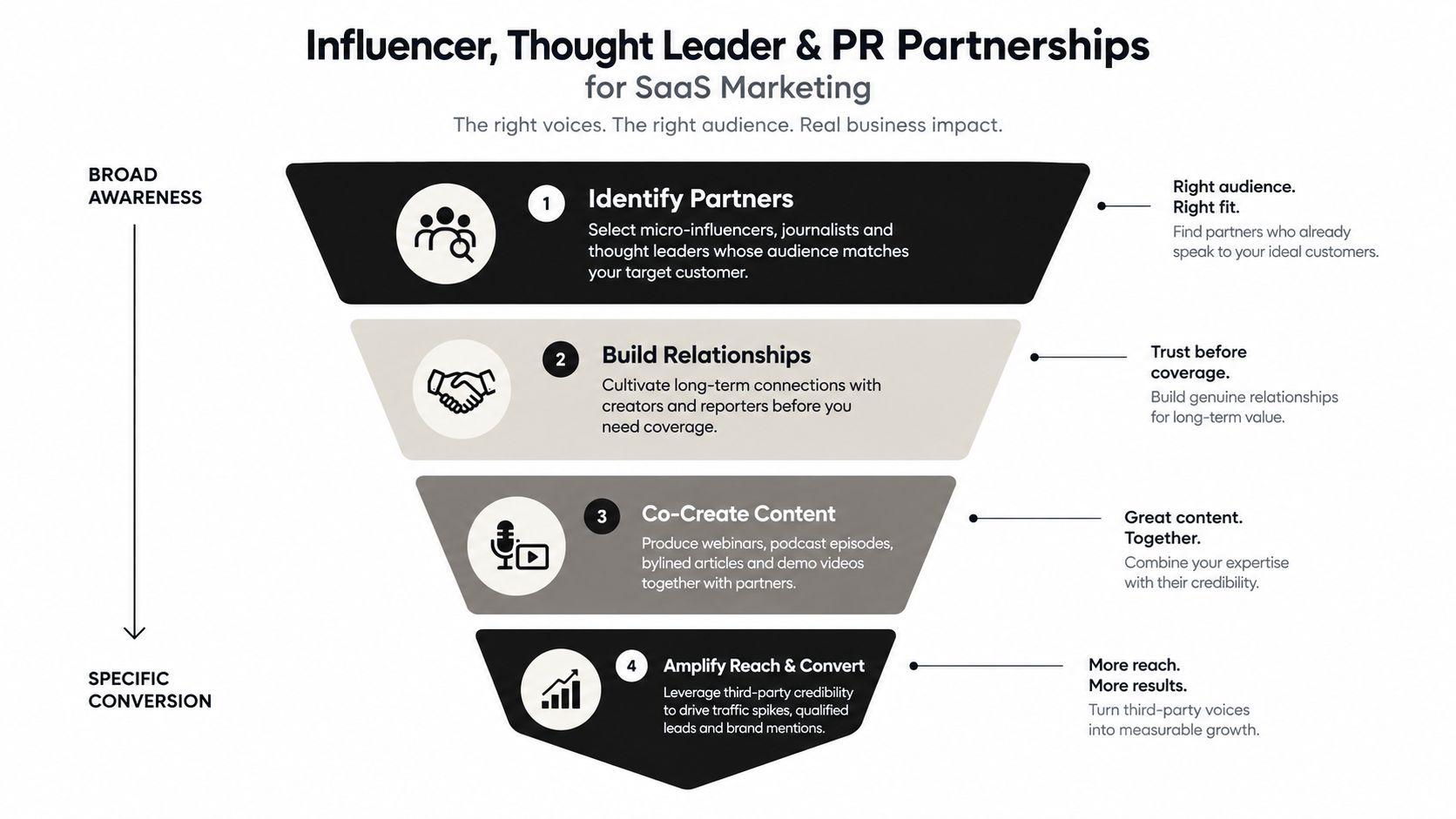
7. Influencer, Thought Leader and PR Partnerships
Partnerships with creators, journalists, analysts, and niche experts work best when your product needs borrowed trust. This is common in crowded categories where prospects don't lack awareness of the problem. They lack confidence in which tool to believe.
The strongest version of this trend isn't celebrity sponsorship. It's contextual endorsement. A technical YouTube creator walking through a developer tool, a respected LinkedIn operator discussing a workflow, or a journalist covering a category shift can all shape consideration faster than brand ads.
When this channel earns a bigger role
Use it once you know who influences your buyer and what format they trust. Early-stage teams can test small creator partnerships for launch amplification. Growth-stage teams can use them to support category positioning, narrative control, and proof distribution.
Real examples include product walkthroughs from niche software creators, founder appearances on technical podcasts, and co-created educational assets with consultants who already advise your target market. What matters is fit between creator audience and product use case.
Monitor direct traffic, branded search lift, assisted signups, and the quality of inbound conversation after a placement. The trade-off is attribution ambiguity. A strong mention may shape pipeline without producing a neat last-click conversion path. That's why this trend scales best after you've already built a baseline of messaging clarity and some demand capture elsewhere.
8. Freemium and Free Trial Conversion Optimization
Freemium is often treated as a growth model. In practice, it is a pricing and product design decision that only works when the main bottleneck is evaluation friction, not lack of demand, weak positioning, or slow onboarding.
That distinction matters because free access can mask deeper problems. If users enter the product but fail to reach a meaningful outcome, the free plan increases hosting, support, and onboarding costs without improving conversion. Teams then blame packaging when the issue is activation.
The stronger question is not whether to offer a free plan or a trial. It is which growth constraint you are trying to remove.
A time-limited trial fits products where value appears quickly and prospects mainly need proof before purchase. A usage-limited free plan fits products that spread through collaboration, repeated workflows, or small-team adoption before budget approval. Figma, Slack, Zoom, Canva, and Airtable all reduced adoption friction through product access, but the durable lesson is narrower. Their conversion paths were built around a clear first success event and a credible reason to upgrade later.
Two operating tests help separate a workable PLG motion from an expensive free tier experiment:
Test one: can a new user reach value without human intervention?
If setup requires data migration, admin permissions, training, or custom configuration, a free motion usually needs sales or customer success support around it. That can still work, but it is no longer a low-touch acquisition model.
Test two: does product usage create a natural expansion trigger?
Healthy triggers include seat growth, collaboration, usage volume, storage, workflow limits, or governance needs. Repeated upgrade prompts before users experience value usually suppress trust rather than increase revenue.
This trend fits different SaaS stages in different ways. Early-stage teams can use a narrow trial to validate activation and message-market fit. Growth-stage PLG teams can use freemium to widen top-of-funnel and capture team expansion. Enterprise-focused companies should be more cautious, especially if implementation effort is high and procurement complexity matters more than product sampling.
A practical pattern is to map the path in sequence: signup, first key action, repeat usage, collaborative behavior, and paid trigger. If any step breaks, conversion optimization should start there rather than at the pricing page.
Monitor activation completion, time to first value, repeat usage within the first week or month, invite behavior, limit hits, upgrade timing, and free-to-paid conversion by acquisition source. Those cuts matter because users from launch discovery, SEO, partnerships, or community often arrive with different expectations and intent. A free motion should be evaluated as part of that broader portfolio, not as an isolated funnel.
The trade-off is operational load. Free users still consume infrastructure, support capacity, lifecycle messaging, and analytics attention. Freemium earns a larger role after the team has evidence that self-serve users can activate efficiently, that upgrade triggers align with actual value, and that the free tier strengthens, rather than distracts from, the rest of the demand mix.
9. Performance Marketing and Conversion Rate Optimization
Performance marketing still matters. It just isn't the center of gravity it once was. Across broader SaaS trend data, owned channels have gained share while paid has become a smaller portion of pipeline mix. That doesn't make paid obsolete. It makes it more tactical.
Use paid search, retargeting, and landing page testing when you need fast feedback on positioning, offers, and high-intent segments. This is especially useful for validating category keywords, demo messaging, or ICP-specific pages before investing heavily in longer-cycle organic programs.
What a healthy paid program looks like now
Healthy paid programs are narrow, message-matched, and connected to conversion behavior. A campaign that sends enterprise buyers to a generic homepage is usually a planning failure, not a channel failure. The ad, keyword, landing page, and next action should all align around one intent.
A realistic use case is a SaaS company testing dedicated pages for competitor comparisons or integration-specific search terms. Those campaigns can reveal whether a market segment converts, what objections show up, and which phrasing earns attention.
Paid works best as a measurement tool and demand-capture layer. It gets expensive when teams use it to compensate for weak positioning or a poor website experience.
Monitor search term quality, landing page engagement, assisted pipeline, and lead-to-opportunity progression. The trade-off is obvious. Paid gives speed, but not much compounding value unless you use what it teaches to improve your site, product pages, and content portfolio.
10. Partnership and Integration Marketing
Some of the best SaaS growth doesn't come from creating demand alone. It comes from attaching your product to workflows buyers already trust. That's why partnership and integration marketing remains one of the more defensible SaaS marketing trends, especially in crowded categories.
Zapier, Slack, Stripe, and HubSpot all demonstrate the same principle in different ways. Integrations don't just improve product utility. They also create new discovery surfaces, partner-led referrals, marketplace visibility, and stronger retention because the tool becomes embedded in existing work.
The stage fit and proof threshold
This trend fits best once your product has a stable core use case and a clear sense of the other tools customers already rely on. If your usage data shows repeated export workarounds, API requests, or customer questions about another platform, that's a partnership clue.
A practical rollout often starts with a small set of integrations tied to the most common workflows, then expands into co-marketing and partner enablement. Teams should look for evidence such as partner-sourced demos, integration page engagement, activation lift among integrated accounts, and expansion behavior after connection.
The trade-off is complexity. Integrations create maintenance work, support considerations, and roadmap dependency on outside platforms. If an integration doesn't improve adoption or distribution, it can become expensive middleware. The wins are real, but only when the ecosystem logic matches how customers already buy and work.
10-Point SaaS Marketing Trends Comparison
| Strategy | 🔄 Implementation Complexity | ⚡ Resource Requirements | 📊 Expected Outcomes | 💡 Ideal Use Cases | ⭐ Key Advantages |
|---|---|---|---|---|---|
| Product Launch Communities and Discovery Platforms | Medium‑high, coordinated, time‑sensitive launch work | Moderate, assets, community manager, launch creatives | Immediate visibility spike, qualified leads, backlinks (short window) | New SaaS launches, indie makers, rapid validation | ⭐ Quick credibility, SEO backlinks, early adopter access |
| Content Marketing (Case Studies & Demos) | High, deep research, production and customer cooperation | Significant, writers, video production, customer participation | Evergreen organic traffic, trust, lead generation over months | Products needing ROI proof or complex implementations | ⭐ Strong social proof, reduced CAC long‑term |
| Community‑Driven Marketing & UGC | High, ongoing moderation and engagement required | Moderate, community managers, events, incentives | Improved retention, organic referrals, UGC over 6–12 months | Developer/creator tools, collaboration platforms | ⭐ High loyalty, authentic content, network effects |
| AI‑Powered Personalization & Dynamic Optimization | Very high, ML models, integrations, data pipelines | High, data engineering, tooling, compliance effort | Significant conversion & retention uplift when data is good | Mid/large SaaS with substantial user behavior data | ⭐ Scalable personalization, measurable conversion gains |
| Account‑Based Marketing (ABM) for Enterprise SaaS | High, bespoke campaigns and tight sales coordination | High, ABM team, intent data, custom content & tools | Higher win rates and deal sizes; longer closing timelines | Enterprise SaaS with 6‑figure+ ACV and complex buying groups | ⭐ Very high ROI per account; strong sales‑marketing alignment |
| SEO & Content Authority Building | High, sustained technical and editorial effort | Moderate‑high, content team, SEO tools, outreach | Compounding organic traffic and defensible topical authority | SaaS seeking scalable long‑term organic acquisition | ⭐ Sustainable, low CAC over time; brand authority |
| Influencer, Thought Leader & PR Partnerships | Medium, relationship building and pitchcraft | Variable, PR time, influencer fees or exchanges | Quick reach and credibility; impact varies and is hard to attribute | Newsworthy launches, founder branding, niche audiences | ⭐ Rapid amplification and third‑party endorsement |
| Freemium & Free Trial Conversion Optimization | Medium, product gating, onboarding design, analytics | Moderate, product engineering, support, analytics | High user acquisition; revenue depends on conversion rates | Viral/team tools, products with easy trial experience | ⭐ Low friction acquisition; rich usage data for upsells |
| Performance Marketing & CRO | Medium, setup, tracking, continuous experimentation | High, ad budget, analytics, testing tools, creatives | Fast, measurable acquisition and rapid iteration | Demand gen, high‑intent keyword acquisition and scale | ⭐ Direct ROI, rapid feedback loops, scalable growth |
| Partnership & Integration Marketing | Medium, API work plus partner ops and co‑marketing | Moderate, engineering, partner management, co‑promo budget | New distribution channels, improved retention via integrations | Products that complement larger platforms or marketplaces | ⭐ Access to partner audiences, network effects, added value |
Turn Trends Into a Focused Growth Portfolio
The practical way to use these SaaS marketing trends is not to pick your favorites. It's to pick your constraints. If your product is new and discovery is weak, start with one fast-feedback channel such as a launch platform, highly targeted paid search, or a narrow creator partnership. If your product already has some traction but acquisition is inconsistent, pair that with one compounding channel such as SEO authority, product-focused content, or integration marketing.
Set one audience and one activation event for each channel. For example, a launch-stage AI tool might target early adopters and measure qualified signup-to-activation behavior after a SubmitMySaas or Product Hunt launch. A content-led SaaS team might target operations buyers and measure demo requests or trial starts from use-case pages. An enterprise team might assign ABM to named accounts and define progress around multistakeholder engagement, sales acceptance, and opportunity creation. A product-led company might focus less on new sessions and more on whether free users reach the core in-product action that predicts paid conversion.
Then time-box the test. Don't let a trend become a permanent budget line before it has earned one. Teams should decide in advance what evidence is required before expanding spend or headcount. That evidence can be qualitative or operational if hard benchmarks aren't available yet: better-fit conversations, repeated objections resolved by a new landing page, stronger activation after onboarding changes, partner-sourced leads that close faster, or content assets that sales repeatedly uses.
This matters even more in today's market because SaaS marketing budgets are generally tighter and more revenue-tied than in the past. The median private B2B SaaS marketing budget has converged around about 8% of ARR, which means discipline isn't optional. Every trend in this list becomes more useful when treated as part of a sequence. Launch discovery can create the first wave of attention. Product content can turn attention into understanding. SEO authority and answer-engine visibility can compound discovery. Freemium and onboarding can convert usage into revenue. Community and partnerships can deepen retention and widen distribution.
The winning approach isn't adopting every trend. It's choosing the few that match your product, buyer complexity, data maturity, and operating capacity right now. For some teams, a discovery platform such as SubmitMySaas will be a sensible first move. For others, the better next step is a use-case content engine, a tighter free-trial path, or a coordinated enterprise account strategy. Good SaaS marketing in 2026 won't come from doing more. It will come from sequencing better.
If you're preparing a launch and want a discovery channel that also supports visibility, backlinks, and early user feedback, SubmitMySaas is built for that use case. Founders can submit SaaS and other tech products to appear in curated launches, trending lists, and monthly roundups. Explore how it fits your 2026 distribution mix at SubmitMySaas.