Product Discovery Techniques That Actually Work
Learn the product discovery techniques modern SaaS and AI teams use to find real problems, validate ideas fast, and ship what customers actually need.
You've spent months building the product, polished the launch page, and prepared the announcement. Launch day arrives, and almost nobody signs up. The few who do don't reach the moment of value, while your team debates whether to add more features or change the messaging.
That pattern usually isn't a delivery problem. It's a discovery problem. Effective product discovery techniques help you test who has a problem, how serious it is, what people do today, and whether your proposed solution deserves engineering time. In 2026, that work also includes a new question: can buyers find and understand your product when their research begins inside an AI assistant rather than on your website?
Why Product Discovery Matters Before You Build Anything
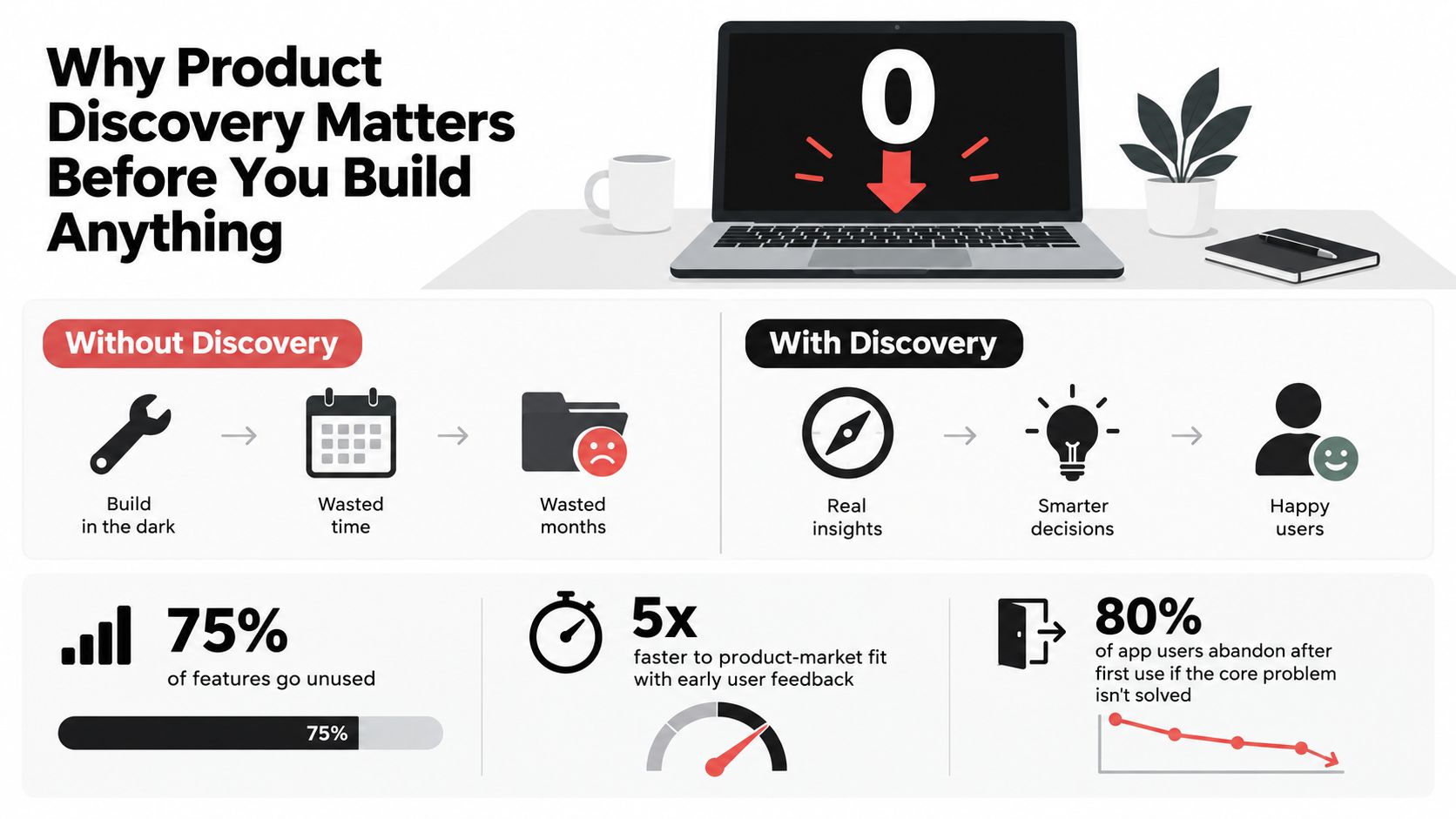
Product discovery is the discipline of reducing uncertainty before committing to a solution. It turns statements such as “customers need an AI dashboard” into testable assumptions about a specific user, a concrete job, an existing workaround, and a measurable outcome.
Skipping that work creates three predictable costs. First, you spend runway on features that solve a weak or incorrectly framed problem. Second, you optimize for the loudest segment instead of the buying segment, so a feature can receive enthusiastic feedback without improving adoption or retention. Third, you add complexity that makes the core workflow harder for everyone else.
A short discovery sprint can expose those risks while the decision is still reversible. Interviews can reveal that an onboarding issue is caused by unclear permissions rather than missing functionality. A clickable prototype can show that users misunderstand a proposed workflow before developers build it. Analytics can identify the exact step where people stop, while contextual inquiry can explain what they're trying to do at that moment.
Practical rule: Before writing a feature brief, write the problem as a sentence describing who is struggling, what they're trying to accomplish, and what blocks them.
The technique set is broader than interviews. Modern quantitative discovery commonly combines surveys, A/B and multivariate testing, analytics, cohort and funnel analysis, clickstream analysis, heatmaps, benchmark studies, NPS, CSAT, task-success measures, and error-rate analysis, as described in this overview of quantitative product discovery methods. That range matters because discovery must uncover both customer needs and whether a proposed solution works.
For a deeper check on whether your idea has enough evidence to proceed, use this guide to validate product-market fit. Discovery won't guarantee a successful launch, but it can stop your team from confusing activity with demand.
The Discovery Loop Explained Simply
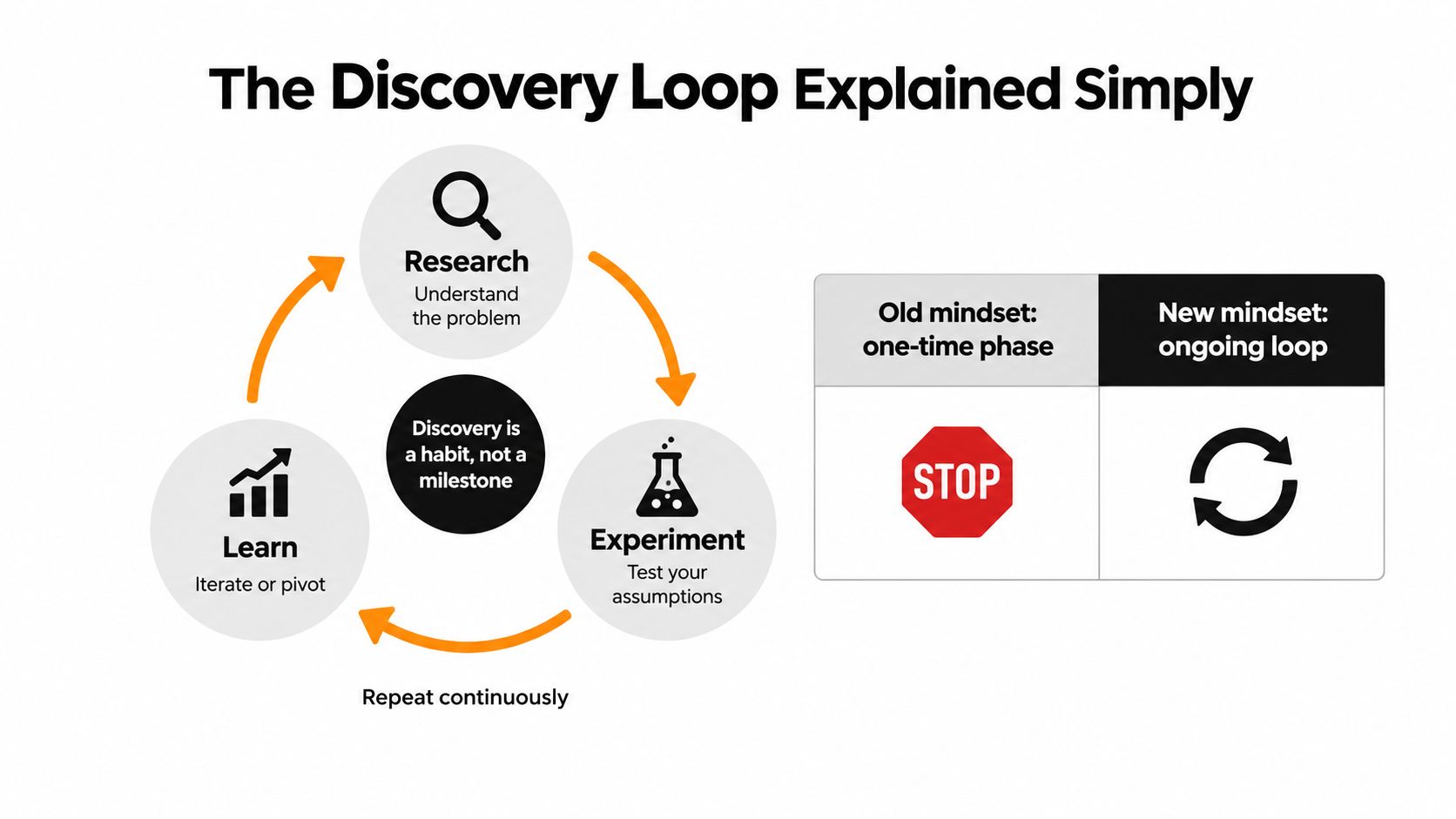
The discovery loop is a recurring decision process, not a gate that your team passes once. You research to understand the problem, experiment to test a solution, and learn enough to refine, continue, or stop. Each result changes what you investigate next.
Consider a SaaS onboarding team that sees new accounts create workspaces but fail to invite colleagues. Interviews may uncover a permissions concern, an unclear value proposition, or a workflow that assumes the administrator already knows the team structure. The team can then sketch several onboarding approaches and test them with a low-fidelity prototype instead of arguing from preference.
The loop has three connected moves:
- Research the situation. Gather recent examples, observe workarounds, review support conversations, and inspect behavioral data. The output should be a sharper problem hypothesis, not a feature list.
- Experiment with solutions. Use a prototype, concierge workflow, fake-door test, or controlled product change to test the riskiest assumption. Keep the experiment cheap enough that abandoning it feels normal.
- Learn and choose. Compare what people said with what they did. Decide whether to refine the idea, investigate a different opportunity, or commit to delivery.
Prioritization belongs inside the loop because teams always have more possible solutions than capacity. For the onboarding example, a RICE score might favor improving workspace setup over adding a new reporting feature, but the score should reflect evidence gathered during research rather than stakeholder enthusiasm.
The point isn't to make every decision slow. It's to make uncertainty visible early. One contemporary discovery guide recommends tracking 2–3 validated ideas per sprint, aiming for 5–10 days to first validation, and treating a 50–70% experiment success rate as healthy, while discarding 30–60% of explored ideas before build. These ranges are presented in this guide to measuring discovery success, and they illustrate the operating principle: strong teams learn quickly and reject weak assumptions before delivery absorbs them.
Qualitative Techniques That Reveal Real Problems
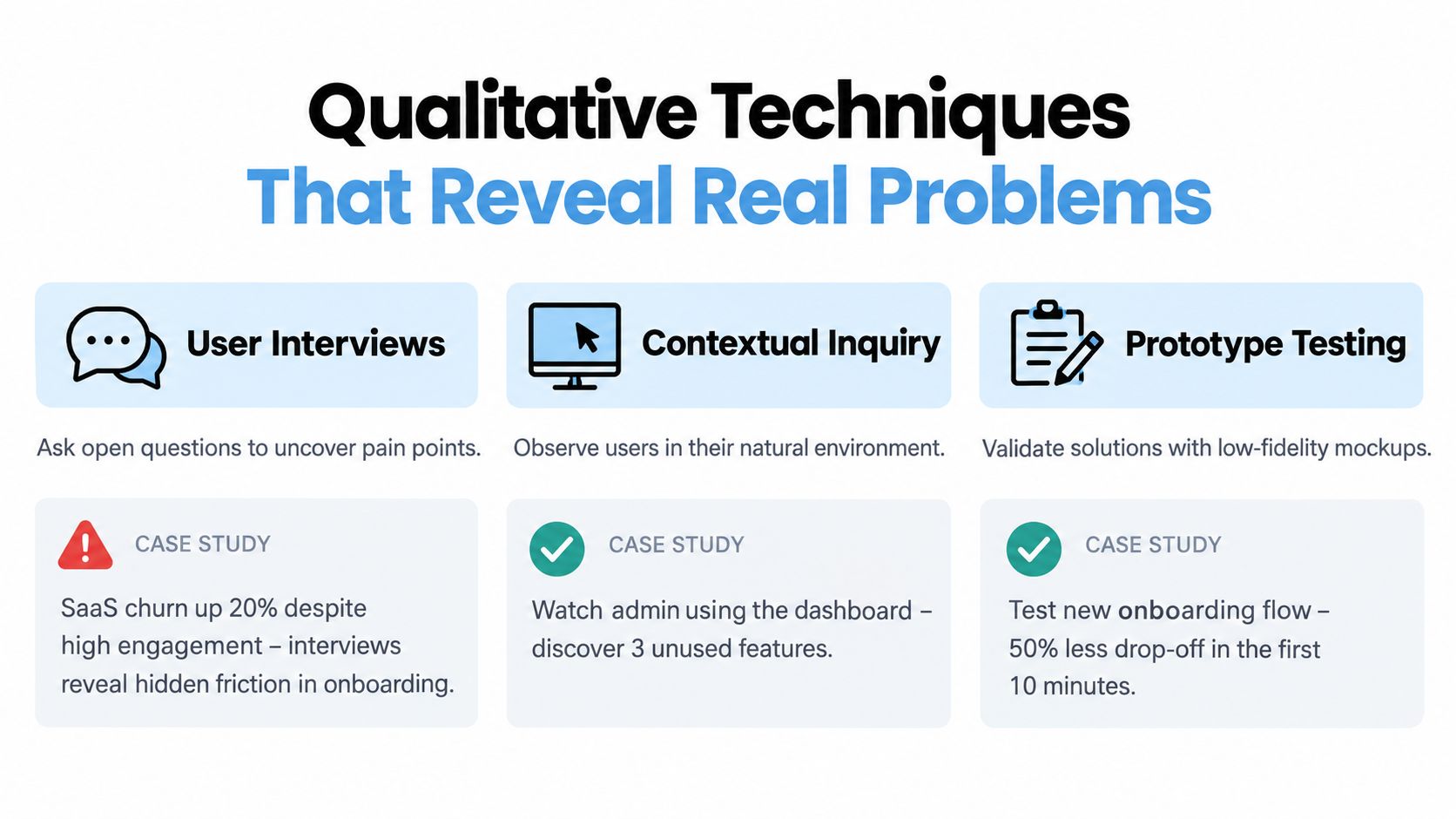
A SaaS product can show strong usage and still lose customers. Imagine an analytics tool where active accounts open dashboards regularly, yet cancellation conversations keep mentioning “setup.” A dashboard tells you where activity occurs. It doesn't tell you whether an administrator can explain the result to a manager, whether data arrives too late, or whether the team has created a manual workaround.
Start with recent behavior
Customer interviews work best when they focus on what happened recently, not what someone imagines they might do later. Ask, “Walk me through the last time you tried to complete this task,” then follow the sequence. What triggered the task? What did the person try first? Where did they hesitate? What workaround did they use?
A useful thirty-minute interview usually includes:
- A concrete opening: Ask about the last real occurrence of the problem.
- Neutral prompts: Avoid asking whether a proposed feature sounds useful.
- Detailed probing: Explore tools, people, constraints, interruptions, and consequences.
- A behavior check: Ask what the participant did after the problem occurred.
- A quiet close: Invite anything important that your questions missed.
This approach aligns with guidance that interviews should emphasize recent behavior, current workarounds, and context rather than hypothetical opinions. The practical guide to conducting user interviews offers a useful reference for designing those conversations.
Observe the work, then prototype the change
Contextual inquiry is valuable when people can't easily describe the workflow. Watch an administrator configure the product in their normal environment. You may notice that they copy data between systems, pause to ask a colleague for approval, or avoid a feature because the terminology conflicts with their internal process.
Use structured interviews when you need comparable conversations across a defined segment. Use observation when the work is fragmented, physical, interrupted, or heavily dependent on surrounding tools. Recruit people who represent the problem, including stalled users, recent churn risks, and customers with different operating contexts. A convenient group of enthusiastic power users can produce polished but narrow insights.
Once you understand the job, test a prototype. People are poor predictors of future behavior when all they can evaluate is an abstract description. A rough screen flow lets you watch whether they understand the next action, interpret the labels correctly, and recover from an error.
Qualitative evidence creates hypotheses. It doesn't prove market-wide demand.
Synthesize findings into patterns, not a collection of memorable quotes. Separate what participants directly did from your interpretation of why they did it. That distinction prevents one dramatic interview from overpowering a broader but quieter signal.
Quantitative Techniques That Prove the Solution Works
Qualitative research tells you what to investigate. Quantitative methods help you determine how often a pattern occurs, which segment experiences it, and whether behavior changes after an intervention.
Start by translating the research finding into an event model. If users struggle to reach their first report, define the sequence clearly: account created, data connected, report configured, report viewed, and report shared. Instrument those actions before changing the flow. Otherwise, you'll know that engagement moved without knowing which part of the experience caused it.
A concierge MVP can test the service manually while you learn which steps matter. A smoke-test page can test whether a proposed capability attracts qualified interest before you build it. Surveys can quantify a known pattern, but they're less useful when you're still unsure what language customers use to describe the problem.
| Method | Best For | Healthy Signal |
|---|---|---|
| Surveys | Measuring a defined pattern across a broader audience | Responses map clearly to a previously observed hypothesis |
| A/B testing | Comparing two versions of an existing experience | A pre-defined behavioral outcome moves without unacceptable trade-offs |
| Product analytics | Finding activation, funnel, cohort, and usage patterns | The team can connect an observed drop-off to a meaningful user task |
| Heatmaps and clickstream analysis | Locating interaction friction | The observed behavior prompts a testable usability question |
| Task-success and error-rate analysis | Evaluating whether users complete a workflow | People complete the intended task with fewer breakdowns |
Survey-led discovery has a specific weakness at scale. Recent reporting describes surveys losing ground as response rates collapse while request volume rises, creating a measurement gap rather than merely a tooling gap, as discussed in this analysis of AI's effect on product discovery. Treat a low-response survey as incomplete evidence, not confirmation that nobody cares.
A/B tests also need discipline. Decide the primary outcome before launch, define what would count as a meaningful change for your product, and avoid changing the interpretation after seeing early results. Analytics can expose behavior, but it can't explain motivation by itself. Pair the numbers with interviews, support conversations, or usability sessions, including this guide to conducting usability testing.
Choosing the Right Prioritization Framework
Prioritization frameworks are decision shortcuts. They help a team compare options, but they don't decide which customer problem deserves attention.
RICE combines Reach, Impact, Confidence, and Effort. It suits teams that need a shared scoring language across product, design, engineering, sales, and leadership. ICE uses Impact, Confidence, and Ease, so it works well when a small team needs a fast ordering pass without building a detailed model.
MoSCoW separates work into Must, Should, Could, and Won't categories. It's useful when the immediate conflict concerns scope and delivery commitments. Opportunity sizing asks where solving a validated customer problem could create the greatest value, which makes it useful when evidence is rich but resources are limited.
Suppose a SaaS team is choosing among an onboarding redesign, AI summarization, and SSO. A RICE discussion might favor onboarding if it affects most new accounts and the team has strong evidence of friction. ICE could place AI summarization first if the team believes it can test that idea quickly. MoSCoW might mark SSO as a Must for a specific enterprise commitment, even if it ranks lower for the broader customer base. Opportunity sizing could favor the problem connected to the most valuable unmet workflow, regardless of which feature sounds most impressive.
Use the framework that matches the decision:
- Need alignment across functions: Choose RICE and document the evidence behind each score.
- Need speed: Choose ICE, then revisit the order when new evidence appears.
- Need scope clarity: Choose MoSCoW and make the Won't category explicit.
- Need commercial judgment: Choose opportunity sizing, grounded in customer and market evidence.
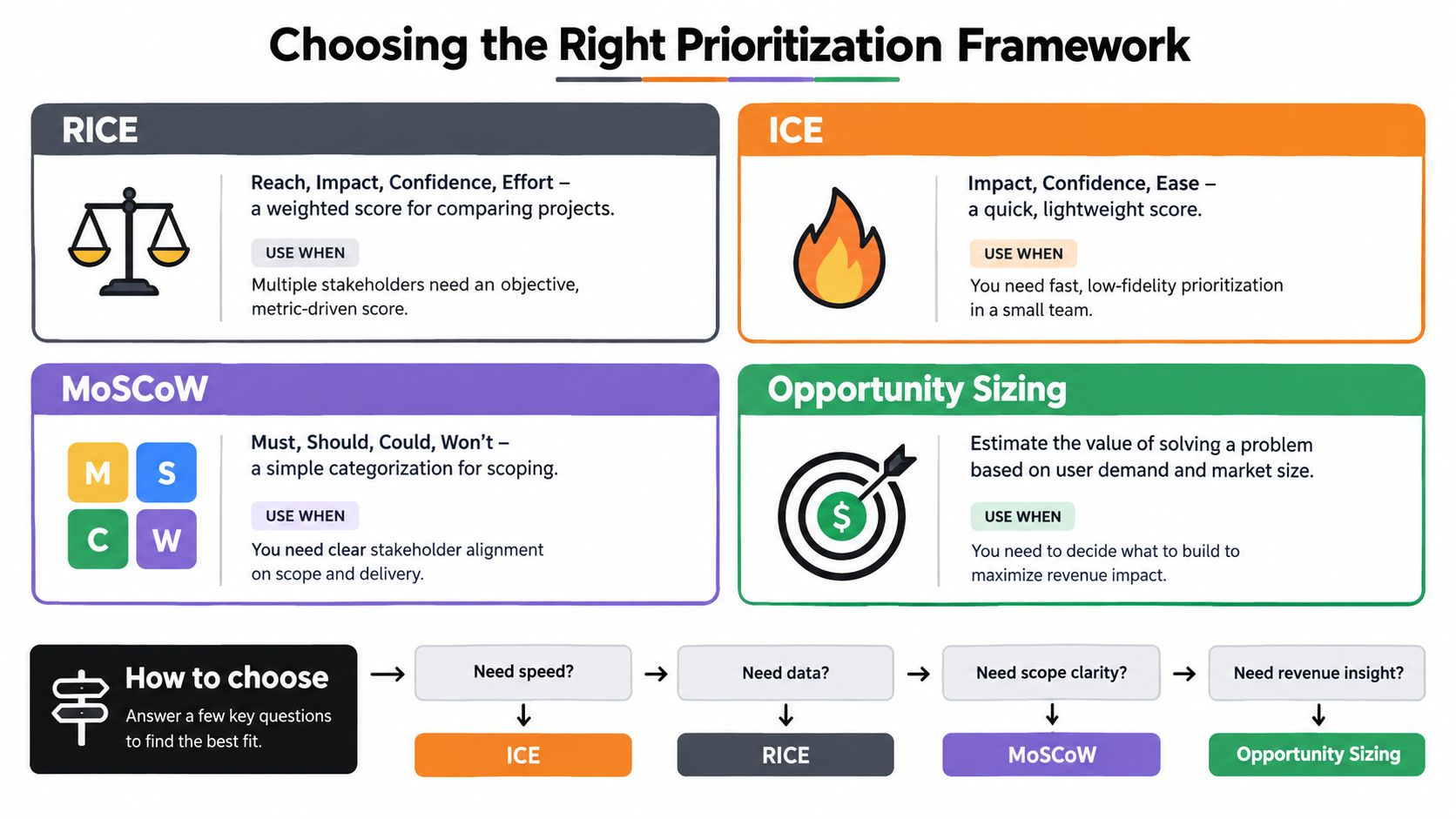
If your team is evaluating adjacent tools or monetizable product ideas, this resource on how to find the right affiliate products can help you assess fit more systematically. For a broader feature decision process, see this feature prioritization framework. Keep the scoring lightweight, review it consistently, and never confuse a precise score with a sound strategy.
When Standard Techniques Break Down
More feedback doesn't automatically produce better decisions. A large pile of unfiltered opinions can create false confidence when the sample is biased, the questions are leading, or the input comes from people who don't represent the buying context.
Interviews fail when founders ask for approval instead of evidence. “Would you use an AI assistant for this?” invites politeness and speculation. “Tell me about the last time you handled this task without an assistant” exposes the current workflow, its cost, and the workaround the customer already tolerates.
Surveys fail when the respondents are easy to reach but irrelevant to the decision. A product team may send a questionnaire to active users, receive enthusiastic answers, and conclude that a requested feature should be prioritized. Yet the request might come mostly from power users who are not the buying center, while the administrators who control renewal never responded.
Analytics fails when teams treat activity as motivation. A rising feature count, longer session, or frequent click can indicate value, confusion, repeated failure, or internal reporting requirements. The metric needs a behavioral interpretation and a clear connection to the user's desired outcome.
Use a red-team review before a major commitment:
- Check the segment: Who provided the evidence, and who makes the purchase or renewal decision?
- Check the behavior: Did people perform the action, or only approve the idea?
- Check the framing: Could the question have pushed participants toward your preferred answer?
- Check the counterevidence: Which findings contradict the proposed solution?
- Check the consequence: What would you learn if the experiment failed?
When survey response quality is weak, interviews are difficult to recruit, or the market is shifting rapidly, choose the method that produces actionable evidence rather than the most feedback. The contrarian discipline is knowing when to stop collecting input and make a falsifiable decision.
Discovery in the Age of AI Assistants
Product discovery now happens across more than search results, review sites, and vendor pages. Buyers increasingly ask assistants such as ChatGPT, Claude, Perplexity, and Gemini to compare products, interpret use cases, and recommend a shortlist before they visit a website.
Independent research from 2025 and 2026 reports that 64% of shoppers in a multi-country survey use AI shopping tools to discover or research new products, including 54% using AI chatbots, 19% using AI shopping assistants, and 16% using AI-powered visual search tools, according to these LLM product discovery benchmarks. The implication for SaaS teams is practical: discovery includes being understandable and referenceable inside machine-generated comparisons.
Build inputs an assistant can interpret
Start by auditing category prompts. Ask how an assistant describes your product for different jobs, segments, integrations, pricing constraints, and alternatives. Record whether the product appears, which facts are missing, and whether the assistant confuses it with another category.
Then strengthen the evidence layer:
- Structured product information: Keep names, capabilities, integrations, pricing logic, use cases, and limitations consistent across public pages.
- Comparison assets: Publish clear alternatives and comparison pages that explain differences without vague superiority claims.
- Evaluation content: Show workflows, setup requirements, security details, and boundaries so assistants can summarize the product accurately.
- Referenceable proof: Make customer outcomes, documentation, and independent mentions easy to understand and verify.
An AI scheduling tool might discover that prompts such as “best async standup tool for engineering teams” produce more qualified interest than conventional category language. The team could review those prompts regularly, improve the relevant comparison page, track assistant referrals, and feed the resulting questions back into interviews and prioritization.
This doesn't replace customer research. It adds another surface where customers express intent and another source of discovery signal. Teams building responsible human and AI collaboration should treat assistant visibility as part of the same research, experiment, and learning loop, not as a separate marketing trick.
Putting It All Together
Run product discovery as a weekly operating rhythm. Choose the technique according to the uncertainty you need to reduce, not according to whichever tool your team already has open.
- No problem defined yet: Conduct interviews focused on recent behavior, then use contextual inquiry if the workflow is hard to describe.
- Problem suspected: Test a concierge MVP, prototype, or fake-door experience to learn whether the proposed outcome matters.
- Solution built: Instrument the key workflow and run a controlled experiment or usability test.
- Backlog full: Use RICE, ICE, MoSCoW, or opportunity sizing to make trade-offs explicit.
- Category fit uncertain: Audit AI assistant prompts, comparison pages, structured product information, and referral paths.
- Feedback noisy: Separate segments, inspect behavior, search for counterevidence, and run a red-team review.
The strongest teams don't treat discovery as paperwork before delivery. They use it to decide what not to build, what to test next, and which signals deserve more investigation. A framework can organize judgment, but it can't replace the team's willingness to change direction when evidence disagrees with the plan.
SubmitMySaas gives SaaS and AI makers a launch and discovery platform for submitting products, appearing in curated categories, and testing how a new product is presented to early adopters. Visit SubmitMySaas to submit your product, gather another discoverability signal, and connect your launch work to an ongoing learning loop.