By Outrank
Marketing Growth Hacking: What It Is and How to Test It
Learn marketing growth hacking: core principles, proven tactics, and how to test and measure each growth experiment with clear metrics and examples.
On this page
You've launched your SaaS, published a few posts, and watched people visit the website. Some sign up, fewer finish setup, and you still can't tell which marketing activity deserves another week of work. Meanwhile, someone recommends a referral program, someone else suggests more SEO, and your backlog keeps growing.
Marketing growth hacking starts by replacing that pile of suggestions with a testable question. Instead of asking how to get more attention, ask what's stopping the right users from reaching value, and what evidence would prove that a change helped.
What Growth Hacking Means in Marketing
Growth hacking is a measurable, experiment-led approach to finding repeatable mechanisms that move a growth metric. It isn't a bag of traffic tricks, and it doesn't require exploiting a platform loophole.
According to Bliss Agency's history of growth hacking, Sean Ellis introduced the term in 2010 for startups that needed measurable growth while working with limited budgets and establishing product-market fit. The distinction was the operating method: test a hypothesis, observe what users do, and keep mechanisms that produce useful results.
Practical rule: A tactic becomes a growth experiment when you specify what should change and how you'll judge the outcome.
Say a seed-stage SaaS team has a useful reporting product but no established brand. Buying attention might bring visitors, but helping new users connect their first data source could do more to create active customers. Think of tuning an engine: changing the part that limits performance can improve speed, while repainting the body won't fix the mechanical problem.
Growth belongs across the team
Marketing identifies an audience and communicates the promise. Product and engineering shape the experience, analytics checks the evidence, and customer success explains where users struggle. A solo founder may wear all those hats, but the responsibilities still matter.
SaaS offers practical places to experiment: onboarding, invitations, integrations, free trials, usage limits, content distribution, and referral loops. None is automatically a growth mechanism. Each must connect a user action to a business outcome.
Before choosing a channel or rewriting a page, name the growth metric your product needs to move first. That choice gives the work a purpose beyond launching something new.
The Five Stages to Map Your Growth Funnel
The five-stage growth funnel maps the journey from discovering a product to paying for it and bringing others along. Use it to locate friction, not to assume every customer follows a perfectly straight path.
The diagram gives you the overall map.
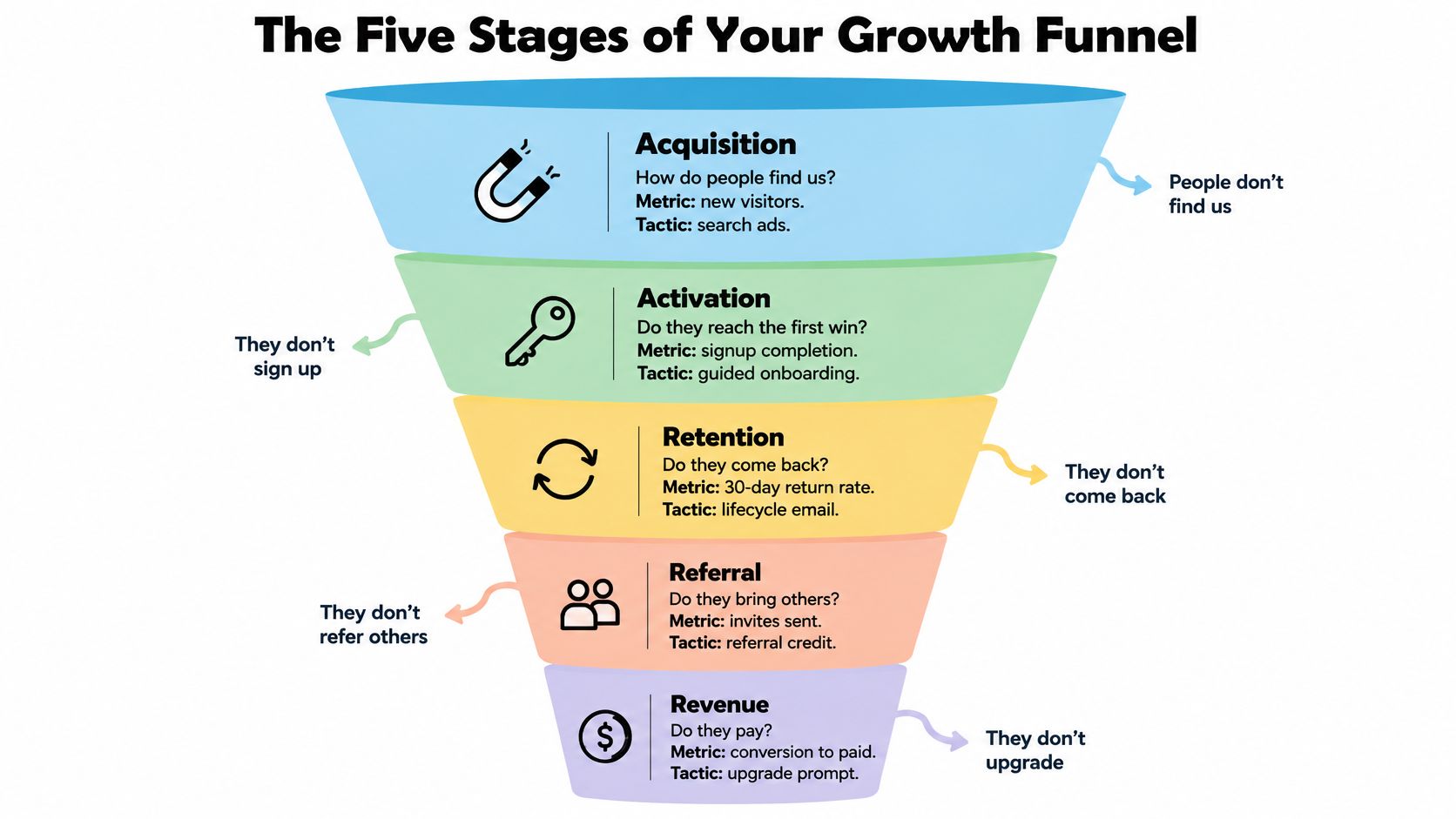
Growth funnel stages, questions and metrics
| Stage | Question it answers | Metric to track | Example tactic |
|---|---|---|---|
| Acquisition | How do people first find the product? | Visitors and sign-up rate by source | Free tool or calculator linked to the product |
| Activation | Do new users reach their first moment of value? | Share of sign-ups completing setup | Guided onboarding checklist |
| Retention | Do users come back after week one? | Week-4 active user rate | Usage email triggered by inactivity |
| Referral | Do users invite others? | Invites sent per active user | Double-sided reward tied to the core value |
| Revenue | Do users pay and expand? | Trial-to-paid conversion and expansion revenue | Upgrade prompt at a usage limit |
Find the constraint, not the smallest percentage
Start with the stage performing worst relative to its own target. Don't compare unrelated rates directly: a referral rate and an activation rate describe different behaviors, so the smaller number isn't automatically the bigger problem.
Say your reporting tool attracts relevant visitors and gets consistent sign-ups, but new accounts rarely connect a data source. Acquisition isn't the immediate constraint. Inspect the connection flow, explain permission requests, and test a clearer setup path before buying more traffic.
Also define what your metric means. Completing a checklist is only a useful activation proxy if users reach something valuable. For a reporting product, that might mean viewing a report built from their own data rather than opening a sample dashboard.
Match acquisition to the intended customer
If you sell to a narrow business audience, Pipecorn's guide to build a targeted prospect list can help you define whom an acquisition test should reach. Keep qualification criteria consistent so you don't mistake a change in audience quality for a better message.
For the broader connection between messages, offers, and customer actions, use our guide to creating a marketing funnel.
The stages also depend on each other. An invitation reward won't help much if the invited user can't finish setup. Fill in your current measure for every stage, give each a realistic internal target, and circle the largest meaningful gap.
Tactics Worth Testing and When Each Fits
Let the weakest stage pick the tactic. A launch feature can help people discover a new product, but it can't repair a confusing onboarding screen. An upgrade prompt can test willingness to pay, but it won't explain why prospective customers never arrive.
Treat the options below as a menu, not a ranking. Their time to a usable signal depends on reaching enough relevant users and observing the behavior you care about, not waiting for a calendar deadline.
Growth tactics by fit, time to signal and risk
| Tactic | Best for | Typical time to a signal | Main risk |
|---|---|---|---|
| Referral loop | Products whose value grows when shared | After invited users have time to activate | Incentive attracts low-intent users |
| Free tool or calculator | Search-led acquisition | After relevant discovery and downstream use occur | Traffic without product fit |
| Onboarding experiment | Activation gaps | Once exposed users complete the setup opportunity | Changes that hurt long-term retention |
| Integration listing | Tools inside existing workflows | After qualified marketplace visitors try the integration | Low visibility without marketplace effort |
| Launch directory feature | New products needing first users and backlinks | Initial launch exposure, followed by user-quality checks | Spike fades without follow-up |
| Programmatic SEO pages | Large sets of search queries | After indexing, relevant impressions, and qualified visits | Thin pages reduce quality |
Choose a useful signal
A free calculator should solve a problem adjacent to your paid product. If you sell project-estimation software, an estimate worksheet can attract relevant buyers; a broadly popular but unrelated calculator may only fill your analytics dashboard.
An integration listing needs a clear workflow story. Explain what users can accomplish with the connected tools, not just that the connection exists. Programmatic SEO requires the same discipline: each page needs a useful answer, not a location or keyword swapped into an otherwise identical template.
Launch directories offer a direct route to early exposure without waiting for a search-content library to mature. At SubmitMySaas, makers can submit a launch for visibility, feedback, and a high-authority backlink. A Free Launch receives a dofollow backlink only if the product ranks in the top 3 weekly and displays our badge on its site; advertising costs $79 per product for a month. Account for those conditions before treating a backlink as a guaranteed test outcome.
Use a short selection checklist:
- Product fit: Does this tactic reach people with the problem you solve?
- Weakest stage: Which specific user behavior should improve?
- Time budget: Can you support the test until that behavior is observable?
- Accepted risk: What downside will you monitor?
Set a review window before starting. If the intended signal doesn't appear, investigate whether the hypothesis failed or whether too few relevant users encountered the test. Those are different conclusions.
Real Cases That Show the Mechanics at Work
Dropbox's referral program is useful because the mechanism matched the product. People used Dropbox for storage, and the referral reward gave them more storage. The company didn't have to persuade users that an unrelated prize was worth chasing.
The acquisition economics explain why another route mattered: B2B Growth Hacking's Dropbox teardown reports paid-search acquisition costs of about $233–$388 per customer, against an annual product price of around $99. That comparison made paid acquisition unattractive on the reported terms, though it isn't a complete lifetime-value calculation.
A reward that extended the product
Dropbox built a double-sided referral incentive. Existing users received additional storage for referring someone, and the new user received storage too. The invitation therefore carried a useful benefit for both people rather than asking the recipient to help the sender win a prize.
The same teardown reports that the program permanently increased sign-ups by approximately 60%. That's a concrete outcome tied to the mechanism, not a count of people who might have seen a campaign.
The lesson isn't that every SaaS company needs a referral program. Storage was a reward users could understand immediately and consume within the product. A product without a natural sharing context needs a different explanation for why someone would invite another person.
Copy the relationship between the reward and customer value, not the reward itself.
What founders should take from it
- Solve a product-specific problem: Choose a distribution mechanism that fits how customers already use your software.
- Keep the incentive relevant: Offer something that helps the recipient accomplish the underlying job.
- Measure the resulting behavior: Track whether invitations create activated users, not just whether people send them.
Say you build collaborative review software. An invitation that lets a colleague comment on a real draft has a natural purpose. Giving people an unrelated gift for inviting contacts might produce more invitations without producing useful collaboration.
Before borrowing the Dropbox pattern, ask what feature could carry your invitation. Then ask what happens after the recipient accepts. A reward that generates accounts but not meaningful use hasn't yet demonstrated a repeatable growth mechanism.
Measuring Impact When Clicks Stop Telling the Story
Search Engine Land's coverage of AI-search adoption reports that 50% of marketers experienced organic-traffic declines after AI Overviews launched, while 40% reported traffic growth from AI assistants. These are reported experiences, not proof that a specific platform change caused a particular company's results.
They do illustrate why traffic alone is an inadequate north-star metric. Someone can discover your product in an answer, discussion, or video, then return later through a branded search. A referral-click report won't necessarily reveal that path.
Separate visibility from business impact
Use complementary measures rather than forcing every outcome into a last-click report:
- Branded-search lift: Compare searches for your product before and after exposure.
- Direct-traffic quality: Check whether those visitors activate or become qualified opportunities.
- Assisted pipeline: Record discovery touchpoints alongside sales opportunities.
- Cohort retention: Check whether newly acquired users keep using the product.
- Backlink discovery: Record new links as distribution evidence, not proof of revenue.
An external estimate of how much traffic a website gets, using Expressify AI, can provide directional context. It can't establish whether your campaign caused additional customers. Our guide to attribution modeling helps distinguish assigning credit from demonstrating cause.
Test what wouldn't have happened otherwise
Incrementality asks whether the activity produced an outcome that wouldn't otherwise have occurred. Where feasible, withhold the campaign from a comparable audience or region and compare changes in qualified activation or revenue against the exposed group.
Keep eligibility, timing, and other campaigns as consistent as possible. Watch for spillover, such as people sharing the campaign with the holdout.
Before scaling a channel that looks successful, check whether it adds customers or merely receives credit for customers already on their way.
Principles and Steps to Run a Growth Experiment
A campaign is like a billboard: it announces something. An experiment is like a lab notebook: it records a question, a method, and evidence. The same campaign can serve as an experiment, but only if you design it to answer a question.
Keep that distinction visible while planning the work.

Principles that make a result interpretable
Write a falsifiable hypothesis. Specify the audience, change, predicted behavior, and reason. For example: showing an invitation prompt after a user finishes a project should increase useful invitations because the user now has something worth sharing.
Choose a primary outcome. Give the experiment a decision metric, then add guardrails for possible harm. More completed setups shouldn't count as a win if users subsequently abandon the product or submit more support requests.
Compare coherent cohorts. A cohort is a group with something relevant in common, such as joining during the same test period. Don't compare experienced customers with new trial users and attribute the difference to a screen change.
Prioritize with impact, confidence, and ease. Use ICE scoring to make assumptions discussable. Impact describes the potential benefit, confidence reflects supporting evidence, and ease captures implementation effort. Treat the score as a prioritization aid, not a scientific prediction.
Keep ownership cross-functional. Assign responsibility for implementation, event tracking, customer communication, and the final decision. Before prioritizing a solution, use user research techniques to check whether you've understood the user's difficulty.
Run the smallest credible test
Select the bottleneck. Choose a stage where better performance would matter commercially. Identify the behavior you can realistically change rather than using a vague objective such as engagement.
Write the hypothesis and observation window. Include who qualifies for the test and how long their relevant behavior needs to unfold. A setup test and a renewal test require different observation periods.
Set the success threshold before launch. Define the minimum improvement worth implementing, accounting for development cost and potential harm. Distinguish this practical threshold from the statistical uncertainty around the measured effect.
Assign eligible users to test and holdout groups. Randomize where feasible, keep assignments stable, and avoid mixing variants within the same account when colleagues share a workspace.
Ship the smallest version that tests the idea. Change an onboarding step rather than redesigning the entire application. Verify event tracking before relying on the results.
Let the agreed window run. Don't declare victory because the early chart looks encouraging. Stop early for a predefined safety issue, such as broken setup, rather than because a temporary result supports your preference.
Evaluate the outcome and its uncertainty. Check exposure, missing events, group comparability, and guardrails. If the sample is too small to distinguish a useful improvement from noise, record the result as inconclusive.
Decide whether to scale, iterate, or drop. Preserve the reasoning, including what the result does and doesn't establish. A failed version may reveal a better hypothesis without validating the original one.
Use the video as a discussion prompt alongside your written test plan.
Leave a usable experiment record
Running many tests without hypotheses creates activity but little transferable learning. Keep a record containing hypothesis, metric, result, and decision, plus the audience, dates, implementation, and caveats needed to interpret it.
That record should let a teammate understand why you acted without reconstructing the story from dashboards and chat messages.
Start Your First Growth Experiment This Month
Week one is for establishing a trustworthy baseline. Fill in your funnel map using named systems: acquisition and sign-ups from your analytics tool, meaningful product actions from your event tracking, and payments from your billing system. Write down each metric's definition so a setup completion doesn't mean something different to marketing and engineering.
Circle the stage furthest from a realistic internal target. If you don't yet have enough activity to estimate a stable rate, inspect individual user journeys and speak with prospective customers rather than manufacturing certainty from a tiny sample.
Turn the baseline into a decision
Week two is for choosing a bounded test. Write a hypothesis with a predicted direction, a success threshold, and a defined audience. Select the least expensive credible tactic that addresses the bottleneck, not the tactic you're most excited to launch.
From week three onward, run and document the experiment. Maintain the holdout where feasible, monitor safety issues, and keep the planned observation window. Your first month may end with a test still running; a calendar deadline isn't a reason to force a verdict.
Before launching, make these commitments explicit:
- Weekly decision metric: Name the behavior you'll review, such as qualified setup completion.
- Guardrail: State what must not get worse.
- Decision owner: Assign someone to record whether you'll scale, revise, or stop.
Marketing growth hacking becomes useful when your team can explain not just what changed, but why the evidence supports the next action. Write your first hypothesis today, including the customer behavior you expect and the result that would make you reconsider.
SubmitMySaas offers product-launch visibility, feedback, and a high-authority backlink opportunity for makers introducing new tools. If discovery is the bottleneck you're ready to test, visit SubmitMySaas and plan a launch around qualified sign-ups and activation, not exposure alone.