How to Market a SaaS Product the Way Founders Actually Do
Learn how to market a SaaS product with a founder-tested playbook covering positioning, channels, launch, and measurement that drives real revenue.
You've got a product people say they want, a launch date on the calendar, and a growing list of channels telling you where to spend. Paid traffic is getting pricier, signups aren't turning into regular users, and you're not sure whether to buy more demand or fix what happens after someone arrives. That's the question behind how to market a SaaS product: where will the next dollar create durable revenue, acquisition or retention?
I'd answer it with payback period and cohort retention, not impressions or a channel trend. If new customers take too long to repay their acquisition cost, or they don't stick around, more traffic can make the economics worse. Fix the leak first, then scale what brings in customers who reach value and stay.
The Marketing Decision Every SaaS Founder Gets Wrong
Most SaaS marketing advice starts with a channel list. But the decision that determines whether those channels help is how you divide the budget between filling the funnel and fixing the funnel.
Founders often treat weak growth as an awareness problem. They raise ad spend, publish more content, or commission a launch campaign, even when new users struggle to activate or disappear soon after signup. That creates a costly mismatch: more people enter a system that hasn't shown it can turn them into retained customers. Acquisition deserves investment, but only when the product and customer journey can make use of it.
The market is large, and the competition for attention is real. Grand View Research valued the global SaaS market at approximately $464.7 billion in 2025 and projected it to reach $1.109 trillion by 2033, with an 11.1% compound annual growth rate from 2026 through 2033 (Grand View Research's SaaS market report). That scale makes discoverability and category positioning important. It doesn't make every traffic source profitable.
The budget-shifting rule
Here's the rule I'd use: when payback is drifting beyond your target or cohort retention is weakening, shift the next marginal dollar from acquisition into activation, onboarding, pricing, or retention. When the cohorts you acquire repay their cost on schedule and keep using the product, put more into the channels that reliably produce them.
That's different from pausing all acquisition until the product is perfect. You still need customer conversations and enough demand to learn. But you shouldn't mistake activity for evidence. A paid campaign that drives clicks but not activated accounts hasn't earned a bigger budget.
The contrast is familiar. One team doubles paid spend because signups are flat, then discovers that the new cohort behaves just like the old one: plenty of registrations, little sustained use. Another team fixes the first-run experience, watches more of its existing signups reach value, and then increases spending on the channel that brings in the right users. The second team isn't necessarily spending less. It's spending in sequence.
Practical rule: Don't scale a source until you can explain which customers it attracts, how they reach value, and whether they stay.
Positioning and ICP Before You Spend a Single Dollar
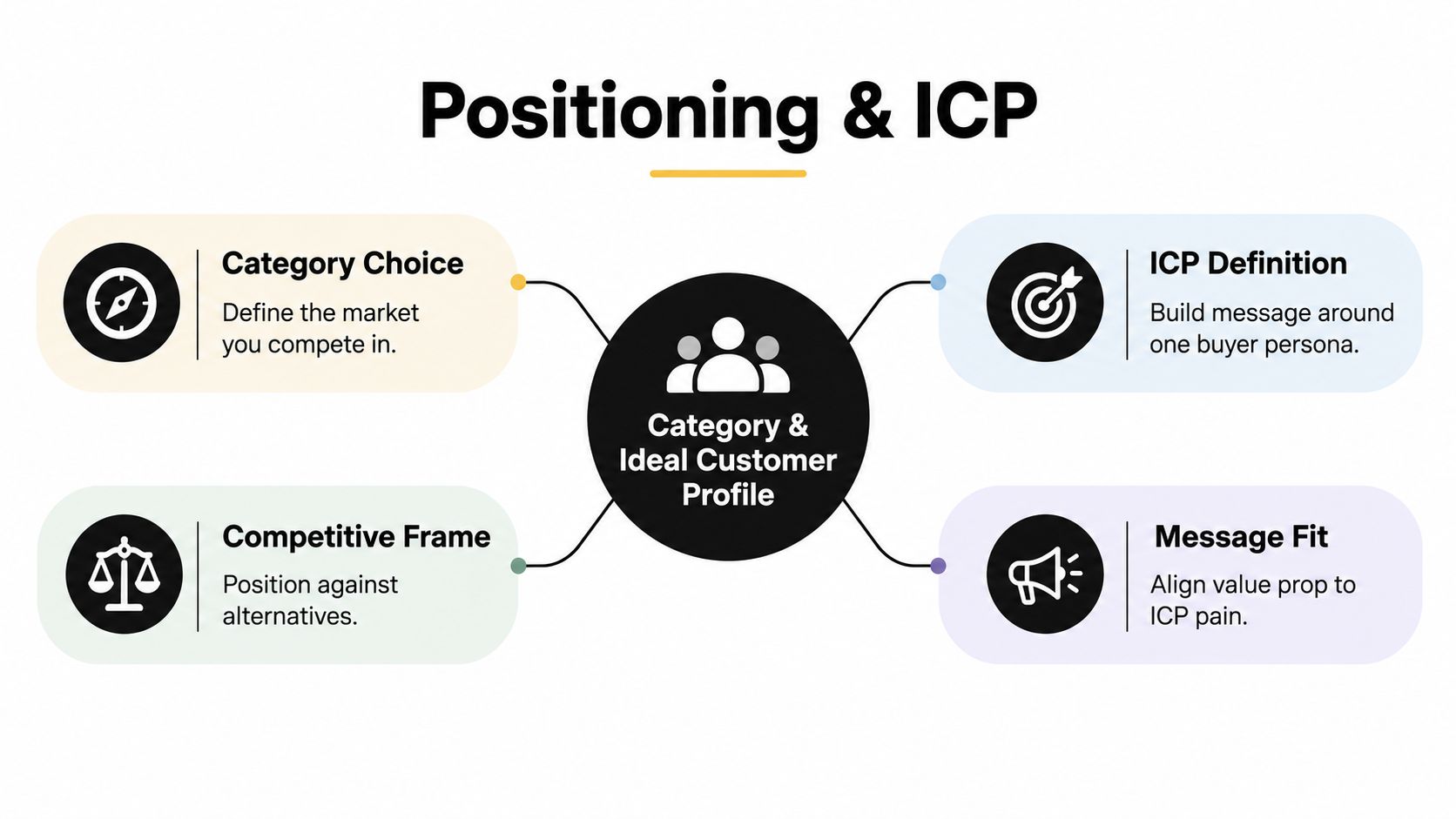
A good channel can't rescue a fuzzy message. Before you choose where to promote, decide what category you compete in, who buys, and why they choose you over an alternative. Those decisions shape your homepage, pricing page, sales conversations, and the content that attracts evaluators.
Start with the category. Describe the market in the language buyers already use, not the internal label your team prefers. Then define your ideal customer profile around a real buying situation: the type of organization, the problem it needs to solve, and the trigger that makes the problem urgent. A persona like “busy marketer” is too broad to guide a campaign. An ICP should help you decide which prospects to pursue and which to leave alone.
For a SaaS product listed on a launch and discovery platform such as SubmitMySaas, the positioning shouldn't stop at “we help founders launch.” It should say which founder has which problem and what useful outcome the product supports. That clarity gives a tired CMO, founder, or buyer something they can repeat accurately to a colleague.
Write a positioning brief you can test
Use a one-page brief. Write down the buyer, the urgent pain, the outcome your product delivers, the category it belongs to, and the alternative the buyer would otherwise choose. Then test the value claim in customer conversations. If people interpret it differently from how you intended, the message needs work before you build a campaign around it.
For a useful primer on connecting customer needs to an offer, see this Osterwalder value proposition design summary. Use the framework to sharpen the relationship between buyer pains, desired gains, and what your product does. Don's use it to decorate a slide with generic benefits.
Your headline should make the target customer recognize their problem. Your pricing page should show proof relevant to that buyer, not a collection of unsupported claims. Your comparison content should explain the trade-offs between your product and alternatives. For practical guidance on narrowing your audience, use this guide to finding your target audience.
Finish the brief with one sentence: “We help [specific buyer] achieve [valuable outcome] when [trigger or pain] makes it urgent.” If a prospective customer can't understand that sentence, fix the sentence before you spend on distribution.
Channel Strategy Built Around Payback, Not Clicks
A channel earns budget by bringing in customers who can repay the cost of acquisition and remain valuable, not by producing cheap clicks. That sounds obvious, yet many teams compare channels by cost per visit because it's visible, while payback takes more effort to calculate.
SaaSCubes' summary of a 2025 SaaS performance benchmark reports that the median B2B SaaS company spent $2.00 in sales and marketing for each $1.00 of new annual recurring revenue in 2024, and that median customer-acquisition-cost payback had increased 12.5% since 2022. The same research cites average B2B SaaS acquisition costs of about $239 per customer, with roughly $205 through organic channels and $341 through paid channels (SaaSCubes' SaaS marketing statistics). Treat those as benchmarks, not promises. Your pricing, sales motion, conversion, and retention determine your own economics.
A blended CAC doesn't tell you if a channel works by itself. Calculate acquisition cost and payback by source and customer segment, then compare them with retained revenue. Organic acquisition may take longer to produce a signal but build assets that keep drawing attention. Paid acquisition can test a message or reach a defined audience faster, but those gains don't automatically continue when the spend stops. Partnerships can introduce qualified buyers, while product-led growth can improve the value users get after arriving.
Score each channel before you scale it
Don't fill this table with invented precision. Use your own results, state the measurement window clearly, and compare like with like. “Time to first signal” means the first useful evidence, such as a qualified conversation or activated user, not a click.
| Channel | Payback Period | Time to First Signal | Test Cost | Growth Ceiling |
|---|---|---|---|---|
| Content and SEO | Your measured cohort result | Your expected learning window | Your production and distribution cost | Your reachable search demand |
| Paid acquisition | Your measured cohort result | Your expected learning window | Your planned test budget | Your audience and economics |
| Partnerships | Your measured cohort result | Your expected learning window | Your integration and co-marketing effort | Your partner audience and fit |
| Product-led growth | Your measured cohort result | Your expected learning window | Your onboarding and product work | Your ability to activate and retain |
For outbound, targeted outreach can be part of a channel mix when it starts relevant conversations instead of sending generic volume. A practical cold email guide can help teams think through the mechanics, but the list and message still need to match a real buyer and problem.
Set a payback target that fits your business. When a channel moves past it, investigate the cause before raising spend: the audience may be wrong, the landing page may overpromise, or onboarding may fail to deliver. For an approach to connecting spend to outcomes, use this guide on measuring marketing ROI.
Content, SEO, and Partnerships That Compound
Content works when it helps a buyer make a decision before talking to sales. B2B buyers spend just 17% of purchase time in direct vendor contact, according to the buyer-journey research summarized by Dad's Growth Lab (B2B buyer journey statistics). The implication is straightforward: your pages, comparison material, implementation guidance, and partner recommendations need to do useful work while buyers research on their own.
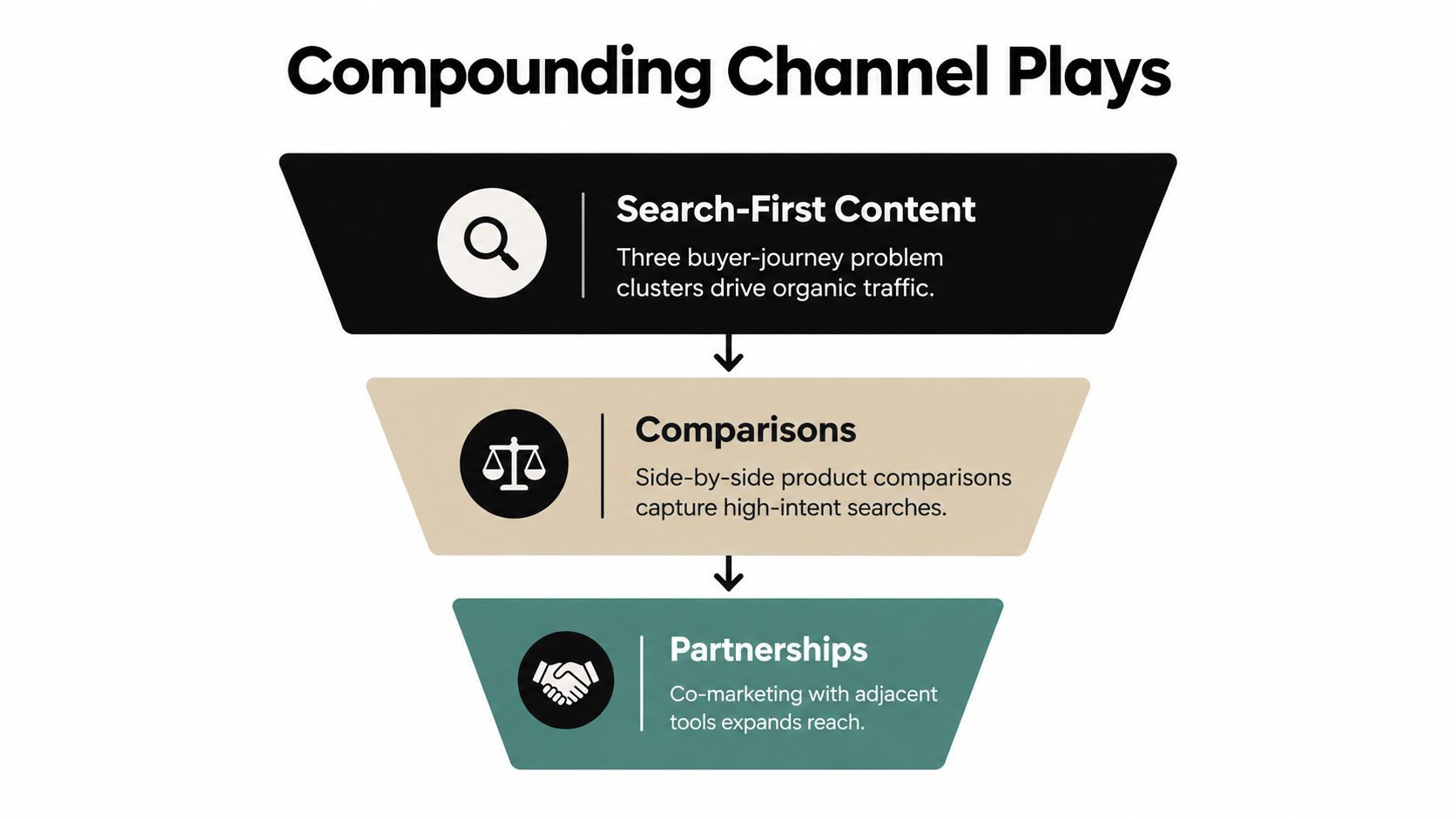
Build around the questions your ICP asks at different stages. Start with three high-intent problem clusters. For each cluster, create an asset that helps a buyer evaluate the approach, validate implementation, or get internal approval. A comparison page can clarify where your product fits. An implementation guide can answer technical concerns. A concise proof asset, such as a customer example or integration walkthrough, can help a champion make the case.
Build assets buyers can share
Write for the question behind the search, not just a broad category term. If the page promises a comparison, show the meaningful differences. If it promises an implementation guide, explain the work and constraints. Make the next step clear, but don't turn every useful page into a disguised sales pitch. A strong SEO content planning approach can help your team map topics to buyer needs and maintain a useful publishing cadence.
Partnerships deserve the same discipline. Choose a partner because your audiences overlap and the product relationship makes sense, not because its logo looks impressive on a slide. A good partner may share a workflow, serve the same customer in a different way, or have an integration that makes both products easier to adopt. Agree on the audience, the offer, and how you'll attribute qualified accounts and retained revenue before you promote anything.
Keep the work manageable. Create one useful asset for each problem cluster, then distribute them through search, communities, partner channels, and launch activity. Test partner fit through a small, trackable campaign before you promise a broader collaboration. Reach is an input. Activated, retained customers are the result you're buying.
Product-Led Growth and the Activation Bottleneck
A signup can look like a marketing win while producing no lasting value. If a user registers but never experiences the product's value, that account is unlikely to support retention or expansion. Treat marketing as an allocation decision: acquisition earns more budget when new cohorts reach value and stay; weak activation or retention calls for investment in the product experience first.
Choose one activation event, the earliest observable action showing that a user got meaningful value. It could be completing a workflow, connecting an integration, inviting a teammate, or publishing a first result. Pick the action that reflects your product's actual value, not a convenient dashboard milestone.
Userpilot's benchmark, compiled from 547 SaaS companies, reports average activation of 37.5% and average time-to-value of approximately 1 day, 12 hours, and 23 minutes. It reports category differences, including 54.8% for AI/ML products and 5% for FinTech (Userpilot's user onboarding metrics). Use these figures as context, not targets. Your own baseline and retained usage should guide spend decisions.

Instrument the path to value
Track signup-to-activation cohorts by acquisition source and persona. Add device or geography when those factors could change the experience. This reveals which sources bring users who activate, not merely users who arrive. Keep the activation definition stable, especially when a channel underperforms.
Then shorten the route to value. Reduce onboarding to roughly 3–5 critical steps, add contextual prompts where users need them, and show a prefilled example when a blank screen would leave them guessing. Send lifecycle messages when users miss a meaningful milestone, rather than on an arbitrary calendar schedule.
Test the landing-page promise, signup friction, onboarding sequence, and first-session prompts. Judge each experiment by activation and Day-30 retention, not click-through alone. A practical initial target is to improve activation by 10–20% relative to your own baseline, then verify that retained usage rises. Set both targets against your own cohorts, using the category benchmarks above only as context.
Shift budget according to the results. If a source brings signups that activate and remain engaged, increase its allocation when payback supports it. If activation improves but cohort GRR stays weak, redirect effort from acquisition toward onboarding and retention before buying more traffic. A completed tour is not proof of value: users can finish a walkthrough without reaching the product's core benefit. Use this guide to what product-led growth means to distinguish product-led growth from signup-led reporting.
Launch Mechanics and Early Traction
A launch is useful when it connects the right people to a clear promise, then gives them a direct path to experience the product. It's not a substitute for positioning, onboarding, or a distribution plan.
Make launch week a sequence
Start with a teaser that explains the problem and shows the product doing something concrete. A short product clip can work well when it gives buyers an understandable reason to pay attention; this 15-second SaaS launch teaser guide offers a useful reference for shaping one. Before launch day, prepare the listing copy, product category, key features, landing page, and a tracked link so you can connect discovery to downstream behavior.
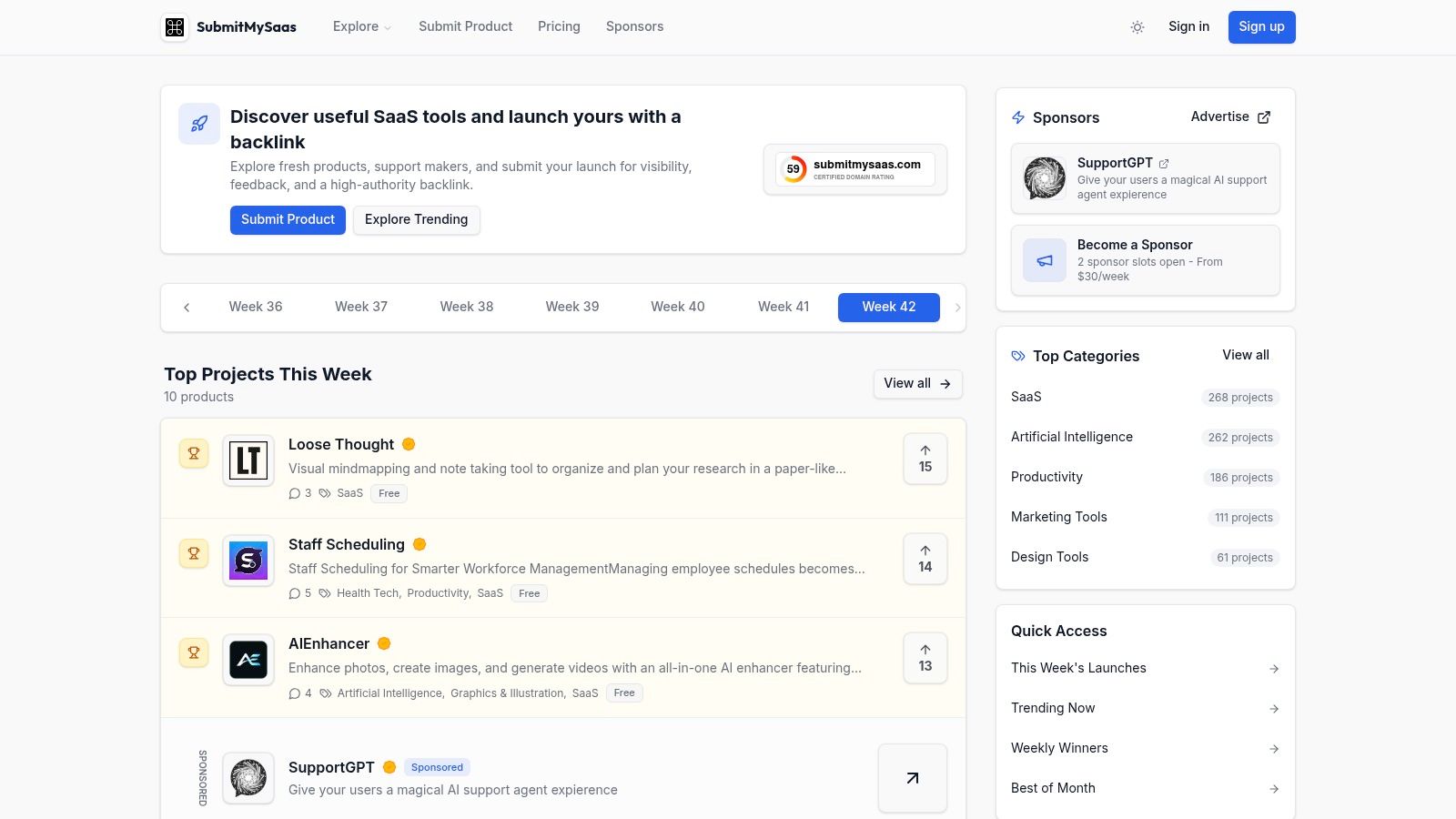
On launch day, submit to relevant discovery channels. SubmitMySaas is one option: founders can submit products for daily launch listings, trending lists, and monthly roundups. Its prominent launch package includes a badge and 35+ DR backlinks. Treat those as a potential discovery and SEO asset, not proof that traffic will convert; you still need to measure qualified visits and product use.
Then keep distributing. Follow up with your own audience, share a useful product demonstration, and approach relevant communities or partners with a message suited to their members. Don't post the same “we're live” announcement everywhere and call the work done. Each push should give people a reason to look and a clear next step.
A simple UTM convention could use the source, medium, and campaign name consistently, such as directory / referral / launch-name. Apply it to the listing and other campaign links, then connect those visits to your activation event. Review which sources produce activated users, not just listing views or clicks. This early-adopter marketing guide can help you think about who to reach and how to turn early interest into useful feedback.
Use the launch to learn what resonates. If visitors arrive but don't activate, inspect the message match and first-run experience before adding more promotion. If a particular audience activates and returns, follow up with relevant proof, onboarding help, or an invitation to share feedback.
A launch checklist is only valuable if the team uses it. Confirm the message, landing page, tracking, listing details, follow-up content, and post-launch review are ready before the announcement goes out. Then keep the loop open long enough to learn which discovery touchpoints led to real product use.
Measurement, Iteration, and Your Operating Cadence
A marketing plan is an operating system, not a list of campaigns. Review it often enough to catch a failing assumption before you've spent the quarter proving it wrong.
Track activation rate by source, payback by cohort, gross revenue retention by segment, and expansion revenue. Each metric answers a different question. Activation shows whether users reach value. Payback shows whether acquisition is economically sustainable. Retention and expansion show whether the customers you win keep finding value after the first sale.
The budget trade-off gets sharper when acquisition costs rise as retention weakens. Widelly's benchmark reporting indicates SaaS customer-acquisition costs rose 22% from 2022, sales cycles increased 14%, and LinkedIn CPMs rose 28%. The same reporting describes gross revenue retention declining from 90% to 88% over three years, while usage-based pricing companies reached 92% GRR versus 88% for subscription and hybrid models (Widelly's SaaS marketing benchmark report). These figures don't prescribe a pricing model for your product. They do make it hard to justify pouring more into acquisition while ignoring retention.
Put the review on the calendar
Use a weekly review to inspect activation, payback, and retention signals by source. Ask what changed, which cohort moved, and what experiment should run next. Keep the discussion focused on decisions rather than reporting every marketing activity.
Once a month, prune content and campaigns that attract the wrong audience or fail to move users toward product value. Each quarter, reallocate budget across acquisition, activation, and retention based on cohort results, not habit. Include expansion revenue as a second-order signal: it helps show whether the customers who stay are finding additional value.
The decision rule is simple. If payback is moving beyond target or cohort GRR is deteriorating, fix activation, onboarding, pricing, or retention before you buy more demand. If those measures hold and a channel brings in qualified customers who keep using the product, increase investment there. That's how to market a SaaS product without confusing more activity for better growth.
If you're preparing a SaaS launch, SubmitMySaas offers daily product listings, trending features, monthly roundups, and launch options that include a badge and backlinks. Visit SubmitMySaas to review the submission options, then track whether discovery turns into activated and retained customers.