By Outrank
How to Increase Domain Rating Safely in 2026
Learn how to increase domain rating through quality backlinks, technical fixes and monthly audits. A practical six-phase plan for 2026.
On this page
Search "how to increase domain rating" and you'll get the same recipe on every blog: build as many backlinks as you can, ideally from the highest-DR sites you can reach. It's easy to follow, and it reliably produces a rising number in Ahrefs, which is exactly why it's popular. It's also the fastest route to links that get discounted, nullified, or flagged, because the shortcuts that move the score are the ones Google's link-spam systems are built to catch.
Domain Rating is a third-party link-profile metric. Google doesn't use it, and Google doesn't read the number. What Google does use is the underlying link graph, and the rules there are narrower than most DR guides admit: links have to be crawlable, editorially placed, and attached to pages that deserve a citation. A directory badge and a paid guest post can both add referring domains to your report. Only one of them tends to survive scrutiny.
The work runs in a fixed order: baseline, linkable assets, outreach, qualification, then a monthly audit that catches what slipped through. That order matters more than the volume of links you acquire.
The Six-Phase Plan and How Domain Rating Works
A rising Domain Rating is easy to misread as progress. Ahrefs scores a site from 0 to 100 by comparing the strength of its backlink profile with every other site in its index. The number is a third-party reading of that profile. Ahrefs' research has linked referring domain counts to search traffic: pages with no referring domains tend to get none, and more unique referring domains tend to travel with more traffic. That relationship is about the links underneath the score, not about Google reading DR.
What moves the score is a set of distinct, credible referring domains. A hundred links from one site do not. Five hundred links from one badge widget do not either. Editorial relevance still has to be there, spread across reputable domains, on pages a publication would cite because the page deserves it. Links that only exist to pass credit are the ones most likely to be discounted, nullified, or wiped out of the graph later, taking the DR bump with them.
Why the Score Moves Slowly Once You're Past 40
DR is logarithmic. Moving from 10 to 20 generally takes less authority-building than moving from 70 to 80. Early gains can come from a handful of real links. Later gains can take hundreds, and a share of those will never stick if they were bought, swapped, or templated. Link teams that budget for a straight line give up before results become visible, then call the campaign a failure when the scale was doing exactly what a log scale does.
The other trap is using DR as a forecast. It is a comparative prospecting tool: useful for sizing a keyword, a competitor, or a niche, and useless as proof that organic traffic will follow. The same links that lift the score still have to sit on useful, accessible pages that match search intent. I would rather hold a lower DR built on links that survive a spam review than chase a higher one that a single algorithm update can erase.
| Phase | Main action | What to track |
|---|---|---|
| 1. Baseline | Record current DR, referring domains and top linking pages | Referring domains and followed links |
| 2. Build linkable assets | Publish original data, tools and resources people cite | Pages that earn editorial links |
| 3. Run outreach | Pitch relevant editorial gaps to specific publications | Delivered emails, replies and placements |
| 4. Check link technicalities | Confirm links are crawlable and correctly qualified | Indexable linking pages and rel attributes |
| 5. Avoid link schemes | Refuse paid or swapped links that pass ranking credit | Sudden bursts of low-quality referring domains |
| 6. Monthly audit | Review new domains and set the next target | Relevant referring domains, referral traffic and conversions |
Phase 1 is the baseline, and it comes first for a reason. In Ahrefs, note current DR, referring domain count, followed backlink count, and the top five linking pages. Run the same check on two or three direct competitors. Ten minutes of recording turns every later claim about progress into a comparison: which new domains are relevant, which links are followed and crawlable, and which gains look too cheap to last.
Build Linkable Assets Other Sites Want to Cite
Nobody links to a landing page because you asked nicely. They link because the page answers a question they were already writing about. The first deliverable of a link campaign is therefore an asset, and outreach is just its distribution.
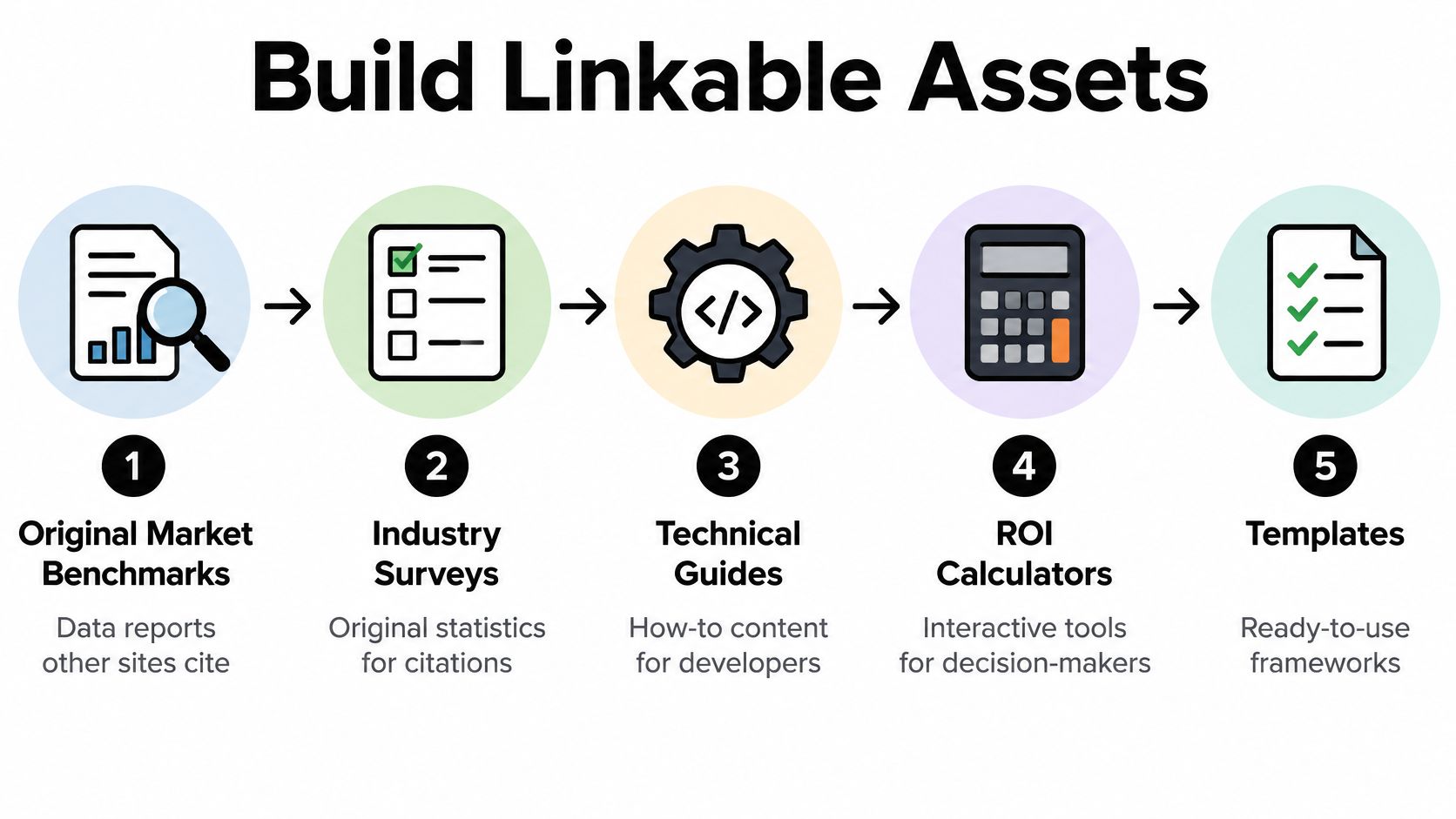
Pick the Asset Type That Fits the Data You Already Have
- Original market benchmarks. A monthly count of new launches by category, annotated with what changed and why, gives journalists a number they can't get anywhere else.
- Reusable datasets. Publish the raw table with a clear licence and a stable URL. Analysts link to datasets because they need the source, not the prose around it.
- Integration and technical guides. The exact steps to connect your product to a tool your buyers already run. Developer audiences link to these from docs, forums and internal wikis.
- Free comparison data. Side-by-side pricing and feature tables for your category, kept current so the citations stay live.
- Customer research. A survey of your own users on a question the market cares about, with sample size, date range and method stated near the top.
Six Steps From Question to Pitchable Asset
- Pick one question your audience asks that no page answers well. The gap is the reason a stranger will link.
- Gather the data and write down the method. Pull it from your own platform or from clearly described public sources, and record the sample size and any exclusions.
- Publish as HTML rather than a PDF. A summary at the top, three key findings, and one chart other sites can embed. PDFs get downloaded, cited once, and forgotten.
- Add a plain citation line and a descriptive title. Something an editor can copy in one sentence, such as "Source: your brand, new launches by category, Q1".
- Link to the asset from category and product pages. Internal links pass authority to the new page and help crawlers find it fast.
- Write a press-friendly summary. Two short paragraphs, the chart, and the citation line, ready to paste into an email.
Here's a walkthrough of the same asset-first approach applied to a real campaign.
A finished asset has one headline finding, one chart, one method note and one citation line. If you can't state the finding in a single sentence, it isn't ready to pitch, and no amount of outreach will fix that.
Run a Quality-Weighted Outreach Campaign
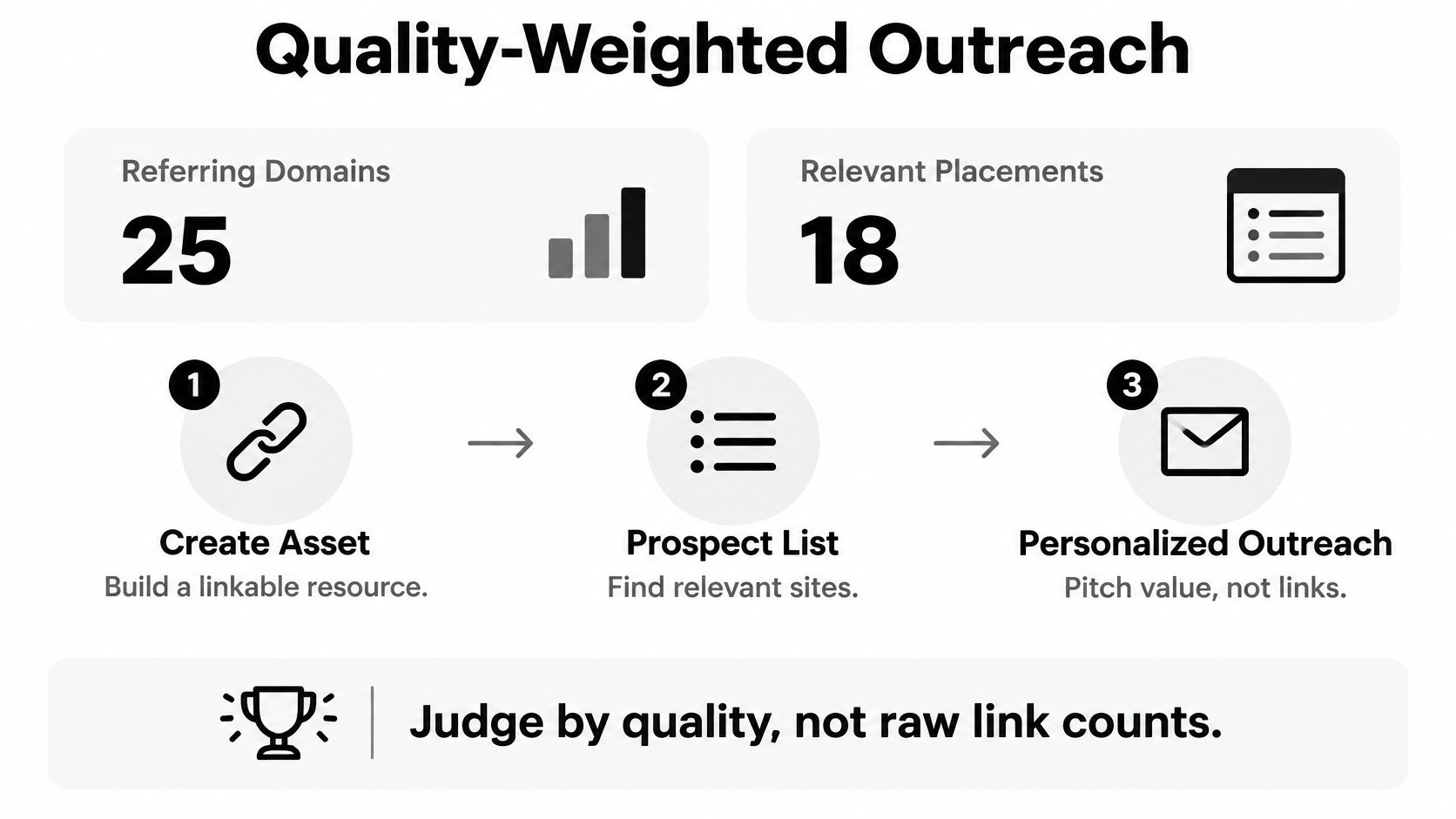
A bigger send does not raise Domain Rating. DR is a third-party read of your link profile, and it moves only when new referring domains stick. In a 2025 survey of 518 SEO professionals run by Editorial.Link, 48.6% named digital PR the most effective link-building tactic (Newsmakers summary of the Editorial.Link survey). That result describes a pitch aimed at specific publications. A blast to every address in a scrape produces links a tool may count today and discount, or drop, later.
| Benchmark | Emails delivered | Result | Conversion rate |
|---|---|---|---|
| Documented Ahrefs campaign | 515 | 36 backlinks from 32 websites | 5.7 percent as reported |
A documented campaign in Ahrefs' link-building case study sent 515 emails and earned 36 backlinks from 32 websites, a published conversion of 5.7 percent among delivered messages. Size the next list from those raw counts. Targeted outreach converts only a small share of delivered mail, so plan for a modest set of placements rather than treating volume as the goal.
Segment Before You Write a Single Email
Prospect lists fail on relevance, not size. Sort every site into three tiers. Tier 1 is publications that cover your category and have linked to comparable resources in the last year. Tier 2 is relevant sites that have not covered the topic but share your audience. Tier 3 is everything else. Do not send.
Fifty honestly sorted prospects beat five hundred scraped from a competitor's backlink export.
The trade-off is speed against survival. Tier 1 lists are short, and replies come slowly, but an editor who already cites this kind of resource is more likely to place a link that still looks editorial a year from now. Tier 2 can widen the list, yet the fit is weaker and the placement is easier for a quality filter to ignore.
Personalize around an editorial gap, not your own news. "You covered launch trends in March but didn't have category-level data" beats "we'd love a backlink". When an editor asks how to credit you, suggest a natural descriptive anchor and then let them write it. Demanding exact-match anchor text turns a placement into a negotiation you lose, and a forced anchor is one of the patterns that later gets a link devalued.
What to Track and What to Ignore
Track delivered emails, replies, placements, referring root domains and qualified-link conversion. Ignore total backlink count as a headline metric. It flatters campaigns that place the same link repeatedly on one domain and hides the fact that nothing new was earned. DR will not reward that repetition the way a raw backlink total does.
The predictable failure modes are measuring only total backlinks, sending generic mass outreach, accepting irrelevant placements because they were free, and forcing exact-match anchors into an editor's copy. Google warns that automated link acquisition, paid ranking links, excessive exchanges, and optimized guest-post or press-release links can qualify as link spam. A campaign built on any of them is a write-off waiting for an update. Those are the links most likely to be ignored or erased, which means the DR gain never arrives.
Your next step is small and specific: build a list of 50 relevant sites, sort them into the three tiers, and pitch only Tier 1 this month.
Qualify Every Link and Avoid Link Schemes
A link either passes a signal or it doesn't, and the difference is mechanical rather than aesthetic. Run three checks on every acquired link before it appears in a report.
Three Checks Before a Link Counts
- Is the destination indexable? If the linking page is blocked, canonicalised elsewhere, or sitting behind a login, the link contributes nothing to your profile no matter how good the domain looks.
- Is it a real anchor with an href? Google states that crawlable links generally use an anchor element with an href and recommends natural anchor text over keyword stuffing (Google's guide to crawlable links). JavaScript-only handlers and image credits are weaker bets than a plain text link in body copy.
- Does the surrounding text explain why the resource is useful? A link inside a sentence that describes the asset reads as an endorsement. A link in a footer widget reads as furniture, and it earns accordingly.
Match the Attribute to the Link Type
| Link type | Attribute to use | When it comes up |
|---|---|---|
| Editorial endorsement | None (standard followed link) | A journalist or editor links to your resource |
| Sponsorship or paid placement | rel="sponsored" | Sponsored posts, ads and paid features |
| Affiliate or paid link not meant to pass credit | rel="nofollow" or rel="sponsored" | Affiliate programmes and referral deals |
| User-generated submission | rel="ugc" or moderated before publishing | Comments, profiles and project submissions |
| Product exchange or link swap | Do not build | Any arrangement that trades products or links for ranking |
Directory listings and badges count only when the linking page is crawlable, relevant, trusted, and outside a manipulative network. That's a real distinction rather than a technicality. On SubmitMySaas, a Free Launch carries a dofollow backlink only when the product ranks in the top 3 weekly and displays our badge on the site. A conditional link with a visible reason behind it is the kind worth having, because the condition is what makes it credible.
The rule I apply to paid offers: if a placement is paid, disclose it and ship it with rel="sponsored". If it's only a trade, decline it. There's no third option that survives an algorithm update.
Google says spammy links may be detected and nullified, and that after its link-spam systems remove their effects, the lost ranking benefit may not return. That asymmetry is what makes qualification worth the effort. You can spend a year acquiring links and discover, twelve months later, that the ones carrying your score no longer count, with no way to reclaim the positions they bought.
Disavowal isn't a growth tactic either. It's a cleanup tool for a mess you shouldn't have made, and the better investment is preventing low-quality acquisition upstream. The failure mode isn't a low DR. It's spending a year on links that produce no durable authority while creating algorithmic and manual-action exposure you'll have to explain to someone.
Open your backlink export this week, filter to links you paid for or swapped in the last twelve months, and mark each one keep, qualify, or request removal. That list, not next month's outreach, is the highest-return work available to you right now.
Audit Your Links Monthly and Set Your Next Target
Start with the honest measurement question. Ahrefs summarized a 2025 study that found only a 0.131 correlation between Domain Rating and SERP rankings, a small relationship that can't establish cause (Ahrefs on what makes a good Domain Rating). Teams keep DR on the dashboard as a primary KPI anyway, because it's the only number that moves weekly and fits neatly in a screenshot.

Google's documentation says AI Overviews and AI Mode use the same foundational SEO principles as ordinary Search: indexability, helpful and reliable content, internal linking, page experience, and clear textual information. There are no separate AI-specific requirements to chase. Which means the visibility you're buying with links still depends on the pages those links point at being worth surfacing.
The Monthly Routine
- Export new referring domains and compare them with last month's list. Growth should look gradual.
- Flag sudden bursts from a single site, a subnet of near-identical domains, or a network with templated content.
- Check each flagged link for topical relevance and real traffic. A relevant placement from a small site beats an irrelevant one from a large site with no readers.
- Inspect anchor-text distribution for unnatural exact-match patterns. If 40% of your anchors are the same commercial phrase, that's a footprint.
- Request removal or qualification of failing links. Keep disavowal for cases where a request goes unanswered and the pattern is clearly manipulative.
A link that lifts a third-party score while sending no referral traffic from an irrelevant page is a reporting artifact, not authority.
What Should Replace DR as the Primary Metric
Track relevant referring domains, branded mentions, non-brand clicks, conversions, assisted pipeline and indexed pages. Those six numbers describe demand and durability. DR describes one input to them, loosely, and it can rise while all six stay flat.
For this month, pick one linkable asset to publish and one outreach segment to pitch. Set the target in referring domains and referral sessions rather than DR points, then measure again in 30 days and compare the two.
If you're launching a product and want a link that comes with actual distribution, SubmitMySaas puts your project in front of founders, marketers and early adopters through daily launches, trending lists and monthly roundups. Makers submit a launch for visibility, feedback and a high-authority backlink, and our Premium Launch adds priority placement and a guaranteed high-authority dofollow link. Visit SubmitMySaas to submit your project and start building referring domains the same week you ship.