How to Create Content Strategy
How to create content strategy. Learn how to create a content strategy that drives real SaaS growth, with practical steps for audience research, topic clusters
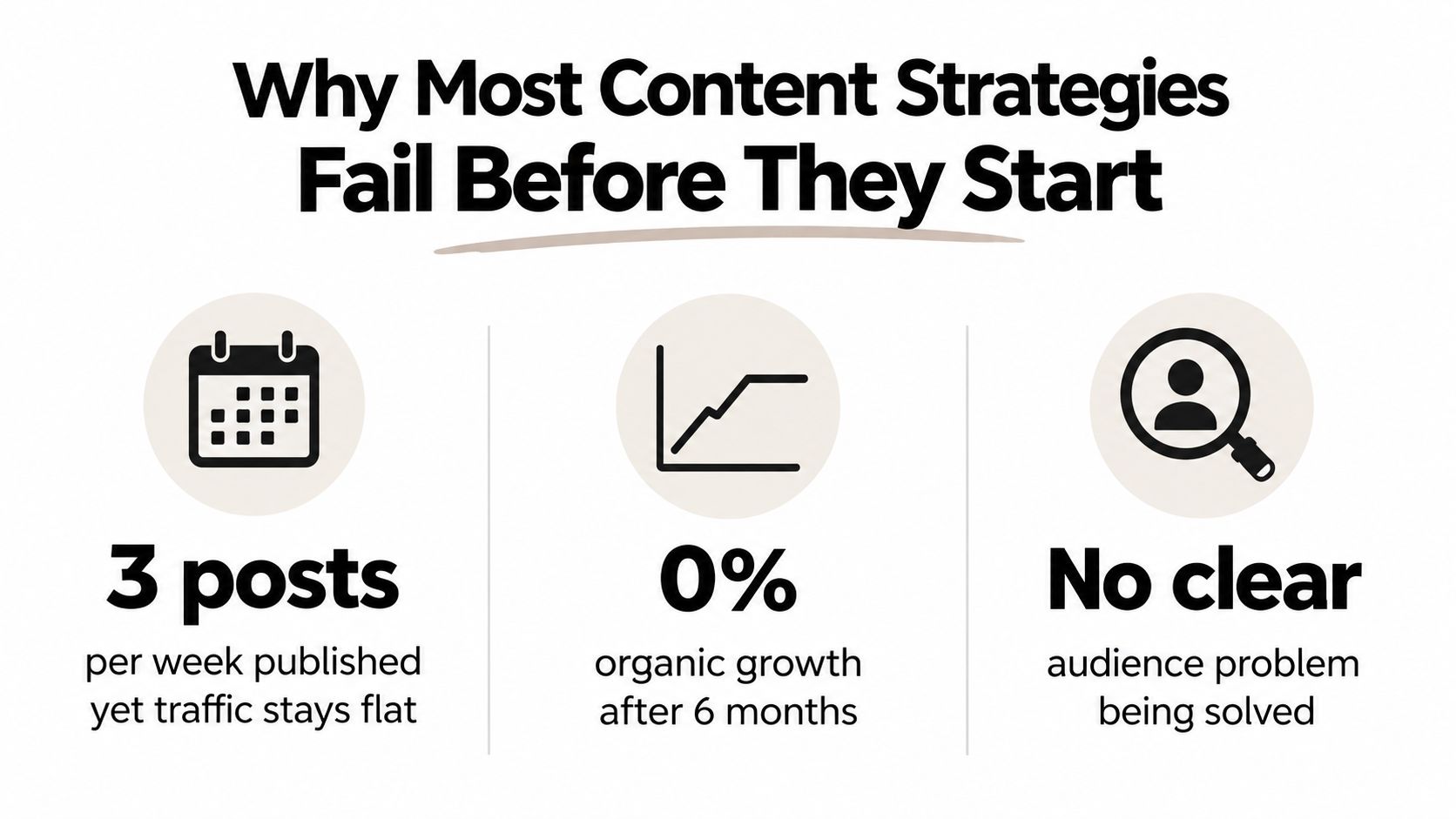
A founder publishes three blog posts a week, shares each one on social, and waits for the compounding effect everyone promised. The traffic graph barely moves. Pipeline stays empty. Nobody can explain which article influenced a signup, or whether the content is reaching founders, SEO professionals, early adopters, or people who were never likely to buy.
That's the failure mode behind many content programs. The team has a calendar, but not a system. Learning how to create content strategy means deciding who the content serves, which commercial problem it addresses, what evidence makes it worth reading, where it will be distributed, and how the business will recognize progress.
Why Most Content Strategies Fail Before They Start
A launch-driven SaaS team can publish on schedule and still produce little business value. The usual failure is treating the calendar as the strategy. A calendar records dates. It does not decide audience, purpose, content, distribution, and measurement.
The 2025 B2B benchmark from Content Marketing Institute and MarketingProfs surveyed 1,186 marketers. 58% described their content strategy as only moderately effective, while 22% rated their content marketing extremely or very successful. Among top performers, 82% credited understanding their audience as a major contributor to success. The practical lesson is to define the problem before choosing the format or filling a publishing queue.
A small SaaS team needs an operating system for four connected decisions:
- Who: Which audience has a problem the product can help solve?
- Why: Which business outcome should content support?
- What: Which evidence, format, and topic will help that audience act?
- Measured how: Which behavior signals progress, from qualified referral traffic to activated users?
Publishing volume comes later. A founder launching your first WordPress blog may choose a practical platform, but WordPress cannot define the audience, supply distinctive evidence, or show why one article deserves resources over another. In AI-search results, original examples, product experience, and clear proof often matter more than adding another generic keyword article.
Practical rule: An asset needs a defined audience problem and a measurable next action before it qualifies as strategic content.
A strategy documents the links between audience needs, editorial themes, channels, owners, and business metrics. The calendar is the schedule those decisions produce, not the strategy itself.
Set Goals, Audience and Funnel Before You Pick a Topic
Start with the commercial outcome, not a keyword list. A launch-driven SaaS team might want more qualified submissions, stronger referring-domain growth, organic visits to product pages, email sign-ups, or assisted conversions. These are different objectives, so they require different content and different evidence.
Write one primary goal for the planning period. Then define the audience narrowly enough that a writer can recognize a real person behind the segment. SubmitMySaas could work with segments such as SaaS founders, indie makers, SEO professionals, and early adopters. Each segment needs a job-to-be-done, not a decorative persona:
- SaaS founders: Find credible distribution channels for a new product.
- Indie makers: Turn a launch into qualified discovery without building a large marketing team.
- SEO professionals: Evaluate tools and acquisition channels using clear evidence.
- Early adopters: Discover useful new products and decide quickly whether they fit a need.
Audience research should come from founder interviews, support questions, submission behavior, sales conversations, and search-query analysis. A practical guide to creating buyer personas can help organize the research, but don't stop at age, job title, or company size. Capture the trigger that makes the person search, the alternatives they're considering, and the objection that could prevent action.
Map each asset to a stage
Use four stages for a launch-focused content system:
- Launch preparation: Help a founder clarify positioning, submission assets, messaging, and distribution.
- Discovery: Answer a specific problem or introduce a category, channel, or workflow.
- Evaluation: Compare options, explain selection criteria, and provide proof.
- Post-launch growth: Help teams improve acquisition, activation, retention, and repeat distribution.
The stage determines the job of the page. Discovery content may earn a relevant visit. Evaluation content should reduce uncertainty. A launch page should make the next action obvious.
Before selecting topics, create a one-page brief with five fields: commercial goal, audience segment, funnel stage, primary KPI, and minimum production plan. This prevents a common mistake, choosing an attractive topic first and trying to invent its business purpose afterward.
Measurement also belongs here. The benchmark found that 56% of respondents identified both ROI attribution and customer-journey tracking as challenges, as reported by CMI's B2B content marketing statistics. Decide in advance whether an asset will be judged by qualified traffic, submissions, sign-ups, activated users, or assisted conversions. Otherwise, the team will default to pageviews because they're easy to report.
Audit What You Already Have Before You Publish More
New content feels productive because it produces a visible artifact. An audit is less glamorous, but it tells you whether the next article should exist at all.
Begin with a complete inventory. Include blog posts, product pages, category pages, launch pages, comparison pages, documentation, downloadable assets, and important external profiles. Record the URL, format, topic, intended audience, funnel stage, owner, last update, organic visibility, engagement, internal links, and conversion contribution.

Run the review in three passes.
Pass one, establish the estate
Find duplicate pages, abandoned drafts, thin category descriptions, outdated launch information, and articles that target the same intent. Note whether important pages receive internal links from relevant content. A page can be useful and still remain invisible if the site gives crawlers and readers no clear route to it.
Pass two, judge contribution
Score each asset against four questions:
- Intent match: Does it answer the question the visitor appears to have?
- Freshness: Would a knowledgeable reader trust the information today?
- Internal-link health: Does it connect to relevant category, launch, product, or deeper educational pages?
- Conversion contribution: Does it lead to a meaningful action or assist one elsewhere?
Use a simple qualitative scale such as strong, uncertain, or weak. The point isn't to create false precision. It's to force a decision.
Pass three, find the missing answers
Read support questions, founder interviews, search queries, and submission descriptions beside the inventory. Gaps appear where users repeatedly ask about a problem that the site handles only indirectly. Those gaps deserve priority over another generic article aimed at a broad keyword.
A keep, refresh, merge, or remove rule makes the audit operational:
- Keep pages that match a defined audience need and still perform their job.
- Refresh pages with useful foundations but stale examples, weak structure, or missing evidence.
- Merge overlapping pages when several URLs compete for the same intent.
- Remove pages that have no audience fit, no useful information, and no realistic role in the system.
Teams often rush to create more SEO content when the stronger move is to consolidate what already exists. A focused site gives internal links, editorial attention, and conversion paths fewer places to scatter. For on-page improvements and technical priorities, use this guide to improve search engine rankings, then return to the audit and assign each recommendation to a specific URL.
Build Content Pillars and Topic Clusters That Compound
A content pillar is not a broad subject such as “marketing.” It's a commercial problem that a defined audience repeatedly pays attention to solving. A topic cluster is the supporting set of questions, comparisons, examples, and how-to pages that prove the site can address that problem from several useful angles.
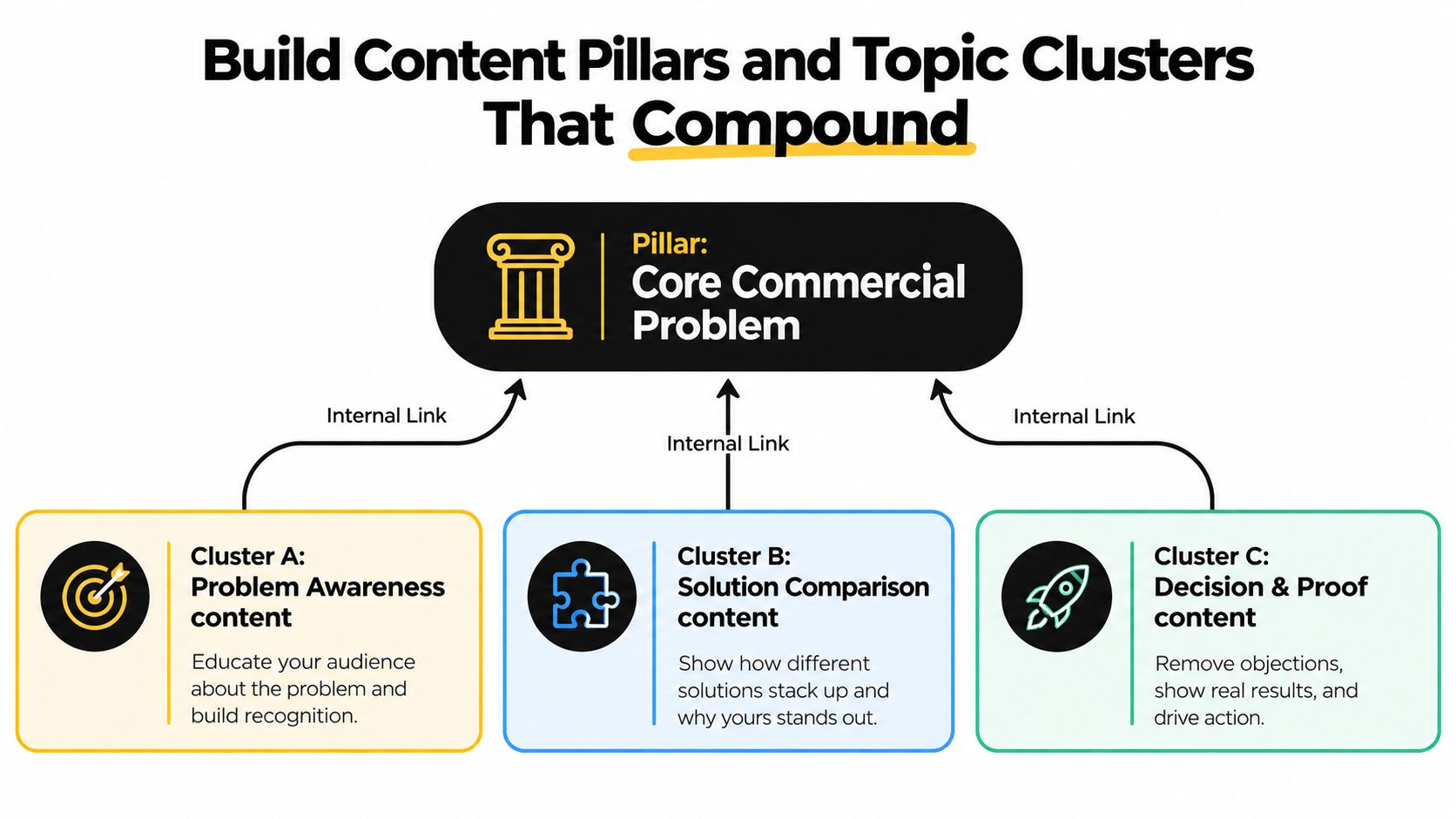
For a launch and discovery platform, useful clusters could include:
- Launch strategy: Preparation checklists, positioning, launch assets, submission decisions, and launch-week workflows.
- SaaS distribution: Directory discovery, communities, partnerships, email, social adaptation, and referral paths.
- AI-tool evaluation: Selection criteria, transparent comparisons, implementation questions, and trust signals.
- Product-led growth: Activation friction, onboarding education, product use cases, and expansion content.
- SEO for early-stage teams: Search intent, internal linking, content refreshes, technical foundations, and measurement.
The pillar should establish the commercial problem and route readers to the most relevant supporting pages. A cluster page might answer one narrow question, compare alternatives, or document a process. Every supporting asset should link upward to the pillar and sideways to the next logical step, using descriptive anchor text rather than vague “learn more” links.
Give every asset a job card
A theme isn't a production system until each asset has operational metadata:
- Primary intent: Informational, evaluative, navigational, or action-oriented.
- Target query: The language a qualified reader is likely to use.
- Internal-link destination: The page the asset should strengthen or feed.
- Author or subject-matter expert: The person responsible for experience and accuracy.
- Conversion event: Submission, sign-up, product-page visit, or another defined action.
- Refresh date: The point when the team will reassess evidence, links, and usefulness.
A practical SEO content planning process earns its place here. It connects research to structure, but the planning document still needs commercial intent and ownership. Pillars without metadata become slogans. Clusters without conversion events become a collection of articles that may attract attention without helping the business.
A strong cluster also contains different levels of commitment. One page may provide a concise answer. Another may show a comparison framework. A third may offer original research, product evidence, or a detailed workflow. That variety gives readers a reason to continue and gives the site more than one opportunity to demonstrate expertise.
Run an Editorial Calendar and Workflow That Actually Ships
A cluster defines what the team should build. The editorial workflow decides who builds it, in what order, and with which quality checks.
For a small team, the calendar should be deliberately narrow. Assign one person to editorial ownership, one person to subject-matter input, and one person to final approval when those roles are available. If the team has only two people, combine production and approval, but keep a short review pause so the writer isn't the only judge of clarity and accuracy.

Each brief should answer four questions before drafting begins:
- Desired outcome: What should the reader understand, decide, or do?
- Required evidence: Which product observations, interviews, documentation, examples, or sources support the argument?
- Competing assumptions: What might the audience believe already, and where could that belief be incomplete?
- First-hand contribution: What can this team add that a generic search summary can't?
The workflow can stay lightweight:
- Draft the brief and confirm the intent.
- Gather first-hand evidence and outline the page.
- Write the draft with clear examples and internal links.
- Run editorial review for usefulness, structure, and voice.
- Run subject-matter review for accuracy.
- Publish, distribute, and record the conversion event.
- Check performance after the initial review window.
Google's guidance on creating helpful, reliable, people-first content asks whether a site has a clear audience, demonstrates first-hand expertise, serves a focused purpose, and leaves readers sufficiently informed to achieve their goal. Use those questions as a pre-publish gate, not as a paragraph added after drafting.
A launch can interrupt the normal sequence without destroying it. Reserve space for timely launch pages, founder interviews, product comparisons, or announcement assets, while protecting the core cluster work. The calendar should include status, owner, intended audience, funnel stage, primary query, distribution channels, CTA, and next review date.
For tool selection, a focused stack is enough. A team can compare editorial, analytics, research, and distribution options using this overview of content marketing tools, then choose only what supports the workflow it can maintain.
Use the video below as a practical reminder that collaboration matters as much as scheduling.
The workflow succeeds when every stage has an owner and a definition of done. Without that, the calendar becomes a list of intentions that stalls in review.
Distribution and Amplification in an AI-Search World
AI-mediated search hasn't made SEO irrelevant. It has changed which pages deserve investment.
Google reported in August 2025 that total organic click volume to websites remained relatively stable year over year and that average click quality increased, as described in its update on AI search driving more queries and higher-quality clicks. Separately, research covering 24,000 queries across 243 countries found that exposure to AI search results expanded sharply during 2025 and varied by country, topic, and query style. The practical implication is not to abandon search. It's to stop assuming that every useful answer must generate a click.
Mass-produced keyword pages are vulnerable because they offer little that an answer system or an informed reader needs to cite. Stronger assets contain original product data, transparent methodology, expert explanations, clear comparison criteria, documentation, and distinctive first-party observations.
Build a portfolio for different search outcomes
Use three content types:
- Answer-ready discovery pages: Concise, structured explanations that answer a narrow question clearly and point to deeper evidence.
- Authority assets: Original research, transparent comparisons, founder interviews, and documented experiments that deserve citation and discussion.
- Conversion pages: Launch pages, category pages, product pages, and documentation that help a visitor act once they arrive.
Distribution begins before publication. Decide which audience already has a reason to care, which communities can provide informed feedback, which partners may reference the asset, and which owned channels can carry the first wave. A useful framework for audience mapping and channel planning helps connect audience behavior to channel choice instead of broadcasting every article everywhere.
A launch directory can fit into this system as one distribution and discovery channel. SubmitMySaas lets founders submit products for launch features, trending lists, and roundups, with a prominent package that includes a badge and 35+ DR backlinks, according to the publisher's product information. The point isn't to replace product-led distribution or useful editorial content. It's to put a launch asset in front of a relevant discovery audience while the product is newsworthy.
Adapt one strong asset into channel-specific forms. Turn research into a founder post, a concise newsletter insight, a comparison checklist, and a short launch update. Then track which versions produce qualified visits, branded searches, product-page engagement, and assisted conversions. The content distribution channels guide can help organize that follow-up without turning distribution into repetitive copying.
Measure What Matters and Iterate Every Quarter
A content calendar can look busy while the strategy produces little qualified demand. Measurement should show which audience problems attract attention, which evidence earns trust, and which assets help people take the next step.
Use separate views for separate jobs. Content may introduce a product, support evaluation later, and receive conversion credit only after another interaction. A layered measurement model keeps those roles visible instead of forcing every contribution into a last-click report.
| Layer | Metrics | Question it answers | Review cadence |
|---|---|---|---|
| First touch | Qualified referral traffic, branded searches, discovery-page engagement | Did content introduce the product to a relevant audience? | Monthly and quarterly |
| Last touch | Trial starts, sign-ups, activated users, submissions | Did the final content interaction help produce action? | Weekly for launches, monthly thereafter |
| Assisted conversion | Assisted conversions, returning visits, product-page paths, content-influenced submissions | Did content help the visitor progress even if it wasn't the final touch? | Quarterly |
| Authority and reach | Referring-domain growth, backlink quality, qualified mentions | Is the content earning credible distribution beyond the site? | Quarterly |
Attribution remains difficult for B2B teams. The same 2025 B2B benchmark cited earlier reports that 56% identified ROI attribution and customer-journey tracking as challenges. A last-click report can therefore hide the interview, comparison, research asset, or launch listing that created the initial demand.
Review at 30, 90 and 180 days
The 30-day review checks reach and intent. Examine qualified organic traffic, engaged sessions, signup or submission rate, assisted conversions, and backlink quality. A page without a direct conversion is not automatically a failure. First establish whether it attracted the intended audience and addressed the right problem.
At 90 days, review the cluster rather than isolated URLs. Which pages support one another? Which internal links are missing? Did a founder interview hold attention better than a generic explainer? Did a comparison page assist product-page visits? Refresh an asset when its evidence is useful but its structure, examples, or call to action limit its effect.
At 180 days, make a portfolio decision. Keep funding a cluster that attracts the right audience and supports business actions. Consolidate pages that overlap. Retire content with no audience fit or strategic role. Shift resources toward first-party research when generic pages earn impressions but fail to influence qualified behavior.
Use a 30, 60 and 90-day rollout
A practical rollout keeps the operating system small enough for an early-stage team to run:
- Days 1 to 30: Write the one-page strategy brief, define audience segments and jobs-to-be-done, audit the existing estate, and map the initial pillars and clusters.
- Days 31 to 60: Build the editorial calendar, standardize the content brief, assign owners, and produce the first three launch-ready assets.
- Days 61 to 90: Distribute those assets through owned, earned, and relevant discovery channels. Run the first performance review and record the first refresh decisions.
Keep four templates in the working system:
- One-page strategy brief: Goal, audience, funnel stage, KPI, and production constraint.
- Content brief: Desired outcome, evidence, assumptions, first-hand contribution, internal links, and conversion event.
- Launch-week calendar: Asset, owner, channel, message, publish status, and follow-up action.
- Quarterly review: First-touch, last-touch, assisted-conversion, authority, keep, refresh, merge, or retire decision.
Measurement should also reflect the relationships behind distribution. If the audience includes founders, investors, or creators, a resource on matching early stage creators with investors can help identify relationships that support credibility and reach.
The operating principle is simple: do not reward a team for filling a spreadsheet. Reward it for learning which audience problems create qualified attention, which evidence earns trust, which channels distribute it, and which assets assist a business outcome.
A strategy is an operating system, not a document or calendar. The calendar is only the visible output of decisions about audience, evidence, ownership, distribution, and iteration.
SubmitMySaas gives founders and makers a way to place launch content in front of a focused discovery audience through featured launches, trending lists, roundups, and launch-related backlinks. If the strategy needs a distribution channel connected to product discovery, SubmitMySaas provides a submission route for the next measurement cycle.